Learning objectives

• Validation
• Steps in validation, and understanding of
 such steps
Validation?
• Validation is the assessment of a process or
  instrument to assure that the process and
  instrument is suitable for its intended use
  (FDA, 1987).
• Validation enables an efficient and productive
  use of the process and instrumental
  variables.
• A new assay method, change in operator,
  laboratory and equipment than the one in
  previous method requires validation.
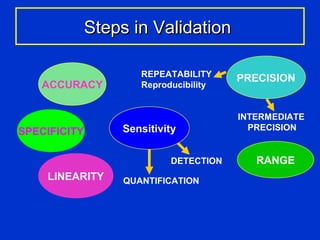
Steps in Validation

                      REPEATABILITY
                                        PRECISION
   ACCURACY           Reproducibility


                                        INTERMEDIATE
                  Sensitivity             PRECISION
SPECIFICITY

                            DETECTION      RANGE
    LINEARITY      QUANTIFICATION
Specificit
y
• Specificity is the ability to assess
  unequivocally the analyte in the presence of
  other components such as impurities,
  degradants and matrix etc.

• Lack of specificity of an assay procedure, may
  be compensated by other supporting assay(s).
• Indicates the linear relationship
  between concentration and
  response of the detector
EVALUATION OF
     LINEARITY
• Linearity is evaluated by visual inspection of a plot of
    signals as a function of analyte concentration.
•   If there is a linear relationship, the data is evaluated by
    appropriate statistical methods, for example, linear
    regression.
•   In some cases, to obtain linearity, the test data may need
    mathematical transformation prior to the regression
    analysis.
•   For the establishment of linearity, a minimum of 5
    concentrations are recommended.
RANGE
• The specified range is normally derived
    from linearity studies and depends on the
    intended application of the procedure.
•   It confirms that the assay will provide an
    acceptable accuracy and precision when
    applied to samples containing analyte,
    within or at the extremes of the specified
    range
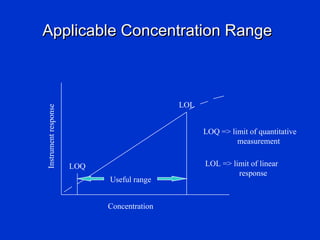
Applicable Concentration Range


                                            LOL
Instrument response


                                                  LOQ => limit of quantitative
                                                           measurement


                      LOQ                         LOL => limit of linear
                                                           response
                            Useful range


                            Concentration
ACCURACY
• The accuracy of an assay expresses the
  closeness or agreement between the true value
  and the value found. This is sometimes termed
  as trueness
• Within day accuracy (Repeatability)

• Between days accuracy (Reproducibility)
PRECISION
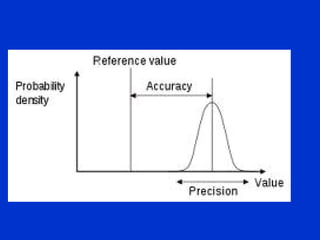
• The precision of an assay expresses the degree of
  scatter between a series of measurements
  obtained from multiple sampling of the same
  homogeneous sample under the prescribed
  conditions.
• Precision may be considered at three levels:
  –   Repeatability
  –   Intermediate precision
  –   Reproducibility


• The precision is usually expressed as the
  variance, standard deviation or coefficient of
  variance of a series of measurements.
Repeatability

• Repeatability expresses the precision under the
  same operating conditions over a short interval
  of time.
• Repeatability is also termed as intra-assay
  precision.
Intermediate precision
• Intermediate precision expresses
 within-laboratories variations,
 different days, different analysts,
 different equipment, etc.
• Typical variations to be studied
 include days, analysts, equipment
 etc.
Reproducibility

• Reproducibility is assessed by
 means of an inter-laboratory trial,
 and between days assay.
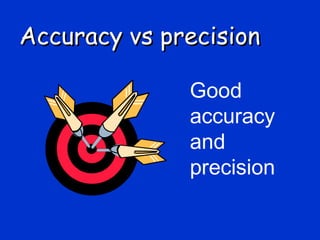
Accuracy vs precision

              Good
              accuracy
              and
              precision
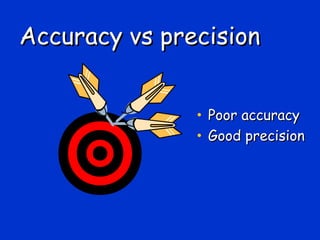
Accuracy vs precision


               • Poor accuracy
               • Good precision
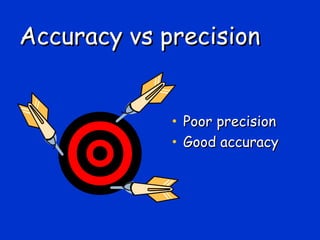
Accuracy vs precision


             • Poor precision
             • Good accuracy
DETECTION LIMIT

• The detection limit of an analyte in an assay is
  the lowest amount of analyte in a sample
  which can be detected but not necessarily
  quantitated as an exact value
• Several approaches for determining the
  detection limit are used, depending on whether
  the procedure is a non-instrumental or
  instrumental
Based on Visual Evaluation
• Visual evaluation may be used for non-
    instrumental methods but may also be used
    for instrumental methods.
•   The detection limit is determined by the
    analyzing samples having known
    concentrations of analyte and by establishing
    the minimum level at which the analyte can
    reliably be detected
Based on Signal-to-Noise
• This approach is applied to analytical procedures
  which exhibit baseline noise.
• Determination of the signal-to-noise ratio is
  performed by comparing measured signals of
  samples having known low concentration of
  analyte with those of blanks , and establishing the
  minimum concentration at which the analyte can
  reliably be detected.
• A signal-to-noise ratio between 3:1 or 2:1 is
  generally considered acceptable for estimating the
  detection limit.
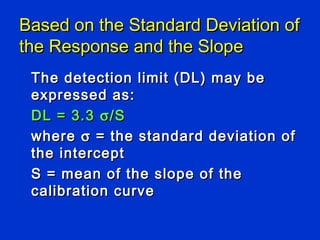
Based on the Standard Deviation of
the Response and the Slope
 The detection limit (DL) may be
 expressed as:
 DL = 3.3 σ /S
 where σ = the standard deviation of
 the intercept
 S = mean of the slope of the
 calibration curve
Robustness
 Small changes do not affect the
  parameters of the assay

Instrumentation 2

  • 1.
    Learning objectives • Validation •Steps in validation, and understanding of such steps
  • 2.
    Validation? • Validation isthe assessment of a process or instrument to assure that the process and instrument is suitable for its intended use (FDA, 1987). • Validation enables an efficient and productive use of the process and instrumental variables. • A new assay method, change in operator, laboratory and equipment than the one in previous method requires validation.
  • 3.
    Steps in Validation REPEATABILITY PRECISION ACCURACY Reproducibility INTERMEDIATE Sensitivity PRECISION SPECIFICITY DETECTION RANGE LINEARITY QUANTIFICATION
  • 4.
    Specificit y • Specificity isthe ability to assess unequivocally the analyte in the presence of other components such as impurities, degradants and matrix etc. • Lack of specificity of an assay procedure, may be compensated by other supporting assay(s).
  • 5.
    • Indicates thelinear relationship between concentration and response of the detector
  • 6.
    EVALUATION OF LINEARITY • Linearity is evaluated by visual inspection of a plot of signals as a function of analyte concentration. • If there is a linear relationship, the data is evaluated by appropriate statistical methods, for example, linear regression. • In some cases, to obtain linearity, the test data may need mathematical transformation prior to the regression analysis. • For the establishment of linearity, a minimum of 5 concentrations are recommended.
  • 7.
    RANGE • The specifiedrange is normally derived from linearity studies and depends on the intended application of the procedure. • It confirms that the assay will provide an acceptable accuracy and precision when applied to samples containing analyte, within or at the extremes of the specified range
  • 8.
    Applicable Concentration Range LOL Instrument response LOQ => limit of quantitative measurement LOQ LOL => limit of linear response Useful range Concentration
  • 9.
    ACCURACY • The accuracyof an assay expresses the closeness or agreement between the true value and the value found. This is sometimes termed as trueness • Within day accuracy (Repeatability) • Between days accuracy (Reproducibility)
  • 10.
    PRECISION • The precisionof an assay expresses the degree of scatter between a series of measurements obtained from multiple sampling of the same homogeneous sample under the prescribed conditions. • Precision may be considered at three levels: – Repeatability – Intermediate precision – Reproducibility • The precision is usually expressed as the variance, standard deviation or coefficient of variance of a series of measurements.
  • 11.
    Repeatability • Repeatability expressesthe precision under the same operating conditions over a short interval of time. • Repeatability is also termed as intra-assay precision.
  • 12.
    Intermediate precision • Intermediateprecision expresses within-laboratories variations, different days, different analysts, different equipment, etc. • Typical variations to be studied include days, analysts, equipment etc.
  • 13.
    Reproducibility • Reproducibility isassessed by means of an inter-laboratory trial, and between days assay.
  • 14.
    Accuracy vs precision Good accuracy and precision
  • 15.
    Accuracy vs precision • Poor accuracy • Good precision
  • 16.
    Accuracy vs precision • Poor precision • Good accuracy
  • 18.
    DETECTION LIMIT • Thedetection limit of an analyte in an assay is the lowest amount of analyte in a sample which can be detected but not necessarily quantitated as an exact value • Several approaches for determining the detection limit are used, depending on whether the procedure is a non-instrumental or instrumental
  • 19.
    Based on VisualEvaluation • Visual evaluation may be used for non- instrumental methods but may also be used for instrumental methods. • The detection limit is determined by the analyzing samples having known concentrations of analyte and by establishing the minimum level at which the analyte can reliably be detected
  • 20.
    Based on Signal-to-Noise •This approach is applied to analytical procedures which exhibit baseline noise. • Determination of the signal-to-noise ratio is performed by comparing measured signals of samples having known low concentration of analyte with those of blanks , and establishing the minimum concentration at which the analyte can reliably be detected. • A signal-to-noise ratio between 3:1 or 2:1 is generally considered acceptable for estimating the detection limit.
  • 21.
    Based on theStandard Deviation of the Response and the Slope The detection limit (DL) may be expressed as: DL = 3.3 σ /S where σ = the standard deviation of the intercept S = mean of the slope of the calibration curve
  • 22.
    Robustness Small changesdo not affect the parameters of the assay