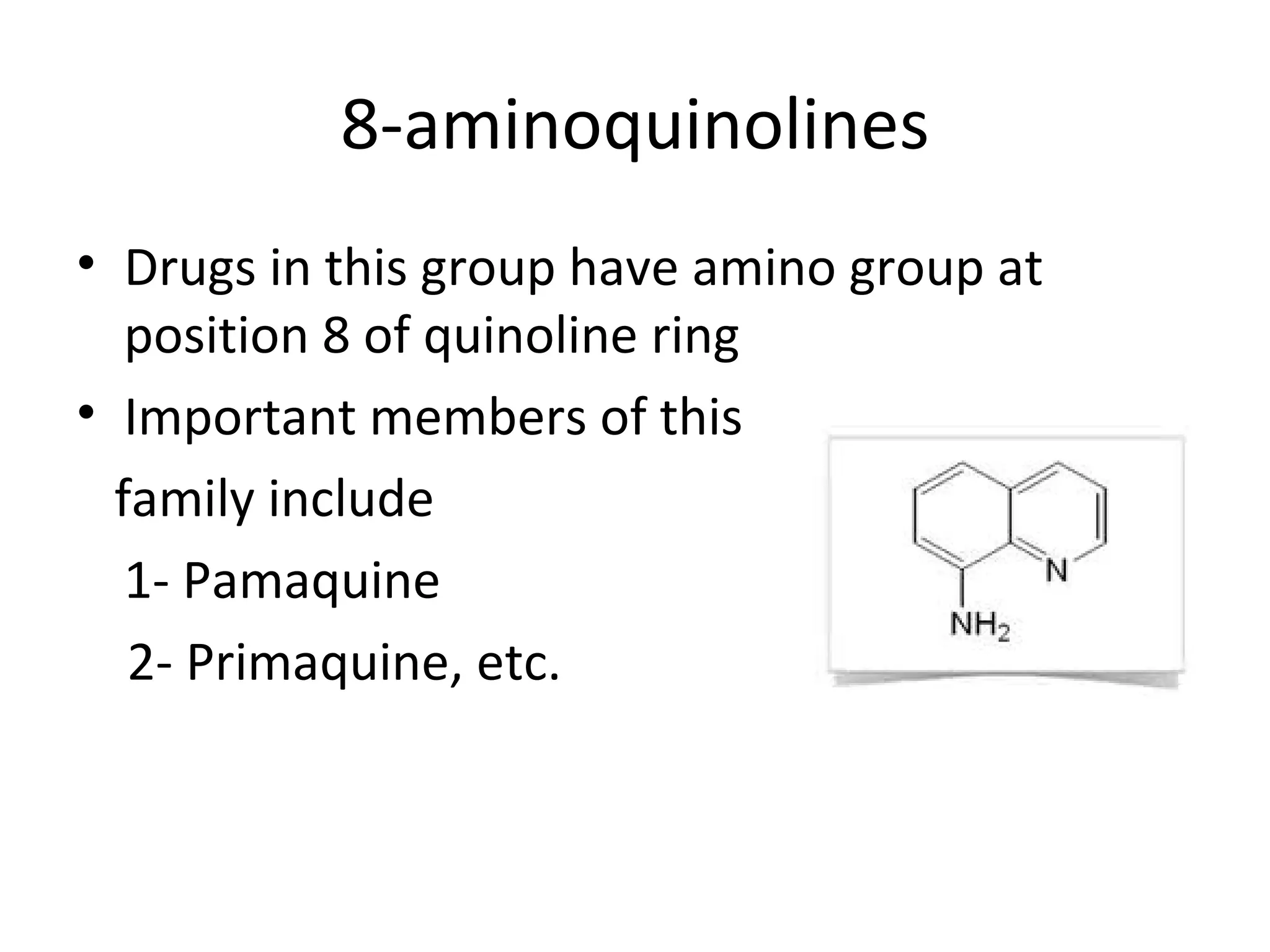
8-aminoquinolines
• Drugs in this group have amino group at
   position 8 of quinoline ring
• Important members of this
  family include
   1- Pamaquine
   2- Primaquine, etc.
• Such drugs have OCH3 group at position 6
• This molecule has antimalarial
  activity but when side chain
  is introduced at amino
  group antimalarial activity is
  intensified e.g
  pamaquine
• It causes hemolysis
  of RBCs
                              Diethyl amino pentyl side chain
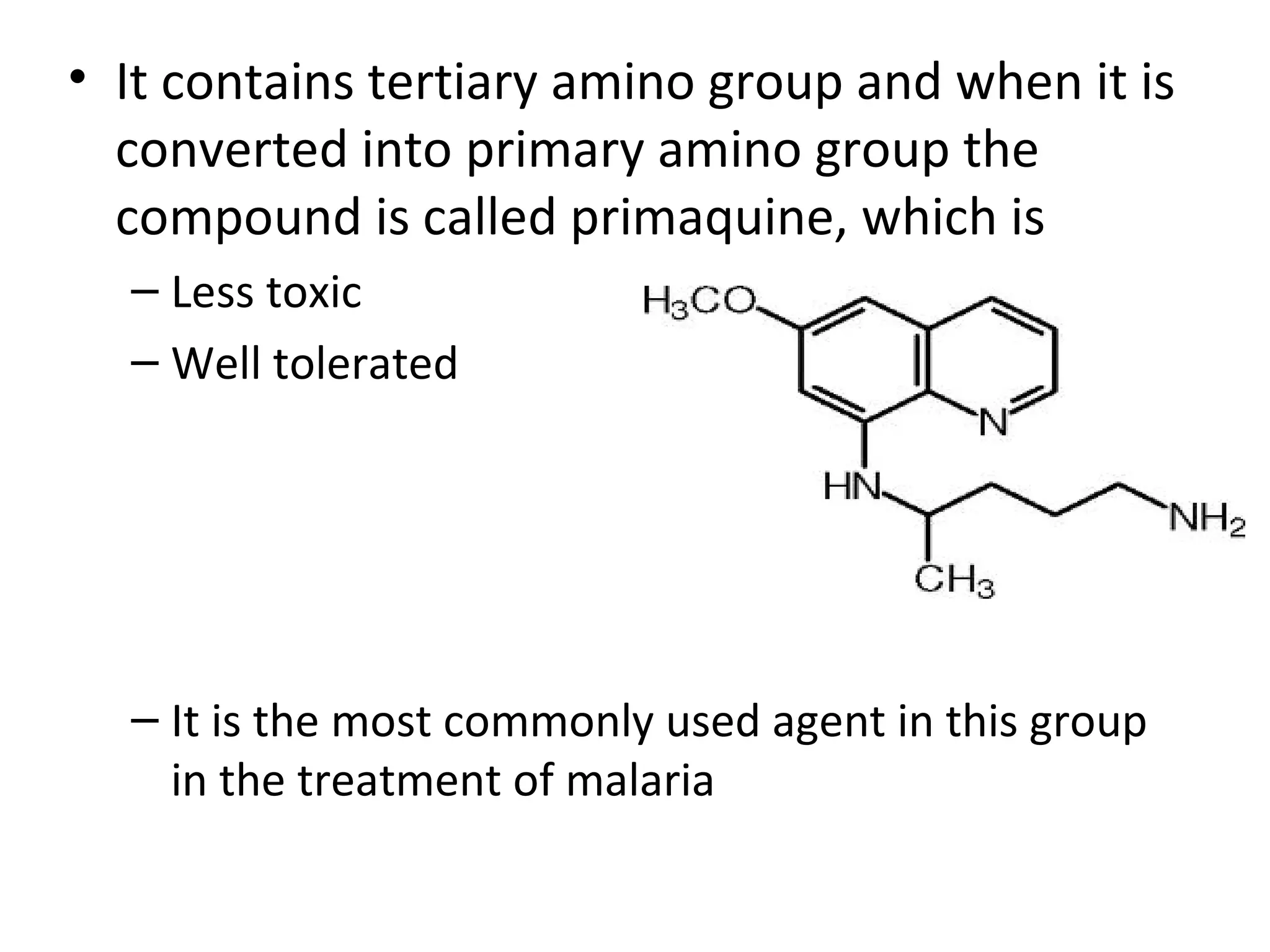
• It contains tertiary amino group and when it is
  converted into primary amino group the
  compound is called primaquine, which is
  – Less toxic
  – Well tolerated


  – It is the most commonly used agent in this group
    in the treatment of malaria
• OCH3 is not necessary for antimalarial activity
  but when replaced by OC2H5 the compound
  became
  – less active
  – Toxic in nature
• OCH3 when replaced by CH3 the compound
  become inactive
• Introduction of halogens increases toxicity
• Presence of quinoline ring is necessary for
  antimalarial activity. When pyridine ring is
  converted to piperidine (saturated) the
  compound became inactive
• Pentyl side chain gives maximum activity,
  increase or decrease of chain result is reduction
  of activity.
• The branched side chain when converted into
  straight chain pentaquine is obtained


• It has less antimalarial activity as compared to
  both pamaquine and primaquine
Chemical synthesis (pamaquine)


• Glycerol undergoes dehydration to produce
  propene aldehyde
• Dehydrating agent is sulphuric acid
• Addition reaction of propene aldehyde and 4
  methoxy 2-nitro aniline to form 4 methoxy 2-
  nitro propene aldehyde
• Tautomerization: 4 methoxy 2-nitro propene
  aldehyde (keto form) converted in enol form
• Enol form undergoes cyclization to form 8 nitro 6
  methoxy dihydroquinoline which then oxidized to
  form 8 nitro 6 methoxy quinoline
• 6 methoxy 8 nitro quinoline undergoes
  reduction to form 8 amino 6 methoxy
  quinoline
• 8 amino 6 methoxy quinoline reacts with 2
  chloro diethyl amino pentane to form
  pamaquine
Therapeutic uses
• Active against hepatic stage of plasmodium
• Provide radical cure hepatic stage of P. vivax
  and P. ovale
• It also acts at gametocytes, hence used as
  prophylactic drugs
• Used in combination with chloroquine for
  complete eradication of malaria
• Side effect: hemolysis in G6 phosphate
  dehydrogenase deficient people

8 aminoquinolines

  • 1.
    8-aminoquinolines • Drugs inthis group have amino group at position 8 of quinoline ring • Important members of this family include 1- Pamaquine 2- Primaquine, etc.
  • 2.
    • Such drugshave OCH3 group at position 6 • This molecule has antimalarial activity but when side chain is introduced at amino group antimalarial activity is intensified e.g pamaquine • It causes hemolysis of RBCs Diethyl amino pentyl side chain
  • 3.
    • It containstertiary amino group and when it is converted into primary amino group the compound is called primaquine, which is – Less toxic – Well tolerated – It is the most commonly used agent in this group in the treatment of malaria
  • 4.
    • OCH3 isnot necessary for antimalarial activity but when replaced by OC2H5 the compound became – less active – Toxic in nature • OCH3 when replaced by CH3 the compound become inactive • Introduction of halogens increases toxicity • Presence of quinoline ring is necessary for antimalarial activity. When pyridine ring is converted to piperidine (saturated) the compound became inactive
  • 5.
    • Pentyl sidechain gives maximum activity, increase or decrease of chain result is reduction of activity. • The branched side chain when converted into straight chain pentaquine is obtained • It has less antimalarial activity as compared to both pamaquine and primaquine
  • 6.
    Chemical synthesis (pamaquine) •Glycerol undergoes dehydration to produce propene aldehyde • Dehydrating agent is sulphuric acid
  • 7.
    • Addition reactionof propene aldehyde and 4 methoxy 2-nitro aniline to form 4 methoxy 2- nitro propene aldehyde
  • 8.
    • Tautomerization: 4methoxy 2-nitro propene aldehyde (keto form) converted in enol form
  • 9.
    • Enol formundergoes cyclization to form 8 nitro 6 methoxy dihydroquinoline which then oxidized to form 8 nitro 6 methoxy quinoline
  • 10.
    • 6 methoxy8 nitro quinoline undergoes reduction to form 8 amino 6 methoxy quinoline
  • 11.
    • 8 amino6 methoxy quinoline reacts with 2 chloro diethyl amino pentane to form pamaquine
  • 12.
    Therapeutic uses • Activeagainst hepatic stage of plasmodium • Provide radical cure hepatic stage of P. vivax and P. ovale • It also acts at gametocytes, hence used as prophylactic drugs • Used in combination with chloroquine for complete eradication of malaria • Side effect: hemolysis in G6 phosphate dehydrogenase deficient people