Miscellaneous Tests
         Weight/ml
         Total solids
         Loss on drying
         Ash test
         Toxicity tests
         Moisture contents
Weight per milliliter

   Important for tinctures and extracts and
    defined as
    The weight per milliliter of a liquid is the
    weight expressed in grams of 1 milliliter
    of a liquid when weighed in air at the
    specific temperature
 Almost equal to density of the liquid
 For this,
    –   Weigh a clean and dry pycnometer
        accurately
    –   Fill it with liquid, remove any access and
        weigh
    –   Determine the weight of liquid by subtraction
 Determine   wt/ml by dividing the
  weight of liquid that filled the
  pycnometer by the capacity of
  pycnometer
 Expressed in g/ml
Total Solids (BP)

   The term total solids is applied to the residue
    obtained when the prescribed amount of the
    preparation is dried to constant weight under
    the conditions specified
   Total solids usually include extractives, both
    soluble in alcoholic or hydroalcoholic
    preparations as tinctures and extracts
   Apparatus a hollow flat bottom, flanged dish
    75mm in diameter 25mm deep made up of
    nickel or other metal
   Place an accurately measured weight or
    quantity of the preparation after thorough
    shaking, say 10 ml in a tarred dish
   Evaporate at as low a temperature as
    possible until the alcohol is removed, and
    heat on a water bath until the residue is
    apparently dry
 Transfer to oven and dry to a
  constant weight at 105oC or dry in
  desiccator
 Weigh the dish containing residue
 Difference in two weights is the
  amount of total solid per 10ml.
 Determine total solid as g/100ml
Determination of Ash

   Acid soluble ash
   Acid insoluble ash
   Water soluble ash
   Sulphated ash
Total ash
   Clean dry silica crucible is heated and
    weighed to a constant weight. Then 2 g
    accurately weighed sample is taken in it and
    incinerated by gradually increasing heat to
    dull redness (675 ± 25 oC) until free from
    carbon. The crucible was then kept in
    desiccator and allowed to cool to a constant
    weight and weighed. The percentage of total
    ash with reference to air dried sample was
    calculated
Acid insoluble Ash
   The total ash is boiled for 5 min in 25 mL
    dilute HCl. The insoluble matter is collected
    on ash less filter paper and washed with hot
    distilled water. The filter paper is then dried
    and ignited in tarred silica crucible until free
    from carbon. The crucible is allowed to cool
    in desiccator till a constant weight and
    weighed. The percentage of acid insoluble
    ash with reference to air dried sample is
    calculated
Sulphated Ash
   Two gram accurately weighed sample is
    taken in tarred silica crucible, moistened with
    sulphuric acid and ignited gently. Crucible is
    then allowed to cool in desiccator and again
    moistened with sulphuric acid, reignited and
    weighed. The process is repeated till a
    constant weight is obtained. The percentage
    of sulphated ash with reference to air dried
    sample was calculated
Toxicity test

   Usually performed on finished dosage form of
    toxoids and plastic containers in order to determine
    there safety or toxicity.
   DIPHTHERIA TOXOID
   Inject IV/SC 4 healthy guinea pigs (300-400g) with a
    of DT that is atleast 5 times the human immunizing
    dose (not less than 2ml).
   Comply if no symptom of DT poisoning appear within
    30 days.
   TETANUS TOXOID
   Perform similar as DT but it is given SC.
   Check the symptoms of tetanus toxin poisoning after
    21 days.
   PLASTIC CONTAINERS
   Extract of plastic containers used for parenteral
    preparations is prepared.
   Its IV injection to mice determine its gross toxicity
    and mortality.
Give IC into dorsal shaved skin of rabbit
 or
The standardized plastic strips are
 implanted
The local reaction is observed for toxicity.
Loss on drying

   Test determines the amount of volatile matter of any
    kind that is driven of under specified conditions.
   Take 1-2g of substance, reduce particle size if
    necessary, in a dried glass stoppered, weighed
    bottle.
   Weigh and shake to evenly distribute the substance.
   Place the loaded bottle in drying chamber, remove
    stopper and place it also in the chamber.
   Dry the sample at temperature specified in
    monograph, close the bottle. Cool in desiccator &
    weigh
   If the substance melts at a temperature at which loss
    on drying is to be performed, it is kept at 5 -10oC for
    1-2 h for drying.
   For substance requiring thermogravimetric analysis a
    sensitive electrobalance is used.
   For vacuum drying vacuum desiccator or vacuum
    drying pistol are used.
Moisture Content

 Heating
  method/thermogravimetry
 Karl Fischer
 – Volumetricmethod
 – Coulometric method
Moisture contents
   Accurately weighed powder (2 g) of the plant
    material is taken in a tarred silica crucible.
   The powder is the dried in an oven at 105 oC
    for 30 min, cooled at room temperature in
    desiccator until constant weight and weighed
    to calculate the moisture contents.
   The results are expressed as a percent of
    dry powder.
Karl Fisher Method---Standard technique for low
moisture products.
Especially good for reducing sugars, protein-rich
food and foods and pharmaceuticals with high
volatile oils.
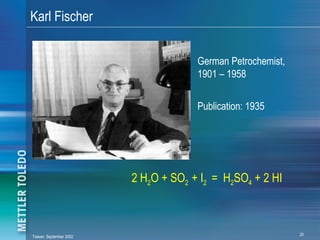
Karl Fischer


                                      German Petrochemist,
                                      1901 – 1958


                                      Publication: 1935


                         2 H2O + SO2 + I2 = H2SO4 + 2 HI


Taiwan, September 2002                                       20
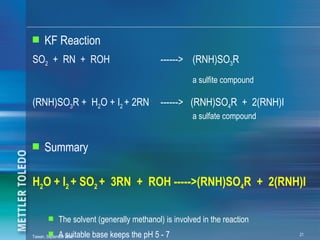
s     KF Reaction
SO2 + RN + ROH                                ------> (RNH)SO3R
                                                        a sulfite compound

(RNH)SO3R + H2O + I2 + 2RN                    ------> (RNH)SO4R + 2(RNH)I
                                                        a sulfate compound


s     Summary

H2O + I2 + SO2 + 3RN + ROH ----->(RNH)SO4R + 2(RNH)I

        s     The solvent (generally methanol) is involved in the reaction
         s    A suitable base keeps the pH 5 - 7
Taiwan, September 2002                                                       21
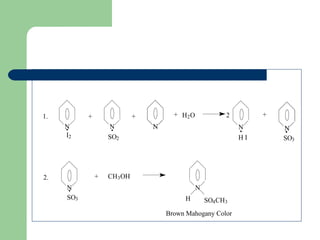
1.         +                +         + H2 O             2        +
     N             N            N                            N        N
     I2            SO2                                       HI       SO3


2.             +   CH3 OH
     N                                         N
     SO3                                 H         SO4 CH3
                                    Brown Mahogany Color
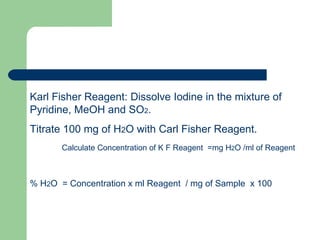
Karl Fisher Reagent: Dissolve Iodine in the mixture of
Pyridine, MeOH and SO2.
Titrate 100 mg of H2O with Carl Fisher Reagent.
       Calculate Concentration of K F Reagent =mg H2O /ml of Reagent


% H2O = Concentration x ml Reagent / mg of Sample x 100

Miscelanous tests

  • 1.
    Miscellaneous Tests Weight/ml Total solids Loss on drying Ash test Toxicity tests Moisture contents
  • 2.
    Weight per milliliter  Important for tinctures and extracts and defined as The weight per milliliter of a liquid is the weight expressed in grams of 1 milliliter of a liquid when weighed in air at the specific temperature
  • 3.
     Almost equalto density of the liquid  For this, – Weigh a clean and dry pycnometer accurately – Fill it with liquid, remove any access and weigh – Determine the weight of liquid by subtraction
  • 4.
     Determine wt/ml by dividing the weight of liquid that filled the pycnometer by the capacity of pycnometer  Expressed in g/ml
  • 5.
    Total Solids (BP)  The term total solids is applied to the residue obtained when the prescribed amount of the preparation is dried to constant weight under the conditions specified  Total solids usually include extractives, both soluble in alcoholic or hydroalcoholic preparations as tinctures and extracts
  • 6.
    Apparatus a hollow flat bottom, flanged dish 75mm in diameter 25mm deep made up of nickel or other metal  Place an accurately measured weight or quantity of the preparation after thorough shaking, say 10 ml in a tarred dish  Evaporate at as low a temperature as possible until the alcohol is removed, and heat on a water bath until the residue is apparently dry
  • 7.
     Transfer tooven and dry to a constant weight at 105oC or dry in desiccator  Weigh the dish containing residue  Difference in two weights is the amount of total solid per 10ml.  Determine total solid as g/100ml
  • 8.
    Determination of Ash  Acid soluble ash  Acid insoluble ash  Water soluble ash  Sulphated ash
  • 9.
    Total ash  Clean dry silica crucible is heated and weighed to a constant weight. Then 2 g accurately weighed sample is taken in it and incinerated by gradually increasing heat to dull redness (675 ± 25 oC) until free from carbon. The crucible was then kept in desiccator and allowed to cool to a constant weight and weighed. The percentage of total ash with reference to air dried sample was calculated
  • 10.
    Acid insoluble Ash  The total ash is boiled for 5 min in 25 mL dilute HCl. The insoluble matter is collected on ash less filter paper and washed with hot distilled water. The filter paper is then dried and ignited in tarred silica crucible until free from carbon. The crucible is allowed to cool in desiccator till a constant weight and weighed. The percentage of acid insoluble ash with reference to air dried sample is calculated
  • 11.
    Sulphated Ash  Two gram accurately weighed sample is taken in tarred silica crucible, moistened with sulphuric acid and ignited gently. Crucible is then allowed to cool in desiccator and again moistened with sulphuric acid, reignited and weighed. The process is repeated till a constant weight is obtained. The percentage of sulphated ash with reference to air dried sample was calculated
  • 12.
    Toxicity test  Usually performed on finished dosage form of toxoids and plastic containers in order to determine there safety or toxicity.  DIPHTHERIA TOXOID  Inject IV/SC 4 healthy guinea pigs (300-400g) with a of DT that is atleast 5 times the human immunizing dose (not less than 2ml).  Comply if no symptom of DT poisoning appear within 30 days.
  • 13.
    TETANUS TOXOID  Perform similar as DT but it is given SC.  Check the symptoms of tetanus toxin poisoning after 21 days.  PLASTIC CONTAINERS  Extract of plastic containers used for parenteral preparations is prepared.  Its IV injection to mice determine its gross toxicity and mortality.
  • 14.
    Give IC intodorsal shaved skin of rabbit or The standardized plastic strips are implanted The local reaction is observed for toxicity.
  • 15.
    Loss on drying  Test determines the amount of volatile matter of any kind that is driven of under specified conditions.  Take 1-2g of substance, reduce particle size if necessary, in a dried glass stoppered, weighed bottle.  Weigh and shake to evenly distribute the substance.  Place the loaded bottle in drying chamber, remove stopper and place it also in the chamber.  Dry the sample at temperature specified in monograph, close the bottle. Cool in desiccator & weigh
  • 16.
    If the substance melts at a temperature at which loss on drying is to be performed, it is kept at 5 -10oC for 1-2 h for drying.  For substance requiring thermogravimetric analysis a sensitive electrobalance is used.  For vacuum drying vacuum desiccator or vacuum drying pistol are used.
  • 17.
    Moisture Content  Heating method/thermogravimetry  Karl Fischer – Volumetricmethod – Coulometric method
  • 18.
    Moisture contents  Accurately weighed powder (2 g) of the plant material is taken in a tarred silica crucible.  The powder is the dried in an oven at 105 oC for 30 min, cooled at room temperature in desiccator until constant weight and weighed to calculate the moisture contents.  The results are expressed as a percent of dry powder.
  • 19.
    Karl Fisher Method---Standardtechnique for low moisture products. Especially good for reducing sugars, protein-rich food and foods and pharmaceuticals with high volatile oils.
  • 20.
    Karl Fischer German Petrochemist, 1901 – 1958 Publication: 1935 2 H2O + SO2 + I2 = H2SO4 + 2 HI Taiwan, September 2002 20
  • 21.
    s KF Reaction SO2 + RN + ROH ------> (RNH)SO3R a sulfite compound (RNH)SO3R + H2O + I2 + 2RN ------> (RNH)SO4R + 2(RNH)I a sulfate compound s Summary H2O + I2 + SO2 + 3RN + ROH ----->(RNH)SO4R + 2(RNH)I s The solvent (generally methanol) is involved in the reaction s A suitable base keeps the pH 5 - 7 Taiwan, September 2002 21
  • 22.
    1. + + + H2 O 2 + N N N N N I2 SO2 HI SO3 2. + CH3 OH N N SO3 H SO4 CH3 Brown Mahogany Color
  • 23.
    Karl Fisher Reagent:Dissolve Iodine in the mixture of Pyridine, MeOH and SO2. Titrate 100 mg of H2O with Carl Fisher Reagent. Calculate Concentration of K F Reagent =mg H2O /ml of Reagent % H2O = Concentration x ml Reagent / mg of Sample x 100