Chapter 5
                                  Stereochemistry


 © 2013 Pearson Education, Inc.


© 2013 Pearson Education, Inc.
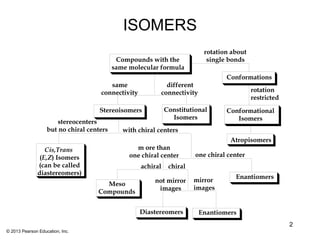
ISOMERS
                                                                           rotation about
                                            Compounds with the              single bonds
                                           same molecular formula
                                                                                  Conformations
                                        same                 different
                                     connectivity          connectivity                     rotation
                                                                                            restricted
                                     Stereoisomers            Constitutional      Conformational
                                                                Isomers              Isomers
                       stereocenters
                   but no chiral centers      with chiral centers
                                                                                    Atropisomers
                 Cis,Trans                        m ore than
               (E,Z) Isomers                    one chiral center       one chiral center
              (can be called                        achiral    chiral
              diastereomers)
                                                                        mirror       Enantiomers
                                      Meso               not mirror
                                                          images        images
                                    Compounds


                                                    Diastereomers         Enantiomers
                                                                                                         2
© 2013 Pearson Education, Inc.
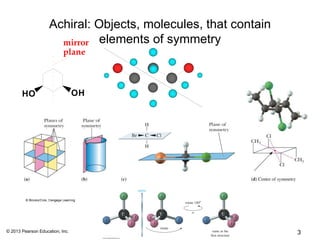
Achiral: Objects, molecules, that contain
                      mirror elements of symmetry
                           plane


       HO                        OH


© 2013 Pearson Education, Inc.        Chapter 5                 3
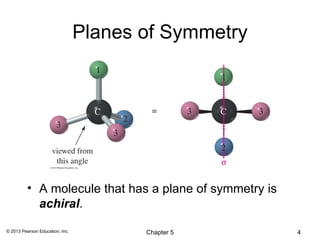
Planes of Symmetry


          • A molecule that has a plane of symmetry is
            achiral.

© 2013 Pearson Education, Inc.          Chapter 5        4
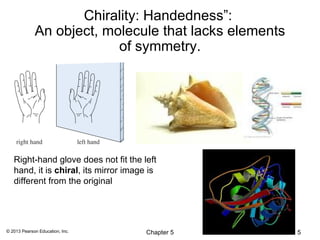
Chirality: Handedness”:
             An object, molecule that lacks elements
                          of symmetry.


   Right-hand glove does not fit the left
   hand, it is chiral, its mirror image is
   different from the original


© 2013 Pearson Education, Inc.         Chapter 5       5
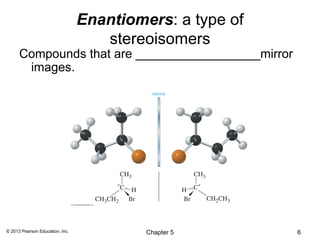
Enantiomers: a type of
                                    stereoisomers
      Compounds that are __________________mirror
       images.


© 2013 Pearson Education, Inc.            Chapter 5       6
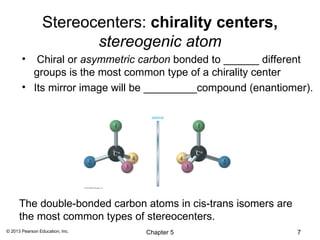
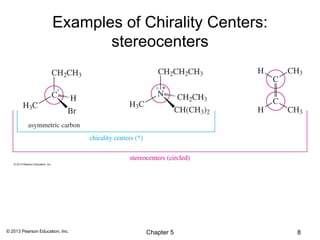
Stereocenters: chirality centers,
                        stereogenic atom
       •  Chiral or asymmetric carbon bonded to ______ different
         groups is the most common type of a chirality center
       • Its mirror image will be _________compound (enantiomer).


      The double-bonded carbon atoms in cis-trans isomers are
      the most common types of stereocenters.
© 2013 Pearson Education, Inc.   Chapter 5                      7
Examples of Chirality Centers:
                             stereocenters


© 2013 Pearson Education, Inc.     Chapter 5           8
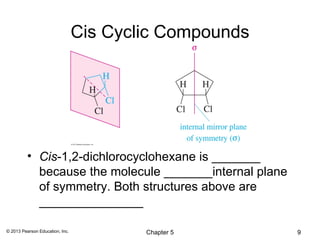
Cis Cyclic Compounds


          • Cis-1,2-dichlorocyclohexane is _______
            because the molecule _______internal plane
            of symmetry. Both structures above are
            _______________

© 2013 Pearson Education, Inc.           Chapter 5       9
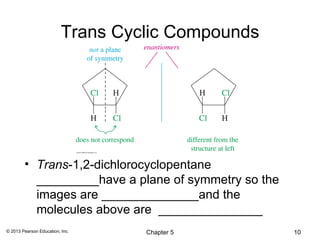
Trans Cyclic Compounds


        • Trans-1,2-dichlorocyclopentane
          _________have a plane of symmetry so the
          images are ______________and the
          molecules above are _______________
© 2013 Pearson Education, Inc.     Chapter 5         10
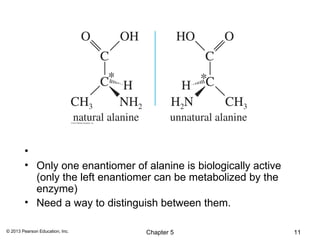
•
        • Only one enantiomer of alanine is biologically active
          (only the left enantiomer can be metabolized by the
          enzyme)
        • Need a way to distinguish between them.

© 2013 Pearson Education, Inc.    Chapter 5                       11
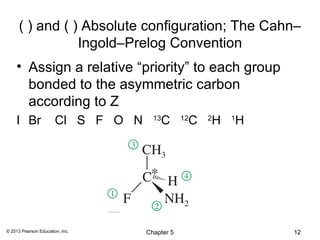
( ) and ( ) Absolute configuration; The Cahn–
                 Ingold–Prelog Convention
    • Assign a relative “priority” to each group
      bonded to the asymmetric carbon
      according to Z
    I Br               Cl S F O N     13
                                        C        C
                                                12
                                                     H
                                                     2
                                                         H
                                                         1


© 2013 Pearson Education, Inc.      Chapter 5                12
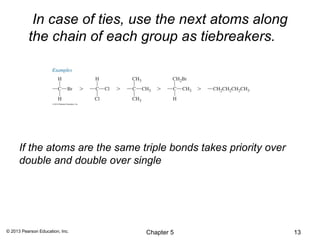
In case of ties, use the next atoms along
          the chain of each group as tiebreakers.


      If the atoms are the same triple bonds takes priority over
      double and double over single


© 2013 Pearson Education, Inc.   Chapter 5                         13
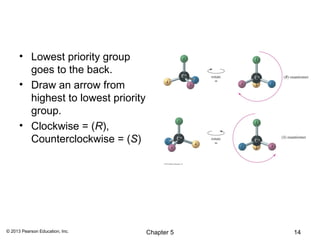
• Lowest priority group
        goes to the back.
      • Draw an arrow from
        highest to lowest priority
        group.
      • Clockwise = (R),
        Counterclockwise = (S)


© 2013 Pearson Education, Inc.       Chapter 5   14
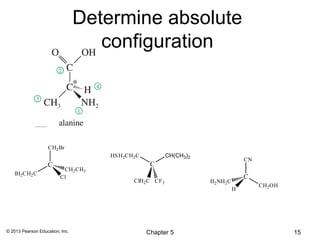
Determine absolute
                                    configuration


                    CH2 Br
                                     HS H2CH2 C            CH(CH3)2
                                                                                     CN
                   C                               C
                          CH2 CH3
   IH2CH2 C
                         Cl                                                          C
                                             ClH2 C CF 3              H2 NH2 C
                                                                                          CH2 OH
                                                                                 H


© 2013 Pearson Education, Inc.                    Chapter 5                                        15
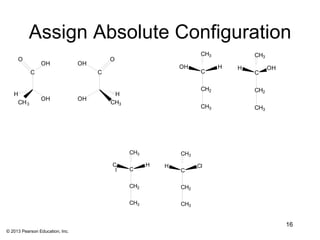
Assign Absolute Configuration
                                                                     CH3           CH3
     O                                    O
                OH               OH
                                                              OH           H   H         OH
           C                          C                              C             C

                                                                     CH2           CH2
   H                                       H
                OH               OH
    CH 3                                  CH3
                                                                     CH3           CH3


                                                CH3           CH3

                                          C           H   H         Cl
                                           l    C             C

                                                CH2           CH2

                                                CH3           CH3


                                                                                              16
© 2013 Pearson Education, Inc.
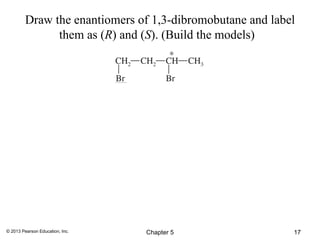
Draw the enantiomers of 1,3-dibromobutane and label
               them as (R) and (S). (Build the models)


© 2013 Pearson Education, Inc.   Chapter 5                 17
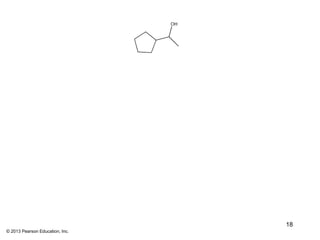
OH


                                      18
© 2013 Pearson Education, Inc.
Properties of Enantiomers
   • Same boiling point, melting point, and density,
     refractive index.
   • Rotate the plane of polarized light in the same
     magnitude, but in opposite directions.
   • Different interaction with other chiral molecules:
           – Active site of enzymes is selective for a specific
             enantiomer.
           – Taste buds and scent receptors are also chiral.
             Enantiomers may have different smells.


© 2013 Pearson Education, Inc.      Chapter 5                     19
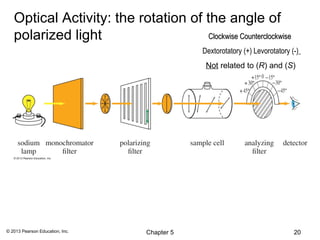
Optical Activity: the rotation of the angle of
   polarized light                    Clockwise Counterclockwise
                                             Dextorotatory (+) Levorotatory (-)
                                              Not related to (R) and (S)


© 2013 Pearson Education, Inc.   Chapter 5                                   20
Specific Rotation
   Observed rotation depends on temperature, wavelength of
    light, _________________________________________
  Normalize:

                                 [α] = α (observed)
                                           c•l
       α(observed) is the rotation observed in the polarimeter

       c is concentration in g/mL,

       l is length of sample cell in decimeters.


© 2013 Pearson Education, Inc.           Chapter 5               21
When one of the enantiomers of 2-butanol is placed in a
      polarimeter, the observed rotation is 4.05° counterclockwise. The
      solution was made by diluting 6 g of 2-butanol to a total of 40 mL,
      and the solution was placed into a 200-mm polarimeter tube for
      the measurement. Determine the specific rotation for this
      enantiomer of 2-butanol.


© 2013 Pearson Education, Inc.     Chapter 5                          22
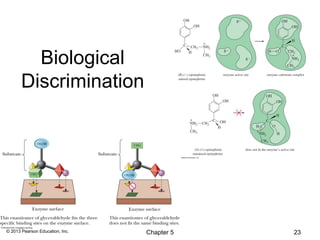
Biological
       Discrimination


© 2013 Pearson Education, Inc.   Chapter 5   23
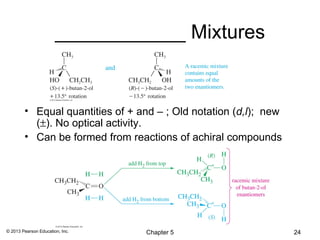
____________ Mixtures


        • Equal quantities of + and – ; Old notation (d,l); new
          (±). No optical activity.
        • Can be formed from reactions of achiral compounds


© 2013 Pearson Education, Inc.    Chapter 5                       24
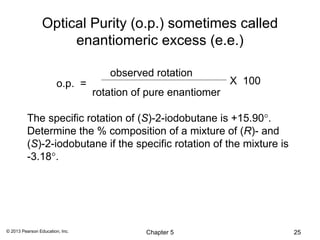
Optical Purity (o.p.) sometimes called
                      enantiomeric excess (e.e.)

                                    observed rotation
                        o.p. =                                 X 100
                                 rotation of pure enantiomer

         The specific rotation of (S)-2-iodobutane is +15.90°.
         Determine the % composition of a mixture of (R)- and
         (S)-2-iodobutane if the specific rotation of the mixture is
         -3.18°.


© 2013 Pearson Education, Inc.              Chapter 5                  25
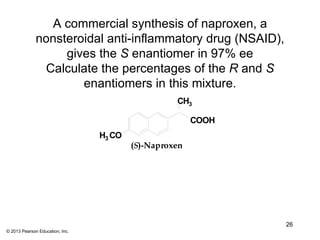
A commercial synthesis of naproxen, a
              nonsteroidal anti-inflammatory drug (NSAID),
                   gives the S enantiomer in 97% ee
               Calculate the percentages of the R and S
                      enantiomers in this mixture.
                                                   CH3

                                                        COOH
                                 H3 CO
                                         (S)-Naproxen


                                                               26
© 2013 Pearson Education, Inc.
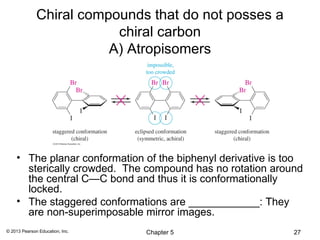
Chiral compounds that do not posses a
                          chiral carbon
                         A) Atropisomers


    • The planar conformation of the biphenyl derivative is too
      sterically crowded. The compound has no rotation around
      the central C—C bond and thus it is conformationally
      locked.
    • The staggered conformations are ____________: They
      are non-superimposable mirror images.
© 2013 Pearson Education, Inc.   Chapter 5                   27
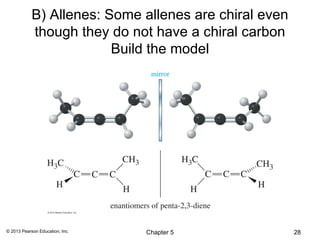
B) Allenes: Some allenes are chiral even
            though they do not have a chiral carbon
                         Build the model


© 2013 Pearson Education, Inc.   Chapter 5             28
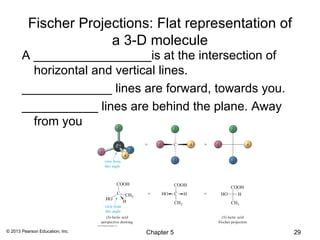
Fischer Projections: Flat representation of
                       a 3-D molecule
       A _________________is at the intersection of
         horizontal and vertical lines.
       _____________ lines are forward, towards you.
       ___________ lines are behind the plane. Away
         from you


© 2013 Pearson Education, Inc.   Chapter 5              29
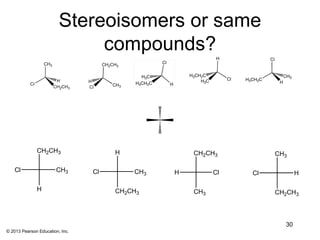
Stereoisomers or same
                                 compounds?
                    CH3                  CH2CH3


                           H       H
           Cl                               CH3
                          CH2CH3   Cl


                CH2CH3                       H              CH2CH3          CH3

   Cl                      CH3      Cl            CH3   H         Cl   Cl          H

                H                            CH2CH3         CH3             CH2CH3


                                                                              30
© 2013 Pearson Education, Inc.
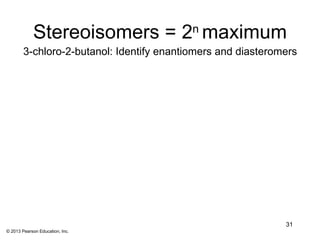
Stereoisomers = 2n maximum
        3-chloro-2-butanol: Identify enantiomers and diasteromers


                                                              31
© 2013 Pearson Education, Inc.
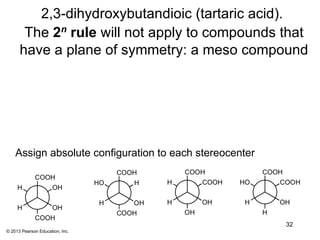
2,3-dihydroxybutandioic (tartaric acid).
       The 2n rule will not apply to compounds that
      have a plane of symmetry: a meso compound


    Assign absolute configuration to each stereocenter


                                                         32
© 2013 Pearson Education, Inc.
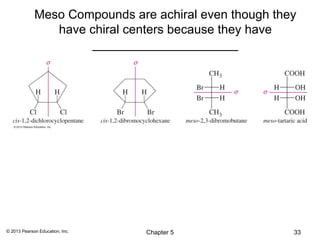
Meso Compounds are achiral even though they
                have chiral centers because they have
                     _____________________


© 2013 Pearson Education, Inc.   Chapter 5             33
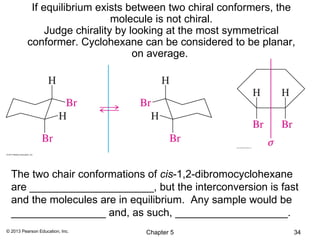
If equilibrium exists between two chiral conformers, the
                              molecule is not chiral.
               Judge chirality by looking at the most symmetrical
          conformer. Cyclohexane can be considered to be planar,
                                   on average.


  The two chair conformations of cis-1,2-dibromocyclohexane
  are _____________________, but the interconversion is fast
  and the molecules are in equilibrium. Any sample would be
  ________________ and, as such, ___________________.
© 2013 Pearson Education, Inc.     Chapter 5                      34
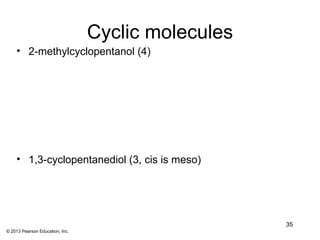
Cyclic molecules
    • 2-methylcyclopentanol (4)


    • 1,3-cyclopentanediol (3, cis is meso)


                                                    35
© 2013 Pearson Education, Inc.
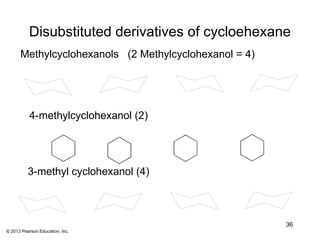
Disubstituted derivatives of cycloehexane
      Methylcyclohexanols (2 Methylcyclohexanol = 4)


           4-methylcyclohexanol (2)


          3-methyl cyclohexanol (4)


                                                       36
© 2013 Pearson Education, Inc.
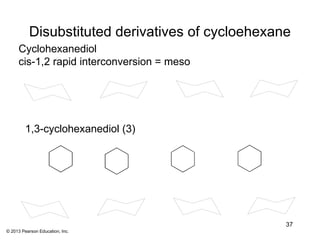
Disubstituted derivatives of cycloehexane
     Cyclohexanediol
     cis-1,2 rapid interconversion = meso


         1,3-cyclohexanediol (3)


                                                  37
© 2013 Pearson Education, Inc.
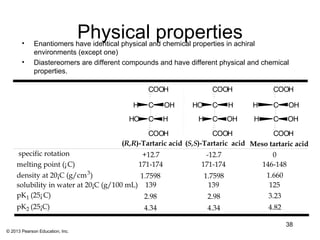
•
                                 Physical properties
             Enantiomers have identical physical and chemical properties in achiral
             environments (except one)
       •     Diastereomers are different compounds and have different physical and chemical
             properties.

                                                 COOH                COOH               COOH

                                           H     C       OH   HO     C      H    H      C      OH
                                          HO     C   H         H     C      OH   H      C      OH

                                               COOH                 COOH             COOH
                                       (R,R)-Tartaric acid (S,S)-Tartaric acid Meso tartaric acid
    specific rotation                           +12.7            -12.7                  0
    melting point (¡ C)                        171-174          171-174              146-148
    density at 20¡C (g/cm 3 )             1.7598                   1.7598             1.660
    solubility in water at 20¡C (g/100 mL) 139                      139                125
    pK1 (25¡ C)                            2.98                     2.98              3.23
    pK2 (25¡C)                             4.34                     4.34              4.82

                                                                                              38
© 2013 Pearson Education, Inc.
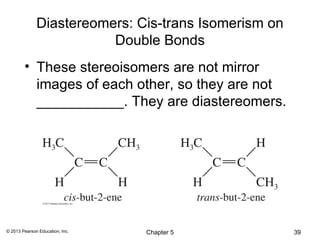
Diastereomers: Cis-trans Isomerism on
                         Double Bonds
        • These stereoisomers are not mirror
          images of each other, so they are not
          ___________. They are diastereomers.


© 2013 Pearson Education, Inc.   Chapter 5            39
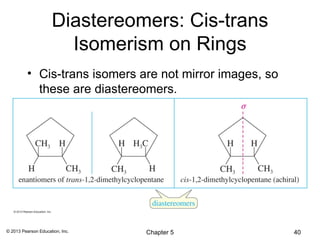
Diastereomers: Cis-trans
                       Isomerism on Rings
          • Cis-trans isomers are not mirror images, so
            these are diastereomers.


© 2013 Pearson Education, Inc.   Chapter 5                40
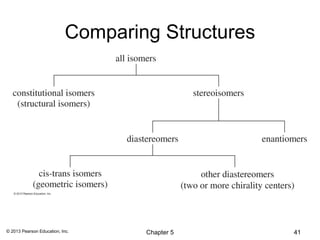
Comparing Structures


© 2013 Pearson Education, Inc.      Chapter 5      41
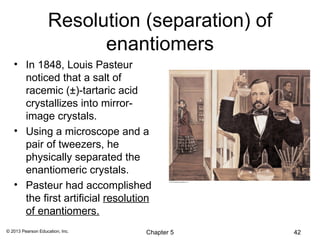
Resolution (separation) of
                         enantiomers
   • In 1848, Louis Pasteur
     noticed that a salt of
     racemic (±)-tartaric acid
     crystallizes into mirror-
     image crystals.
   • Using a microscope and a
     pair of tweezers, he
     physically separated the
     enantiomeric crystals.
   • Pasteur had accomplished
     the first artificial resolution
     of enantiomers.
© 2013 Pearson Education, Inc.    Chapter 5     42
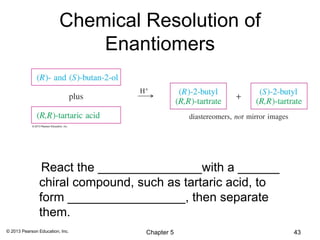
Chemical Resolution of
                             Enantiomers


                React the _______________with a ______
               chiral compound, such as tartaric acid, to
               form _________________, then separate
               them.
© 2013 Pearson Education, Inc.    Chapter 5                 43
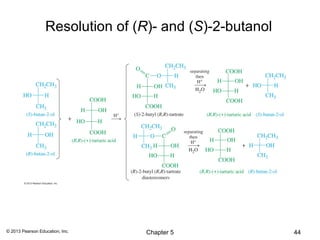
Resolution of (R)- and (S)-2-butanol


© 2013 Pearson Education, Inc.    Chapter 5              44
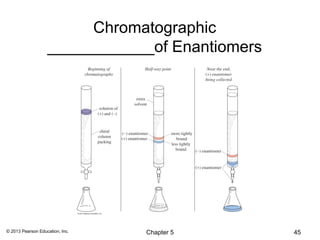
Chromatographic
                   ____________of Enantiomers


© 2013 Pearson Education, Inc.   Chapter 5      45

Ch506/25

  • 1.
    Chapter 5 Stereochemistry © 2013 Pearson Education, Inc. © 2013 Pearson Education, Inc.
  • 2.
    ISOMERS rotation about Compounds with the single bonds same molecular formula Conformations same different connectivity connectivity rotation restricted Stereoisomers Constitutional Conformational Isomers Isomers stereocenters but no chiral centers with chiral centers Atropisomers Cis,Trans m ore than (E,Z) Isomers one chiral center one chiral center (can be called achiral chiral diastereomers) mirror Enantiomers Meso not mirror images images Compounds Diastereomers Enantiomers 2 © 2013 Pearson Education, Inc.
  • 3.
    Achiral: Objects, molecules,that contain mirror elements of symmetry plane HO OH © 2013 Pearson Education, Inc. Chapter 5 3
  • 4.
    Planes of Symmetry • A molecule that has a plane of symmetry is achiral. © 2013 Pearson Education, Inc. Chapter 5 4
  • 5.
    Chirality: Handedness”: An object, molecule that lacks elements of symmetry. Right-hand glove does not fit the left hand, it is chiral, its mirror image is different from the original © 2013 Pearson Education, Inc. Chapter 5 5
  • 6.
    Enantiomers: a typeof stereoisomers Compounds that are __________________mirror images. © 2013 Pearson Education, Inc. Chapter 5 6
  • 7.
    Stereocenters: chirality centers, stereogenic atom • Chiral or asymmetric carbon bonded to ______ different groups is the most common type of a chirality center • Its mirror image will be _________compound (enantiomer). The double-bonded carbon atoms in cis-trans isomers are the most common types of stereocenters. © 2013 Pearson Education, Inc. Chapter 5 7
  • 8.
    Examples of ChiralityCenters: stereocenters © 2013 Pearson Education, Inc. Chapter 5 8
  • 9.
    Cis Cyclic Compounds • Cis-1,2-dichlorocyclohexane is _______ because the molecule _______internal plane of symmetry. Both structures above are _______________ © 2013 Pearson Education, Inc. Chapter 5 9
  • 10.
    Trans Cyclic Compounds • Trans-1,2-dichlorocyclopentane _________have a plane of symmetry so the images are ______________and the molecules above are _______________ © 2013 Pearson Education, Inc. Chapter 5 10
  • 11.
    • Only one enantiomer of alanine is biologically active (only the left enantiomer can be metabolized by the enzyme) • Need a way to distinguish between them. © 2013 Pearson Education, Inc. Chapter 5 11
  • 12.
    ( ) and( ) Absolute configuration; The Cahn– Ingold–Prelog Convention • Assign a relative “priority” to each group bonded to the asymmetric carbon according to Z I Br Cl S F O N 13 C C 12 H 2 H 1 © 2013 Pearson Education, Inc. Chapter 5 12
  • 13.
    In case ofties, use the next atoms along the chain of each group as tiebreakers. If the atoms are the same triple bonds takes priority over double and double over single © 2013 Pearson Education, Inc. Chapter 5 13
  • 14.
    • Lowest prioritygroup goes to the back. • Draw an arrow from highest to lowest priority group. • Clockwise = (R), Counterclockwise = (S) © 2013 Pearson Education, Inc. Chapter 5 14
  • 15.
    Determine absolute configuration CH2 Br HS H2CH2 C CH(CH3)2 CN C C CH2 CH3 IH2CH2 C Cl C ClH2 C CF 3 H2 NH2 C CH2 OH H © 2013 Pearson Education, Inc. Chapter 5 15
  • 16.
    Assign Absolute Configuration CH3 CH3 O O OH OH OH H H OH C C C C CH2 CH2 H H OH OH CH 3 CH3 CH3 CH3 CH3 CH3 C H H Cl l C C CH2 CH2 CH3 CH3 16 © 2013 Pearson Education, Inc.
  • 17.
    Draw the enantiomersof 1,3-dibromobutane and label them as (R) and (S). (Build the models) © 2013 Pearson Education, Inc. Chapter 5 17
  • 18.
    OH 18 © 2013 Pearson Education, Inc.
  • 19.
    Properties of Enantiomers • Same boiling point, melting point, and density, refractive index. • Rotate the plane of polarized light in the same magnitude, but in opposite directions. • Different interaction with other chiral molecules: – Active site of enzymes is selective for a specific enantiomer. – Taste buds and scent receptors are also chiral. Enantiomers may have different smells. © 2013 Pearson Education, Inc. Chapter 5 19
  • 20.
    Optical Activity: therotation of the angle of polarized light Clockwise Counterclockwise Dextorotatory (+) Levorotatory (-) Not related to (R) and (S) © 2013 Pearson Education, Inc. Chapter 5 20
  • 21.
    Specific Rotation Observed rotation depends on temperature, wavelength of light, _________________________________________ Normalize: [α] = α (observed) c•l α(observed) is the rotation observed in the polarimeter c is concentration in g/mL, l is length of sample cell in decimeters. © 2013 Pearson Education, Inc. Chapter 5 21
  • 22.
    When one ofthe enantiomers of 2-butanol is placed in a polarimeter, the observed rotation is 4.05° counterclockwise. The solution was made by diluting 6 g of 2-butanol to a total of 40 mL, and the solution was placed into a 200-mm polarimeter tube for the measurement. Determine the specific rotation for this enantiomer of 2-butanol. © 2013 Pearson Education, Inc. Chapter 5 22
  • 23.
    Biological Discrimination © 2013 Pearson Education, Inc. Chapter 5 23
  • 24.
    ____________ Mixtures • Equal quantities of + and – ; Old notation (d,l); new (±). No optical activity. • Can be formed from reactions of achiral compounds © 2013 Pearson Education, Inc. Chapter 5 24
  • 25.
    Optical Purity (o.p.)sometimes called enantiomeric excess (e.e.) observed rotation o.p. = X 100 rotation of pure enantiomer The specific rotation of (S)-2-iodobutane is +15.90°. Determine the % composition of a mixture of (R)- and (S)-2-iodobutane if the specific rotation of the mixture is -3.18°. © 2013 Pearson Education, Inc. Chapter 5 25
  • 26.
    A commercial synthesisof naproxen, a nonsteroidal anti-inflammatory drug (NSAID), gives the S enantiomer in 97% ee Calculate the percentages of the R and S enantiomers in this mixture. CH3 COOH H3 CO (S)-Naproxen 26 © 2013 Pearson Education, Inc.
  • 27.
    Chiral compounds thatdo not posses a chiral carbon A) Atropisomers • The planar conformation of the biphenyl derivative is too sterically crowded. The compound has no rotation around the central C—C bond and thus it is conformationally locked. • The staggered conformations are ____________: They are non-superimposable mirror images. © 2013 Pearson Education, Inc. Chapter 5 27
  • 28.
    B) Allenes: Someallenes are chiral even though they do not have a chiral carbon Build the model © 2013 Pearson Education, Inc. Chapter 5 28
  • 29.
    Fischer Projections: Flatrepresentation of a 3-D molecule A _________________is at the intersection of horizontal and vertical lines. _____________ lines are forward, towards you. ___________ lines are behind the plane. Away from you © 2013 Pearson Education, Inc. Chapter 5 29
  • 30.
    Stereoisomers or same compounds? CH3 CH2CH3 H H Cl CH3 CH2CH3 Cl CH2CH3 H CH2CH3 CH3 Cl CH3 Cl CH3 H Cl Cl H H CH2CH3 CH3 CH2CH3 30 © 2013 Pearson Education, Inc.
  • 31.
    Stereoisomers = 2nmaximum 3-chloro-2-butanol: Identify enantiomers and diasteromers 31 © 2013 Pearson Education, Inc.
  • 32.
    2,3-dihydroxybutandioic (tartaric acid). The 2n rule will not apply to compounds that have a plane of symmetry: a meso compound Assign absolute configuration to each stereocenter 32 © 2013 Pearson Education, Inc.
  • 33.
    Meso Compounds areachiral even though they have chiral centers because they have _____________________ © 2013 Pearson Education, Inc. Chapter 5 33
  • 34.
    If equilibrium existsbetween two chiral conformers, the molecule is not chiral. Judge chirality by looking at the most symmetrical conformer. Cyclohexane can be considered to be planar, on average. The two chair conformations of cis-1,2-dibromocyclohexane are _____________________, but the interconversion is fast and the molecules are in equilibrium. Any sample would be ________________ and, as such, ___________________. © 2013 Pearson Education, Inc. Chapter 5 34
  • 35.
    Cyclic molecules • 2-methylcyclopentanol (4) • 1,3-cyclopentanediol (3, cis is meso) 35 © 2013 Pearson Education, Inc.
  • 36.
    Disubstituted derivatives ofcycloehexane Methylcyclohexanols (2 Methylcyclohexanol = 4) 4-methylcyclohexanol (2) 3-methyl cyclohexanol (4) 36 © 2013 Pearson Education, Inc.
  • 37.
    Disubstituted derivatives ofcycloehexane Cyclohexanediol cis-1,2 rapid interconversion = meso 1,3-cyclohexanediol (3) 37 © 2013 Pearson Education, Inc.
  • 38.
    Physical properties Enantiomers have identical physical and chemical properties in achiral environments (except one) • Diastereomers are different compounds and have different physical and chemical properties. COOH COOH COOH H C OH HO C H H C OH HO C H H C OH H C OH COOH COOH COOH (R,R)-Tartaric acid (S,S)-Tartaric acid Meso tartaric acid specific rotation +12.7 -12.7 0 melting point (¡ C) 171-174 171-174 146-148 density at 20¡C (g/cm 3 ) 1.7598 1.7598 1.660 solubility in water at 20¡C (g/100 mL) 139 139 125 pK1 (25¡ C) 2.98 2.98 3.23 pK2 (25¡C) 4.34 4.34 4.82 38 © 2013 Pearson Education, Inc.
  • 39.
    Diastereomers: Cis-trans Isomerismon Double Bonds • These stereoisomers are not mirror images of each other, so they are not ___________. They are diastereomers. © 2013 Pearson Education, Inc. Chapter 5 39
  • 40.
    Diastereomers: Cis-trans Isomerism on Rings • Cis-trans isomers are not mirror images, so these are diastereomers. © 2013 Pearson Education, Inc. Chapter 5 40
  • 41.
    Comparing Structures © 2013Pearson Education, Inc. Chapter 5 41
  • 42.
    Resolution (separation) of enantiomers • In 1848, Louis Pasteur noticed that a salt of racemic (±)-tartaric acid crystallizes into mirror- image crystals. • Using a microscope and a pair of tweezers, he physically separated the enantiomeric crystals. • Pasteur had accomplished the first artificial resolution of enantiomers. © 2013 Pearson Education, Inc. Chapter 5 42
  • 43.
    Chemical Resolution of Enantiomers React the _______________with a ______ chiral compound, such as tartaric acid, to form _________________, then separate them. © 2013 Pearson Education, Inc. Chapter 5 43
  • 44.
    Resolution of (R)-and (S)-2-butanol © 2013 Pearson Education, Inc. Chapter 5 44
  • 45.
    Chromatographic ____________of Enantiomers © 2013 Pearson Education, Inc. Chapter 5 45

Editor's Notes

  • #18 Copyright © 2006 Pearson Prentice Hall, Inc.
  • #23 Copyright © 2006 Pearson Prentice Hall, Inc.