Downloaded 2,478 times




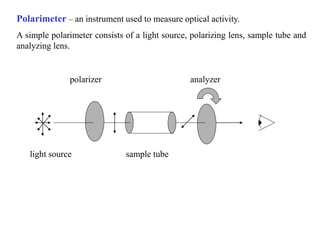
![SPECIFIC ROTATION:
The angle of rotation of plane polarized light by a 1.00 gram per cm-3
sample in a 1 dm tube.
[α ]D (D = sodium lamp, λ = 589 mμ).
α
[ α ]D =
l × d
where α = observed rotation
l = length (dm)
d = concentration (g/cc)
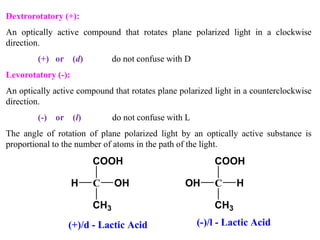
(+)-alanine [ α ]D = +8.5
(-)-lactic acid [α ]D = -3.8
Specific Rotation depends on the nature of substance, wavelength of light used, concentration
of the solution, thickness of the layer, nature of the solvent and temperature at which
experiment is conducted.](https://image.slidesharecdn.com/stereochemistry-151008164425-lva1-app6892/85/Stereochemistry-Organic-Chemistry-17-320.jpg)
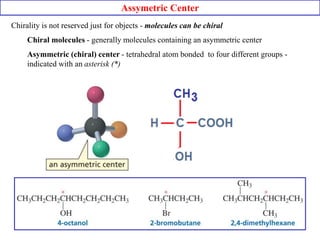

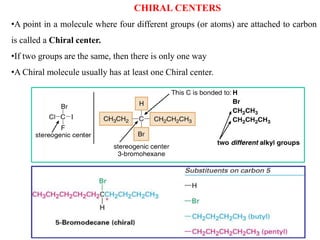
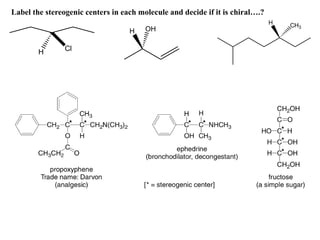
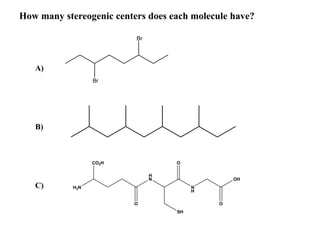

![The arrangement of atoms that characterizes a particular stereoisomer is called
its Configuration.
The following methods are used to assign configuration.
A. Absolute configuration [R and S system]
B. Relative configuration [D and L system]
CONFIGURATION](https://image.slidesharecdn.com/stereochemistry-151008164425-lva1-app6892/85/Stereochemistry-Organic-Chemistry-24-320.jpg)


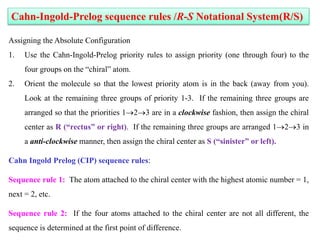

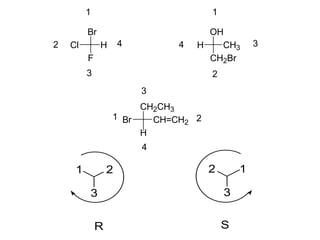
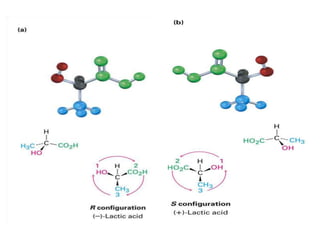

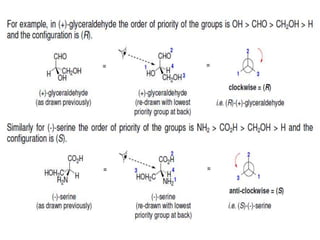
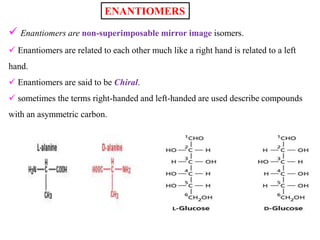

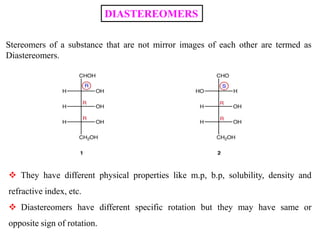

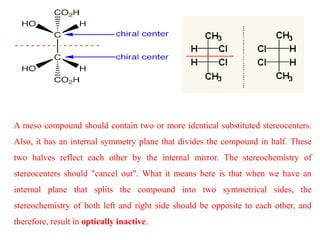
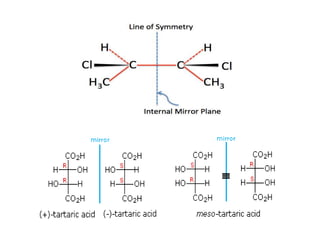
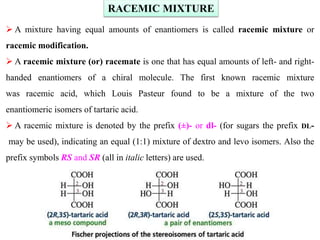
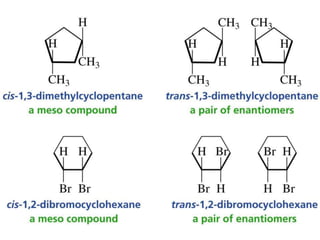


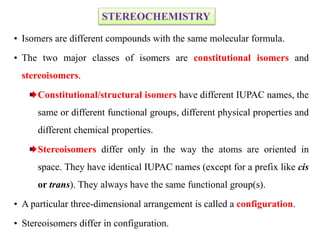
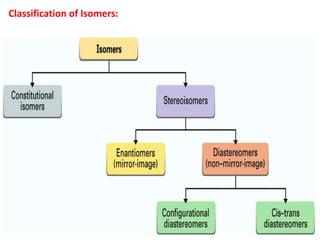
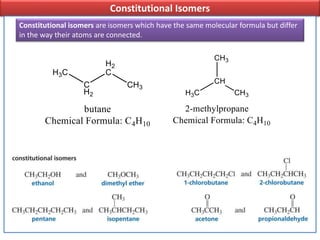
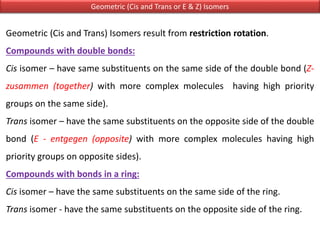
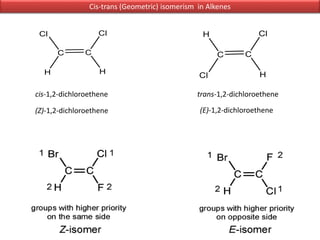
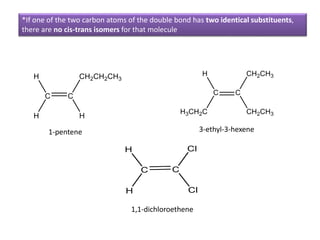
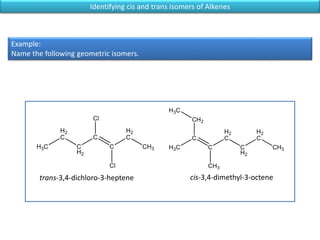
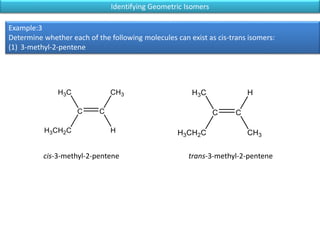
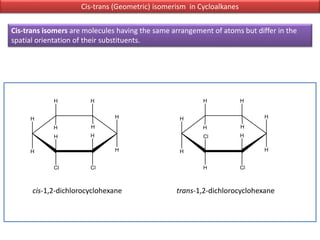
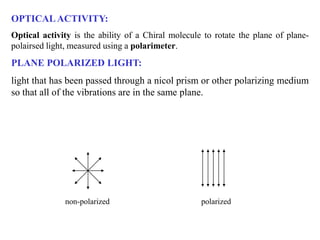
The document discusses different types of isomers including constitutional isomers, stereoisomers, geometric isomers (cis and trans), optical isomers (enantiomers), and diastereomers. It provides examples and definitions for each type of isomerism. Key points covered include how cis and trans isomers differ based on the orientation of groups around a double bond, how enantiomers are non-superimposable mirror images that have different effects in living systems, and methods for assigning absolute configuration using Cahn-Ingold-Prelog rules.


![Cycloaddition reactions [2+2]](https://cdn.slidesharecdn.com/ss_thumbnails/cycloadditionreactions22-200514145354-thumbnail.jpg?width=640&height=640&fit=bounds)


