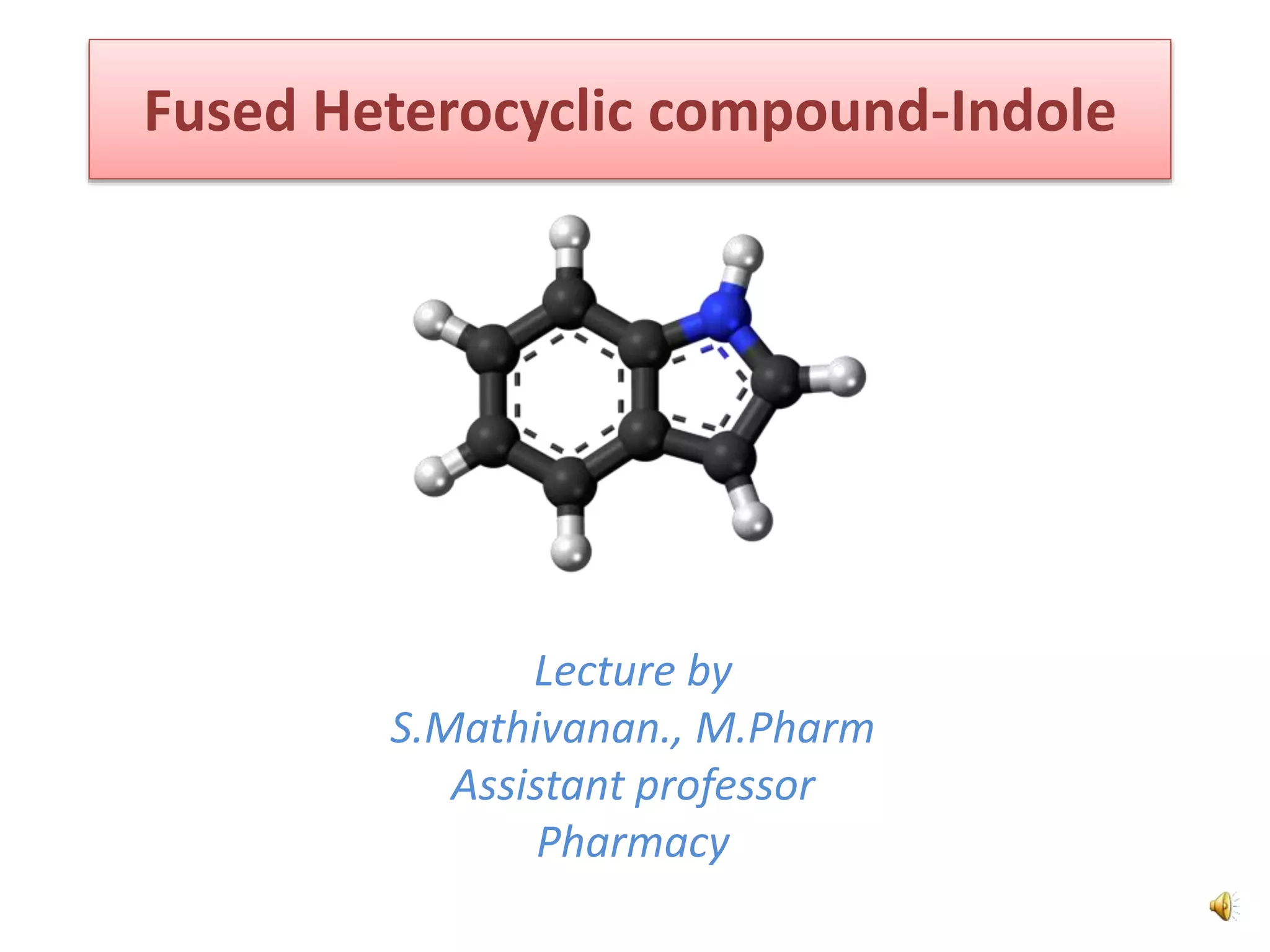
Fused Heterocyclic compound-Indole
Lecture by
S.Mathivanan., M.Pharm
Assistant professor
Pharmacy
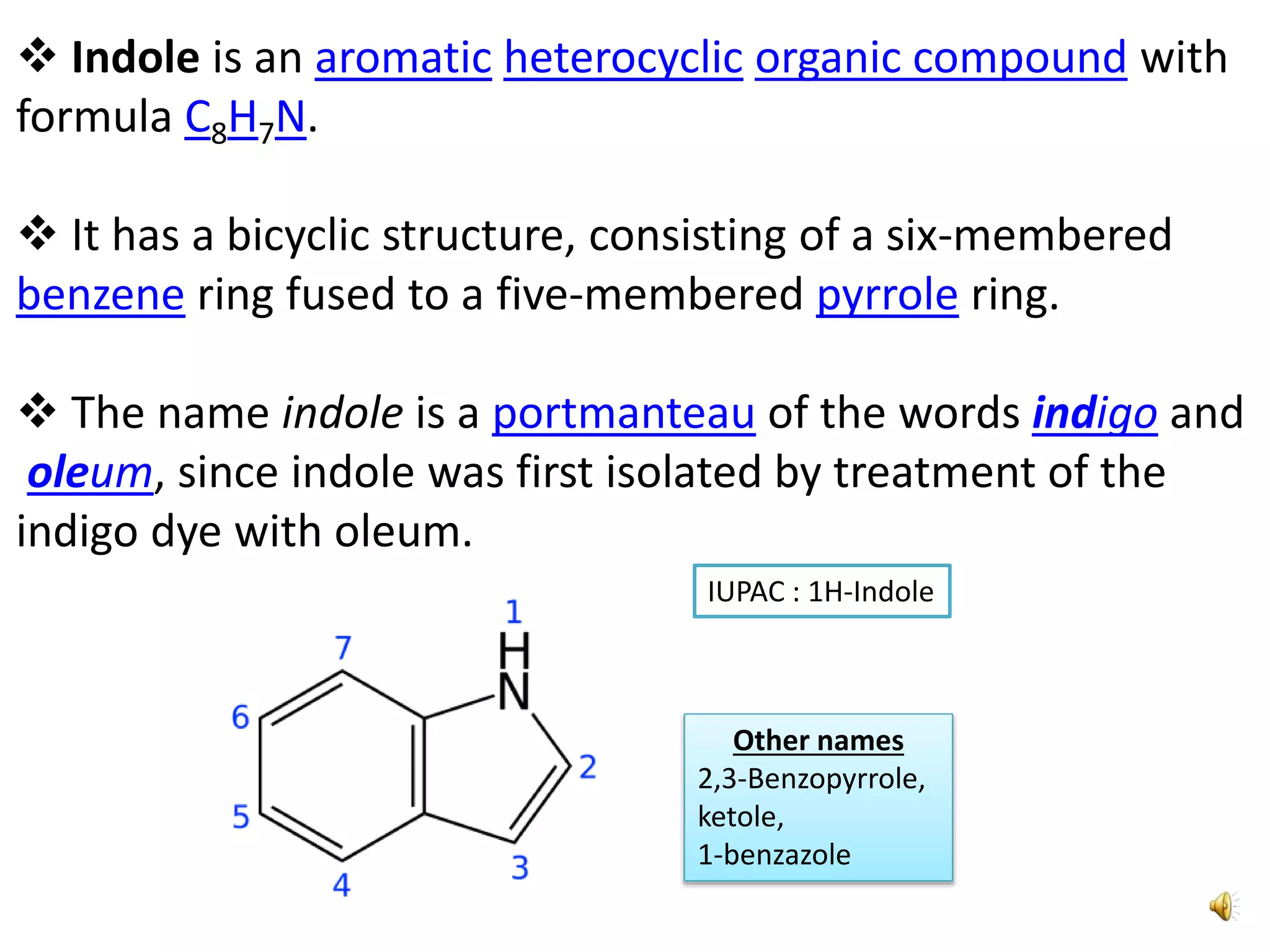
 Indole is an aromatic heterocyclic organic compound with
formula C8H7N.
 It has a bicyclic structure, consisting of a six-membered
benzene ring fused to a five-membered pyrrole ring.
 The name indole is a portmanteau of the words indigo and
oleum, since indole was first isolated by treatment of the
indigo dye with oleum.
Other names
2,3-Benzopyrrole,
ketole,
1-benzazole
IUPAC : 1H-Indole
The amino acid tryptophan is an indole derivative and the
precursor of the neurotransmitter serotonin.
Tryptophan
Seratonin
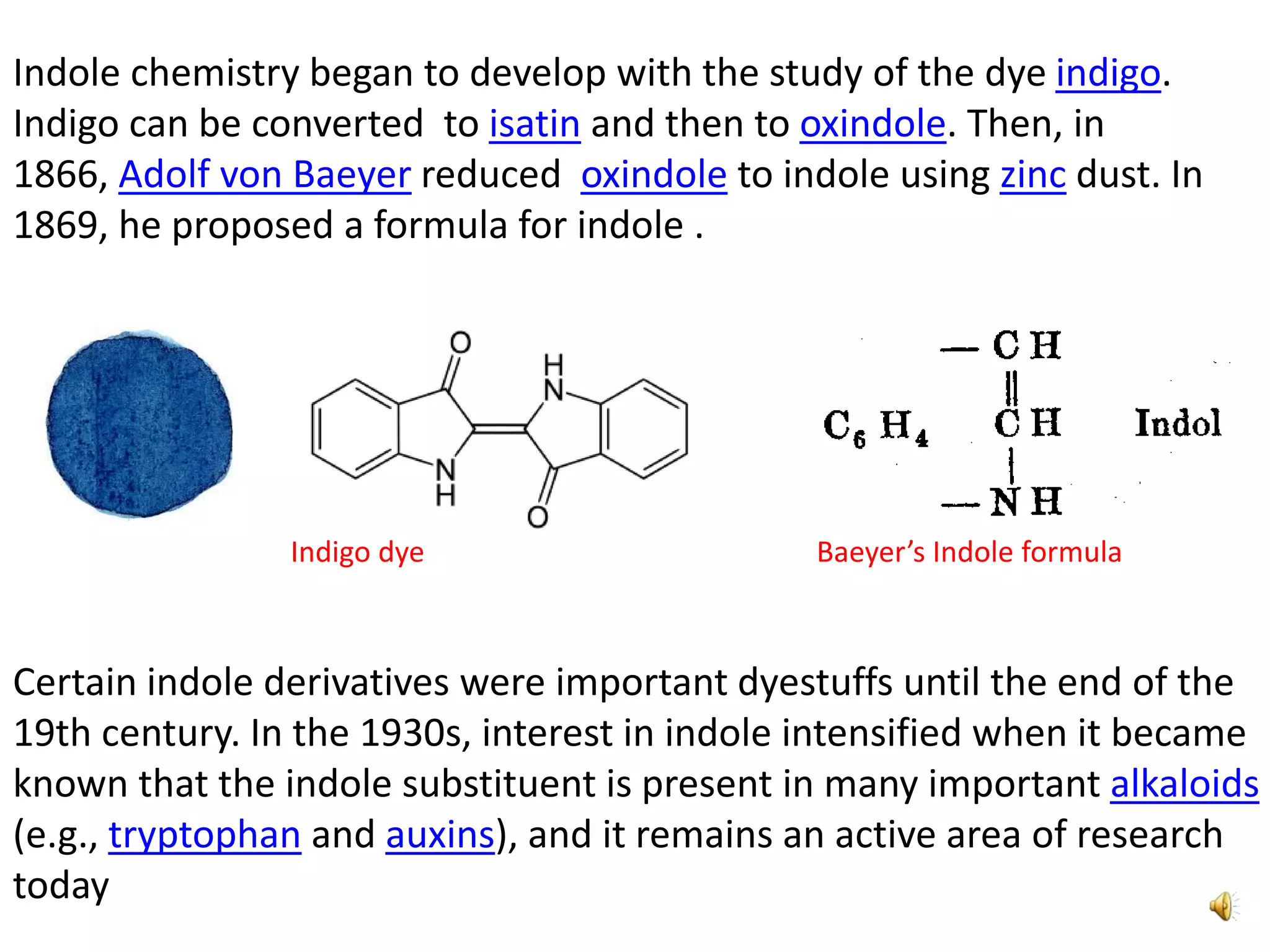
Indole chemistry began to develop with the study of the dye indigo.
Indigo can be converted to isatin and then to oxindole. Then, in
1866, Adolf von Baeyer reduced oxindole to indole using zinc dust. In
1869, he proposed a formula for indole .
Certain indole derivatives were important dyestuffs until the end of the
19th century. In the 1930s, interest in indole intensified when it became
known that the indole substituent is present in many important alkaloids
(e.g., tryptophan and auxins), and it remains an active area of research
today
Indigo dye Baeyer’s Indole formula
Physical properties
• Indole is a solid at room temperature.
• It occurs naturally in human feces and has an intense
fecal odor.
• At very low concentrations, however, it has a flowery
smell, and is a constituent of many perfumes.
• It also occurs in coal tar.
• The corresponding substituent is called indolyl.
• Density : 1.1747 g/cm3
• Melting point : 52 to 54 °C
• Boiling point253 to 254 °C
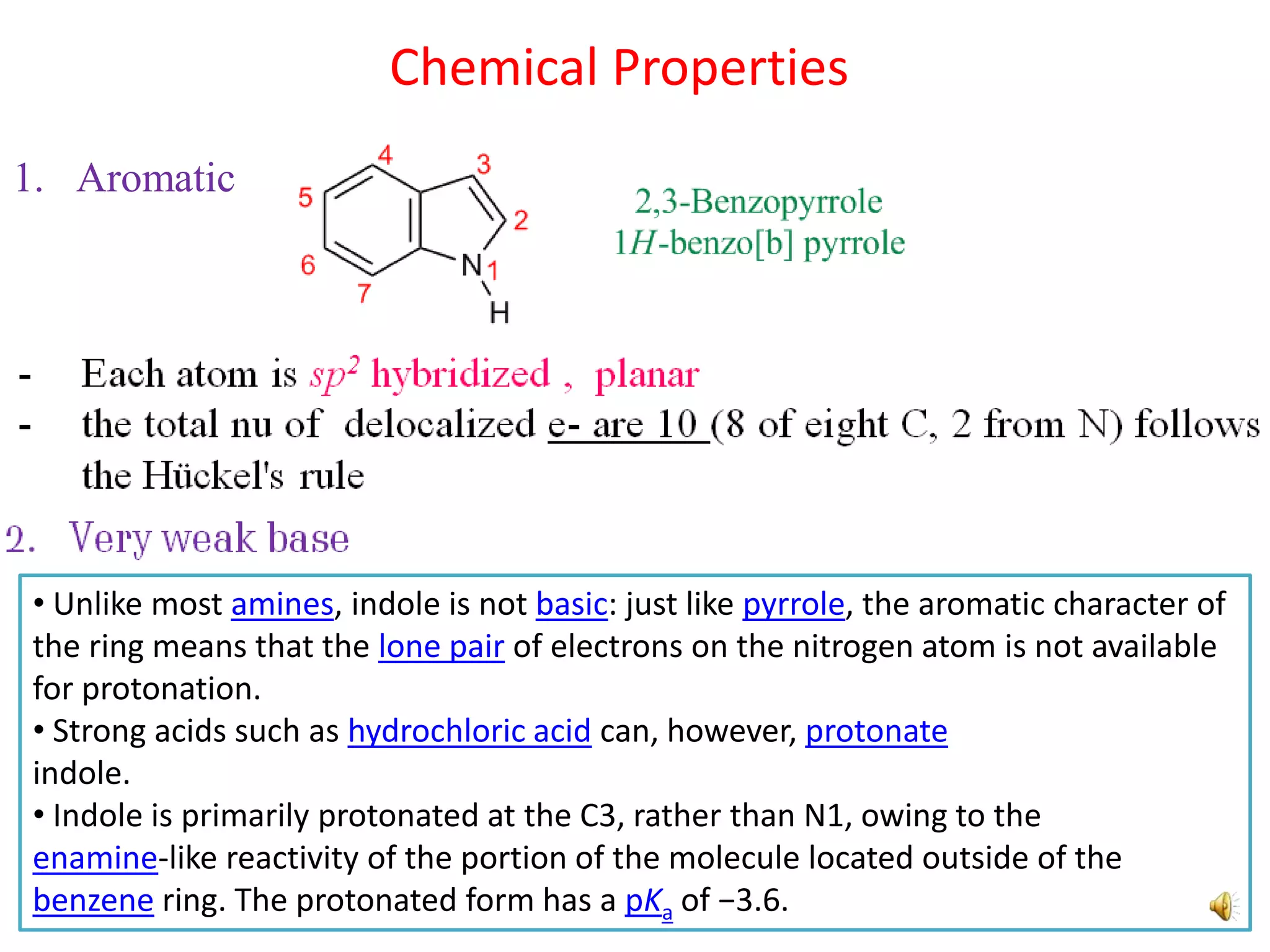
1. Aromatic
Chemical Properties
• Unlike most amines, indole is not basic: just like pyrrole, the aromatic character of
the ring means that the lone pair of electrons on the nitrogen atom is not available
for protonation.
• Strong acids such as hydrochloric acid can, however, protonate
indole.
• Indole is primarily protonated at the C3, rather than N1, owing to the
enamine-like reactivity of the portion of the molecule located outside of the
benzene ring. The protonated form has a pKa of −3.6.
Synthesis
1. Fischer indole synthesis
Synthesis
1. Fischer indole synthesis
Mechanism
Synthesis
1. Fischer indole synthesis
Mechanism
Synthesis
1. Fischer indole synthesis
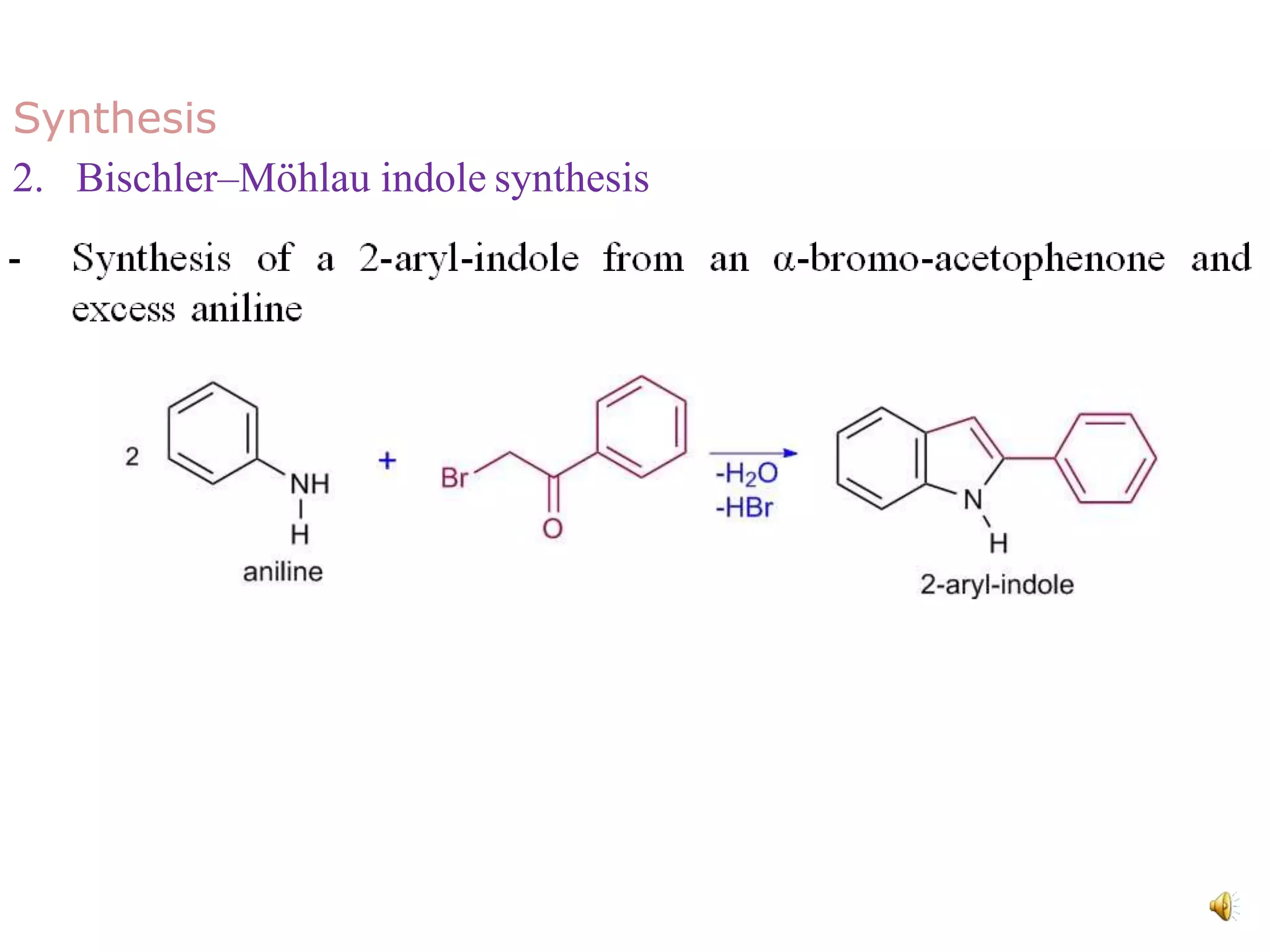
Synthesis
2. Bischler–Möhlau indole synthesis
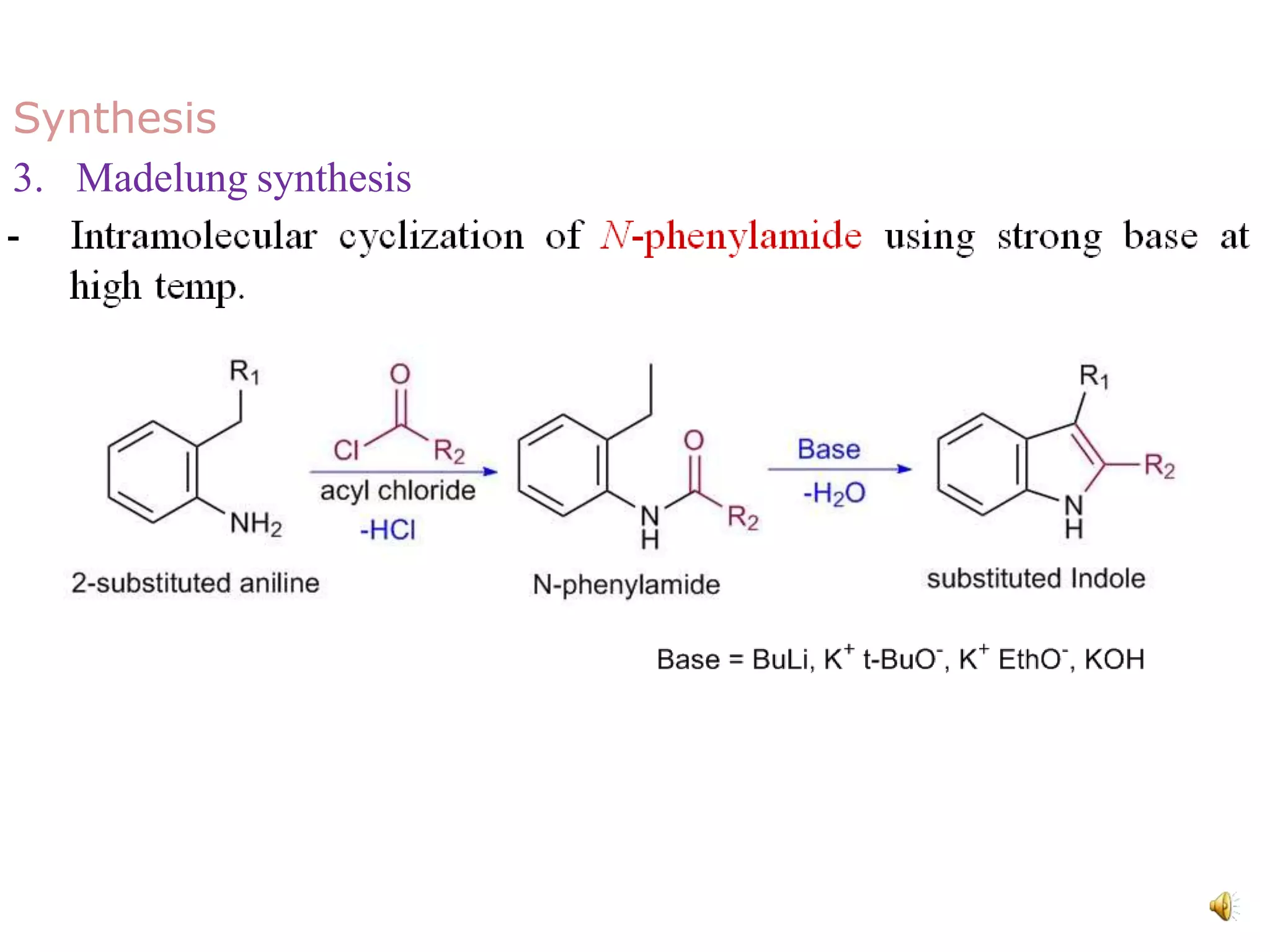
Synthesis
3. Madelung synthesis
Synthesis
3. Madelung synthesis
E.g.
Reactions
1. Electrophilic addition to N
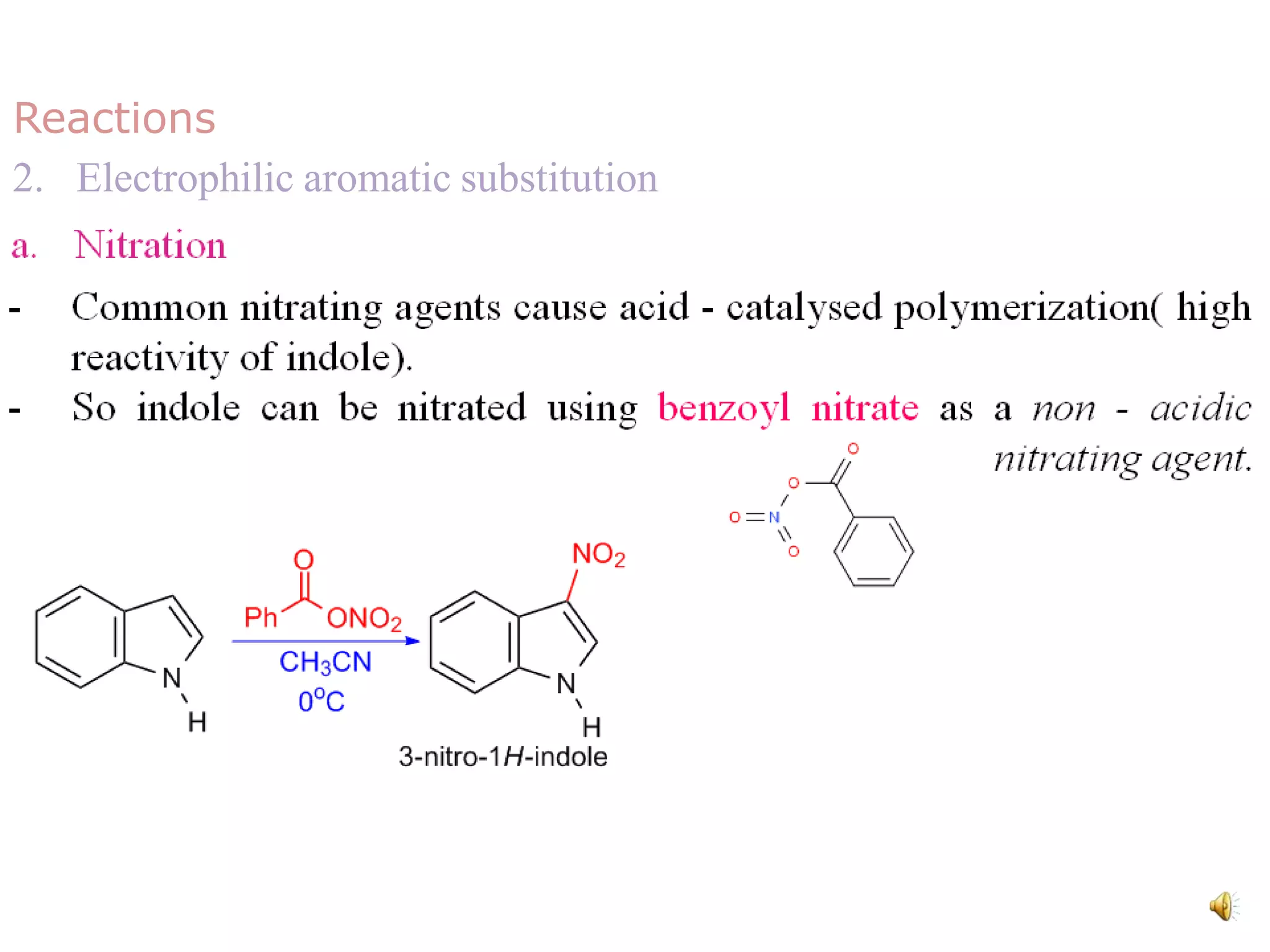
Reactions
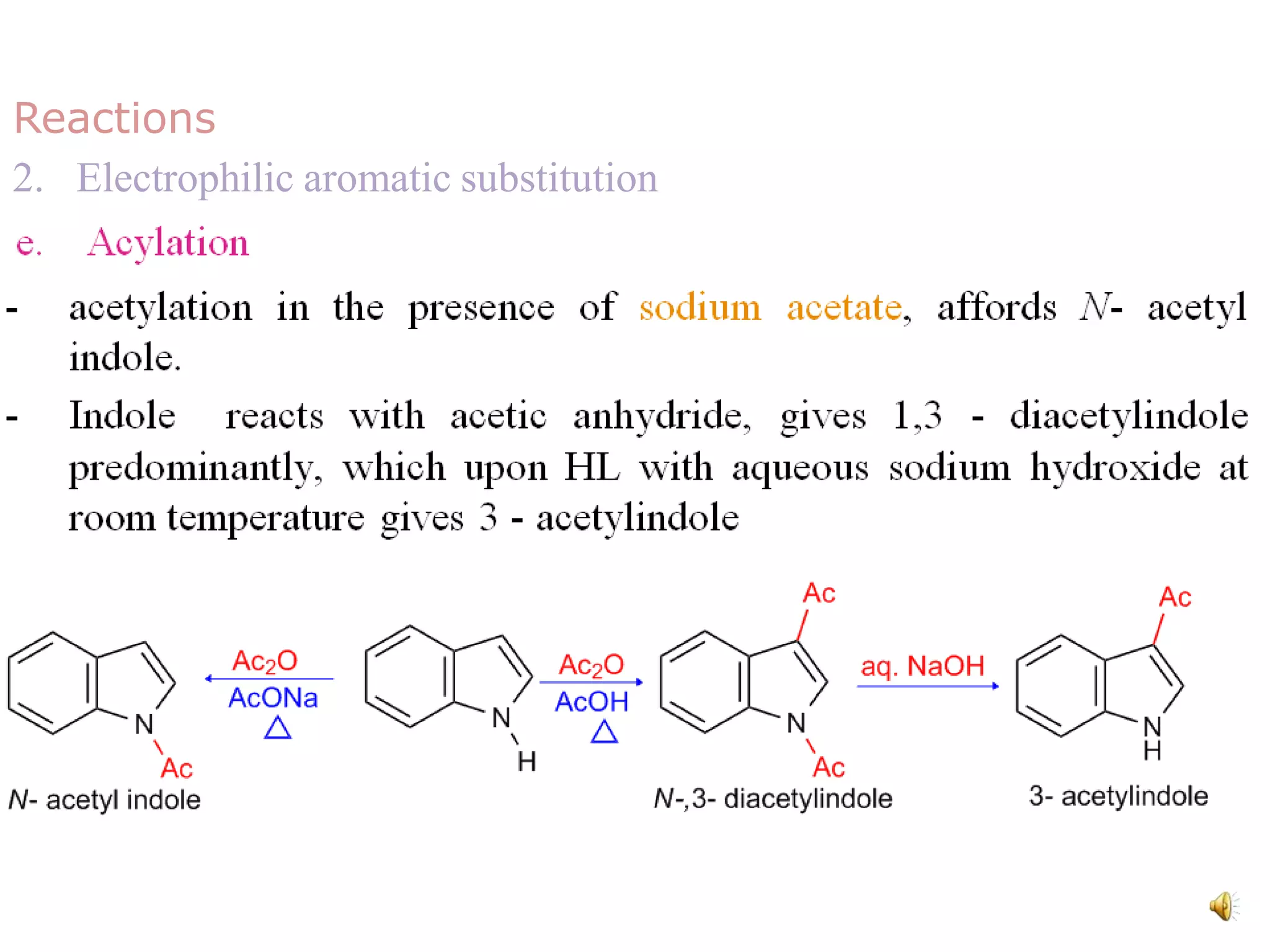
2. Electrophilic aromatic substitution
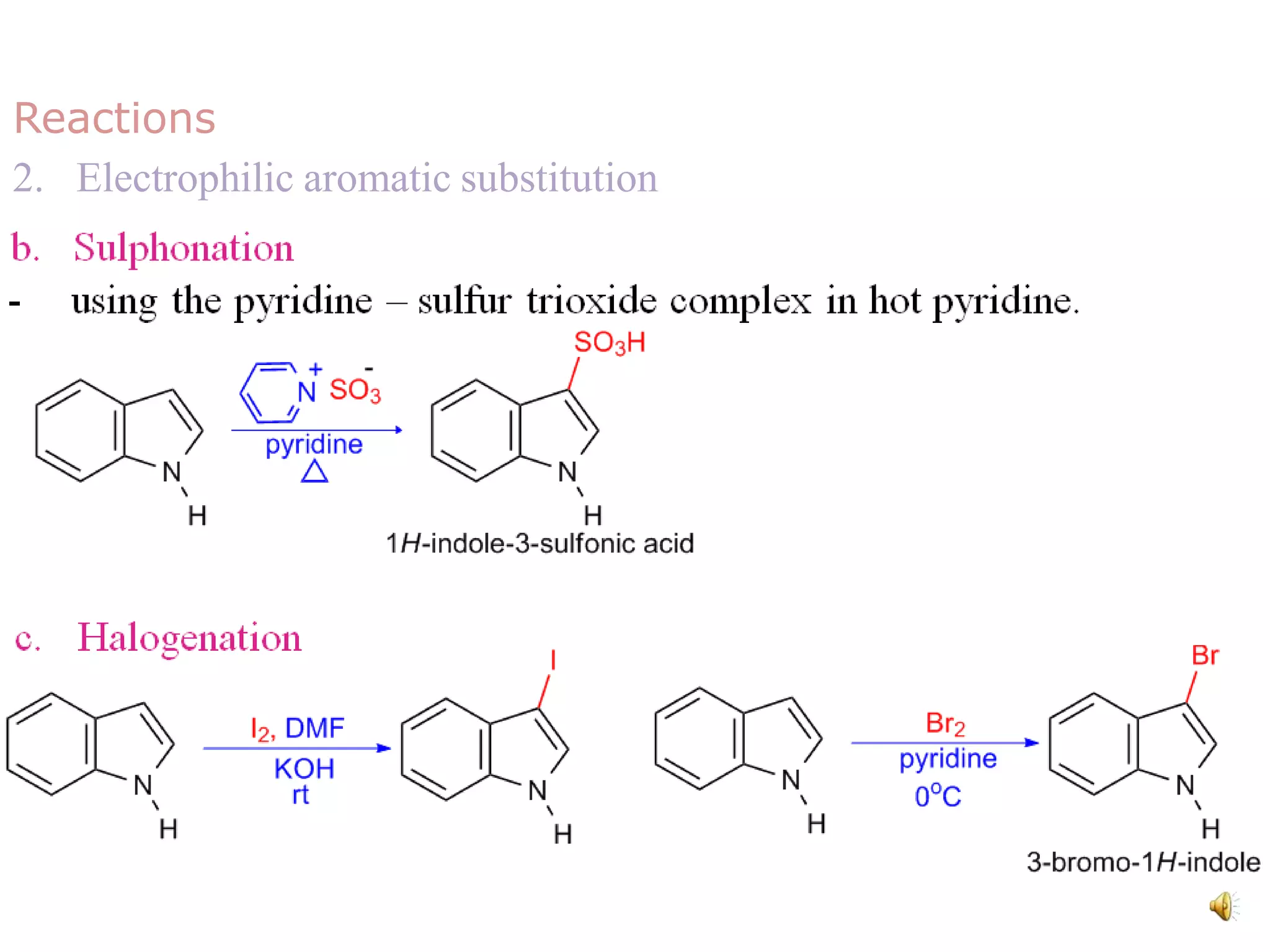
Reactions
2. Electrophilic aromatic substitution
Reactions
2. Electrophilic aromatic substitution
Reactions
2. Electrophilic aromatic substitution
Reactions
2. Electrophilic aromatic substitution
Reactions
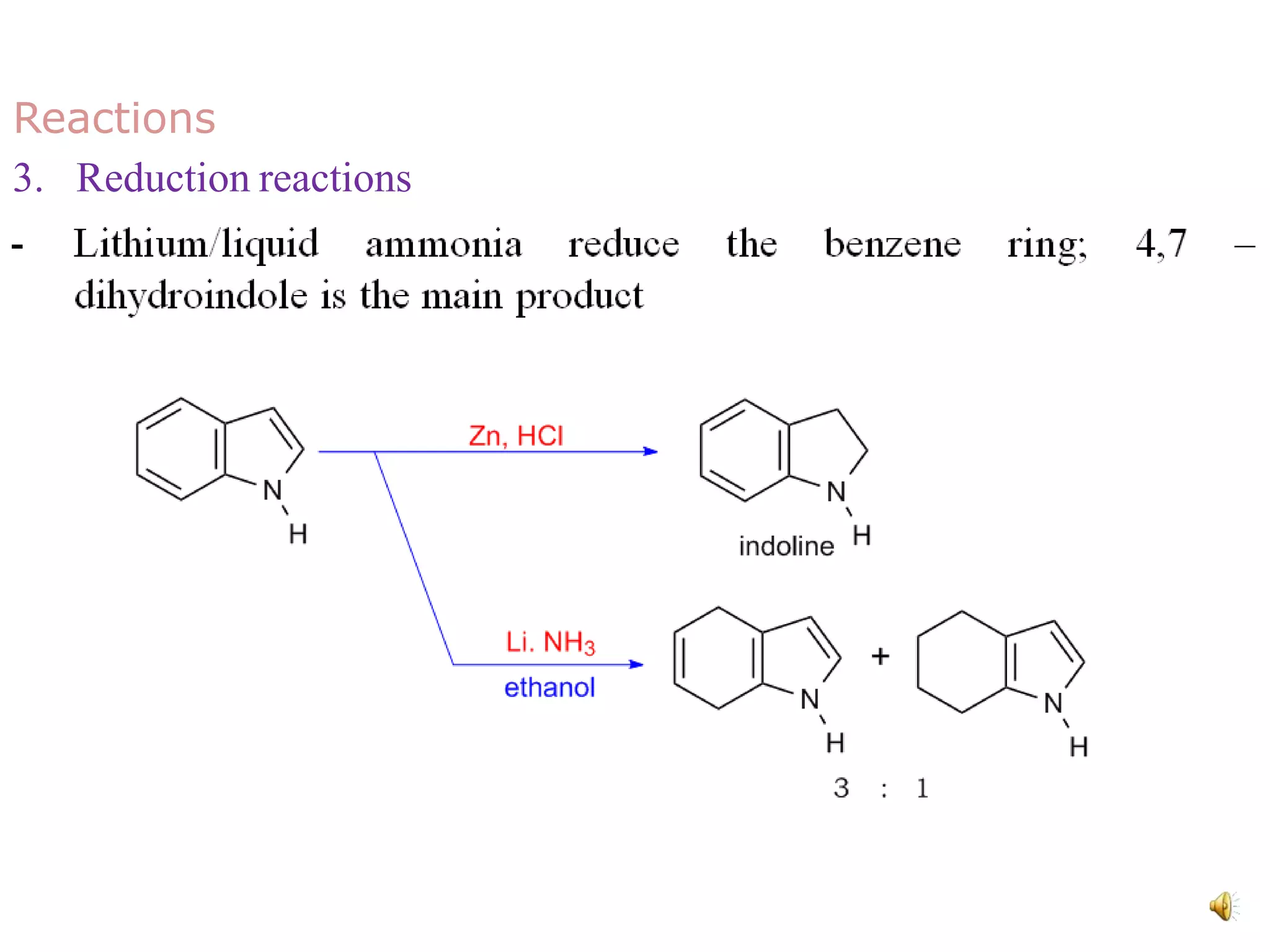
3. Reduction reactions
Reactions
4. Nucleophilic substitution
Medicinal uses
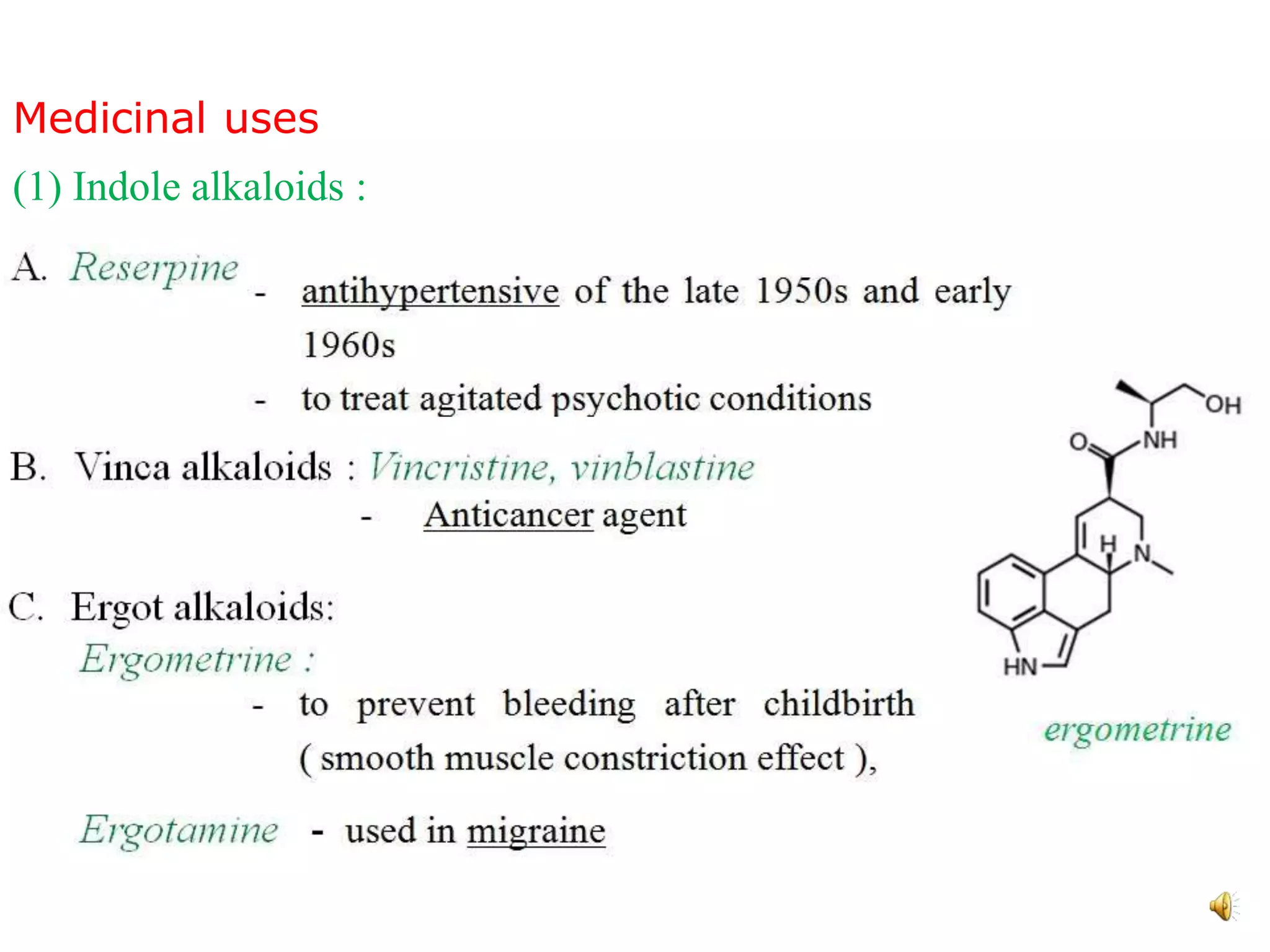
(1) Indole alkaloids :
Medicinal uses
Medicinal uses
Thank you..!!!
STAY HOME...!!!
STAY SAFE...!!!

Fused heterocyclic compound indole