OOPPTTIICCAALL 
IISSOOMMEERRIISSMM 
AA gguuiiddee ffoorr AA lleevveell ssttuuddeennttss 
KKNNOOCCKKHHAARRDDYY PPUUBBLLIISSHHIINNGG
TTYYPPEESS OOFF IISSOOMMEERRIISSMM 
CHAIN ISOMERISM 
Occurs due to the restricted 
rotation of C=C double bonds... 
two forms - CIS and TRANS 
STRUCTURAL ISOMERISM 
STEREOISOMERISM 
E/Z ISOMERISM 
OPTICAL ISOMERISM 
Same molecular formula but 
different structural formulae 
Occurs when molecules have a 
chiral centre. Get two non-superimposable 
mirror images. 
Same molecular 
formula but atoms 
occupy different 
positions in space. 
POSITION ISOMERISM 
FUNCTIONAL GROUP 
ISOMERISM
OOPPTTIICCAALL IISSOOMMEERRIISSMM 
Occurrence another form of stereoisomerism 
occurs when compounds have non-superimposable mirror images 
Isomers the two different forms are known as optical isomers or enantiomers 
they occur when molecules have a chiral centre 
a chiral centre contains an asymmetric carbon atom 
an asymmetric carbon has four different atoms (or groups) 
arranged tetrahedrally around it.
OOPPTTIICCAALL IISSOOMMEERRIISSMM 
Occurrence another form of stereoisomerism 
occurs when compounds have non-superimposable mirror images 
Isomers the two different forms are known as optical isomers or enantiomers 
they occur when molecules have a chiral centre 
a chiral centre contains an asymmetric carbon atom 
an asymmetric carbon has four different atoms (or groups) 
arranged tetrahedrally around it. 
CHIRAL CENTRES 
There are four different colours 
arranged tetrahedrally about 
the carbon atom 
2-chlorobutane exhibits optical isomerism 
because the second carbon atom has four 
different atoms/groups attached
OOPPTTIICCAALL IISSOOMMEERRIISSMM 
SPOTTING CHIRAL CENTRES 
Look at each carbon atom in the chain and see what is attached to it. For a chiral centre 
you need an asymmetric carbon with four different atoms/groups) arranged tetrahedrally around it. 
IF A CARBON HAS MORE THAN ONE OF ANY ATOM/GROUP ATTACHED, IT CAN’T BE CHIRAL 
CH3CH2CH2CH2Cl C 3 H’s around it NOT chiral 
C 2 H’s around it NOT chiral 
1-chlorobutane 
OOPPTTIICCAALL IISSOOMMEERRIISSMM 
SPOTTING CHIRAL CENTRES 
Look at each carbon atom in the chain and see what is attached to it. For a chiral centre 
you need an asymmetric carbon with four different atoms/groups) arranged tetrahedrally around it. 
IF A CARBON HAS MORE THAN ONE OF ANY ATOM/GROUP ATTACHED, IT CAN’T BE CHIRAL 
CH3CH2CH2CH2Cl C 3 H’s around it NOT chiral 
CH3CH2CHClCH3 
C 2 H’s around it NOT chiral 
C 3 H’s around it NOT chiral 
C 2 H’s around it NOT chiral 
C H, CH3, Cl,C2H5 around it CHIRAL 
C 3 H’s around it NOT chiral 
1-chlorobutane 
 
2-chlorobutane 
OOPPTTIICCAALL IISSOOMMEERRIISSMM 
SPOTTING CHIRAL CENTRES 
Look at each carbon atom in the chain and see what is attached to it. For a chiral centre 
you need an asymmetric carbon with four different atoms/groups) arranged tetrahedrally around it. 
IF A CARBON HAS MORE THAN ONE OF ANY ATOM/GROUP ATTACHED, IT CAN’T BE CHIRAL 
CH3CH2CH2CH2Cl C 3 H’s around it NOT chiral 
CH3CH2CHClCH3 
C 2 H’s around it NOT chiral 
C 3 H’s around it NOT chiral 
C 2 H’s around it NOT chiral 
C H, CH3, Cl,C2H5 around it CHIRAL 
C 3 H’s around it NOT chiral 
(CH3)2CHCH2Cl C 3 H’s around it NOT chiral 
(CH3)3CCl C 3 H’s around it NOT chiral 
C 3 CH3’s around it NOT chiral 
1-chlorobutane 
2-chlorobutane 
2-chloro-2-methylpropanane 
C 2 CH3’s around it NOT chiral 
1-chloro-2-methylpropanane C 2 H’s around it NOT chiral 
 
 
 

OOPPTTIICCAALL IISSOOMMEERRIISSMM 
Spatial differences between isomers 
• two forms exist which are NON-SUPERIMPOSABLE MIRROR IMAGES of each other 
• non-superimposable means you you can’t stack one form exactly on top of the other
OOPPTTIICCAALL IISSOOMMEERRIISSMM 
Spatial differences between isomers 
• two forms exist which are NON-SUPERIMPOSABLE MIRROR IMAGES of each other 
• non-superimposable means you you can’t stack one form exactly on top of the other 
Some common objects are mirror images and superimposable spoons 
superimposable but not mirror images books 
non-superimposable mirror images hands
OOPPTTIICCAALL IISSOOMMEERRIISSMM 
Spatial differences between isomers 
• two forms exist which are NON-SUPERIMPOSABLE MIRROR IMAGES of each other 
• non-superimposable means you you can’t stack one form exactly on top of the other 
Some common objects are mirror images and superimposable spoons 
superimposable but not mirror images books 
non-superimposable mirror images hands 
NB For optical isomerism in molecules, both conditions must apply... 
they must be mirror images AND be non-superimposable
OOPPTTIICCAALL IISSOOMMEERRIISSMM 
What is a non-superimposable mirror image? 
Animation doesn’t 
work in old 
versions of 
Powerpoint
OOPPTTIICCAALL IISSOOMMEERRSS -- DDIIFFFFEERREENNCCEE 
• isomers differ in their reaction to plane-polarised light 
• plane polarised light vibrates in one direction only 
• one isomer rotates light to the right, the other to the left 
• rotation of light is measured using a polarimeter 
• rotation is measured by observing the polarised light coming out towards the observer
OOPPTTIICCAALL IISSOOMMEERRSS -- DDIIFFFFEERREENNCCEE 
• isomers differ in their reaction to plane-polarised light 
• plane polarised light vibrates in one direction only 
• one isomer rotates light to the right, the other to the left 
• rotation of light is measured using a polarimeter 
• rotation is measured by observing the polarised light coming out towards the observer 
• If the light appears to have turned to the right turned to the left 
DEXTROROTATORY LAEVOROTATORY 
d or + form l or - form
OOPPTTIICCAALL IISSOOMMEERRSS -- DDIIFFFFEERREENNCCEE 
• isomers differ in their reaction to plane-polarised light 
• plane polarised light vibrates in one direction only 
• one isomer rotates light to the right, the other to the left 
• rotation of light is measured using a polarimeter 
• rotation is measured by observing the polarised light coming out towards the observer 
• If the light appears to have turned to the right turned to the left 
DEXTROROTATORY LAEVOROTATORY 
d or + form l or - form 
Racemate a 50-50 mixture of the two enantiomers (dl) or (±) is a racemic mixture. 
The opposite optical effects of each isomer cancel each other out 
Examples Optical activity is common in biochemistry and pharmaceuticals 
• Most amino acids exhibit optical activity 
• many drugs must be made of one optical isomer to be effective 
- need smaller doses (safer and cost effective) 
- get reduced side effects 
- improved pharmacological activity
OOPPTTIICCAALL IISSOOMMEERRIISSMM 
The polarimeter 
A Light source produces light vibrating in all directions 
B Polarising filter only allows through light vibrating in one direction 
C Plane polarised light passes through sample 
D If substance is optically active it rotates the plane polarised light 
E Analysing filter is turned so that light reaches a maximum 
F Direction of rotation is measured coming towards the observer 
If the light appears to have turned to the right turned to the left 
DEXTROROTATORY LAEVOROTATORY 
A B 
C D 
E 
F
OOPPTTIICCAALL IISSOOMMEERRIISSMM 
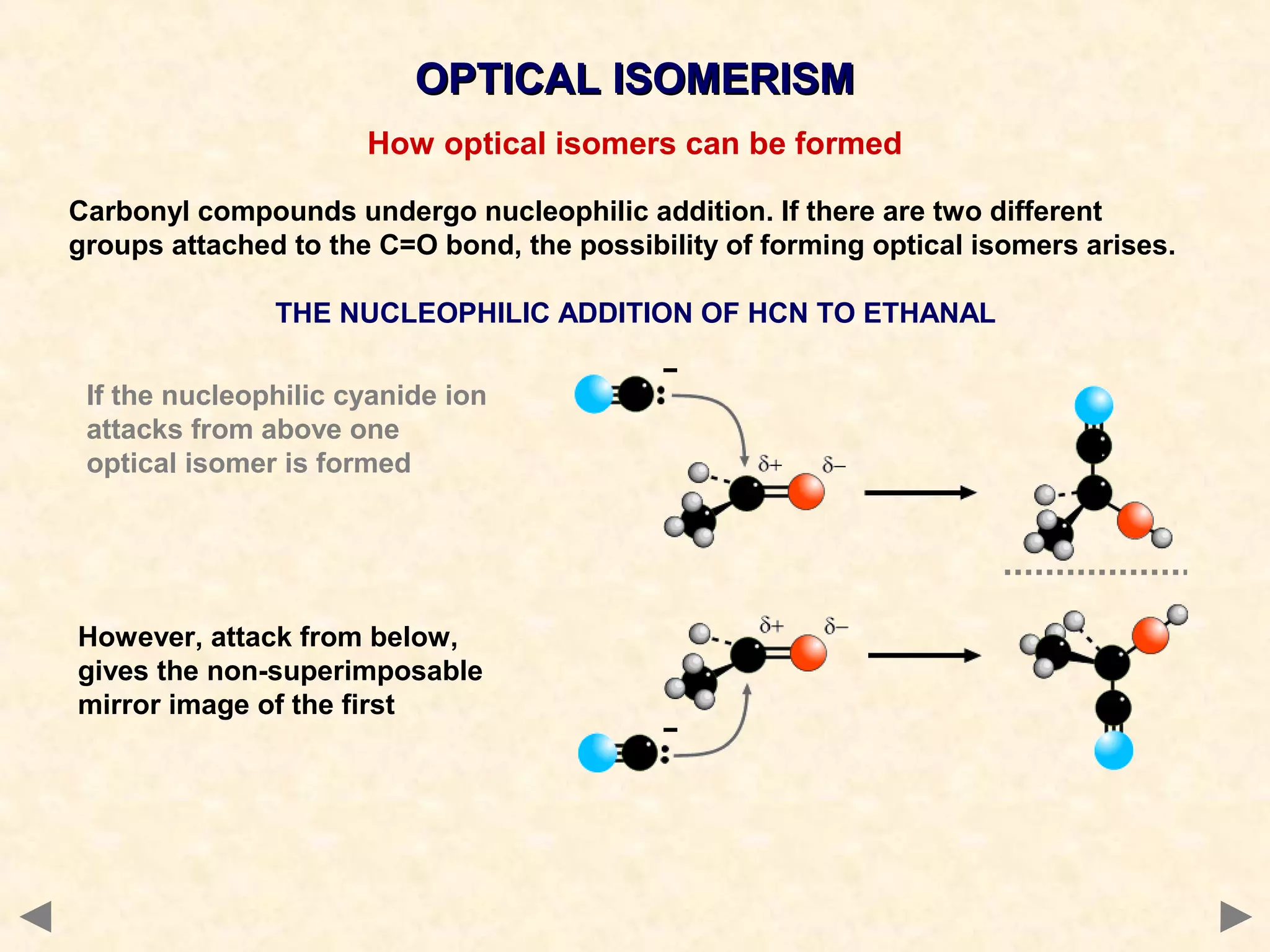
How optical isomers can be formed 
Carbonyl compounds undergo nucleophilic addition. If there are two different 
groups attached to the C=O bond, the possibility of forming optical isomers arises. 
THE NUCLEOPHILIC ADDITION OF HCN TO ETHANAL 
If the nucleophilic cyanide ion 
attacks from above one 
optical isomer is formed
OOPPTTIICCAALL IISSOOMMEERRIISSMM 
How optical isomers can be formed 
Carbonyl compounds undergo nucleophilic addition. If there are two different 
groups attached to the C=O bond, the possibility of forming optical isomers arises. 
THE NUCLEOPHILIC ADDITION OF HCN TO ETHANAL 
If the nucleophilic cyanide ion 
attacks from above one 
optical isomer is formed 
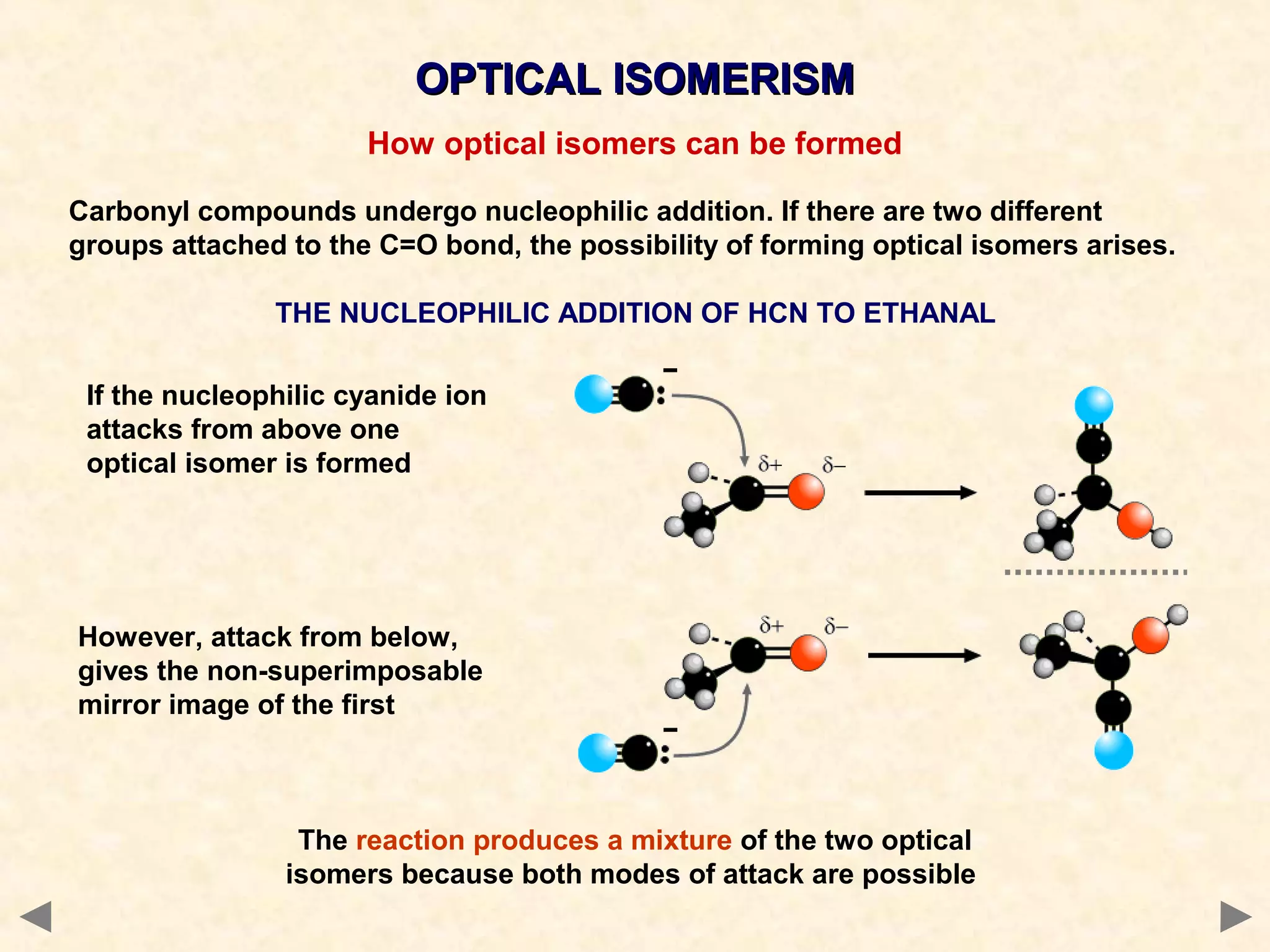
However, attack from below, 
gives the non-superimposable 
mirror image of the first
OOPPTTIICCAALL IISSOOMMEERRIISSMM 
How optical isomers can be formed 
Carbonyl compounds undergo nucleophilic addition. If there are two different 
groups attached to the C=O bond, the possibility of forming optical isomers arises. 
THE NUCLEOPHILIC ADDITION OF HCN TO ETHANAL 
If the nucleophilic cyanide ion 
attacks from above one 
optical isomer is formed 
However, attack from below, 
gives the non-superimposable 
mirror image of the first 
The reaction produces a mixture of the two optical 
isomers because both modes of attack are possible
OOPPTTIICCAALL IISSOOMMEERRIISSMM 
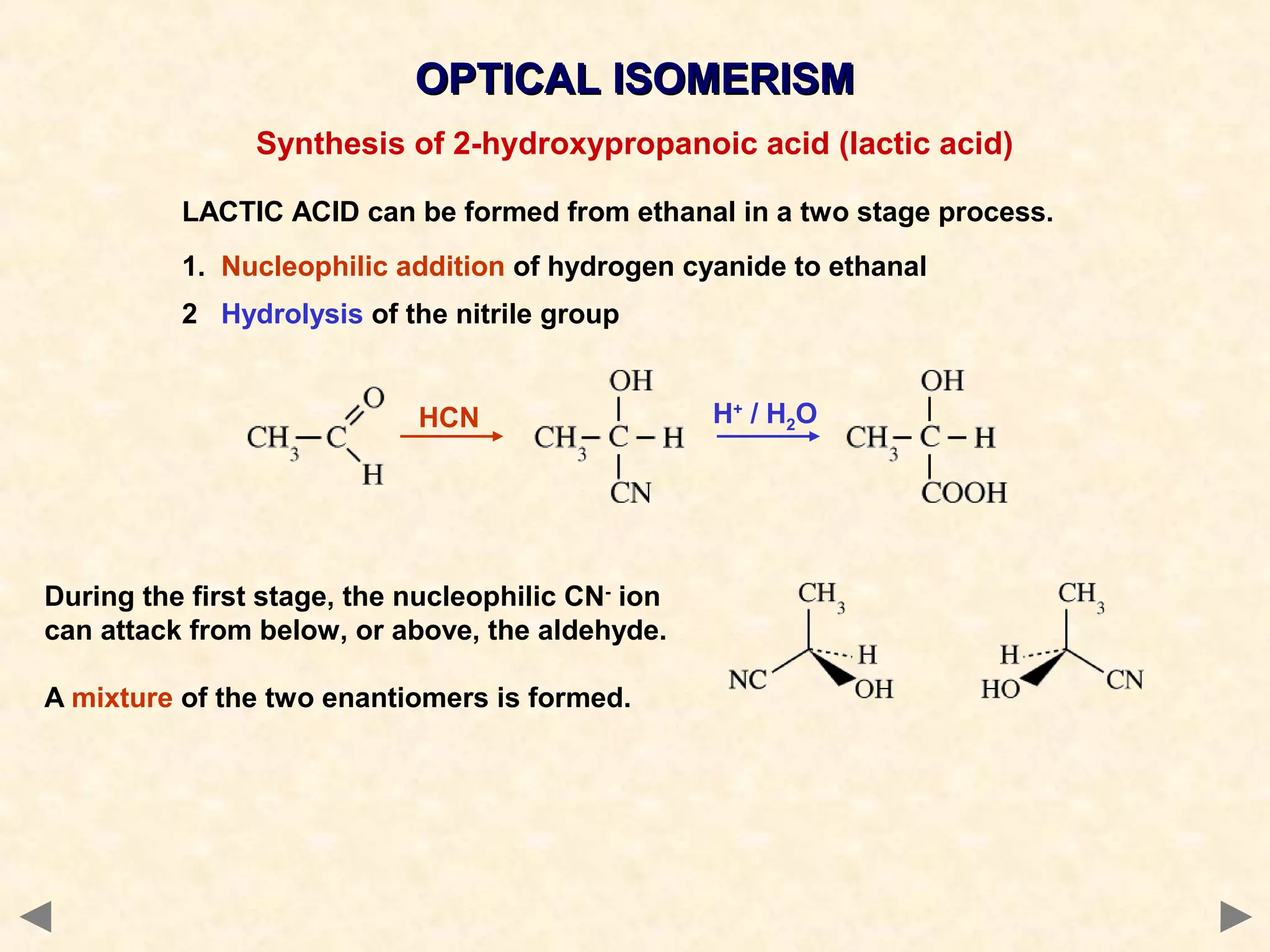
Synthesis of 2-hydroxypropanoic acid (lactic acid) 
LACTIC ACID can be formed from ethanal in a two stage process. 
1. Nucleophilic addition of hydrogen cyanide to ethanal 
2 Hydrolysis of the nitrile group 
HCN H+ / H2O
OOPPTTIICCAALL IISSOOMMEERRIISSMM 
Synthesis of 2-hydroxypropanoic acid (lactic acid) 
LACTIC ACID can be formed from ethanal in a two stage process. 
1. Nucleophilic addition of hydrogen cyanide to ethanal 
2 Hydrolysis of the nitrile group 
HCN H+ / H2O 
During the first stage, the nucleophilic CN- ion 
can attack from below, or above, the aldehyde. 
A mixture of the two enantiomers is formed.
OOPPTTIICCAALL IISSOOMMEERRIISSMM 
Synthesis of 2-hydroxypropanoic acid (lactic acid) 
LACTIC ACID can be formed from ethanal in a two stage process. 
1. Nucleophilic addition of hydrogen cyanide to ethanal 
2 Hydrolysis of the nitrile group 
HCN H+ / H2O 
During the first stage, the nucleophilic CN- ion 
can attack from below, or above, the aldehyde. 
A mixture of the two enantiomers is formed. 
Acid hydrolysis of the mixture provides a 
mixture of the two lactic acid forms.
OOPPTTIICCAALL IISSOOMMEERRIISSMM -- TTHHAALLIIDDOOMMIIDDEE 
The one obvious difference between optical isomers is their response to plane 
polarised light. However, some naturally occurring molecules or specifically 
synthesised pharmaceuticals show different chemical reactivity. 
The drug, THALIDOMIDE is a chiral molecule and can exist as two enantiomers. In the 
1960’s it was used to treat anxiety and morning sickness in pregnant women. 
Tragically, many gave birth to children with deformities and missing limbs. 
It turned out that only one of the enantiomers (the structure on the right) was effective 
and safe; its optically active counterpart was not. The major problem was that during 
manufacture a mixture of the isomers was produced. The drug was banned world-wide, 
but not after tens of thousands of babies had been affected.
OOPPTTIICCAALL IISSOOMMEERRIISSMM –– OOtthheerr ppooiinnttss 
The following points are useful when discussing reactions producing optical isomers. 
The formation of racemic mixtures is more likely in a laboratory reaction 
than in a chemical process occurring naturally in the body. 
If a compound can exist in more than one form, only one of the optical 
isomers is usually effective. 
The separation of isomers will make manufacture more expensive. 
A drug made up of both isomers will require a larger dose and may cause 
problems if the other isomer is ‘poisonous’ like thalidomide.

Optical isomerism

  • 1.
    OOPPTTIICCAALL IISSOOMMEERRIISSMM AAgguuiiddee ffoorr AA lleevveell ssttuuddeennttss KKNNOOCCKKHHAARRDDYY PPUUBBLLIISSHHIINNGG
  • 2.
    TTYYPPEESS OOFF IISSOOMMEERRIISSMM CHAIN ISOMERISM Occurs due to the restricted rotation of C=C double bonds... two forms - CIS and TRANS STRUCTURAL ISOMERISM STEREOISOMERISM E/Z ISOMERISM OPTICAL ISOMERISM Same molecular formula but different structural formulae Occurs when molecules have a chiral centre. Get two non-superimposable mirror images. Same molecular formula but atoms occupy different positions in space. POSITION ISOMERISM FUNCTIONAL GROUP ISOMERISM
  • 3.
    OOPPTTIICCAALL IISSOOMMEERRIISSMM Occurrenceanother form of stereoisomerism occurs when compounds have non-superimposable mirror images Isomers the two different forms are known as optical isomers or enantiomers they occur when molecules have a chiral centre a chiral centre contains an asymmetric carbon atom an asymmetric carbon has four different atoms (or groups) arranged tetrahedrally around it.
  • 4.
    OOPPTTIICCAALL IISSOOMMEERRIISSMM Occurrenceanother form of stereoisomerism occurs when compounds have non-superimposable mirror images Isomers the two different forms are known as optical isomers or enantiomers they occur when molecules have a chiral centre a chiral centre contains an asymmetric carbon atom an asymmetric carbon has four different atoms (or groups) arranged tetrahedrally around it. CHIRAL CENTRES There are four different colours arranged tetrahedrally about the carbon atom 2-chlorobutane exhibits optical isomerism because the second carbon atom has four different atoms/groups attached
  • 5.
    OOPPTTIICCAALL IISSOOMMEERRIISSMM SPOTTINGCHIRAL CENTRES Look at each carbon atom in the chain and see what is attached to it. For a chiral centre you need an asymmetric carbon with four different atoms/groups) arranged tetrahedrally around it. IF A CARBON HAS MORE THAN ONE OF ANY ATOM/GROUP ATTACHED, IT CAN’T BE CHIRAL CH3CH2CH2CH2Cl C 3 H’s around it NOT chiral C 2 H’s around it NOT chiral C 2 H’s around it NOT chiral C 2 H’s around it NOT chiral 1-chlorobutane 
  • 6.
    OOPPTTIICCAALL IISSOOMMEERRIISSMM SPOTTINGCHIRAL CENTRES Look at each carbon atom in the chain and see what is attached to it. For a chiral centre you need an asymmetric carbon with four different atoms/groups) arranged tetrahedrally around it. IF A CARBON HAS MORE THAN ONE OF ANY ATOM/GROUP ATTACHED, IT CAN’T BE CHIRAL CH3CH2CH2CH2Cl C 3 H’s around it NOT chiral CH3CH2CHClCH3 C 2 H’s around it NOT chiral C 2 H’s around it NOT chiral C 2 H’s around it NOT chiral C 3 H’s around it NOT chiral C 2 H’s around it NOT chiral C H, CH3, Cl,C2H5 around it CHIRAL C 3 H’s around it NOT chiral 1-chlorobutane  2-chlorobutane 
  • 7.
    OOPPTTIICCAALL IISSOOMMEERRIISSMM SPOTTINGCHIRAL CENTRES Look at each carbon atom in the chain and see what is attached to it. For a chiral centre you need an asymmetric carbon with four different atoms/groups) arranged tetrahedrally around it. IF A CARBON HAS MORE THAN ONE OF ANY ATOM/GROUP ATTACHED, IT CAN’T BE CHIRAL CH3CH2CH2CH2Cl C 3 H’s around it NOT chiral CH3CH2CHClCH3 C 2 H’s around it NOT chiral C 2 H’s around it NOT chiral C 2 H’s around it NOT chiral C 3 H’s around it NOT chiral C 2 H’s around it NOT chiral C H, CH3, Cl,C2H5 around it CHIRAL C 3 H’s around it NOT chiral (CH3)2CHCH2Cl C 3 H’s around it NOT chiral (CH3)3CCl C 3 H’s around it NOT chiral C 3 CH3’s around it NOT chiral 1-chlorobutane 2-chlorobutane 2-chloro-2-methylpropanane C 2 CH3’s around it NOT chiral 1-chloro-2-methylpropanane C 2 H’s around it NOT chiral    
  • 8.
    OOPPTTIICCAALL IISSOOMMEERRIISSMM Spatialdifferences between isomers • two forms exist which are NON-SUPERIMPOSABLE MIRROR IMAGES of each other • non-superimposable means you you can’t stack one form exactly on top of the other
  • 9.
    OOPPTTIICCAALL IISSOOMMEERRIISSMM Spatialdifferences between isomers • two forms exist which are NON-SUPERIMPOSABLE MIRROR IMAGES of each other • non-superimposable means you you can’t stack one form exactly on top of the other Some common objects are mirror images and superimposable spoons superimposable but not mirror images books non-superimposable mirror images hands
  • 10.
    OOPPTTIICCAALL IISSOOMMEERRIISSMM Spatialdifferences between isomers • two forms exist which are NON-SUPERIMPOSABLE MIRROR IMAGES of each other • non-superimposable means you you can’t stack one form exactly on top of the other Some common objects are mirror images and superimposable spoons superimposable but not mirror images books non-superimposable mirror images hands NB For optical isomerism in molecules, both conditions must apply... they must be mirror images AND be non-superimposable
  • 11.
    OOPPTTIICCAALL IISSOOMMEERRIISSMM Whatis a non-superimposable mirror image? Animation doesn’t work in old versions of Powerpoint
  • 12.
    OOPPTTIICCAALL IISSOOMMEERRSS --DDIIFFFFEERREENNCCEE • isomers differ in their reaction to plane-polarised light • plane polarised light vibrates in one direction only • one isomer rotates light to the right, the other to the left • rotation of light is measured using a polarimeter • rotation is measured by observing the polarised light coming out towards the observer
  • 13.
    OOPPTTIICCAALL IISSOOMMEERRSS --DDIIFFFFEERREENNCCEE • isomers differ in their reaction to plane-polarised light • plane polarised light vibrates in one direction only • one isomer rotates light to the right, the other to the left • rotation of light is measured using a polarimeter • rotation is measured by observing the polarised light coming out towards the observer • If the light appears to have turned to the right turned to the left DEXTROROTATORY LAEVOROTATORY d or + form l or - form
  • 14.
    OOPPTTIICCAALL IISSOOMMEERRSS --DDIIFFFFEERREENNCCEE • isomers differ in their reaction to plane-polarised light • plane polarised light vibrates in one direction only • one isomer rotates light to the right, the other to the left • rotation of light is measured using a polarimeter • rotation is measured by observing the polarised light coming out towards the observer • If the light appears to have turned to the right turned to the left DEXTROROTATORY LAEVOROTATORY d or + form l or - form Racemate a 50-50 mixture of the two enantiomers (dl) or (±) is a racemic mixture. The opposite optical effects of each isomer cancel each other out Examples Optical activity is common in biochemistry and pharmaceuticals • Most amino acids exhibit optical activity • many drugs must be made of one optical isomer to be effective - need smaller doses (safer and cost effective) - get reduced side effects - improved pharmacological activity
  • 15.
    OOPPTTIICCAALL IISSOOMMEERRIISSMM Thepolarimeter A Light source produces light vibrating in all directions B Polarising filter only allows through light vibrating in one direction C Plane polarised light passes through sample D If substance is optically active it rotates the plane polarised light E Analysing filter is turned so that light reaches a maximum F Direction of rotation is measured coming towards the observer If the light appears to have turned to the right turned to the left DEXTROROTATORY LAEVOROTATORY A B C D E F
  • 16.
    OOPPTTIICCAALL IISSOOMMEERRIISSMM Howoptical isomers can be formed Carbonyl compounds undergo nucleophilic addition. If there are two different groups attached to the C=O bond, the possibility of forming optical isomers arises. THE NUCLEOPHILIC ADDITION OF HCN TO ETHANAL If the nucleophilic cyanide ion attacks from above one optical isomer is formed
  • 17.
    OOPPTTIICCAALL IISSOOMMEERRIISSMM Howoptical isomers can be formed Carbonyl compounds undergo nucleophilic addition. If there are two different groups attached to the C=O bond, the possibility of forming optical isomers arises. THE NUCLEOPHILIC ADDITION OF HCN TO ETHANAL If the nucleophilic cyanide ion attacks from above one optical isomer is formed However, attack from below, gives the non-superimposable mirror image of the first
  • 18.
    OOPPTTIICCAALL IISSOOMMEERRIISSMM Howoptical isomers can be formed Carbonyl compounds undergo nucleophilic addition. If there are two different groups attached to the C=O bond, the possibility of forming optical isomers arises. THE NUCLEOPHILIC ADDITION OF HCN TO ETHANAL If the nucleophilic cyanide ion attacks from above one optical isomer is formed However, attack from below, gives the non-superimposable mirror image of the first The reaction produces a mixture of the two optical isomers because both modes of attack are possible
  • 19.
    OOPPTTIICCAALL IISSOOMMEERRIISSMM Synthesisof 2-hydroxypropanoic acid (lactic acid) LACTIC ACID can be formed from ethanal in a two stage process. 1. Nucleophilic addition of hydrogen cyanide to ethanal 2 Hydrolysis of the nitrile group HCN H+ / H2O
  • 20.
    OOPPTTIICCAALL IISSOOMMEERRIISSMM Synthesisof 2-hydroxypropanoic acid (lactic acid) LACTIC ACID can be formed from ethanal in a two stage process. 1. Nucleophilic addition of hydrogen cyanide to ethanal 2 Hydrolysis of the nitrile group HCN H+ / H2O During the first stage, the nucleophilic CN- ion can attack from below, or above, the aldehyde. A mixture of the two enantiomers is formed.
  • 21.
    OOPPTTIICCAALL IISSOOMMEERRIISSMM Synthesisof 2-hydroxypropanoic acid (lactic acid) LACTIC ACID can be formed from ethanal in a two stage process. 1. Nucleophilic addition of hydrogen cyanide to ethanal 2 Hydrolysis of the nitrile group HCN H+ / H2O During the first stage, the nucleophilic CN- ion can attack from below, or above, the aldehyde. A mixture of the two enantiomers is formed. Acid hydrolysis of the mixture provides a mixture of the two lactic acid forms.
  • 22.
    OOPPTTIICCAALL IISSOOMMEERRIISSMM --TTHHAALLIIDDOOMMIIDDEE The one obvious difference between optical isomers is their response to plane polarised light. However, some naturally occurring molecules or specifically synthesised pharmaceuticals show different chemical reactivity. The drug, THALIDOMIDE is a chiral molecule and can exist as two enantiomers. In the 1960’s it was used to treat anxiety and morning sickness in pregnant women. Tragically, many gave birth to children with deformities and missing limbs. It turned out that only one of the enantiomers (the structure on the right) was effective and safe; its optically active counterpart was not. The major problem was that during manufacture a mixture of the isomers was produced. The drug was banned world-wide, but not after tens of thousands of babies had been affected.
  • 23.
    OOPPTTIICCAALL IISSOOMMEERRIISSMM ––OOtthheerr ppooiinnttss The following points are useful when discussing reactions producing optical isomers. The formation of racemic mixtures is more likely in a laboratory reaction than in a chemical process occurring naturally in the body. If a compound can exist in more than one form, only one of the optical isomers is usually effective. The separation of isomers will make manufacture more expensive. A drug made up of both isomers will require a larger dose and may cause problems if the other isomer is ‘poisonous’ like thalidomide.