Presented by:
Rajina Shakya
B.Pharm
4th year , 7th semester
STABILITY
 It is the capability of a particular
 formulation to remain within its physical,
 chemical,microbiological, therapeutic and
 toxicological condition.
Importance of stability in
pharmaceutics
 Drug products complex chemical and physical stability kinetics .
 Chemical and physical degradation of drug substances may
  change their pharmacological effects, resulting in altered
  efficacy therapeutic as well as toxicological consequences.
 Because pharmaceuticals are used therapeutically based on their
  efficacy and safety, they should be stable
 Maintainance of quality until the time of usage or until
  their expiration date.
 The quality should be maintained under the various conditions
  that pharmaceuticals encounter, during production, storage in
  warehouses, transportation, and storage in hospital and
  community pharmacies, as well as in the home.
Chemical stability of drug
substances
  Pathways of chemical degradation
     Hydrolysis
     Dehydration
     Isomerization and Racemization
     Decarboxylation and Elimination
     Oxidation
     Photodegradation
     Drug-Excipienand Drug-Drug Interactions
Factors affecting Chemical stability
   Temperature
   pH and pH rate profiles
   Ionic strength (primary salt effects)
   Dielectric constant of solvents
   Oxygen
   Light
   Crystalline state and polymorphism in solid drugs
   Effect of moisture and humidity on solid and semi solid drugs
   Excipients
     effects of the amount of moisture present in excipients
     effects of the physical state of water molecules in excipients
     effect of the mobility of water molecules in excipients on drug
      degradation
     other properties of excipients

 Miscellaneous Factors
physical stability of drug
substances
  physical degradation
      crystallization of amorphous drugs
      transitions in crystalline states
      formation and growth of crystals
      Vapor-phase Transfers including sublimation
      Moisture Absorption
Hydrolysis
 A chemical reaction in which the interaction of
  a     compound        with     water    results     in
  the decomposition of that compound.In this
  reaction,a water molecule (HOH) and a reactant
  exchange functional groups resulting in two end
  products, one containing the hydrogen cation (H) and
  the other the hydroxyl anion (OH).
 hydrolysis is one of the most common reactions seen
  with pharmaceuticals mainly in parenteral products.
 Hydrolytic reactions
1) Hydrolysis of Esters and Ethers

2) Hydrolysis of Amides.

3) Hydrolytic cleavage of non aromatic heterocycles.

4) Hydrolytic Dehalogination.

5) Miscellaneous hydrolytic reactions.
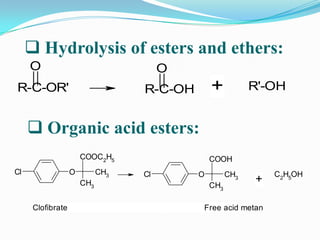
 Hydrolysis of esters and ethers:
     O                                  O
R-C-OR'                            R-C-OH       +           R'-OH


      Organic acid esters:
                       COOC2H5                  COOH
Cl                 O         CH3   Cl       O         CH3       C2H5OH
                       CH3                      CH3
                                                            +

      Clofibrate                            Free acid metan
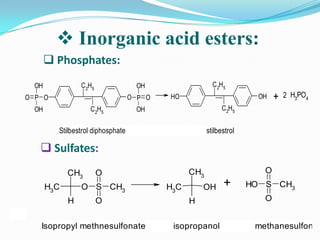
 Inorganic acid esters:
        Phosphates:
  OH             C 2H5               OH                  C 2H5
O P O                              O P O   HO                          OH   +   2 H3PO4
  OH                C 2H5            OH                      C 2H5


         Stilbestrol diphosphate                       stilbestrol

    Sulfates:
             CH3         O                       CH3                    O
       H3C       O S CH3                   H3C       OH      +       HO S CH3
             H           O                       H                      O


   Isopropyl methnesulfonate                isopropanol               methanesulfonic
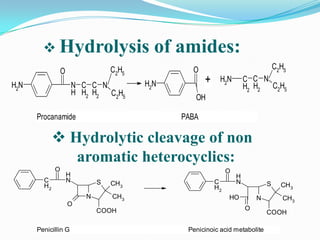
 Hydrolysis                         of amides:
                                    C2H5           O                                 C2H5
                 O
H2N                      N C C N           H2N          +    H2N         C C N
                                                                         H2 H2 C2H5
                         H H2 H2 C2H5
                                                    OH

      Procanamide                                PABA

              Hydrolytic cleavage of non
                aromatic heterocyclics:
             O                                                   O
                     H                                               H
        C            N          S   CH3                     C        N
        H2                                                                       S     CH3
                                                            H2
                            N       CH3                          HO          N          CH3
                     O
                                COOH                                     O
                                                                                 COOH

      Penicillin G                                Penicinoic acid metabolite
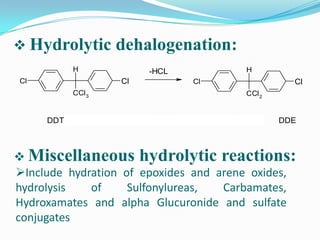
 Hydrolytic       dehalogenation:
           H            -HCL           H
Cl                 Cl          Cl                Cl
           CCl 3                       CCl 2


     DDT                                       DDE


 Miscellaneous hydrolytic reactions:
Include hydration of epoxides and arene oxides,
hydrolysis   of     Sulfonylureas,  Carbamates,
Hydroxamates and alpha Glucuronide and sulfate
conjugates
OXIDATION
Oxidation is defined as the interaction
 between oxygen molecules and all the different
 substances they may contact, from metal to
 living tissue.
 Technically, however, with the discovery of
 electrons, oxidation came to be more precisely
 defined as the loss of at least one electron when
 two or more substances interact.
Oxidative reactions:
1) Oxidation of aromatic carbon atoms

2) Oxidation of olefins (C=C bonds)

3) Oxidation of Benzylic, Allylic carbon atoms &
   carbon atoms alpha to carbonyl & imines

4) Oxidation of aliphatic carbon atoms

5) Oxidation of alicyclic carbon atoms
6) Oxidation of carbon-heteroatom systems:

A. Carbon-Nitrogen system
 N- Dealkylation.
 Oxidative deamination
 N-Oxide formation
 N-Hydroxylation

B. Carbon-Sulfur system
 S- Dealkylation
 Desulfuration
 S-oxidation

C. Carbon-Oxygen systems(O- Dealkylation)

7) Oxidation of Alcohol, Carbonyle and Acid functios.

8) Miscellaneous oxidative reactions.
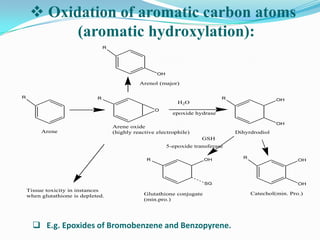
 Oxidation of aromatic carbon atoms
           (aromatic hydroxylation):
                                  R


                                                       OH

                                                Arenol (major)

R                             R                                                 R                  OH
                                                                H2O
                                                       O
                                                              epoxide hydrase

                                                                                                   OH
                                      Arene oxide
         Arene                        (highly reactive electrophile)                Dihyrdrodiol
                                                                         GSH
                                                            5-epoxide transferase

                                                                                      R
                                                   R                      OH                               OH


                                                                          SG                               OH
    Tissue toxicity in instances
                                                  Glutathione conjugate                   Catechol(min. Pro.)
    when glutathione is depleted.
                                                  (min.pro.)


       E.g. Epoxides of Bromobenzene and Benzopyrene.
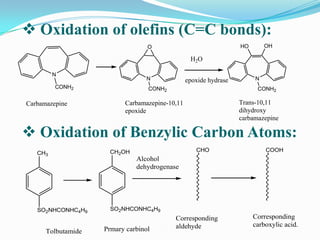
 Oxidation of olefins (C=C bonds):
                                  O                               HO       OH

                                                 H2O

         N
                                 N              epoxide hydrase        N
         CONH2                    CONH2                                 CONH2

Carbamazepine             Carbamazepine-10,11                     Trans-10,11
                          epoxide                                 dihydroxy
                                                                  carbamazepine

 Oxidation of Benzylic Carbon Atoms:
                     CH2OH                         CHO                     COOH
   CH3
                              Alcohol
                              dehydrogenase


   SO2NHCONHC4H9      SO2NHCONHC4H9
                                          Corresponding                Corresponding
                                          aldehyde                     carboxylic acid.
      Tolbutamide   Prmary carbinol
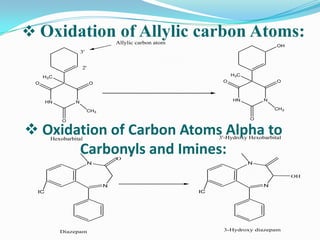
 Oxidation of Allylic carbon Atoms:Allylic carbon atom
                                                                                    OH
                     3'


                     2'
     H3C                                                            H3C
 O                        O                                     O                   O


       HN        N                                                  HN         N

                          CH3                                                      CH3

            O                                                             O


 Oxidation of Carbon Atoms Alpha to
        Hexobarbital                                           3'-Hydroxy Hexobarbital

       Carbonyls and Imines:        O
                          N                                               N

                                                                                         OH

                                N                                              N
  IC                                                      IC


            Diazepam                                            3-Hydroxy diazepam
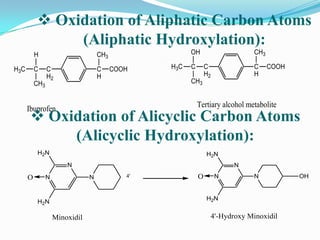
 Oxidation of Aliphatic Carbon Atoms
               (Aliphatic Hydroxylation):
          H                         CH3                 OH                     CH3

H3C       C     C                   C     COOH    H3C   C       C              C     COOH
                H2                  H                           H2             H
          CH3                                           CH3


      Ibuprofen                                             Tertiary alcohol metabolite
        Oxidation of Alicyclic Carbon Atoms
            (Alicyclic Hydroxylation):
           H2N                                                  H2N
                        N                                                N

      O         N               N            4'             O        N         N            OH


                                                                H2N
           H2N

                    Minoxidil                                    4'-Hydroxy Minoxidil
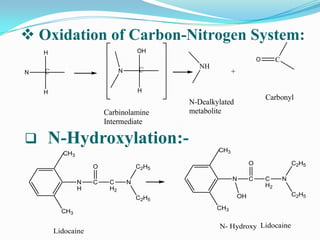
 Oxidation of Carbon-Nitrogen System:
    H                                 OH
                                                                        O        C
                                               NH
N   C                         N       C                    +

    H                                 H
                                                                            Carbonyl
                                             N-Dealkylated
                        Carbinolamine        metabolite
                        Intermediate

   N-Hydroxylation:-                                CH3
          CH3
                                                                    O                    C2H5
                    O                 C2H5

                                                           N        C       C        N
                N   C    C        N
                                                                            H2
                H        H2
                                                               OH                        C2H5
                                      C2H5
                                                     CH3
          CH3

                                                     N- Hydroxy Lidocaine
        Lidocaine
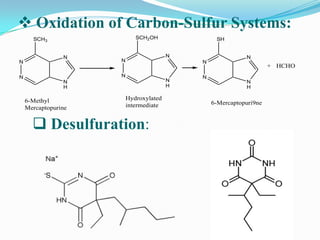
 Oxidation of Carbon-Sulfur Systems:
      SCH3                  SCH2OH               SH


                N                       N                  N
N                    N                      N
                                                                    + HCHO
N                    N                      N
                N                       N                  N
                H                       H                  H

    6-Methyl             Hydroxylated
                         intermediate           6-Mercaptopuri9ne
    Mercaptopurine


       Desulfuration:
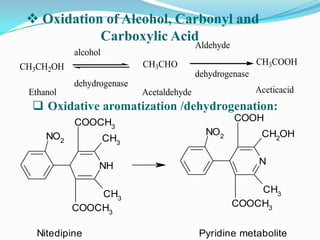
 Oxidation of Alcohol, Carbonyl and
            Carboxylic Acid
                                          Aldehyde
           alcohol
CH3CH2OH                   CH3CHO                         CH3COOH
                                          dehydrogenase
           dehydrogenase
 Ethanol                   Acetaldehyde                   Aceticacid
   Oxidative aromatization /dehydrogenation:
           COOCH3                                    COOH
     NO2                                    NO2            CH2OH
                     CH3

                 NH                                       N


               CH3                                       CH3
           COOCH3                                    COOCH3


   Nitedipine                             Pyridine metabolite
Photolysis
 chemical reaction in which a chemical compound is
  broken down by photons.
 is not limited to visible light. Any photon with
  sufficient energy can affect the chemical bonds of a
  chemical compound
Photochemical transformation reactions
  Direct photolysis = transformation of a
   compound due to its absorption of UV light

  Indirect photolysis = transformation of a
   compound due to its interaction with a reactant
   generated by the influence of UV light
   (photosensitizer or reactive oxygen species)
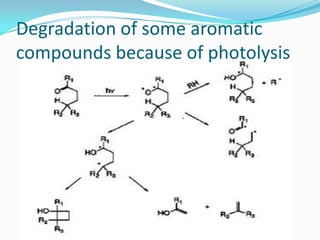
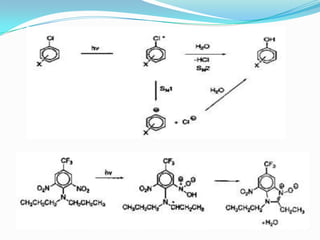
Degradation of some aromatic
compounds because of photolysis
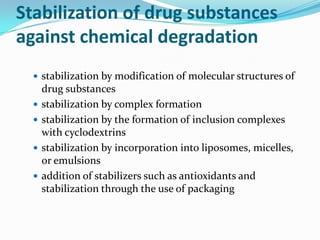
Stabilization of drug substances
against chemical degradation
   stabilization by modification of molecular structures of
      drug substances
     stabilization by complex formation
     stabilization by the formation of inclusion complexes
      with cyclodextrins
     stabilization by incorporation into liposomes, micelles,
      or emulsions
     addition of stabilizers such as antioxidants and
      stabilization through the use of packaging
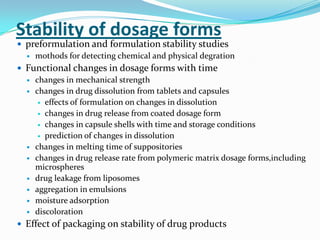
Stability of dosage forms
 preformulation and formulation stability studies
   mothods for detecting chemical and physical degration

 Functional changes in dosage forms with time
   changes in mechanical strength
   changes in drug dissolution from tablets and capsules
      effects of formulation on changes in dissolution

      changes in drug release from coated dosage form

      changes in capsule shells with time and storage conditions

      prediction of changes in dissolution

   changes in melting time of suppositories
   changes in drug release rate from polymeric matrix dosage forms,including
    microspheres
   drug leakage from liposomes
   aggregation in emulsions
   moisture adsorption
   discoloration

 Effect of packaging on stability of drug products
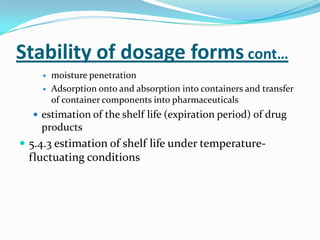
Stability of dosage forms cont…
       moisture penetration
       Adsorption onto and absorption into containers and transfer
        of container components into pharmaceuticals
   estimation of the shelf life (expiration period) of drug
    products
 5.4.3 estimation of shelf life under temperature-
 fluctuating conditions
Reference
 http://www.scribd.com/doc/25293385/Stability-of-
  Drugs-and-Dosage-Forms
 http://www.google.com/url?sa=t&rct=j&q=&esrc=s&so
  urce=web&cd=1&ved=0CGIQFjAA&url=http%3A%2F%
  2Fpubs.acs.org%2Fdoi%2Fabs%2F10.1021%2Fjo00436a
  016&ei=wYQiUOiLKcPjrAfZoYCQBw&usg=AFQjCNGF
  0H71UUQWgb22bS6iKLZjF64SZg&sig2=r-
  Ny5wsp4ohhXbu8xBpbVQ

Stability techniques

  • 1.
  • 2.
    STABILITY  It isthe capability of a particular formulation to remain within its physical, chemical,microbiological, therapeutic and toxicological condition.
  • 3.
    Importance of stabilityin pharmaceutics  Drug products complex chemical and physical stability kinetics .  Chemical and physical degradation of drug substances may change their pharmacological effects, resulting in altered efficacy therapeutic as well as toxicological consequences.  Because pharmaceuticals are used therapeutically based on their efficacy and safety, they should be stable  Maintainance of quality until the time of usage or until their expiration date.  The quality should be maintained under the various conditions that pharmaceuticals encounter, during production, storage in warehouses, transportation, and storage in hospital and community pharmacies, as well as in the home.
  • 4.
    Chemical stability ofdrug substances  Pathways of chemical degradation  Hydrolysis  Dehydration  Isomerization and Racemization  Decarboxylation and Elimination  Oxidation  Photodegradation  Drug-Excipienand Drug-Drug Interactions
  • 5.
    Factors affecting Chemicalstability  Temperature  pH and pH rate profiles  Ionic strength (primary salt effects)  Dielectric constant of solvents  Oxygen  Light  Crystalline state and polymorphism in solid drugs  Effect of moisture and humidity on solid and semi solid drugs  Excipients  effects of the amount of moisture present in excipients  effects of the physical state of water molecules in excipients  effect of the mobility of water molecules in excipients on drug degradation  other properties of excipients  Miscellaneous Factors
  • 6.
    physical stability ofdrug substances  physical degradation  crystallization of amorphous drugs  transitions in crystalline states  formation and growth of crystals  Vapor-phase Transfers including sublimation  Moisture Absorption
  • 7.
    Hydrolysis  A chemicalreaction in which the interaction of a compound with water results in the decomposition of that compound.In this reaction,a water molecule (HOH) and a reactant exchange functional groups resulting in two end products, one containing the hydrogen cation (H) and the other the hydroxyl anion (OH).  hydrolysis is one of the most common reactions seen with pharmaceuticals mainly in parenteral products.
  • 8.
     Hydrolytic reactions 1)Hydrolysis of Esters and Ethers 2) Hydrolysis of Amides. 3) Hydrolytic cleavage of non aromatic heterocycles. 4) Hydrolytic Dehalogination. 5) Miscellaneous hydrolytic reactions.
  • 9.
     Hydrolysis ofesters and ethers: O O R-C-OR' R-C-OH + R'-OH  Organic acid esters: COOC2H5 COOH Cl O CH3 Cl O CH3 C2H5OH CH3 CH3 + Clofibrate Free acid metan
  • 10.
     Inorganic acidesters:  Phosphates: OH C 2H5 OH C 2H5 O P O O P O HO OH + 2 H3PO4 OH C 2H5 OH C 2H5 Stilbestrol diphosphate stilbestrol  Sulfates: CH3 O CH3 O H3C O S CH3 H3C OH + HO S CH3 H O H O Isopropyl methnesulfonate isopropanol methanesulfonic
  • 11.
     Hydrolysis of amides: C2H5 O C2H5 O H2N N C C N H2N + H2N C C N H2 H2 C2H5 H H2 H2 C2H5 OH Procanamide PABA  Hydrolytic cleavage of non aromatic heterocyclics: O O H H C N S CH3 C N H2 S CH3 H2 N CH3 HO N CH3 O COOH O COOH Penicillin G Penicinoic acid metabolite
  • 12.
     Hydrolytic dehalogenation: H -HCL H Cl Cl Cl Cl CCl 3 CCl 2 DDT DDE  Miscellaneous hydrolytic reactions: Include hydration of epoxides and arene oxides, hydrolysis of Sulfonylureas, Carbamates, Hydroxamates and alpha Glucuronide and sulfate conjugates
  • 13.
    OXIDATION Oxidation is definedas the interaction between oxygen molecules and all the different substances they may contact, from metal to living tissue.  Technically, however, with the discovery of electrons, oxidation came to be more precisely defined as the loss of at least one electron when two or more substances interact.
  • 14.
    Oxidative reactions: 1) Oxidationof aromatic carbon atoms 2) Oxidation of olefins (C=C bonds) 3) Oxidation of Benzylic, Allylic carbon atoms & carbon atoms alpha to carbonyl & imines 4) Oxidation of aliphatic carbon atoms 5) Oxidation of alicyclic carbon atoms
  • 15.
    6) Oxidation ofcarbon-heteroatom systems: A. Carbon-Nitrogen system  N- Dealkylation.  Oxidative deamination  N-Oxide formation  N-Hydroxylation B. Carbon-Sulfur system  S- Dealkylation  Desulfuration  S-oxidation C. Carbon-Oxygen systems(O- Dealkylation) 7) Oxidation of Alcohol, Carbonyle and Acid functios. 8) Miscellaneous oxidative reactions.
  • 16.
     Oxidation ofaromatic carbon atoms (aromatic hydroxylation): R OH Arenol (major) R R R OH H2O O epoxide hydrase OH Arene oxide Arene (highly reactive electrophile) Dihyrdrodiol GSH 5-epoxide transferase R R OH OH SG OH Tissue toxicity in instances Glutathione conjugate Catechol(min. Pro.) when glutathione is depleted. (min.pro.)  E.g. Epoxides of Bromobenzene and Benzopyrene.
  • 17.
     Oxidation ofolefins (C=C bonds): O HO OH H2O N N epoxide hydrase N CONH2 CONH2 CONH2 Carbamazepine Carbamazepine-10,11 Trans-10,11 epoxide dihydroxy carbamazepine  Oxidation of Benzylic Carbon Atoms: CH2OH CHO COOH CH3 Alcohol dehydrogenase SO2NHCONHC4H9 SO2NHCONHC4H9 Corresponding Corresponding aldehyde carboxylic acid. Tolbutamide Prmary carbinol
  • 18.
     Oxidation ofAllylic carbon Atoms:Allylic carbon atom OH 3' 2' H3C H3C O O O O HN N HN N CH3 CH3 O O  Oxidation of Carbon Atoms Alpha to Hexobarbital 3'-Hydroxy Hexobarbital Carbonyls and Imines: O N N OH N N IC IC Diazepam 3-Hydroxy diazepam
  • 19.
     Oxidation ofAliphatic Carbon Atoms (Aliphatic Hydroxylation): H CH3 OH CH3 H3C C C C COOH H3C C C C COOH H2 H H2 H CH3 CH3 Ibuprofen Tertiary alcohol metabolite  Oxidation of Alicyclic Carbon Atoms (Alicyclic Hydroxylation): H2N H2N N N O N N 4' O N N OH H2N H2N Minoxidil 4'-Hydroxy Minoxidil
  • 20.
     Oxidation ofCarbon-Nitrogen System: H OH O C NH N C N C + H H Carbonyl N-Dealkylated Carbinolamine metabolite Intermediate  N-Hydroxylation:- CH3 CH3 O C2H5 O C2H5 N C C N N C C N H2 H H2 OH C2H5 C2H5 CH3 CH3 N- Hydroxy Lidocaine Lidocaine
  • 21.
     Oxidation ofCarbon-Sulfur Systems: SCH3 SCH2OH SH N N N N N N + HCHO N N N N N N H H H 6-Methyl Hydroxylated intermediate 6-Mercaptopuri9ne Mercaptopurine  Desulfuration:
  • 22.
     Oxidation ofAlcohol, Carbonyl and Carboxylic Acid Aldehyde alcohol CH3CH2OH CH3CHO CH3COOH dehydrogenase dehydrogenase Ethanol Acetaldehyde Aceticacid  Oxidative aromatization /dehydrogenation: COOCH3 COOH NO2 NO2 CH2OH CH3 NH N CH3 CH3 COOCH3 COOCH3 Nitedipine Pyridine metabolite
  • 23.
    Photolysis  chemical reactionin which a chemical compound is broken down by photons.  is not limited to visible light. Any photon with sufficient energy can affect the chemical bonds of a chemical compound
  • 24.
    Photochemical transformation reactions  Direct photolysis = transformation of a compound due to its absorption of UV light  Indirect photolysis = transformation of a compound due to its interaction with a reactant generated by the influence of UV light (photosensitizer or reactive oxygen species)
  • 25.
    Degradation of somearomatic compounds because of photolysis
  • 27.
    Stabilization of drugsubstances against chemical degradation  stabilization by modification of molecular structures of drug substances  stabilization by complex formation  stabilization by the formation of inclusion complexes with cyclodextrins  stabilization by incorporation into liposomes, micelles, or emulsions  addition of stabilizers such as antioxidants and stabilization through the use of packaging
  • 28.
    Stability of dosageforms  preformulation and formulation stability studies  mothods for detecting chemical and physical degration  Functional changes in dosage forms with time  changes in mechanical strength  changes in drug dissolution from tablets and capsules  effects of formulation on changes in dissolution  changes in drug release from coated dosage form  changes in capsule shells with time and storage conditions  prediction of changes in dissolution  changes in melting time of suppositories  changes in drug release rate from polymeric matrix dosage forms,including microspheres  drug leakage from liposomes  aggregation in emulsions  moisture adsorption  discoloration  Effect of packaging on stability of drug products
  • 29.
    Stability of dosageforms cont…  moisture penetration  Adsorption onto and absorption into containers and transfer of container components into pharmaceuticals  estimation of the shelf life (expiration period) of drug products  5.4.3 estimation of shelf life under temperature- fluctuating conditions
  • 30.
    Reference  http://www.scribd.com/doc/25293385/Stability-of- Drugs-and-Dosage-Forms  http://www.google.com/url?sa=t&rct=j&q=&esrc=s&so urce=web&cd=1&ved=0CGIQFjAA&url=http%3A%2F% 2Fpubs.acs.org%2Fdoi%2Fabs%2F10.1021%2Fjo00436a 016&ei=wYQiUOiLKcPjrAfZoYCQBw&usg=AFQjCNGF 0H71UUQWgb22bS6iKLZjF64SZg&sig2=r- Ny5wsp4ohhXbu8xBpbVQ