Discussion
Dr. Prashant Shukla
Junior Resident
Dept. of Pharmacology
GMC Patiala
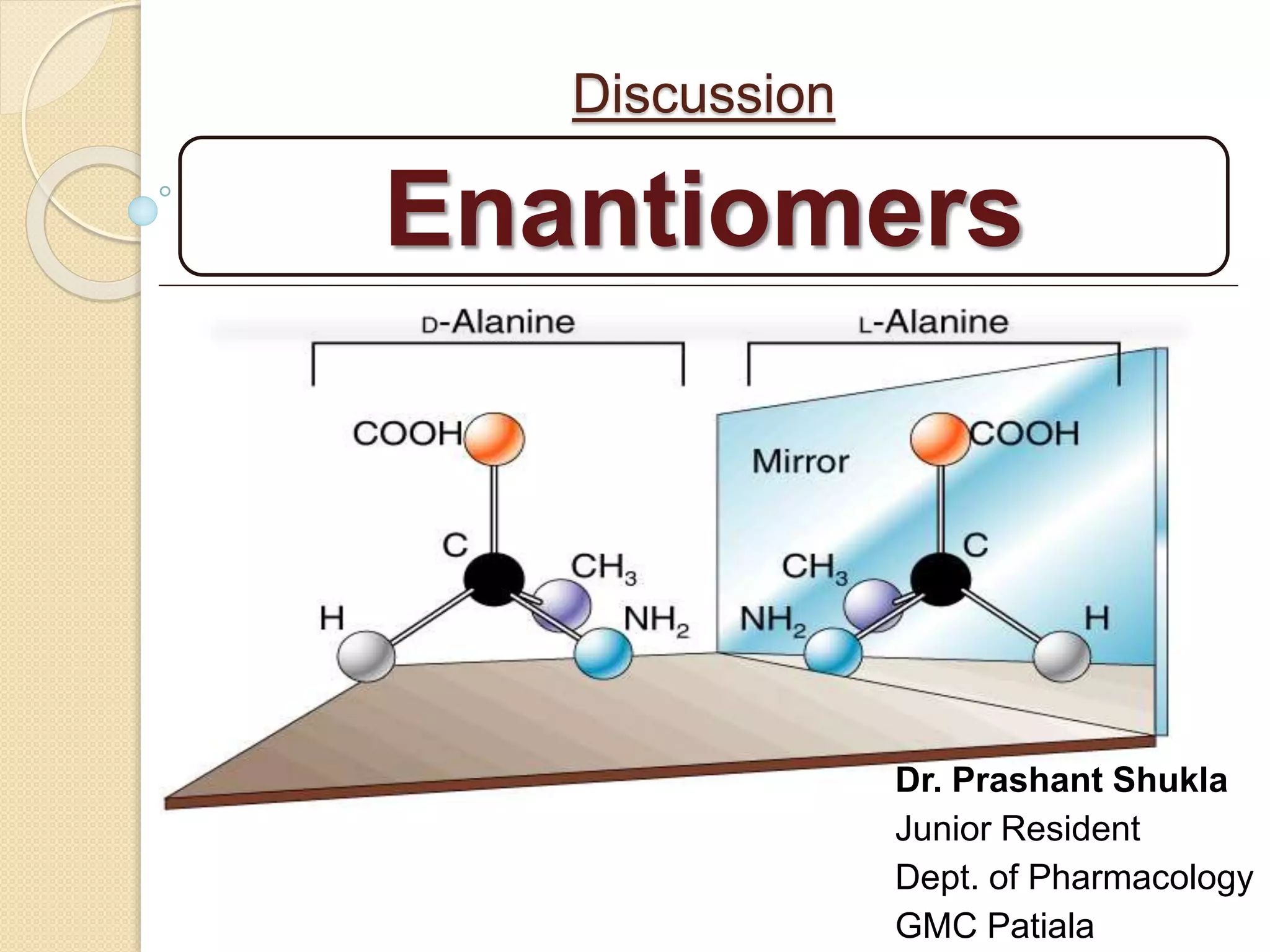
Enantiomers
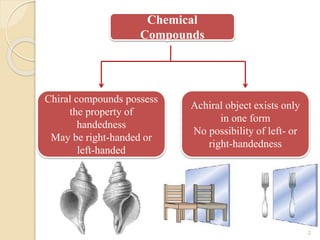
Chiral compounds possess
the property of
handedness
May be right-handed or
left-handed
Achiral object exists only
in one form
No possibility of left- or
right-handedness
Chemical
Compounds
2
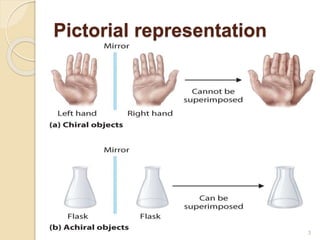
Pictorial representation
3
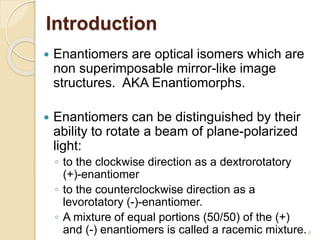
Introduction
 Enantiomers are optical isomers which are
non superimposable mirror-like image
structures. AKA Enantiomorphs.
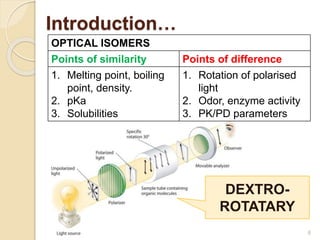
 Enantiomers can be distinguished by their
ability to rotate a beam of plane-polarized
light:
◦ to the clockwise direction as a dextrorotatory
(+)-enantiomer
◦ to the counterclockwise direction as a
levorotatory (-)-enantiomer.
◦ A mixture of equal portions (50/50) of the (+)
and (-) enantiomers is called a racemic mixture.4
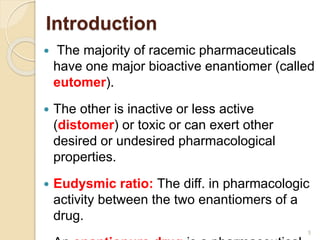
 The majority of racemic pharmaceuticals
have one major bioactive enantiomer (called
eutomer).
 The other is inactive or less active
(distomer) or toxic or can exert other
desired or undesired pharmacological
properties.
 Eudysmic ratio: The diff. in pharmacologic
activity between the two enantiomers of a
drug.
Introduction
5
OPTICAL ISOMERS
Points of similarity Points of difference
1. Melting point, boiling
point, density.
2. pKa
3. Solubilities
1. Rotation of polarised
light
2. Odor, enzyme activity
3. PK/PD parameters
Introduction…
DEXTRO-
ROTATARY
6
Naming Conventions
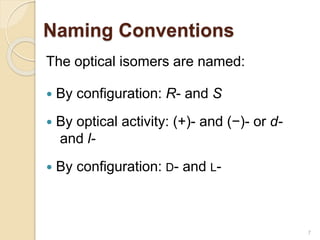
The optical isomers are named:
 By configuration: R- and S
 By optical activity: (+)- and (−)- or d-
and l-
 By configuration: D- and L-
7
Importance of enantiomers
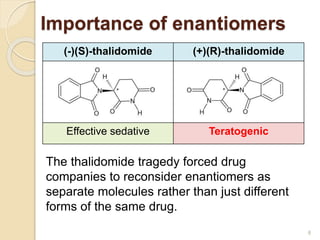
(-)(S)-thalidomide (+)(R)-thalidomide
Effective sedative Teratogenic
The thalidomide tragedy forced drug
companies to reconsider enantiomers as
separate molecules rather than just different
forms of the same drug.
8
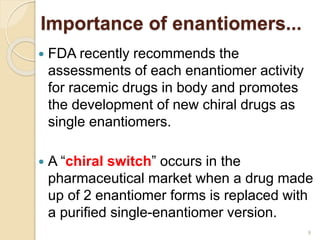
 FDA recently recommends the
assessments of each enantiomer activity
for racemic drugs in body and promotes
the development of new chiral drugs as
single enantiomers.
 A “chiral switch” occurs in the
pharmaceutical market when a drug made
up of 2 enantiomer forms is replaced with
a purified single-enantiomer version.
Importance of enantiomers...
9
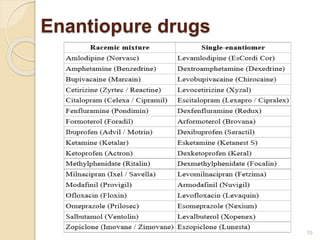
Enantiopure drugs
10
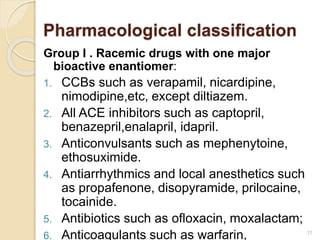
Pharmacological classification
Group I . Racemic drugs with one major
bioactive enantiomer:
1. CCBs such as verapamil, nicardipine,
nimodipine,etc, except diltiazem.
2. All ACE inhibitors such as captopril,
benazepril,enalapril, idapril.
3. Anticonvulsants such as mephenytoine,
ethosuximide.
4. Antiarrhythmics and local anesthetics such
as propafenone, disopyramide, prilocaine,
tocainide.
5. Antibiotics such as ofloxacin, moxalactam;
6. Anticoagulants such as warfarin, 11
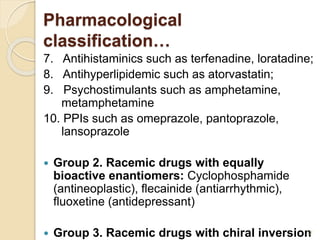
7. Antihistaminics such as terfenadine, loratadine;
8. Antihyperlipidemic such as atorvastatin;
9. Psychostimulants such as amphetamine,
metamphetamine
10. PPIs such as omeprazole, pantoprazole,
lansoprazole
 Group 2. Racemic drugs with equally
bioactive enantiomers: Cyclophosphamide
(antineoplastic), flecainide (antiarrhythmic),
fluoxetine (antidepressant)
 Group 3. Racemic drugs with chiral inversion12
Pharmacological
classification…
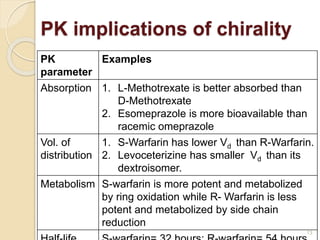
PK
parameter
Examples
Absorption 1. L-Methotrexate is better absorbed than
D-Methotrexate
2. Esomeprazole is more bioavailable than
racemic omeprazole
Vol. of
distribution
1. S-Warfarin has lower Vd than R-Warfarin.
2. Levoceterizine has smaller Vd than its
dextroisomer.
Metabolism S-warfarin is more potent and metabolized
by ring oxidation while R- Warfarin is less
potent and metabolized by side chain
reduction
PK implications of chirality
13
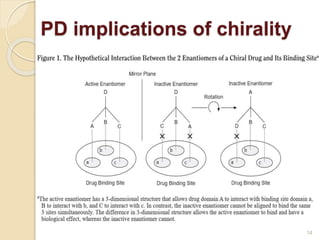
PD implications of chirality
14
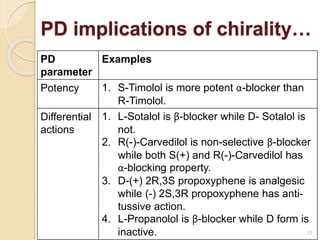
PD
parameter
Examples
Potency 1. S-Timolol is more potent α-blocker than
R-Timolol.
Differential
actions
1. L-Sotalol is β-blocker while D- Sotalol is
not.
2. R(-)-Carvedilol is non-selective β-blocker
while both S(+) and R(-)-Carvedilol has
α-blocking property.
3. D-(+) 2R,3S propoxyphene is analgesic
while (-) 2S,3R propoxyphene has anti-
tussive action.
4. L-Propanolol is β-blocker while D form is
inactive.
PD implications of chirality…
15
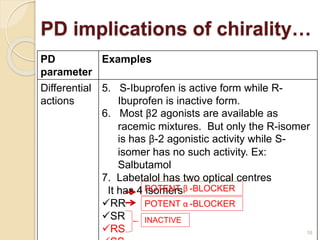
PD
parameter
Examples
Differential
actions
5. S-Ibuprofen is active form while R-
Ibuprofen is inactive form.
6. Most β2 agonists are available as
racemic mixtures. But only the R-isomer
is has β-2 agonistic activity while S-
isomer has no such activity. Ex:
Salbutamol
7. Labetalol has two optical centres
It has 4 isomers
RR
SR
RS
PD implications of chirality…
INACTIVE
POTENT β -BLOCKER
POTENT α -BLOCKER
16
Advantages
1. Separating unwanted side effects if
these reside exclusively in one
enantiomer.
2. Reduce metabolic/renal/hepatic drug
load.
3. Easier assessment of physiology,
disease and drug co-administration
effects.
4. Reduce drug interactions.
5. Avoid enantiomer–enantiomer drug 17
Chiral inversion
A metabolic process which requires enzyme activit
y to convert one enantiomeric form into
the other. Metabolic enzymes can:
1. introduce a stereogenic centre into a non-
chiral molecule to form enantiomeric metabolite
2. alter a ligand attached to a stereogenic centre w
ith either retention or inversion of chirality
3. introduce an additional stereogenic centre into a
chiral molecule to produce diastereomeric
metabolites
4. convert a pair of enantiomers into a common
metabolite by removal of a stereogenic centre
18
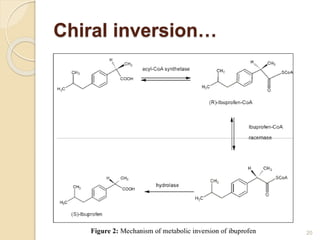
There are two kinds of drug chiral
inversion:
1. Unidirectional inversion: R-
enantiomer can undergo chiral
inversion by hepatic enzymes into the
active S-enantiomer and notvice-versa
2. Bidirectional inversion: Bidirectional
chiral inversion or racemization should
be represented by 3-hydroxy-
benzodiazepines (oxazepam,
lorazepam, temazepam) and 19
Chiral inversion
Chiral inversion…
20
Regulatory considerations
 A pure enantiomer developed from a
previously registered racemic drug
should be submitted, treated, and
evaluated as an application for a new
drug to the formulary.
 Therapeutic economic risk/benefit
aspects of enantiomer versus racemate
must be judged separately for each
drug.
It may not be economically feasible to
pay an increased amount for only
slightly increased efficacy. 21
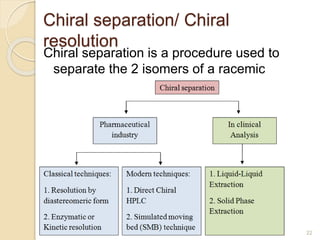
Chiral separation/ Chiral
resolution
Chiral separation is a procedure used to
separate the 2 isomers of a racemic
compound.
22
Conclusions
Chirality is now a top-class subject for
academic research as well as for
pharmaceutical development.
Accounting for the important role of chiral
separation, the 2001 Nobel Prize was
awarded to Dr. W.S. Knowles, Dr. K.
Barry and Dr. R. Nyori, for their
development of asymmetric synthesis
using chiral catalysts in the production of
single enantiomer drugs. 23
24
References
1. Chhabra N, Aseri ML, Padmanabhan D.
A review of drug isomerism and its
significance. Int J Appl Basic Med Res.
2013 Jan-Jul;3(1):16-18.
2. McConathy J, Owens MJ.
Stereochemistry in drug action. Primary
care companion J clin
psychiatry.2003;5(2):70-73.
3. Leffingwell JC. Chirality & Bioactivity I.:
Pharmacology Leffingwell Reports. May
2003;3(1).
4. Nguyen LA, He H, Huy CP. Chiral drugs:
AN overview. Int J Biomed Sci. 2006;85-
106. 25
26

Role of Enantiomers in Pharmacology

  • 1.
    Discussion Dr. Prashant Shukla JuniorResident Dept. of Pharmacology GMC Patiala Enantiomers
  • 2.
    Chiral compounds possess theproperty of handedness May be right-handed or left-handed Achiral object exists only in one form No possibility of left- or right-handedness Chemical Compounds 2
  • 3.
  • 4.
    Introduction  Enantiomers areoptical isomers which are non superimposable mirror-like image structures. AKA Enantiomorphs.  Enantiomers can be distinguished by their ability to rotate a beam of plane-polarized light: ◦ to the clockwise direction as a dextrorotatory (+)-enantiomer ◦ to the counterclockwise direction as a levorotatory (-)-enantiomer. ◦ A mixture of equal portions (50/50) of the (+) and (-) enantiomers is called a racemic mixture.4
  • 5.
     The majorityof racemic pharmaceuticals have one major bioactive enantiomer (called eutomer).  The other is inactive or less active (distomer) or toxic or can exert other desired or undesired pharmacological properties.  Eudysmic ratio: The diff. in pharmacologic activity between the two enantiomers of a drug. Introduction 5
  • 6.
    OPTICAL ISOMERS Points ofsimilarity Points of difference 1. Melting point, boiling point, density. 2. pKa 3. Solubilities 1. Rotation of polarised light 2. Odor, enzyme activity 3. PK/PD parameters Introduction… DEXTRO- ROTATARY 6
  • 7.
    Naming Conventions The opticalisomers are named:  By configuration: R- and S  By optical activity: (+)- and (−)- or d- and l-  By configuration: D- and L- 7
  • 8.
    Importance of enantiomers (-)(S)-thalidomide(+)(R)-thalidomide Effective sedative Teratogenic The thalidomide tragedy forced drug companies to reconsider enantiomers as separate molecules rather than just different forms of the same drug. 8
  • 9.
     FDA recentlyrecommends the assessments of each enantiomer activity for racemic drugs in body and promotes the development of new chiral drugs as single enantiomers.  A “chiral switch” occurs in the pharmaceutical market when a drug made up of 2 enantiomer forms is replaced with a purified single-enantiomer version. Importance of enantiomers... 9
  • 10.
  • 11.
    Pharmacological classification Group I. Racemic drugs with one major bioactive enantiomer: 1. CCBs such as verapamil, nicardipine, nimodipine,etc, except diltiazem. 2. All ACE inhibitors such as captopril, benazepril,enalapril, idapril. 3. Anticonvulsants such as mephenytoine, ethosuximide. 4. Antiarrhythmics and local anesthetics such as propafenone, disopyramide, prilocaine, tocainide. 5. Antibiotics such as ofloxacin, moxalactam; 6. Anticoagulants such as warfarin, 11
  • 12.
    7. Antihistaminics suchas terfenadine, loratadine; 8. Antihyperlipidemic such as atorvastatin; 9. Psychostimulants such as amphetamine, metamphetamine 10. PPIs such as omeprazole, pantoprazole, lansoprazole  Group 2. Racemic drugs with equally bioactive enantiomers: Cyclophosphamide (antineoplastic), flecainide (antiarrhythmic), fluoxetine (antidepressant)  Group 3. Racemic drugs with chiral inversion12 Pharmacological classification…
  • 13.
    PK parameter Examples Absorption 1. L-Methotrexateis better absorbed than D-Methotrexate 2. Esomeprazole is more bioavailable than racemic omeprazole Vol. of distribution 1. S-Warfarin has lower Vd than R-Warfarin. 2. Levoceterizine has smaller Vd than its dextroisomer. Metabolism S-warfarin is more potent and metabolized by ring oxidation while R- Warfarin is less potent and metabolized by side chain reduction PK implications of chirality 13
  • 14.
    PD implications ofchirality 14
  • 15.
    PD parameter Examples Potency 1. S-Timololis more potent α-blocker than R-Timolol. Differential actions 1. L-Sotalol is β-blocker while D- Sotalol is not. 2. R(-)-Carvedilol is non-selective β-blocker while both S(+) and R(-)-Carvedilol has α-blocking property. 3. D-(+) 2R,3S propoxyphene is analgesic while (-) 2S,3R propoxyphene has anti- tussive action. 4. L-Propanolol is β-blocker while D form is inactive. PD implications of chirality… 15
  • 16.
    PD parameter Examples Differential actions 5. S-Ibuprofen isactive form while R- Ibuprofen is inactive form. 6. Most β2 agonists are available as racemic mixtures. But only the R-isomer is has β-2 agonistic activity while S- isomer has no such activity. Ex: Salbutamol 7. Labetalol has two optical centres It has 4 isomers RR SR RS PD implications of chirality… INACTIVE POTENT β -BLOCKER POTENT α -BLOCKER 16
  • 17.
    Advantages 1. Separating unwantedside effects if these reside exclusively in one enantiomer. 2. Reduce metabolic/renal/hepatic drug load. 3. Easier assessment of physiology, disease and drug co-administration effects. 4. Reduce drug interactions. 5. Avoid enantiomer–enantiomer drug 17
  • 18.
    Chiral inversion A metabolicprocess which requires enzyme activit y to convert one enantiomeric form into the other. Metabolic enzymes can: 1. introduce a stereogenic centre into a non- chiral molecule to form enantiomeric metabolite 2. alter a ligand attached to a stereogenic centre w ith either retention or inversion of chirality 3. introduce an additional stereogenic centre into a chiral molecule to produce diastereomeric metabolites 4. convert a pair of enantiomers into a common metabolite by removal of a stereogenic centre 18
  • 19.
    There are twokinds of drug chiral inversion: 1. Unidirectional inversion: R- enantiomer can undergo chiral inversion by hepatic enzymes into the active S-enantiomer and notvice-versa 2. Bidirectional inversion: Bidirectional chiral inversion or racemization should be represented by 3-hydroxy- benzodiazepines (oxazepam, lorazepam, temazepam) and 19 Chiral inversion
  • 20.
  • 21.
    Regulatory considerations  Apure enantiomer developed from a previously registered racemic drug should be submitted, treated, and evaluated as an application for a new drug to the formulary.  Therapeutic economic risk/benefit aspects of enantiomer versus racemate must be judged separately for each drug. It may not be economically feasible to pay an increased amount for only slightly increased efficacy. 21
  • 22.
    Chiral separation/ Chiral resolution Chiralseparation is a procedure used to separate the 2 isomers of a racemic compound. 22
  • 23.
    Conclusions Chirality is nowa top-class subject for academic research as well as for pharmaceutical development. Accounting for the important role of chiral separation, the 2001 Nobel Prize was awarded to Dr. W.S. Knowles, Dr. K. Barry and Dr. R. Nyori, for their development of asymmetric synthesis using chiral catalysts in the production of single enantiomer drugs. 23
  • 24.
  • 25.
    References 1. Chhabra N,Aseri ML, Padmanabhan D. A review of drug isomerism and its significance. Int J Appl Basic Med Res. 2013 Jan-Jul;3(1):16-18. 2. McConathy J, Owens MJ. Stereochemistry in drug action. Primary care companion J clin psychiatry.2003;5(2):70-73. 3. Leffingwell JC. Chirality & Bioactivity I.: Pharmacology Leffingwell Reports. May 2003;3(1). 4. Nguyen LA, He H, Huy CP. Chiral drugs: AN overview. Int J Biomed Sci. 2006;85- 106. 25
  • 26.