Topic outline
• Brief introduction of TB
• Medicinal Chemistry of INH: Anti-TB drug
Dr. Khalid Hussain (hussain_761@yahoo.com)
Tuberculosis (TB)
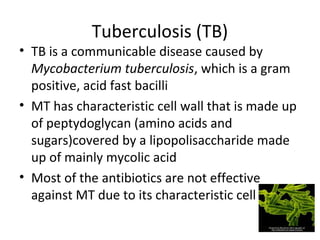
• TB is a communicable disease caused by
Mycobacterium tuberculosis, which is a gram
positive, acid fast bacilli
• MT has characteristic cell wall that is made up
of peptydoglycan (amino acids and
sugars)covered by a lipopolisaccharide made
up of mainly mycolic acid
• Most of the antibiotics are not effective
against MT due to its characteristic cell wall
Anti-TB drugs
• First agent used as an anti-TB drug was
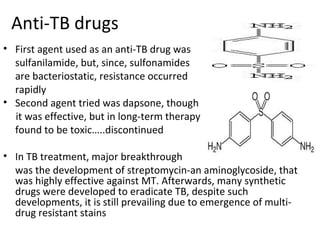
sulfanilamide, but, since, sulfonamides
are bacteriostatic, resistance occurred
rapidly
• Second agent tried was dapsone, though
it was effective, but in long-term therapy
found to be toxic…..discontinued
• In TB treatment, major breakthrough
was the development of streptomycin-an aminoglycoside, that
was highly effective against MT. Afterwards, many synthetic
drugs were developed to eradicate TB, despite such
developments, it is still prevailing due to emergence of multi-
drug resistant stains
Isoniazid
• It is synthetic anti-TB drug introduced in 1950
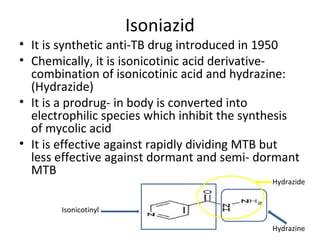
• Chemically, it is isonicotinic acid derivative-
combination of isonicotinic acid and hydrazine:
(Hydrazide)
• It is a prodrug- in body is converted into
electrophilic species which inhibit the synthesis
of mycolic acid
• It is effective against rapidly dividing MTB but
less effective against dormant and semi- dormant
MTB
Isonicotinyl
Hydrazine
Hydrazide
Structure activity relationship
• Pyridine ring, if replaced with piperidine then
the compound is less active than the original
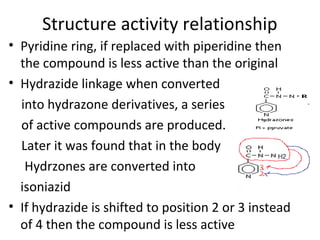
• Hydrazide linkage when converted
into hydrazone derivatives, a series
of active compounds are produced.
Later it was found that in the body
Hydrzones are converted into
isoniazid
• If hydrazide is shifted to position 2 or 3 instead
of 4 then the compound is less active
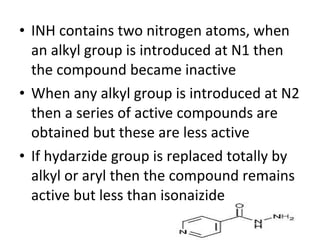
• INH contains two nitrogen atoms, when
an alkyl group is introduced at N1 then
the compound became inactive
• When any alkyl group is introduced at N2
then a series of active compounds are
obtained but these are less active
• If hydarzide group is replaced totally by
alkyl or aryl then the compound remains
active but less than isonaizide
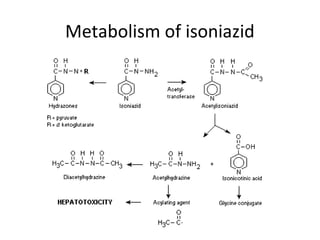
Metabolism of isoniazid
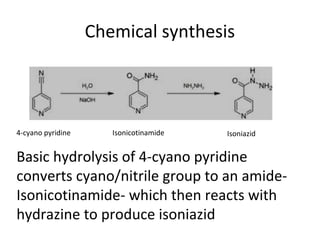
Chemical synthesis
4-cyano pyridine Isonicotinamide Isoniazid
Basic hydrolysis of 4-cyano pyridine
converts cyano/nitrile group to an amide-
Isonicotinamide- which then reacts with
hydrazine to produce isoniazid
Mechanism of action
• INH undergoes oxidation reaction by
endogenous catalyzing enzymes, producing
reactive species capable of acylating the
enzyme (inhA)-found in MT
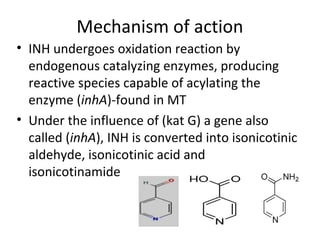
• Under the influence of (kat G) a gene also
called (inhA), INH is converted into isonicotinic
aldehyde, isonicotinic acid and
isonicotinamide
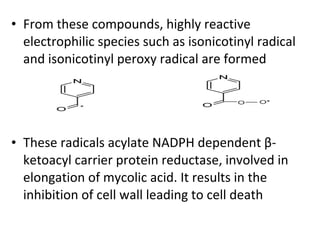
• From these compounds, highly reactive
electrophilic species such as isonicotinyl radical
and isonicotinyl peroxy radical are formed
• These radicals acylate NADPH dependent β-
ketoacyl carrier protein reductase, involved in
elongation of mycolic acid. It results in the
inhibition of cell wall leading to cell death
• This enzyme selectively acts on fatty acids (more
than 26 carbon). Mycolic acid is a α-branched
fatty acids having short arm of 20-24 carbon and
long arm of 26-50 carbon
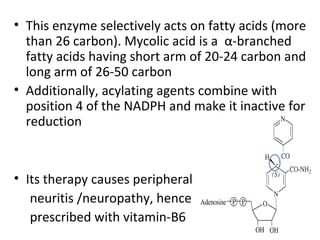
• Additionally, acylating agents combine with
position 4 of the NADPH and make it inactive for
reduction
• Its therapy causes peripheral
neuritis /neuropathy, hence
prescribed with vitamin-B6
Pyrazinamide (PZA )
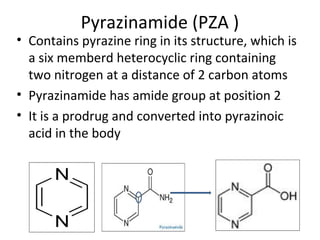
• Contains pyrazine ring in its structure, which is
a six memberd heterocyclic ring containing
two nitrogen at a distance of 2 carbon atoms
• Pyrazinamide has amide group at position 2
• It is a prodrug and converted into pyrazinoic
acid in the body
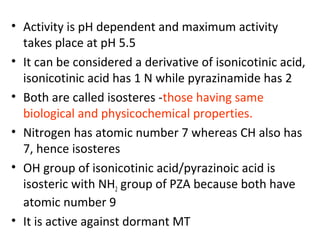
• Activity is pH dependent and maximum activity
takes place at pH 5.5
• It can be considered a derivative of isonicotinic acid,
isonicotinic acid has 1 N while pyrazinamide has 2
• Both are called isosteres -those having same
biological and physicochemical properties.
• Nitrogen has atomic number 7 whereas CH also has
7, hence isosteres
• OH group of isonicotinic acid/pyrazinoic acid is
isosteric with NH2 group of PZA because both have
atomic number 9
• It is active against dormant MT
Structure activity relationship
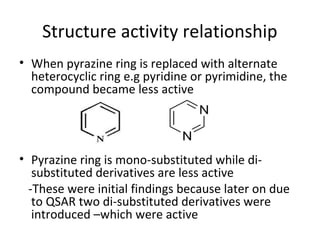
• When pyrazine ring is replaced with alternate
heterocyclic ring e.g pyridine or pyrimidine, the
compound became less active
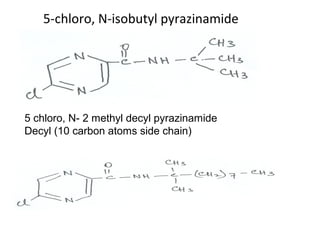
• Pyrazine ring is mono-substituted while di-
substituted derivatives are less active
-These were initial findings because later on due
to QSAR two di-substituted derivatives were
introduced –which were active
5-chloro, N-isobutyl pyrazinamide
5 chloro, N- 2 methyl decyl pyrazinamide
Decyl (10 carbon atoms side chain)
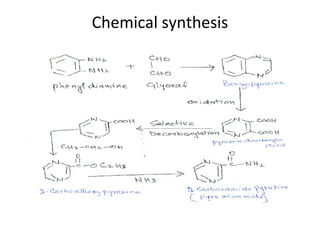
Chemical synthesis
Therapeutic uses
• It is effective against dormant MT
• Activity is pH dependent, when administered
pH is lowered to 5.5 which is not suitable for
the growth of MT-suitable is 7.2- hence MT is
eradicated
• It is given in combination with other anti-TB
drugs

TB, historical perspective of anti TB drugs and medicinal chemistry of INH

  • 1.
    Topic outline • Briefintroduction of TB • Medicinal Chemistry of INH: Anti-TB drug Dr. Khalid Hussain (hussain_761@yahoo.com)
  • 2.
    Tuberculosis (TB) • TBis a communicable disease caused by Mycobacterium tuberculosis, which is a gram positive, acid fast bacilli • MT has characteristic cell wall that is made up of peptydoglycan (amino acids and sugars)covered by a lipopolisaccharide made up of mainly mycolic acid • Most of the antibiotics are not effective against MT due to its characteristic cell wall
  • 3.
    Anti-TB drugs • Firstagent used as an anti-TB drug was sulfanilamide, but, since, sulfonamides are bacteriostatic, resistance occurred rapidly • Second agent tried was dapsone, though it was effective, but in long-term therapy found to be toxic…..discontinued • In TB treatment, major breakthrough was the development of streptomycin-an aminoglycoside, that was highly effective against MT. Afterwards, many synthetic drugs were developed to eradicate TB, despite such developments, it is still prevailing due to emergence of multi- drug resistant stains
  • 4.
    Isoniazid • It issynthetic anti-TB drug introduced in 1950 • Chemically, it is isonicotinic acid derivative- combination of isonicotinic acid and hydrazine: (Hydrazide) • It is a prodrug- in body is converted into electrophilic species which inhibit the synthesis of mycolic acid • It is effective against rapidly dividing MTB but less effective against dormant and semi- dormant MTB Isonicotinyl Hydrazine Hydrazide
  • 5.
    Structure activity relationship •Pyridine ring, if replaced with piperidine then the compound is less active than the original • Hydrazide linkage when converted into hydrazone derivatives, a series of active compounds are produced. Later it was found that in the body Hydrzones are converted into isoniazid • If hydrazide is shifted to position 2 or 3 instead of 4 then the compound is less active
  • 6.
    • INH containstwo nitrogen atoms, when an alkyl group is introduced at N1 then the compound became inactive • When any alkyl group is introduced at N2 then a series of active compounds are obtained but these are less active • If hydarzide group is replaced totally by alkyl or aryl then the compound remains active but less than isonaizide
  • 7.
  • 8.
    Chemical synthesis 4-cyano pyridineIsonicotinamide Isoniazid Basic hydrolysis of 4-cyano pyridine converts cyano/nitrile group to an amide- Isonicotinamide- which then reacts with hydrazine to produce isoniazid
  • 9.
    Mechanism of action •INH undergoes oxidation reaction by endogenous catalyzing enzymes, producing reactive species capable of acylating the enzyme (inhA)-found in MT • Under the influence of (kat G) a gene also called (inhA), INH is converted into isonicotinic aldehyde, isonicotinic acid and isonicotinamide
  • 10.
    • From thesecompounds, highly reactive electrophilic species such as isonicotinyl radical and isonicotinyl peroxy radical are formed • These radicals acylate NADPH dependent β- ketoacyl carrier protein reductase, involved in elongation of mycolic acid. It results in the inhibition of cell wall leading to cell death
  • 11.
    • This enzymeselectively acts on fatty acids (more than 26 carbon). Mycolic acid is a α-branched fatty acids having short arm of 20-24 carbon and long arm of 26-50 carbon • Additionally, acylating agents combine with position 4 of the NADPH and make it inactive for reduction • Its therapy causes peripheral neuritis /neuropathy, hence prescribed with vitamin-B6
  • 12.
    Pyrazinamide (PZA ) •Contains pyrazine ring in its structure, which is a six memberd heterocyclic ring containing two nitrogen at a distance of 2 carbon atoms • Pyrazinamide has amide group at position 2 • It is a prodrug and converted into pyrazinoic acid in the body
  • 13.
    • Activity ispH dependent and maximum activity takes place at pH 5.5 • It can be considered a derivative of isonicotinic acid, isonicotinic acid has 1 N while pyrazinamide has 2 • Both are called isosteres -those having same biological and physicochemical properties. • Nitrogen has atomic number 7 whereas CH also has 7, hence isosteres • OH group of isonicotinic acid/pyrazinoic acid is isosteric with NH2 group of PZA because both have atomic number 9 • It is active against dormant MT
  • 14.
    Structure activity relationship •When pyrazine ring is replaced with alternate heterocyclic ring e.g pyridine or pyrimidine, the compound became less active • Pyrazine ring is mono-substituted while di- substituted derivatives are less active -These were initial findings because later on due to QSAR two di-substituted derivatives were introduced –which were active
  • 15.
    5-chloro, N-isobutyl pyrazinamide 5chloro, N- 2 methyl decyl pyrazinamide Decyl (10 carbon atoms side chain)
  • 16.
  • 17.
    Therapeutic uses • Itis effective against dormant MT • Activity is pH dependent, when administered pH is lowered to 5.5 which is not suitable for the growth of MT-suitable is 7.2- hence MT is eradicated • It is given in combination with other anti-TB drugs