Ethambutol
• Due to its efficacy and less adverse effects it is
  included in first-line therapy of Tuberculosis
• It has synergistic action with other anti-Tb drugs
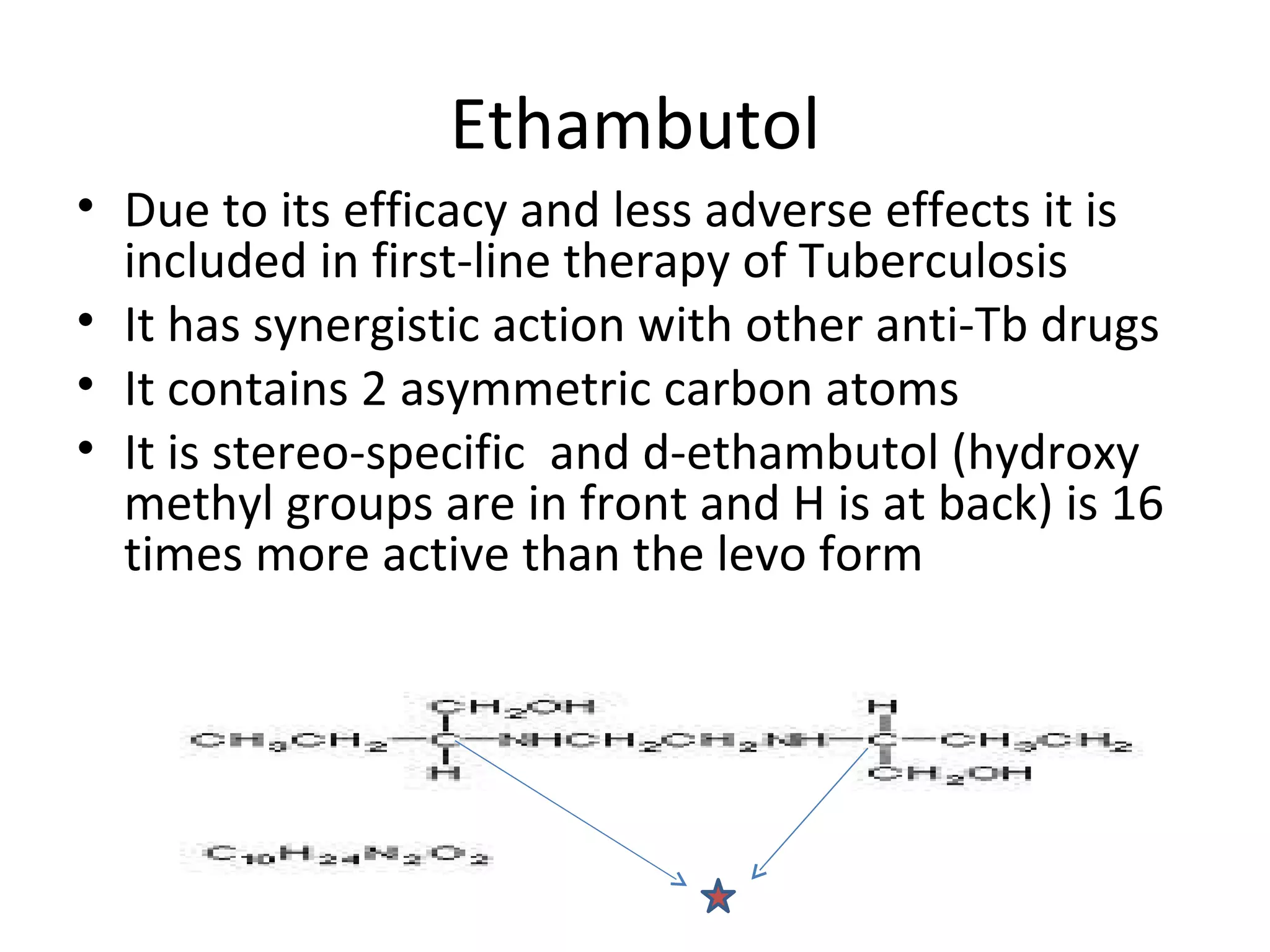
• It contains 2 asymmetric carbon atoms
• It is stereo-specific and d-ethambutol (hydroxy
  methyl groups are in front and H is at back) is 16
  times more active than the levo form
• It is more active on dividing cells, whereas, low or
  inactive on non-dividing cells. It inhibits the
  formation of cell wall.
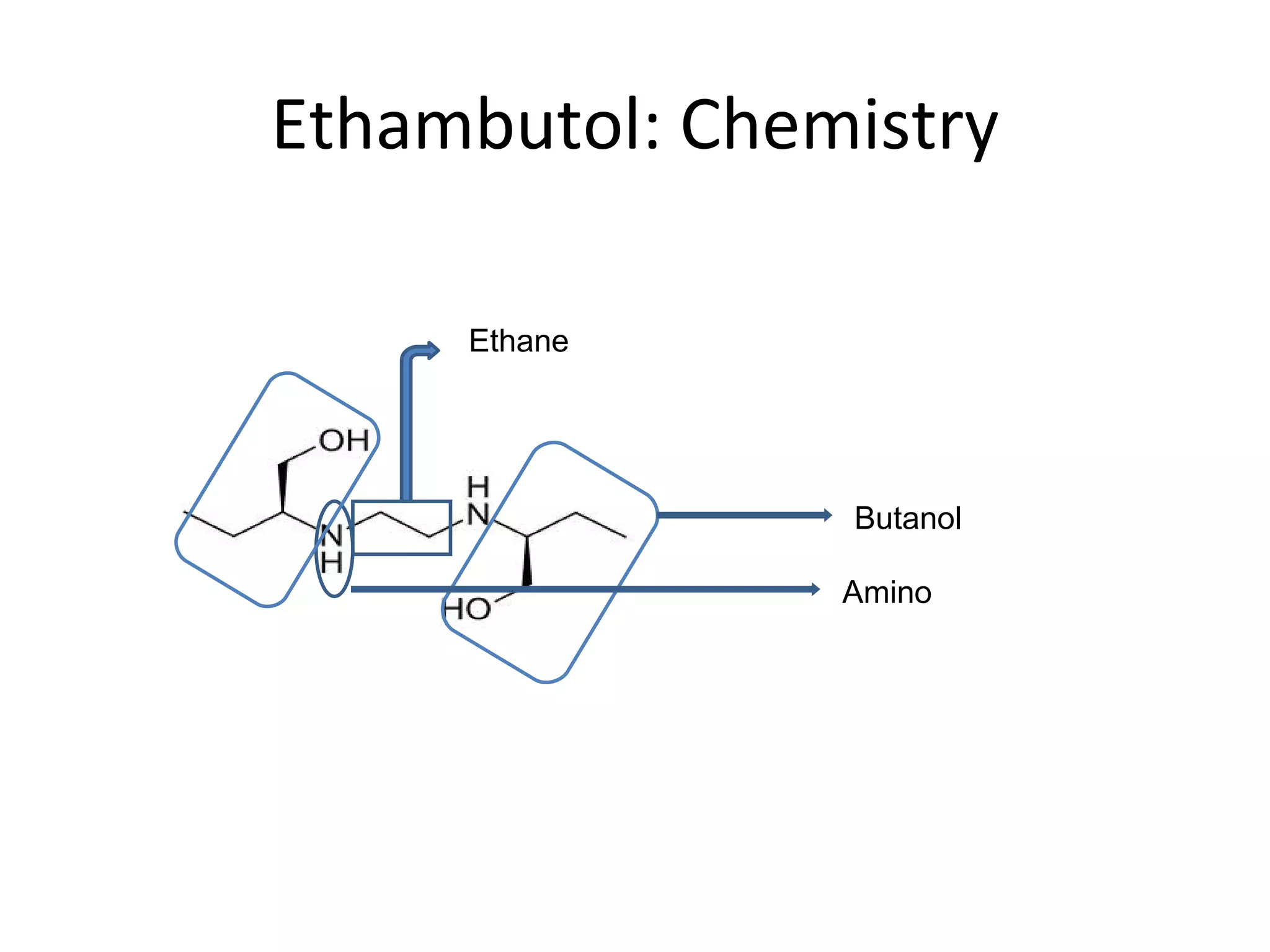
Ethambutol: Chemistry

     Ethane


                Butanol

                Amino
Mechanism of action
• Mechanism of EMB remains unknown though
  there was mounting evidence that it inhibits
  synthesis of cell wall
• But due to complex structure of the cell wall
  it was difficult to know the mechanism
Mechanism of action
• Peptidoglycan of the cell wall is covered by an
  envelop of arabinofuranose and galactose
  (AG) which is covalently attached with
  peptidoglycan and intercalated network of
  lipoarabinomannan (LAM). AG portion is
  highly branched and has distinct segments of
  galactan and distinct segments of arabinan.
  Mycolic acid is attached at C5 of the arabinan,
  usually penultimate unit
• Initially, it was thought that EMB inhibits the
  synthesis of AG part of the cell wall
• Now, it is found that it inhibits arabinosyl
  transferase that catalyzes the polymerization
  of D-arabinofuranose leading to the formation
  of AG and LAM
• As a result the accumulation of alpha D-
  arabinosyl-1 monophosphoryl decaprenol that
  leads to the over expression of the enzyme
  results in resistance
• Hence, the inhibition of the formation of these
  complexes increases permeability of the cell
  wall
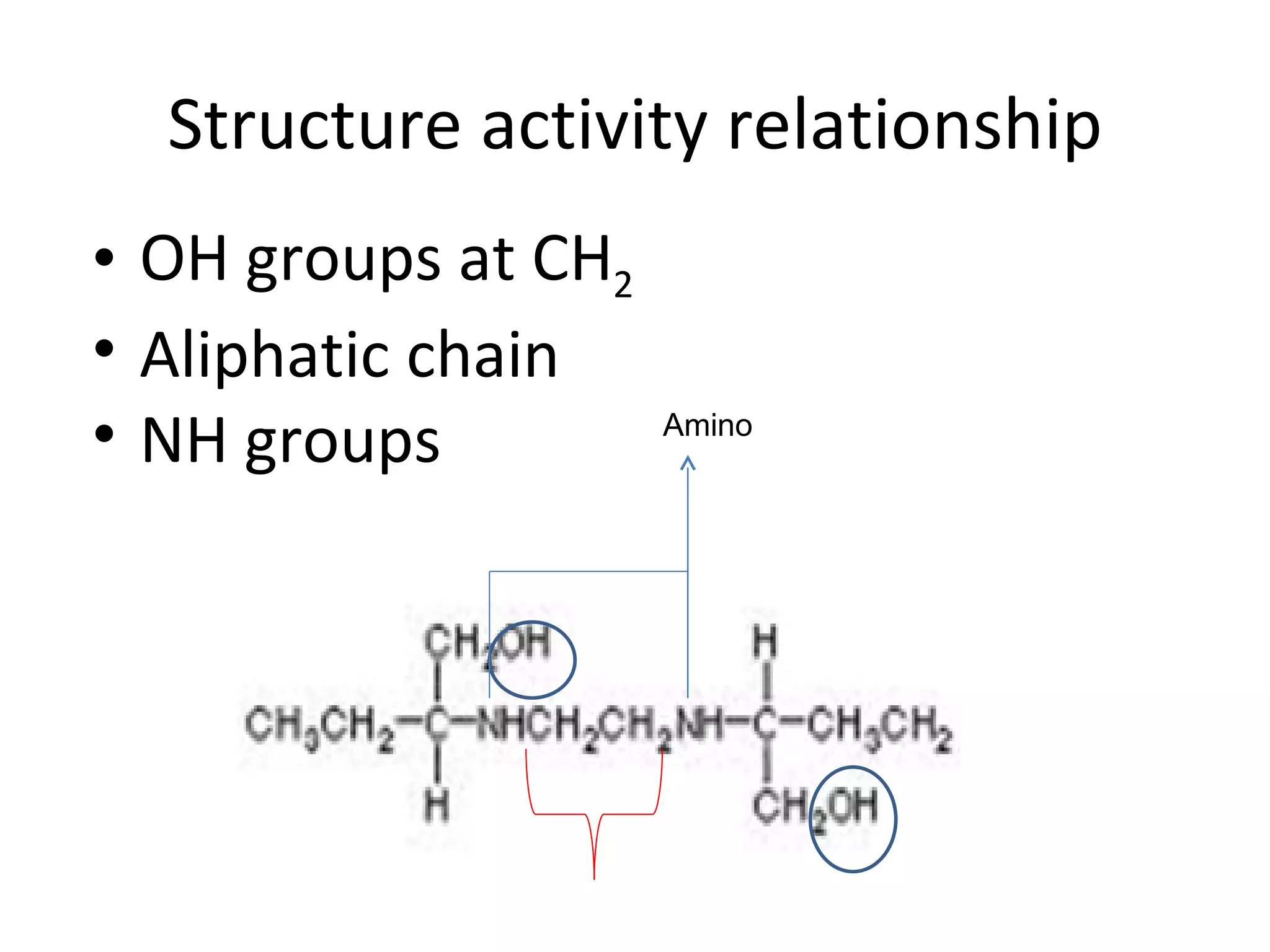
Structure activity relationship
• OH groups at CH2
• Aliphatic chain
• NH groups          Amino
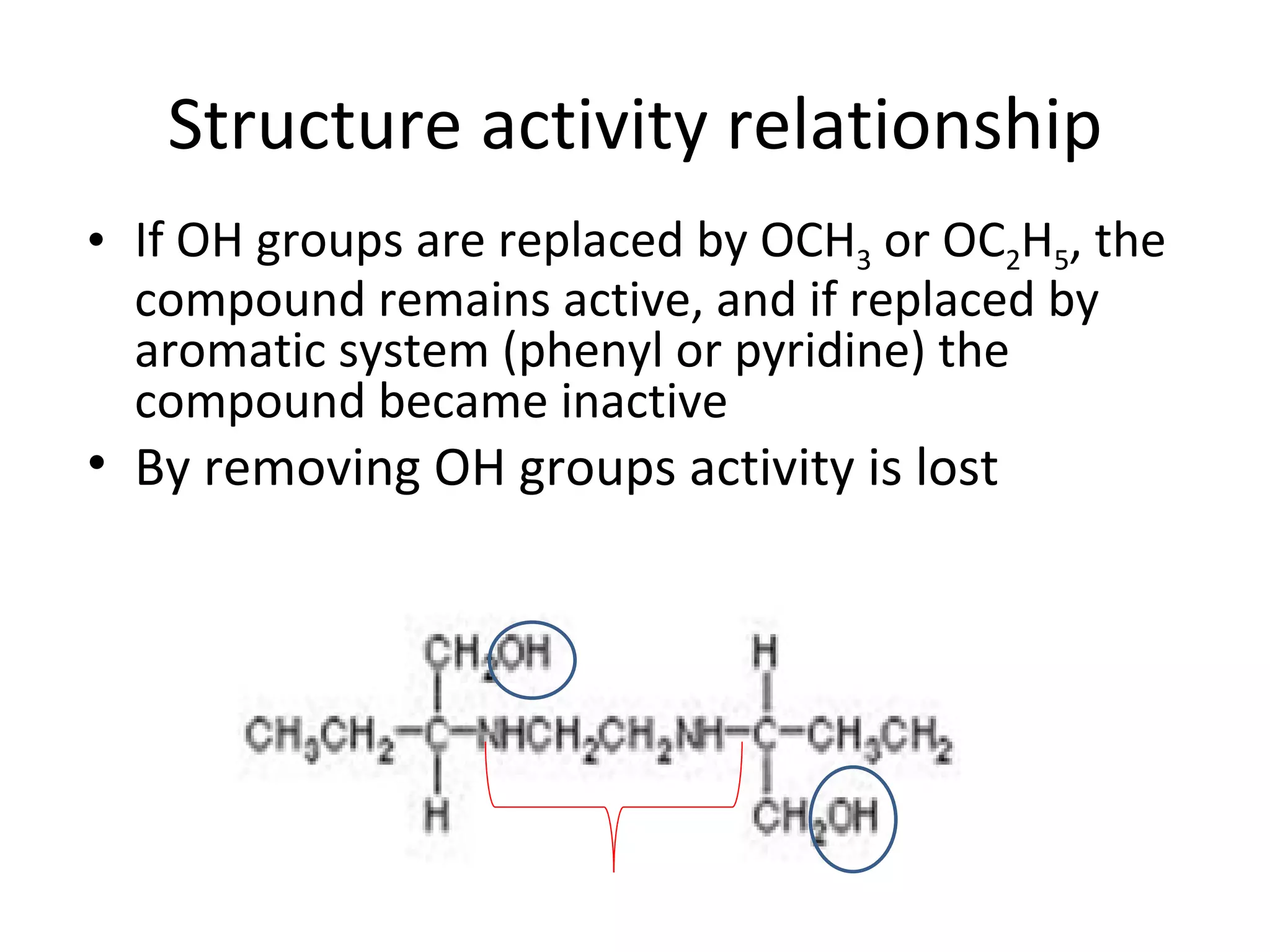
Structure activity relationship
• If OH groups are replaced by OCH3 or OC2H5, the
  compound remains active, and if replaced by
  aromatic system (phenyl or pyridine) the
  compound became inactive
• By removing OH groups activity is lost
• Extension of ethane diamine results in loss of
  activity
• Removal of either of the amino groups activity
  is lost
• Increase in size of N-substituent activity is lost
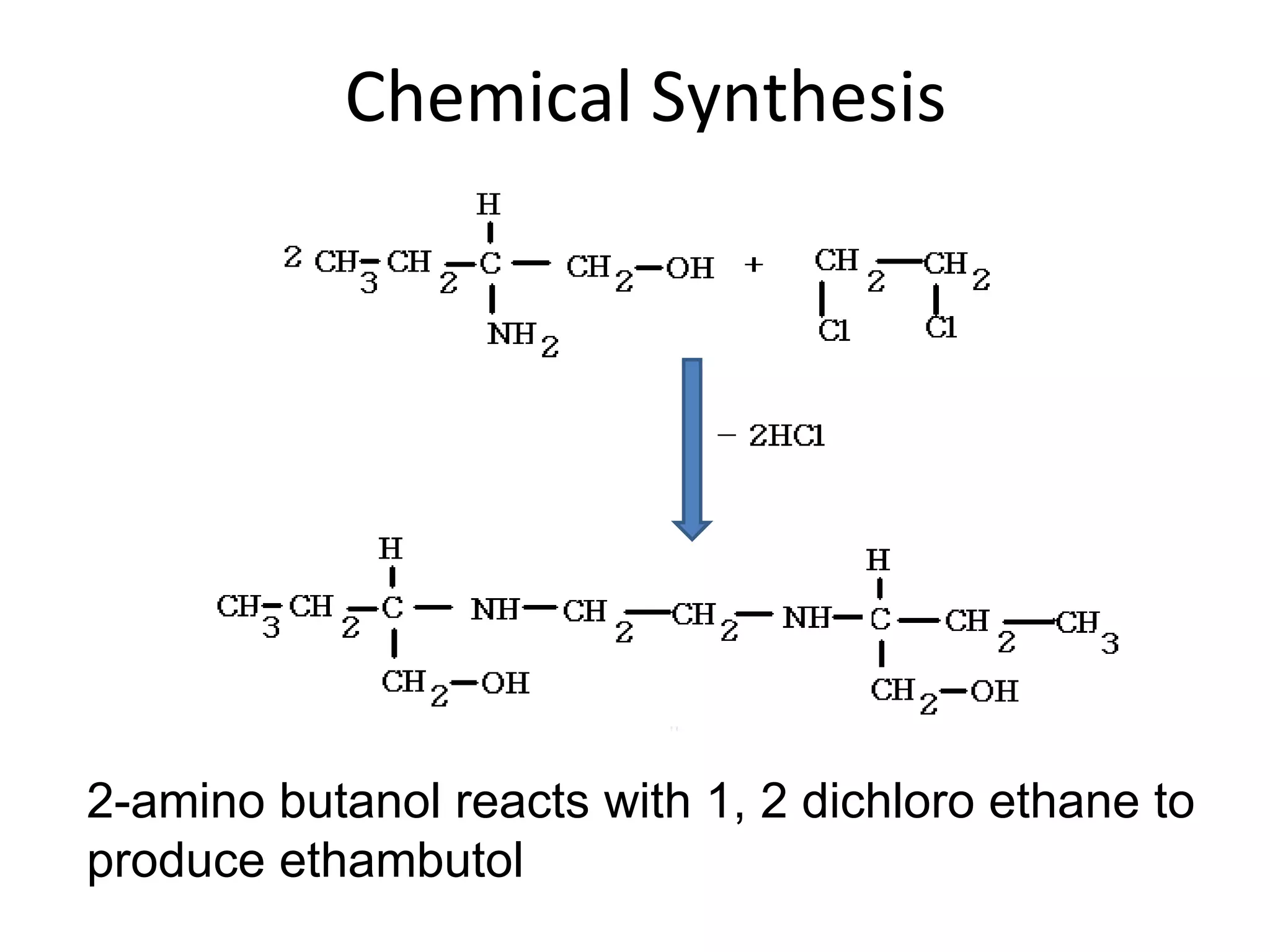
Chemical Synthesis


2-amino butanol reacts with 1, 2 dichloro ethane to
produce ethambutol
Antibacterial spectrum
• Bacteriostatic
• Specific for most of the strains like MT and M.
  kansasii
• Absorption
  – Well absorbed after oral absorption
• Distribution
  – Well distributed in all body fluids and tissues
    including CNS
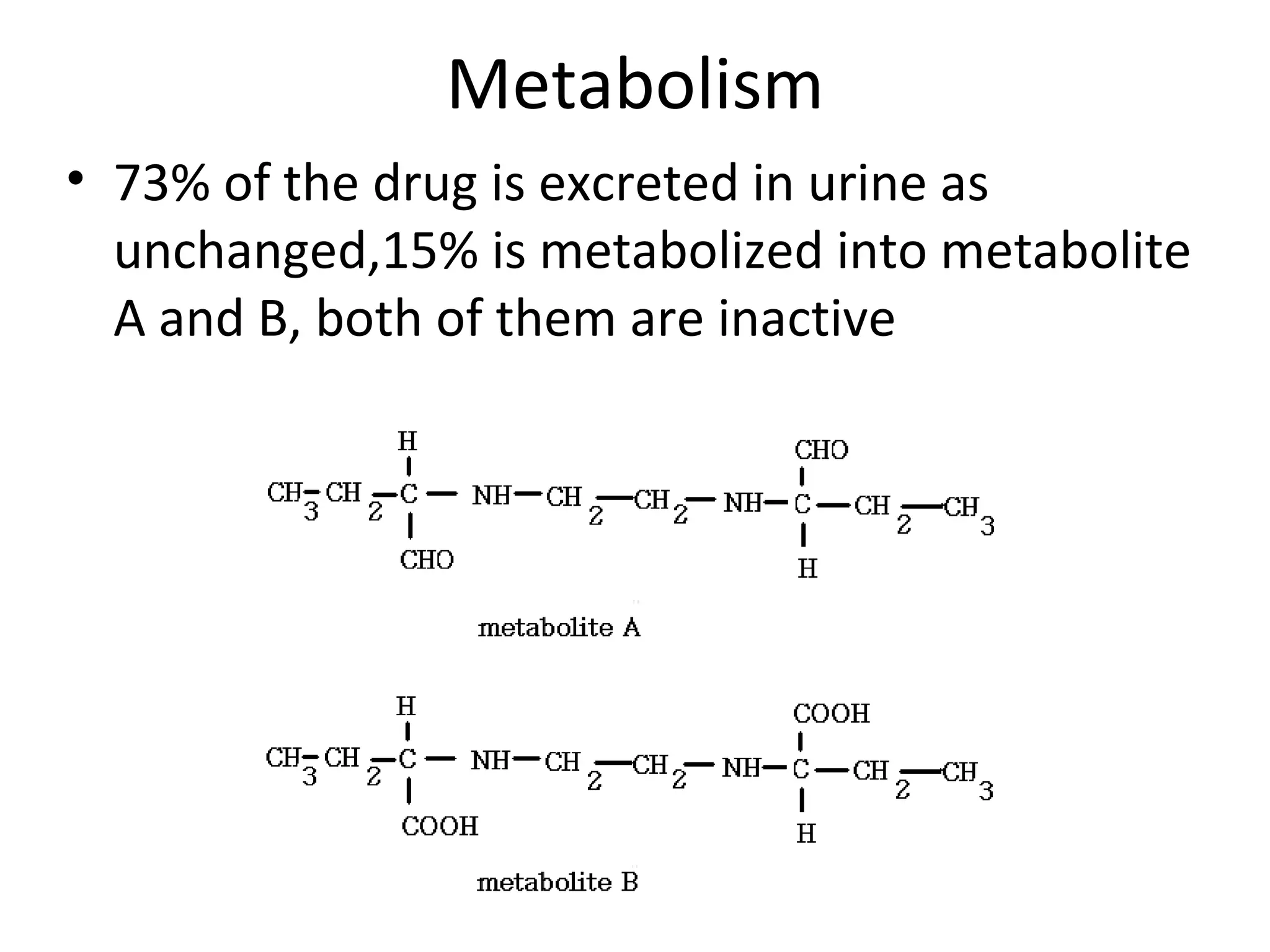
Metabolism
• 73% of the drug is excreted in urine as
  unchanged,15% is metabolized into metabolite
  A and B, both of them are inactive
Therapeutic uses
• Used in combination with INH, PZA and
  Rifampicin
• Its action is synergistic with other drugs
  because it disrupts cell wall and facilitates the
  penetration of other drugs
• Adverse reactions
  – Optic neuritis
  – Red green color blindness
  – Arthralgia (due to decreased urate excretion)
  – Vertical nystagmus (movement of eye ball)
  – Milk skin reaction
Para-aminosalisylic acid
• It is a synthetic 2nd line agent, used in case
  of resistance, re-treatment and
  intolerance to first line therapy, used in
  treatment of Tuberculosis
• It is used in combination with
  streptomycin and INH and in long term
  treatment (6-9 months) causes toxic
  effects on GIT and shows
  allergic reactions
• GIT: nausea, vomiting, diarrhoea, abdominal
  pain, un-dissolved granule coatings in stools

• Allergic reaction: difficulty in breathing,
  closing of throat and swelling of lips, tongue
  or face
• For maximum activity COOH and NH2 groups
  should be at para-position to each other
• OH group may be at ortho or meta position,
  but max activity when at ortho
• NH2 group if replaced with Cl
  or alkyl activity is reduced
• COOH if converted into amide or
  ester compound became less active
Mechanism of action
• It acts as an anti-metabolite interfering with
  incorporation of PABA into folic acid
• It is a structural analogue of PABA, hence inhibits
  the synthesis of folates in MT
• MT can distinguish between PABA and
  sulfonamides but not between PABA and PASA
• When co-administered with INH, prevents the
  acetylation of INH, being a substrate, results in
  increase in INH concentration in plasma
Mechanism of action continued
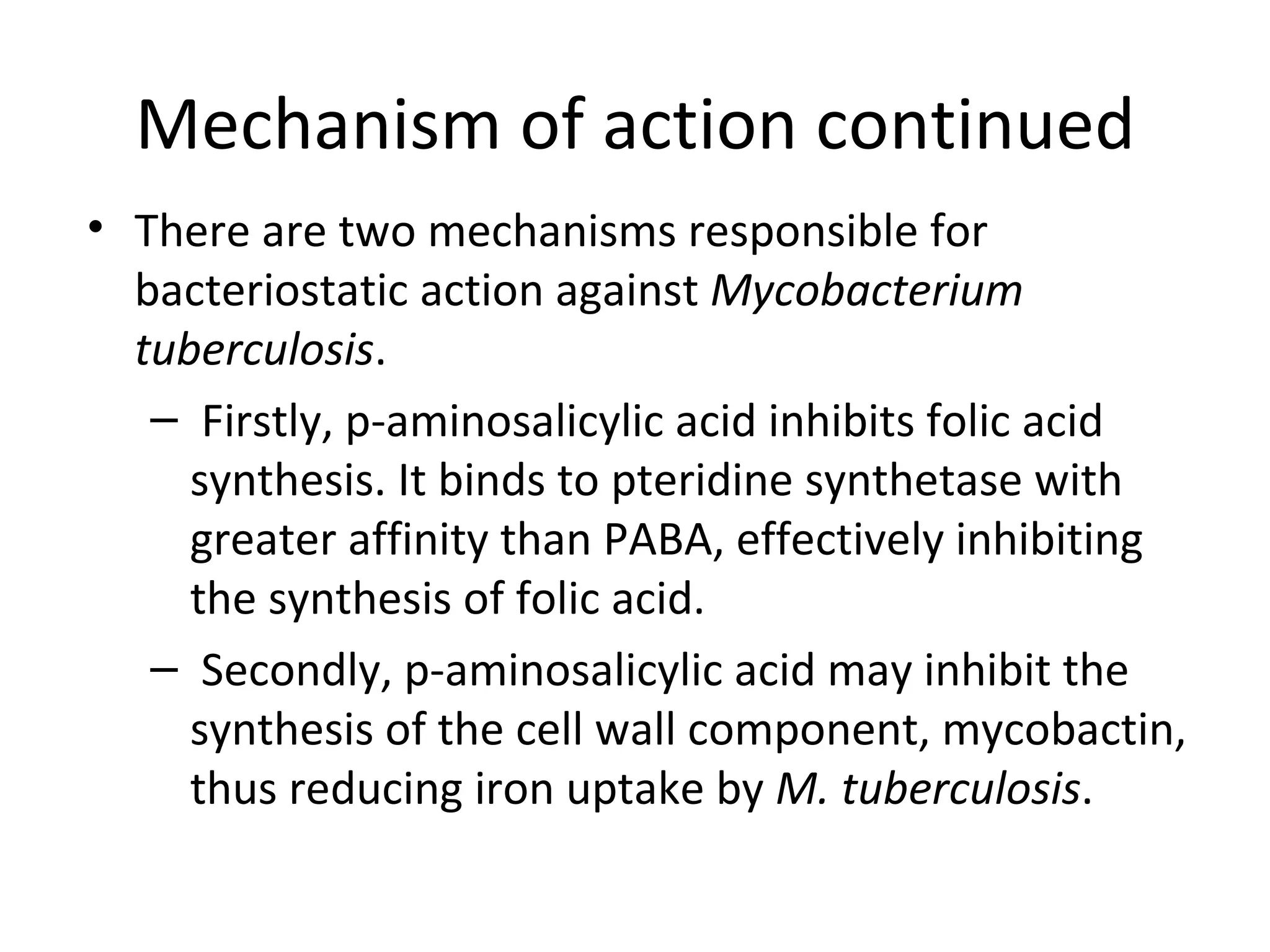
• There are two mechanisms responsible for
  bacteriostatic action against Mycobacterium
  tuberculosis.
   – Firstly, p-aminosalicylic acid inhibits folic acid
     synthesis. It binds to pteridine synthetase with
     greater affinity than PABA, effectively inhibiting
     the synthesis of folic acid.
   – Secondly, p-aminosalicylic acid may inhibit the
     synthesis of the cell wall component, mycobactin,
     thus reducing iron uptake by M. tuberculosis.
Metabolism
• It is extensively acetylated at amino group
• It is conjugated with glucuronic acid and
  glycine at the carboxylic group
Synthesis
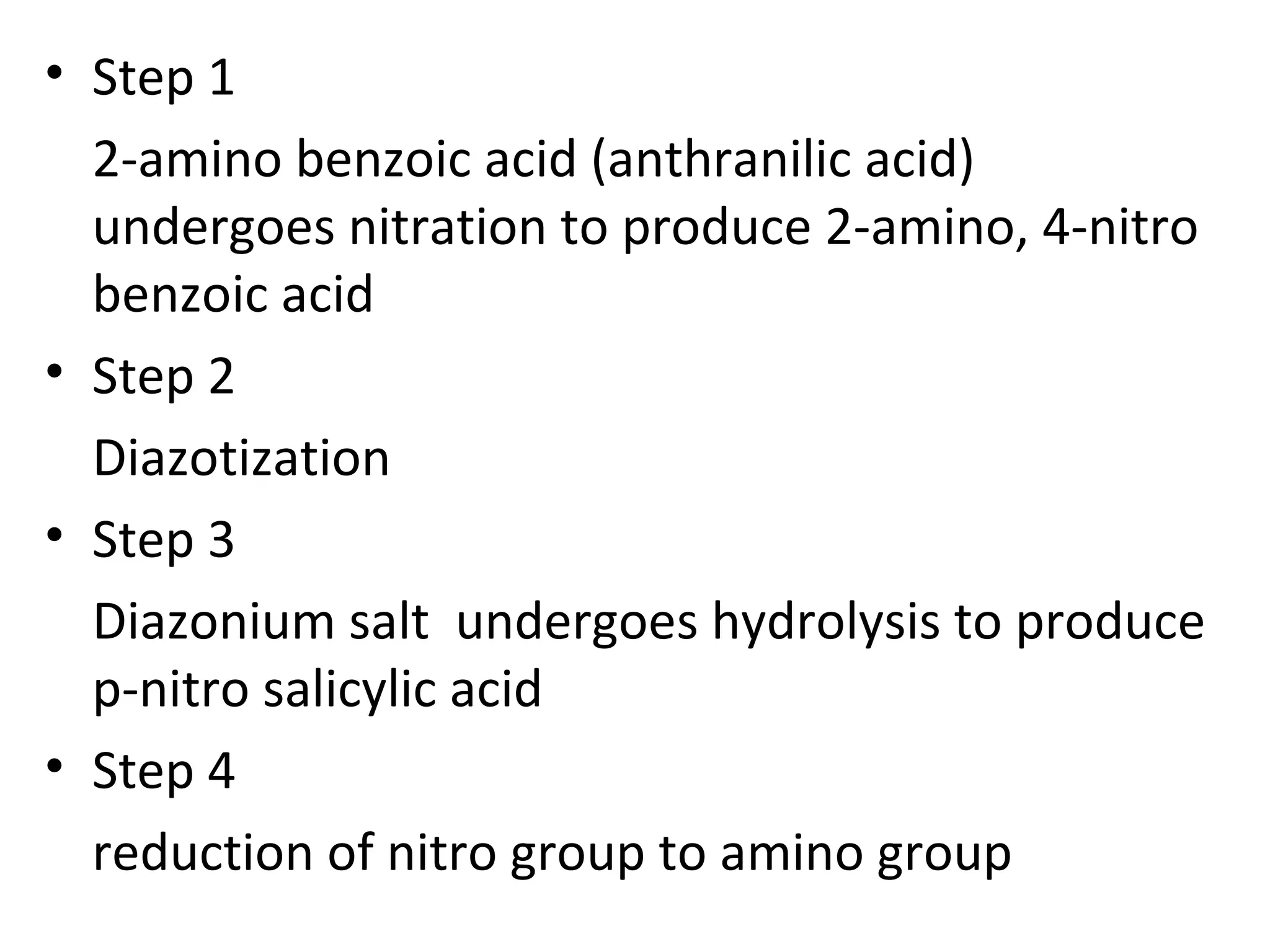
• Step 1
  2-amino benzoic acid (anthranilic acid)
  undergoes nitration to produce 2-amino, 4-nitro
  benzoic acid
• Step 2
  Diazotization
• Step 3
  Diazonium salt undergoes hydrolysis to produce
  p-nitro salicylic acid
• Step 4
  reduction of nitro group to amino group
2-amino benzoic acid
                       Synthesis
                                           2-amino, 4-nitro benzoic acid


                        p-nitro salicylic acid
Ethionamide
• A 2nd line anti TB agent, analogue of
  isonicotinamide but it is di-substituted
  and contains S in place of O
• It contains ethyl group at position 2
• In vitro it is less active but in vivo more active
  because of increased lipocity due to C2H5
• Mechanism of action is similar to INH
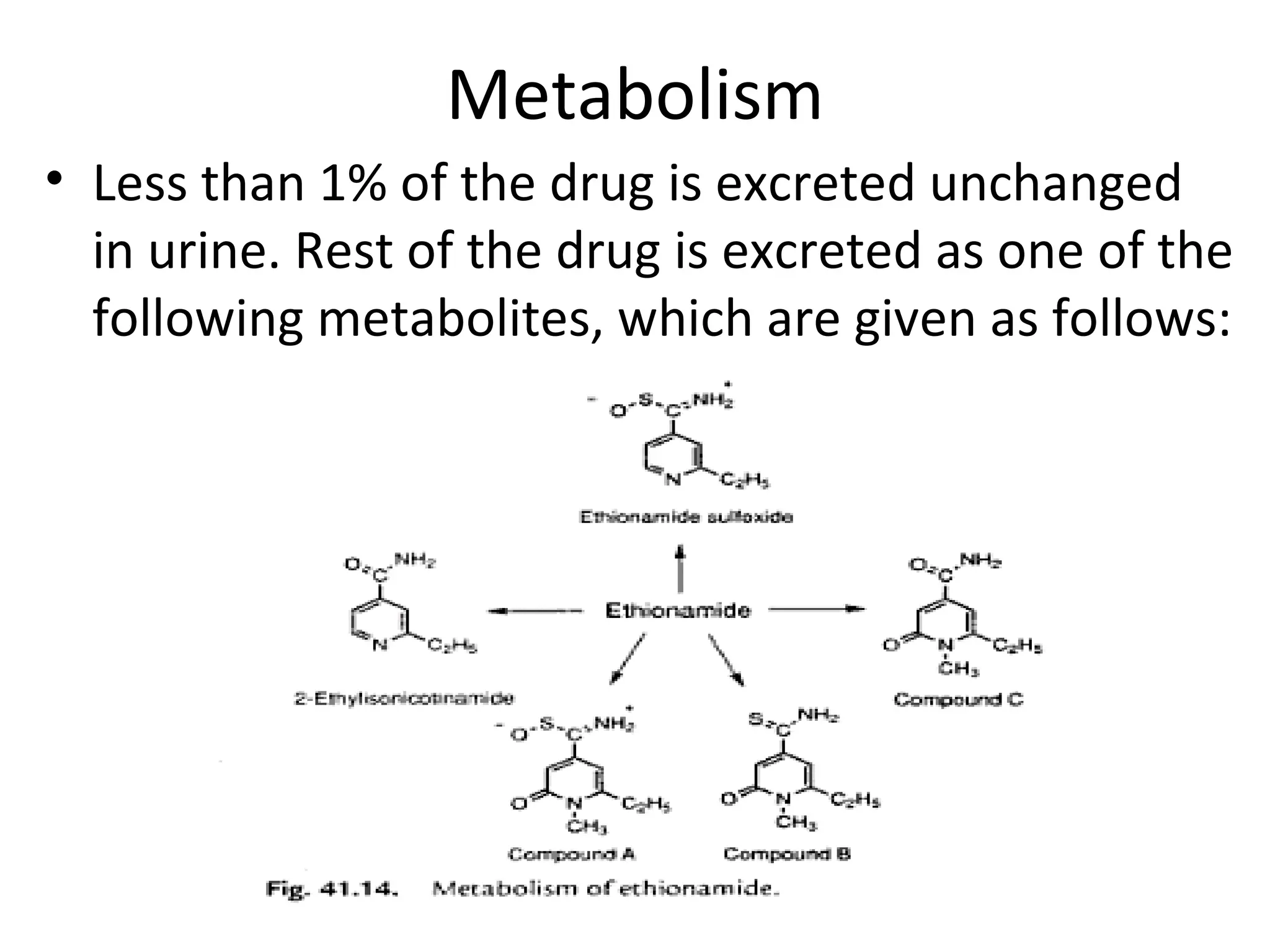
• Its active metabolite is ethionamide sulfoxide
Mechanism of action
• Ethionamide upon oxidation with catalase-
  peroxidase is converted to an active acylating
  agent, ethionamide sulfoxide, which inturn
  inactivate inhA enoyal reductase. It acylates
  cystine No. 243 in inhA protein
Mechanism of action


              Ethionamide sulfoxide


Ethionamide
Metabolism
• Less than 1% of the drug is excreted unchanged
  in urine. Rest of the drug is excreted as one of the
  following metabolites, which are given as follows:
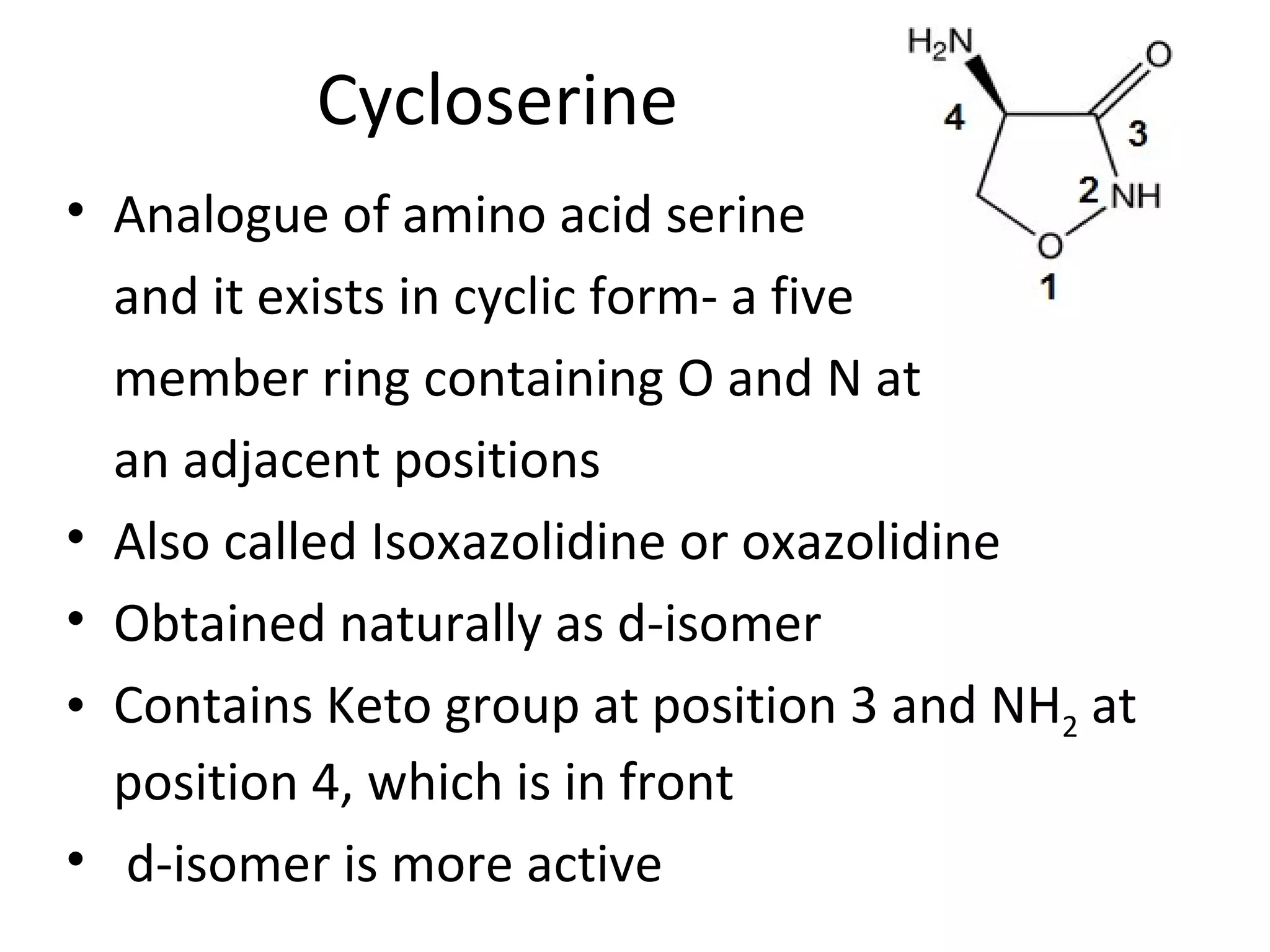
Cycloserine
• Analogue of amino acid serine
  and it exists in cyclic form- a five
  member ring containing O and N at
  an adjacent positions
• Also called Isoxazolidine or oxazolidine
• Obtained naturally as d-isomer
• Contains Keto group at position 3 and NH2 at
  position 4, which is in front
• d-isomer is more active
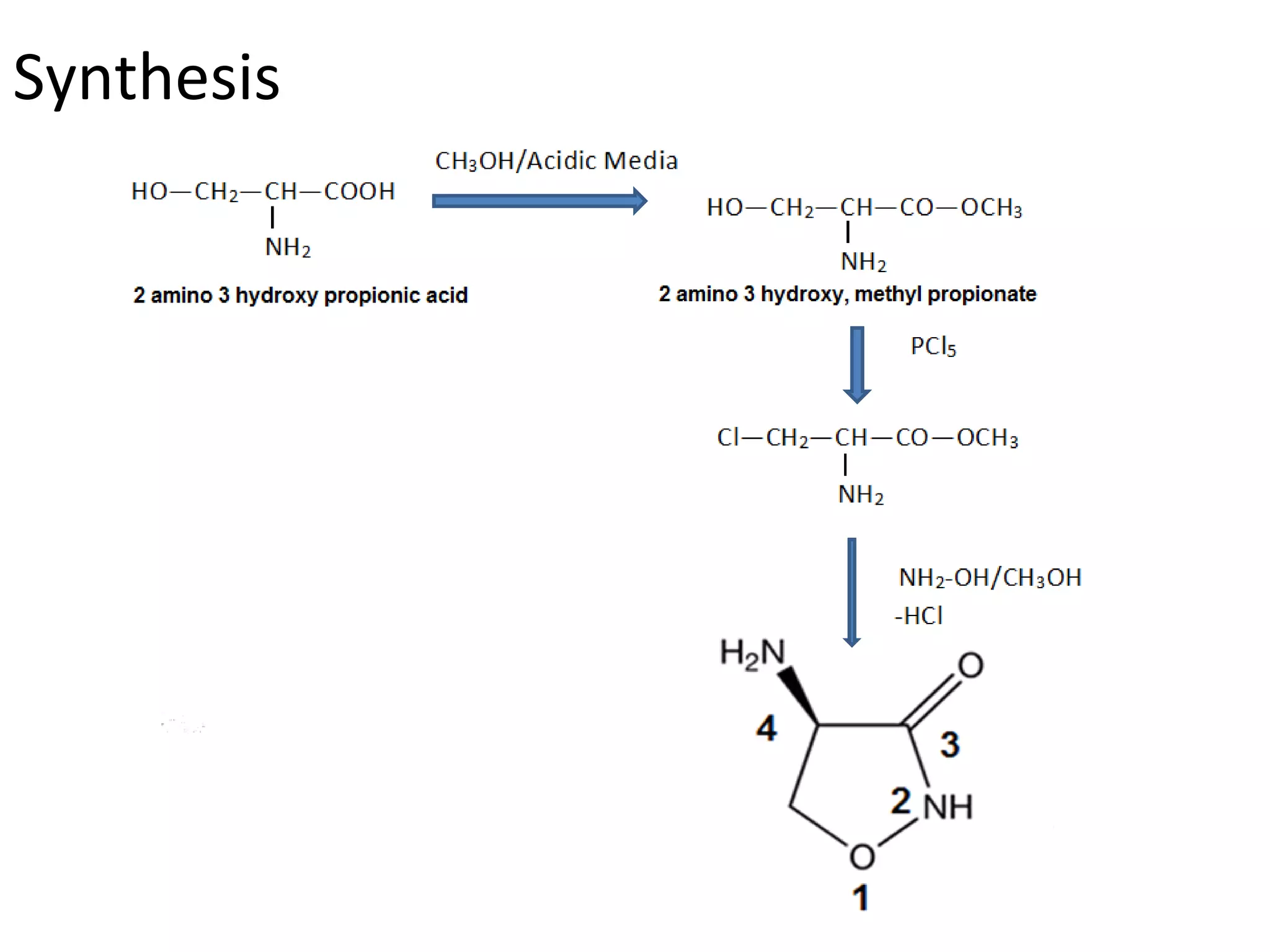
• It was first isolated from Streptomyces
  orchidaceous, but now being synthesized in
  laboratory
• It causes CNS toxicity
• Bacteria become resistant after sometime
• It acts on cell wall of bacteria and is not
  selective against MT because all bacteria
  contain peptidoglycan
• It acts on normal peptidoglycan portion of cell
  wall rather than acting on outer layer of
  mycolic acid
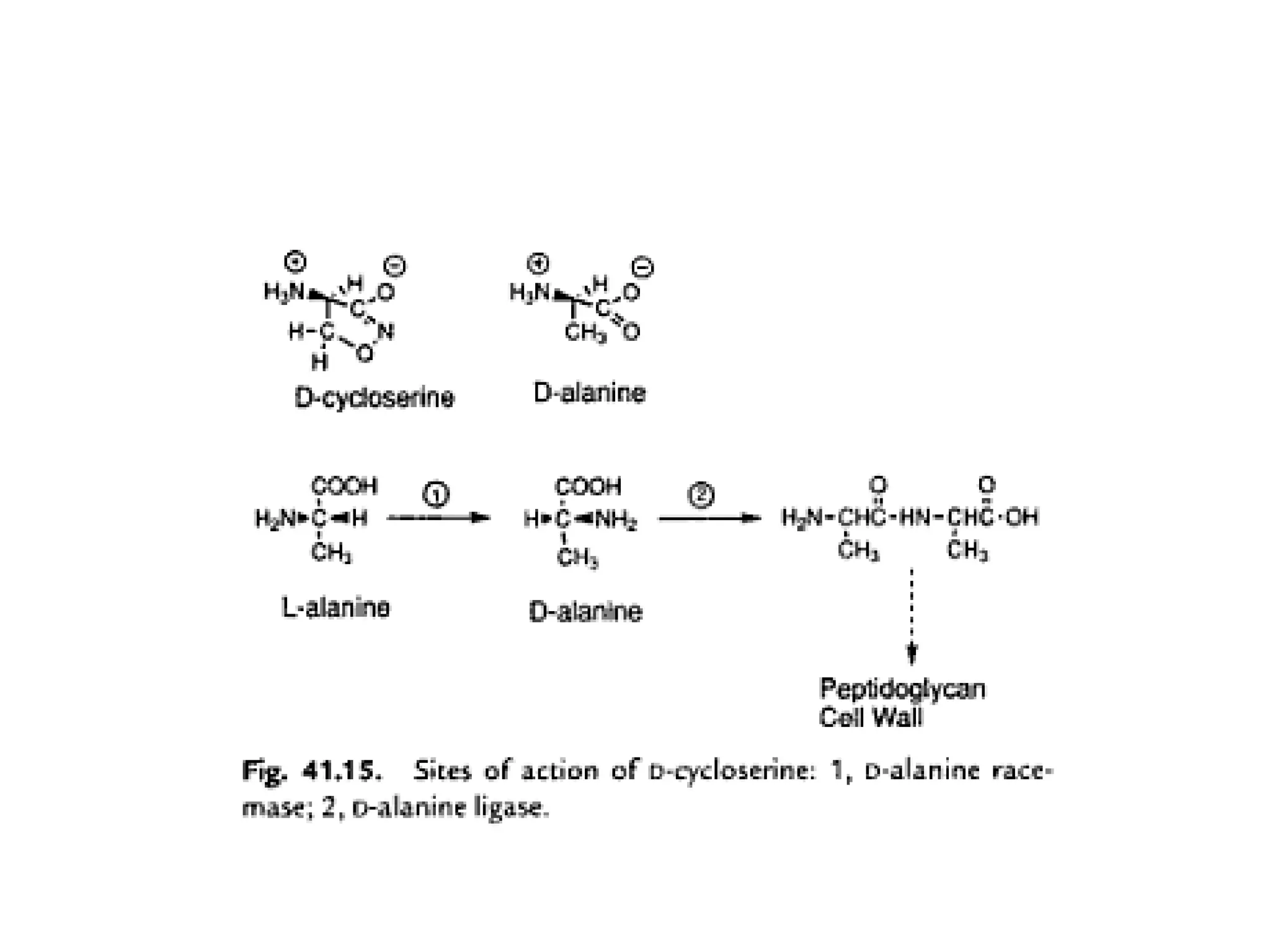
• It inhibits alanine resemase and alanine ligase
• Alanine resemase converts L-isomer of alanine
  to d-isomer. Because only d-form can be
  incorporated into cell wall. Alanine is present
  in levo form, hence need to be converted to d-
  form
• alanine ligase is necessary for attachment of
  two alanine units
Synthesis
• Readily absorbed after oral administration and
  is widely distributed including CNS
• It binds to neuronal N-methyl, d-aspartate
  receptor and effects the synthesis and
  metabolism of aminobutyric acid leading to
  serious CNS effects
Emb +pasa

Emb +pasa

  • 1.
    Ethambutol • Due toits efficacy and less adverse effects it is included in first-line therapy of Tuberculosis • It has synergistic action with other anti-Tb drugs • It contains 2 asymmetric carbon atoms • It is stereo-specific and d-ethambutol (hydroxy methyl groups are in front and H is at back) is 16 times more active than the levo form
  • 2.
    • It ismore active on dividing cells, whereas, low or inactive on non-dividing cells. It inhibits the formation of cell wall.
  • 3.
    Ethambutol: Chemistry Ethane Butanol Amino
  • 4.
    Mechanism of action •Mechanism of EMB remains unknown though there was mounting evidence that it inhibits synthesis of cell wall • But due to complex structure of the cell wall it was difficult to know the mechanism
  • 5.
    Mechanism of action •Peptidoglycan of the cell wall is covered by an envelop of arabinofuranose and galactose (AG) which is covalently attached with peptidoglycan and intercalated network of lipoarabinomannan (LAM). AG portion is highly branched and has distinct segments of galactan and distinct segments of arabinan. Mycolic acid is attached at C5 of the arabinan, usually penultimate unit
  • 6.
    • Initially, itwas thought that EMB inhibits the synthesis of AG part of the cell wall • Now, it is found that it inhibits arabinosyl transferase that catalyzes the polymerization of D-arabinofuranose leading to the formation of AG and LAM • As a result the accumulation of alpha D- arabinosyl-1 monophosphoryl decaprenol that leads to the over expression of the enzyme results in resistance • Hence, the inhibition of the formation of these complexes increases permeability of the cell wall
  • 7.
    Structure activity relationship •OH groups at CH2 • Aliphatic chain • NH groups Amino
  • 8.
    Structure activity relationship •If OH groups are replaced by OCH3 or OC2H5, the compound remains active, and if replaced by aromatic system (phenyl or pyridine) the compound became inactive • By removing OH groups activity is lost
  • 9.
    • Extension ofethane diamine results in loss of activity • Removal of either of the amino groups activity is lost • Increase in size of N-substituent activity is lost
  • 10.
    Chemical Synthesis 2-amino butanolreacts with 1, 2 dichloro ethane to produce ethambutol
  • 11.
    Antibacterial spectrum • Bacteriostatic •Specific for most of the strains like MT and M. kansasii • Absorption – Well absorbed after oral absorption • Distribution – Well distributed in all body fluids and tissues including CNS
  • 12.
    Metabolism • 73% ofthe drug is excreted in urine as unchanged,15% is metabolized into metabolite A and B, both of them are inactive
  • 13.
    Therapeutic uses • Usedin combination with INH, PZA and Rifampicin • Its action is synergistic with other drugs because it disrupts cell wall and facilitates the penetration of other drugs
  • 14.
    • Adverse reactions – Optic neuritis – Red green color blindness – Arthralgia (due to decreased urate excretion) – Vertical nystagmus (movement of eye ball) – Milk skin reaction
  • 15.
    Para-aminosalisylic acid • Itis a synthetic 2nd line agent, used in case of resistance, re-treatment and intolerance to first line therapy, used in treatment of Tuberculosis • It is used in combination with streptomycin and INH and in long term treatment (6-9 months) causes toxic effects on GIT and shows allergic reactions
  • 16.
    • GIT: nausea,vomiting, diarrhoea, abdominal pain, un-dissolved granule coatings in stools • Allergic reaction: difficulty in breathing, closing of throat and swelling of lips, tongue or face
  • 17.
    • For maximumactivity COOH and NH2 groups should be at para-position to each other • OH group may be at ortho or meta position, but max activity when at ortho • NH2 group if replaced with Cl or alkyl activity is reduced • COOH if converted into amide or ester compound became less active
  • 18.
    Mechanism of action •It acts as an anti-metabolite interfering with incorporation of PABA into folic acid • It is a structural analogue of PABA, hence inhibits the synthesis of folates in MT • MT can distinguish between PABA and sulfonamides but not between PABA and PASA • When co-administered with INH, prevents the acetylation of INH, being a substrate, results in increase in INH concentration in plasma
  • 19.
    Mechanism of actioncontinued • There are two mechanisms responsible for bacteriostatic action against Mycobacterium tuberculosis. – Firstly, p-aminosalicylic acid inhibits folic acid synthesis. It binds to pteridine synthetase with greater affinity than PABA, effectively inhibiting the synthesis of folic acid. – Secondly, p-aminosalicylic acid may inhibit the synthesis of the cell wall component, mycobactin, thus reducing iron uptake by M. tuberculosis.
  • 20.
    Metabolism • It isextensively acetylated at amino group • It is conjugated with glucuronic acid and glycine at the carboxylic group
  • 21.
  • 22.
    • Step 1 2-amino benzoic acid (anthranilic acid) undergoes nitration to produce 2-amino, 4-nitro benzoic acid • Step 2 Diazotization • Step 3 Diazonium salt undergoes hydrolysis to produce p-nitro salicylic acid • Step 4 reduction of nitro group to amino group
  • 23.
    2-amino benzoic acid Synthesis 2-amino, 4-nitro benzoic acid p-nitro salicylic acid
  • 24.
    Ethionamide • A 2ndline anti TB agent, analogue of isonicotinamide but it is di-substituted and contains S in place of O • It contains ethyl group at position 2
  • 25.
    • In vitroit is less active but in vivo more active because of increased lipocity due to C2H5 • Mechanism of action is similar to INH • Its active metabolite is ethionamide sulfoxide
  • 26.
    Mechanism of action •Ethionamide upon oxidation with catalase- peroxidase is converted to an active acylating agent, ethionamide sulfoxide, which inturn inactivate inhA enoyal reductase. It acylates cystine No. 243 in inhA protein
  • 27.
    Mechanism of action Ethionamide sulfoxide Ethionamide
  • 28.
    Metabolism • Less than1% of the drug is excreted unchanged in urine. Rest of the drug is excreted as one of the following metabolites, which are given as follows:
  • 29.
    Cycloserine • Analogue ofamino acid serine and it exists in cyclic form- a five member ring containing O and N at an adjacent positions • Also called Isoxazolidine or oxazolidine • Obtained naturally as d-isomer • Contains Keto group at position 3 and NH2 at position 4, which is in front • d-isomer is more active
  • 30.
    • It wasfirst isolated from Streptomyces orchidaceous, but now being synthesized in laboratory • It causes CNS toxicity • Bacteria become resistant after sometime • It acts on cell wall of bacteria and is not selective against MT because all bacteria contain peptidoglycan
  • 31.
    • It actson normal peptidoglycan portion of cell wall rather than acting on outer layer of mycolic acid • It inhibits alanine resemase and alanine ligase • Alanine resemase converts L-isomer of alanine to d-isomer. Because only d-form can be incorporated into cell wall. Alanine is present in levo form, hence need to be converted to d- form • alanine ligase is necessary for attachment of two alanine units
  • 33.
  • 34.
    • Readily absorbedafter oral administration and is widely distributed including CNS • It binds to neuronal N-methyl, d-aspartate receptor and effects the synthesis and metabolism of aminobutyric acid leading to serious CNS effects