9-phenethrenyl methanol class
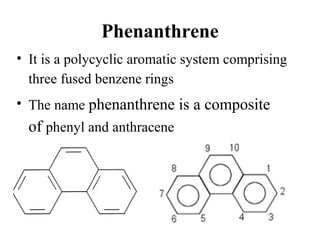
Phenanthrene
• It is a polycyclic aromatic system comprising
three fused benzene rings
• The name phenanthrene is a composite
of phenyl and anthracene
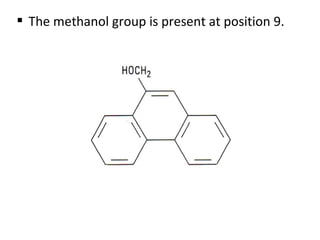
 The methanol group is present at position 9.
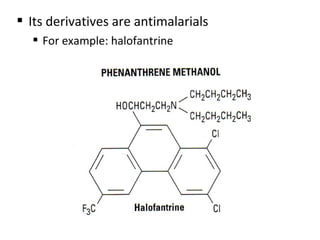
 Its derivatives are antimalarials
 For example: halofantrine
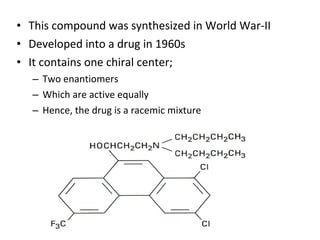
• This compound was synthesized in World War-II
• Developed into a drug in 1960s
• It contains one chiral center;
– Two enantiomers
– Which are active equally
– Hence, the drug is a racemic mixture
• It is an alternative drug for both chloroquine sensitive
and chloroquine resistant falciparum
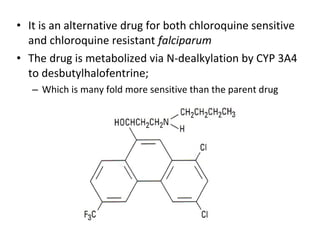
• The drug is metabolized via N-dealkylation by CYP 3A4
to desbutylhalofentrine;
– Which is many fold more sensitive than the parent drug
• Only available in oral dosage forms
• Main problems associated are low bioavailability
(Excretion in feces)-treatment failure and resistance
• Prolong half-life of the drug and its metabolite is
responsible for resistance
• Fatty meal may enhance bioavailability
• Halofantrine has caused serious, even fatal,
heart problems (ventricular arrhythmias), even
at the recommended dose.
• Halofantrine is not recommended for use while
other medicines known to cause heart
problems (prolonged QT interval)
Mode of action
• The mode of action is unknown, although
• Crystallographic study showed that it binds
to hematin in vitro, suggesting a possible
mechanism of action
• Halofantrine has also been shown to bind
to plasmpesin, a hemoglobin degrading
enzyme
• In addition there is evidence to suggest that
halofantrine may inhibit the energy-dependent
proton pump on the external surface of the
plasmodia in erythrocytes, thereby destroying
the membrane integrity of the parasite
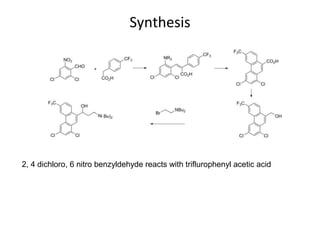
Synthesis
2, 4 dichloro, 6 nitro benzyldehyde reacts with triflurophenyl acetic acid
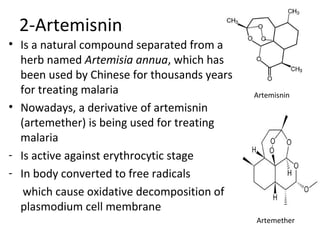
2-Artemisnin
• Is a natural compound separated from a
herb named Artemisia annua, which has
been used by Chinese for thousands years
for treating malaria
• Nowadays, a derivative of artemisnin
(artemether) is being used for treating
malaria
- Is active against erythrocytic stage
- In body converted to free radicals
which cause oxidative decomposition of
plasmodium cell membrane
Artemether
Artemisnin
• Chemically, artemisinin is a sesquiterpene
lactone containing an unusual peroxide
bridge. It is believed that this peroxide is
responsible for the drug's mechanism of
action.

Miscellaneous antimalarial agents

  • 1.
  • 2.
    Phenanthrene • It isa polycyclic aromatic system comprising three fused benzene rings • The name phenanthrene is a composite of phenyl and anthracene
  • 3.
     The methanolgroup is present at position 9.
  • 4.
     Its derivativesare antimalarials  For example: halofantrine
  • 5.
    • This compoundwas synthesized in World War-II • Developed into a drug in 1960s • It contains one chiral center; – Two enantiomers – Which are active equally – Hence, the drug is a racemic mixture
  • 6.
    • It isan alternative drug for both chloroquine sensitive and chloroquine resistant falciparum • The drug is metabolized via N-dealkylation by CYP 3A4 to desbutylhalofentrine; – Which is many fold more sensitive than the parent drug
  • 7.
    • Only availablein oral dosage forms • Main problems associated are low bioavailability (Excretion in feces)-treatment failure and resistance • Prolong half-life of the drug and its metabolite is responsible for resistance • Fatty meal may enhance bioavailability
  • 8.
    • Halofantrine hascaused serious, even fatal, heart problems (ventricular arrhythmias), even at the recommended dose. • Halofantrine is not recommended for use while other medicines known to cause heart problems (prolonged QT interval)
  • 9.
    Mode of action •The mode of action is unknown, although • Crystallographic study showed that it binds to hematin in vitro, suggesting a possible mechanism of action • Halofantrine has also been shown to bind to plasmpesin, a hemoglobin degrading enzyme
  • 10.
    • In additionthere is evidence to suggest that halofantrine may inhibit the energy-dependent proton pump on the external surface of the plasmodia in erythrocytes, thereby destroying the membrane integrity of the parasite
  • 11.
    Synthesis 2, 4 dichloro,6 nitro benzyldehyde reacts with triflurophenyl acetic acid
  • 12.
    2-Artemisnin • Is anatural compound separated from a herb named Artemisia annua, which has been used by Chinese for thousands years for treating malaria • Nowadays, a derivative of artemisnin (artemether) is being used for treating malaria - Is active against erythrocytic stage - In body converted to free radicals which cause oxidative decomposition of plasmodium cell membrane Artemether Artemisnin
  • 13.
    • Chemically, artemisininis a sesquiterpene lactone containing an unusual peroxide bridge. It is believed that this peroxide is responsible for the drug's mechanism of action.