Synthesis, reactivity, aromatic
character and importance of
Pyrimidine
Prepared by
Dr. Krishna swamy
Faculty
DOS & R in Organic Chemistry
Tumkur University
Diazines are the six membered heterocylic compounds derived from benzene by
replacement of two -CH group by two nitrogen atoms.
This replacement results in three isomeric forms
(1) 1, 2- isomer
(2) 1, 3-isomer
(3) 1, 4-isomer N
N
N
N
N
N
Diazines
Replace two CH group
by two nitrogen atom
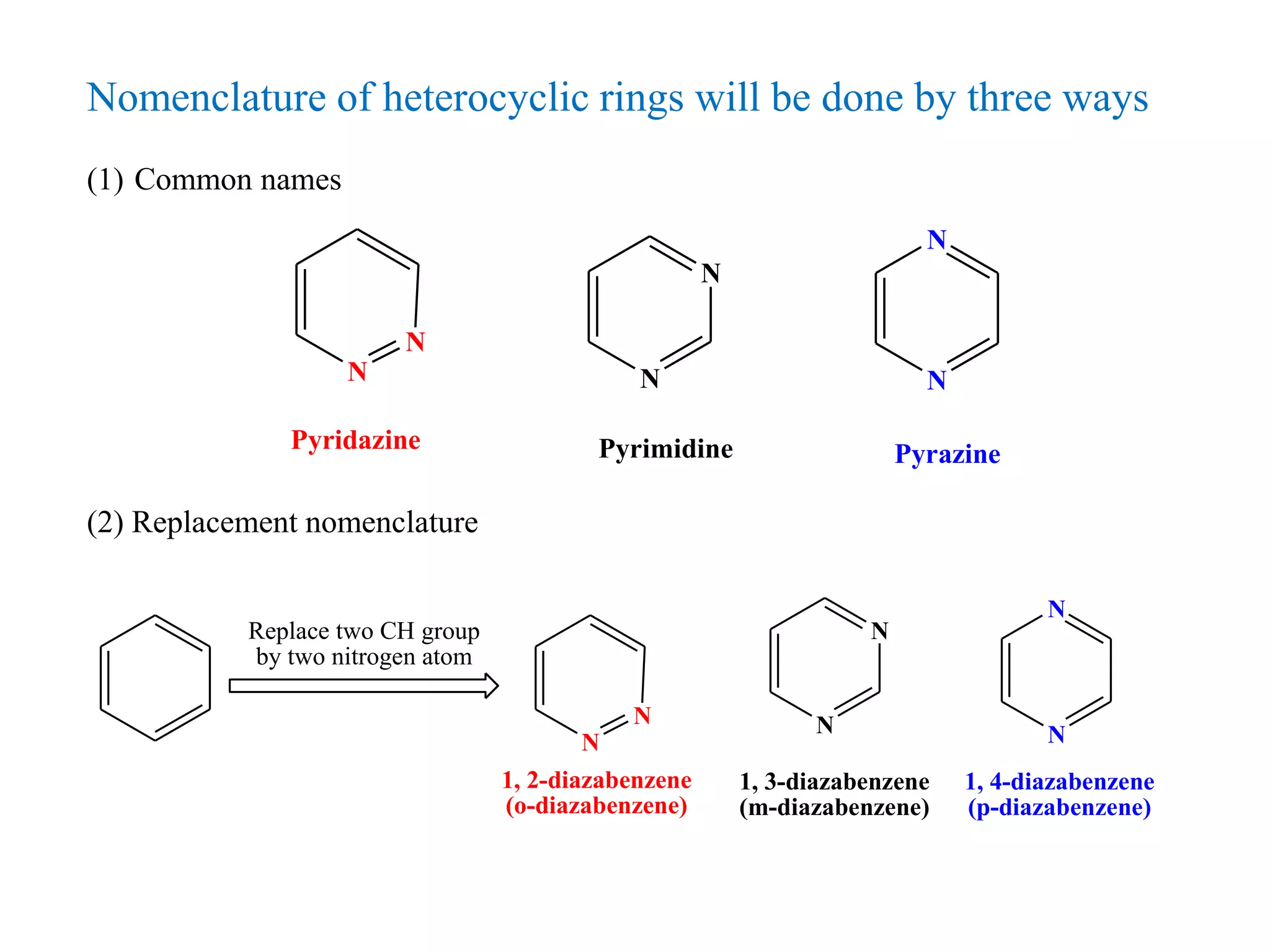
Nomenclature of heterocyclic rings will be done by three ways
(1) Common names
(2) Replacement nomenclature
N
N
N
N
N
N
Pyridazine Pyrimidine Pyrazine
1, 4-diazabenzene
(p-diazabenzene)
1, 3-diazabenzene
(m-diazabenzene)
1, 2-diazabenzene
(o-diazabenzene)
N
N N
N
N
N
Replace two CH group
by two nitrogen atom
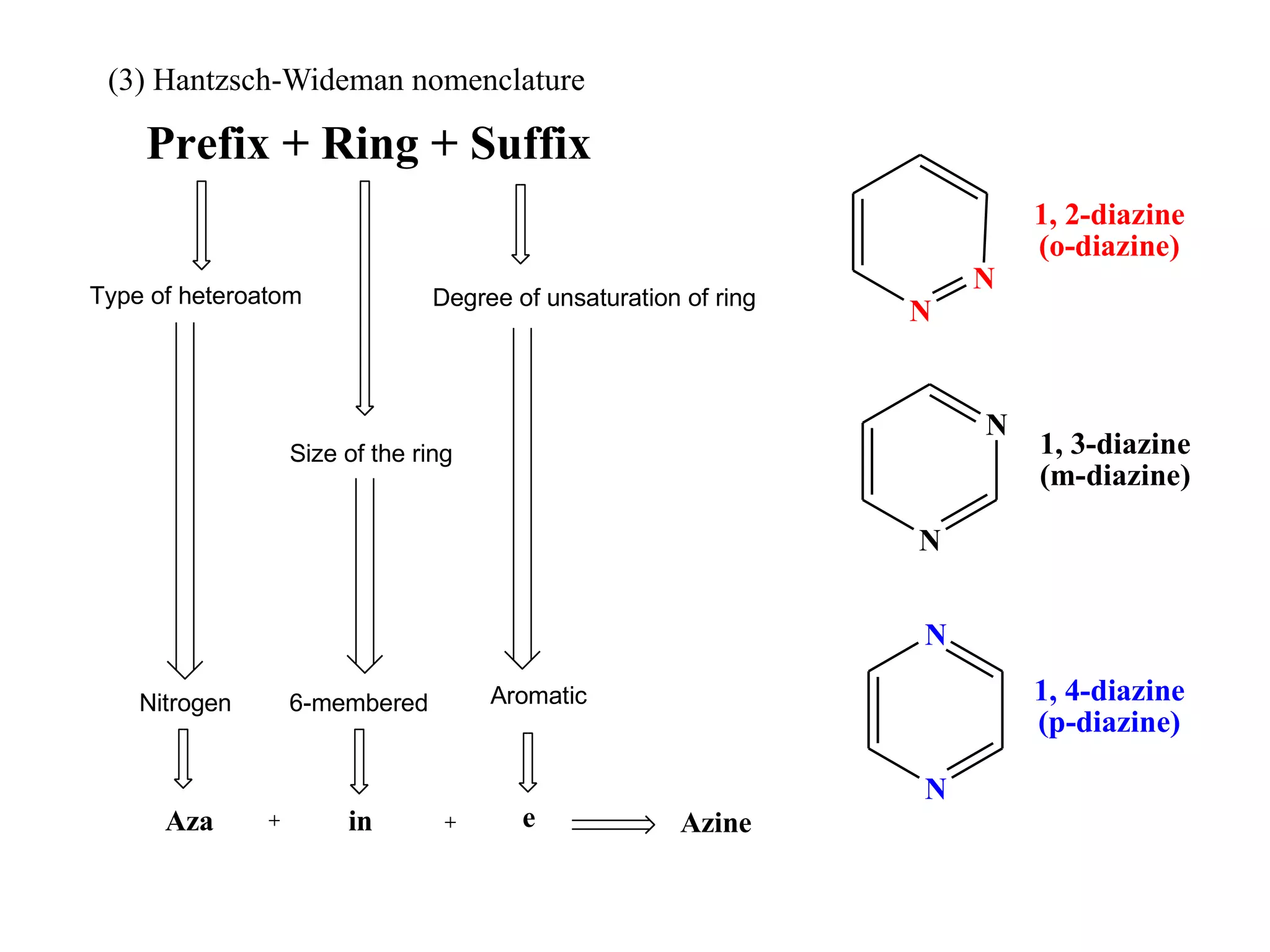
(3) Hantzsch-Wideman nomenclature
Prefix + Ring + Suffix
Type of heteroatom
Size of the ring
Degree of unsaturation of ring
Nitrogen 6-membered Aromatic
Aza in e Azine
N
N
N
N
N
N
1, 4-diazine
(p-diazine)
1, 3-diazine
(m-diazine)
1, 2-diazine
(o-diazine)
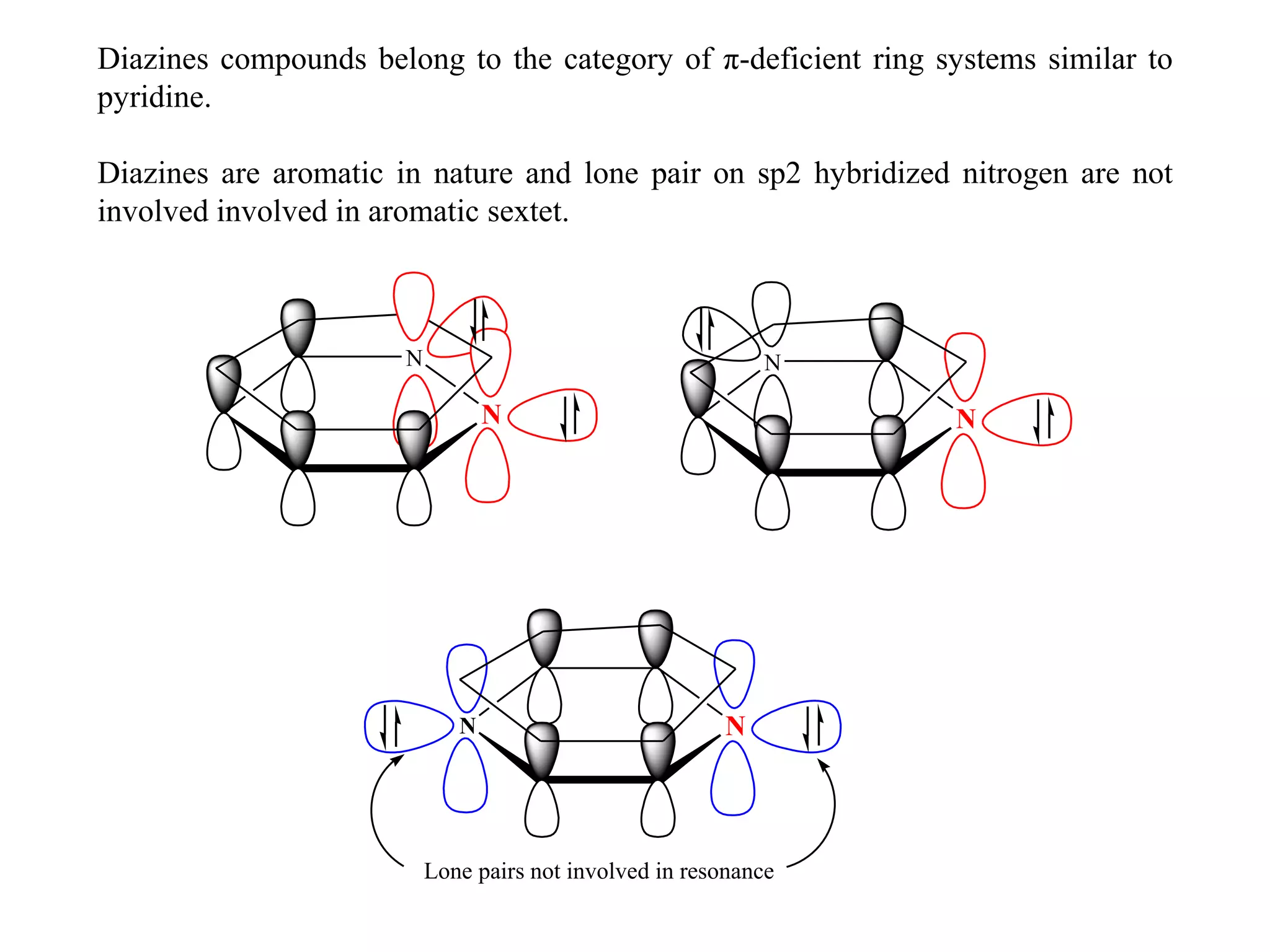
Diazines compounds belong to the category of π-deficient ring systems similar to
pyridine.
Diazines are aromatic in nature and lone pair on sp2 hybridized nitrogen are not
involved involved in aromatic sextet.
N
N N
N
N N
Lone pairs not involved in resonance
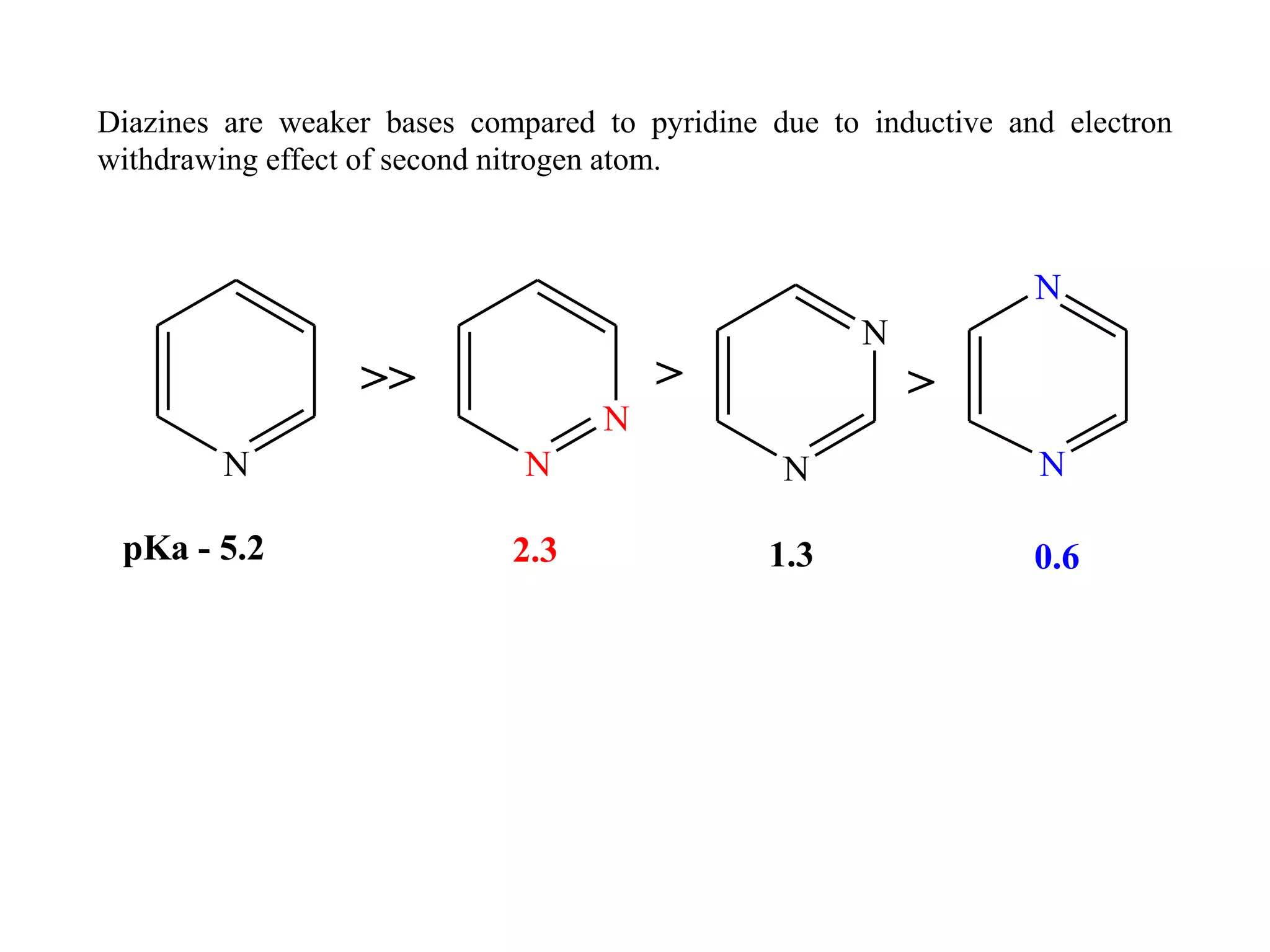
Diazines are weaker bases compared to pyridine due to inductive and electron
withdrawing effect of second nitrogen atom.
N N
N
N
N
N
N
>> > >
pKa - 5.2 2.3 1.3 0.6
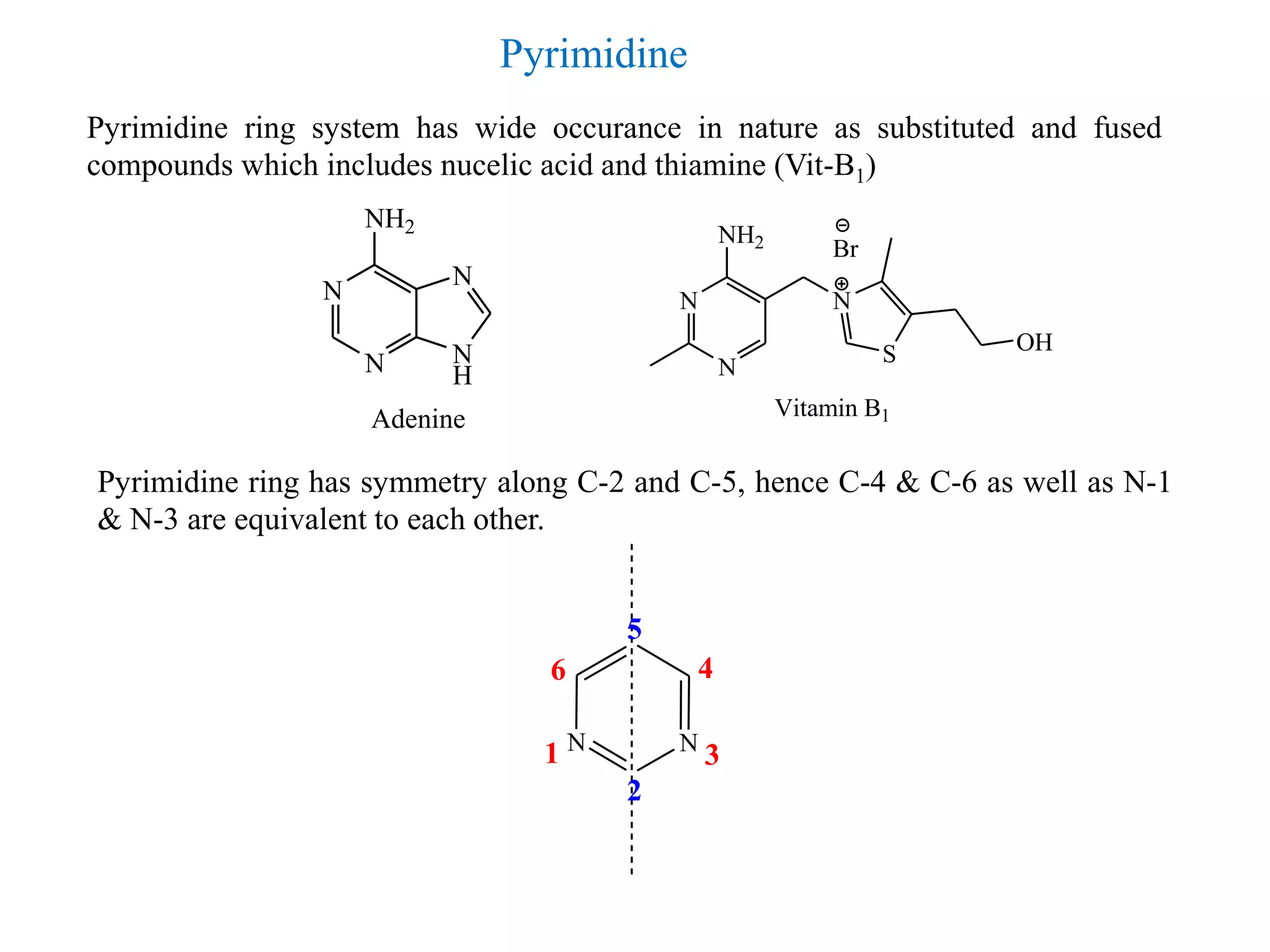
Pyrimidine ring system has wide occurance in nature as substituted and fused
compounds which includes nucelic acid and thiamine (Vit-B1)
Pyrimidine ring has symmetry along C-2 and C-5, hence C-4 & C-6 as well as N-1
& N-3 are equivalent to each other.
N N1
2
3
4
5
6
Pyrimidine
N
N
NH2
N
H
N
Adenine
N
N
NH2
N
S OH
Br
Vitamin B1
N
N
N
N
N
N
N
N
N
N
N
N
N
N
N
NN1
1
3
N3
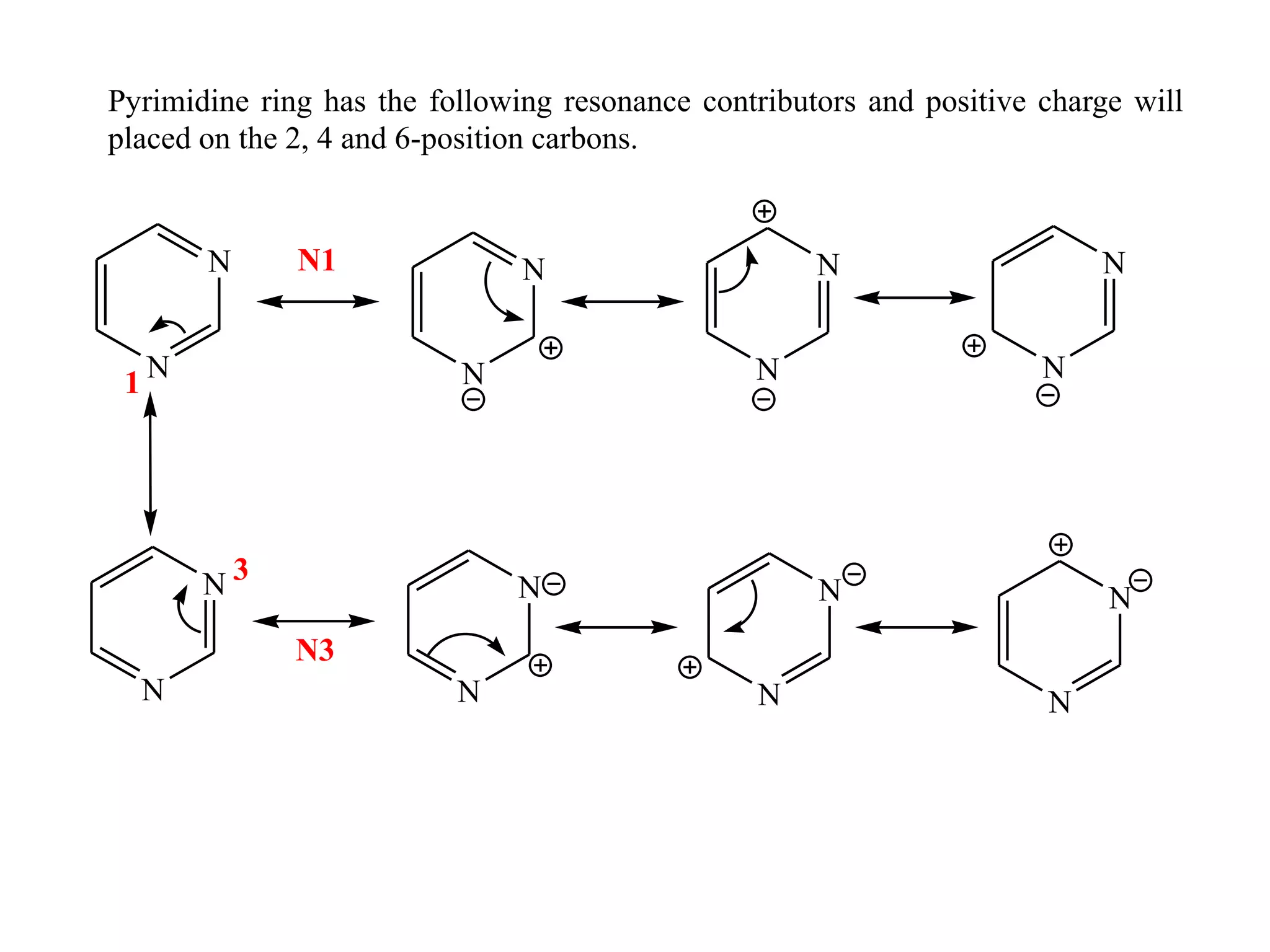
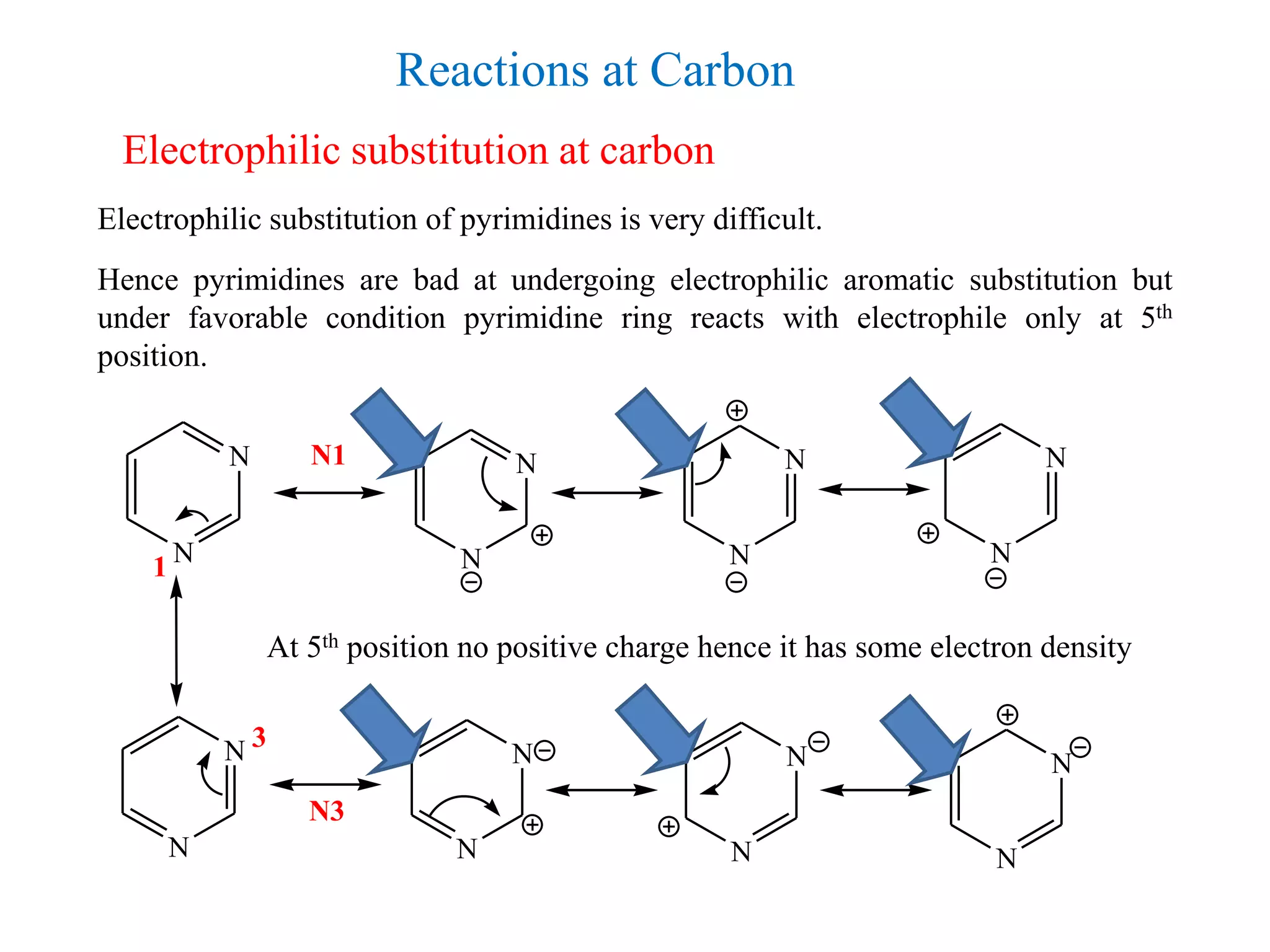
Pyrimidine ring has the following resonance contributors and positive charge will
placed on the 2, 4 and 6-position carbons.
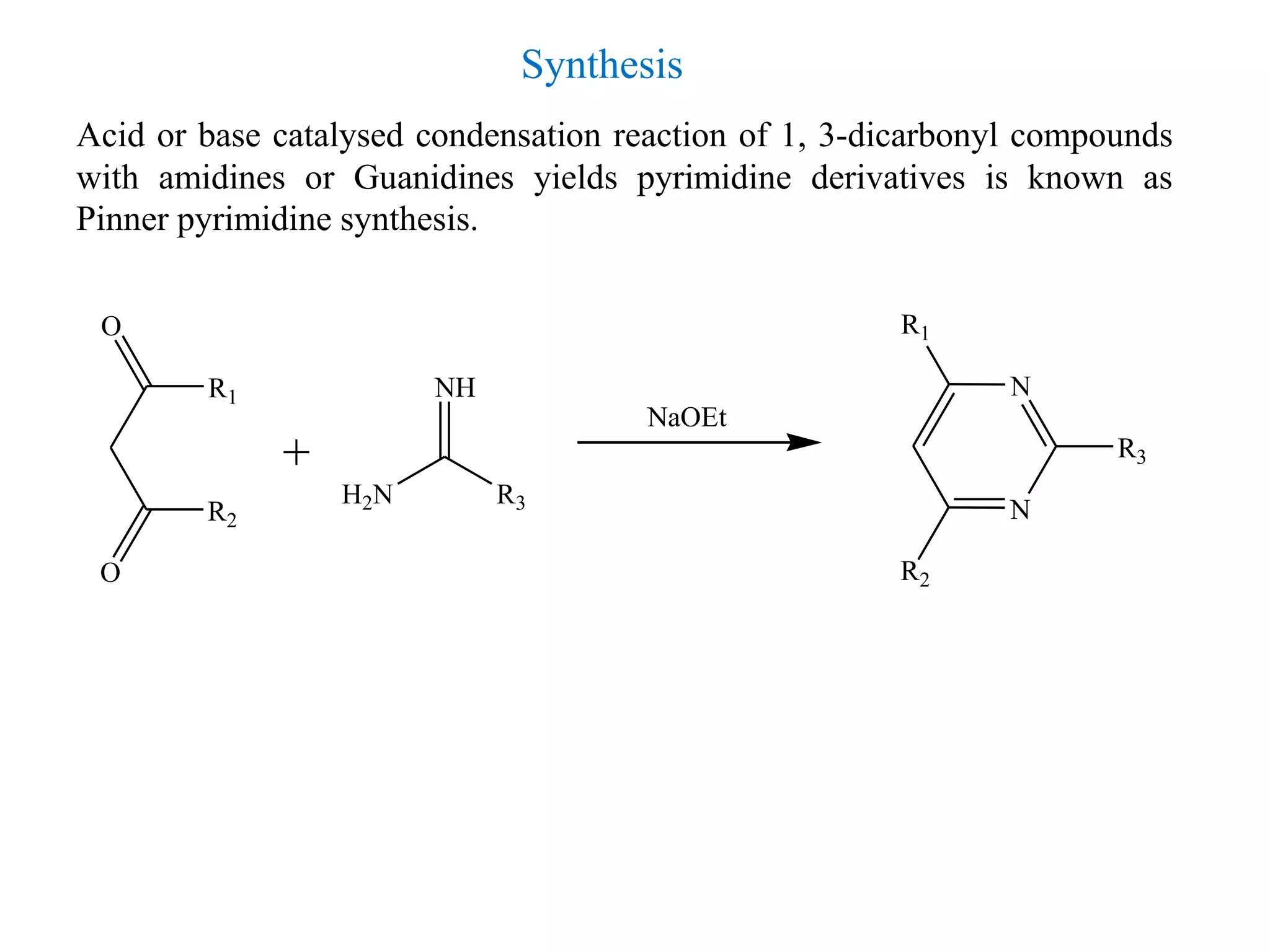
Acid or base catalysed condensation reaction of 1, 3-dicarbonyl compounds
with amidines or Guanidines yields pyrimidine derivatives is known as
Pinner pyrimidine synthesis.
R1
R2
O
O
H2N R3
NH
NaOEt
N
N
R2
R1
R3
Synthesis
R1
R2
O
O
H2N R3
NH
NH
N
H2
R2
R1
R3
HO
O
N
R2
R1
O
NH
R3
-H2O
H
N
R2
R1
O
NH2
R3
NR1
NH
R3
HO R2
-H2O
NR1
N
R3
R2
Mechanism
O O
NH2
NH
.HCl
K2CO3
N N
2, 4, 6-trimethyl pyrimidines
O
OEt
O
NH2
NH
.HCl
NaOH
N N
HO
2, 6-dimethyl-4-hydroxy
pyrimidine
By applying Pinner’s procedure variety of pyrimidine derivatives can be
prepared from different 1,3-dicarbonyl starting materials like acetylacetone
and ethyl acetoacetate.
O
OEt
O
NH2
NH
.HCl
NaOH
N
N
HO
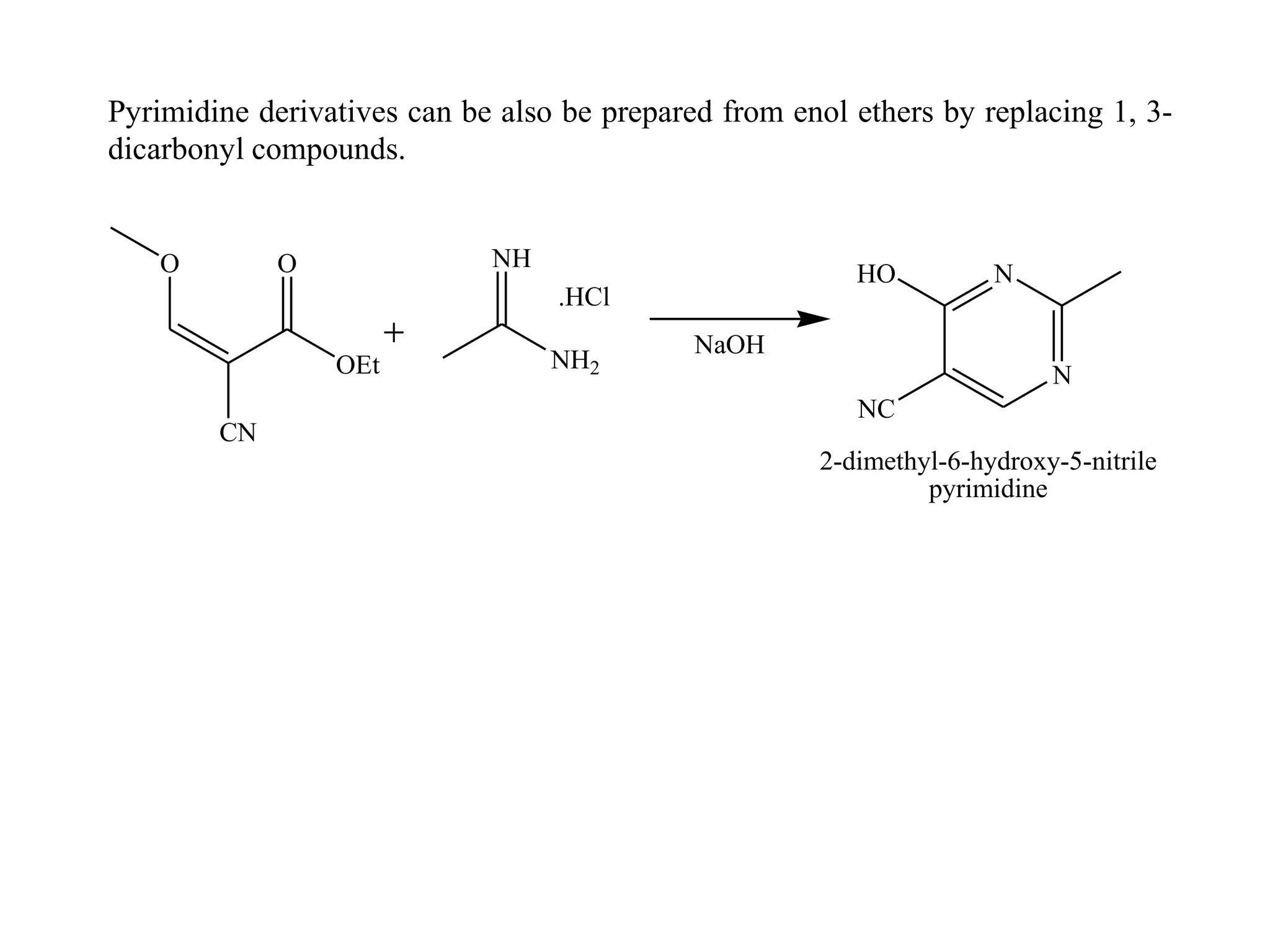
2-dimethyl-6-hydroxy-5-nitrile
pyrimidine
CN
NC
Pyrimidine derivatives can be also be prepared from enol ethers by replacing 1, 3-
dicarbonyl compounds.
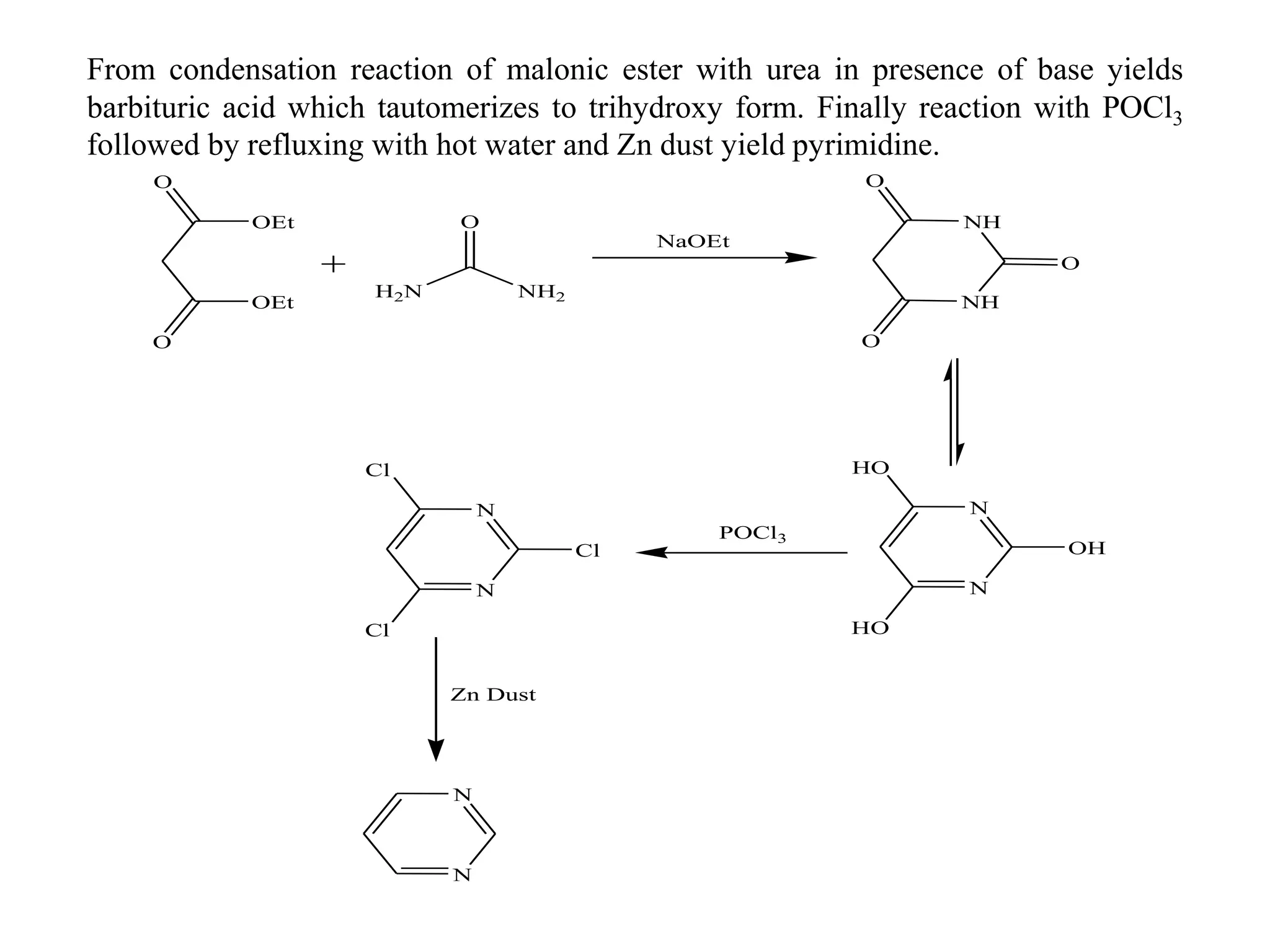
From condensation reaction of malonic ester with urea in presence of base yields
barbituric acid which tautomerizes to trihydroxy form. Finally reaction with POCl3
followed by refluxing with hot water and Zn dust yield pyrimidine.
OEt
OEt
O
O
H2N NH2
O
NH
NH
O
O
O
NaOEt
N
N
HO
HO
OH
N
N
Cl
Cl
Cl
N
N
POCl3
Zn Dust
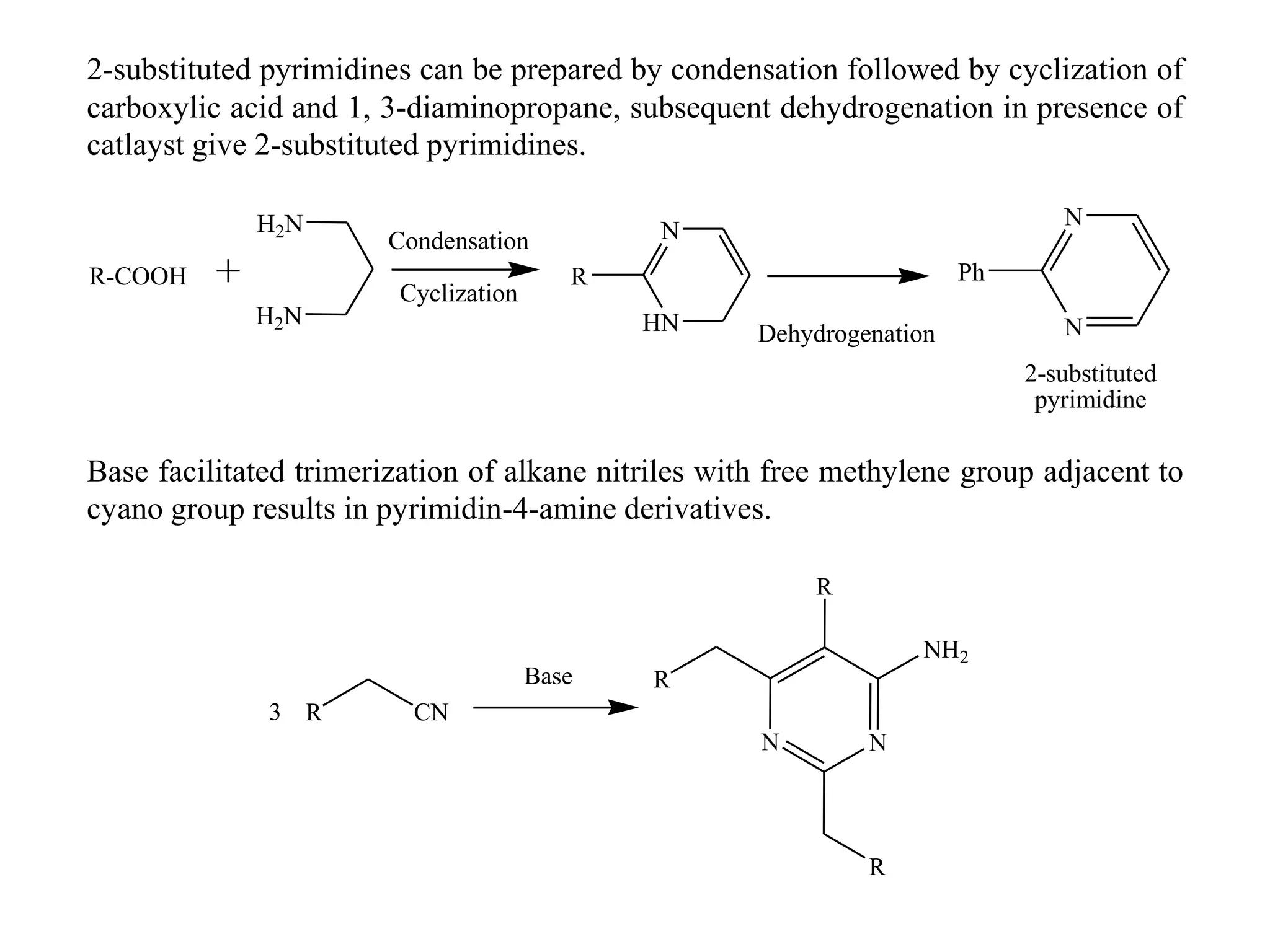
2-substituted pyrimidines can be prepared by condensation followed by cyclization of
carboxylic acid and 1, 3-diaminopropane, subsequent dehydrogenation in presence of
catlayst give 2-substituted pyrimidines.
H2N
H2N
N
HN N
N
Ph
2-substituted
pyrimidine
R-COOH R
Condensation
Cyclization
Dehydrogenation
Base facilitated trimerization of alkane nitriles with free methylene group adjacent to
cyano group results in pyrimidin-4-amine derivatives.
Base
R CN3
NN
R
NH2
R
R
Reactions of Pyrimidines
Pyrimidine undergoes reaction at Nitrogen as well as at Carbon similar to
Pyridine.
Electrophilic addition reaction like Protonation and alkylation occurs at ring
nitrogen
Electrophilic substitution reaction less facile because of decreased basicity and
under favorable conditions reaction occurs at 5th position.
Nucleophilic substitution takes place at 2, 4 and 6th positions.
Reactions at Nitrogen
Electrophilic addition at Nitrogen
Lone pair of electrons on the ring nitrogen undergoes electrophilic addition reaction
with electrophiles only at one nitrogen and under drastic condition both nitrogen
undergo electrophilic addition. This electrophilic addition results in the formation of
pyrimidinium salts.
BOTH ARE AROMATIC
N
N
E N
N
E
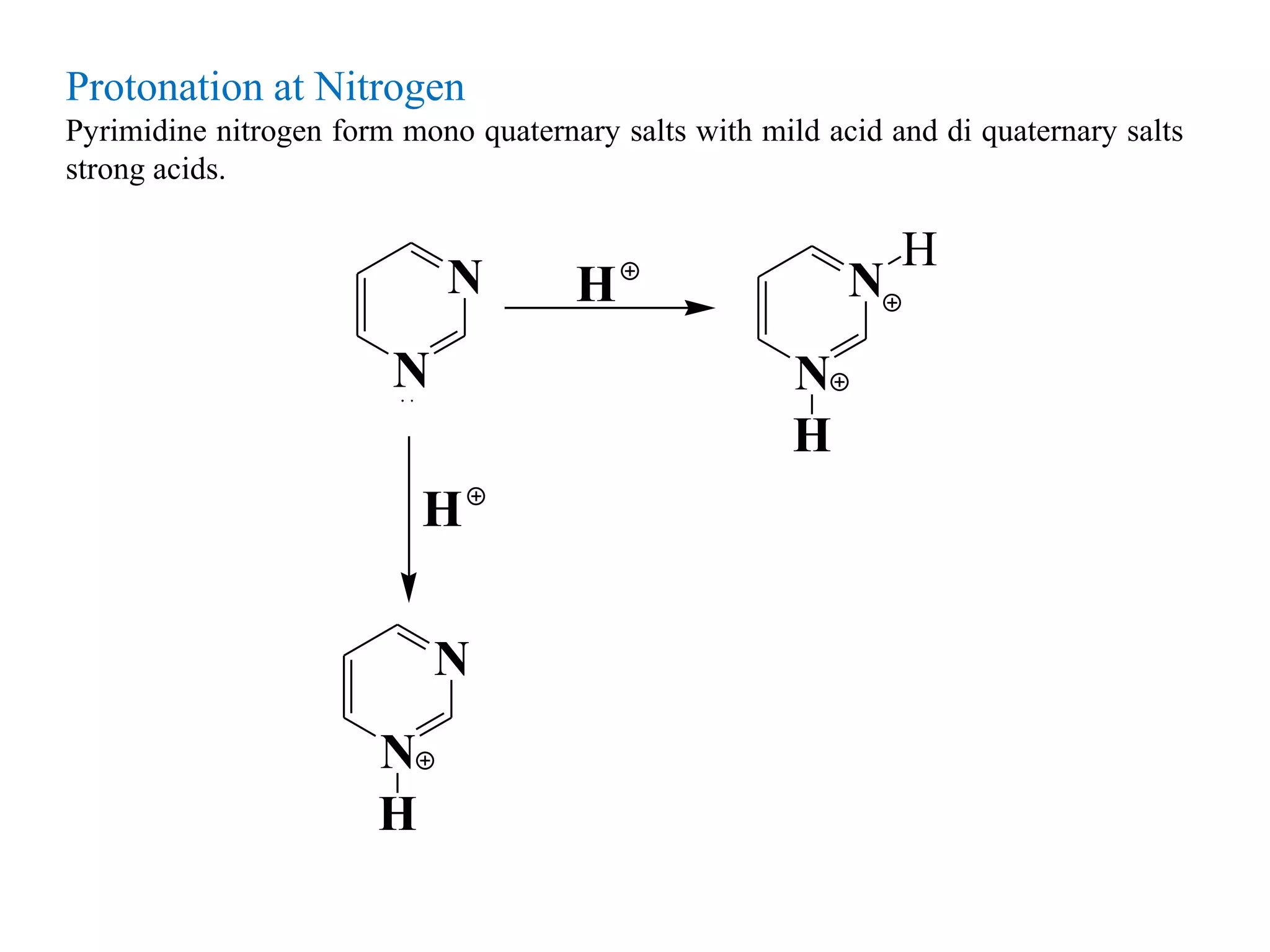
Protonation at Nitrogen
Pyrimidine nitrogen form mono quaternary salts with mild acid and di quaternary salts
strong acids.
N
N
N
N
H
H
H
N
N
H
H
Pyrimidine reacts with alkyl halide to give mono quaternary salts less readily
compared to pyrdine.
Dialkylation cannot be achieved with simple alkyl halides, however more reactive
trialkoxonium tetrafluoroborates converts pyrimidine to di quaternary salts.
Alkylation at Nitrogen
N
N
N
N
Me
MeI
N
N
Et
Et3OBF4
MeOH, rt
I
Et
BF4
BF4
Reflux
Electrophilic substitution of pyrimidines is very difficult.
Hence pyrimidines are bad at undergoing electrophilic aromatic substitution but
under favorable condition pyrimidine ring reacts with electrophile only at 5th
position.
Reactions at Carbon
N
N
N
N
N
N
N
N
N
N
N
N
N
N
N
NN1
1
3
N3
At 5th position no positive charge hence it has some electron density
Electrophilic substitution at carbon
N
N
N
N
O2N
Nitration
N
N
N
N
X
Halogenation
N
N
N
N
N
Azo coupling N
Activating groups (alkyl, OH, OMe) on pyrimidine ring increase basicity and assists
in electrophilic substitution reaction at 5th position.
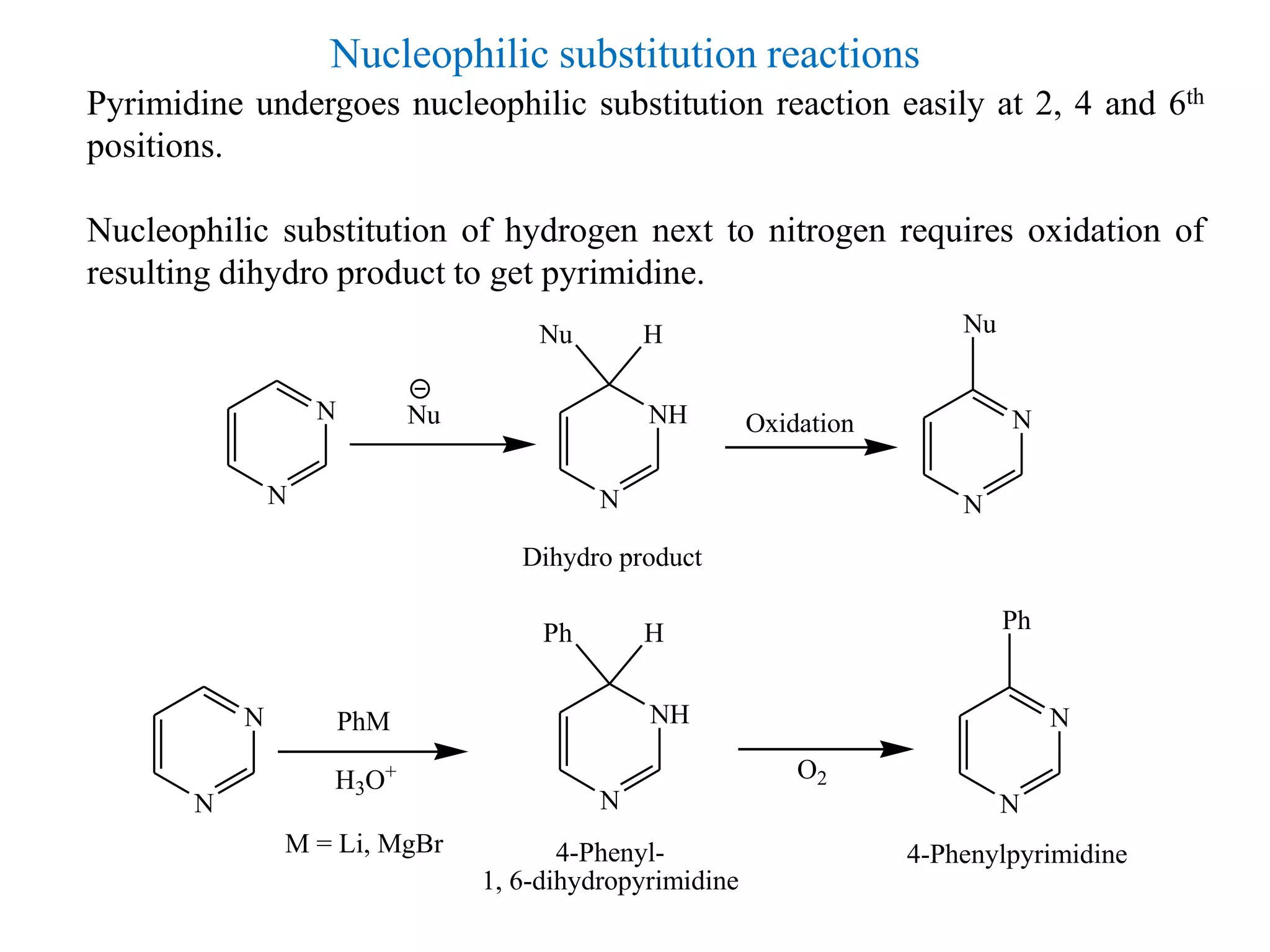
Pyrimidine undergoes nucleophilic substitution reaction easily at 2, 4 and 6th
positions.
Nucleophilic substitution of hydrogen next to nitrogen requires oxidation of
resulting dihydro product to get pyrimidine.
N
N
N
NH
Nu H
N
N
Nu
Dihydro product
OxidationNu
N
N
N
NH
Ph H
N
N
Ph
4-Phenyl-
1, 6-dihydropyrimidine
PhM
M = Li, MgBr
H3O+ O2
4-Phenylpyrimidine
Nucleophilic substitution reactions
130o
C
N
N
NH
N
H NHNH2
NH
N
H NHNH2
H
N
NH
HN
H
NH
H
N
NH
N2H4
Nucleophilic substitution of pyrimidines are very susceptible to nucleophilic
addition. Pyrimidine converts into pyrazole by reaction with hot hydrazine.
Pyrimidine

Pyrimidine

  • 1.
    Synthesis, reactivity, aromatic characterand importance of Pyrimidine Prepared by Dr. Krishna swamy Faculty DOS & R in Organic Chemistry Tumkur University
  • 2.
    Diazines are thesix membered heterocylic compounds derived from benzene by replacement of two -CH group by two nitrogen atoms. This replacement results in three isomeric forms (1) 1, 2- isomer (2) 1, 3-isomer (3) 1, 4-isomer N N N N N N Diazines Replace two CH group by two nitrogen atom
  • 3.
    Nomenclature of heterocyclicrings will be done by three ways (1) Common names (2) Replacement nomenclature N N N N N N Pyridazine Pyrimidine Pyrazine 1, 4-diazabenzene (p-diazabenzene) 1, 3-diazabenzene (m-diazabenzene) 1, 2-diazabenzene (o-diazabenzene) N N N N N N Replace two CH group by two nitrogen atom
  • 4.
    (3) Hantzsch-Wideman nomenclature Prefix+ Ring + Suffix Type of heteroatom Size of the ring Degree of unsaturation of ring Nitrogen 6-membered Aromatic Aza in e Azine N N N N N N 1, 4-diazine (p-diazine) 1, 3-diazine (m-diazine) 1, 2-diazine (o-diazine)
  • 5.
    Diazines compounds belongto the category of π-deficient ring systems similar to pyridine. Diazines are aromatic in nature and lone pair on sp2 hybridized nitrogen are not involved involved in aromatic sextet. N N N N N N Lone pairs not involved in resonance
  • 6.
    Diazines are weakerbases compared to pyridine due to inductive and electron withdrawing effect of second nitrogen atom. N N N N N N N >> > > pKa - 5.2 2.3 1.3 0.6
  • 7.
    Pyrimidine ring systemhas wide occurance in nature as substituted and fused compounds which includes nucelic acid and thiamine (Vit-B1) Pyrimidine ring has symmetry along C-2 and C-5, hence C-4 & C-6 as well as N-1 & N-3 are equivalent to each other. N N1 2 3 4 5 6 Pyrimidine N N NH2 N H N Adenine N N NH2 N S OH Br Vitamin B1
  • 8.
    N N N N N N N N N N N N N N N NN1 1 3 N3 Pyrimidine ring hasthe following resonance contributors and positive charge will placed on the 2, 4 and 6-position carbons.
  • 9.
    Acid or basecatalysed condensation reaction of 1, 3-dicarbonyl compounds with amidines or Guanidines yields pyrimidine derivatives is known as Pinner pyrimidine synthesis. R1 R2 O O H2N R3 NH NaOEt N N R2 R1 R3 Synthesis
  • 10.
  • 11.
    O O NH2 NH .HCl K2CO3 N N 2,4, 6-trimethyl pyrimidines O OEt O NH2 NH .HCl NaOH N N HO 2, 6-dimethyl-4-hydroxy pyrimidine By applying Pinner’s procedure variety of pyrimidine derivatives can be prepared from different 1,3-dicarbonyl starting materials like acetylacetone and ethyl acetoacetate.
  • 12.
    O OEt O NH2 NH .HCl NaOH N N HO 2-dimethyl-6-hydroxy-5-nitrile pyrimidine CN NC Pyrimidine derivatives canbe also be prepared from enol ethers by replacing 1, 3- dicarbonyl compounds.
  • 13.
    From condensation reactionof malonic ester with urea in presence of base yields barbituric acid which tautomerizes to trihydroxy form. Finally reaction with POCl3 followed by refluxing with hot water and Zn dust yield pyrimidine. OEt OEt O O H2N NH2 O NH NH O O O NaOEt N N HO HO OH N N Cl Cl Cl N N POCl3 Zn Dust
  • 14.
    2-substituted pyrimidines canbe prepared by condensation followed by cyclization of carboxylic acid and 1, 3-diaminopropane, subsequent dehydrogenation in presence of catlayst give 2-substituted pyrimidines. H2N H2N N HN N N Ph 2-substituted pyrimidine R-COOH R Condensation Cyclization Dehydrogenation Base facilitated trimerization of alkane nitriles with free methylene group adjacent to cyano group results in pyrimidin-4-amine derivatives. Base R CN3 NN R NH2 R R
  • 15.
    Reactions of Pyrimidines Pyrimidineundergoes reaction at Nitrogen as well as at Carbon similar to Pyridine. Electrophilic addition reaction like Protonation and alkylation occurs at ring nitrogen Electrophilic substitution reaction less facile because of decreased basicity and under favorable conditions reaction occurs at 5th position. Nucleophilic substitution takes place at 2, 4 and 6th positions.
  • 16.
    Reactions at Nitrogen Electrophilicaddition at Nitrogen Lone pair of electrons on the ring nitrogen undergoes electrophilic addition reaction with electrophiles only at one nitrogen and under drastic condition both nitrogen undergo electrophilic addition. This electrophilic addition results in the formation of pyrimidinium salts. BOTH ARE AROMATIC N N E N N E
  • 17.
    Protonation at Nitrogen Pyrimidinenitrogen form mono quaternary salts with mild acid and di quaternary salts strong acids. N N N N H H H N N H H
  • 18.
    Pyrimidine reacts withalkyl halide to give mono quaternary salts less readily compared to pyrdine. Dialkylation cannot be achieved with simple alkyl halides, however more reactive trialkoxonium tetrafluoroborates converts pyrimidine to di quaternary salts. Alkylation at Nitrogen N N N N Me MeI N N Et Et3OBF4 MeOH, rt I Et BF4 BF4 Reflux
  • 19.
    Electrophilic substitution ofpyrimidines is very difficult. Hence pyrimidines are bad at undergoing electrophilic aromatic substitution but under favorable condition pyrimidine ring reacts with electrophile only at 5th position. Reactions at Carbon N N N N N N N N N N N N N N N NN1 1 3 N3 At 5th position no positive charge hence it has some electron density Electrophilic substitution at carbon
  • 20.
    N N N N O2N Nitration N N N N X Halogenation N N N N N Azo coupling N Activatinggroups (alkyl, OH, OMe) on pyrimidine ring increase basicity and assists in electrophilic substitution reaction at 5th position.
  • 21.
    Pyrimidine undergoes nucleophilicsubstitution reaction easily at 2, 4 and 6th positions. Nucleophilic substitution of hydrogen next to nitrogen requires oxidation of resulting dihydro product to get pyrimidine. N N N NH Nu H N N Nu Dihydro product OxidationNu N N N NH Ph H N N Ph 4-Phenyl- 1, 6-dihydropyrimidine PhM M = Li, MgBr H3O+ O2 4-Phenylpyrimidine Nucleophilic substitution reactions
  • 22.
    130o C N N NH N H NHNH2 NH N H NHNH2 H N NH HN H NH H N NH N2H4 Nucleophilicsubstitution of pyrimidines are very susceptible to nucleophilic addition. Pyrimidine converts into pyrazole by reaction with hot hydrazine.