Stereoisomerism
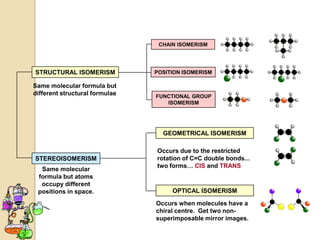
CHAIN ISOMERISM


STRUCTURAL ISOMERISM            POSITION ISOMERISM

Same molecular formula but
different structural formulae   FUNCTIONAL GROUP
                                   ISOMERISM


                                  GEOMETRICAL ISOMERISM

                                Occurs due to the restricted
STEREOISOMERISM                 rotation of C=C double bonds...
                                two forms… CIS and TRANS
  Same molecular
 formula but atoms
  occupy different
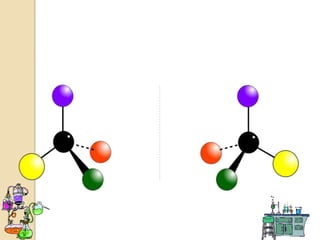
 positions in space.                 OPTICAL ISOMERISM

                                Occurs when molecules have a
                                chiral centre. Get two non-
                                superimposable mirror images.
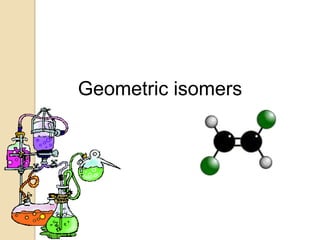
Geometric isomers
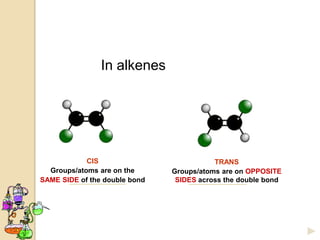
In alkenes


            CIS                           TRANS
  Groups/atoms are on the      Groups/atoms are on OPPOSITE
SAME SIDE of the double bond    SIDES across the double bond
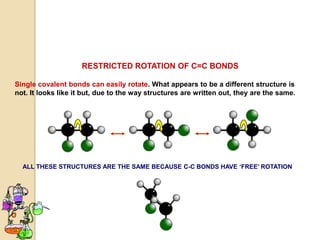
RESTRICTED ROTATION OF C=C BONDS

Single covalent bonds can easily rotate. What appears to be a different structure is
not. It looks like it but, due to the way structures are written out, they are the same.


  ALL THESE STRUCTURES ARE THE SAME BECAUSE C-C BONDS HAVE ‘FREE’ ROTATION
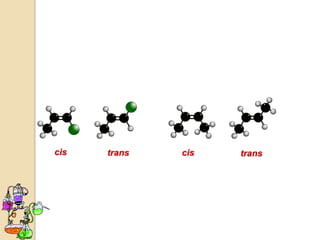
RESTRICTED ROTATION OF C=C BONDS

C=C bonds have restricted rotation so the groups on either end of the bond are
        ‘frozen’ in one position; it isn’t easy to flip between the two.


This produces two possibilities. The two structures cannot interchange easily
    so the atoms in the two molecules occupy different positions in space.
cis   trans   cis   trans
Isomerism

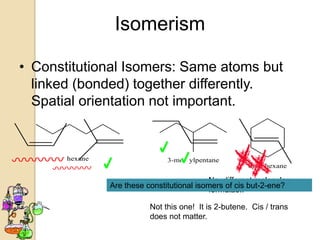
• Constitutional Isomers: Same atoms but
  linked (bonded) together differently.
  Spatial orientation not important.


       hexane                   3-methylpentane
                                                        cyclohexane

                                            No, different molecular
                Are these constitutional isomers of isomers of hexane?
                          Are these constitutional cis but-2-ene?
                                            formulae!!

                           Not this one! It is 2-butene. Cis / trans
                           does not matter.
Stereoisomerism
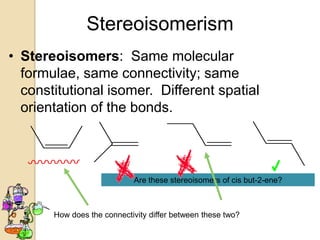
• Stereoisomers: Same molecular
  formulae, same connectivity; same
  constitutional isomer. Different spatial
  orientation of the bonds.


                            Are these stereoisomers of cis but-2-ene?


       How does the connectivity differ between these two?
Enantiomers and Diastereomers

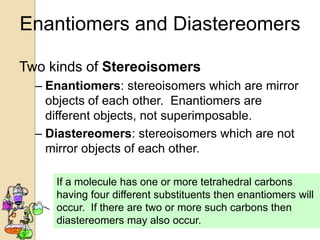
Two kinds of Stereoisomers
  – Enantiomers: stereoisomers which are mirror
    objects of each other. Enantiomers are
    different objects, not superimposable.
  – Diastereomers: stereoisomers which are not
    mirror objects of each other.

     If a molecule has one or more tetrahedral carbons
     having four different substituents then enantiomers will
     occur. If there are two or more such carbons then
     diastereomers may also occur.
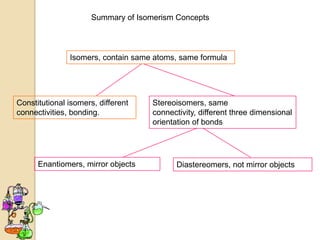
Summary of Isomerism Concepts


               Isomers, contain same atoms, same formula


Constitutional isomers, different    Stereoisomers, same
connectivities, bonding.             connectivity, different three dimensional
                                     orientation of bonds


      Enantiomers, mirror objects           Diastereomers, not mirror objects
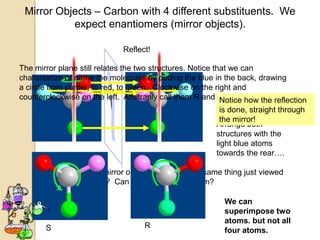
Mirror Objects – Carbon with 4 different substituents. We
           expect enantiomers (mirror objects).

                              Reflect!

The mirror plane still relates the two structures. Notice that we can
characterize or name the molecules by putting the blue in the back, drawing
a circle from purple, to red, to green. Clockwise on the right and
counterclockwise on the left. Arbitrarily call them R and S.Notice how the reflection
                                                            is done, straight through
                                                            the mirror!
                                                          Arrange both
                                                          structures with the
                                                          light blue atoms
                                                          towards the rear….

             These are mirror objects. Are they the same thing just viewed
             differently ?? Can we superimpose them?

                                                            We can
                                                            superimpose two
                                                            atoms. but not all
       S                             R
                                                            four atoms.
Recap: Tetrahedral Carbon with four
Different Substituents. Enantiomers

                 Mirror objects.
                 Different, not
                 superimposable.
  Simple                           Simple
  Rotation, Sa   Enantiomers       Rotation, Sa
  me                               me
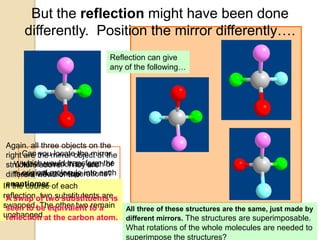
But the reflection might have been done
     differently. Position the mirror differently….
                             Reflection can give
                             any of the following…


 Again. all three objects on the
 right Can the mirror object of the
       are you locate the mirror
 structure above. They eachthe
       which would transform
    What is common to are of
 different reflectionthe into each
       original molecule
    these views of operations?
In themirror object?
 enantiomer. of each
        course
reflection, two substitutents are
 A swap of two substituents is
swapped.be equivalent to a
 seen to The other two remain All three of these structures are the same, just made by
unchanged.at the carbon atom. different mirrors. The structures are superimposable.
 reflection
                                  What rotations of the whole molecules are needed to
                                  superimpose the structures?
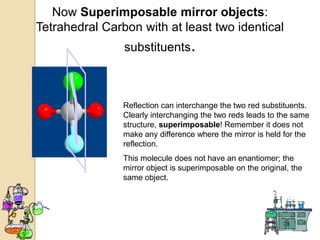
Now Superimposable mirror objects:
Tetrahedral Carbon with at least two identical
                substituents.


                Reflection can interchange the two red substituents.
                Clearly interchanging the two reds leads to the same
                structure, superimposable! Remember it does not
                make any difference where the mirror is held for the
                reflection.
                This molecule does not have an enantiomer; the
                mirror object is superimposable on the original, the
                same object.
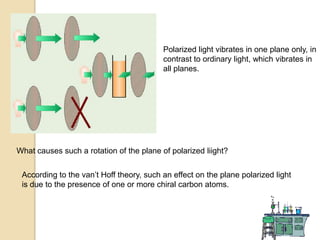
Polarized light vibrates in one plane only, in
                                          contrast to ordinary light, which vibrates in
                                          all planes.


What causes such a rotation of the plane of polarized liight?


 According to the van’t Hoff theory, such an effect on the plane polarized light
 is due to the presence of one or more chiral carbon atoms.
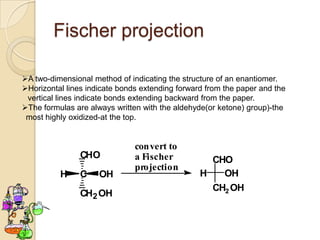
Fischer projection

A two-dimensional method of indicating the structure of an enantiomer.
Horizontal lines indicate bonds extending forward from the paper and the
 vertical lines indicate bonds extending backward from the paper.
The formulas are always written with the aldehyde(or ketone) group)-the
 most highly oxidized-at the top.


                               convert to
                CHO            a Fischer           CHO
                               projection
          H     C    OH                          H   OH
                                                   CH2 OH
                CH2 OH
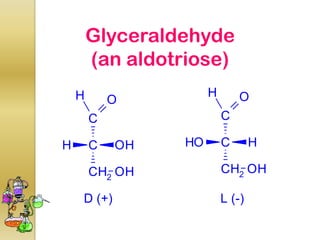
Glyceraldehyde
        (an aldotriose)
    H                  H       O
            O
        C                  C

H       C   OH    HO       C       H

        CH2 OH             CH2 OH

    D (+)                  L (-)
Stereoisomerism(1)

Stereoisomerism(1)

  • 1.
  • 2.
    CHAIN ISOMERISM STRUCTURAL ISOMERISM POSITION ISOMERISM Same molecular formula but different structural formulae FUNCTIONAL GROUP ISOMERISM GEOMETRICAL ISOMERISM Occurs due to the restricted STEREOISOMERISM rotation of C=C double bonds... two forms… CIS and TRANS Same molecular formula but atoms occupy different positions in space. OPTICAL ISOMERISM Occurs when molecules have a chiral centre. Get two non- superimposable mirror images.
  • 3.
  • 4.
    In alkenes CIS TRANS Groups/atoms are on the Groups/atoms are on OPPOSITE SAME SIDE of the double bond SIDES across the double bond
  • 5.
    RESTRICTED ROTATION OFC=C BONDS Single covalent bonds can easily rotate. What appears to be a different structure is not. It looks like it but, due to the way structures are written out, they are the same. ALL THESE STRUCTURES ARE THE SAME BECAUSE C-C BONDS HAVE ‘FREE’ ROTATION
  • 6.
    RESTRICTED ROTATION OFC=C BONDS C=C bonds have restricted rotation so the groups on either end of the bond are ‘frozen’ in one position; it isn’t easy to flip between the two. This produces two possibilities. The two structures cannot interchange easily so the atoms in the two molecules occupy different positions in space.
  • 7.
    cis trans cis trans
  • 8.
    Isomerism • Constitutional Isomers:Same atoms but linked (bonded) together differently. Spatial orientation not important. hexane 3-methylpentane cyclohexane No, different molecular Are these constitutional isomers of isomers of hexane? Are these constitutional cis but-2-ene? formulae!! Not this one! It is 2-butene. Cis / trans does not matter.
  • 9.
    Stereoisomerism • Stereoisomers: Samemolecular formulae, same connectivity; same constitutional isomer. Different spatial orientation of the bonds. Are these stereoisomers of cis but-2-ene? How does the connectivity differ between these two?
  • 10.
    Enantiomers and Diastereomers Twokinds of Stereoisomers – Enantiomers: stereoisomers which are mirror objects of each other. Enantiomers are different objects, not superimposable. – Diastereomers: stereoisomers which are not mirror objects of each other. If a molecule has one or more tetrahedral carbons having four different substituents then enantiomers will occur. If there are two or more such carbons then diastereomers may also occur.
  • 11.
    Summary of IsomerismConcepts Isomers, contain same atoms, same formula Constitutional isomers, different Stereoisomers, same connectivities, bonding. connectivity, different three dimensional orientation of bonds Enantiomers, mirror objects Diastereomers, not mirror objects
  • 12.
    Mirror Objects –Carbon with 4 different substituents. We expect enantiomers (mirror objects). Reflect! The mirror plane still relates the two structures. Notice that we can characterize or name the molecules by putting the blue in the back, drawing a circle from purple, to red, to green. Clockwise on the right and counterclockwise on the left. Arbitrarily call them R and S.Notice how the reflection is done, straight through the mirror! Arrange both structures with the light blue atoms towards the rear…. These are mirror objects. Are they the same thing just viewed differently ?? Can we superimpose them? We can superimpose two atoms. but not all S R four atoms.
  • 13.
    Recap: Tetrahedral Carbonwith four Different Substituents. Enantiomers Mirror objects. Different, not superimposable. Simple Simple Rotation, Sa Enantiomers Rotation, Sa me me
  • 14.
    But the reflectionmight have been done differently. Position the mirror differently…. Reflection can give any of the following… Again. all three objects on the right Can the mirror object of the are you locate the mirror structure above. They eachthe which would transform What is common to are of different reflectionthe into each original molecule these views of operations? In themirror object? enantiomer. of each course reflection, two substitutents are A swap of two substituents is swapped.be equivalent to a seen to The other two remain All three of these structures are the same, just made by unchanged.at the carbon atom. different mirrors. The structures are superimposable. reflection What rotations of the whole molecules are needed to superimpose the structures?
  • 15.
    Now Superimposable mirrorobjects: Tetrahedral Carbon with at least two identical substituents. Reflection can interchange the two red substituents. Clearly interchanging the two reds leads to the same structure, superimposable! Remember it does not make any difference where the mirror is held for the reflection. This molecule does not have an enantiomer; the mirror object is superimposable on the original, the same object.
  • 16.
    Polarized light vibratesin one plane only, in contrast to ordinary light, which vibrates in all planes. What causes such a rotation of the plane of polarized liight? According to the van’t Hoff theory, such an effect on the plane polarized light is due to the presence of one or more chiral carbon atoms.
  • 17.
    Fischer projection A two-dimensionalmethod of indicating the structure of an enantiomer. Horizontal lines indicate bonds extending forward from the paper and the vertical lines indicate bonds extending backward from the paper. The formulas are always written with the aldehyde(or ketone) group)-the most highly oxidized-at the top. convert to CHO a Fischer CHO projection H C OH H OH CH2 OH CH2 OH
  • 18.
    Glyceraldehyde (an aldotriose) H H O O C C H C OH HO C H CH2 OH CH2 OH D (+) L (-)