Department of Chemistry
University of kashmir
Topic:-Nucleophilic Aromatic Substitution
Presented By
Aadil Ali Wani
Nucleophilic Aromatic Substitution
• Substitution reactions in which the nucleophile displaces a good
leaving group such as halide on an aromatic ring.
• Reactions that are successful at an aromatic substrate are largely of
four kinds.
• Electrophilic substitution is by far the most common mode of
substitution in aromatic systems, the nucleophilic substitution is
indeed and useful tool in certain cases.
• The early industrial synthesis of phenols and anilines were based
on nucleophilic aromatic substitution reaction
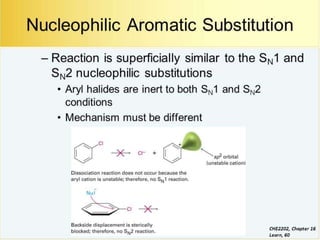
• SN₂ at Sp² carbon doesn’t occur.
• SN1 at Sp2 carbon also doesn't occur.
Mechanisms
• SNAr Mechanism - addition / elimination
• SN1 Mechanism
• benzyne Mechanism - elimination / addition
• Srn 1 Mechanism
SNAr Ar Mechanism - addition / elimination
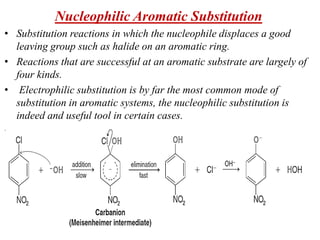
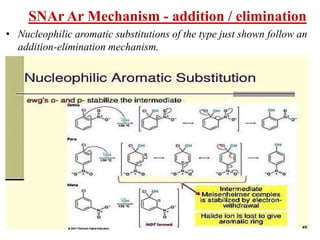
• Nucleophilic aromatic substitutions of the type just shown follow an
addition-elimination mechanism.
• The rate-determining intermediate is a cyclohexadienyl anion and
is stabilized by electron-withdrawing substituents.
• Attack of the strong nucleophile on the halogen substituted
aromatic carbon forming an anionic intermediate.
• Loss of the leaving group, the halide ion restores the aromaticity.
• Kinetics of the reaction are observed to be second order.
• The addition step is the rate determining step (loss of aromaticity).
• The rate-determining intermediate is a
cyclohexadienyl anion and is stabilized by
electron-withdrawing substituents especially in
positions Ortho and Para to leaving group.
• Attack of the strong nucleophile on the halogen
substituted aromatic carbon forming an anionic
intermediate.
• Loss of the leaving group, the halide ion restores
the aromaticity.
• The addition step is the rate determining step
(loss of aromaticity).
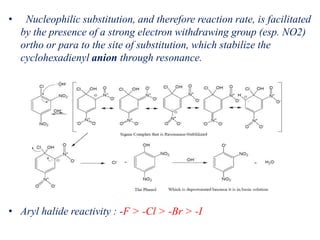
• Nucleophilic substitution, and therefore reaction rate, is facilitated
by the presence of a strong electron withdrawing group (esp. NO2)
ortho or para to the site of substitution, which stabilize the
cyclohexadienyl anion through resonance.
• Aryl halide reactivity : -F > -Cl > -Br > -I
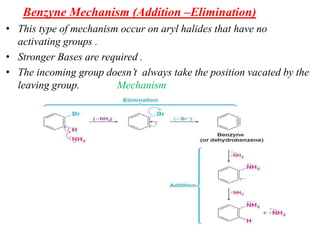
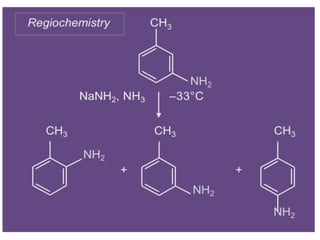
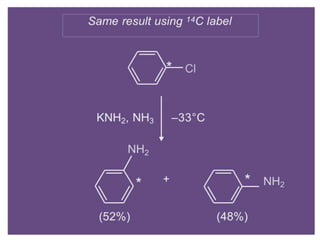
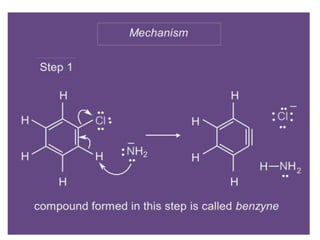
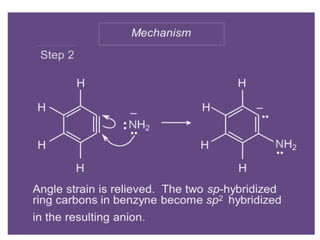
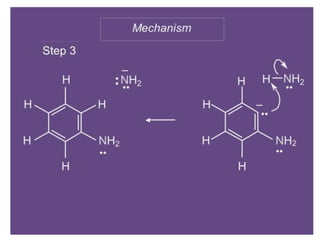
Benzyne Mechanism (Addition –Elimination)
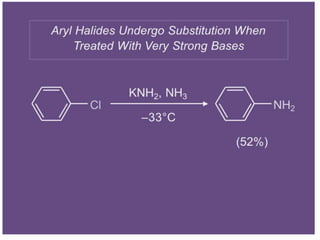
• This type of mechanism occur on aryl halides that have no
activating groups .
• Stronger Bases are required .
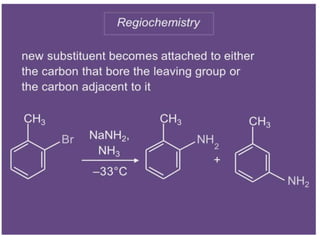
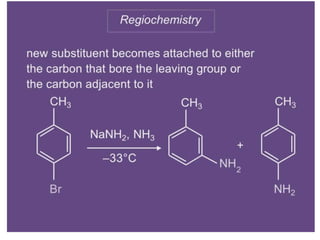
• The incoming group doesn’t always take the position vacated by the
leaving group. Mechanism
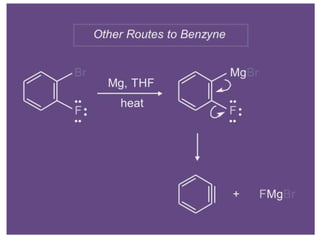
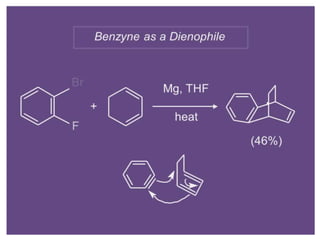
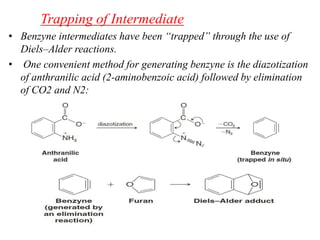
Trapping of Intermediate
• Benzyne intermediates have been “trapped” through the use of
Diels–Alder reactions.
• One convenient method for generating benzyne is the diazotization
of anthranilic acid (2-aminobenzoic acid) followed by elimination
of CO2 and N2:
SRN1 Mechanism
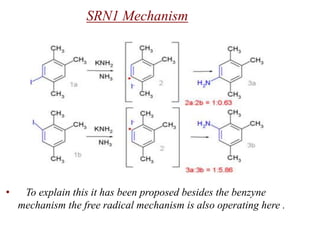
• To explain this it has been proposed besides the benzyne
mechanism the free radical mechanism is also operating here .
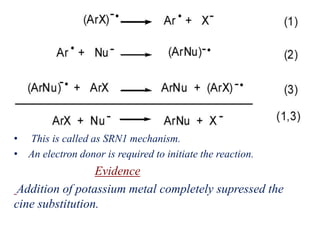
• This is called as SRN1 mechanism.
• An electron donor is required to initiate the reaction.
Evidence
Addition of potassium metal completely supressed the
cine substitution.
Von Richter Rearrangement
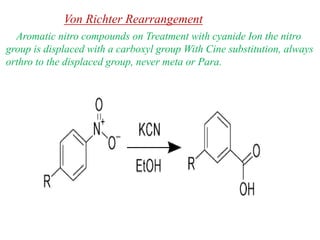
Aromatic nitro compounds on Treatment with cyanide Ion the nitro
group is displaced with a carboxyl group With Cine substitution, always
orthro to the displaced group, never meta or Para.
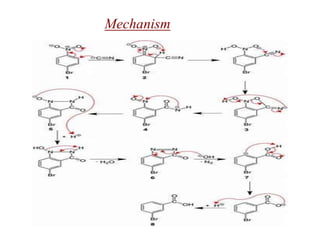
Mechanism
Smiles Rearrangement
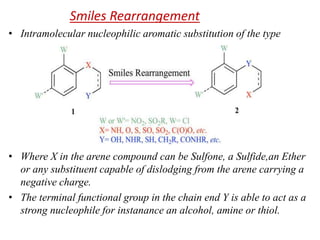
• Intramolecular nucleophilic aromatic substitution of the type
• Where X in the arene compound can be Sulfone, a Sulfide,an Ether
or any substituent capable of dislodging from the arene carrying a
negative charge.
• The terminal functional group in the chain end Y is able to act as a
strong nucleophile for instanance an alcohol, amine or thiol.
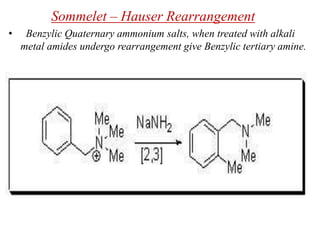
Sommelet – Hauser Rearrangement
• Benzylic Quaternary ammonium salts, when treated with alkali
metal amides undergo rearrangement give Benzylic tertiary amine.
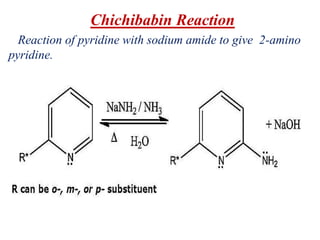
Chichibabin Reaction
Reaction of pyridine with sodium amide to give 2-amino
pyridine.
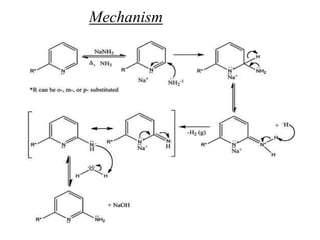
Mechanism
Nucleophilic Aromatic Substitution 1

Nucleophilic Aromatic Substitution 1

  • 1.
    Department of Chemistry Universityof kashmir Topic:-Nucleophilic Aromatic Substitution Presented By Aadil Ali Wani
  • 2.
    Nucleophilic Aromatic Substitution •Substitution reactions in which the nucleophile displaces a good leaving group such as halide on an aromatic ring. • Reactions that are successful at an aromatic substrate are largely of four kinds. • Electrophilic substitution is by far the most common mode of substitution in aromatic systems, the nucleophilic substitution is indeed and useful tool in certain cases. • The early industrial synthesis of phenols and anilines were based on nucleophilic aromatic substitution reaction
  • 3.
    • SN₂ atSp² carbon doesn’t occur. • SN1 at Sp2 carbon also doesn't occur.
  • 4.
    Mechanisms • SNAr Mechanism- addition / elimination • SN1 Mechanism • benzyne Mechanism - elimination / addition • Srn 1 Mechanism
  • 5.
    SNAr Ar Mechanism- addition / elimination • Nucleophilic aromatic substitutions of the type just shown follow an addition-elimination mechanism. • The rate-determining intermediate is a cyclohexadienyl anion and is stabilized by electron-withdrawing substituents. • Attack of the strong nucleophile on the halogen substituted aromatic carbon forming an anionic intermediate. • Loss of the leaving group, the halide ion restores the aromaticity. • Kinetics of the reaction are observed to be second order. • The addition step is the rate determining step (loss of aromaticity).
  • 6.
    • The rate-determiningintermediate is a cyclohexadienyl anion and is stabilized by electron-withdrawing substituents especially in positions Ortho and Para to leaving group. • Attack of the strong nucleophile on the halogen substituted aromatic carbon forming an anionic intermediate. • Loss of the leaving group, the halide ion restores the aromaticity. • The addition step is the rate determining step (loss of aromaticity).
  • 7.
    • Nucleophilic substitution,and therefore reaction rate, is facilitated by the presence of a strong electron withdrawing group (esp. NO2) ortho or para to the site of substitution, which stabilize the cyclohexadienyl anion through resonance. • Aryl halide reactivity : -F > -Cl > -Br > -I
  • 8.
    Benzyne Mechanism (Addition–Elimination) • This type of mechanism occur on aryl halides that have no activating groups . • Stronger Bases are required . • The incoming group doesn’t always take the position vacated by the leaving group. Mechanism
  • 19.
    Trapping of Intermediate •Benzyne intermediates have been “trapped” through the use of Diels–Alder reactions. • One convenient method for generating benzyne is the diazotization of anthranilic acid (2-aminobenzoic acid) followed by elimination of CO2 and N2:
  • 20.
    SRN1 Mechanism • Toexplain this it has been proposed besides the benzyne mechanism the free radical mechanism is also operating here .
  • 21.
    • This iscalled as SRN1 mechanism. • An electron donor is required to initiate the reaction. Evidence Addition of potassium metal completely supressed the cine substitution.
  • 22.
    Von Richter Rearrangement Aromaticnitro compounds on Treatment with cyanide Ion the nitro group is displaced with a carboxyl group With Cine substitution, always orthro to the displaced group, never meta or Para.
  • 23.
  • 24.
    Smiles Rearrangement • Intramolecularnucleophilic aromatic substitution of the type • Where X in the arene compound can be Sulfone, a Sulfide,an Ether or any substituent capable of dislodging from the arene carrying a negative charge. • The terminal functional group in the chain end Y is able to act as a strong nucleophile for instanance an alcohol, amine or thiol.
  • 25.
    Sommelet – HauserRearrangement • Benzylic Quaternary ammonium salts, when treated with alkali metal amides undergo rearrangement give Benzylic tertiary amine.
  • 26.
    Chichibabin Reaction Reaction ofpyridine with sodium amide to give 2-amino pyridine.
  • 27.