Schematic diagram and basic
   components of HPLC system
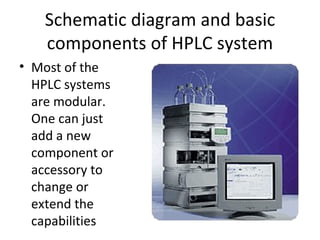
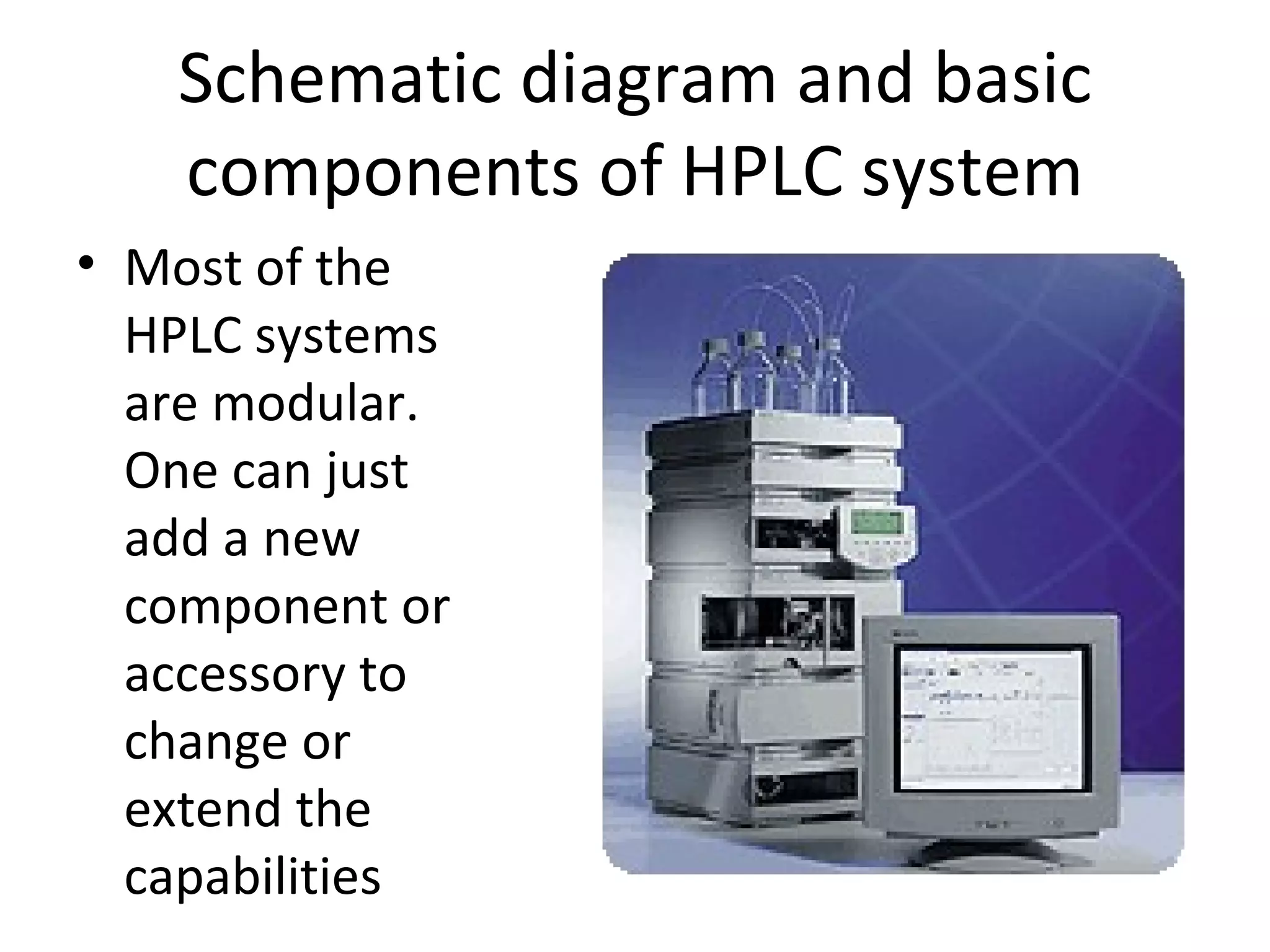
• Most of the
  HPLC systems
  are modular.
  One can just
  add a new
  component or
  accessory to
  change or
  extend the
  capabilities
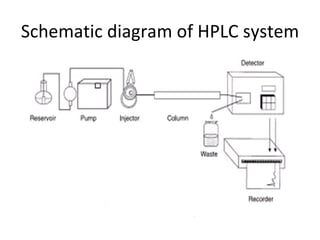
Schematic diagram of HPLC system
Mobile phase reservoir and its
            Functions
• Is a tray having glass bottles fitted a lid and
  1/8 inch diameter PTFE tubing to carry mobile
  phase to pump
• Liquid entering in pump should not contain
  air, dust or any particulate matter which can
  interfere with pumping action or cause
  damage to seals and valves- need filteration
• Air bubble can also effect behavior of
  detector, hence, need to degas the mobile
  phase
• Filtered solvents extend the life of
  pump and reduce column plugging
• Stainless steel filtering element
  (filter size 2µm) at one end of PTFE
  tubing serves as an in-line filter
• All solvents should be HPLC grade
Explain HPLC Pump
• Function: Passes mobile phase through the
  column at a high pressure and constant flow
  rate
• Characteristics:
1-Inetrior of the pump is made up of inert
  material so that it could not be corroded with
  solvents
2-May allow to change a range of flow rates
3-Non pulsating solvent flow. Pulsation may
  cause baseline noise especially if detector is
  flow sensitive. Pulse effect should be
  minimized using pulse damper
4-Large dead volume between pump and
  injector should be avoided
5-Easy to change from one mobile phase to
  another
6- Easy to dismantle and repair
Types of pumps
• Constant pressure pump
1-Apply a constant pressure to the mobile phase
2- Flow rate is determined by the resistance of
  the column and restrictions between pump
  and outlet. Hence flow rate will change if flow
  resistance change
3- It is not suitable for HPLC analysis
4- Only suitable for packing of column whereby
  small changes in flow are not important
• Constant flow pump
1-Generates a given flow of liquid so that the
  pressure developed depends on flow
  resistance
2-Changes in flow resistance compensated for
  by a change of pressure
3-Two types of constant flow pumps used for
  HPLC are
A-Motor-driven syringe pump
B- Reciprocating piston pump (mostly used)
Gradient controller and function in
          HPLC system
• It is a device that allows one to create a
  gradient program so as to alter the nature or
  polarity of the solvent
• Gradient may be linear, concave, convex or
  even stepped in terms of percentage of the
  stronger solvent
• Must form a homogenous mixture before it
  reaches the column
Sample injector
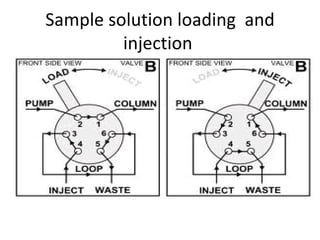
• To introduce sample solution into the column
  via a sampling loop
• It must have zero dead volume valve
• Manual and automated valve systems are
  available
• Change sample loop 5-500 µl or larger
  volumes to alter sample size
Sample solution loading and
         injection
Analytical columns of HPLC
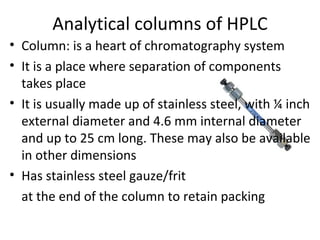
• Column: is a heart of chromatography system
• It is a place where separation of components
  takes place
• It is usually made up of stainless steel, with ¼ inch
  external diameter and 4.6 mm internal diameter
  and up to 25 cm long. These may also be available
  in other dimensions
• Has stainless steel gauze/frit
  at the end of the column to retain packing
• Small bore HPLC columns are also available for low
  mobile phase flow rates for higher efficiency and
  small sample size
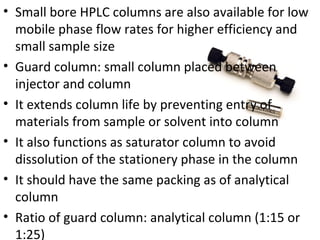
• Guard column: small column placed between
  injector and column
• It extends column life by preventing entry of
  materials from sample or solvent into column
• It also functions as saturator column to avoid
  dissolution of the stationery phase in the column
• It should have the same packing as of analytical
  column
• Ratio of guard column: analytical column (1:15 or
  1:25)
Column packing
• Three types of packing are used in HPLC columns
1-Fully porous
• Originally used silica or alumina
• Has porous channels through the packing
• Give low efficiency because solute takes a long
  time to diffuse from porous structure
• No longer used in analytical HPLC
• However, still used in preparative columns
  because of high sample capacity
2-Superficially porous layer beads
• Rough surface
• Consists of inert solid core of glass or plastic
  within a thin outer coating of silica or
  modified silica
• Fast mass transfer
• High efficiency
• Rapid re-equilibriation
• For analytical separation
• More efficient than porous packing
3-Micro-particulate
• Small diameter 3, 5, 10 µm
• Fully porous
• Spherical or irregular
• Analytical or preparative
• Combines the best features of fully porous
  and superficially porous beads
Sample preparation
• Goal of sample preparation: obtain a sample with
  the components of interest free from interfering
  constituents of the matrix at a suitable
  concentration for detection and measurement in
  a suitable solvent
• Sample preparation: liquid-liquid extraction and
  solid phase extraction
• Sample should be dissolved in same solvent or
  mixture like mobile phase wherever possible
Detectors
• Monitor mobile phase emerging from the
  column
• Its output is an electrical signal which is
  proportional to some property of the mobile
  phase/solute or both e.g.
1-Refractive index- property of solutes and
  mobile phase (bulk property)
2- Absorbance (UV/Vis, fluorescence) and
  electrochemical activity- solute property
• Required characteristics of detectors
1- Adequate sensitivity
2-Linearity (Wide linear dynamic range)
3-Universal or selective response
4-Predictable response, unaffected by changes in
  conditions
5- Short response time
5- Low dead volume (cell volume, length and bore
  of tubing)
6- Non-destructive
7- Cheap, reliable and easy to use
Types of detectors
• Bulk property detectors
1- Principle: Sense the difference in refractive
  index between column eluent and reference
  beam of pure mobile phase
2- Universal, not sensitive (limit of detection 1 µg)
3-Difficult to do gradient elution work
4- Must have good control of temperature of the
   instrument and composition of mobile phase
• Solute property detectors
1-UV/Vis spectrophotometer
• Most popular
• Only detects solute that absorb UV/Vis radiation
• Mobile phase should not absorb radiation
• Absorption of radiation by solute is a function of
  concentration according to Beer Lambert’s law
• Limit of detection is sub ng
Absorbance detectors
         UV/Visible detectors
• Three types
    Fixed wavelength detector
    Variable wavelength detector
    Diode array detector


                                   22
• Spectrofluorometric detectors
1-Absorb UV radiation and subsequently emit
  radiation of longer wavelength, either instantly
  (fluorescence) or after a time of delay
  (phosphorescence)
2-For compounds that are inherently fluorescent,
  otherwise compound has to be made
  fluorescent by derivatization using suitable
  reagent
3- Limit of detection 1pg
• Electrochemical detectors
1-Measure conductance of eluent (analyte must be
  ionic or redox system)
2-Measures current associated with oxidation and
  reduction of solutes, and may be coulometric or
  amperometric
1- Amperometric detector-most commonly used- a
  known potential is applied across a set of
  electrodes typically glassy carbon as a working
  electrode. It requires conducting mobile phase.
  Limit of detection pg
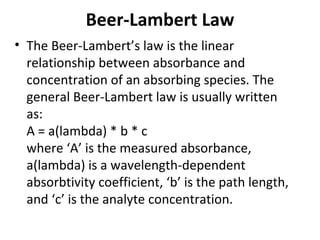
Beer-Lambert Law
• The Beer-Lambert’s law is the linear
  relationship between absorbance and
  concentration of an absorbing species. The
  general Beer-Lambert law is usually written
  as:
  A = a(lambda) * b * c
  where ‘A’ is the measured absorbance,
  a(lambda) is a wavelength-dependent
  absorbtivity coefficient, ‘b’ is the path length,
  and ‘c’ is the analyte concentration.
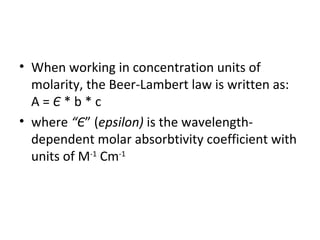
• When working in concentration units of
  molarity, the Beer-Lambert law is written as:
  A=Є*b*c
• where “Є” (epsilon) is the wavelength-
  dependent molar absorbtivity coefficient with
  units of M-1 Cm-1
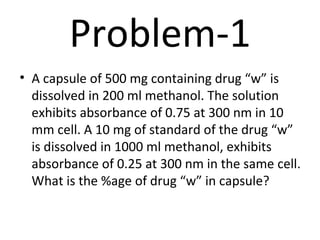
Problem-1
• A capsule of 500 mg containing drug “w” is
  dissolved in 200 ml methanol. The solution
  exhibits absorbance of 0.75 at 300 nm in 10
  mm cell. A 10 mg of standard of the drug “w”
  is dissolved in 1000 ml methanol, exhibits
  absorbance of 0.25 at 300 nm in the same cell.
  What is the %age of drug “w” in capsule?
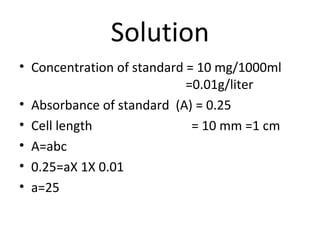
Solution
• Concentration of standard = 10 mg/1000ml
                            =0.01g/liter
• Absorbance of standard (A) = 0.25
• Cell length                = 10 mm =1 cm
• A=abc
• 0.25=aX 1X 0.01
• a=25
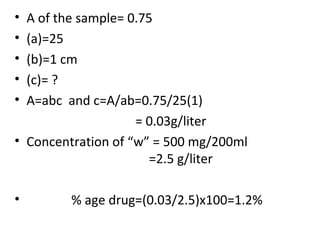
• A of the sample= 0.75
• (a)=25
• (b)=1 cm
• (c)= ?
• A=abc and c=A/ab=0.75/25(1)
                    = 0.03g/liter
• Concentration of “w” = 500 mg/200ml
                       =2.5 g/liter

•        % age drug=(0.03/2.5)x100=1.2%
Problem 2
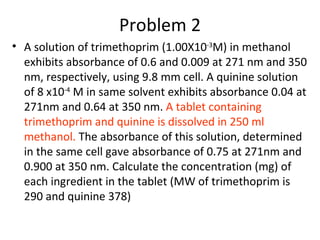
• A solution of trimethoprim (1.00X10⁻³M) in methanol
  exhibits absorbance of 0.6 and 0.009 at 271 nm and 350
  nm, respectively, using 9.8 mm cell. A quinine solution
  of 8 x10⁻⁴ M in same solvent exhibits absorbance 0.04 at
  271nm and 0.64 at 350 nm. A tablet containing
  trimethoprim and quinine is dissolved in 250 ml
  methanol. The absorbance of this solution, determined
  in the same cell gave absorbance of 0.75 at 271nm and
  0.900 at 350 nm. Calculate the concentration (mg) of
  each ingredient in the tablet (MW of trimethoprim is
  290 and quinine 378)

Hplc

  • 1.
    Schematic diagram andbasic components of HPLC system • Most of the HPLC systems are modular. One can just add a new component or accessory to change or extend the capabilities
  • 2.
  • 3.
    Mobile phase reservoirand its Functions • Is a tray having glass bottles fitted a lid and 1/8 inch diameter PTFE tubing to carry mobile phase to pump • Liquid entering in pump should not contain air, dust or any particulate matter which can interfere with pumping action or cause damage to seals and valves- need filteration • Air bubble can also effect behavior of detector, hence, need to degas the mobile phase
  • 4.
    • Filtered solventsextend the life of pump and reduce column plugging • Stainless steel filtering element (filter size 2µm) at one end of PTFE tubing serves as an in-line filter • All solvents should be HPLC grade
  • 5.
    Explain HPLC Pump •Function: Passes mobile phase through the column at a high pressure and constant flow rate • Characteristics: 1-Inetrior of the pump is made up of inert material so that it could not be corroded with solvents 2-May allow to change a range of flow rates
  • 6.
    3-Non pulsating solventflow. Pulsation may cause baseline noise especially if detector is flow sensitive. Pulse effect should be minimized using pulse damper 4-Large dead volume between pump and injector should be avoided 5-Easy to change from one mobile phase to another 6- Easy to dismantle and repair
  • 7.
    Types of pumps •Constant pressure pump 1-Apply a constant pressure to the mobile phase 2- Flow rate is determined by the resistance of the column and restrictions between pump and outlet. Hence flow rate will change if flow resistance change 3- It is not suitable for HPLC analysis 4- Only suitable for packing of column whereby small changes in flow are not important
  • 8.
    • Constant flowpump 1-Generates a given flow of liquid so that the pressure developed depends on flow resistance 2-Changes in flow resistance compensated for by a change of pressure 3-Two types of constant flow pumps used for HPLC are A-Motor-driven syringe pump B- Reciprocating piston pump (mostly used)
  • 9.
    Gradient controller andfunction in HPLC system • It is a device that allows one to create a gradient program so as to alter the nature or polarity of the solvent • Gradient may be linear, concave, convex or even stepped in terms of percentage of the stronger solvent • Must form a homogenous mixture before it reaches the column
  • 10.
    Sample injector • Tointroduce sample solution into the column via a sampling loop • It must have zero dead volume valve • Manual and automated valve systems are available • Change sample loop 5-500 µl or larger volumes to alter sample size
  • 11.
  • 12.
    Analytical columns ofHPLC • Column: is a heart of chromatography system • It is a place where separation of components takes place • It is usually made up of stainless steel, with ¼ inch external diameter and 4.6 mm internal diameter and up to 25 cm long. These may also be available in other dimensions • Has stainless steel gauze/frit at the end of the column to retain packing
  • 13.
    • Small boreHPLC columns are also available for low mobile phase flow rates for higher efficiency and small sample size • Guard column: small column placed between injector and column • It extends column life by preventing entry of materials from sample or solvent into column • It also functions as saturator column to avoid dissolution of the stationery phase in the column • It should have the same packing as of analytical column • Ratio of guard column: analytical column (1:15 or 1:25)
  • 14.
    Column packing • Threetypes of packing are used in HPLC columns 1-Fully porous • Originally used silica or alumina • Has porous channels through the packing • Give low efficiency because solute takes a long time to diffuse from porous structure • No longer used in analytical HPLC • However, still used in preparative columns because of high sample capacity
  • 15.
    2-Superficially porous layerbeads • Rough surface • Consists of inert solid core of glass or plastic within a thin outer coating of silica or modified silica • Fast mass transfer • High efficiency • Rapid re-equilibriation • For analytical separation • More efficient than porous packing
  • 16.
    3-Micro-particulate • Small diameter3, 5, 10 µm • Fully porous • Spherical or irregular • Analytical or preparative • Combines the best features of fully porous and superficially porous beads
  • 17.
    Sample preparation • Goalof sample preparation: obtain a sample with the components of interest free from interfering constituents of the matrix at a suitable concentration for detection and measurement in a suitable solvent • Sample preparation: liquid-liquid extraction and solid phase extraction • Sample should be dissolved in same solvent or mixture like mobile phase wherever possible
  • 18.
    Detectors • Monitor mobilephase emerging from the column • Its output is an electrical signal which is proportional to some property of the mobile phase/solute or both e.g. 1-Refractive index- property of solutes and mobile phase (bulk property) 2- Absorbance (UV/Vis, fluorescence) and electrochemical activity- solute property
  • 19.
    • Required characteristicsof detectors 1- Adequate sensitivity 2-Linearity (Wide linear dynamic range) 3-Universal or selective response 4-Predictable response, unaffected by changes in conditions 5- Short response time 5- Low dead volume (cell volume, length and bore of tubing) 6- Non-destructive 7- Cheap, reliable and easy to use
  • 20.
    Types of detectors •Bulk property detectors 1- Principle: Sense the difference in refractive index between column eluent and reference beam of pure mobile phase 2- Universal, not sensitive (limit of detection 1 µg) 3-Difficult to do gradient elution work 4- Must have good control of temperature of the instrument and composition of mobile phase
  • 21.
    • Solute propertydetectors 1-UV/Vis spectrophotometer • Most popular • Only detects solute that absorb UV/Vis radiation • Mobile phase should not absorb radiation • Absorption of radiation by solute is a function of concentration according to Beer Lambert’s law • Limit of detection is sub ng
  • 22.
    Absorbance detectors UV/Visible detectors • Three types Fixed wavelength detector Variable wavelength detector Diode array detector 22
  • 23.
    • Spectrofluorometric detectors 1-AbsorbUV radiation and subsequently emit radiation of longer wavelength, either instantly (fluorescence) or after a time of delay (phosphorescence) 2-For compounds that are inherently fluorescent, otherwise compound has to be made fluorescent by derivatization using suitable reagent 3- Limit of detection 1pg
  • 24.
    • Electrochemical detectors 1-Measureconductance of eluent (analyte must be ionic or redox system) 2-Measures current associated with oxidation and reduction of solutes, and may be coulometric or amperometric 1- Amperometric detector-most commonly used- a known potential is applied across a set of electrodes typically glassy carbon as a working electrode. It requires conducting mobile phase. Limit of detection pg
  • 25.
    Beer-Lambert Law • TheBeer-Lambert’s law is the linear relationship between absorbance and concentration of an absorbing species. The general Beer-Lambert law is usually written as: A = a(lambda) * b * c where ‘A’ is the measured absorbance, a(lambda) is a wavelength-dependent absorbtivity coefficient, ‘b’ is the path length, and ‘c’ is the analyte concentration.
  • 26.
    • When workingin concentration units of molarity, the Beer-Lambert law is written as: A=Є*b*c • where “Є” (epsilon) is the wavelength- dependent molar absorbtivity coefficient with units of M-1 Cm-1
  • 27.
    Problem-1 • A capsuleof 500 mg containing drug “w” is dissolved in 200 ml methanol. The solution exhibits absorbance of 0.75 at 300 nm in 10 mm cell. A 10 mg of standard of the drug “w” is dissolved in 1000 ml methanol, exhibits absorbance of 0.25 at 300 nm in the same cell. What is the %age of drug “w” in capsule?
  • 28.
    Solution • Concentration ofstandard = 10 mg/1000ml =0.01g/liter • Absorbance of standard (A) = 0.25 • Cell length = 10 mm =1 cm • A=abc • 0.25=aX 1X 0.01 • a=25
  • 29.
    • A ofthe sample= 0.75 • (a)=25 • (b)=1 cm • (c)= ? • A=abc and c=A/ab=0.75/25(1) = 0.03g/liter • Concentration of “w” = 500 mg/200ml =2.5 g/liter • % age drug=(0.03/2.5)x100=1.2%
  • 30.
    Problem 2 • Asolution of trimethoprim (1.00X10⁻³M) in methanol exhibits absorbance of 0.6 and 0.009 at 271 nm and 350 nm, respectively, using 9.8 mm cell. A quinine solution of 8 x10⁻⁴ M in same solvent exhibits absorbance 0.04 at 271nm and 0.64 at 350 nm. A tablet containing trimethoprim and quinine is dissolved in 250 ml methanol. The absorbance of this solution, determined in the same cell gave absorbance of 0.75 at 271nm and 0.900 at 350 nm. Calculate the concentration (mg) of each ingredient in the tablet (MW of trimethoprim is 290 and quinine 378)