Topic : Thévenin’s Theorems
Branch : Batch :
Name ENROLLMENT NO.
Abhishek Chokshi 140120109005
Himal Desai
Harsh Dedakia
140120109008
140120109012
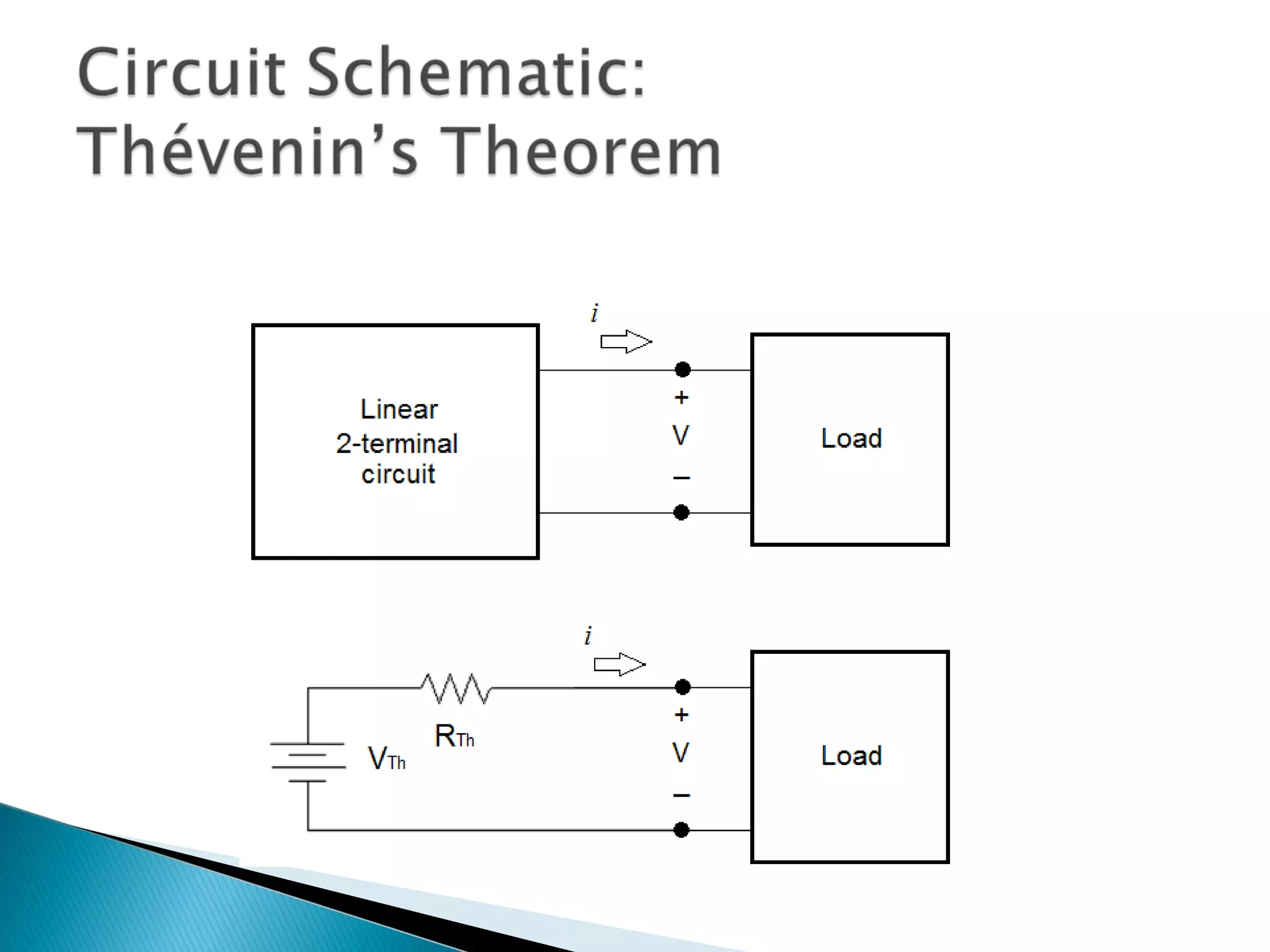
 A linear two-terminal circuit can be replaced with
an equivalent circuit of an ideal voltage source,
VTh, in series with a resistor, RTh.
◦ VTh is equal to the open-circuit voltage at the terminals.
◦ RTh is the equivalent or input resistance when the
independent sources in the linear circuit are turned off.
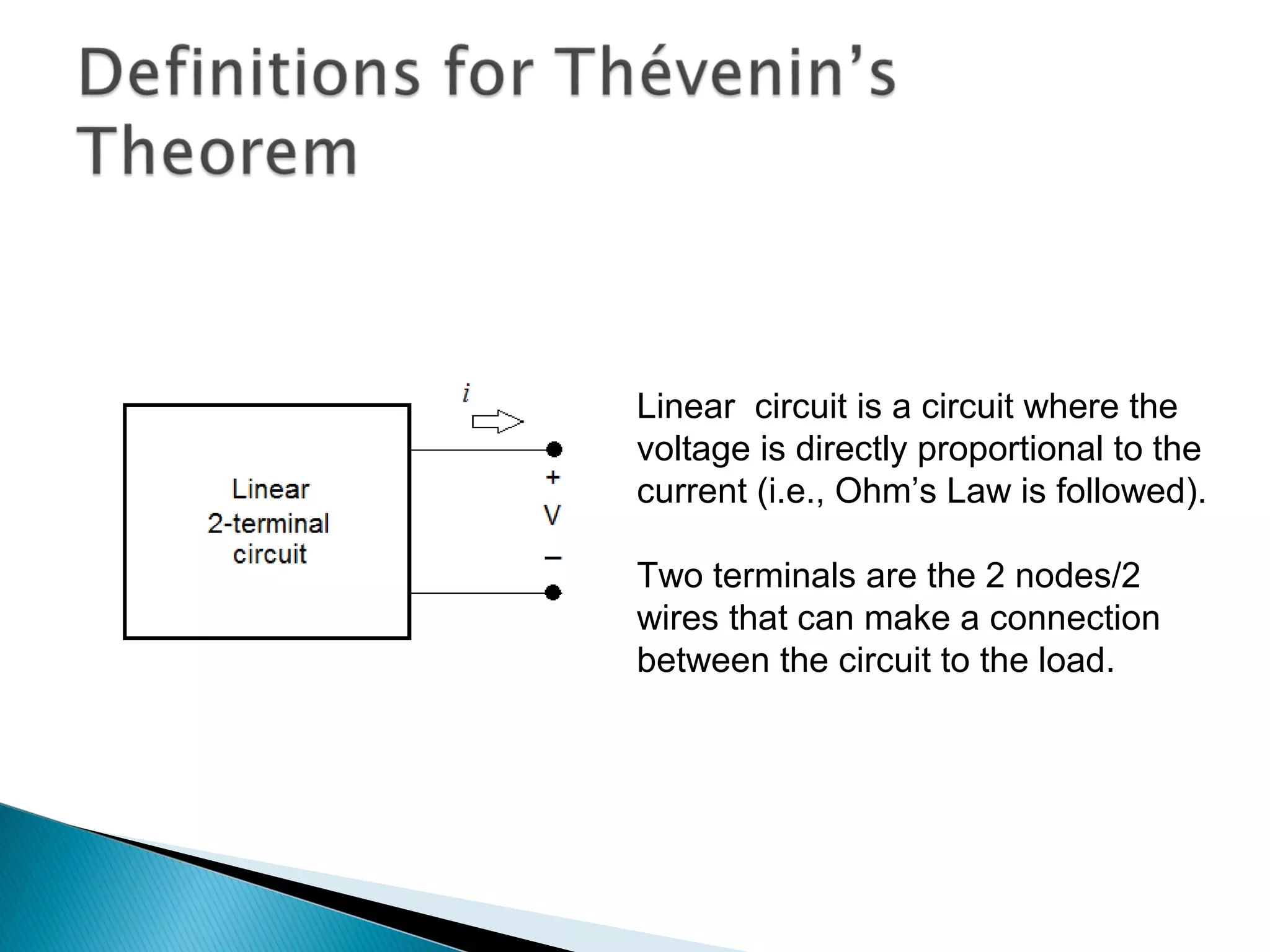
Linear circuit is a circuit where the
voltage is directly proportional to the
current (i.e., Ohm’s Law is followed).
Two terminals are the 2 nodes/2
wires that can make a connection
between the circuit to the load.
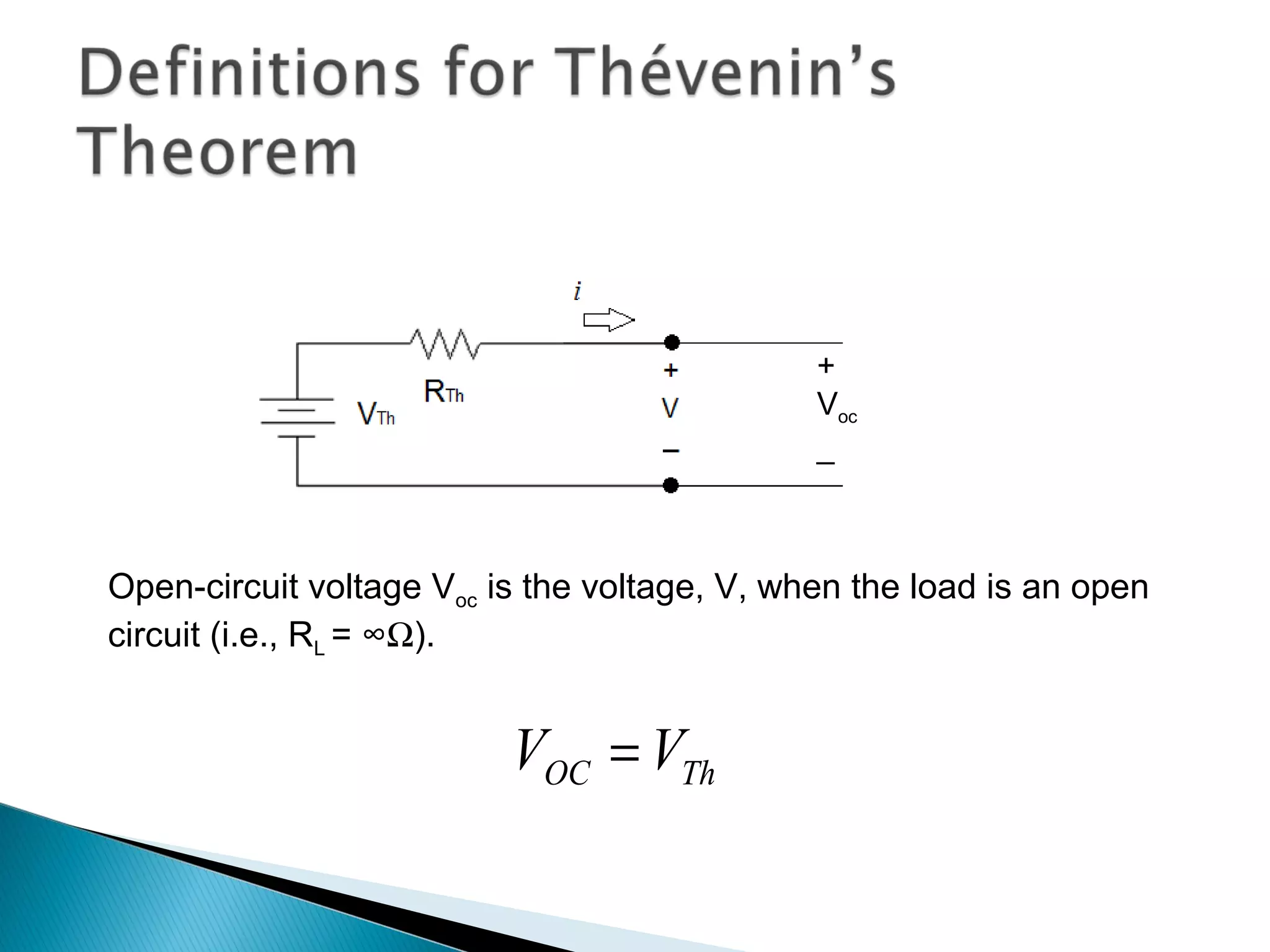
Open-circuit voltage Voc is the voltage, V, when the load is an open
circuit (i.e., RL = ∞Ω).
+
Voc
_
ThOC VV =
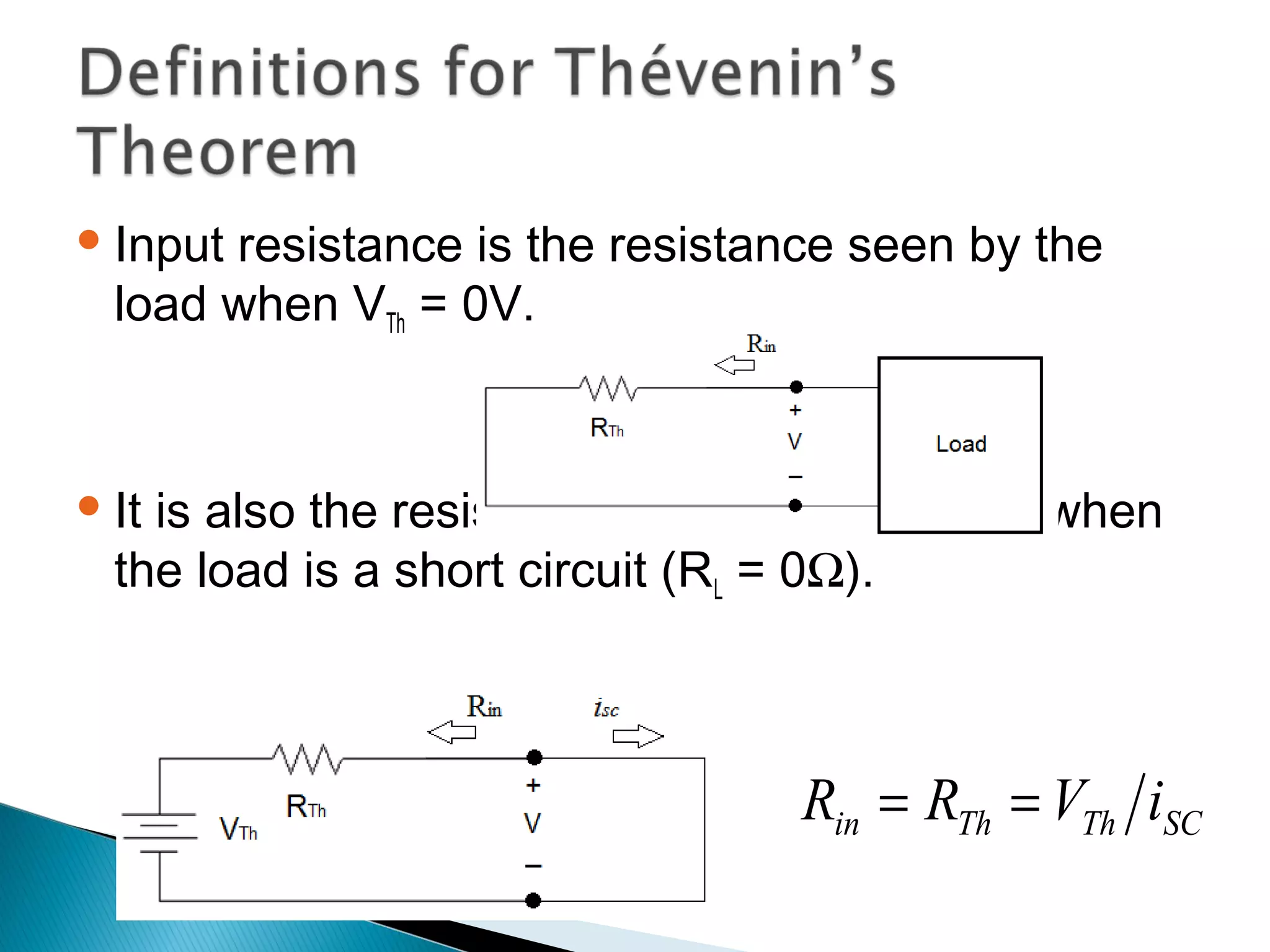
Input resistance is the resistance seen by the
load when VTh = 0V.
It is also the resistance of the linear circuit when
the load is a short circuit (RL = 0Ω).
SCThThin iVRR ==
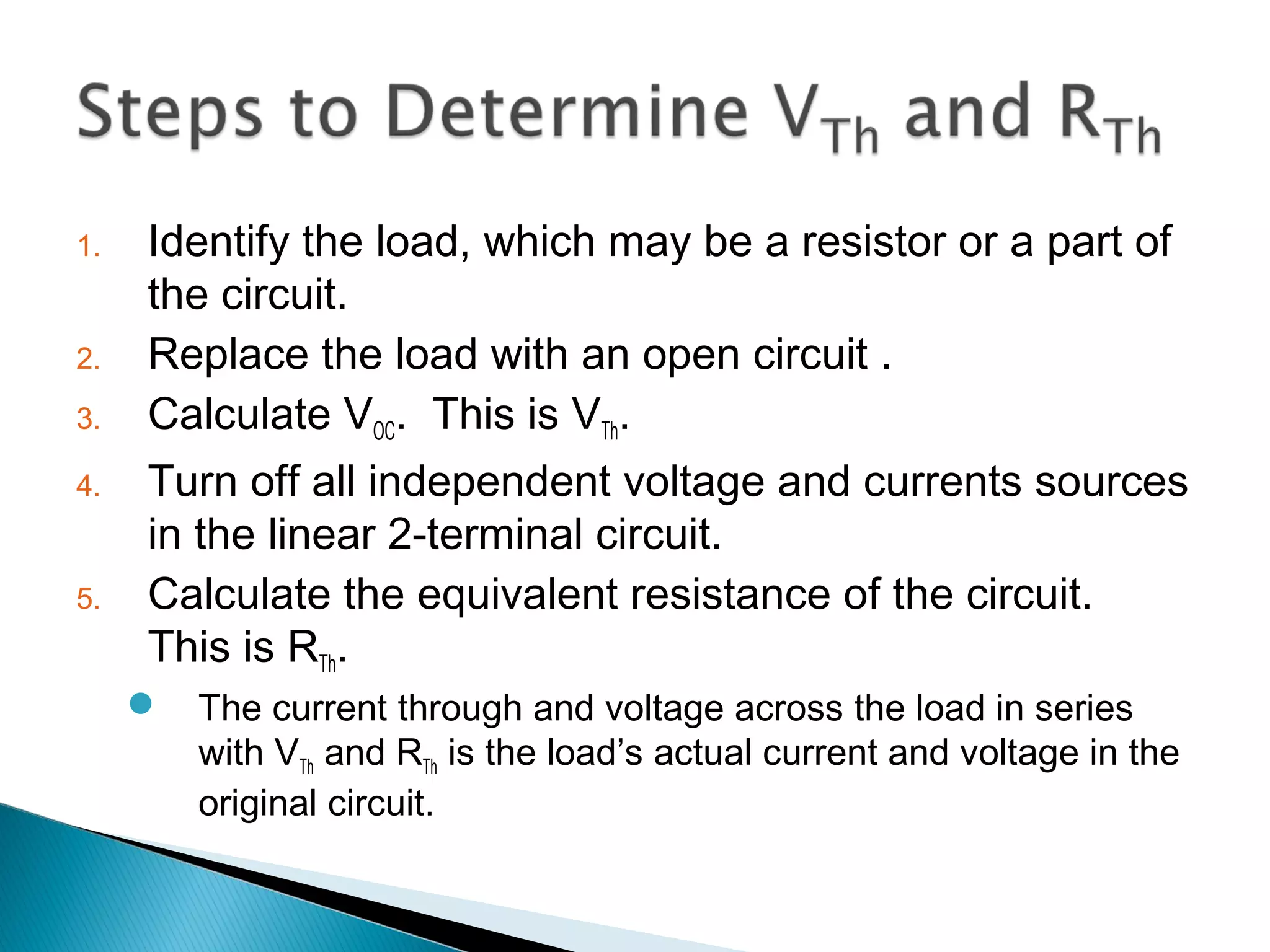
1. Identify the load, which may be a resistor or a part of
the circuit.
2. Replace the load with an open circuit .
3. Calculate VOC. This is VTh.
4. Turn off all independent voltage and currents sources
in the linear 2-terminal circuit.
5. Calculate the equivalent resistance of the circuit.
This is RTh.
 The current through and voltage across the load in series
with VTh and RTh is the load’s actual current and voltage in the
original circuit.
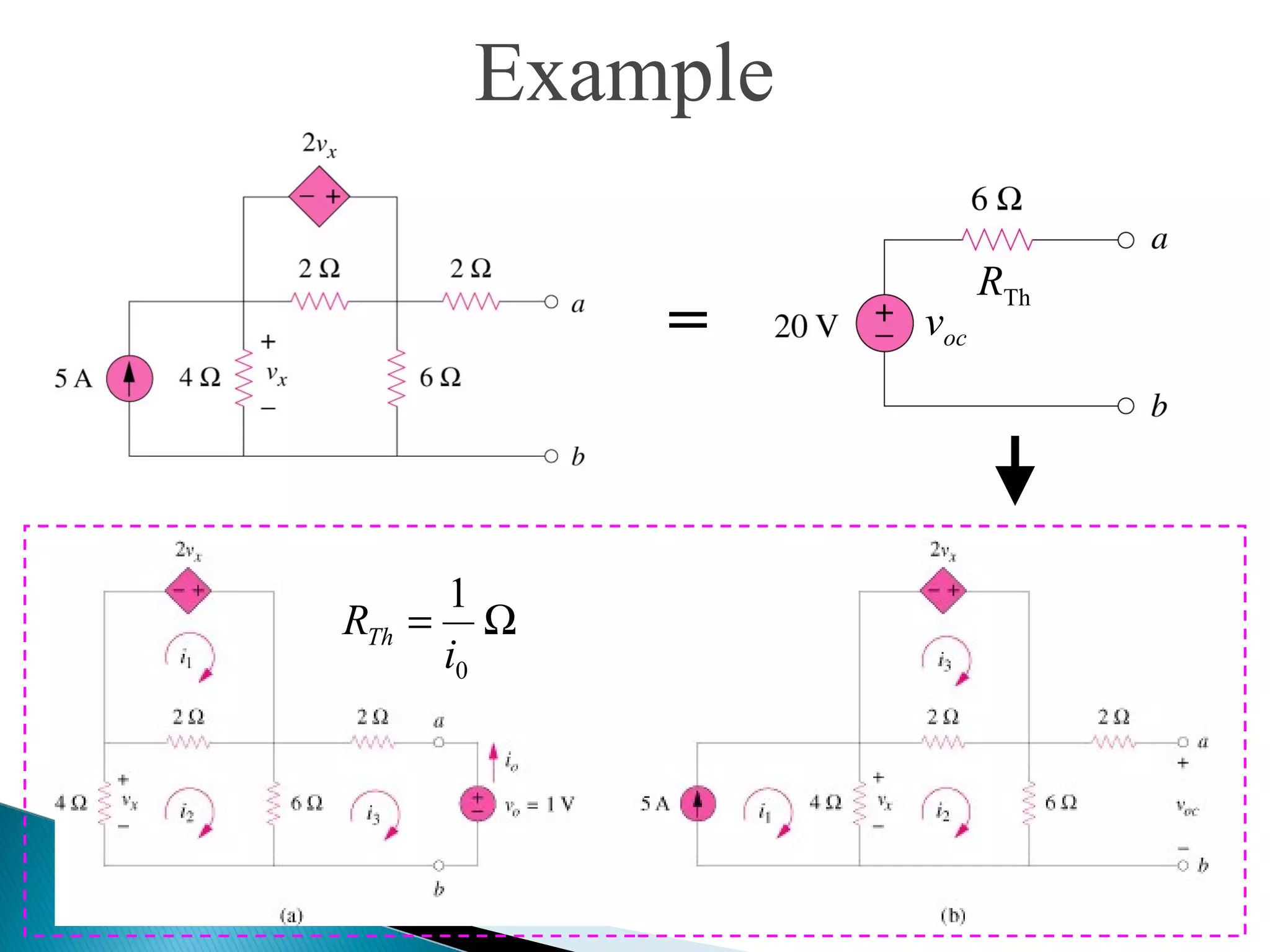
Example
=
RTh
voc
Ω=
1
0i
RTh
THEVENIN & NORTON
THEVENIN’S THEOREM:
Find VX by first finding VTH and RTH to the left of A-B.
1 2 Ω 4 Ω
6 Ω 2 Ω V X3 0 V +_
+
_
A
B
•
•
Circuit for Example
First remove everything to the right of A-B.
THEVENIN & NORTON
THEVENIN’S THEOREM:
1 2 Ω 4 Ω
6 Ω3 0 V +_
A
B
•
•
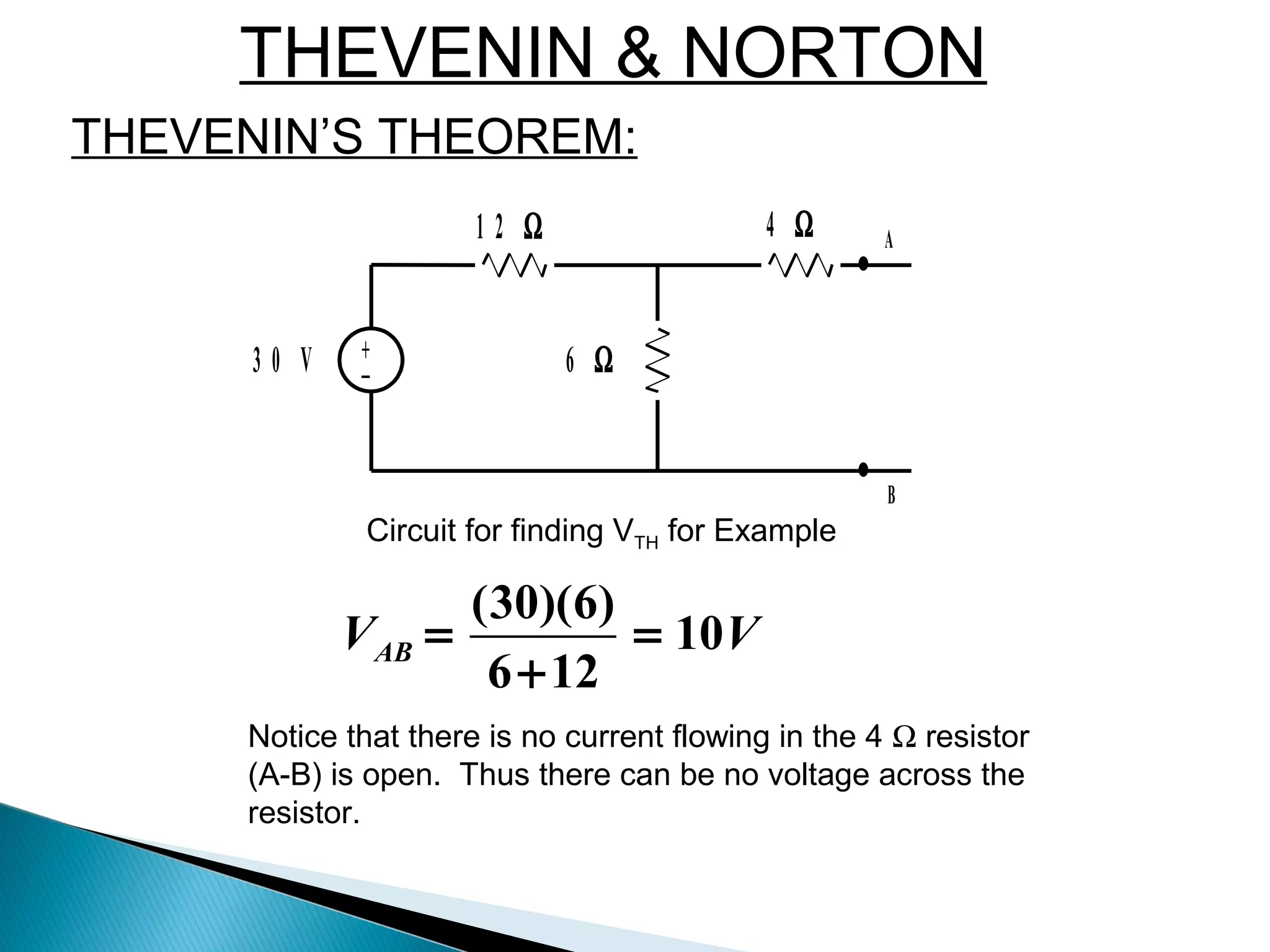
Circuit for finding VTH for Example
(30)(6)
10
6 12
ABV V= =
+
Notice that there is no current flowing in the 4 Ω resistor
(A-B) is open. Thus there can be no voltage across the
resistor.
THEVENIN & NORTON
THEVENIN’S THEOREM:
We now deactivate the sources to the left of A-B and find
the resistance seen looking in these terminals.
1 2 Ω 4 Ω
6 Ω
A
B
•
•
RTH
Circuit for find RTH for Example
We see,
RTH = 12||6 + 4 = 8 Ω
THEVENIN & NORTON
THEVENIN’S THEOREM:
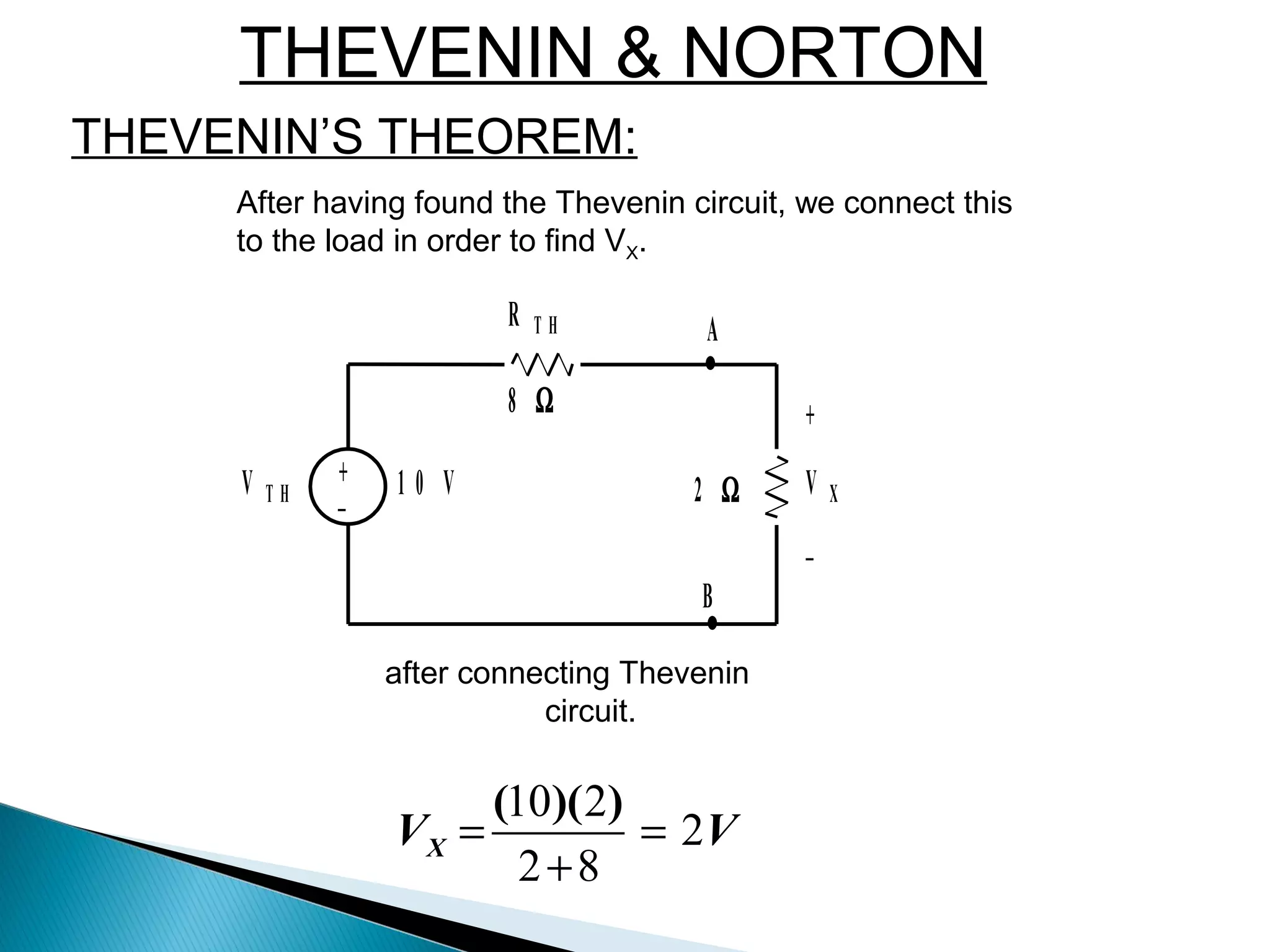
After having found the Thevenin circuit, we connect this
to the load in order to find VX.
8 Ω
1 0 VV T H
R T H
2 Ω V X
+
_
+
_
A
B
•
•
after connecting Thevenin
circuit.
10 2
2
2 8
= =
+
( )( )
XV V
THEVENIN & NORTON
THEVENIN’S THEOREM:
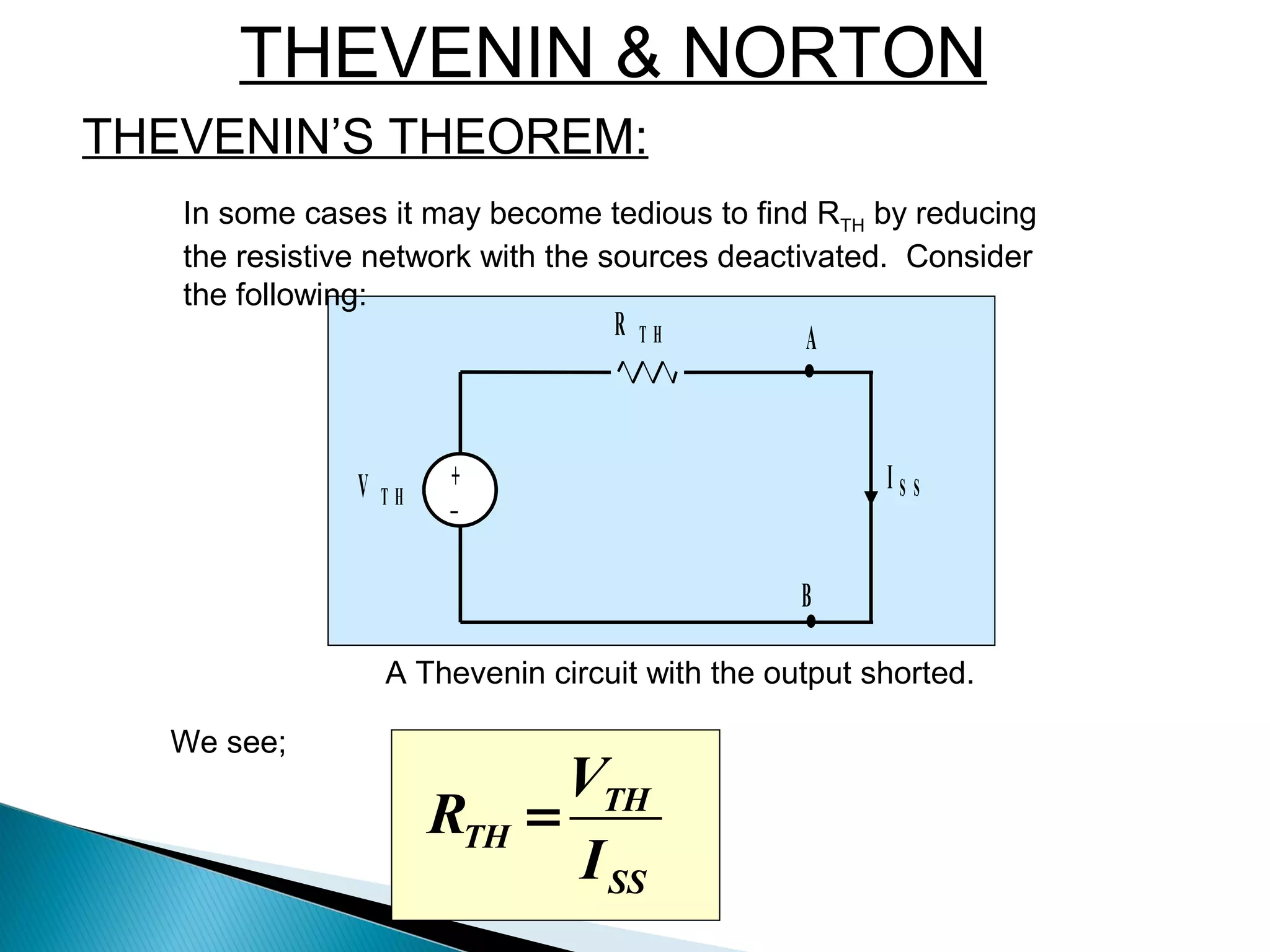
In some cases it may become tedious to find RTH by reducing
the resistive network with the sources deactivated. Consider
the following:
V T H
R T H
+
_
A
B
•
•
I S S
A Thevenin circuit with the output shorted.
We see;
TH
TH
SS
V
R
I
=
circuits
Thevenin

Thévenin’s Theorems

  • 1.
    Topic : Thévenin’sTheorems Branch : Batch :
  • 2.
    Name ENROLLMENT NO. AbhishekChokshi 140120109005 Himal Desai Harsh Dedakia 140120109008 140120109012
  • 4.
     A lineartwo-terminal circuit can be replaced with an equivalent circuit of an ideal voltage source, VTh, in series with a resistor, RTh. ◦ VTh is equal to the open-circuit voltage at the terminals. ◦ RTh is the equivalent or input resistance when the independent sources in the linear circuit are turned off.
  • 6.
    Linear circuit isa circuit where the voltage is directly proportional to the current (i.e., Ohm’s Law is followed). Two terminals are the 2 nodes/2 wires that can make a connection between the circuit to the load.
  • 7.
    Open-circuit voltage Vocis the voltage, V, when the load is an open circuit (i.e., RL = ∞Ω). + Voc _ ThOC VV =
  • 8.
    Input resistance isthe resistance seen by the load when VTh = 0V. It is also the resistance of the linear circuit when the load is a short circuit (RL = 0Ω). SCThThin iVRR ==
  • 9.
    1. Identify theload, which may be a resistor or a part of the circuit. 2. Replace the load with an open circuit . 3. Calculate VOC. This is VTh. 4. Turn off all independent voltage and currents sources in the linear 2-terminal circuit. 5. Calculate the equivalent resistance of the circuit. This is RTh.  The current through and voltage across the load in series with VTh and RTh is the load’s actual current and voltage in the original circuit.
  • 10.
  • 11.
    THEVENIN & NORTON THEVENIN’STHEOREM: Find VX by first finding VTH and RTH to the left of A-B. 1 2 Ω 4 Ω 6 Ω 2 Ω V X3 0 V +_ + _ A B • • Circuit for Example First remove everything to the right of A-B.
  • 12.
    THEVENIN & NORTON THEVENIN’STHEOREM: 1 2 Ω 4 Ω 6 Ω3 0 V +_ A B • • Circuit for finding VTH for Example (30)(6) 10 6 12 ABV V= = + Notice that there is no current flowing in the 4 Ω resistor (A-B) is open. Thus there can be no voltage across the resistor.
  • 13.
    THEVENIN & NORTON THEVENIN’STHEOREM: We now deactivate the sources to the left of A-B and find the resistance seen looking in these terminals. 1 2 Ω 4 Ω 6 Ω A B • • RTH Circuit for find RTH for Example We see, RTH = 12||6 + 4 = 8 Ω
  • 14.
    THEVENIN & NORTON THEVENIN’STHEOREM: After having found the Thevenin circuit, we connect this to the load in order to find VX. 8 Ω 1 0 VV T H R T H 2 Ω V X + _ + _ A B • • after connecting Thevenin circuit. 10 2 2 2 8 = = + ( )( ) XV V
  • 15.
    THEVENIN & NORTON THEVENIN’STHEOREM: In some cases it may become tedious to find RTH by reducing the resistive network with the sources deactivated. Consider the following: V T H R T H + _ A B • • I S S A Thevenin circuit with the output shorted. We see; TH TH SS V R I =
  • 16.