Gandhinagar Institute Of
Technology
Subject – Signals and Systems ( 2141005)
Branch – Electrical
Topic – Discrete Fourier Transform
Name Enrollment No.
Abhishek Chokshi 140120109005
Soham Davra 140120109007
Keval Darji 140120109006
Guided By – Prof. Hardik Sir
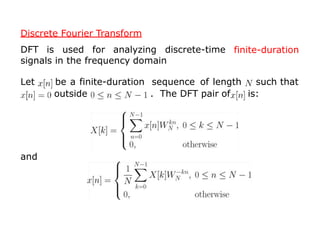
finite-duration
Discrete Fourier Transform
DFT is used for analyzing discrete-time
signals in the frequency domain
Let be a finite-duration sequence of length
outside . The DFT pair of
such that
is:
and
time domain frequency domain
... ...... ...
discrete and finite discrete and finite
Discrete Fourier Transform
• Definition - For a length-N sequence x[n],
defined for 0 ≤ n ≤ N −1 only N samples of its
DFT are required, which are obtained by
uniformly sampling X (e jω
) on the ω-axis
between 0 ≤ ω≤ 2π at ωk = 2πk/ N, 0 ≤ k ≤ N −1
• From the definition of the DFT we thus have
N−1
ω=2πk/ N
= ∑ x[n]e− j2πk/ N ,
k=0
X[k] = X (e jω
)
0 ≤ k ≤ N −1
Discrete Fourier Transform
 X[k] is also a length-N sequence in the
frequency domain
• The sequence X[k] is called the Discrete
Fourier Transform (DFT) of thesequence
x[n]
• Using the notation WN = e− j2π/ N
the
DFT is usually expressed as:
N−1
n=0
X[k] = ∑ x[n]W kn
, 0 ≤ k ≤ N −1N
Discrete Fourier Transform
• To verify the above expression we multiply
N
and sum the result from n = 0 to n = N −1
both sides of the above equation by W ln
1
∑ , 0 ≤ n ≤ N −1X[k]Wx[n]=
• The Inverse Discrete Fourier Transform
(IDFT) is given by
N−1
N k=0
−kn
N
Discrete Fourier Transform
 resulting in
∑ ( ∑
N −1 1 N−1
n=0 k=0
−kn
N−1
∑
n=0
WN
N
l nl n
X[k]WNx[n]WN =
=
1
∑ ∑
N−1N−1
n=0 k=0N
X[k]WN
−(k−l)n
=
1
∑ ∑
N−1N−1
k=0 n=0N
X[k]WN
−(k−l)n
)
Discrete Fourier Transform
=
• Making use of the identity
N−1
n=0
∑ WN
−(k−l )n
0, otherwise
N, for k − l = rN, r an integer
we observe that the RHS of the last
equation is equal to X[l]
• Hence
Nx[n]W ln = X[l]
N−1
∑
n=0
{
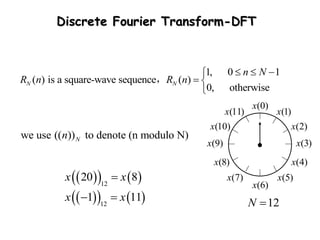
Discrete Fourier Transform-DFT
1, 0 1
( ) is a square-wave sequence ( )
0, otherwise
N N
n N
R n R n
  
 

,
we use (( )) to denote (n modulo N)Nn
(0)x
(1)x
(2)x
(3)x
(4)x
(6)x
(7)x
(8)x
(11)x
(10)x
(9)x
(5)x
12N 
    12
20 8x x
    12
1 11x x 
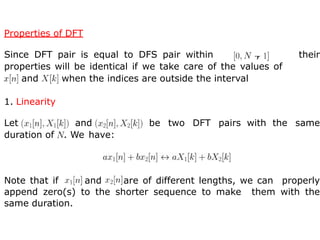
Properties of DFT
Since DFT pair is equal to DFS pair within , their
properties will be identical if we take care of the values of
and when the indices are outside the interval
1. Linearity
Let and be two DFT pairs with the same
duration of . We have:
Note that if and are of different lengths, we can properly
append zero(s) to the shorter sequence to make them with the
same duration.
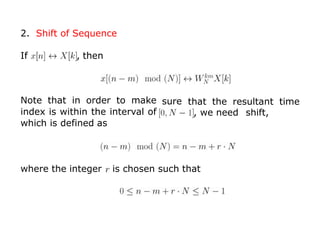
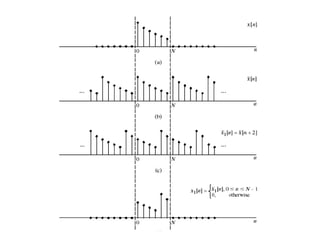
2. Shift of Sequence
If , then
sure that the resultant time
, we need shift,
Note that in order to make
index is within the interval of
which is defined as
where the integer is chosen such that
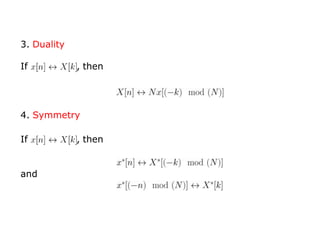
3. Duality
If , then
4. Symmetry
If , then
and
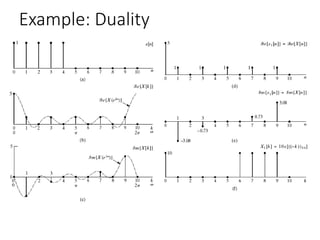
Example: Duality
be two DFT pairs with the
5. Circular Convolution
Let and
same duration of . We have
where is the circular convolution operator.
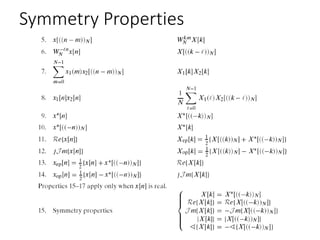
Symmetry Properties
References
•Techmax and Technical
•Wikipedia
•Youtube Channel
https://www.youtube.com/results?sea
rch_query=properties+of+discrete+fouri
er+transform
Discrete Fourier Transform

Discrete Fourier Transform

  • 1.
    Gandhinagar Institute Of Technology Subject– Signals and Systems ( 2141005) Branch – Electrical Topic – Discrete Fourier Transform
  • 2.
    Name Enrollment No. AbhishekChokshi 140120109005 Soham Davra 140120109007 Keval Darji 140120109006 Guided By – Prof. Hardik Sir
  • 3.
    finite-duration Discrete Fourier Transform DFTis used for analyzing discrete-time signals in the frequency domain Let be a finite-duration sequence of length outside . The DFT pair of such that is: and
  • 4.
    time domain frequencydomain ... ...... ... discrete and finite discrete and finite
  • 5.
    Discrete Fourier Transform •Definition - For a length-N sequence x[n], defined for 0 ≤ n ≤ N −1 only N samples of its DFT are required, which are obtained by uniformly sampling X (e jω ) on the ω-axis between 0 ≤ ω≤ 2π at ωk = 2πk/ N, 0 ≤ k ≤ N −1 • From the definition of the DFT we thus have N−1 ω=2πk/ N = ∑ x[n]e− j2πk/ N , k=0 X[k] = X (e jω ) 0 ≤ k ≤ N −1
  • 6.
    Discrete Fourier Transform X[k] is also a length-N sequence in the frequency domain • The sequence X[k] is called the Discrete Fourier Transform (DFT) of thesequence x[n] • Using the notation WN = e− j2π/ N the DFT is usually expressed as: N−1 n=0 X[k] = ∑ x[n]W kn , 0 ≤ k ≤ N −1N
  • 7.
    Discrete Fourier Transform •To verify the above expression we multiply N and sum the result from n = 0 to n = N −1 both sides of the above equation by W ln 1 ∑ , 0 ≤ n ≤ N −1X[k]Wx[n]= • The Inverse Discrete Fourier Transform (IDFT) is given by N−1 N k=0 −kn N
  • 8.
    Discrete Fourier Transform resulting in ∑ ( ∑ N −1 1 N−1 n=0 k=0 −kn N−1 ∑ n=0 WN N l nl n X[k]WNx[n]WN = = 1 ∑ ∑ N−1N−1 n=0 k=0N X[k]WN −(k−l)n = 1 ∑ ∑ N−1N−1 k=0 n=0N X[k]WN −(k−l)n )
  • 9.
    Discrete Fourier Transform = •Making use of the identity N−1 n=0 ∑ WN −(k−l )n 0, otherwise N, for k − l = rN, r an integer we observe that the RHS of the last equation is equal to X[l] • Hence Nx[n]W ln = X[l] N−1 ∑ n=0 {
  • 10.
    Discrete Fourier Transform-DFT 1,0 1 ( ) is a square-wave sequence ( ) 0, otherwise N N n N R n R n       , we use (( )) to denote (n modulo N)Nn (0)x (1)x (2)x (3)x (4)x (6)x (7)x (8)x (11)x (10)x (9)x (5)x 12N      12 20 8x x     12 1 11x x 
  • 11.
    Properties of DFT SinceDFT pair is equal to DFS pair within , their properties will be identical if we take care of the values of and when the indices are outside the interval 1. Linearity Let and be two DFT pairs with the same duration of . We have: Note that if and are of different lengths, we can properly append zero(s) to the shorter sequence to make them with the same duration.
  • 12.
    2. Shift ofSequence If , then sure that the resultant time , we need shift, Note that in order to make index is within the interval of which is defined as where the integer is chosen such that
  • 14.
    3. Duality If ,then 4. Symmetry If , then and
  • 15.
  • 16.
    be two DFTpairs with the 5. Circular Convolution Let and same duration of . We have where is the circular convolution operator.
  • 17.
  • 18.
    References •Techmax and Technical •Wikipedia •YoutubeChannel https://www.youtube.com/results?sea rch_query=properties+of+discrete+fouri er+transform