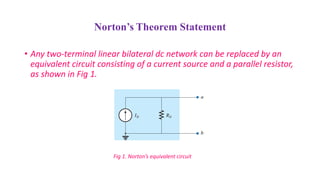
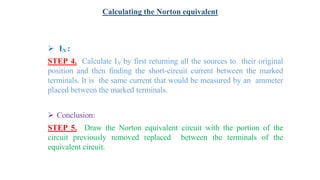
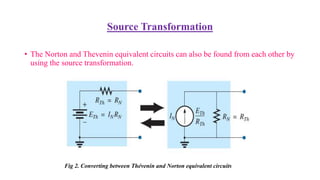
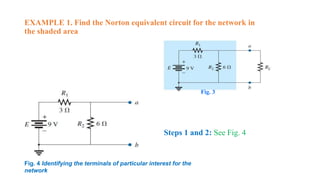
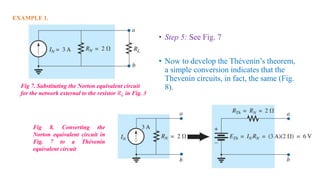
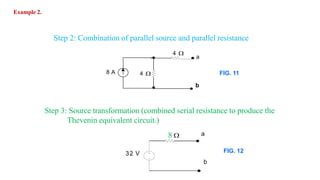
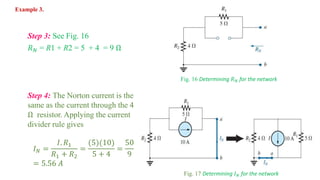
Norton's theorem states that any two-terminal linear dc network can be represented by an equivalent circuit consisting of a current source in parallel with a resistor. The theorem provides steps to calculate the equivalent current source (IN) and resistor (RN) values. First, remove the network and mark the terminals. RN is found by setting sources to 0 and measuring resistance between terminals. IN is found by returning sources and measuring short circuit current between terminals. The Norton equivalent circuit can then be drawn by replacing the original network between the terminals. Examples demonstrate applying the theorem to networks containing resistors and voltage/current sources.