Downloaded 14 times





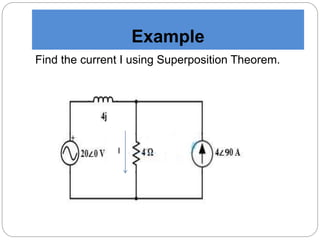


The document discusses the superposition theorem. It defines superposition theorem as stating that the voltage or current through an element of a linear, bilateral network with multiple sources is equivalent to the summation of the voltage or current across that element generated independently by each source. It lists the conditions for applying superposition theorem as the circuit elements being linear and the sources being independent. It provides steps for using superposition theorem which involve solving the circuit for each source independently and then summing the contributions. An example problem demonstrates using superposition theorem to find the total current in a circuit. Finally, it discusses an application of superposition theorem in separating contributions of DC and AC sources.


