WELCOME TO MY
PRESENTATION
PRESENTED BY
Name: Kawsar Ahmed
ID: 12105297
Program: BSEEE
PRESENTATION TOPIC:
Bipolar Junction
Transistors
Bipolar Junction Transistors
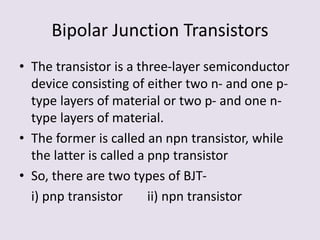
• The transistor is a three-layer semiconductor
device consisting of either two n- and one p-
type layers of material or two p- and one n-
type layers of material.
• The former is called an npn transistor, while
the latter is called a pnp transistor
• So, there are two types of BJT-
i) pnp transistor ii) npn transistor
Bipolar Junction Transistors
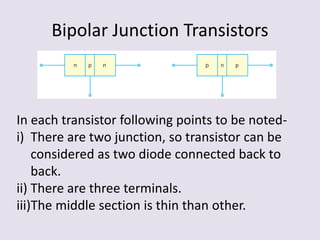
In each transistor following points to be noted-
i) There are two junction, so transistor can be
considered as two diode connected back to
back.
ii) There are three terminals.
iii)The middle section is thin than other.
Naming of Transistor Terminals
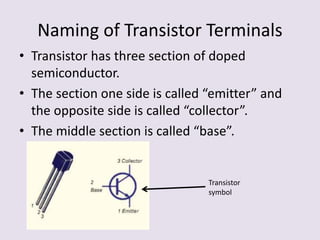
• Transistor has three section of doped
semiconductor.
• The section one side is called “emitter” and
the opposite side is called “collector”.
• The middle section is called “base”.
Transistor
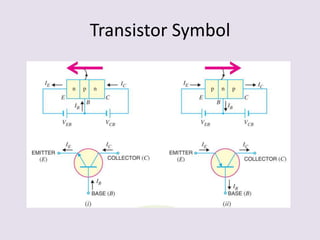
symbol
Naming of Transistor Terminals
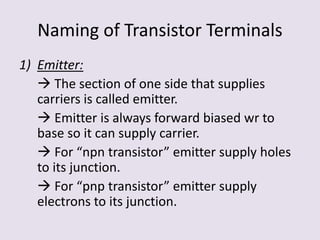
1) Emitter:
 The section of one side that supplies
carriers is called emitter.
 Emitter is always forward biased wr to
base so it can supply carrier.
 For “npn transistor” emitter supply holes
to its junction.
 For “pnp transistor” emitter supply
electrons to its junction.
Naming of Transistor Terminals
2) Collector:
The section on the other side that collects
carrier is called collector.
 The collector is always reversed biased wr to
base.
For “npn transistor” collector receives holes
to its junction.
 For “pnp transistor” collector receives
electrons to its junction.
Naming of Transistor Terminals
3) Base:
The middle section which forms two pn
junction between emitter and collector is
called Base.
Some important factors to be
remembered-
• The transistor has three region named emitter,
base and collector.
• The Base is much thinner than other region.
• Emitter is heavily doped so it can inject large
amount of carriers into the base.
• Base is lightly doped so it can pass most of the
carrier to the collector.
• Collector is moderately doped.
Some important factors to be
remembered-
• The junction between emitter and base is called
emitter-base junction(emitter diode) and junction
between base and collector is called collector-base
junction(collector diode).
• The emitter diode is always forward biased and
collector diode is reverse biased.
• The resistance of emitter diode is very
small(forward) and resistance of collector diode is
high(reverse).
Transistor Operation
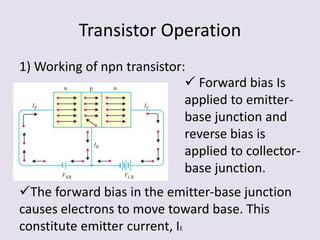
1) Working of npn transistor:
 Forward bias Is
applied to emitter-
base junction and
reverse bias is
applied to collector-
base junction.
The forward bias in the emitter-base junction
causes electrons to move toward base. This
constitute emitter current, IE
Transistor Operation
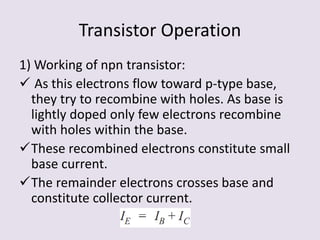
1) Working of npn transistor:
 As this electrons flow toward p-type base,
they try to recombine with holes. As base is
lightly doped only few electrons recombine
with holes within the base.
These recombined electrons constitute small
base current.
The remainder electrons crosses base and
constitute collector current.
Transistor Operation
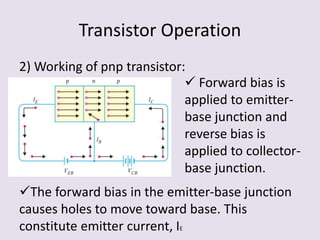
2) Working of pnp transistor:
 Forward bias is
applied to emitter-
base junction and
reverse bias is
applied to collector-
base junction.
The forward bias in the emitter-base junction
causes holes to move toward base. This
constitute emitter current, IE
Transistor Operation
2) Working of pnp transistor:
 As this holes flow toward n-type base, they
try to recombine with electrons. As base is
lightly doped only few holes recombine with
electrons within the base.
These recombined holes constitute small base
current.
The remainder holes crosses base and
constitute collector current.
Transistor Symbol
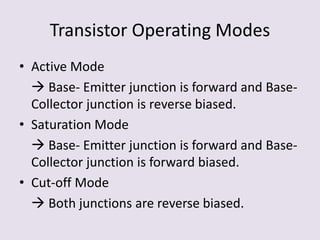
Transistor Operating Modes
• Active Mode
 Base- Emitter junction is forward and Base-
Collector junction is reverse biased.
• Saturation Mode
 Base- Emitter junction is forward and Base-
Collector junction is forward biased.
• Cut-off Mode
 Both junctions are reverse biased.
Transistor Connection
• Transistor can be connected in a circuit in
following three ways-
1) Common Base
2) Common Emitter
3) Common Collector
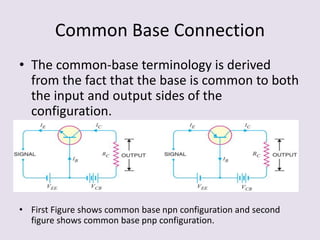
Common Base Connection
• The common-base terminology is derived
from the fact that the base is common to both
the input and output sides of the
configuration.
• First Figure shows common base npn configuration and second
figure shows common base pnp configuration.
Common Base Connection
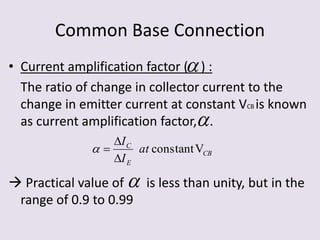
• Current amplification factor ( ) :
The ratio of change in collector current to the
change in emitter current at constant VCB is known
as current amplification factor, .
 Practical value of is less than unity, but in the
range of 0.9 to 0.99


Vconstant CB
E
C
at
I
I




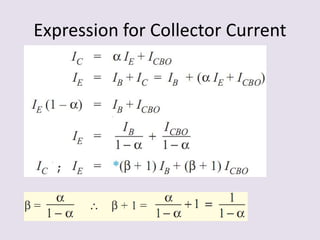
Expression for Collector Current
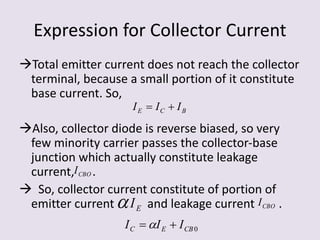
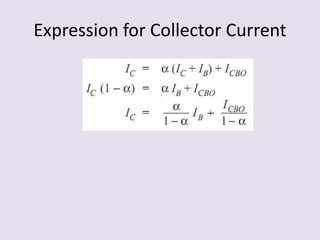
Total emitter current does not reach the collector
terminal, because a small portion of it constitute
base current. So,
Also, collector diode is reverse biased, so very
few minority carrier passes the collector-base
junction which actually constitute leakage
current, .
 So, collector current constitute of portion of
emitter current and leakage current .
BCE III 
CBOI
 EI CBOI
0CBEC III  
Expression for Collector Current
Characteristics of common base
configuration
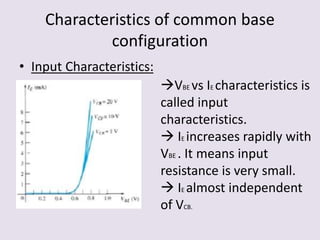
• Input Characteristics:
VBE vs IE characteristics is
called input
characteristics.
 IE increases rapidly with
VBE . It means input
resistance is very small.
 IE almost independent
of VCB.
Characteristics of common base
configuration
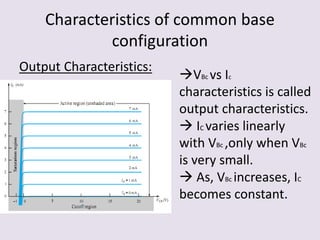
Output Characteristics:
VBc vs Ic
characteristics is called
output characteristics.
 IC varies linearly
with VBc ,only when VBc
is very small.
 As, VBc increases, IC
becomes constant.
Input and Output Resistance of
common base conf.
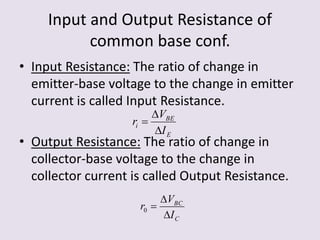
• Input Resistance: The ratio of change in
emitter-base voltage to the change in emitter
current is called Input Resistance.
• Output Resistance: The ratio of change in
collector-base voltage to the change in
collector current is called Output Resistance.
E
BE
i
I
V
r



C
BC
I
V
r


0
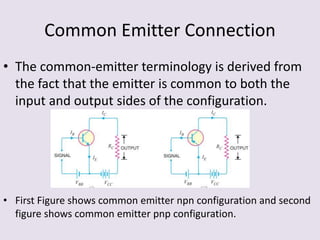
Common Emitter Connection
• The common-emitter terminology is derived from
the fact that the emitter is common to both the
input and output sides of the configuration.
• First Figure shows common emitter npn configuration and second
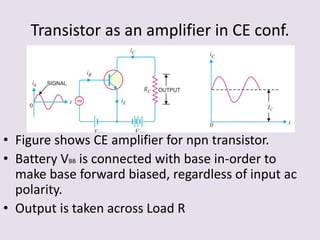
figure shows common emitter pnp configuration.
Common Emitter Connection
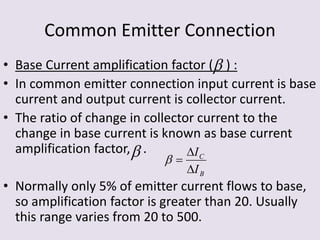
• Base Current amplification factor ( ) :
• In common emitter connection input current is base
current and output current is collector current.
• The ratio of change in collector current to the
change in base current is known as base current
amplification factor, .
• Normally only 5% of emitter current flows to base,
so amplification factor is greater than 20. Usually
this range varies from 20 to 500.


B
C
I
I



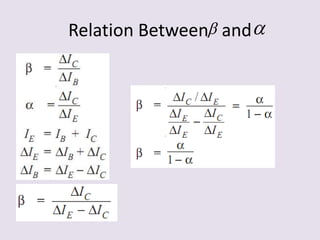
Relation Between and 
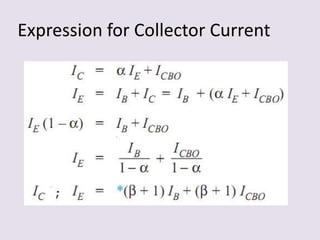
Expression for Collector Current
Characteristics of common emitter
configuration
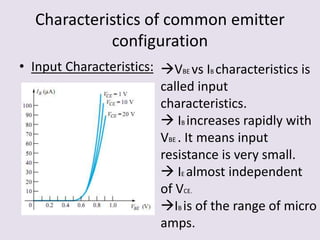
• Input Characteristics: VBE vs IB characteristics is
called input
characteristics.
 IB increases rapidly with
VBE . It means input
resistance is very small.
 IE almost independent
of VCE.
IB is of the range of micro
amps.
Characteristics of common emitter
configuration
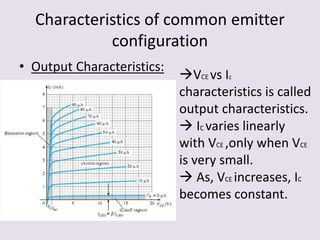
• Output Characteristics:
VCE vs Ic
characteristics is called
output characteristics.
 IC varies linearly
with VCE ,only when VCE
is very small.
 As, VCE increases, IC
becomes constant.
Input and Output Resistance of
common emitter conf.
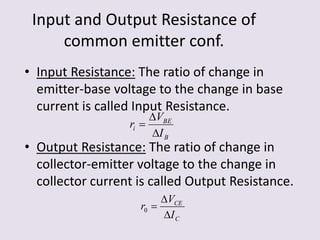
• Input Resistance: The ratio of change in
emitter-base voltage to the change in base
current is called Input Resistance.
• Output Resistance: The ratio of change in
collector-emitter voltage to the change in
collector current is called Output Resistance.
B
BE
i
I
V
r



C
CE
I
V
r


0
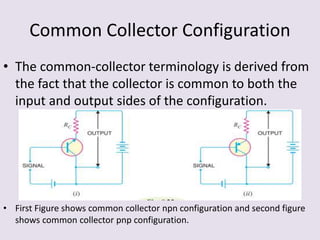
Common Collector Configuration
• The common-collector terminology is derived from
the fact that the collector is common to both the
input and output sides of the configuration.
• First Figure shows common collector npn configuration and second figure
shows common collector pnp configuration.
Common Collector Configuration
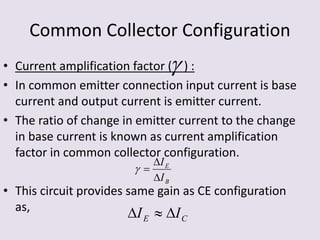
• Current amplification factor ( ) :
• In common emitter connection input current is base
current and output current is emitter current.
• The ratio of change in emitter current to the change
in base current is known as current amplification
factor in common collector configuration.
• This circuit provides same gain as CE configuration
as,

B
E
I
I



CE II 
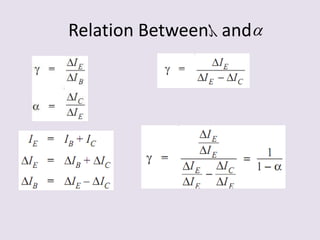
Relation Between and 
Expression for Collector Current
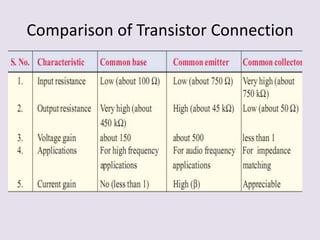
Comparison of Transistor Connection
Transistor as an amplifier in CE conf.
• Figure shows CE amplifier for npn transistor.
• Battery VBB is connected with base in-order to
make base forward biased, regardless of input ac
polarity.
• Output is taken across Load R
Transistor as an amplifier in CE conf.
• During positive half cycle input ac will keep the emitter-
base junction more forward biased. So, more carrier
will be emitted by emitter, this huge current will flow
through load and we will find output amplified signal.
• During negative half cycle input ac will keep the
emitter-base junction less forward biased. So, less
carrier will be emitted by emitter. Hence collector
current decreases.
• This results in decreased output voltage (In opposite
direction).
Transistor Load line analysis
• In transistor circuit analysis it is necessary to
determine collector current for various VCE
voltage.
• One method is we can determine the collector
current at any desired VCE voltage, from the
output characteristics.
• More conveniently we can use load line
analysis to determine operating point.
Transistor Load line analysis
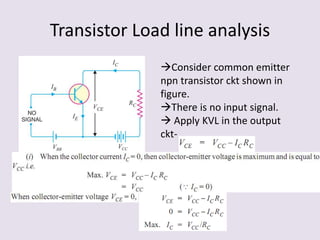
Consider common emitter
npn transistor ckt shown in
figure.
There is no input signal.
 Apply KVL in the output
ckt-
Transistor Load line analysis
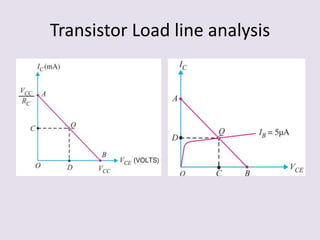
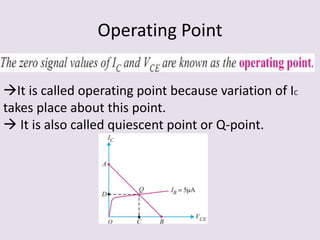
Operating Point
It is called operating point because variation of IC
takes place about this point.
 It is also called quiescent point or Q-point.
ANY QUESTION?
THANKS TO ALL
for stay with me

Presentation on bipolar junction transistor

  • 1.
  • 2.
    PRESENTED BY Name: KawsarAhmed ID: 12105297 Program: BSEEE
  • 3.
  • 4.
    Bipolar Junction Transistors •The transistor is a three-layer semiconductor device consisting of either two n- and one p- type layers of material or two p- and one n- type layers of material. • The former is called an npn transistor, while the latter is called a pnp transistor • So, there are two types of BJT- i) pnp transistor ii) npn transistor
  • 5.
    Bipolar Junction Transistors Ineach transistor following points to be noted- i) There are two junction, so transistor can be considered as two diode connected back to back. ii) There are three terminals. iii)The middle section is thin than other.
  • 6.
    Naming of TransistorTerminals • Transistor has three section of doped semiconductor. • The section one side is called “emitter” and the opposite side is called “collector”. • The middle section is called “base”. Transistor symbol
  • 7.
    Naming of TransistorTerminals 1) Emitter:  The section of one side that supplies carriers is called emitter.  Emitter is always forward biased wr to base so it can supply carrier.  For “npn transistor” emitter supply holes to its junction.  For “pnp transistor” emitter supply electrons to its junction.
  • 8.
    Naming of TransistorTerminals 2) Collector: The section on the other side that collects carrier is called collector.  The collector is always reversed biased wr to base. For “npn transistor” collector receives holes to its junction.  For “pnp transistor” collector receives electrons to its junction.
  • 9.
    Naming of TransistorTerminals 3) Base: The middle section which forms two pn junction between emitter and collector is called Base.
  • 10.
    Some important factorsto be remembered- • The transistor has three region named emitter, base and collector. • The Base is much thinner than other region. • Emitter is heavily doped so it can inject large amount of carriers into the base. • Base is lightly doped so it can pass most of the carrier to the collector. • Collector is moderately doped.
  • 11.
    Some important factorsto be remembered- • The junction between emitter and base is called emitter-base junction(emitter diode) and junction between base and collector is called collector-base junction(collector diode). • The emitter diode is always forward biased and collector diode is reverse biased. • The resistance of emitter diode is very small(forward) and resistance of collector diode is high(reverse).
  • 12.
    Transistor Operation 1) Workingof npn transistor:  Forward bias Is applied to emitter- base junction and reverse bias is applied to collector- base junction. The forward bias in the emitter-base junction causes electrons to move toward base. This constitute emitter current, IE
  • 13.
    Transistor Operation 1) Workingof npn transistor:  As this electrons flow toward p-type base, they try to recombine with holes. As base is lightly doped only few electrons recombine with holes within the base. These recombined electrons constitute small base current. The remainder electrons crosses base and constitute collector current.
  • 14.
    Transistor Operation 2) Workingof pnp transistor:  Forward bias is applied to emitter- base junction and reverse bias is applied to collector- base junction. The forward bias in the emitter-base junction causes holes to move toward base. This constitute emitter current, IE
  • 15.
    Transistor Operation 2) Workingof pnp transistor:  As this holes flow toward n-type base, they try to recombine with electrons. As base is lightly doped only few holes recombine with electrons within the base. These recombined holes constitute small base current. The remainder holes crosses base and constitute collector current.
  • 16.
  • 17.
    Transistor Operating Modes •Active Mode  Base- Emitter junction is forward and Base- Collector junction is reverse biased. • Saturation Mode  Base- Emitter junction is forward and Base- Collector junction is forward biased. • Cut-off Mode  Both junctions are reverse biased.
  • 18.
    Transistor Connection • Transistorcan be connected in a circuit in following three ways- 1) Common Base 2) Common Emitter 3) Common Collector
  • 19.
    Common Base Connection •The common-base terminology is derived from the fact that the base is common to both the input and output sides of the configuration. • First Figure shows common base npn configuration and second figure shows common base pnp configuration.
  • 20.
    Common Base Connection •Current amplification factor ( ) : The ratio of change in collector current to the change in emitter current at constant VCB is known as current amplification factor, .  Practical value of is less than unity, but in the range of 0.9 to 0.99   Vconstant CB E C at I I    
  • 21.
    Expression for CollectorCurrent Total emitter current does not reach the collector terminal, because a small portion of it constitute base current. So, Also, collector diode is reverse biased, so very few minority carrier passes the collector-base junction which actually constitute leakage current, .  So, collector current constitute of portion of emitter current and leakage current . BCE III  CBOI  EI CBOI 0CBEC III  
  • 22.
  • 23.
    Characteristics of commonbase configuration • Input Characteristics: VBE vs IE characteristics is called input characteristics.  IE increases rapidly with VBE . It means input resistance is very small.  IE almost independent of VCB.
  • 24.
    Characteristics of commonbase configuration Output Characteristics: VBc vs Ic characteristics is called output characteristics.  IC varies linearly with VBc ,only when VBc is very small.  As, VBc increases, IC becomes constant.
  • 25.
    Input and OutputResistance of common base conf. • Input Resistance: The ratio of change in emitter-base voltage to the change in emitter current is called Input Resistance. • Output Resistance: The ratio of change in collector-base voltage to the change in collector current is called Output Resistance. E BE i I V r    C BC I V r   0
  • 26.
    Common Emitter Connection •The common-emitter terminology is derived from the fact that the emitter is common to both the input and output sides of the configuration. • First Figure shows common emitter npn configuration and second figure shows common emitter pnp configuration.
  • 27.
    Common Emitter Connection •Base Current amplification factor ( ) : • In common emitter connection input current is base current and output current is collector current. • The ratio of change in collector current to the change in base current is known as base current amplification factor, . • Normally only 5% of emitter current flows to base, so amplification factor is greater than 20. Usually this range varies from 20 to 500.   B C I I   
  • 28.
  • 29.
  • 30.
    Characteristics of commonemitter configuration • Input Characteristics: VBE vs IB characteristics is called input characteristics.  IB increases rapidly with VBE . It means input resistance is very small.  IE almost independent of VCE. IB is of the range of micro amps.
  • 31.
    Characteristics of commonemitter configuration • Output Characteristics: VCE vs Ic characteristics is called output characteristics.  IC varies linearly with VCE ,only when VCE is very small.  As, VCE increases, IC becomes constant.
  • 32.
    Input and OutputResistance of common emitter conf. • Input Resistance: The ratio of change in emitter-base voltage to the change in base current is called Input Resistance. • Output Resistance: The ratio of change in collector-emitter voltage to the change in collector current is called Output Resistance. B BE i I V r    C CE I V r   0
  • 33.
    Common Collector Configuration •The common-collector terminology is derived from the fact that the collector is common to both the input and output sides of the configuration. • First Figure shows common collector npn configuration and second figure shows common collector pnp configuration.
  • 34.
    Common Collector Configuration •Current amplification factor ( ) : • In common emitter connection input current is base current and output current is emitter current. • The ratio of change in emitter current to the change in base current is known as current amplification factor in common collector configuration. • This circuit provides same gain as CE configuration as,  B E I I    CE II 
  • 35.
  • 36.
  • 37.
  • 38.
    Transistor as anamplifier in CE conf. • Figure shows CE amplifier for npn transistor. • Battery VBB is connected with base in-order to make base forward biased, regardless of input ac polarity. • Output is taken across Load R
  • 39.
    Transistor as anamplifier in CE conf. • During positive half cycle input ac will keep the emitter- base junction more forward biased. So, more carrier will be emitted by emitter, this huge current will flow through load and we will find output amplified signal. • During negative half cycle input ac will keep the emitter-base junction less forward biased. So, less carrier will be emitted by emitter. Hence collector current decreases. • This results in decreased output voltage (In opposite direction).
  • 40.
    Transistor Load lineanalysis • In transistor circuit analysis it is necessary to determine collector current for various VCE voltage. • One method is we can determine the collector current at any desired VCE voltage, from the output characteristics. • More conveniently we can use load line analysis to determine operating point.
  • 41.
    Transistor Load lineanalysis Consider common emitter npn transistor ckt shown in figure. There is no input signal.  Apply KVL in the output ckt-
  • 42.
  • 43.
    Operating Point It iscalled operating point because variation of IC takes place about this point.  It is also called quiescent point or Q-point.
  • 44.
  • 45.
    THANKS TO ALL forstay with me