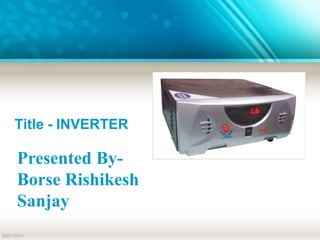
Title - INVERTER
Presented By-
Borse Rishikesh
Sanjay
Contents
• Introduction
• History
• Classification of Inverter
• Square wave Inverter
• Sine wave inverter
• Modified Sine wave Inverter
• Block Diagram of Inverter
• Batteries
• Advantages and Disadvantages
• Applications
Introduction
1. An inverter is a device that changes or inverts
direct current (DC) input to alternating
current (AC) output.
2. It doesn't "create" or "make" electricity, just
changes it from one form to another. DC in is
changed to AC out.
3. Output is usually 120 or 240 volts at 50-cycle
alternating current to match line power.
Introduction(continued..)
HISTORY
Classification of Inverter
The Inverters can be classified in to following types
based on output Waveform and according to charging
process -.
According to wave form
• Square wave Inverter
• Sine wave Inverter
• Modified Sine wave Inverter
Classification of Inverter
Square wave Inverter
Sine wave Inverter
A power inverter device which
produces a multiple step sinusoidal
AC waveform is referred to as a
sine wave inverter. To more
clearly distinguish the inverters
with outputs of much less
distortion than the "modified sine
wave" (three step) inverter designs,
the manufacturers often use the
phrase pure sine wave inverter.
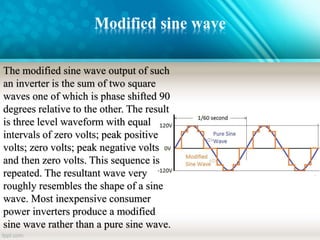
Modified sine wave
The modified sine wave output of such
an inverter is the sum of two square
waves one of which is phase shifted 90
degrees relative to the other. The result
is three level waveform with equal
intervals of zero volts; peak positive
volts; zero volts; peak negative volts
and then zero volts. This sequence is
repeated. The resultant wave very
roughly resembles the shape of a sine
wave. Most inexpensive consumer
power inverters produce a modified
sine wave rather than a pure sine wave.
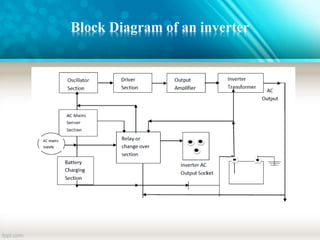
Block Diagram of an inverter
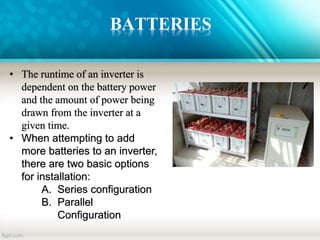
BATTERIES
• The runtime of an inverter is
dependent on the battery power
and the amount of power being
drawn from the inverter at a
given time.
• When attempting to add
more batteries to an inverter,
there are two basic options
for installation:
A. Series configuration
B. Parallel
Configuration
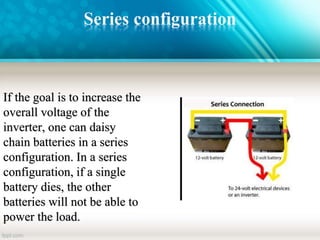
Series configuration
If the goal is to increase the
overall voltage of the
inverter, one can daisy
chain batteries in a series
configuration. In a series
configuration, if a single
battery dies, the other
batteries will not be able to
power the load.
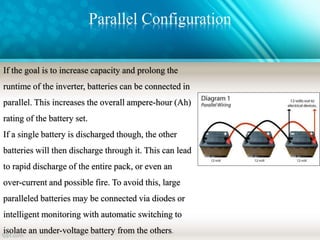
Parallel Configuration
If the goal is to increase capacity and prolong the
runtime of the inverter, batteries can be connected in
parallel. This increases the overall ampere-hour (Ah)
rating of the battery set.
If a single battery is discharged though, the other
batteries will then discharge through it. This can lead
to rapid discharge of the entire pack, or even an
over-current and possible fire. To avoid this, large
paralleled batteries may be connected via diodes or
intelligent monitoring with automatic switching to
isolate an under-voltage battery from the others.
ADVANTAGES
• The price is very cheap; can work with ordinary light bulbs, fans,
etc.(Square Sine wave inverter)
• High quality and inexpensive; using modified square wave; output
correction waveform; relatively stable; suitable for ordinary personal users
with TV, fan, lamp, computer, hot pot etc.(Modified Sine wave Inverters)
• Full power output; protection functions; improved modified sine wave
output steady; low-power machines also built in fan, you can keep your
machine to use for long time; no similar products on the market; can bring
printers, rice cookers, vacuum cleaners, small refrigerators and a lot of
small appliances (Sine wave Inverters)
• Pure sine wave inverter output waveform is good; low distortion; low
interference to radio and equipment; low noise. In addition, protective
functions; high efficiency; suitable for use in the communications,
industrial electricity by enterprises and other users
DISADVANTAGES
• Square wave output waveform and not stable enough. (Square
Sine wave inverter)
• Lack of power, cannot run the appliances with same power
labeled; it’s easy to damage the machine if customers are not
familiar with the operation, the user needs to strictly follow the
manufacturers’ instructions. (Modified Sine wave Inverters)
• Higher prices, the domestic customers know less about it.
(Sine wave Inverters)
• line is relatively complex; high technically demanding for
maintenance; more expensive.( Pure sine wave inverter)
APPLICATIONS
1. Used in UPS with batteries
2. Used in Solar panels
3. Used in HVDC Transmission
4. Used as a backup purpose

Inverter

  • 1.
    Title - INVERTER PresentedBy- Borse Rishikesh Sanjay
  • 2.
    Contents • Introduction • History •Classification of Inverter • Square wave Inverter • Sine wave inverter • Modified Sine wave Inverter • Block Diagram of Inverter • Batteries • Advantages and Disadvantages • Applications
  • 3.
    Introduction 1. An inverteris a device that changes or inverts direct current (DC) input to alternating current (AC) output. 2. It doesn't "create" or "make" electricity, just changes it from one form to another. DC in is changed to AC out. 3. Output is usually 120 or 240 volts at 50-cycle alternating current to match line power.
  • 4.
  • 5.
  • 6.
    Classification of Inverter TheInverters can be classified in to following types based on output Waveform and according to charging process -. According to wave form • Square wave Inverter • Sine wave Inverter • Modified Sine wave Inverter
  • 7.
  • 8.
  • 9.
    Sine wave Inverter Apower inverter device which produces a multiple step sinusoidal AC waveform is referred to as a sine wave inverter. To more clearly distinguish the inverters with outputs of much less distortion than the "modified sine wave" (three step) inverter designs, the manufacturers often use the phrase pure sine wave inverter.
  • 10.
    Modified sine wave Themodified sine wave output of such an inverter is the sum of two square waves one of which is phase shifted 90 degrees relative to the other. The result is three level waveform with equal intervals of zero volts; peak positive volts; zero volts; peak negative volts and then zero volts. This sequence is repeated. The resultant wave very roughly resembles the shape of a sine wave. Most inexpensive consumer power inverters produce a modified sine wave rather than a pure sine wave.
  • 11.
    Block Diagram ofan inverter
  • 12.
    BATTERIES • The runtimeof an inverter is dependent on the battery power and the amount of power being drawn from the inverter at a given time. • When attempting to add more batteries to an inverter, there are two basic options for installation: A. Series configuration B. Parallel Configuration
  • 13.
    Series configuration If thegoal is to increase the overall voltage of the inverter, one can daisy chain batteries in a series configuration. In a series configuration, if a single battery dies, the other batteries will not be able to power the load.
  • 14.
    Parallel Configuration If thegoal is to increase capacity and prolong the runtime of the inverter, batteries can be connected in parallel. This increases the overall ampere-hour (Ah) rating of the battery set. If a single battery is discharged though, the other batteries will then discharge through it. This can lead to rapid discharge of the entire pack, or even an over-current and possible fire. To avoid this, large paralleled batteries may be connected via diodes or intelligent monitoring with automatic switching to isolate an under-voltage battery from the others.
  • 15.
    ADVANTAGES • The priceis very cheap; can work with ordinary light bulbs, fans, etc.(Square Sine wave inverter) • High quality and inexpensive; using modified square wave; output correction waveform; relatively stable; suitable for ordinary personal users with TV, fan, lamp, computer, hot pot etc.(Modified Sine wave Inverters) • Full power output; protection functions; improved modified sine wave output steady; low-power machines also built in fan, you can keep your machine to use for long time; no similar products on the market; can bring printers, rice cookers, vacuum cleaners, small refrigerators and a lot of small appliances (Sine wave Inverters) • Pure sine wave inverter output waveform is good; low distortion; low interference to radio and equipment; low noise. In addition, protective functions; high efficiency; suitable for use in the communications, industrial electricity by enterprises and other users
  • 16.
    DISADVANTAGES • Square waveoutput waveform and not stable enough. (Square Sine wave inverter) • Lack of power, cannot run the appliances with same power labeled; it’s easy to damage the machine if customers are not familiar with the operation, the user needs to strictly follow the manufacturers’ instructions. (Modified Sine wave Inverters) • Higher prices, the domestic customers know less about it. (Sine wave Inverters) • line is relatively complex; high technically demanding for maintenance; more expensive.( Pure sine wave inverter)
  • 17.
    APPLICATIONS 1. Used inUPS with batteries 2. Used in Solar panels 3. Used in HVDC Transmission 4. Used as a backup purpose