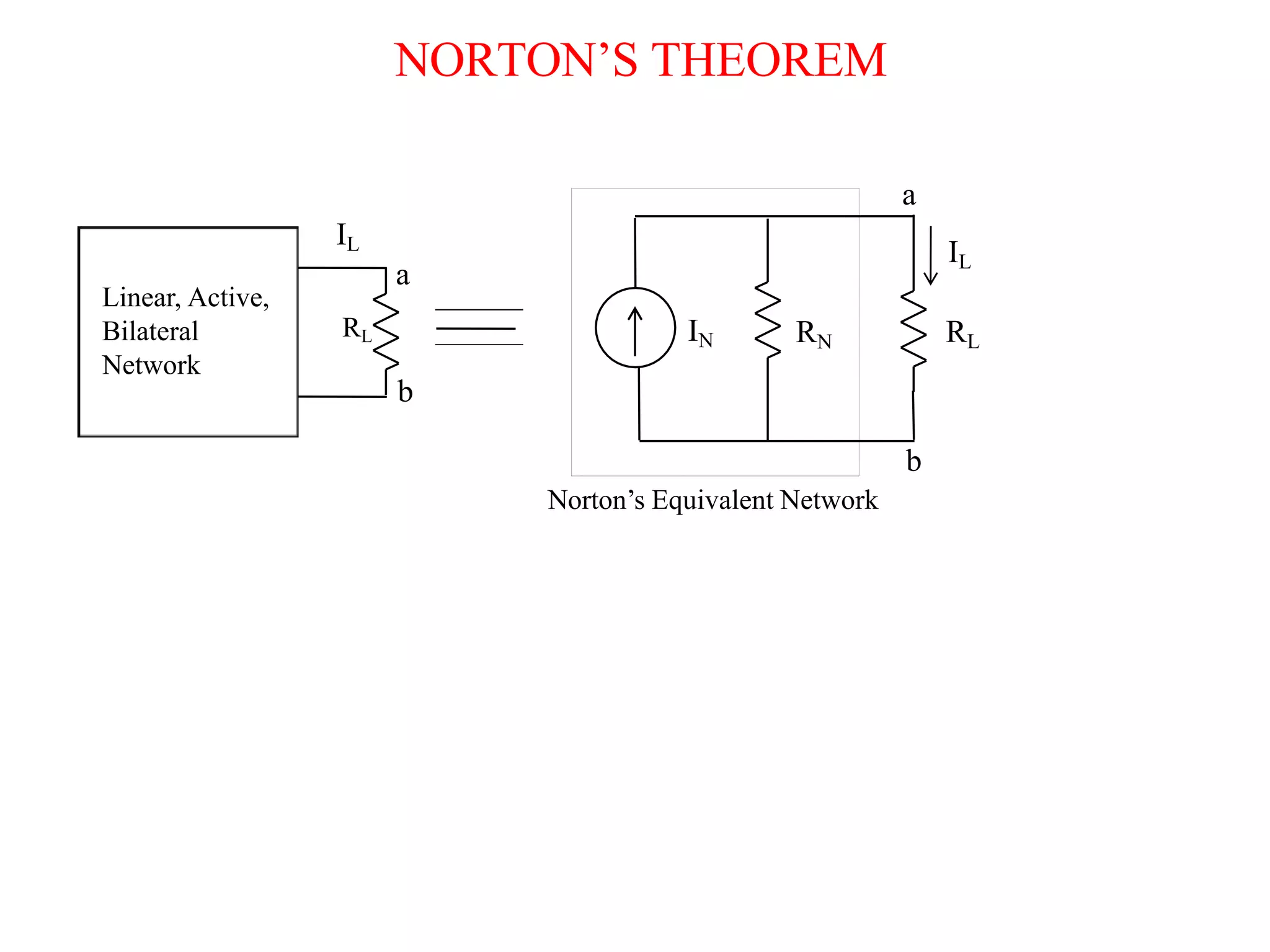
Norton's theorem states that any linear DC network containing voltage sources, current sources, and resistances can be replaced by an equivalent circuit with a single current source (IN) in parallel with a single resistance (RN). The Norton equivalent current (IN) is equal to the short circuit current through the terminals, and the Norton equivalent resistance (RN) is equal to the resistance looking into the network from the terminals with independent sources replaced. To find the Norton equivalent circuit, first the short circuit current is calculated, then independent sources are replaced to find the equivalent resistance. Once IN and RN are determined, the original network can be replaced in all calculations by this equivalent Norton circuit connected across the terminals.







![NT PPT[Norton’s Theorem].pdf](https://cdn.slidesharecdn.com/ss_thumbnails/ntpptnortonstheorem-230903030724-e12d6d74-thumbnail.jpg?width=640&height=640&fit=bounds)


