CIRCUIT THEORY
NORTON’S THEOREM
Friday, July 26, 2019 1syed hasan saeed
SYED HASAN SAEED
NORTON’S THEOREM
REFERENCE BOOKS
• Introductory Circuit Analysis, Robert L. Boylested, Pearson Education,
Prentice Hall.
• Networks And Systems, Ashfaq Husain, Khanna Book Publishing Co (P)
Ltd. Delhi.
• Networks And Systems, A Sudhakr, Shyammohan S Palli, Tata McGraw
Hill, New Delhi.
• Network Analysis, M.E. Van Valkenburg, PHI Learning Private limited,
New Delhi.
• Circuit Analysis Principle and Applications, Allan H. Robbins &Wilhelm
C. Miller, DELMAR CENGAGE Learning, Indian Reprint.
Friday, July 26, 2019 syed hasan saeed 2
NORTON’S THEOREM
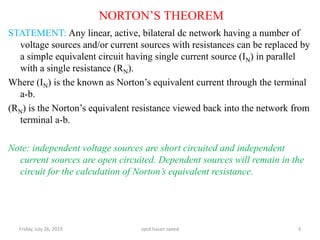
STATEMENT: Any linear, active, bilateral dc network having a number of
voltage sources and/or current sources with resistances can be replaced by
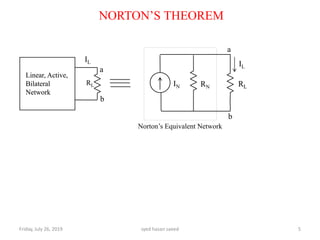
a simple equivalent circuit having single current source (IN) in parallel
with a single resistance (RN).
Where (IN) is the known as Norton’s equivalent current through the terminal
a-b.
(RN) is the Norton’s equivalent resistance viewed back into the network from
terminal a-b.
Note: independent voltage sources are short circuited and independent
current sources are open circuited. Dependent sources will remain in the
circuit for the calculation of Norton’s equivalent resistance.
Friday, July 26, 2019 syed hasan saeed 3
NORTON’S THEOREM
Friday, July 26, 2019 syed hasan saeed 4
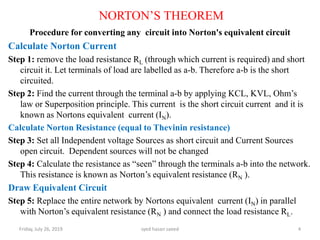
Procedure for converting any circuit into Norton's equivalent circuit
Calculate Norton Current
Step 1: remove the load resistance RL (through which current is required) and short
circuit it. Let terminals of load are labelled as a-b. Therefore a-b is the short
circuited.
Step 2: Find the current through the terminal a-b by applying KCL, KVL, Ohm’s
law or Superposition principle. This current is the short circuit current and it is
known as Nortons equivalent current (IN).
Calculate Norton Resistance (equal to Thevinin resistance)
Step 3: Set all Independent voltage Sources as short circuit and Current Sources
open circuit. Dependent sources will not be changed
Step 4: Calculate the resistance as “seen” through the terminals a-b into the network.
This resistance is known as Norton’s equivalent resistance (RN ).
Draw Equivalent Circuit
Step 5: Replace the entire network by Nortons equivalent current (IN) in parallel
with Norton’s equivalent resistance (RN ) and connect the load resistance RL.
NORTON’S THEOREM
Friday, July 26, 2019 syed hasan saeed 5
RL
Linear, Active,
Bilateral
Network
Linear, Active,
Bilateral
Network
RL
a
b
IL
RL
Norton’s Equivalent Network
RL
b
a
IL
RNIN
NORTON’S THEOREM
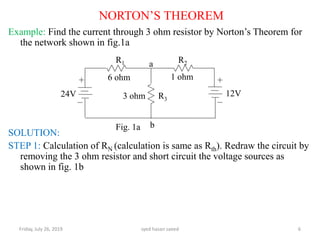
Example: Find the current through 3 ohm resistor by Norton’s Theorem for
the network shown in fig.1a
SOLUTION:
STEP 1: Calculation of RN (calculation is same as Rth). Redraw the circuit by
removing the 3 ohm resistor and short circuit the voltage sources as
shown in fig. 1b
Friday, July 26, 2019 syed hasan saeed 6
Fig. 1a
6 ohm 1 ohm
3 ohm 12V24V
R1 R2
R3
a
b
NORTON’S THEOREM
Friday, July 26, 2019 syed hasan saeed 7
6 ohm 1 ohm
R2
a
b
RN
R2
a
b
24V 12VIN
R1
Fig. 1c
Fig. 1b
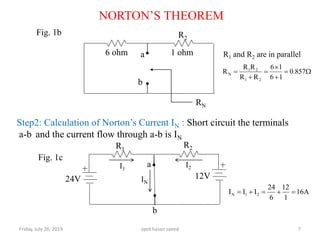
R1 and R2 are in parallel
A16
1
12
6
24
III 21N 





 0.857
16
16
RR
RR
R
21
21
N
Step2: Calculation of Norton’s Current IN : Short circuit the terminals
a-b and the current flow through a-b is IN
I1
I2
NORTON’S THEOREM
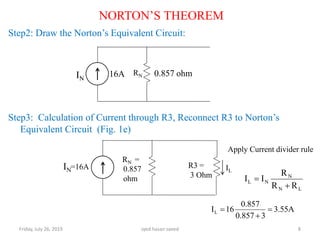
Step2: Draw the Norton’s Equivalent Circuit:
Step3: Calculation of Current through R3, Reconnect R3 to Norton’s
Equivalent Circuit (Fig. 1e)
Friday, July 26, 2019 syed hasan saeed 8
IN
16A 0.857 ohmRN
IN=16A 0.857
ohm
RN =
R3 =
3 Ohm
Apply Current divider rule
A55.3
30.857
0.857
16IL 


IL
LN
N
NL
RR
R
II


Friday, July 26, 2019 syed hasan saeed 9
THANK YOU
hasansaeedcontrol@gmail.com
shasansaeed@yolasite.com
hasansaeed872726549.wordpress.com
saeed.moodlecloud.com
syedhasansaeed.gnomio.com

Norton's theorem

  • 1.
    CIRCUIT THEORY NORTON’S THEOREM Friday,July 26, 2019 1syed hasan saeed SYED HASAN SAEED
  • 2.
    NORTON’S THEOREM REFERENCE BOOKS •Introductory Circuit Analysis, Robert L. Boylested, Pearson Education, Prentice Hall. • Networks And Systems, Ashfaq Husain, Khanna Book Publishing Co (P) Ltd. Delhi. • Networks And Systems, A Sudhakr, Shyammohan S Palli, Tata McGraw Hill, New Delhi. • Network Analysis, M.E. Van Valkenburg, PHI Learning Private limited, New Delhi. • Circuit Analysis Principle and Applications, Allan H. Robbins &Wilhelm C. Miller, DELMAR CENGAGE Learning, Indian Reprint. Friday, July 26, 2019 syed hasan saeed 2
  • 3.
    NORTON’S THEOREM STATEMENT: Anylinear, active, bilateral dc network having a number of voltage sources and/or current sources with resistances can be replaced by a simple equivalent circuit having single current source (IN) in parallel with a single resistance (RN). Where (IN) is the known as Norton’s equivalent current through the terminal a-b. (RN) is the Norton’s equivalent resistance viewed back into the network from terminal a-b. Note: independent voltage sources are short circuited and independent current sources are open circuited. Dependent sources will remain in the circuit for the calculation of Norton’s equivalent resistance. Friday, July 26, 2019 syed hasan saeed 3
  • 4.
    NORTON’S THEOREM Friday, July26, 2019 syed hasan saeed 4 Procedure for converting any circuit into Norton's equivalent circuit Calculate Norton Current Step 1: remove the load resistance RL (through which current is required) and short circuit it. Let terminals of load are labelled as a-b. Therefore a-b is the short circuited. Step 2: Find the current through the terminal a-b by applying KCL, KVL, Ohm’s law or Superposition principle. This current is the short circuit current and it is known as Nortons equivalent current (IN). Calculate Norton Resistance (equal to Thevinin resistance) Step 3: Set all Independent voltage Sources as short circuit and Current Sources open circuit. Dependent sources will not be changed Step 4: Calculate the resistance as “seen” through the terminals a-b into the network. This resistance is known as Norton’s equivalent resistance (RN ). Draw Equivalent Circuit Step 5: Replace the entire network by Nortons equivalent current (IN) in parallel with Norton’s equivalent resistance (RN ) and connect the load resistance RL.
  • 5.
    NORTON’S THEOREM Friday, July26, 2019 syed hasan saeed 5 RL Linear, Active, Bilateral Network Linear, Active, Bilateral Network RL a b IL RL Norton’s Equivalent Network RL b a IL RNIN
  • 6.
    NORTON’S THEOREM Example: Findthe current through 3 ohm resistor by Norton’s Theorem for the network shown in fig.1a SOLUTION: STEP 1: Calculation of RN (calculation is same as Rth). Redraw the circuit by removing the 3 ohm resistor and short circuit the voltage sources as shown in fig. 1b Friday, July 26, 2019 syed hasan saeed 6 Fig. 1a 6 ohm 1 ohm 3 ohm 12V24V R1 R2 R3 a b
  • 7.
    NORTON’S THEOREM Friday, July26, 2019 syed hasan saeed 7 6 ohm 1 ohm R2 a b RN R2 a b 24V 12VIN R1 Fig. 1c Fig. 1b R1 and R2 are in parallel A16 1 12 6 24 III 21N        0.857 16 16 RR RR R 21 21 N Step2: Calculation of Norton’s Current IN : Short circuit the terminals a-b and the current flow through a-b is IN I1 I2
  • 8.
    NORTON’S THEOREM Step2: Drawthe Norton’s Equivalent Circuit: Step3: Calculation of Current through R3, Reconnect R3 to Norton’s Equivalent Circuit (Fig. 1e) Friday, July 26, 2019 syed hasan saeed 8 IN 16A 0.857 ohmRN IN=16A 0.857 ohm RN = R3 = 3 Ohm Apply Current divider rule A55.3 30.857 0.857 16IL    IL LN N NL RR R II  
  • 9.
    Friday, July 26,2019 syed hasan saeed 9 THANK YOU hasansaeedcontrol@gmail.com shasansaeed@yolasite.com hasansaeed872726549.wordpress.com saeed.moodlecloud.com syedhasansaeed.gnomio.com