Arham Veerayatan Institute
Of
Engineering, Technology
&
Research.(Mandvi)
Made by:-
Matang.Prabhat.D
(150920109001)
Guided by:-
Prof.kashyappuri Goswami.
THEVENIN
Circuit &
Network
THEVENIN’S THEOREM:-
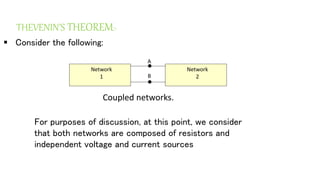
 Consider the following:
Network
1
Network
2
•
•
A
B
Coupled networks.
For purposes of discussion, at this point, we consider
that both networks are composed of resistors and
independent voltage and current sources
THEVENIN’S THEOREM:
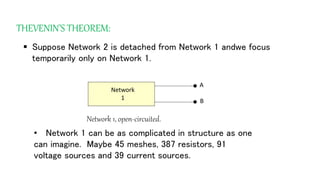
 Suppose Network 2 is detached from Network 1 andwe focus
temporarily only on Network 1.
Network
1
•
•
A
B
Network 1, open-circuited.
• Network 1 can be as complicated in structure as one
can imagine. Maybe 45 meshes, 387 resistors, 91
voltage sources and 39 current sources.
Network
1
•
•
A
B
THEVENIN’S THEOREM:
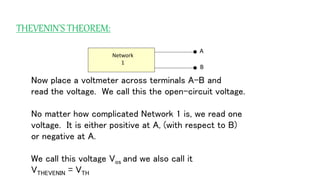
Now place a voltmeter across terminals A-B and
read the voltage. We call this the open-circuit voltage.
No matter how complicated Network 1 is, we read one
voltage. It is either positive at A, (with respect to B)
or negative at A.
We call this voltage Vos and we also call it
VTHEVENIN = VTH
THEVENIN’S THEOREM:
• We now deactivate all sources of Network 1.
• To deactivate a voltage source, we remove
the source and replace it with a short circuit.
• To deactivate a current source, we remove
the source.
THEVENIN’S THEOREM:
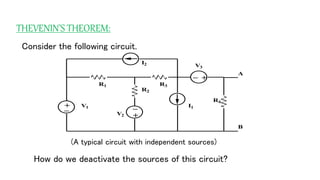
Consider the following circuit.
+_
+
+
_ _
A
B
V1
I2
V2
I1
V3
R1
R2
R3
R4
(A typical circuit with independent sources)
How do we deactivate the sources of this circuit?
THEVENIN’S THEOREM:
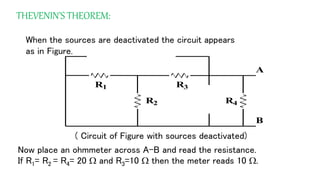
When the sources are deactivated the circuit appears
as in Figure.
R1
R2
R3
R4
A
B
( Circuit of Figure with sources deactivated)
Now place an ohmmeter across A-B and read the resistance.
If R1= R2 = R4= 20  and R3=10  then the meter reads 10 .
THEVENIN’S THEOREM:
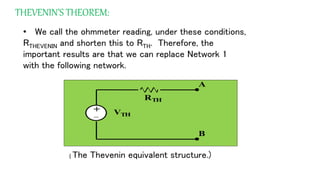
• We call the ohmmeter reading, under these conditions,
RTHEVENIN and shorten this to RTH. Therefore, the
important results are that we can replace Network 1
with the following network.
VTH
RTH
A
B
+_


( The Thevenin equivalent structure.)
THEVENIN’S THEOREM:
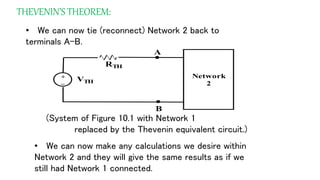
• We can now tie (reconnect) Network 2 back to
terminals A-B.
A
B
Network
2
VTH
RTH
+
_


(System of Figure 10.1 with Network 1
replaced by the Thevenin equivalent circuit.)
• We can now make any calculations we desire within
Network 2 and they will give the same results as if we
still had Network 1 connected.
THEVENIN’S THEOREM:
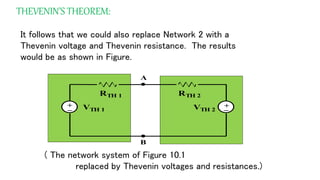
It follows that we could also replace Network 2 with a
Thevenin voltage and Thevenin resistance. The results
would be as shown in Figure.
A
B
+ +_ _
RTH 1 RTH 2
VTH 1 VTH 2


( The network system of Figure 10.1
replaced by Thevenin voltages and resistances.)
THEVENIN’S THEOREM:-
Example:-1.
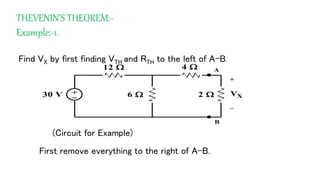
Find VX by first finding VTH and RTH to the left of A-B.
12  4 
6  2  VX30 V +_
+
_
A
B


(Circuit for Example)
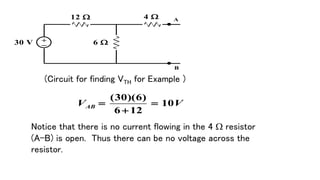
First remove everything to the right of A-B.
12  4 
6 30 V +_
A
B


(Circuit for finding VTH for Example )
(30)(6)
10
6 12
ABV V 

Notice that there is no current flowing in the 4  resistor
(A-B) is open. Thus there can be no voltage across the
resistor.
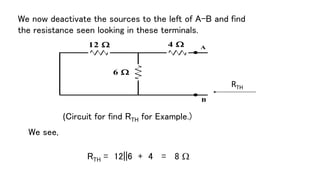
We now deactivate the sources to the left of A-B and find
the resistance seen looking in these terminals.
12  4 
6 
A
B


RTH
(Circuit for find RTH for Example.)
We see,
RTH = 12||6 + 4 = 8 
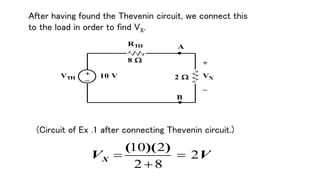
After having found the Thevenin circuit, we connect this
to the load in order to find VX.
8 
10 VVTH
RTH
2  VX
+
_
+
_
A
B


(Circuit of Ex .1 after connecting Thevenin circuit.)
10 2
2
2 8
 

( )( )
XV V
THEVENIN’S THEOREM:
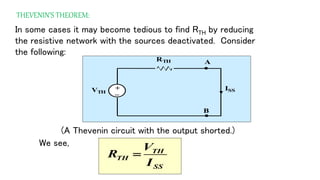
In some cases it may become tedious to find RTH by reducing
the resistive network with the sources deactivated. Consider
the following:
VTH
RTH
+
_
A
B


ISS
(A Thevenin circuit with the output shorted.)
We see,
TH
TH
SS
V
R
I

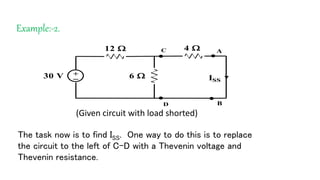
Example:-2.
12  4 
6 30 V +_
A
B


ISS


C
D
(Given circuit with load shorted)
The task now is to find ISS. One way to do this is to replace
the circuit to the left of C-D with a Thevenin voltage and
Thevenin resistance.
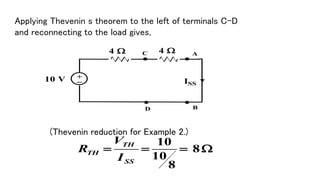
Applying Thevenin s theorem to the left of terminals C-D
and reconnecting to the load gives,
4  4 
10 V +_
A
B


ISS


C
D
(Thevenin reduction for Example 2.)
10
8
10
8
TH
TH
SS
V
R
I
   
circuit & network

circuit & network

  • 1.
    Arham Veerayatan Institute Of Engineering,Technology & Research.(Mandvi) Made by:- Matang.Prabhat.D (150920109001) Guided by:- Prof.kashyappuri Goswami. THEVENIN Circuit & Network
  • 2.
    THEVENIN’S THEOREM:-  Considerthe following: Network 1 Network 2 • • A B Coupled networks. For purposes of discussion, at this point, we consider that both networks are composed of resistors and independent voltage and current sources
  • 3.
    THEVENIN’S THEOREM:  SupposeNetwork 2 is detached from Network 1 andwe focus temporarily only on Network 1. Network 1 • • A B Network 1, open-circuited. • Network 1 can be as complicated in structure as one can imagine. Maybe 45 meshes, 387 resistors, 91 voltage sources and 39 current sources.
  • 4.
    Network 1 • • A B THEVENIN’S THEOREM: Now placea voltmeter across terminals A-B and read the voltage. We call this the open-circuit voltage. No matter how complicated Network 1 is, we read one voltage. It is either positive at A, (with respect to B) or negative at A. We call this voltage Vos and we also call it VTHEVENIN = VTH
  • 5.
    THEVENIN’S THEOREM: • Wenow deactivate all sources of Network 1. • To deactivate a voltage source, we remove the source and replace it with a short circuit. • To deactivate a current source, we remove the source.
  • 6.
    THEVENIN’S THEOREM: Consider thefollowing circuit. +_ + + _ _ A B V1 I2 V2 I1 V3 R1 R2 R3 R4 (A typical circuit with independent sources) How do we deactivate the sources of this circuit?
  • 7.
    THEVENIN’S THEOREM: When thesources are deactivated the circuit appears as in Figure. R1 R2 R3 R4 A B ( Circuit of Figure with sources deactivated) Now place an ohmmeter across A-B and read the resistance. If R1= R2 = R4= 20  and R3=10  then the meter reads 10 .
  • 8.
    THEVENIN’S THEOREM: • Wecall the ohmmeter reading, under these conditions, RTHEVENIN and shorten this to RTH. Therefore, the important results are that we can replace Network 1 with the following network. VTH RTH A B +_   ( The Thevenin equivalent structure.)
  • 9.
    THEVENIN’S THEOREM: • Wecan now tie (reconnect) Network 2 back to terminals A-B. A B Network 2 VTH RTH + _   (System of Figure 10.1 with Network 1 replaced by the Thevenin equivalent circuit.) • We can now make any calculations we desire within Network 2 and they will give the same results as if we still had Network 1 connected.
  • 10.
    THEVENIN’S THEOREM: It followsthat we could also replace Network 2 with a Thevenin voltage and Thevenin resistance. The results would be as shown in Figure. A B + +_ _ RTH 1 RTH 2 VTH 1 VTH 2   ( The network system of Figure 10.1 replaced by Thevenin voltages and resistances.)
  • 11.
    THEVENIN’S THEOREM:- Example:-1. Find VXby first finding VTH and RTH to the left of A-B. 12  4  6  2  VX30 V +_ + _ A B   (Circuit for Example) First remove everything to the right of A-B.
  • 12.
    12  4 6 30 V +_ A B   (Circuit for finding VTH for Example ) (30)(6) 10 6 12 ABV V   Notice that there is no current flowing in the 4  resistor (A-B) is open. Thus there can be no voltage across the resistor.
  • 13.
    We now deactivatethe sources to the left of A-B and find the resistance seen looking in these terminals. 12  4  6  A B   RTH (Circuit for find RTH for Example.) We see, RTH = 12||6 + 4 = 8 
  • 14.
    After having foundthe Thevenin circuit, we connect this to the load in order to find VX. 8  10 VVTH RTH 2  VX + _ + _ A B   (Circuit of Ex .1 after connecting Thevenin circuit.) 10 2 2 2 8    ( )( ) XV V
  • 15.
    THEVENIN’S THEOREM: In somecases it may become tedious to find RTH by reducing the resistive network with the sources deactivated. Consider the following: VTH RTH + _ A B   ISS (A Thevenin circuit with the output shorted.) We see, TH TH SS V R I 
  • 16.
    Example:-2. 12  4 6 30 V +_ A B   ISS   C D (Given circuit with load shorted) The task now is to find ISS. One way to do this is to replace the circuit to the left of C-D with a Thevenin voltage and Thevenin resistance.
  • 17.
    Applying Thevenin stheorem to the left of terminals C-D and reconnecting to the load gives, 4  4  10 V +_ A B   ISS   C D (Thevenin reduction for Example 2.) 10 8 10 8 TH TH SS V R I    