MAXIMUM POWER
TRANSFER THEOREM
DEPARTMENT OF ELECTRICAL ENGINEERING
YEAR: 2ND YEAR (3rd Semester)
CONTENTS
• INTRODUCTION
• MAXIMUM POWER TRANSFER THEOREM STATEMENT
• PROOF OF MAXIMUM POWER TRANSFER THEOREM
• CONDITION FOR MAXIMUM POWER TRANSFER
• THE VALUE OF MAXIMUM POWER TRANSFER
• PRACTICAL APPLICATION
INTRODUCTION
• In any electric circuit, the electrical energy from the supply
is delivered to the load where it is converted into a useful
work.
• Practically the entire supplied power will not present at
load due to heating effect and other constraints in the
network.
• Therefore there exist a certain difference between join and
delivering powers.
• The load size always affects the amount of power
transferred from the supply source that is any change in the
load resistance result to change in power transfer in the
load. Thus, the maximum power transfer theorem ensures
the condition to transfer the maximum power to the load.
MAXIMUM POWER TRANSFER THEOREM
STATEMENT
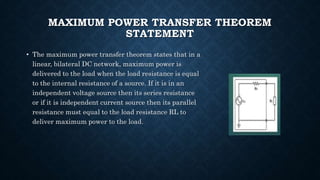
• The maximum power transfer theorem states that in a
linear, bilateral DC network, maximum power is
delivered to the load when the load resistance is equal
to the internal resistance of a source. If it is in an
independent voltage source then its series resistance
or if it is independent current source then its parallel
resistance must equal to the load resistance RL to
deliver maximum power to the load.
PROOF OF MAXIMUM POWER TRANSFER THEOREM
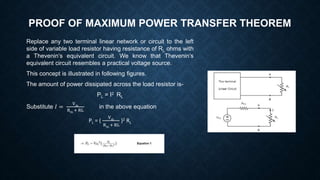
Replace any two terminal linear network or circuit to the left
side of variable load resistor having resistance of RL ohms with
a Thevenin’s equivalent circuit. We know that Thevenin’s
equivalent circuit resembles a practical voltage source.
This concept is illustrated in following figures.
The amount of power dissipated across the load resistor is-
PL = I2 RL
Substitute 𝐼 =
Vth
Rth
+ RL
in the above equation
PL = (
Vth
Rth
+ RL
)2 RL
CONDITION FOR MAXIMUM POWER TRANSFER
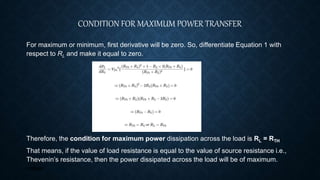
For maximum or minimum, first derivative will be zero. So, differentiate Equation 1 with
respect to RL and make it equal to zero.
Therefore, the condition for maximum power dissipation across the load is RL = RTH
That means, if the value of load resistance is equal to the value of source resistance i.e.,
Thevenin’s resistance, then the power dissipated across the load will be of maximum.
value.
THE VALUE OF MAXIMUM POWER TRANSFER
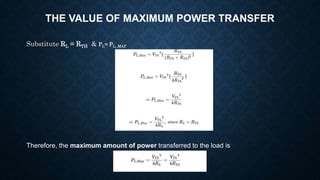
Substitute RL = RTH & PL= PL, MAX
Therefore, the maximum amount of power transferred to the load is
PRACTICAL APPLICATION
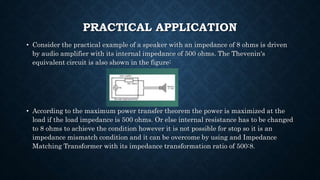
• Consider the practical example of a speaker with an impedance of 8 ohms is driven
by audio amplifier with its internal impedance of 500 ohms. The Thevenin's
equivalent circuit is also shown in the figure:
• According to the maximum power transfer theorem the power is maximized at the
load if the load impedance is 500 ohms. Or else internal resistance has to be changed
to 8 ohms to achieve the condition however it is not possible for stop so it is an
impedance mismatch condition and it can be overcome by using and Impedance
Matching Transformer with its impedance transformation ratio of 500:8.
Maximum Power Transfer Theorem

Maximum Power Transfer Theorem

  • 1.
    MAXIMUM POWER TRANSFER THEOREM DEPARTMENTOF ELECTRICAL ENGINEERING YEAR: 2ND YEAR (3rd Semester)
  • 2.
    CONTENTS • INTRODUCTION • MAXIMUMPOWER TRANSFER THEOREM STATEMENT • PROOF OF MAXIMUM POWER TRANSFER THEOREM • CONDITION FOR MAXIMUM POWER TRANSFER • THE VALUE OF MAXIMUM POWER TRANSFER • PRACTICAL APPLICATION
  • 3.
    INTRODUCTION • In anyelectric circuit, the electrical energy from the supply is delivered to the load where it is converted into a useful work. • Practically the entire supplied power will not present at load due to heating effect and other constraints in the network. • Therefore there exist a certain difference between join and delivering powers. • The load size always affects the amount of power transferred from the supply source that is any change in the load resistance result to change in power transfer in the load. Thus, the maximum power transfer theorem ensures the condition to transfer the maximum power to the load.
  • 4.
    MAXIMUM POWER TRANSFERTHEOREM STATEMENT • The maximum power transfer theorem states that in a linear, bilateral DC network, maximum power is delivered to the load when the load resistance is equal to the internal resistance of a source. If it is in an independent voltage source then its series resistance or if it is independent current source then its parallel resistance must equal to the load resistance RL to deliver maximum power to the load.
  • 5.
    PROOF OF MAXIMUMPOWER TRANSFER THEOREM Replace any two terminal linear network or circuit to the left side of variable load resistor having resistance of RL ohms with a Thevenin’s equivalent circuit. We know that Thevenin’s equivalent circuit resembles a practical voltage source. This concept is illustrated in following figures. The amount of power dissipated across the load resistor is- PL = I2 RL Substitute 𝐼 = Vth Rth + RL in the above equation PL = ( Vth Rth + RL )2 RL
  • 6.
    CONDITION FOR MAXIMUMPOWER TRANSFER For maximum or minimum, first derivative will be zero. So, differentiate Equation 1 with respect to RL and make it equal to zero. Therefore, the condition for maximum power dissipation across the load is RL = RTH That means, if the value of load resistance is equal to the value of source resistance i.e., Thevenin’s resistance, then the power dissipated across the load will be of maximum. value.
  • 7.
    THE VALUE OFMAXIMUM POWER TRANSFER Substitute RL = RTH & PL= PL, MAX Therefore, the maximum amount of power transferred to the load is
  • 8.
    PRACTICAL APPLICATION • Considerthe practical example of a speaker with an impedance of 8 ohms is driven by audio amplifier with its internal impedance of 500 ohms. The Thevenin's equivalent circuit is also shown in the figure: • According to the maximum power transfer theorem the power is maximized at the load if the load impedance is 500 ohms. Or else internal resistance has to be changed to 8 ohms to achieve the condition however it is not possible for stop so it is an impedance mismatch condition and it can be overcome by using and Impedance Matching Transformer with its impedance transformation ratio of 500:8.