BEF 12403

 Maximum Power
Transfer Theorem
Learning Outcomes:

Upon completion of this unit the student will be able to:
(i) Determine the conditions for maximum power transfer
    to any circuit element.
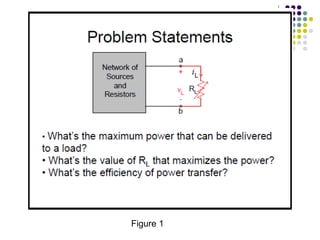
Figure 1
Maximum Power Transfer Theorem
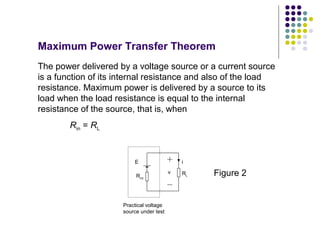
The power delivered by a voltage source or a current source
is a function of its internal resistance and also of the load
resistance. Maximum power is delivered by a source to its
load when the load resistance is equal to the internal
resistance of the source, that is, when
        Rin = RL


                         E                   i

                          Rint
                                         v   RL   Figure 2


                     Practical voltage
                     source under test
Proof

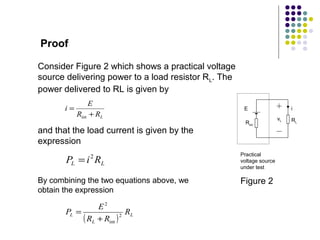
Consider Figure 2 which shows a practical voltage
source delivering power to a load resistor RL. The
power delivered to RL is given by
                E
       i=                                             E                    i
            Rint + RL
                                                                      vL   RL
                                                       Rint
and that the load current is given by the
expression
                                                     Practical
       PL = i RL2
                                                     voltage source
                                                     under test

By combining the two equations above, we             Figure 2
obtain the expression

                 E2
       PL =                 RL
            ( RL + Rint ) 2
Proof (continued)

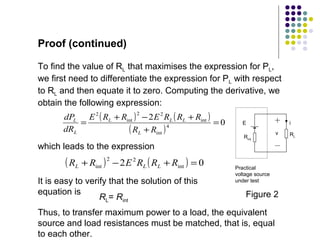
To find the value of RL that maximises the expression for PL,
we first need to differentiate the expression for PL with respect
to RL and then equate it to zero. Computing the derivative, we
obtain the following expression:
             E 2 ( RL + Rint ) − 2 E 2 RL ( RL + Rint )
                              2
       dPL
           =                                            =0     E                  i
       dRL                ( RL + Rint ) 4
                                                                              v   RL
                                                                Rint
which leads to the expression
       ( RL + Rint ) 2 − 2 E 2 RL ( RL + Rint ) = 0          Practical
                                                             voltage source
It is easy to verify that the solution of this               under test

equation is                                                      Figure 2
                  RL= Rint
Thus, to transfer maximum power to a load, the equivalent
source and load resistances must be matched, that is, equal
to each other.
•   This is called a "matched condition" and as a general rule,
    maximum power is transferred from an active device such
    as a power supply or battery to an external device when
    the impedance of the external device exactly matches the
    impedance of the source.
•   One good example of impedance matching is between an
    audio amplifier and a loudspeaker.
•   Improper impedance matching can lead to excessive
    power loss and heat dissipation.
Proof (continued)
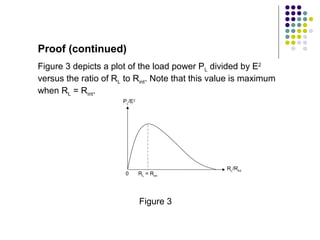
Figure 3 depicts a plot of the load power PL divided by E2
versus the ratio of RL to Rint. Note that this value is maximum
when RL = Rint.
                      PL/E2


                                                  RL/Rint
                       0      RL = Rint


                              Figure 3
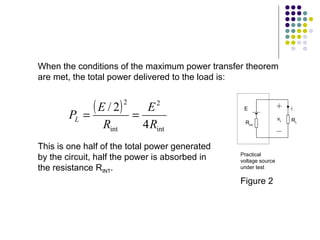
When the conditions of the maximum power transfer theorem
are met, the total power delivered to the load is:


        PL   =
               ( E / 2)   2
                              =
                                 E2              E                    i
                                                                 vL   RL
                  Rint          4 Rint            Rint


This is one half of the total power generated
                                                Practical
by the circuit, half the power is absorbed in   voltage source
the resistance RINT.                            under test

                                                Figure 2
Worked Example

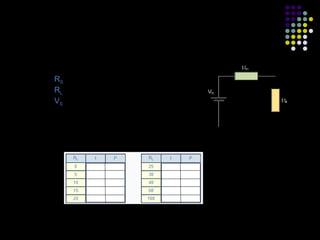
Given the circuit in Figure 4, where:
    RS = 25Ω
    RL is variable between 0 - 100Ω
    VS = 100v
Complete the following table to determine
the current and power in the circuit for
different values of load resistance.
                                            Figure 4
Solution


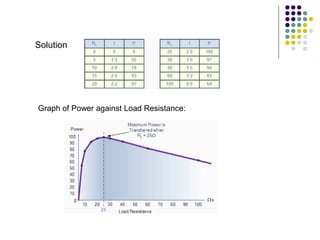
Graph of Power against Load Resistance:
Solution (continued)

From the above table and graph we can see that the Maximum
Power Transfer occurs in the load when the load resistance, RL is
equal in value to the source resistance, RS that is: RS = RL = 25 Ω.
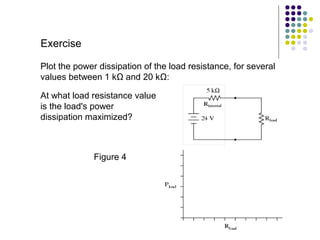
Exercise

Plot the power dissipation of the load resistance, for several
values between 1 kΩ and 20 kΩ:

At what load resistance value
is the load's power
dissipation maximized?


              Figure 4
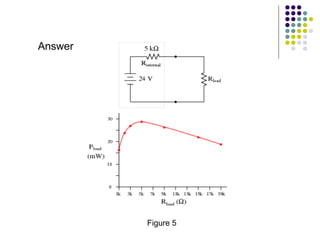
Answer


         Figure 5
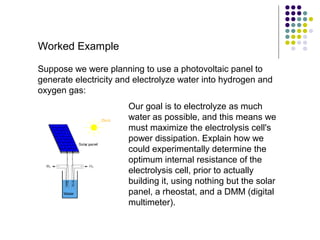
Worked Example

Suppose we were planning to use a photovoltaic panel to
generate electricity and electrolyze water into hydrogen and
oxygen gas:
                       Our goal is to electrolyze as much
                       water as possible, and this means we
                       must maximize the electrolysis cell's
                       power dissipation. Explain how we
                       could experimentally determine the
                       optimum internal resistance of the
                       electrolysis cell, prior to actually
                       building it, using nothing but the solar
                       panel, a rheostat, and a DMM (digital
                       multimeter).
Answer
Experimentally determine what amount load resistance drops
exactly one-half of the panel's open-circuit voltage.
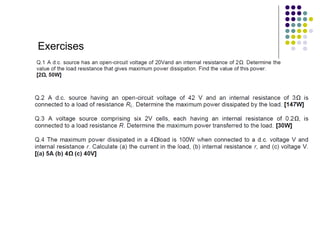
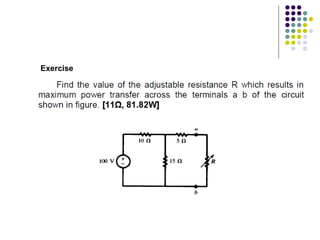
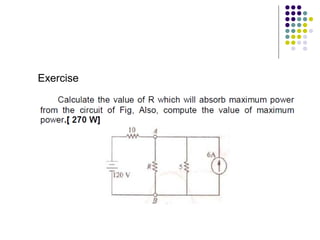
Exercises
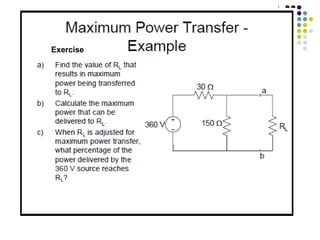
Exercise
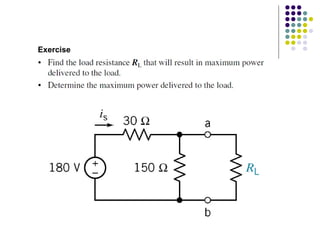
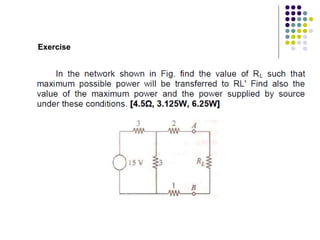
Exercise
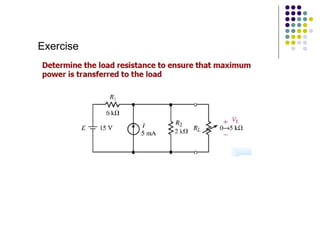
Exercise
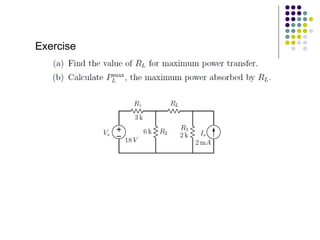
Exercise
Exercise
Exercise
Exercise

Max+power+theorem

  • 1.
    BEF 12403 MaximumPower Transfer Theorem
  • 2.
    Learning Outcomes: Upon completionof this unit the student will be able to: (i) Determine the conditions for maximum power transfer to any circuit element.
  • 3.
  • 4.
    Maximum Power TransferTheorem The power delivered by a voltage source or a current source is a function of its internal resistance and also of the load resistance. Maximum power is delivered by a source to its load when the load resistance is equal to the internal resistance of the source, that is, when Rin = RL E i Rint v RL Figure 2 Practical voltage source under test
  • 5.
    Proof Consider Figure 2which shows a practical voltage source delivering power to a load resistor RL. The power delivered to RL is given by E i= E i Rint + RL vL RL Rint and that the load current is given by the expression Practical PL = i RL2 voltage source under test By combining the two equations above, we Figure 2 obtain the expression E2 PL = RL ( RL + Rint ) 2
  • 6.
    Proof (continued) To findthe value of RL that maximises the expression for PL, we first need to differentiate the expression for PL with respect to RL and then equate it to zero. Computing the derivative, we obtain the following expression: E 2 ( RL + Rint ) − 2 E 2 RL ( RL + Rint ) 2 dPL = =0 E i dRL ( RL + Rint ) 4 v RL Rint which leads to the expression ( RL + Rint ) 2 − 2 E 2 RL ( RL + Rint ) = 0 Practical voltage source It is easy to verify that the solution of this under test equation is Figure 2 RL= Rint Thus, to transfer maximum power to a load, the equivalent source and load resistances must be matched, that is, equal to each other.
  • 7.
    This is called a "matched condition" and as a general rule, maximum power is transferred from an active device such as a power supply or battery to an external device when the impedance of the external device exactly matches the impedance of the source. • One good example of impedance matching is between an audio amplifier and a loudspeaker. • Improper impedance matching can lead to excessive power loss and heat dissipation.
  • 8.
    Proof (continued) Figure 3depicts a plot of the load power PL divided by E2 versus the ratio of RL to Rint. Note that this value is maximum when RL = Rint. PL/E2 RL/Rint 0 RL = Rint Figure 3
  • 9.
    When the conditionsof the maximum power transfer theorem are met, the total power delivered to the load is: PL = ( E / 2) 2 = E2 E i vL RL Rint 4 Rint Rint This is one half of the total power generated Practical by the circuit, half the power is absorbed in voltage source the resistance RINT. under test Figure 2
  • 10.
    Worked Example Given thecircuit in Figure 4, where: RS = 25Ω RL is variable between 0 - 100Ω VS = 100v Complete the following table to determine the current and power in the circuit for different values of load resistance. Figure 4
  • 11.
    Solution Graph of Poweragainst Load Resistance:
  • 12.
    Solution (continued) From theabove table and graph we can see that the Maximum Power Transfer occurs in the load when the load resistance, RL is equal in value to the source resistance, RS that is: RS = RL = 25 Ω.
  • 13.
    Exercise Plot the powerdissipation of the load resistance, for several values between 1 kΩ and 20 kΩ: At what load resistance value is the load's power dissipation maximized? Figure 4
  • 14.
    Answer Figure 5
  • 15.
    Worked Example Suppose wewere planning to use a photovoltaic panel to generate electricity and electrolyze water into hydrogen and oxygen gas: Our goal is to electrolyze as much water as possible, and this means we must maximize the electrolysis cell's power dissipation. Explain how we could experimentally determine the optimum internal resistance of the electrolysis cell, prior to actually building it, using nothing but the solar panel, a rheostat, and a DMM (digital multimeter).
  • 16.
    Answer Experimentally determine whatamount load resistance drops exactly one-half of the panel's open-circuit voltage.
  • 17.
  • 18.
  • 19.
  • 20.
  • 21.
  • 22.
  • 23.
  • 24.