MAXIMUM POWER
TRANSFER
THEOREM
ASHWANI KUMAR
14030141EEE016
MAXIMUM POWER TRANSFER THEOREM
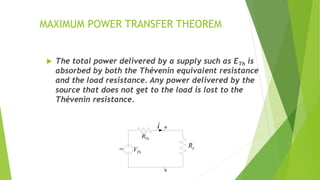
 The total power delivered by a supply such as ETh is
absorbed by both the Thévenin equivalent resistance
and the load resistance. Any power delivered by the
source that does not get to the load is lost to the
Thévenin resistance.
DC
b
a
LR
i
ThR
ThV
MAXIMUM POWER TRANSFER THEOREM
 When designing a circuit, it is often important to be able to answer one of the
following questions:
 What load should be applied to a system to ensure that the load is receiving
maximum power from the system?
 Conversely:
 For a particular load, what conditions should be imposed on the source to
ensure that it will deliver the maximum power available?
DC
b
a
LR
i
ThR
ThV
4
DC
b
a
LR
i
ThR
ThV
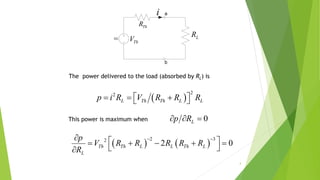
The power delivered to the load (absorbed by RL) is
 
22
L Th Th L Lp i R V R R R    
This power is maximum when
   
2 32
2 0Th Th L L Th L
L
p
V R R R R R
R
       
 
0Lp R  
5
   
2 32
2 0Th Th L L Th L
L
dp
V R R R R R
dR
 
     
 
2Th L LR R R 
L ThR R
 
2
max L Th
Th Th L L R R
p V R R R 
   
 
2 2
max 2 4Th Th Th Th Thp V R R V R   
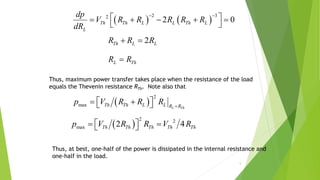
Thus, maximum power transfer takes place when the resistance of the load
equals the Thevenin resistance RTh. Note also that
Thus, at best, one-half of the power is dissipated in the internal resistance and
one-half in the load.
MAXIMUM POWER TRANSFER THEOREM
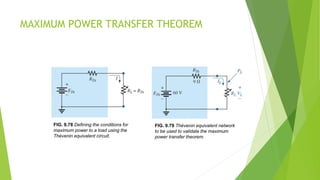
FIG. 9.78 Defining the conditions for
maximum power to a load using the
Thévenin equivalent circuit.
FIG. 9.79 Thévenin equivalent network
to be used to validate the maximum
power transfer theorem.

MAXIMUM POWER TRANSFER THEOREM
TABLE 9.1
DC
b
a
LR
i
ThR
ThV
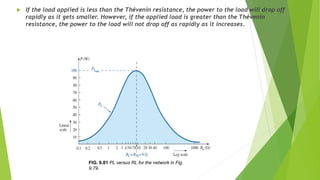
 If the load applied is less than the Thévenin resistance, the power to the load will drop off
rapidly as it gets smaller. However, if the applied load is greater than the Thévenin
resistance, the power to the load will not drop off as rapidly as it increases.
FIG. 9.81 PL versus RL for the network in Fig.
9.79.
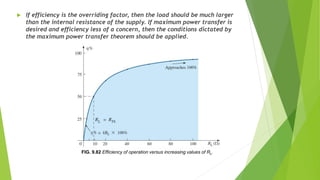
FIG. 9.82 Efficiency of operation versus increasing values of RL.
 If efficiency is the overriding factor, then the load should be much larger
than the internal resistance of the supply. If maximum power transfer is
desired and efficiency less of a concern, then the conditions dictated by
the maximum power transfer theorem should be applied.
BIBLIOGRAPHY
Introductory Circuit Analysis by
Boylested
http://www.secs.oakland.edu

Maximum power transfer_theowem

  • 1.
  • 2.
    MAXIMUM POWER TRANSFERTHEOREM  The total power delivered by a supply such as ETh is absorbed by both the Thévenin equivalent resistance and the load resistance. Any power delivered by the source that does not get to the load is lost to the Thévenin resistance. DC b a LR i ThR ThV
  • 3.
    MAXIMUM POWER TRANSFERTHEOREM  When designing a circuit, it is often important to be able to answer one of the following questions:  What load should be applied to a system to ensure that the load is receiving maximum power from the system?  Conversely:  For a particular load, what conditions should be imposed on the source to ensure that it will deliver the maximum power available? DC b a LR i ThR ThV
  • 4.
    4 DC b a LR i ThR ThV The power deliveredto the load (absorbed by RL) is   22 L Th Th L Lp i R V R R R     This power is maximum when     2 32 2 0Th Th L L Th L L p V R R R R R R           0Lp R  
  • 5.
    5    2 32 2 0Th Th L L Th L L dp V R R R R R dR           2Th L LR R R  L ThR R   2 max L Th Th Th L L R R p V R R R        2 2 max 2 4Th Th Th Th Thp V R R V R    Thus, maximum power transfer takes place when the resistance of the load equals the Thevenin resistance RTh. Note also that Thus, at best, one-half of the power is dissipated in the internal resistance and one-half in the load.
  • 6.
    MAXIMUM POWER TRANSFERTHEOREM FIG. 9.78 Defining the conditions for maximum power to a load using the Thévenin equivalent circuit. FIG. 9.79 Thévenin equivalent network to be used to validate the maximum power transfer theorem.
  • 7.
    MAXIMUM POWER TRANSFERTHEOREM TABLE 9.1 DC b a LR i ThR ThV
  • 8.
     If theload applied is less than the Thévenin resistance, the power to the load will drop off rapidly as it gets smaller. However, if the applied load is greater than the Thévenin resistance, the power to the load will not drop off as rapidly as it increases. FIG. 9.81 PL versus RL for the network in Fig. 9.79.
  • 9.
    FIG. 9.82 Efficiencyof operation versus increasing values of RL.  If efficiency is the overriding factor, then the load should be much larger than the internal resistance of the supply. If maximum power transfer is desired and efficiency less of a concern, then the conditions dictated by the maximum power transfer theorem should be applied.
  • 10.
    BIBLIOGRAPHY Introductory Circuit Analysisby Boylested http://www.secs.oakland.edu