Superposition Theorem
By
Rajni Maurya
MITS, Gwalior
rajni.maurya2790@gmail.com
Superposition Theorem
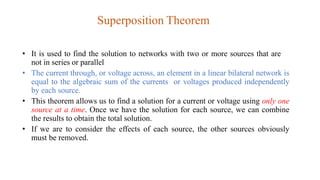
• It is used to find the solution to networks with two or more sources that are
not in series or parallel
• The current through, or voltage across, an element in a linear bilateral network is
equal to the algebraic sum of the currents or voltages produced independently
by each source.
• This theorem allows us to find a solution for a current or voltage using only one
source at a time. Once we have the solution for each source, we can combine
the results to obtain the total solution.
• If we are to consider the effects of each source, the other sources obviously
must be removed.
Superposition Theorem
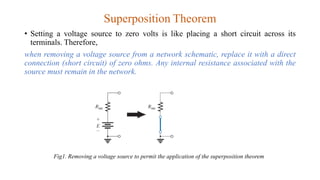
• Setting a voltage source to zero volts is like placing a short circuit across its
terminals. Therefore,
when removing a voltage source from a network schematic, replace it with a direct
connection (short circuit) of zero ohms. Any internal resistance associated with the
source must remain in the network.
Fig1. Removing a voltage source to permit the application of the superposition theorem
Superposition Theorem
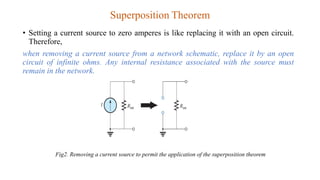
• Setting a current source to zero amperes is like replacing it with an open circuit.
Therefore,
when removing a current source from a network schematic, replace it by an open
circuit of infinite ohms. Any internal resistance associated with the source must
remain in the network.
Fig2. Removing a current source to permit the application of the superposition theorem
Superposition Theorem
Since the effect of each source will be determined independently, the number of
networks to be analyzed will equal the number of sources.
• For a two-source network, if the current produced by one source is in one
direction, while that produced by the other is in the opposite direction through the
same resistor, the resulting current is the difference of the two and has the
direction of the larger.
If the individual currents are in the same direction, the resulting current is the
sum of two in the direction of either current.
Superposition Theorem
• Similarly, if a particular voltage of a network is to be determined, the contribution to
that voltage must be determined for each source.
When the effect of each source has been determined, those voltages with the
same polarity are added, and those with the opposite polarity are subtracted; the
algebraic sum is being determined.
The total result has the polarity of the larger sum and the magnitude of the difference.
Example 1: Determine the branches current using
Superposition Theorem
Solutio
n:
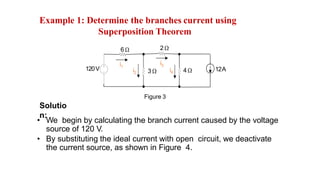
• We begin by calculating the branch current caused by the voltage
source of 120 V.
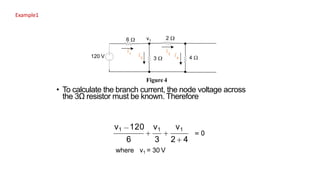
• By substituting the ideal current with open circuit, we deactivate
the current source, as shown in Figure 4.
120V 3
6
12A4
2
i1
i2
i3
i4
Figure 3
120 V 3
6
4
2
i'
1
i'
2
i'
3
i'
4
v1
Figure 4
• To calculate the branch current, the node voltage across
the 3Ω resistor must be known. Therefore
v1 120 v1 v1
= 0
6 3 2 4
where v1 = 30 V
Example1
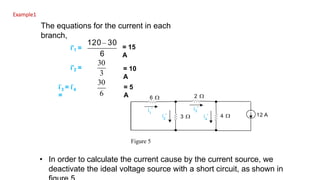
120 30
6
30
= 15
A
i'2 =
3
30
= 10
A
i'
3 = i'
4
= 6
= 5
A
• In order to calculate the current cause by the current source, we
deactivate the ideal voltage source with a short circuit, as shown in
3
6
12 A4
2
1
i "
2
i "
i3
"
4
i "
i'1 =
Figure 5
Example1
The equations for the current in each
branch,
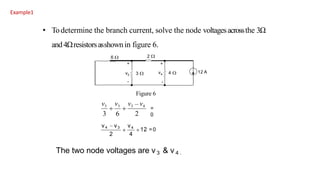
• Todetermine the branch current, solve the node voltagesacrossthe 3Ω
and4Ωresistorsasshownin figure 6.
The two node voltages are v 3 & v 4 .
12 A
6 2
+ +
v3 3 v4 4
- -
2
2 4
v3 v3 v3 v4
3 6
v4 v3 v4
12 =0
=
0
Figure 6
Example1
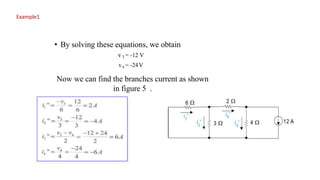
• By solving these equations, we obtain
v3 = -12 V
v4 = -24V
Now we can find the branches current as shown
in figure 5 .
Example1
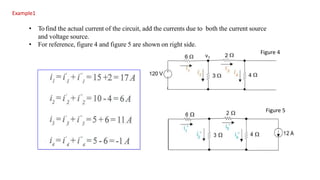
• Tofind the actual current of the circuit, add the currents due to both the current source
and voltage source.
• For reference, figure 4 and figure 5 are shown on right side.
Figure 4
Figure 5
Example1
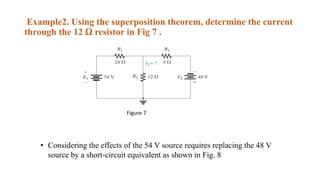
Example2. Using the superposition theorem, determine the current
through the 12 Ω resistor in Fig 7 .
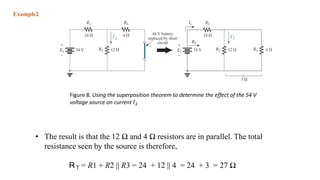
• Considering the effects of the 54 V source requires replacing the 48 V
source by a short-circuit equivalent as shown in Fig. 8
Figure 7
Figure 8. Using the superposition theorem to determine the effect of the 54 V
voltage source on current I2
• The result is that the 12 Ω and 4 Ω resistors are in parallel. The total
resistance seen by the source is therefore,
RT = R1 + R2 || R3 = 24 + 12 || 4 = 24 + 3 = 27 Ω
Example2
• and the source current is
𝐼𝑆 =
𝐸1
𝑅 𝑇
=
54 𝑉
27 Ω
= 2 𝐴
• Using the current divider rule results in the contribution to I2 due to
the 54 V source:
𝐼2
′
=
𝑅3 𝐼 𝑆
𝑅3+ 𝑅2
=
4 Ω 2𝐴
4 Ω + 12 Ω
= 0.5 𝐴
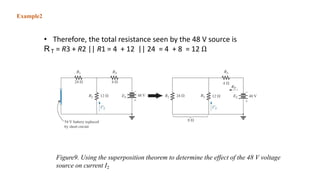
• Now replace the 54 V source by a short-circuit equivalent, the
network in Fig. 9 results. The result is a parallel connection for the
12 Ω and 24 Ω resistors.
Example2
• Therefore, the total resistance seen by the 48 V source is
RT = R3 + R2 || R1 = 4 + 12 || 24 = 4 + 8 = 12 Ω
Figure9. Using the superposition theorem to determine the effect of the 48 V voltage
source on current I2
Example2
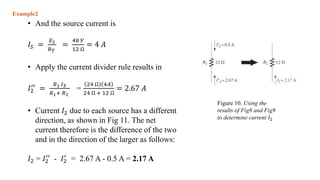
• And the source current is
𝐼𝑆 =
𝐸2
𝑅 𝑇
=
48 𝑉
12 Ω
= 4 𝐴
• Apply the current divider rule results in
𝐼2
′′
=
𝑅1 𝐼 𝑆
𝑅1+ 𝑅2
=
24 Ω 4𝐴
24 Ω + 12 Ω
= 2.67 𝐴
• Current 𝐼2 due to each source has a different
direction, as shown in Fig 11. The net
current therefore is the difference of the two
and in the direction of the larger as follows:
𝐼2 = 𝐼2
′′
- 𝐼2
′
= 2.67 A - 0.5 A = 2.17 A
Figure 10. Using the
results of Fig8 and Fig9
to determine current 𝐼2
Example2
Thanks

Superposition theorem

  • 1.
    Superposition Theorem By Rajni Maurya MITS,Gwalior rajni.maurya2790@gmail.com
  • 2.
    Superposition Theorem • Itis used to find the solution to networks with two or more sources that are not in series or parallel • The current through, or voltage across, an element in a linear bilateral network is equal to the algebraic sum of the currents or voltages produced independently by each source. • This theorem allows us to find a solution for a current or voltage using only one source at a time. Once we have the solution for each source, we can combine the results to obtain the total solution. • If we are to consider the effects of each source, the other sources obviously must be removed.
  • 3.
    Superposition Theorem • Settinga voltage source to zero volts is like placing a short circuit across its terminals. Therefore, when removing a voltage source from a network schematic, replace it with a direct connection (short circuit) of zero ohms. Any internal resistance associated with the source must remain in the network. Fig1. Removing a voltage source to permit the application of the superposition theorem
  • 4.
    Superposition Theorem • Settinga current source to zero amperes is like replacing it with an open circuit. Therefore, when removing a current source from a network schematic, replace it by an open circuit of infinite ohms. Any internal resistance associated with the source must remain in the network. Fig2. Removing a current source to permit the application of the superposition theorem
  • 5.
    Superposition Theorem Since theeffect of each source will be determined independently, the number of networks to be analyzed will equal the number of sources. • For a two-source network, if the current produced by one source is in one direction, while that produced by the other is in the opposite direction through the same resistor, the resulting current is the difference of the two and has the direction of the larger. If the individual currents are in the same direction, the resulting current is the sum of two in the direction of either current.
  • 6.
    Superposition Theorem • Similarly,if a particular voltage of a network is to be determined, the contribution to that voltage must be determined for each source. When the effect of each source has been determined, those voltages with the same polarity are added, and those with the opposite polarity are subtracted; the algebraic sum is being determined. The total result has the polarity of the larger sum and the magnitude of the difference.
  • 7.
    Example 1: Determinethe branches current using Superposition Theorem Solutio n: • We begin by calculating the branch current caused by the voltage source of 120 V. • By substituting the ideal current with open circuit, we deactivate the current source, as shown in Figure 4. 120V 3 6 12A4 2 i1 i2 i3 i4 Figure 3
  • 8.
    120 V 3 6 4 2 i' 1 i' 2 i' 3 i' 4 v1 Figure4 • To calculate the branch current, the node voltage across the 3Ω resistor must be known. Therefore v1 120 v1 v1 = 0 6 3 2 4 where v1 = 30 V Example1
  • 9.
    120 30 6 30 = 15 A i'2= 3 30 = 10 A i' 3 = i' 4 = 6 = 5 A • In order to calculate the current cause by the current source, we deactivate the ideal voltage source with a short circuit, as shown in 3 6 12 A4 2 1 i " 2 i " i3 " 4 i " i'1 = Figure 5 Example1 The equations for the current in each branch,
  • 10.
    • Todetermine thebranch current, solve the node voltagesacrossthe 3Ω and4Ωresistorsasshownin figure 6. The two node voltages are v 3 & v 4 . 12 A 6 2 + + v3 3 v4 4 - - 2 2 4 v3 v3 v3 v4 3 6 v4 v3 v4 12 =0 = 0 Figure 6 Example1
  • 11.
    • By solvingthese equations, we obtain v3 = -12 V v4 = -24V Now we can find the branches current as shown in figure 5 . Example1
  • 12.
    • Tofind theactual current of the circuit, add the currents due to both the current source and voltage source. • For reference, figure 4 and figure 5 are shown on right side. Figure 4 Figure 5 Example1
  • 13.
    Example2. Using thesuperposition theorem, determine the current through the 12 Ω resistor in Fig 7 . • Considering the effects of the 54 V source requires replacing the 48 V source by a short-circuit equivalent as shown in Fig. 8 Figure 7
  • 14.
    Figure 8. Usingthe superposition theorem to determine the effect of the 54 V voltage source on current I2 • The result is that the 12 Ω and 4 Ω resistors are in parallel. The total resistance seen by the source is therefore, RT = R1 + R2 || R3 = 24 + 12 || 4 = 24 + 3 = 27 Ω Example2
  • 15.
    • and thesource current is 𝐼𝑆 = 𝐸1 𝑅 𝑇 = 54 𝑉 27 Ω = 2 𝐴 • Using the current divider rule results in the contribution to I2 due to the 54 V source: 𝐼2 ′ = 𝑅3 𝐼 𝑆 𝑅3+ 𝑅2 = 4 Ω 2𝐴 4 Ω + 12 Ω = 0.5 𝐴 • Now replace the 54 V source by a short-circuit equivalent, the network in Fig. 9 results. The result is a parallel connection for the 12 Ω and 24 Ω resistors. Example2
  • 16.
    • Therefore, thetotal resistance seen by the 48 V source is RT = R3 + R2 || R1 = 4 + 12 || 24 = 4 + 8 = 12 Ω Figure9. Using the superposition theorem to determine the effect of the 48 V voltage source on current I2 Example2
  • 17.
    • And thesource current is 𝐼𝑆 = 𝐸2 𝑅 𝑇 = 48 𝑉 12 Ω = 4 𝐴 • Apply the current divider rule results in 𝐼2 ′′ = 𝑅1 𝐼 𝑆 𝑅1+ 𝑅2 = 24 Ω 4𝐴 24 Ω + 12 Ω = 2.67 𝐴 • Current 𝐼2 due to each source has a different direction, as shown in Fig 11. The net current therefore is the difference of the two and in the direction of the larger as follows: 𝐼2 = 𝐼2 ′′ - 𝐼2 ′ = 2.67 A - 0.5 A = 2.17 A Figure 10. Using the results of Fig8 and Fig9 to determine current 𝐼2 Example2
  • 18.