Introduction to Thevenin’s
theorem
F r o m A b h i j i t h P r a b h a
contents
• Introduction.
• What is Thevenin's theorem?
• Steps (with 3 cases).
• Tricks.
• Facts.
Introduction
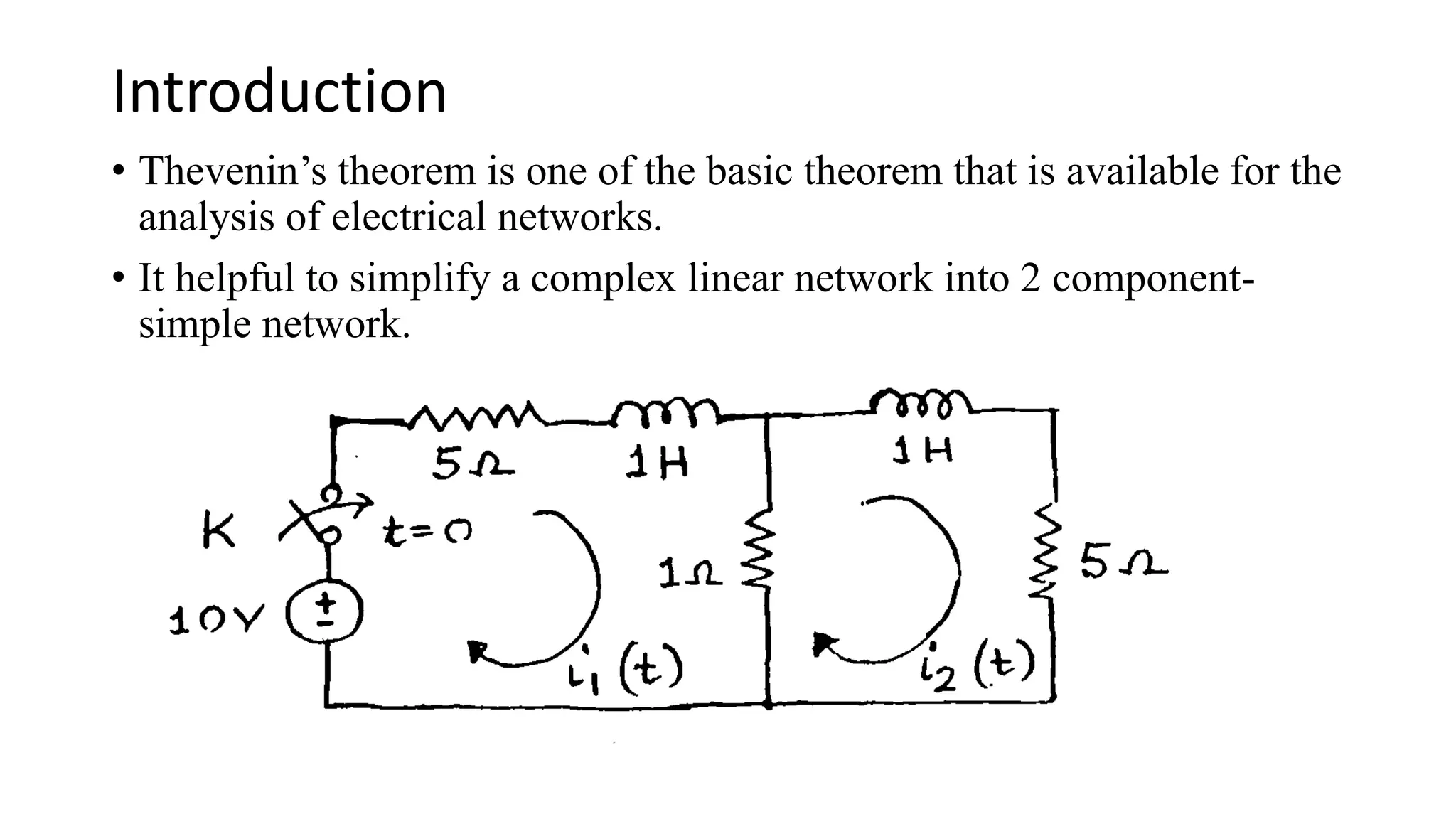
• Thevenin’s theorem is one of the basic theorem that is available for the
analysis of electrical networks.
• It helpful to simplify a complex linear network into 2 component-
simple network.
What is Thevenin's theorem?
• “ any two terminal bilateral linear d.c. or a.c. circuits can be
replaced by an equivalent circuit consists of a voltage source (Vth)
and a series resistor/impedance(Rth or Zth).”
• Where Vth is the voltage seen across the output of the given network.
And Rth is equivalent resistance of the network by short circuiting all
Voltage sources and open circuiting all Current sources.
• Thevenin’s theorem is most extensively used network theorem.
• It is useful in calculation of voltage and current in any element in
network without forming any complex equations or models.
• It is applicable only for linear networks only. Networks consists of
semiconductor elements not strictly follows Thevenin’s theorem.
Steps
• Case 1: network contain only independent sources* only.
To find Vth, open circuit the load resistor and find voltage seen across
by using KVL, KCL etc.
To find Zth or Rth, open circuit all current source and short circuit all
voltage sources. Then find impedance seen by open circuited load.
* Independent sources are the V or I sources whose magnitude doesn't depend on Voltage and current
in other branches of network. For dependent sources it’s magnitude will vary in accordance with
voltage and current in other branches.
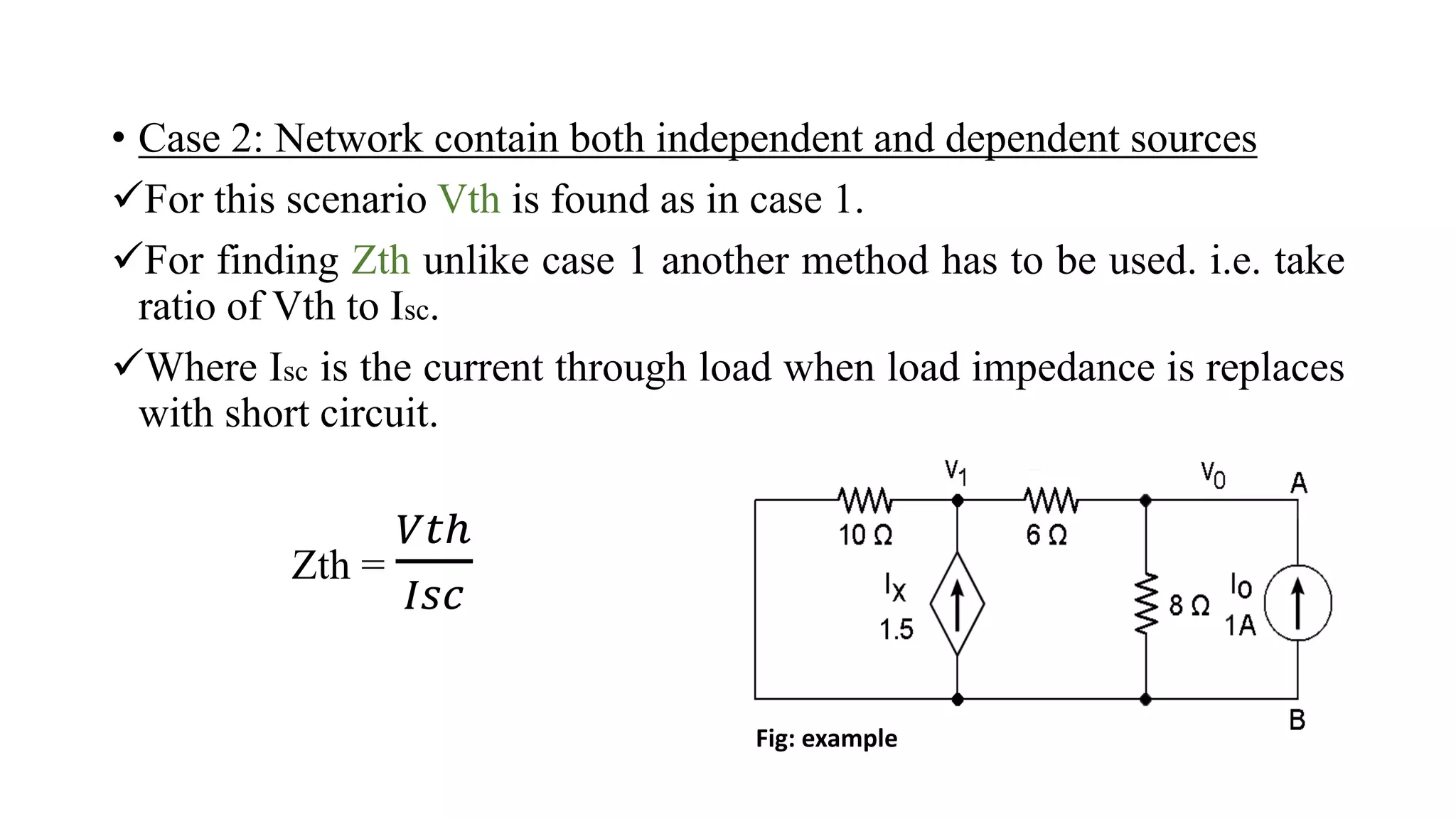
• Case 2: Network contain both independent and dependent sources
For this scenario Vth is found as in case 1.
For finding Zth unlike case 1 another method has to be used. i.e. take
ratio of Vth to Isc.
Where Isc is the current through load when load impedance is replaces
with short circuit.
Zth =
𝑉𝑡ℎ
𝐼𝑠𝑐
Fig: example
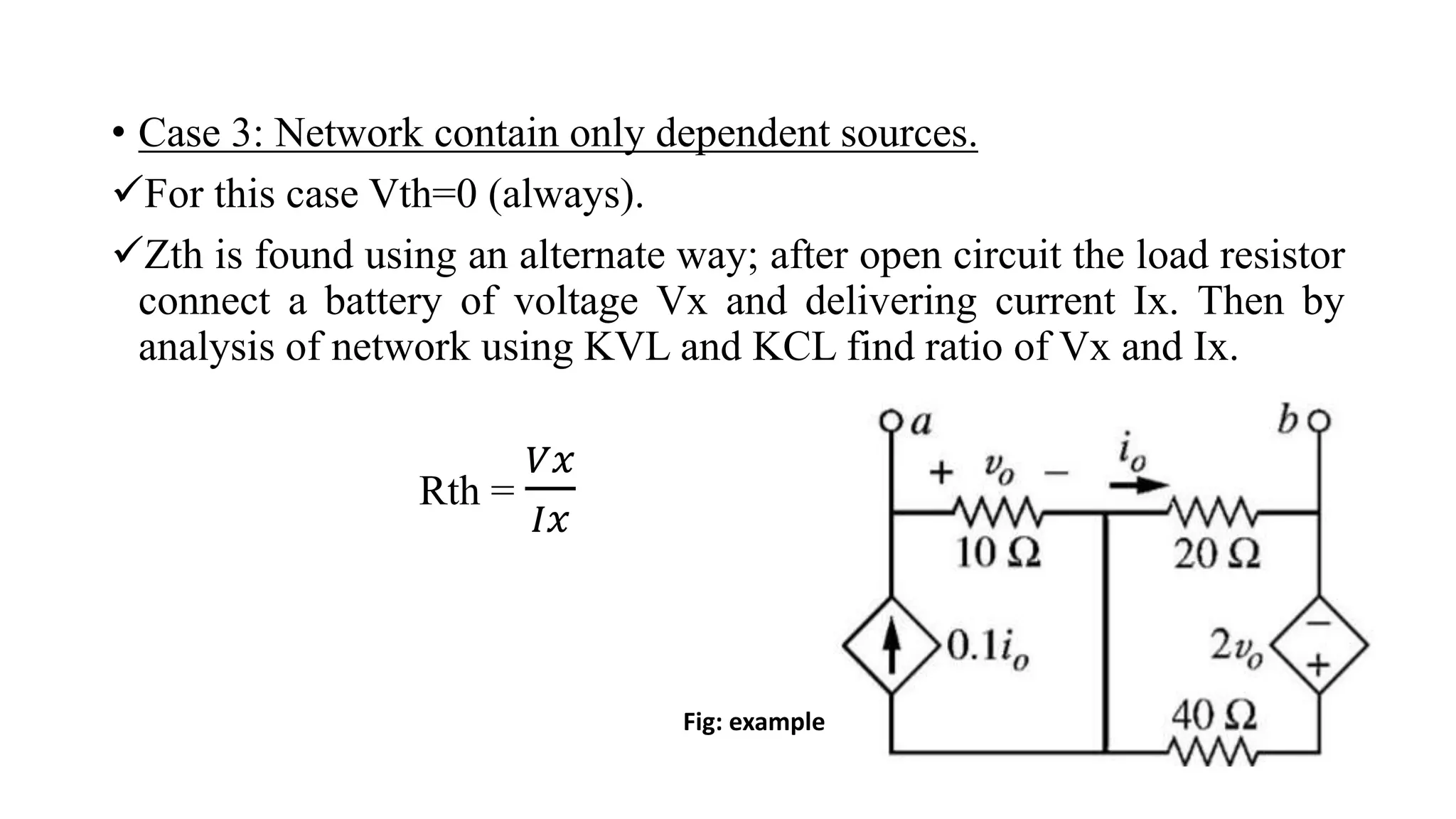
• Case 3: Network contain only dependent sources.
For this case Vth=0 (always).
Zth is found using an alternate way; after open circuit the load resistor
connect a battery of voltage Vx and delivering current Ix. Then by
analysis of network using KVL and KCL find ratio of Vx and Ix.
Rth =
𝑉𝑥
𝐼𝑥
Fig: example
Tricks
• In Case 3 to find ratio;
Rth =
𝑉𝑥
𝐼𝑥
assume Ix= 1 A and do calculations. Therefore finding value of Vx itself gives
value of Rth.
Rth =
𝑉𝑥
1 𝐴
= Vx
• Case 2 sometimes lengthy in nature for certain networks. Therefore it can be
convert into Case 3 by a simple alteration. Short circuit all independent voltage
source and open circuit all independent current sources. Leave dependent sources
and other network elements as same. Then use method of Case 3.
Facts
• Similar to Thevenin's theorem another theorem called Norton
equivalent is also used widely.
• In Norton equivalent a network is replaced by a current source(In or
Isc) in parallel with a resistor or impedance (Rn or Zn).
• This Rn will always equal to Thevenin's resistance.
Rn = Rth
• Thevenin's theorem is applicable for a.c. circuits also. But we have to take care
below two things;
1. Use concept of impedance instead of just resistance.
2. Take care about magnitude and phase of current and voltage.
• Feedbacks: abhijithprabha.ece@gmailcom

Introduction to Thevenin's theorem

  • 1.
    Introduction to Thevenin’s theorem Fr o m A b h i j i t h P r a b h a
  • 2.
    contents • Introduction. • Whatis Thevenin's theorem? • Steps (with 3 cases). • Tricks. • Facts.
  • 3.
    Introduction • Thevenin’s theoremis one of the basic theorem that is available for the analysis of electrical networks. • It helpful to simplify a complex linear network into 2 component- simple network.
  • 4.
    What is Thevenin'stheorem? • “ any two terminal bilateral linear d.c. or a.c. circuits can be replaced by an equivalent circuit consists of a voltage source (Vth) and a series resistor/impedance(Rth or Zth).”
  • 5.
    • Where Vthis the voltage seen across the output of the given network. And Rth is equivalent resistance of the network by short circuiting all Voltage sources and open circuiting all Current sources. • Thevenin’s theorem is most extensively used network theorem. • It is useful in calculation of voltage and current in any element in network without forming any complex equations or models. • It is applicable only for linear networks only. Networks consists of semiconductor elements not strictly follows Thevenin’s theorem.
  • 6.
    Steps • Case 1:network contain only independent sources* only. To find Vth, open circuit the load resistor and find voltage seen across by using KVL, KCL etc. To find Zth or Rth, open circuit all current source and short circuit all voltage sources. Then find impedance seen by open circuited load. * Independent sources are the V or I sources whose magnitude doesn't depend on Voltage and current in other branches of network. For dependent sources it’s magnitude will vary in accordance with voltage and current in other branches.
  • 7.
    • Case 2:Network contain both independent and dependent sources For this scenario Vth is found as in case 1. For finding Zth unlike case 1 another method has to be used. i.e. take ratio of Vth to Isc. Where Isc is the current through load when load impedance is replaces with short circuit. Zth = 𝑉𝑡ℎ 𝐼𝑠𝑐 Fig: example
  • 8.
    • Case 3:Network contain only dependent sources. For this case Vth=0 (always). Zth is found using an alternate way; after open circuit the load resistor connect a battery of voltage Vx and delivering current Ix. Then by analysis of network using KVL and KCL find ratio of Vx and Ix. Rth = 𝑉𝑥 𝐼𝑥 Fig: example
  • 9.
    Tricks • In Case3 to find ratio; Rth = 𝑉𝑥 𝐼𝑥 assume Ix= 1 A and do calculations. Therefore finding value of Vx itself gives value of Rth. Rth = 𝑉𝑥 1 𝐴 = Vx • Case 2 sometimes lengthy in nature for certain networks. Therefore it can be convert into Case 3 by a simple alteration. Short circuit all independent voltage source and open circuit all independent current sources. Leave dependent sources and other network elements as same. Then use method of Case 3.
  • 10.
    Facts • Similar toThevenin's theorem another theorem called Norton equivalent is also used widely. • In Norton equivalent a network is replaced by a current source(In or Isc) in parallel with a resistor or impedance (Rn or Zn). • This Rn will always equal to Thevenin's resistance. Rn = Rth • Thevenin's theorem is applicable for a.c. circuits also. But we have to take care below two things; 1. Use concept of impedance instead of just resistance. 2. Take care about magnitude and phase of current and voltage.
  • 11.