

Active learningassignment
Sub : physics
“Topic: Mars orbiter mission”
GuidedBy:Prof. niravsir
Branch : Electrical Engineering Div: F-1
Vrajesh raval(140120109047)
Ashutosh patel(140120109029)
Amar patel(140120109027)
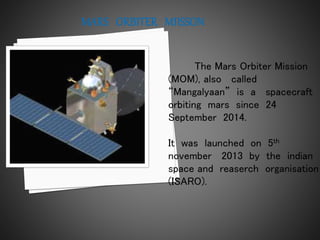
The Mars Orbiter Mission
(MOM), also called
“Mangalyaan” is a spacecraft
orbiting mars since 24
September 2014.
It was launched on 5th
november 2013 by the indian
space and reaserch organisation
(ISARO).
 As originally conceived, ISRO would have
launched MOM on its geosynchronous
satellite launch vehicle (GSLV).
 but as the GSLV failed twice in 2010 and ISRO
was continuing to sort out issues with
its cryogenic engine .
 it was not advisable to wait for the new
batch of rockets as that would have delayed
the MOM project for at least three years.
 ISRO opted to switch to the less-powerful
Poler satellite launch vehicle (PSLV). There is
no way to launch on a direct-to-Mars
trajectory with the PSLV . ISRO would first
launch it into Earth orbit .
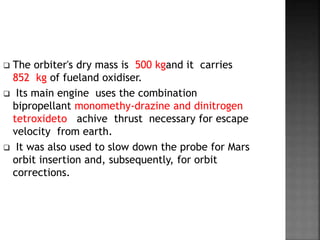
 The orbiter's dry mass is 500 kgand it carries
852 kg of fueland oxidiser.
 Its main engine uses the combination
bipropellant monomethy-drazine and dinitrogen
tetroxideto achive thrust necessary for escape
velocity from earth.
 It was also used to slow down the probe for Mars
orbit insertion and, subsequently, for orbit
corrections.
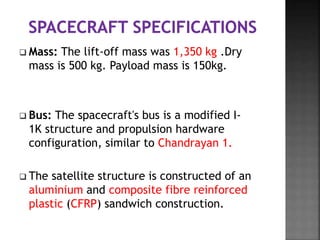
 Mass: The lift-off mass was 1,350 kg .Dry
mass is 500 kg. Payload mass is 150kg.
 Bus: The spacecraft's bus is a modified I-
1K structure and propulsion hardware
configuration, similar to Chandrayan 1.
 The satellite structure is constructed of an
aluminium and composite fibre reinforced
plastic (CFRP) sandwich construction.
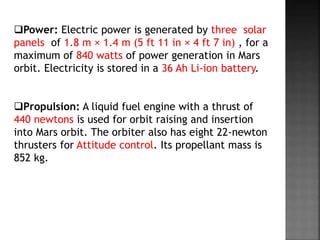
Power: Electric power is generated by three solar
panels of 1.8 m × 1.4 m (5 ft 11 in × 4 ft 7 in) , for a
maximum of 840 watts of power generation in Mars
orbit. Electricity is stored in a 36 Ah Li-ion battery.
Propulsion: A liquid fuel engine with a thrust of
440 newtons is used for orbit raising and insertion
into Mars orbit. The orbiter also has eight 22-newton
thrusters for Attitude control. Its propellant mass is
852 kg.
 The MOM mission concept began with a feasibility study
in 2010, after the launch of lunar satellite Chandrayaan-
1 in 2008.
 The Government of India approved the project on 3
August 2012, after the Indian space reaserch
Organisation completed 125 crore (US$20 million) of
required studies for the orbiter.
 The total project cost maybe up to 454 crore(us$74million)
. The satellite costs 153 crore (US$25 million) and the rest
of the budget has been attributed to ground stations
and relay upgrades that will be used for other ISRO
projects.
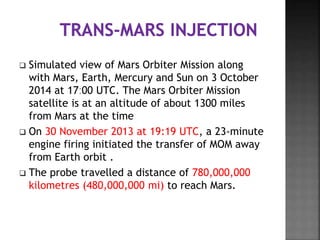
 Simulated view of Mars Orbiter Mission along
with Mars, Earth, Mercury and Sun on 3 October
2014 at 17ː00 UTC. The Mars Orbiter Mission
satellite is at an altitude of about 1300 miles
from Mars at the time
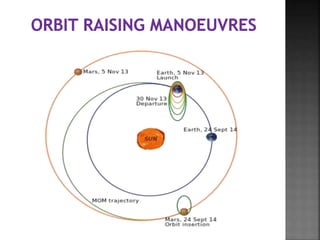
 On 30 November 2013 at 19:19 UTC, a 23-minute
engine firing initiated the transfer of MOM away
from Earth orbit .
 The probe travelled a distance of 780,000,000
kilometres (480,000,000 mi) to reach Mars.
 The plan for an insertion into MARS ORBITER was
on 24 September 2014, approximately 2 days
after the arrival of NASA's MAVEN orbiter.
 The 440N liquid apogee motor was successfully
test fired on 22 September for 3.968 seconds,
about 41 hours before actual orbit insertion.
 At IST 06:56:32 forward rotation started and
locked the position to fire,and with the help of
thrusters after eclipse started at IST 07:12:19
and LAM (Liquid Apogee Motor) started burning
at IST 07:17:32 and ended at IST 07:41:46.
 After that reverse manoeuvre took place, the
spacecraft successfully entered Martian orbit.
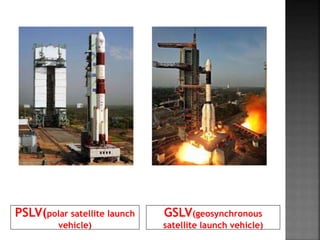
PSLV(polar satellite launch
vehicle)
GSLV(geosynchronous
satellite launch vehicle)
 Incorporate autonomous features to handle
contingency situations.
 Deep space communication, navigation,
mission planning and management.
 Exploration of Mars surface features,
morphology, mineralogy and Martian
atmosphere by indigenous scientific
instruments.
 Thank you.

Mars orbiter mission

  • 1.
    Active learningassignment Sub :physics “Topic: Mars orbiter mission” GuidedBy:Prof. niravsir Branch : Electrical Engineering Div: F-1
  • 2.
  • 3.
    The Mars OrbiterMission (MOM), also called “Mangalyaan” is a spacecraft orbiting mars since 24 September 2014. It was launched on 5th november 2013 by the indian space and reaserch organisation (ISARO).
  • 5.
     As originallyconceived, ISRO would have launched MOM on its geosynchronous satellite launch vehicle (GSLV).  but as the GSLV failed twice in 2010 and ISRO was continuing to sort out issues with its cryogenic engine .  it was not advisable to wait for the new batch of rockets as that would have delayed the MOM project for at least three years.  ISRO opted to switch to the less-powerful Poler satellite launch vehicle (PSLV). There is no way to launch on a direct-to-Mars trajectory with the PSLV . ISRO would first launch it into Earth orbit .
  • 7.
     The orbiter'sdry mass is 500 kgand it carries 852 kg of fueland oxidiser.  Its main engine uses the combination bipropellant monomethy-drazine and dinitrogen tetroxideto achive thrust necessary for escape velocity from earth.  It was also used to slow down the probe for Mars orbit insertion and, subsequently, for orbit corrections.
  • 8.
     Mass: Thelift-off mass was 1,350 kg .Dry mass is 500 kg. Payload mass is 150kg.  Bus: The spacecraft's bus is a modified I- 1K structure and propulsion hardware configuration, similar to Chandrayan 1.  The satellite structure is constructed of an aluminium and composite fibre reinforced plastic (CFRP) sandwich construction.
  • 9.
    Power: Electric poweris generated by three solar panels of 1.8 m × 1.4 m (5 ft 11 in × 4 ft 7 in) , for a maximum of 840 watts of power generation in Mars orbit. Electricity is stored in a 36 Ah Li-ion battery. Propulsion: A liquid fuel engine with a thrust of 440 newtons is used for orbit raising and insertion into Mars orbit. The orbiter also has eight 22-newton thrusters for Attitude control. Its propellant mass is 852 kg.
  • 10.
     The MOMmission concept began with a feasibility study in 2010, after the launch of lunar satellite Chandrayaan- 1 in 2008.  The Government of India approved the project on 3 August 2012, after the Indian space reaserch Organisation completed 125 crore (US$20 million) of required studies for the orbiter.  The total project cost maybe up to 454 crore(us$74million) . The satellite costs 153 crore (US$25 million) and the rest of the budget has been attributed to ground stations and relay upgrades that will be used for other ISRO projects.
  • 13.
     Simulated viewof Mars Orbiter Mission along with Mars, Earth, Mercury and Sun on 3 October 2014 at 17ː00 UTC. The Mars Orbiter Mission satellite is at an altitude of about 1300 miles from Mars at the time  On 30 November 2013 at 19:19 UTC, a 23-minute engine firing initiated the transfer of MOM away from Earth orbit .  The probe travelled a distance of 780,000,000 kilometres (480,000,000 mi) to reach Mars.
  • 14.
     The planfor an insertion into MARS ORBITER was on 24 September 2014, approximately 2 days after the arrival of NASA's MAVEN orbiter.  The 440N liquid apogee motor was successfully test fired on 22 September for 3.968 seconds, about 41 hours before actual orbit insertion.  At IST 06:56:32 forward rotation started and locked the position to fire,and with the help of thrusters after eclipse started at IST 07:12:19 and LAM (Liquid Apogee Motor) started burning at IST 07:17:32 and ended at IST 07:41:46.  After that reverse manoeuvre took place, the spacecraft successfully entered Martian orbit.
  • 15.
  • 16.
     Incorporate autonomousfeatures to handle contingency situations.  Deep space communication, navigation, mission planning and management.  Exploration of Mars surface features, morphology, mineralogy and Martian atmosphere by indigenous scientific instruments.
  • 17.