Gandhinagar Institute Of
Technology
Subject – Electrical Power System – 1 (2150908)
Branch – Electrical
Topic – Supply System
Name Enrollment No.
Abhishek Chokshi 140120109005
Himal Desai 140120109008
Raj Shah 140120109054
Adnan Vohra 140120109063
Guided By – Prof. Yogesh Patel
Introduction
• In early days, there was a little demand for electrical energy so that
small power stations were built to supply lighting and heating loads.
However, the widespread use of electrical energy by modern
civilisation has necessitated to produce bulk electrical energy
economically and efficiently.
• The increased demand of electrical energy can be met by building
big power stations at favourable places where fuel (coal or gas) or
water energy is available in abundance.
• This has shifted the site of power stations to places quite away from
the consumers. The electrical energy produced at the power stations
has to be supplied to the consumers. There is a large network of
conductors between the power station and the consumers.
sources
• Hydroelectric generation which uses falling water to turn the
turbines.
• Steam generation, which uses fossil fuels or nuclear fusion to
make the steam that turns the turbines.
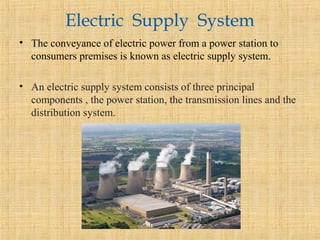
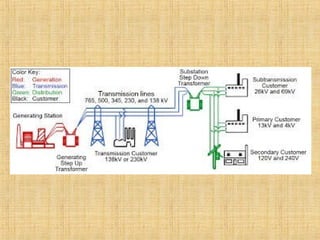
Electric Supply System
• The conveyance of electric power from a power station to
consumers premises is known as electric supply system.
• An electric supply system consists of three principal
components , the power station, the transmission lines and the
distribution system.
• Electric power is produced at the power stations which are located at
favourable places, generally quite away from the consumers. It is
then transmitted over large distances to load centres with the help of
conductors known as transmission lines.
• Finally, it is distributed to a large number of small and big
consumers through a distribution network.
• The electric supply system can be
broadly classified into (i) d.c. or a.c.
system (ii) overhead or underground
system. Nowadays, 3-phase, 3-wire
a.c. system is universally adopted
for generation and transmission of
electric power as an economical
proposition.
• However, distribution of electric
power is done by 3-phase, 4-wire
a.c. system. The underground
system is more expensive than the
overhead system. Therefore, in our
country, overhead system is mostly
adopted for transmission and
distribution of electric power.
Comparison of D.C. and A.C. Transmission
• D.C. transmission : For some years past, the transmission of
electric power by d.c. has been receiving the active consideration of
engineers due to its numerous advantages.
• Advantages : (i) It requires only two conductors as compared to
three for a.c. transmission
• (ii) There is no inductance, capacitance, phase displacement and
surge problems in d.c. transmission.
• (iii) Due to the absence of inductance, the voltage drop in a
d.c. transmission line is less than the a.c. line for the same load
and sending end voltage. For this reason, a d.c. transmission
line has better voltage regulation.
• (iv) There is no skin effect in a d.c. system. Therefore, entire
cross-section of the line conductor is utilised.
• (vii) In d.c. transmission, there are no stability problems and
synchronising difficulties
• Disadvantages : (i) Electric power cannot be generated at
high d.c. voltage due to commutation problems.
• (ii) The d.c. voltage cannot be stepped up for transmission of
power at high voltages
• (iii) The d.c. switches and circuit breakers have their own
limitations.
• A.C. transmission. Now-a-days, electrical energy is almost exclusively
generated, transmitted and distributed in the form of a.c.
• Advantages : (i) The power can be generated at high voltages.
• (ii) The maintenance of a.c. sub-stations is easy and cheaper.
• (iii) The a.c. voltage can be stepped up or stepped down by transformers
with ease and efficiency. This permits to transmit power at high voltages
and distribute it at safe potentials.
• Disadvantages : (i) An a.c. line requires more copper than a d.c.
line
• (ii) The construction of a.c. transmission line is more complicated
than a d.c. transmission line.
(iii) Due to skin effect in the a.c. system, the effective resistance of
the line is increased.
• (iv) An a.c. line has capacitance. Therefore, there is a continuous
loss of power due to charging current even when the line is
open.
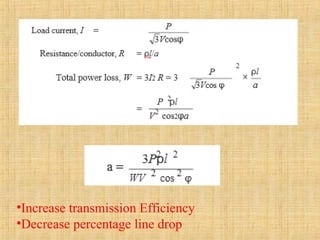
Advantages of High Transmission Voltage
• Reduces volume of conductor material.
• Consider the transmission of electric power by a three-phase line.
• P = power transmitted in watts
• V = line voltage in volts
• cos φ = power factor of the load
• l = length of the line in metres
• R = resistance per conductor in ohms
• ρ = resistivity of conductor material
• a = area of X-section of conductor
•Increase transmission Efficiency
•Decrease percentage line drop
Limitations of high transmission voltage.
• From the above discussion, it might appear advis-
able to use the highest possible voltage for transmission of power
in a bid to save conductor material.
• However, it must be realised that high transmission voltage
results in
• (i) the increased cost of insulating the conductors
• (ii) the increased cost of transformers, switchgear and other
terminal apparatus.
Elements of a transmission line
• Conductors-made up of Aluminium reinforced
with steel
• Step up & Step down transformer
• Line insulators-mechanically support the line
conductors and isolate them from ground
• Support-steel towers,support the conductors
• Protective device-such as ground wire lightning
arrester relay etc.
• Voltage regulation device-maintain the voltage at
receiving end within permissible limit
1.It is one whose secondary
voltage is less than its
primary voltage.
2. It is designed to reduce the
voltage.
A high tension cable is used for
electric power transmission at high
voltage.
INSIDE
EXTERIOR
 It is an effective electrical enclosure to provide electrical
services for low voltage electrical distribution applications.
References
• www.wikipedia.org
• https://iitg.vlab.co.in/
• https://coep.vlab.co.in/
• https://www.youtube.com/watch?v=dtzn63hlBrU
• V.K. Mehta
Supply system (Electrical Power System)

Supply system (Electrical Power System)

  • 1.
    Gandhinagar Institute Of Technology Subject– Electrical Power System – 1 (2150908) Branch – Electrical Topic – Supply System
  • 2.
    Name Enrollment No. AbhishekChokshi 140120109005 Himal Desai 140120109008 Raj Shah 140120109054 Adnan Vohra 140120109063 Guided By – Prof. Yogesh Patel
  • 3.
    Introduction • In earlydays, there was a little demand for electrical energy so that small power stations were built to supply lighting and heating loads. However, the widespread use of electrical energy by modern civilisation has necessitated to produce bulk electrical energy economically and efficiently. • The increased demand of electrical energy can be met by building big power stations at favourable places where fuel (coal or gas) or water energy is available in abundance.
  • 4.
    • This hasshifted the site of power stations to places quite away from the consumers. The electrical energy produced at the power stations has to be supplied to the consumers. There is a large network of conductors between the power station and the consumers.
  • 5.
    sources • Hydroelectric generationwhich uses falling water to turn the turbines. • Steam generation, which uses fossil fuels or nuclear fusion to make the steam that turns the turbines.
  • 6.
    Electric Supply System •The conveyance of electric power from a power station to consumers premises is known as electric supply system. • An electric supply system consists of three principal components , the power station, the transmission lines and the distribution system.
  • 7.
    • Electric poweris produced at the power stations which are located at favourable places, generally quite away from the consumers. It is then transmitted over large distances to load centres with the help of conductors known as transmission lines. • Finally, it is distributed to a large number of small and big consumers through a distribution network.
  • 8.
    • The electricsupply system can be broadly classified into (i) d.c. or a.c. system (ii) overhead or underground system. Nowadays, 3-phase, 3-wire a.c. system is universally adopted for generation and transmission of electric power as an economical proposition. • However, distribution of electric power is done by 3-phase, 4-wire a.c. system. The underground system is more expensive than the overhead system. Therefore, in our country, overhead system is mostly adopted for transmission and distribution of electric power.
  • 9.
    Comparison of D.C.and A.C. Transmission • D.C. transmission : For some years past, the transmission of electric power by d.c. has been receiving the active consideration of engineers due to its numerous advantages. • Advantages : (i) It requires only two conductors as compared to three for a.c. transmission • (ii) There is no inductance, capacitance, phase displacement and surge problems in d.c. transmission.
  • 10.
    • (iii) Dueto the absence of inductance, the voltage drop in a d.c. transmission line is less than the a.c. line for the same load and sending end voltage. For this reason, a d.c. transmission line has better voltage regulation. • (iv) There is no skin effect in a d.c. system. Therefore, entire cross-section of the line conductor is utilised. • (vii) In d.c. transmission, there are no stability problems and synchronising difficulties • Disadvantages : (i) Electric power cannot be generated at high d.c. voltage due to commutation problems. • (ii) The d.c. voltage cannot be stepped up for transmission of power at high voltages • (iii) The d.c. switches and circuit breakers have their own limitations.
  • 11.
    • A.C. transmission.Now-a-days, electrical energy is almost exclusively generated, transmitted and distributed in the form of a.c. • Advantages : (i) The power can be generated at high voltages. • (ii) The maintenance of a.c. sub-stations is easy and cheaper. • (iii) The a.c. voltage can be stepped up or stepped down by transformers with ease and efficiency. This permits to transmit power at high voltages and distribute it at safe potentials.
  • 12.
    • Disadvantages :(i) An a.c. line requires more copper than a d.c. line • (ii) The construction of a.c. transmission line is more complicated than a d.c. transmission line. (iii) Due to skin effect in the a.c. system, the effective resistance of the line is increased. • (iv) An a.c. line has capacitance. Therefore, there is a continuous loss of power due to charging current even when the line is open.
  • 13.
    Advantages of HighTransmission Voltage • Reduces volume of conductor material. • Consider the transmission of electric power by a three-phase line. • P = power transmitted in watts • V = line voltage in volts • cos φ = power factor of the load • l = length of the line in metres • R = resistance per conductor in ohms • ρ = resistivity of conductor material • a = area of X-section of conductor
  • 14.
  • 15.
    Limitations of hightransmission voltage. • From the above discussion, it might appear advis- able to use the highest possible voltage for transmission of power in a bid to save conductor material. • However, it must be realised that high transmission voltage results in • (i) the increased cost of insulating the conductors • (ii) the increased cost of transformers, switchgear and other terminal apparatus.
  • 17.
    Elements of atransmission line • Conductors-made up of Aluminium reinforced with steel • Step up & Step down transformer • Line insulators-mechanically support the line conductors and isolate them from ground • Support-steel towers,support the conductors • Protective device-such as ground wire lightning arrester relay etc. • Voltage regulation device-maintain the voltage at receiving end within permissible limit
  • 18.
    1.It is onewhose secondary voltage is less than its primary voltage. 2. It is designed to reduce the voltage.
  • 19.
    A high tensioncable is used for electric power transmission at high voltage.
  • 20.
    INSIDE EXTERIOR  It isan effective electrical enclosure to provide electrical services for low voltage electrical distribution applications.
  • 22.
    References • www.wikipedia.org • https://iitg.vlab.co.in/ •https://coep.vlab.co.in/ • https://www.youtube.com/watch?v=dtzn63hlBrU • V.K. Mehta