FET (Field Effect Transistor)
Presented by-
Sameeksha Verma
Introduction
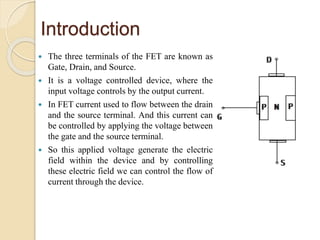
 The three terminals of the FET are known as
Gate, Drain, and Source.
 It is a voltage controlled device, where the
input voltage controls by the output current.
 In FET current used to flow between the drain
and the source terminal. And this current can
be controlled by applying the voltage between
the gate and the source terminal.
 So this applied voltage generate the electric
field within the device and by controlling
these electric field we can control the flow of
current through the device.
BJT Vs. FET
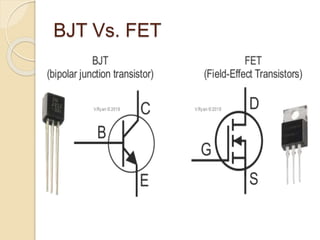
 The bipolar junction transistor has two main
disadvantage.
◦ It has a low input impedance
◦ It has considerable noise level
 To overcome this problem Field effect transistor
(FET) is introduced because of its:
◦ High input impedance
◦ Low noise level than ordinary transistor
 Junction Field Effect Transistor (JFET) is a type of
FET.
◦ Basically, FETs are available in small sizes and they use low space on a
chip.
Types of FET:
There are two types of FET:
◦ JFET (Junction Field Effect Transistor)
 n-channel JFET
 p-channel JFET
◦ IG-FET (Insulated Gate Field Effect Transistor)
 MOSFET (Metal Oxide Semiconductor Field Effect Transistor) is
the type of IG-FET,
 where a layer of SiO2 is used as an insulating layer to insulate the gate
from the channel.
 The MOSFET can be further classified into
 Depletion-type MOSFET (n-channel and p-channel)
 Enhancement-Type MOSFET (n-channel and p-channel)
Junction Field Effect Transistor
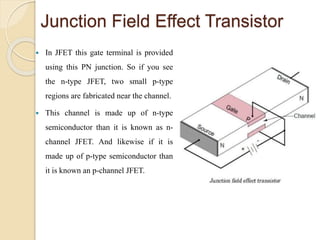
 In JFET this gate terminal is provided
using this PN junction. So if you see
the n-type JFET, two small p-type
regions are fabricated near the channel.
 This channel is made up of n-type
semiconductor than it is known as n-
channel JFET. And likewise if it is
made up of p-type semiconductor than
it is known an p-channel JFET.
Features of JFET
 JFET is a voltage controlled device i.e. input voltage
(VGS) control the output current (ID).
 In JFETs, the width of a junction is used to control the
effective cross-sectional area of the channel through
which current conducts.
 It is always operated with Gate-Source p-n junction in
reverse bias.
 Because of reverse bias it has high input impedance.
 In JFET the gate current is zero i.e. IG=0.
Theory of Operation
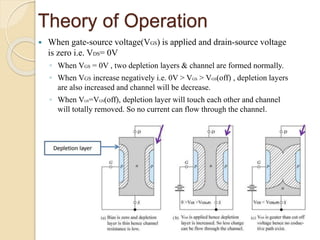
 When gate-source voltage(VGS) is applied and drain-source voltage
is zero i.e. VDS= 0V
◦ When VGS = 0V , two depletion layers & channel are formed normally.
◦ When VGS increase negatively i.e. 0V > VGS > VGS(off) , depletion layers
are also increased and channel will be decrease.
◦ When VGS=VGS(off), depletion layer will touch each other and channel
will totally removed. So no current can flow through the channel.
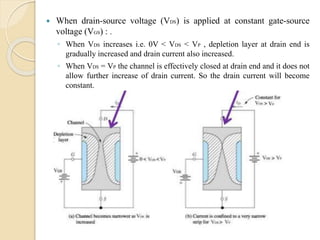
 When drain-source voltage (VDS) is applied at constant gate-source
voltage (VGS) : .
◦ When VDS increases i.e. 0V < VDS < VP , depletion layer at drain end is
gradually increased and drain current also increased.
◦ When VDS = VP the channel is effectively closed at drain end and it does not
allow further increase of drain current. So the drain current will become
constant.
I-V Characteristics
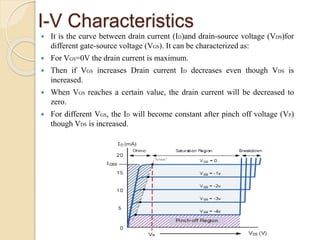
 It is the curve between drain current (ID)and drain-source voltage (VDS)for
different gate-source voltage (VGS). It can be characterized as:
 For VGS=0V the drain current is maximum.
 Then if VGS increases Drain current ID decreases even though VDS is
increased.
 When VGS reaches a certain value, the drain current will be decreased to
zero.
 For different VGS, the ID will become constant after pinch off voltage (VP)
though VDS is increased.
Transfer Characteristics
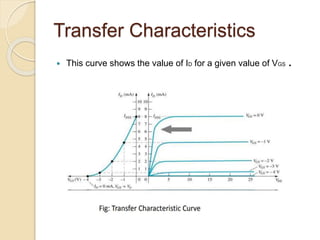
 This curve shows the value of ID for a given value of VGS .
IG-FET (Insulated Gate-Field Effect
Transistor)
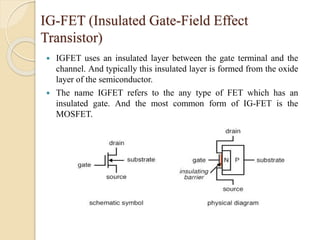
 IGFET uses an insulated layer between the gate terminal and the
channel. And typically this insulated layer is formed from the oxide
layer of the semiconductor.
 The name IGFET refers to the any type of FET which has an
insulated gate. And the most common form of IG-FET is the
MOSFET.
MOSFET
(Metal Oxide
Semiconductor
Field Effect
Transistor)
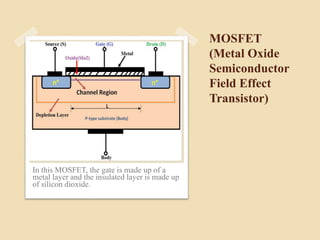
In this MOSFET, the gate is made up of a
metal layer and the insulated layer is made up
of silicon dioxide.
Classification of MOSFET
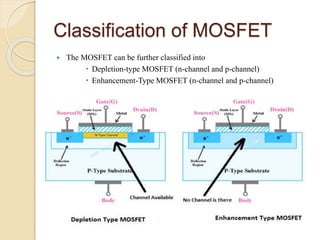
 The MOSFET can be further classified into
 Depletion-type MOSFET (n-channel and p-channel)
 Enhancement-Type MOSFET (n-channel and p-channel)
 When we apply the voltage at the gate terminal than due to the
electric field it can either deplete or enhance a number of charge
carriers in this given channel.
 So by the application of voltage if the number of charge carrier gets
depleted in this channel than it is known as the depletion type
MOSFET.
 If the number of charge carrier increases than it is known as the
enhancement type MOSFET.
Advantage of FETs
 It is simpler to fabricate, smaller in size.
 It has longer life and higher efficiency.
 It has high input impedance.
 It has negative temperature coefficient of resistance .
 It has high power gain.
Disadvantage of FETs
 JFET has low voltage gain.
 They are more costly than junction transistor.
 It has lower switching time compare to BJT.
 Special handling is required during installation.
Applications of FETs
 Amplifier
 Oscillator
 Analog Switch
 Integrated Circuits
 Buffer Amplifiers
Field Effect Transistor ppt

Field Effect Transistor ppt

  • 1.
    FET (Field EffectTransistor) Presented by- Sameeksha Verma
  • 2.
    Introduction  The threeterminals of the FET are known as Gate, Drain, and Source.  It is a voltage controlled device, where the input voltage controls by the output current.  In FET current used to flow between the drain and the source terminal. And this current can be controlled by applying the voltage between the gate and the source terminal.  So this applied voltage generate the electric field within the device and by controlling these electric field we can control the flow of current through the device.
  • 3.
  • 4.
     The bipolarjunction transistor has two main disadvantage. ◦ It has a low input impedance ◦ It has considerable noise level  To overcome this problem Field effect transistor (FET) is introduced because of its: ◦ High input impedance ◦ Low noise level than ordinary transistor  Junction Field Effect Transistor (JFET) is a type of FET. ◦ Basically, FETs are available in small sizes and they use low space on a chip.
  • 5.
    Types of FET: Thereare two types of FET: ◦ JFET (Junction Field Effect Transistor)  n-channel JFET  p-channel JFET ◦ IG-FET (Insulated Gate Field Effect Transistor)  MOSFET (Metal Oxide Semiconductor Field Effect Transistor) is the type of IG-FET,  where a layer of SiO2 is used as an insulating layer to insulate the gate from the channel.  The MOSFET can be further classified into  Depletion-type MOSFET (n-channel and p-channel)  Enhancement-Type MOSFET (n-channel and p-channel)
  • 6.
    Junction Field EffectTransistor  In JFET this gate terminal is provided using this PN junction. So if you see the n-type JFET, two small p-type regions are fabricated near the channel.  This channel is made up of n-type semiconductor than it is known as n- channel JFET. And likewise if it is made up of p-type semiconductor than it is known an p-channel JFET.
  • 7.
    Features of JFET JFET is a voltage controlled device i.e. input voltage (VGS) control the output current (ID).  In JFETs, the width of a junction is used to control the effective cross-sectional area of the channel through which current conducts.  It is always operated with Gate-Source p-n junction in reverse bias.  Because of reverse bias it has high input impedance.  In JFET the gate current is zero i.e. IG=0.
  • 8.
    Theory of Operation When gate-source voltage(VGS) is applied and drain-source voltage is zero i.e. VDS= 0V ◦ When VGS = 0V , two depletion layers & channel are formed normally. ◦ When VGS increase negatively i.e. 0V > VGS > VGS(off) , depletion layers are also increased and channel will be decrease. ◦ When VGS=VGS(off), depletion layer will touch each other and channel will totally removed. So no current can flow through the channel.
  • 9.
     When drain-sourcevoltage (VDS) is applied at constant gate-source voltage (VGS) : . ◦ When VDS increases i.e. 0V < VDS < VP , depletion layer at drain end is gradually increased and drain current also increased. ◦ When VDS = VP the channel is effectively closed at drain end and it does not allow further increase of drain current. So the drain current will become constant.
  • 10.
    I-V Characteristics  Itis the curve between drain current (ID)and drain-source voltage (VDS)for different gate-source voltage (VGS). It can be characterized as:  For VGS=0V the drain current is maximum.  Then if VGS increases Drain current ID decreases even though VDS is increased.  When VGS reaches a certain value, the drain current will be decreased to zero.  For different VGS, the ID will become constant after pinch off voltage (VP) though VDS is increased.
  • 11.
    Transfer Characteristics  Thiscurve shows the value of ID for a given value of VGS .
  • 12.
    IG-FET (Insulated Gate-FieldEffect Transistor)  IGFET uses an insulated layer between the gate terminal and the channel. And typically this insulated layer is formed from the oxide layer of the semiconductor.  The name IGFET refers to the any type of FET which has an insulated gate. And the most common form of IG-FET is the MOSFET.
  • 13.
    MOSFET (Metal Oxide Semiconductor Field Effect Transistor) Inthis MOSFET, the gate is made up of a metal layer and the insulated layer is made up of silicon dioxide.
  • 14.
    Classification of MOSFET The MOSFET can be further classified into  Depletion-type MOSFET (n-channel and p-channel)  Enhancement-Type MOSFET (n-channel and p-channel)
  • 15.
     When weapply the voltage at the gate terminal than due to the electric field it can either deplete or enhance a number of charge carriers in this given channel.  So by the application of voltage if the number of charge carrier gets depleted in this channel than it is known as the depletion type MOSFET.  If the number of charge carrier increases than it is known as the enhancement type MOSFET.
  • 16.
    Advantage of FETs It is simpler to fabricate, smaller in size.  It has longer life and higher efficiency.  It has high input impedance.  It has negative temperature coefficient of resistance .  It has high power gain.
  • 17.
    Disadvantage of FETs JFET has low voltage gain.  They are more costly than junction transistor.  It has lower switching time compare to BJT.  Special handling is required during installation.
  • 18.
    Applications of FETs Amplifier  Oscillator  Analog Switch  Integrated Circuits  Buffer Amplifiers