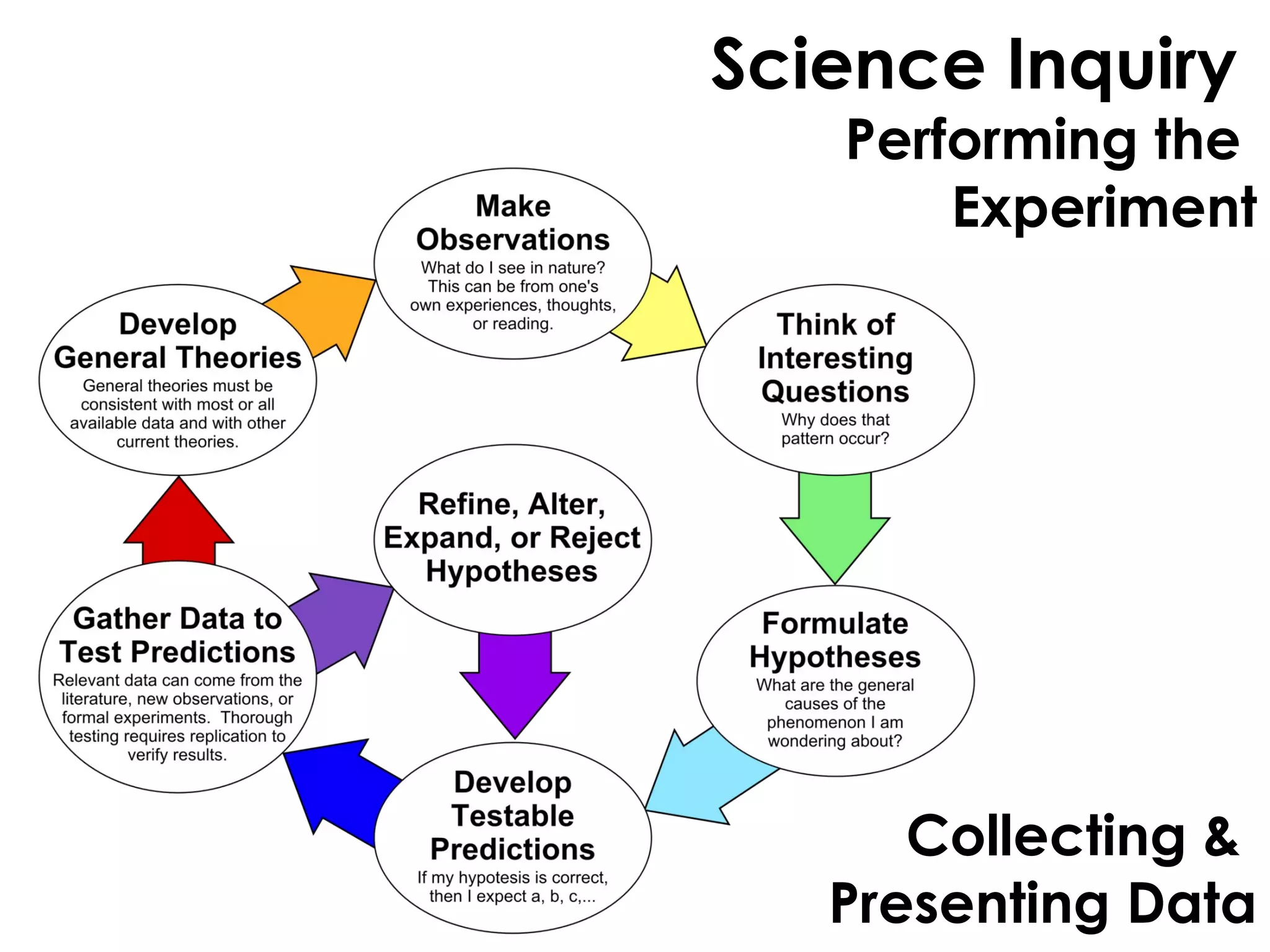
Science Inquiry
Performing the
Experiment
Collecting &
Presenting Data
In your lab notebook, please answer as best you can:
1. What are the four MAIN steps of the Scientific Method?
• Observation, Hypothesis, Experiment, Conclusion
2. What happens during the FIRST step of the Scientific Method?
• Observe the world around you, recognize a problem/curiosity, ask a testable
question, and gather background information
3. What is an “If…, then…, because…” statement that gives an educated
guess to the scientific question being investigated?
• Hypothesis
4. What are the things in an experiment that will change called?
• Variables
4. Name what IV and DV stand for and explain what they are.
• IV = Independent Variable, the thing you choose to test/change (cause)
• DV = Dependent Variable, the measured response to the IV (effect)
Bonus Q: What are the things in an experiment that do NOT change called & why are they important?
Review
Quiz 13
Bias in Scientific Research
• Hypothesizing requires speculation
– bias is an assumed belief that affect the way you see and
understand things
– bias is always present when formulating a hypothesis
• The Scientific Method forces only the
facts to be considered
– seeks to eliminate variables that can skew
results
– encourages collaboration & accountability
• shared results, repeated studies
– still, bias is ALWAYS present & affects
many research outcomes
The Scientific Method - Experiment
• What will you need to perform your experiment?
– List of materials
• Fine-tune your list, plan ahead
• Remember safety equipment
• HOW will you perform the experiment?
– Step-by-step procedure
• Specific and detailed!
• Include method of data collection
– DEMO: Build a Model
Lab Safety
• Read, listen, and follow directions carefully.
• NO gum, food or drinks during lab time.
• Proper attire (shoes, hair, protective items).
– Goggles, labs coats & gloves will be provided.
• Eyewash sink (for skin, too).
• Fumes.
• Clean-up (proper disposal). *NOT down the drain*
The Scientific Method –
Performing the Experiment
• Write down your:
–Modified List of Materials
• Add to or remove items from your previous list
• Plan on enough materials for MULTIPLE TRIALS
• Include safety gear/supplies
–Detailed List of Procedures
• Step-by-step
• Numbered list
• Objective (measurable) data collection
• Planned ahead with written instructions, but edit in
detail as the experiment is performed
State the
Problem (as a ?)
Do Background
Research
"Best Guess"
Solution
Design (Materials
& Procedures)
Perform (Collect
& Analyze Data)
Report Results
Hypothesis is
False or Partly True
Hypothesis is
True
Revise!
Try Again
Conclusion
Experiment
Hypothesis
Observation
Experiment Procedures
• To perform an experiment, you need written
procedures. Why?
– to record EXACTLY what you did
• Detailed, step-by-step instructions
• Specific list of materials (name brand of soap used, etc.)
– so it can be repeated (by you or others)
Experiment Data Collection
• As you perform the experiment, observations and
data must be recorded.
– measurements listed in a chart
– written observations
– drawings
– photos
Magnet Type
(Independent Variable)
Distance to Paper Clip (cm)
(Dependent Variable)
N Pole
Trial 1 Trial 2
S Pole
Trial 1 Trial 2
Midway
between N & S
Ceramic bar
Neodymium disc
Oval hematite
The Scientific Method - Conclusion
• Next, an analysis of the data is required:
– numbers, observations, and measurements are broken
down, organized, and studied to gain better understanding
– patterns often emerge, showing cause-and-effect
relationships
• After analyzing your data, you form a CONCLUSION
– The measurements, when compared, showed an average 1.6 mm
difference in length and .8 mm difference in width.
– The cast was almost identical in shape, but did not fit into the mold of
the hypothesized animal because it was 7 mm smaller in width and 4
mm shorter length-wise.
– This supports the hypothesis that the animal tracks were made by...
The Scientific Method
• If hypothesis is rejected
– modify and repeat
• If hypothesis is supported
– repeat to verify results
– share findings and let others perform the experiment
• Either way, something was learned!
– NEVER make up results simply because you
think it was “supposed” to go differently
State the
Problem (as a ?)
Do Background
Research
"Best Guess"
Solution
Design (Materials
& Procedures)
Perform (Collect
& Analyze Data)
Report Results
Hypothesis is
False or Partly True
Hypothesis is
True
Revise!
Try Again
Conclusion
Experiment
Hypothesis
Observation
F = Gm1m2
r2
Fact - Theory - Law
• Fact:
– an objective, verifiable observation of
something that occurs in our natural world
– i.e. gravity, natural selection, heat exchange
• Theory:
– an explanation of how natural occurrences work
• it can be repeated, and tested with predictable results
• a hypothesis that is proven correct often explains part of theory
– i.e. Theory of Gravity, Theory of Evolution, Kinetic Theory of Matter
• Law:
– a mathematical description of observable phenomenon
– i.e. Newton's First Law of Universal Gravitation

Science Inquiry 2

  • 1.
  • 2.
    In your labnotebook, please answer as best you can: 1. What are the four MAIN steps of the Scientific Method? • Observation, Hypothesis, Experiment, Conclusion 2. What happens during the FIRST step of the Scientific Method? • Observe the world around you, recognize a problem/curiosity, ask a testable question, and gather background information 3. What is an “If…, then…, because…” statement that gives an educated guess to the scientific question being investigated? • Hypothesis 4. What are the things in an experiment that will change called? • Variables 4. Name what IV and DV stand for and explain what they are. • IV = Independent Variable, the thing you choose to test/change (cause) • DV = Dependent Variable, the measured response to the IV (effect) Bonus Q: What are the things in an experiment that do NOT change called & why are they important? Review Quiz 13
  • 3.
    Bias in ScientificResearch • Hypothesizing requires speculation – bias is an assumed belief that affect the way you see and understand things – bias is always present when formulating a hypothesis • The Scientific Method forces only the facts to be considered – seeks to eliminate variables that can skew results – encourages collaboration & accountability • shared results, repeated studies – still, bias is ALWAYS present & affects many research outcomes
  • 4.
    The Scientific Method- Experiment • What will you need to perform your experiment? – List of materials • Fine-tune your list, plan ahead • Remember safety equipment • HOW will you perform the experiment? – Step-by-step procedure • Specific and detailed! • Include method of data collection – DEMO: Build a Model
  • 5.
    Lab Safety • Read,listen, and follow directions carefully. • NO gum, food or drinks during lab time. • Proper attire (shoes, hair, protective items). – Goggles, labs coats & gloves will be provided. • Eyewash sink (for skin, too). • Fumes. • Clean-up (proper disposal). *NOT down the drain*
  • 6.
    The Scientific Method– Performing the Experiment • Write down your: –Modified List of Materials • Add to or remove items from your previous list • Plan on enough materials for MULTIPLE TRIALS • Include safety gear/supplies –Detailed List of Procedures • Step-by-step • Numbered list • Objective (measurable) data collection • Planned ahead with written instructions, but edit in detail as the experiment is performed
  • 7.
    State the Problem (asa ?) Do Background Research "Best Guess" Solution Design (Materials & Procedures) Perform (Collect & Analyze Data) Report Results Hypothesis is False or Partly True Hypothesis is True Revise! Try Again Conclusion Experiment Hypothesis Observation
  • 8.
    Experiment Procedures • Toperform an experiment, you need written procedures. Why? – to record EXACTLY what you did • Detailed, step-by-step instructions • Specific list of materials (name brand of soap used, etc.) – so it can be repeated (by you or others)
  • 9.
    Experiment Data Collection •As you perform the experiment, observations and data must be recorded. – measurements listed in a chart – written observations – drawings – photos Magnet Type (Independent Variable) Distance to Paper Clip (cm) (Dependent Variable) N Pole Trial 1 Trial 2 S Pole Trial 1 Trial 2 Midway between N & S Ceramic bar Neodymium disc Oval hematite
  • 10.
    The Scientific Method- Conclusion • Next, an analysis of the data is required: – numbers, observations, and measurements are broken down, organized, and studied to gain better understanding – patterns often emerge, showing cause-and-effect relationships • After analyzing your data, you form a CONCLUSION – The measurements, when compared, showed an average 1.6 mm difference in length and .8 mm difference in width. – The cast was almost identical in shape, but did not fit into the mold of the hypothesized animal because it was 7 mm smaller in width and 4 mm shorter length-wise. – This supports the hypothesis that the animal tracks were made by...
  • 11.
    The Scientific Method •If hypothesis is rejected – modify and repeat • If hypothesis is supported – repeat to verify results – share findings and let others perform the experiment • Either way, something was learned! – NEVER make up results simply because you think it was “supposed” to go differently
  • 12.
    State the Problem (asa ?) Do Background Research "Best Guess" Solution Design (Materials & Procedures) Perform (Collect & Analyze Data) Report Results Hypothesis is False or Partly True Hypothesis is True Revise! Try Again Conclusion Experiment Hypothesis Observation
  • 13.
    F = Gm1m2 r2 Fact- Theory - Law • Fact: – an objective, verifiable observation of something that occurs in our natural world – i.e. gravity, natural selection, heat exchange • Theory: – an explanation of how natural occurrences work • it can be repeated, and tested with predictable results • a hypothesis that is proven correct often explains part of theory – i.e. Theory of Gravity, Theory of Evolution, Kinetic Theory of Matter • Law: – a mathematical description of observable phenomenon – i.e. Newton's First Law of Universal Gravitation

Editor's Notes

  • #3 Bonus ?: Controls or controlled variables are important because they isolate/eliminate factors that could influence the DV, thus masking the actual effect of the IV
  • #5 For demo, leave the room and have ONE student build a model using: Gum drops, toothpicks, and a Styrofoam cup Legos, K’nex, Lincoln Logs, etc. PBJ sandwich, veggie sculpture, or other food Hairstyle? Other students write a numbered list of instructions explaining what was done. Hide student’s model. Teacher comes back and follows written (read by students) instructions.
  • #12 ...or unrecognized variable (maybe two different animals made tracks on top of each other - they'd be hard to distinguish)? ...or no control (you couldn't tell what's causing a change)
  • #14 NOT theory becomes law becomes fact! Gravitational Force (pull) = gravitational constant (6.67 x 10 -11) x mass of object 1 x mass of object 2 divided by the square of the distance between their centers (r).