Faizan Shafi and Rahul Pandya
Department of Electrical, Electronics and Communication Engineering,
Indian Institute of Technology (IIT), Dharwad
1
Quantitative, Qualitative, and Mixed Methods for
Research
Outline
RJEs: Remote job entry points
▪ Introduction to Research Methodologies
▪ Overview of Types of Research Methodologies
▪ Choosing the Right Research Methodology
▪ Research Paradigms
▪ Aim of Research
▪ When to use Which Methodology
▪ Challenges and Criticisms
▪ Conclusion 2
All electronic information sources are highly acknowledged. https://gencraft.com/generate
3
Introduction to Research
Methodologies/Methods
Overview of Research Methodologies
Creswell, J. W. (2014). Research Design: Qualitative, Quantitative, and Mixed Methods Approaches (4th ed.)/ https://gencraft.com/generate
4
▪ What are Research Methodologies/Methods?
• Research methods refer to the techniques and
strategies used to systematically collect and
analyze information (data) in order to answer a
specific research question.
• The appropriate selection of research methods
depends on the nature of the research problem,
the questions being addressed, and the
theoretical framework of the study.
Overview of Research Methodologies
Creswell, J. W. (2014). Research Design: Qualitative, Quantitative, and Mixed Methods Approaches (4th ed.)/ https://gencraft.com/generate
5
▪ Importance of Research Methods:
• Research methods provide a structured
approach to collecting, analyzing, and
interpreting data, ensuring consistency and
reliability in findings.
• Proper selection of methods ensures the
integrity and validity of research. It also aligns
research objectives with suitable data collection
and analysis techniques.
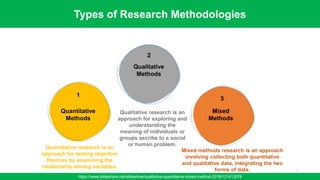
Quantitative
Methods
Qualitative
Methods
Mixed
Methods
Types of Research Methodologies
https://www.slideshare.net/slideshow/qualitative-quantitative-mixed-method-2018/121413078
1
2
3
Quantitative research is an
approach for testing objective
theories by examining the
relationship among variables.
Qualitative research is an
approach for exploring and
understanding the
meaning of individuals or
groups ascribe to a social
or human problem.
Mixed methods research is an approach
involving collecting both quantitative
and qualitative data, integrating the two
forms of data. 6
Types of Research Methodologies
Creswell, J. W. (2014). Research Design: Qualitative, Quantitative, and Mixed Methods Approaches (4th ed.)/ https://researcher.life/blog/article/choose-research-methodology
7
1. Quantitative Methods:
• Relies on numerical and statistical data to
quantify the problem.
• The primary aim is to identify general
patterns and predict future outcomes.
• This approach is rooted in the positivist
paradigm, where reality is assumed to be
stable, measurable, and observable.
Types of Research Methodologies
Creswell, J. W. (2014). Research Design: Qualitative, Quantitative, and Mixed Methods Approaches (4th ed.)./ https://researcher.life/blog/article/choose-research-methodology
8
• Quantitative research aims to produce
reliable, replicable, and valid results by
focusing on structured techniques and large
sample sizes.
• Quantitative research employs structured tools
like surveys, experiments, and numerical data
to test theories.
• The goal is often to establish relationships or
causality between variables.
Types of Research Methodologies
Merriam, S. B., & Tisdell, E. J. (2015). Qualitative Research: A Guide to Design and Implementation/ https://researcher.life/blog/article/choose-research-methodology
9
2. Qualitative Methods:
• Involves non-numerical data to explore
concepts, experiences, or social
phenomena in depth.
• It seeks to understand how individuals
interpret or make sense of their world.
• In contrast, qualitative research is aligned
with the constructivist or interpretivist
paradigms.
Types of Research Methodologies
Merriam, S. B., & Tisdell, E. J. (2015). Qualitative Research: A Guide to Design and Implementation/ https://researcher.life/blog/article/choose-research-methodology
10
• The goal is to capture the subjective
experiences of participants, offering rich,
detailed narratives.
• This method is often used when the
researcher seeks to understand social
processes, behaviors, or cultural
phenomena.
Types of Research Methodologies
Creswell, J. W., & Plano Clark, V. L. (2017). Designing and Conducting Mixed Methods Research/ https://researcher.life/blog/article/choose-research-methodology
11
3. Mixed Methods:
• Integrates both quantitative and qualitative
approaches, leveraging the strengths of both
to provide a richer, more nuanced
understanding.
• The mixed-method approach is pragmatic,
integrating quantitative and qualitative
techniques to capitalize on the strengths of
each.
Types of Research Methodologies
Creswell, J. W., & Plano Clark, V. L. (2017). Designing and Conducting Mixed Methods Research/ https://researcher.life/blog/article/choose-research-methodology
12
• By combining these methods, mixed
methods research can validate findings,
explore diverse perspectives, and uncover
deeper insights that might be missed when
using a single methodology.
• It is particularly useful in studies requiring
both broad statistical analysis and detailed,
context-rich exploration, making it a versatile
tool for addressing multifaceted issues in
various fields.
Examples for Context
Creswell, J. W. (2014). Research Design: Qualitative, Quantitative, and Mixed Methods Approaches (4th ed.). Sage
13
1. Quantitative Study in Civil Engineering:
• A quantitative study in civil engineering could
explore the relationship between the frequency of
preventive maintenance and the structural
lifespan of bridges across a region using
regression analysis.
• For instance, data from 50 bridges could be
analyzed to quantify how maintenance intervals
influence material degradation rates, providing
actionable insights for infrastructure management.
Examples for Context
Creswell, J. W. (2014). Research Design: Qualitative, Quantitative, and Mixed Methods Approaches (4th ed.). Sage
14
2. Qualitative Study in Software Engineering:
• A qualitative study in software engineering might
investigate developers' perceptions of a newly
implemented agile methodology through in-depth
interviews and thematic analysis.
• For example, interviews with 15 software
engineers could reveal themes like adaptability,
collaboration challenges, and productivity
changes, helping refine agile practices for specific
project types.
Examples for Context
Creswell, J. W. (2014). Research Design: Qualitative, Quantitative, and Mixed Methods Approaches (4th ed.). Sage
15
3. Mixed-Method Study in Renewable Energy
Engineering:
• A mixed-method study in renewable energy
engineering might begin with quantitative surveys to
assess the efficiency of solar panel installations in urban
areas, followed by qualitative interviews with engineers
to explore challenges in panel design and placement.
• For example, survey data from 200 installations could
highlight performance trends, while interviews could
uncover design constraints such as shading or local
regulations that influence these trends.
Choosing the Right Research Methodology
Bryman, A. (2016). Social Research Methods/https://researcher.life/blog/article/what-is-quantitative-research-types-and-examples
16
▪ Why Choosing the Right Method Matters:
• The choice of research method determines how
effectively you can answer your research questions.
• For example, if you're exploring the lived experiences
of engineers working in high-stress environments,
such as those managing critical infrastructure during
natural disasters, qualitative methods will offer
insights into their subjective experiences, coping
mechanisms, and decision-making processes that
quantitative methods cannot capture.
Choosing the Right Research Methodology
Bryman, A. (2016). Social Research Methods/https://researcher.life/blog/article/what-is-quantitative-research-types-and-examples
17
• Selecting the appropriate research
methodology is crucial for ensuring that the
research question is addressed effectively and
rigorously.
• The choice should be based on several critical
factors, including the nature of the research
problem, the goals of the research, the type of
data required, and the philosophical orientation
of the researcher.
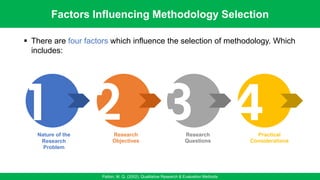
1 2 3 4
Nature of the
Research
Problem
Research
Objectives
Research
Questions
Practical
Considerations
Factors Influencing Methodology Selection
Patton, M. Q. (2002). Qualitative Research & Evaluation Methods
▪ There are four factors which influence the selection of methodology. Which
includes:
Factors Influencing Methodology Selection
Patton, M. Q. (2002). Qualitative Research & Evaluation Methods/ https://gencraft.com/generate
19
1. Nature of the Research Problem:
• Quantitative methods are often suitable for
research that seeks to test a theory or establish
cause-and-effect relationships.
• Qualitative methods are better for exploratory
research where the objective is to gain a deep
understanding of a phenomenon.
2. Research Objectives:
• Is the goal to measure and quantify variables or
to explore concepts and perspectives?
Factors Influencing Methodology Selection
Patton, M. Q. (2002). Qualitative Research & Evaluation Methods/ https://gencraft.com/generate
20
3. Research Questions:
• Quantitative research often involves questions
that begin with "how much," "what is the
correlation," or "to what extent."
• Qualitative research questions are open-ended
and exploratory, such as "how" and "why"
questions that seek to understand complex
human behaviors.
Factors Influencing Methodology Selection
Patton, M. Q. (2002). Qualitative Research & Evaluation Methods/ https://gencraft.com/generate
21
4. Practical Considerations:
• Available resources, including time, access to
participants, and funding, can impact the
choice of methodology.
• The familiarity and expertise of the
researcher with particular methods can also
influence the selection.
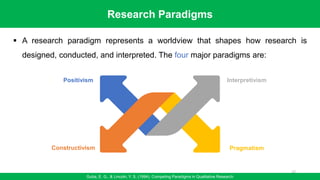
Positivism
Constructivism
Interpretivism
Pragmatism
Research Paradigms
Guba, E. G., & Lincoln, Y. S. (1994). Competing Paradigms in Qualitative Research
▪ A research paradigm represents a worldview that shapes how research is
designed, conducted, and interpreted. The four major paradigms are:
22
Types of Research Paradigms
Crotty, M. (1998). The Foundations of Social Research: Meaning and Perspective in the Research Process/ https://gencraft.com/generate
23
1. Positivism:
• Assumes that reality is objective and can be
discovered through empirical observation and
measurement.
• Positivism aligns with quantitative methods, as it
supports the idea that phenomena can be observed
and quantified in a controlled, objective manner.
• Research designs based on positivism often use
structured techniques, such as experiments and
surveys, to produce generalizable findings.
Types of Research Paradigms
Crotty, M. (1998). The Foundations of Social Research: Meaning and Perspective in the Research Process/ https://gencraft.com/generate
24
2. Interpretivism:
• Contrasts with positivism, as it holds that reality is
socially constructed and cannot be understood
through objective measurement alone.
• Interpretivism aligns with qualitative methods, as it
seeks to understand the subjective meanings that
people attach to their experiences.
• Interpretive research often involves close
interaction between the researcher and participants,
with an emphasis on context and depth.
Types of Research Paradigms
Crotty, M. (1998). The Foundations of Social Research: Meaning and Perspective in the Research Process/ https://gencraft.com/generate
25
3. Constructivism:
• Closely related to interpretivism but places more
emphasis on the co-construction of knowledge
between researchers and participants. Knowledge
is seen as evolving, not static.
• Methods include participant observation, interviews,
and document analysis, focusing on understanding
the processes by which individuals make sense of
their world.
Types of Research Paradigms
Crotty, M. (1998). The Foundations of Social Research: Meaning and Perspective in the Research Process/ https://gencraft.com/generate
26
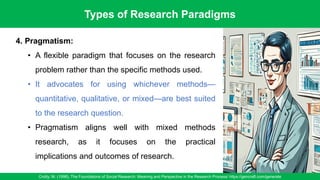
4. Pragmatism:
• A flexible paradigm that focuses on the research
problem rather than the specific methods used.
• It advocates for using whichever methods—
quantitative, qualitative, or mixed—are best suited
to the research question.
• Pragmatism aligns well with mixed methods
research, as it focuses on the practical
implications and outcomes of research.
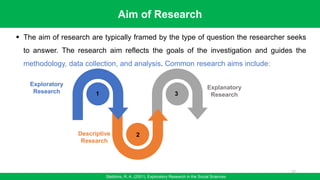
Exploratory
Research
Descriptive
Research
Explanatory
Research
Aim of Research
Stebbins, R. A. (2001). Exploratory Research in the Social Sciences
▪ The aim of research are typically framed by the type of question the researcher seeks
to answer. The research aim reflects the goals of the investigation and guides the
methodology, data collection, and analysis. Common research aims include:
1
2
3
27
Aim of Research
Stebbins, R. A. (2001). Exploratory Research in the Social Sciences / https://gencraft.com/generate
28
1. Exploratory Research:
• Conducted when the subject is new or not well
understood. The goal is to gain insights and
familiarity with a phenomenon, often using
qualitative methods like case studies or
interviews.
• Example: An exploratory study might
investigate the factors that influence social
media usage among teenagers, aiming to
uncover new themes or patterns.
Aim of Research
Stebbins, R. A. (2001). Exploratory Research in the Social Sciences / https://gencraft.com/generate
29
• Often conducted in areas where little prior
research exists, exploratory studies help
researchers formulate hypotheses or
understand the boundaries of a research
question.
• For example, in emerging fields like artificial
intelligence ethics, exploratory research might
involve interviews with experts to identify key
ethical concerns.
Aim of Research
Stebbins, R. A. (2001). Exploratory Research in the Social Sciences / https://gencraft.com/generate
30
2. Descriptive Research:
• Aims to describe the characteristics of a
population or phenomenon.
• This type of research often involves surveys or
observational studies to gather data on "what
is.”
• Example: A descriptive study might measure
the level of job satisfaction among nurses in a
particular hospital.
Aim of Research
Neuman, W. L. (2014). Social Research Methods: Qualitative and Quantitative Approaches / https://gencraft.com/generate
31
• Descriptive studies do not attempt to draw
causal connections but aim to provide a
detailed picture of a situation as it exists.
• An example could be a national survey on
health care access, where the goal is to
describe patterns across different
demographic groups.
Aim of Research
Neuman, W. L. (2014). Social Research Methods: Qualitative and Quantitative Approaches / https://gencraft.com/generate
32
3. Explanatory Research:
• Seeks to explain the relationships between
variables. This is typically the domain of
quantitative research, where hypotheses are
tested to determine cause-and-effect
relationships.
• Example: An explanatory study might
investigate the relationship between
socioeconomic status and academic
achievement using regression analysis.
Aim of Research
Neuman, W. L. (2014). Social Research Methods: Qualitative and Quantitative Approaches / https://gencraft.com/generate
33
• Explanatory research is designed to test
theories and often involves rigorous statistical
techniques to establish causality.
• For example, a study on the effects of
education policies might use a longitudinal
design to track changes in student performance
over time, testing for the influence of new
reforms.
34
Quantitative Research: A Scientific
Approach
The Evolution of Quantitative Research
Bryman, A. (2016). Social Research Methods / https://gencraft.com/generate
35
▪ Origins of Quantitative Research:
• Stemming from the natural sciences (e.g.,
physics, chemistry), it was initially developed to
study phenomena through empirical,
measurable evidence.
▪ Milestones:
• 17th Century: Early use of statistics in
population studies and economics.
• 19th Century: Introduction of randomized trials
and experimental methods in medical research.
The Evolution of Quantitative Research
Bryman, A. (2016). Social Research Methods / https://gencraft.com/generate
36
• 20th Century: Widespread use in the social
sciences to understand human behaviors,
trends, and economic patterns.
▪ Key Theories & Influences:
• Positivism: The belief that knowledge can only
be derived from logical and empirical
observation.
• Critical Rationalism (Karl Popper): Introduced
the concept of falsifiability in hypothesis testing.
Quantitative Research: A Scientific Approach
Bryman, A. (2016). Social Research Methods (5th ed.). Oxford University Press / https://gencraft.com/generate
37
▪ Definition:
• Quantitative research is structured and seeks to
quantify the relationships between variables.
• It’s typically used in studies where the goal is to test
hypotheses, predict outcomes, and find correlations.
▪ Key Characteristics:
1. Hypothesis-Driven: Researchers often begin with
a hypothesis based on existing theories or previous
studies. The goal is to confirm or refute this
hypothesis by collecting measurable data.
Quantitative Research: A Scientific Approach
Bryman, A. (2016). Social Research Methods (5th ed.). Oxford University Press / https://gencraft.com/generate
38
2. Measurable Variables: Variables are
operationalized to allow for clear, precise
measurement.
• For instance, rather than studying "happiness,"
researchers might measure happiness using a
standardized psychological scale (e.g., a 1–7
Likert scale).
Quantitative Research: A Scientific Approach
Bryman, A. (2016). Social Research Methods (5th ed.). Oxford University Press / https://gencraft.com/generate
39
3. Deductive Approach: Starts from a theory,
develops a hypothesis, collects data, and
then tests whether the data supports the
hypothesis.
4. Large Sample Sizes: The emphasis on
generalizability requires large sample sizes to
ensure findings are representative of a
broader population.
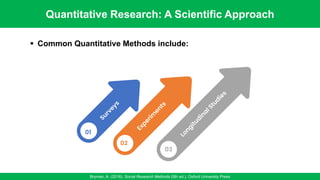
01
02
03
Quantitative Research: A Scientific Approach
Bryman, A. (2016). Social Research Methods (5th ed.). Oxford University Press
▪ Common Quantitative Methods include:
Quantitative Research: A Scientific Approach
Bryman, A. (2016). Social Research Methods (5th ed.). Oxford University Press / https://www.smartsurvey.co.uk/articles/survey-vs-questionnaire
41
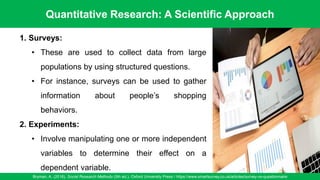
1. Surveys:
• These are used to collect data from large
populations by using structured questions.
• For instance, surveys can be used to gather
information about people’s shopping
behaviors.
2. Experiments:
• Involve manipulating one or more independent
variables to determine their effect on a
dependent variable.
Quantitative Research: A Scientific Approach
Bryman, A. (2016). Social Research Methods (5th ed.). Oxford University Press / https://www.smartsurvey.co.uk/articles/survey-vs-questionnaire
42
• For example, an experiment might measure
how different teaching methods affect student
performance.
3. Longitudinal Studies:
• These track the same subjects over time to
observe changes and identify trends.
• For example, a longitudinal study might
examine the impact of education on income
levels over 10 years.
Quantitative Research: A Scientific Approach
Cohen, L., Manion, L., & Morrison, K. (2017). Research Methods in Education / https://www.smartsurvey.co.uk/articles/survey-vs-questionnaire
43
▪ Core Concepts in Quantitative Research:
• Hypothesis Testing:
• Hypotheses are specific, testable statements
derived from theory. Example: "Regular
exercise reduces stress levels in adults."
• Variables:
• Independent Variables: The variables that are
manipulated (e.g., type of diet in a health study).
• Dependent Variables: The outcomes
measured (e.g., weight loss).
Quantitative Research: A Scientific Approach
Cohen, L., Manion, L., & Morrison, K. (2017). Research Methods in Education / https://www.smartsurvey.co.uk/articles/survey-vs-questionnaire
44
• Operationalization:
• Turning abstract concepts (e.g., intelligence)
into measurable entities, such as IQ scores.
• Reliability and Validity:
• Reliability: Consistency of a measure.
• Validity: Whether the research accurately
reflects the concept it intends to measure.
Quantitative Research: A Scientific Approach
Cohen, L., Manion, L., & Morrison, K. (2017). Research Methods in Education / https://www.smartsurvey.co.uk/articles/survey-vs-questionnaire
45
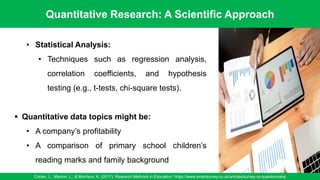
• Statistical Analysis:
• Techniques such as regression analysis,
correlation coefficients, and hypothesis
testing (e.g., t-tests, chi-square tests).
▪ Quantitative data topics might be:
• A company’s profitability
• A comparison of primary school children’s
reading marks and family background
Quantitative Research: A Scientific Approach
https://www.researchgate.net/publication/305215626_Research_Methods-Quantitative_Qualitative_and_Mixed_methods
46
• How rates of secondary infection in a hospital
ward change in winter
• How many newspaper articles mention
immigration in a given period
• The frequency of particular personality types
e.g. introversion
If your purpose is to explore, illustrate, and/or give rich
and detailed information about particular instances,
you are probably going to prefer qualitative data.
Quantitative Research: A Scientific Approach
Bryman, A. (2016). Social Research Methods (5th ed.). Oxford University Press / https://www.smartsurvey.co.uk/articles/survey-vs-questionnaire
47
▪ Strengths and Limitations:
▪ Strengths:
• Can handle large amounts of data, allowing
generalization across populations.
• High reliability due to standardization and
replication.
• Offers clear, objective results.
Quantitative Research: A Scientific Approach
Bryman, A. (2016). Social Research Methods (5th ed.). Oxford University Press / https://www.smartsurvey.co.uk/articles/survey-vs-questionnaire
48
▪ Limitations:
• Lacks contextual understanding and deeper
meaning behind the data.
• May overlook unmeasured variables or the
complexity of human experiences.
49
Qualitative Research: Exploring
Depth and Context
Evolution of Qualitative Research Methods
Denzin, N. K., & Lincoln, Y. S. (Eds.). (2018). The SAGE Handbook of Qualitative Research /https://www.oriresults.com/articles/blog-posts/pilot-surveys-survey-before-survey
50
▪ Origins of Qualitative Research:
• Emerged from fields like anthropology and
sociology in the early 20th century as scholars
sought to understand human culture and
behavior from an emic (insider) perspective.
▪ Key Theories and Movements:
• Symbolic Interactionism (Herbert Blumer):
Emphasizes the meaning-making processes
of social interactions.
Evolution of Qualitative Research Methods
Denzin, N. K., & Lincoln, Y. S. (Eds.). (2018). The SAGE Handbook of Qualitative Research /https://www.oriresults.com/articles/blog-posts/pilot-surveys-survey-before-survey
51
• Phenomenology (Edmund Husserl): Focuses
on the lived experiences of individuals.
• Grounded Theory (Glaser and Strauss): A
method for generating theory from data during
the research process itself.
▪ Shifts in Focus:
• Mid-20th Century: Shifted from "objective" to
more subjective understandings of social
phenomena, often influenced by postmodernist
thinking.
Qualitative Research: Exploring Depth and Context
Denzin, N. K., & Lincoln, Y. S. (Eds.). The SAGE Handbook of Qualitative Research (5th ed.) /https://www.oriresults.com/articles/blog-posts/pilot-surveys-survey-before-survey
52
▪ Definition:
• Qualitative research focuses on exploring and
understanding the perspectives and experiences of
individuals or groups related to an engineering
problem, such as how engineers adapt to emerging
technologies or collaborate in multidisciplinary
teams to solve complex challenges.
• It is generally more flexible than quantitative
research and is used to capture the richness of
human experience.
Qualitative Research: Exploring Depth and Context
Denzin, N. K., & Lincoln, Y. S. (Eds.). The SAGE Handbook of Qualitative Research (5th ed.)/ /https://www.oriresults.com/articles/blog-posts/pilot-surveys-survey-before-survey
53
▪ Key Characteristics:
1. Exploratory Nature: It aims to explore
phenomena where little is known. For
example, exploring how people experience
social media addiction.
2. Context-Driven: The study is typically
conducted in natural settings where
phenomena occur. The focus is on
understanding events or behaviors within the
specific context in which they arise.
Qualitative Research: Exploring Depth and Context
Denzin, N. K., & Lincoln, Y. S. (Eds.). The SAGE Handbook of Qualitative Research (5th ed.) / https://www.oriresults.com/articles/blog-posts/pilot-surveys-survey-before-survey
54
3. Subjective Meaning: Instead of aiming for
objectivity, qualitative research values the
subjective perspectives of participants,
understanding their lived experiences.
4. Small, Purposive Samples: Researchers
often use small, carefully selected samples,
choosing participants who are most likely to
provide rich, detailed insights about the topic.
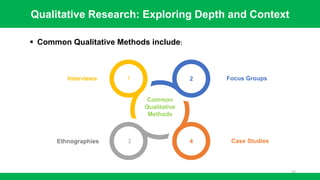
Focus Groups
Interviews
Case Studies
Ethnographies
Common
Qualitative
Methods
Qualitative Research: Exploring Depth and Context
1 2
3 4
55
▪ Common Qualitative Methods include:
Qualitative Research: Exploring Depth and Context
Denzin, N. K., & Lincoln, Y. S. (Eds.). The SAGE Handbook of Qualitative Research (5th ed.) /https://www.oriresults.com/articles/blog-posts/pilot-surveys-survey-before-survey
56
1. Interviews:
• These can be structured, semi-structured, or
unstructured, depending on the level of
flexibility needed.
• Researchers may conduct in-depth interviews
to understand the motivations behind certain
behaviors (e.g., why people choose to quit
smoking).
Qualitative Research: Exploring Depth and Context
Denzin, N. K., & Lincoln, Y. S. (Eds.). The SAGE Handbook of Qualitative Research (5th ed.) /https://www.oriresults.com/articles/blog-posts/pilot-surveys-survey-before-survey
57
2. Focus Groups:
• A small group of people discusses a particular
topic, providing insights into group dynamics and
shared cultural norms.
3. Ethnographies:
• Researchers immerse themselves in a
community to observe behaviors and interactions
in their natural setting.
• For example, an anthropologist might live in a
remote village to study cultural practices.
Qualitative Research: Exploring Depth and Context
Denzin, N. K., & Lincoln, Y. S. (Eds.). The SAGE Handbook of Qualitative Research (5th ed.) /https://www.oriresults.com/articles/blog-posts/pilot-surveys-survey-before-survey
58
4. Case Studies:
• Detailed examination of a single subject, such
as an individual, a small group, or an
organization.
• For example, a researcher may study a tech
company to understand its unique innovation
strategies.
Qualitative Research: Exploring Depth and Context
Flick, U. (2018). An Introduction to Qualitative Research /https://www.oriresults.com/articles/blog-posts/pilot-surveys-survey-before-survey
59
▪ Core Concepts in Qualitative Research:
• Exploratory and Flexible Nature:
• Qualitative research often seeks to explore
areas where little is known.
• It allows for the research design to evolve
during the study.
• Reflexivity:
• The researcher is aware of their own
biases, assumptions, and influence on the
research process.
Qualitative Research: Exploring Depth and Context
Flick, U. (2018). An Introduction to Qualitative Research /https://www.oriresults.com/articles/blog-posts/pilot-surveys-survey-before-survey
60
• Subjectivity and Context:
• Emphasis is placed on understanding
human experience in context.
• Data Collection Techniques:
• In-depth Interviews: Provides detailed
personal narratives.
• Participant Observation: Immersing
oneself in the group being studied to
observe behavior and social interaction.
Qualitative Research: Exploring Depth and Context
Flick, U. (2018). An Introduction to Qualitative Research /https://www.oriresults.com/articles/blog-posts/pilot-surveys-survey-before-survey
61
• Content Analysis: Analyzing written, visual,
or audio data to identify patterns and
meanings.
• Data Saturation:
• Refers to the point in qualitative research
where no new information is being
discovered.
Qualitative Research: Exploring Depth and Context
https://www.researchgate.net/publication/305215626_Research_Methods-Quantitative_Qualitative_and_Mixed_methods
62
▪ Qualitative data topics might be:
• Consumer perceptions of a company or brand
• Parents’ feelings and habits about reading to
their children
• Nurses’ knowledge and opinions of infection
prevention protocols
• How newspaper articles describe and
represent immigrants
• How introverts think of themselves
Qualitative Research: Exploring Depth and Context
Denzin, N. K., & Lincoln, Y. S. The SAGE Handbook of Qualitative Research /https://www.oriresults.com/articles/blog-posts/pilot-surveys-survey-before-survey
63
▪ Strengths and Limitations:
▪ Strengths:
• Offers deep, detailed insights into complex
issues.
• Can uncover underlying motivations, values,
and social processes.
• Flexibility in adapting to new findings as
research progresses.
Qualitative Research: Exploring Depth and Context
Denzin, N. K., & Lincoln, Y. S. The SAGE Handbook of Qualitative Research /https://www.oriresults.com/articles/blog-posts/pilot-surveys-survey-before-survey
64
▪ Limitations:
• Results are not generalizable to larger
populations.
• Subjectivity and potential bias from the
researcher’s interpretation.
• Difficult to replicate studies.
65
Mixed Methods – Historical
and Conceptual Foundations
Mixed Methods – Historical and Conceptual Foundations
Creswell, J. W., & Plano Clark, V. L. Designing and Conducting Mixed Methods Researchhttps://www.dragnsurvey.com/blog/en/the-difference-between-survey-and-questionnaire
66
▪ Historical Development:
• Mixed methods research emerged in the 1980s
and 1990s, fueled by debates over the merits of
qualitative vs. quantitative research. Researchers
began recognizing the value of integrating both
methods.
▪ Paradigm Wars:
• Early mixed-methods researchers navigated
tensions between positivist (quantitative) and
constructivist (qualitative) paradigms.
Mixed Methods – Historical and Conceptual Foundations
Creswell, J. W., & Plano Clark, V. L. Designing and Conducting Mixed Methods Research/https://www.dragnsurvey.com/blog/en/the-difference-between-survey-and-questionnaire
67
▪ Influential Works:
• John W. Creswell’s Contributions:
Pioneered the use of mixed methods as a
legitimate research strategy in the social
sciences.
• Tashakkori & Teddlie: Advocated for the
pragmatic approach, which focuses on what
works best to answer research questions.
Mixed Methods – Historical and Conceptual Foundations
Creswell, J. W., & Plano Clark, V. L. (Designing and Conducting Mixed Methods Research (3rd ed.)/https://www.dragnsurvey.com/blog/en/the-difference-between-survey
68
▪ Definition:
• Mixed methods research combines both
qualitative and quantitative approaches to
address research questions from multiple
perspectives.
• It acknowledges that both types of data are
necessary to fully understand complex
phenomena.
Mixed Methods – Historical and Conceptual Foundations
Creswell, J. W., & Plano Clark, V. L. (Designing and Conducting Mixed Methods Research (3rd ed.)/https://www.dragnsurvey.com/blog/en/the-difference-between-survey
69
▪ Key Characteristics:
1. Combining Breadth and Depth:
• While quantitative data provides a broad
overview (e.g., trends in a population), qualitative
data offers depth and context (e.g., personal
experiences of individuals within that population).
2. Triangulation:
• Mixed methods allow researchers to cross-
validate findings by comparing data from multiple
sources or methods.
Mixed Methods – Historical and Conceptual Foundations
Creswell, J. W., & Plano Clark, V. L. (Designing and Conducting Mixed Methods Research (3rd ed.)/https://www.dragnsurvey.com/blog/en/the-difference-between-survey
70
• For example, if qualitative interviews confirm
trends seen in survey data, this strengthens the
validity of the research.
3. Concurrent or Sequential:
• In concurrent designs, both types of data are
collected simultaneously, while in sequential
designs, one type of data informs the other.
Mixed Methods – Historical and Conceptual Foundations
https://www.slideshare.net/slideshow/mixed-methods-research-241564115/241564115/https://www.dragnsurvey.com/blog/en/the-difference-between-survey-and-questionnaire
71
The procedures of collecting, analysing and mixing the data are
based on three main characteristics according to Moris, 1991:
▪ Timing:
• The sequence or order of the implementation of the
qualitative and the quantitative data collection and
analysis procedures in the study (either Sequentially or
Concurrently).
▪ Weighting:
• The relative importance or priority given to each type of
data (to consider the priority or the emphasis).
Mixed Methods – Historical and Conceptual Foundations
https://www.slideshare.net/slideshow/mixed-methods-research-241564115/241564115
72
▪ Mixing:
• How the two methods (quantitative & qualitative)
integrate within the study. Deciding on how to mix
the methods depends on the (purpose, design and
strategies) that are used for collecting and analysis.
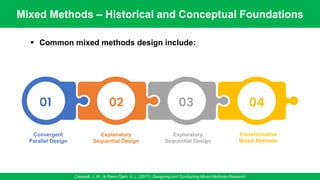
01 02 03 04
Explanatory
Sequential Design
Exploratory
Sequential Design
Transformative
Mixed Methods
Convergent
Parallel Design
Mixed Methods – Historical and Conceptual Foundations
Creswell, J. W., & Plano Clark, V. L. (2017). Designing and Conducting Mixed Methods Research
▪ Common mixed methods design include:
Mixed Methods – Historical and Conceptual Foundations
Creswell, J. W., & Plano Clark, V. L. (Designing and Conducting Mixed Methods Research (3rd ed.)/https://www.dragnsurvey.com/blog/en/the-difference-between-survey
74
1. Convergent Parallel Design:
• Quantitative and qualitative data are collected
and analyzed simultaneously, then the results
are compared and interpreted together.
2. Explanatory Sequential Design:
• Quantitative data is collected first. Then
qualitative data is used to explain the
quantitative findings.
Mixed Methods – Historical and Conceptual Foundations
Creswell, J. W., & Plano Clark, V. L. (Designing and Conducting Mixed Methods Research (3rd ed.)/https://www.dragnsurvey.com/blog/en/the-difference-between-survey
75
3. Exploratory Sequential Design:
• Qualitative data is collected first to explore a
phenomenon. Then quantitative data is used to
test or expand upon the initial findings.
4. Transformative Mixed Methods:
• Combines both methods with an explicit focus on
promoting social change, often used in feminist
or participatory action research.
Mixed Methods – Historical and Conceptual Foundations
Creswell, J. W., & Plano Clark, V. L. (Designing and Conducting Mixed Methods Research (3rd ed.)/https://www.dragnsurvey.com/blog/en/the-difference-between-survey
76
▪ When do we conduct a Mixed Methods Study:
• When we have both quantitative and qualitative
data.
• When one data resource may not be enough to
explain the answer of the question.
• When we want qualitative research to help in
explaining the quantitative findings.
• Want to provide alternative perspectives in a study.
• When we want to generalize findings to a large
population.
Mixed Methods – Historical and Conceptual Foundations
Creswell, J. W., & Plano Clark, V. L. (Designing and Conducting Mixed Methods Research (3rd ed.)/https://www.dragnsurvey.com/blog/en/the-difference-between-survey
77
▪ Reasons for using Mixed Methods Research:
• Combines the strengths of both quantitative and
qualitative approaches to provide a more holistic
view of the research problem.
• Enhances the validity and reliability of findings by
cross-verifying results from different methods.
• Allows researchers to explore a phenomenon
qualitatively and then confirm findings
quantitatively (or vice versa).
Mixed Methods – Historical and Conceptual Foundations
https://www.slideshare.net/slideshow/mixed-methods-research-241564115/241564115
78
▪ Steps for Conducting a Mixed Methods
Research:
According to Jie and Xiaoqing's Mixed Methods
Study, there are eight basic research steps to which
are used while conducting this method and can be
illustrated as follow:
i. Determine if Mixed Methods Research is the
best approach to address the research problem
that you want to study.
Mixed Methods – Historical and Conceptual Foundations
https://www.slideshare.net/slideshow/mixed-methods-research-241564115/241564115
79
ii. Select a specific Mixed Methods Design
(explanatory, exploratory, triangulation or
embedded).
iii. Write a detailed Mixed Methods purpose
statement for your study.
iv. Write a specific research question to address
(quantitative & qualitative) aspects of your study.
v. Choose the (quantitative & qualitative) data to
collect.
Mixed Methods – Historical and Conceptual Foundations
https://www.slideshare.net/slideshow/mixed-methods-research-241564115/241564115
80
vi. Draw a visual diagram of the procedures in
your study.
vii. Collect and analyze the (quantitative &
qualitative) data for your study-this is the major
part of the study.
viii. Write the final report reflecting the mixed
methods design you used in the study.
Mixed Methods – Historical and Conceptual Foundations
Creswell, J. W., & Plano Clark, V. L. (Designing and Conducting Mixed Methods Research (3rd ed.)/https://www.dragnsurvey.com/blog/en/the-difference-between-survey
81
▪ Strengths and Limitations:
▪ Strengths:
• Provides a more comprehensive understanding
by capturing both the measurable and the
experiential aspects of the research problem.
• Allows for more robust conclusions by integrating
both statistical data and personal narratives.
• Reduces researcher bias by using multiple
methods.
Mixed Methods – Historical and Conceptual Foundations
Creswell, J. W., & Plano Clark, V. L. (Designing and Conducting Mixed Methods Research (3rd ed.)/https://www.dragnsurvey.com/blog/en/the-difference-between-survey
82
▪ Limitations:
• More complex and time-consuming to design,
implement, and analyze.
• Requires expertise in both qualitative and
quantitative methods.
• May present challenges in integrating or
reconciling conflicting results.
Mixed Methods – Historical and Conceptual Foundations
Creswell, J. W., & Plano Clark, V. L. (Designing and Conducting Mixed Methods Research (3rd ed.)/https://www.dragnsurvey.com/blog/en/the-difference-between-survey
83
▪ Case Studies of Mixed Methods
• Case Study 1: Engineering Research:
• A mixed methods study might explore how the
implementation of a new energy-efficient HVAC system
reduces energy consumption in commercial buildings.
• Quantitative data could be gathered through sensors
and utility bills to measure changes in energy usage,
while interviews with facility managers and occupants
might uncover qualitative insights about their
experiences, challenges, and satisfaction with the
system.
Mixed Methods – Historical and Conceptual Foundations
Creswell, J. W., & Plano Clark, V. L. (Designing and Conducting Mixed Methods Research (3rd ed.)/https://www.dragnsurvey.com/blog/en/the-difference-between-survey
84
▪ Case Study 2: Educational Research:
• In educational research, a mixed methods
study could investigate the impact of new
teaching strategies on student outcomes.
• Quantitative data might include test scores to
assess improvement, while qualitative data
from classroom observations or interviews
could explore students' and teachers' attitudes
toward the new methods.
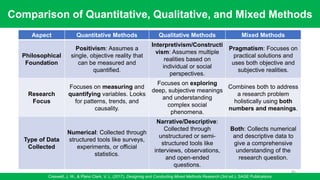
Comparison of Quantitative, Qualitative, and Mixed Methods
Creswell, J. W., & Plano Clark, V. L. (2017). Designing and Conducting Mixed Methods Research (3rd ed.). SAGE Publications
85
Aspect Quantitative Methods Qualitative Methods Mixed Methods
Philosophical
Foundation
Positivism: Assumes a
single, objective reality that
can be measured and
quantified.
Interpretivism/Constructi
vism: Assumes multiple
realities based on
individual or social
perspectives.
Pragmatism: Focuses on
practical solutions and
uses both objective and
subjective realities.
Research
Focus
Focuses on measuring and
quantifying variables. Looks
for patterns, trends, and
causality.
Focuses on exploring
deep, subjective meanings
and understanding
complex social
phenomena.
Combines both to address
a research problem
holistically using both
numbers and meanings.
Type of Data
Collected
Numerical: Collected through
structured tools like surveys,
experiments, or official
statistics.
Narrative/Descriptive:
Collected through
unstructured or semi-
structured tools like
interviews, observations,
and open-ended
questions.
Both: Collects numerical
and descriptive data to
give a comprehensive
understanding of the
research question.
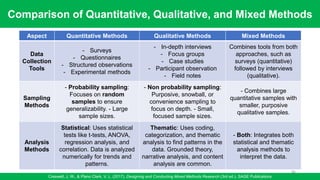
Comparison of Quantitative, Qualitative, and Mixed Methods
Creswell, J. W., & Plano Clark, V. L. (2017). Designing and Conducting Mixed Methods Research (3rd ed.). SAGE Publications
86
Aspect Quantitative Methods Qualitative Methods Mixed Methods
Data
Collection
Tools
- Surveys
- Questionnaires
- Structured observations
- Experimental methods
- In-depth interviews
- Focus groups
- Case studies
- Participant observation
- Field notes
Combines tools from both
approaches, such as
surveys (quantitative)
followed by interviews
(qualitative).
Sampling
Methods
- Probability sampling:
Focuses on random
samples to ensure
generalizability. - Large
sample sizes.
- Non probability sampling:
Purposive, snowball, or
convenience sampling to
focus on depth. - Small,
focused sample sizes.
- Combines large
quantitative samples with
smaller, purposive
qualitative samples.
Analysis
Methods
Statistical: Uses statistical
tests like t-tests, ANOVA,
regression analysis, and
correlation. Data is analyzed
numerically for trends and
patterns.
Thematic: Uses coding,
categorization, and thematic
analysis to find patterns in the
data. Grounded theory,
narrative analysis, and content
analysis are common.
- Both: Integrates both
statistical and thematic
analysis methods to
interpret the data.
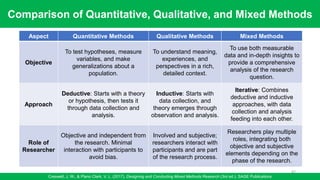
Comparison of Quantitative, Qualitative, and Mixed Methods
Creswell, J. W., & Plano Clark, V. L. (2017). Designing and Conducting Mixed Methods Research (3rd ed.). SAGE Publications
87
Aspect Quantitative Methods Qualitative Methods Mixed Methods
Objective
To test hypotheses, measure
variables, and make
generalizations about a
population.
To understand meaning,
experiences, and
perspectives in a rich,
detailed context.
To use both measurable
data and in-depth insights to
provide a comprehensive
analysis of the research
question.
Approach
Deductive: Starts with a theory
or hypothesis, then tests it
through data collection and
analysis.
Inductive: Starts with
data collection, and
theory emerges through
observation and analysis.
Iterative: Combines
deductive and inductive
approaches, with data
collection and analysis
feeding into each other.
Role of
Researcher
Objective and independent from
the research. Minimal
interaction with participants to
avoid bias.
Involved and subjective;
researchers interact with
participants and are part
of the research process.
Researchers play multiple
roles, integrating both
objective and subjective
elements depending on the
phase of the research.
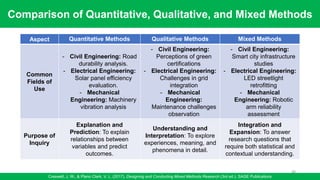
Comparison of Quantitative, Qualitative, and Mixed Methods
Creswell, J. W., & Plano Clark, V. L. (2017). Designing and Conducting Mixed Methods Research (3rd ed.). SAGE Publications
88
Aspect Quantitative Methods Qualitative Methods Mixed Methods
Common
Fields of
Use
- Civil Engineering: Road
durability analysis.
- Electrical Engineering:
Solar panel efficiency
evaluation.
- Mechanical
Engineering: Machinery
vibration analysis
- Civil Engineering:
Perceptions of green
certifications
- Electrical Engineering:
Challenges in grid
integration
- Mechanical
Engineering:
Maintenance challenges
observation
- Civil Engineering:
Smart city infrastructure
studies
- Electrical Engineering:
LED streetlight
retrofitting
- Mechanical
Engineering: Robotic
arm reliability
assessment
Purpose of
Inquiry
Explanation and
Prediction: To explain
relationships between
variables and predict
outcomes.
Understanding and
Interpretation: To explore
experiences, meaning, and
phenomena in detail.
Integration and
Expansion: To answer
research questions that
require both statistical and
contextual understanding.
When to Use Which Methodology
Creswell, J. W. (2013). Qualitative Inquiry and Research Design: Choosing Among Five Approaches (3rd ed.)/https://www.qualitylogic.com/knowledge-center
89
▪ Choosing the Right Methodology
• Quantitative Research: Best suited when the goal is to
measure variables, predict outcomes, or establish causality.
• It's appropriate for research questions such as "What is the
effect of X on Y?" or "How much do variables A and B
correlate?”
• Example: A researcher studying the correlation between
social media use and anxiety might use a large-scale
survey to quantify the relationship between time spent
on social media and self-reported anxiety levels.
When to Use Which Methodology
Creswell, J. W. (2013). Qualitative Inquiry and Research Design: Choosing Among Five Approaches (3rd ed.)/ https://www.qualitylogic.com/knowledge-center
90
• Qualitative Research: Useful for exploratory
research that seeks to understand underlying
meanings or experiences.
• It's suitable for questions like "How do individuals
experience X?" or "What are the processes behind
Y?“
• Example: A study exploring the lived
experiences of refugees might use in-depth
interviews to understand their emotional and
psychological struggles.
When to Use Which Methodology
Creswell, J. W. (2013). Qualitative Inquiry and Research Design: Choosing Among Five Approaches (3rd ed.)/https://www.qualitylogic.com/knowledge-center
91
• Mixed Methods Research: Best when neither
quantitative nor qualitative methods alone are
sufficient to fully address the research problem.
• It's appropriate for research that requires both
breadth and depth.
• Example: A study examining student
performance might start by collecting test
scores (quantitative) and then conducting focus
groups to understand students' attitudes and
behaviors (qualitative).
Challenges and Criticisms
Johnson, R. B., & Onwuegbuzie, A. J. Mixed Methods Research: A Research Paradigm Whose Time Has Come https://researcher.life/blog/article/choose-research-methodology
92
▪ Quantitative Research Challenges:
• Ethical Concerns: Manipulating variables in
experimental settings can raise ethical issues.
• Over-Simplification of Complex Issues:
Quantitative methods might reduce complex social
phenomena to a few measurable variables,
potentially missing the broader context.
• External Validity: Generalizability is often a
challenge when the study sample doesn't
accurately reflect the target population.
Challenges and Criticisms
Johnson, R. B., & Onwuegbuzie, A. J. Mixed Methods Research: A Research Paradigm Whose Time Has Come https://researcher.life/blog/article/choose-research-methodology
93
▪ Qualitative Research Challenges:
• Researcher Bias: Since qualitative analysis often
involves interpretation, there's a risk of the
researcher's personal biases influencing the results.
• Reliability and Replicability: It's difficult to replicate
qualitative studies due to the context-specific nature of
the data.
• Time-Consuming: Collecting and analyzing qualitative
data can take much longer than quantitative methods,
especially for large datasets or ethnographic studies.
Challenges and Criticisms
Johnson, R. B., & Onwuegbuzie, A. J. Mixed Methods Research: A Research Paradigm Whose Time Has Come https://researcher.life/blog/article/choose-research-methodology
94
▪ Mixed Methods Research Challenges:
• Complexity of Design: Designing and implementing
mixed methods research requires careful planning and
expertise in both qualitative and quantitative approaches.
• Integration of Data: Combining qualitative and
quantitative data can be difficult, particularly when the
findings conflict.
• Resource Intensive: Mixed methods research requires
more time, money, and expertise than using a single
method.
Conclusion
Creswell, J. W. (2014). Research Design: Qualitative, Quantitative, and Mixed Methods Approaches (4th ed.)/ttps://www.klcommunications.com
95
• Quantitative, qualitative, and mixed methods research
each offer unique strengths and address different types
of research questions.
• Understanding the procedures of collecting and
analyzing the quantitative and qualitative data will
enable us to reach an effective research design using
mixed method research.
• By integrating these approaches, researchers can offer
more robust, well-rounded conclusions that account for
both measurable data and nuanced human experiences.
96
THANK YOU

Quantitative, Qualitative, and Mixed Methods for Research.pdf

  • 1.
    Faizan Shafi andRahul Pandya Department of Electrical, Electronics and Communication Engineering, Indian Institute of Technology (IIT), Dharwad 1 Quantitative, Qualitative, and Mixed Methods for Research
  • 2.
    Outline RJEs: Remote jobentry points ▪ Introduction to Research Methodologies ▪ Overview of Types of Research Methodologies ▪ Choosing the Right Research Methodology ▪ Research Paradigms ▪ Aim of Research ▪ When to use Which Methodology ▪ Challenges and Criticisms ▪ Conclusion 2 All electronic information sources are highly acknowledged. https://gencraft.com/generate
  • 3.
  • 4.
    Overview of ResearchMethodologies Creswell, J. W. (2014). Research Design: Qualitative, Quantitative, and Mixed Methods Approaches (4th ed.)/ https://gencraft.com/generate 4 ▪ What are Research Methodologies/Methods? • Research methods refer to the techniques and strategies used to systematically collect and analyze information (data) in order to answer a specific research question. • The appropriate selection of research methods depends on the nature of the research problem, the questions being addressed, and the theoretical framework of the study.
  • 5.
    Overview of ResearchMethodologies Creswell, J. W. (2014). Research Design: Qualitative, Quantitative, and Mixed Methods Approaches (4th ed.)/ https://gencraft.com/generate 5 ▪ Importance of Research Methods: • Research methods provide a structured approach to collecting, analyzing, and interpreting data, ensuring consistency and reliability in findings. • Proper selection of methods ensures the integrity and validity of research. It also aligns research objectives with suitable data collection and analysis techniques.
  • 6.
    Quantitative Methods Qualitative Methods Mixed Methods Types of ResearchMethodologies https://www.slideshare.net/slideshow/qualitative-quantitative-mixed-method-2018/121413078 1 2 3 Quantitative research is an approach for testing objective theories by examining the relationship among variables. Qualitative research is an approach for exploring and understanding the meaning of individuals or groups ascribe to a social or human problem. Mixed methods research is an approach involving collecting both quantitative and qualitative data, integrating the two forms of data. 6
  • 7.
    Types of ResearchMethodologies Creswell, J. W. (2014). Research Design: Qualitative, Quantitative, and Mixed Methods Approaches (4th ed.)/ https://researcher.life/blog/article/choose-research-methodology 7 1. Quantitative Methods: • Relies on numerical and statistical data to quantify the problem. • The primary aim is to identify general patterns and predict future outcomes. • This approach is rooted in the positivist paradigm, where reality is assumed to be stable, measurable, and observable.
  • 8.
    Types of ResearchMethodologies Creswell, J. W. (2014). Research Design: Qualitative, Quantitative, and Mixed Methods Approaches (4th ed.)./ https://researcher.life/blog/article/choose-research-methodology 8 • Quantitative research aims to produce reliable, replicable, and valid results by focusing on structured techniques and large sample sizes. • Quantitative research employs structured tools like surveys, experiments, and numerical data to test theories. • The goal is often to establish relationships or causality between variables.
  • 9.
    Types of ResearchMethodologies Merriam, S. B., & Tisdell, E. J. (2015). Qualitative Research: A Guide to Design and Implementation/ https://researcher.life/blog/article/choose-research-methodology 9 2. Qualitative Methods: • Involves non-numerical data to explore concepts, experiences, or social phenomena in depth. • It seeks to understand how individuals interpret or make sense of their world. • In contrast, qualitative research is aligned with the constructivist or interpretivist paradigms.
  • 10.
    Types of ResearchMethodologies Merriam, S. B., & Tisdell, E. J. (2015). Qualitative Research: A Guide to Design and Implementation/ https://researcher.life/blog/article/choose-research-methodology 10 • The goal is to capture the subjective experiences of participants, offering rich, detailed narratives. • This method is often used when the researcher seeks to understand social processes, behaviors, or cultural phenomena.
  • 11.
    Types of ResearchMethodologies Creswell, J. W., & Plano Clark, V. L. (2017). Designing and Conducting Mixed Methods Research/ https://researcher.life/blog/article/choose-research-methodology 11 3. Mixed Methods: • Integrates both quantitative and qualitative approaches, leveraging the strengths of both to provide a richer, more nuanced understanding. • The mixed-method approach is pragmatic, integrating quantitative and qualitative techniques to capitalize on the strengths of each.
  • 12.
    Types of ResearchMethodologies Creswell, J. W., & Plano Clark, V. L. (2017). Designing and Conducting Mixed Methods Research/ https://researcher.life/blog/article/choose-research-methodology 12 • By combining these methods, mixed methods research can validate findings, explore diverse perspectives, and uncover deeper insights that might be missed when using a single methodology. • It is particularly useful in studies requiring both broad statistical analysis and detailed, context-rich exploration, making it a versatile tool for addressing multifaceted issues in various fields.
  • 13.
    Examples for Context Creswell,J. W. (2014). Research Design: Qualitative, Quantitative, and Mixed Methods Approaches (4th ed.). Sage 13 1. Quantitative Study in Civil Engineering: • A quantitative study in civil engineering could explore the relationship between the frequency of preventive maintenance and the structural lifespan of bridges across a region using regression analysis. • For instance, data from 50 bridges could be analyzed to quantify how maintenance intervals influence material degradation rates, providing actionable insights for infrastructure management.
  • 14.
    Examples for Context Creswell,J. W. (2014). Research Design: Qualitative, Quantitative, and Mixed Methods Approaches (4th ed.). Sage 14 2. Qualitative Study in Software Engineering: • A qualitative study in software engineering might investigate developers' perceptions of a newly implemented agile methodology through in-depth interviews and thematic analysis. • For example, interviews with 15 software engineers could reveal themes like adaptability, collaboration challenges, and productivity changes, helping refine agile practices for specific project types.
  • 15.
    Examples for Context Creswell,J. W. (2014). Research Design: Qualitative, Quantitative, and Mixed Methods Approaches (4th ed.). Sage 15 3. Mixed-Method Study in Renewable Energy Engineering: • A mixed-method study in renewable energy engineering might begin with quantitative surveys to assess the efficiency of solar panel installations in urban areas, followed by qualitative interviews with engineers to explore challenges in panel design and placement. • For example, survey data from 200 installations could highlight performance trends, while interviews could uncover design constraints such as shading or local regulations that influence these trends.
  • 16.
    Choosing the RightResearch Methodology Bryman, A. (2016). Social Research Methods/https://researcher.life/blog/article/what-is-quantitative-research-types-and-examples 16 ▪ Why Choosing the Right Method Matters: • The choice of research method determines how effectively you can answer your research questions. • For example, if you're exploring the lived experiences of engineers working in high-stress environments, such as those managing critical infrastructure during natural disasters, qualitative methods will offer insights into their subjective experiences, coping mechanisms, and decision-making processes that quantitative methods cannot capture.
  • 17.
    Choosing the RightResearch Methodology Bryman, A. (2016). Social Research Methods/https://researcher.life/blog/article/what-is-quantitative-research-types-and-examples 17 • Selecting the appropriate research methodology is crucial for ensuring that the research question is addressed effectively and rigorously. • The choice should be based on several critical factors, including the nature of the research problem, the goals of the research, the type of data required, and the philosophical orientation of the researcher.
  • 18.
    1 2 34 Nature of the Research Problem Research Objectives Research Questions Practical Considerations Factors Influencing Methodology Selection Patton, M. Q. (2002). Qualitative Research & Evaluation Methods ▪ There are four factors which influence the selection of methodology. Which includes:
  • 19.
    Factors Influencing MethodologySelection Patton, M. Q. (2002). Qualitative Research & Evaluation Methods/ https://gencraft.com/generate 19 1. Nature of the Research Problem: • Quantitative methods are often suitable for research that seeks to test a theory or establish cause-and-effect relationships. • Qualitative methods are better for exploratory research where the objective is to gain a deep understanding of a phenomenon. 2. Research Objectives: • Is the goal to measure and quantify variables or to explore concepts and perspectives?
  • 20.
    Factors Influencing MethodologySelection Patton, M. Q. (2002). Qualitative Research & Evaluation Methods/ https://gencraft.com/generate 20 3. Research Questions: • Quantitative research often involves questions that begin with "how much," "what is the correlation," or "to what extent." • Qualitative research questions are open-ended and exploratory, such as "how" and "why" questions that seek to understand complex human behaviors.
  • 21.
    Factors Influencing MethodologySelection Patton, M. Q. (2002). Qualitative Research & Evaluation Methods/ https://gencraft.com/generate 21 4. Practical Considerations: • Available resources, including time, access to participants, and funding, can impact the choice of methodology. • The familiarity and expertise of the researcher with particular methods can also influence the selection.
  • 22.
    Positivism Constructivism Interpretivism Pragmatism Research Paradigms Guba, E.G., & Lincoln, Y. S. (1994). Competing Paradigms in Qualitative Research ▪ A research paradigm represents a worldview that shapes how research is designed, conducted, and interpreted. The four major paradigms are: 22
  • 23.
    Types of ResearchParadigms Crotty, M. (1998). The Foundations of Social Research: Meaning and Perspective in the Research Process/ https://gencraft.com/generate 23 1. Positivism: • Assumes that reality is objective and can be discovered through empirical observation and measurement. • Positivism aligns with quantitative methods, as it supports the idea that phenomena can be observed and quantified in a controlled, objective manner. • Research designs based on positivism often use structured techniques, such as experiments and surveys, to produce generalizable findings.
  • 24.
    Types of ResearchParadigms Crotty, M. (1998). The Foundations of Social Research: Meaning and Perspective in the Research Process/ https://gencraft.com/generate 24 2. Interpretivism: • Contrasts with positivism, as it holds that reality is socially constructed and cannot be understood through objective measurement alone. • Interpretivism aligns with qualitative methods, as it seeks to understand the subjective meanings that people attach to their experiences. • Interpretive research often involves close interaction between the researcher and participants, with an emphasis on context and depth.
  • 25.
    Types of ResearchParadigms Crotty, M. (1998). The Foundations of Social Research: Meaning and Perspective in the Research Process/ https://gencraft.com/generate 25 3. Constructivism: • Closely related to interpretivism but places more emphasis on the co-construction of knowledge between researchers and participants. Knowledge is seen as evolving, not static. • Methods include participant observation, interviews, and document analysis, focusing on understanding the processes by which individuals make sense of their world.
  • 26.
    Types of ResearchParadigms Crotty, M. (1998). The Foundations of Social Research: Meaning and Perspective in the Research Process/ https://gencraft.com/generate 26 4. Pragmatism: • A flexible paradigm that focuses on the research problem rather than the specific methods used. • It advocates for using whichever methods— quantitative, qualitative, or mixed—are best suited to the research question. • Pragmatism aligns well with mixed methods research, as it focuses on the practical implications and outcomes of research.
  • 27.
    Exploratory Research Descriptive Research Explanatory Research Aim of Research Stebbins,R. A. (2001). Exploratory Research in the Social Sciences ▪ The aim of research are typically framed by the type of question the researcher seeks to answer. The research aim reflects the goals of the investigation and guides the methodology, data collection, and analysis. Common research aims include: 1 2 3 27
  • 28.
    Aim of Research Stebbins,R. A. (2001). Exploratory Research in the Social Sciences / https://gencraft.com/generate 28 1. Exploratory Research: • Conducted when the subject is new or not well understood. The goal is to gain insights and familiarity with a phenomenon, often using qualitative methods like case studies or interviews. • Example: An exploratory study might investigate the factors that influence social media usage among teenagers, aiming to uncover new themes or patterns.
  • 29.
    Aim of Research Stebbins,R. A. (2001). Exploratory Research in the Social Sciences / https://gencraft.com/generate 29 • Often conducted in areas where little prior research exists, exploratory studies help researchers formulate hypotheses or understand the boundaries of a research question. • For example, in emerging fields like artificial intelligence ethics, exploratory research might involve interviews with experts to identify key ethical concerns.
  • 30.
    Aim of Research Stebbins,R. A. (2001). Exploratory Research in the Social Sciences / https://gencraft.com/generate 30 2. Descriptive Research: • Aims to describe the characteristics of a population or phenomenon. • This type of research often involves surveys or observational studies to gather data on "what is.” • Example: A descriptive study might measure the level of job satisfaction among nurses in a particular hospital.
  • 31.
    Aim of Research Neuman,W. L. (2014). Social Research Methods: Qualitative and Quantitative Approaches / https://gencraft.com/generate 31 • Descriptive studies do not attempt to draw causal connections but aim to provide a detailed picture of a situation as it exists. • An example could be a national survey on health care access, where the goal is to describe patterns across different demographic groups.
  • 32.
    Aim of Research Neuman,W. L. (2014). Social Research Methods: Qualitative and Quantitative Approaches / https://gencraft.com/generate 32 3. Explanatory Research: • Seeks to explain the relationships between variables. This is typically the domain of quantitative research, where hypotheses are tested to determine cause-and-effect relationships. • Example: An explanatory study might investigate the relationship between socioeconomic status and academic achievement using regression analysis.
  • 33.
    Aim of Research Neuman,W. L. (2014). Social Research Methods: Qualitative and Quantitative Approaches / https://gencraft.com/generate 33 • Explanatory research is designed to test theories and often involves rigorous statistical techniques to establish causality. • For example, a study on the effects of education policies might use a longitudinal design to track changes in student performance over time, testing for the influence of new reforms.
  • 34.
    34 Quantitative Research: AScientific Approach
  • 35.
    The Evolution ofQuantitative Research Bryman, A. (2016). Social Research Methods / https://gencraft.com/generate 35 ▪ Origins of Quantitative Research: • Stemming from the natural sciences (e.g., physics, chemistry), it was initially developed to study phenomena through empirical, measurable evidence. ▪ Milestones: • 17th Century: Early use of statistics in population studies and economics. • 19th Century: Introduction of randomized trials and experimental methods in medical research.
  • 36.
    The Evolution ofQuantitative Research Bryman, A. (2016). Social Research Methods / https://gencraft.com/generate 36 • 20th Century: Widespread use in the social sciences to understand human behaviors, trends, and economic patterns. ▪ Key Theories & Influences: • Positivism: The belief that knowledge can only be derived from logical and empirical observation. • Critical Rationalism (Karl Popper): Introduced the concept of falsifiability in hypothesis testing.
  • 37.
    Quantitative Research: AScientific Approach Bryman, A. (2016). Social Research Methods (5th ed.). Oxford University Press / https://gencraft.com/generate 37 ▪ Definition: • Quantitative research is structured and seeks to quantify the relationships between variables. • It’s typically used in studies where the goal is to test hypotheses, predict outcomes, and find correlations. ▪ Key Characteristics: 1. Hypothesis-Driven: Researchers often begin with a hypothesis based on existing theories or previous studies. The goal is to confirm or refute this hypothesis by collecting measurable data.
  • 38.
    Quantitative Research: AScientific Approach Bryman, A. (2016). Social Research Methods (5th ed.). Oxford University Press / https://gencraft.com/generate 38 2. Measurable Variables: Variables are operationalized to allow for clear, precise measurement. • For instance, rather than studying "happiness," researchers might measure happiness using a standardized psychological scale (e.g., a 1–7 Likert scale).
  • 39.
    Quantitative Research: AScientific Approach Bryman, A. (2016). Social Research Methods (5th ed.). Oxford University Press / https://gencraft.com/generate 39 3. Deductive Approach: Starts from a theory, develops a hypothesis, collects data, and then tests whether the data supports the hypothesis. 4. Large Sample Sizes: The emphasis on generalizability requires large sample sizes to ensure findings are representative of a broader population.
  • 40.
    01 02 03 Quantitative Research: AScientific Approach Bryman, A. (2016). Social Research Methods (5th ed.). Oxford University Press ▪ Common Quantitative Methods include:
  • 41.
    Quantitative Research: AScientific Approach Bryman, A. (2016). Social Research Methods (5th ed.). Oxford University Press / https://www.smartsurvey.co.uk/articles/survey-vs-questionnaire 41 1. Surveys: • These are used to collect data from large populations by using structured questions. • For instance, surveys can be used to gather information about people’s shopping behaviors. 2. Experiments: • Involve manipulating one or more independent variables to determine their effect on a dependent variable.
  • 42.
    Quantitative Research: AScientific Approach Bryman, A. (2016). Social Research Methods (5th ed.). Oxford University Press / https://www.smartsurvey.co.uk/articles/survey-vs-questionnaire 42 • For example, an experiment might measure how different teaching methods affect student performance. 3. Longitudinal Studies: • These track the same subjects over time to observe changes and identify trends. • For example, a longitudinal study might examine the impact of education on income levels over 10 years.
  • 43.
    Quantitative Research: AScientific Approach Cohen, L., Manion, L., & Morrison, K. (2017). Research Methods in Education / https://www.smartsurvey.co.uk/articles/survey-vs-questionnaire 43 ▪ Core Concepts in Quantitative Research: • Hypothesis Testing: • Hypotheses are specific, testable statements derived from theory. Example: "Regular exercise reduces stress levels in adults." • Variables: • Independent Variables: The variables that are manipulated (e.g., type of diet in a health study). • Dependent Variables: The outcomes measured (e.g., weight loss).
  • 44.
    Quantitative Research: AScientific Approach Cohen, L., Manion, L., & Morrison, K. (2017). Research Methods in Education / https://www.smartsurvey.co.uk/articles/survey-vs-questionnaire 44 • Operationalization: • Turning abstract concepts (e.g., intelligence) into measurable entities, such as IQ scores. • Reliability and Validity: • Reliability: Consistency of a measure. • Validity: Whether the research accurately reflects the concept it intends to measure.
  • 45.
    Quantitative Research: AScientific Approach Cohen, L., Manion, L., & Morrison, K. (2017). Research Methods in Education / https://www.smartsurvey.co.uk/articles/survey-vs-questionnaire 45 • Statistical Analysis: • Techniques such as regression analysis, correlation coefficients, and hypothesis testing (e.g., t-tests, chi-square tests). ▪ Quantitative data topics might be: • A company’s profitability • A comparison of primary school children’s reading marks and family background
  • 46.
    Quantitative Research: AScientific Approach https://www.researchgate.net/publication/305215626_Research_Methods-Quantitative_Qualitative_and_Mixed_methods 46 • How rates of secondary infection in a hospital ward change in winter • How many newspaper articles mention immigration in a given period • The frequency of particular personality types e.g. introversion If your purpose is to explore, illustrate, and/or give rich and detailed information about particular instances, you are probably going to prefer qualitative data.
  • 47.
    Quantitative Research: AScientific Approach Bryman, A. (2016). Social Research Methods (5th ed.). Oxford University Press / https://www.smartsurvey.co.uk/articles/survey-vs-questionnaire 47 ▪ Strengths and Limitations: ▪ Strengths: • Can handle large amounts of data, allowing generalization across populations. • High reliability due to standardization and replication. • Offers clear, objective results.
  • 48.
    Quantitative Research: AScientific Approach Bryman, A. (2016). Social Research Methods (5th ed.). Oxford University Press / https://www.smartsurvey.co.uk/articles/survey-vs-questionnaire 48 ▪ Limitations: • Lacks contextual understanding and deeper meaning behind the data. • May overlook unmeasured variables or the complexity of human experiences.
  • 49.
  • 50.
    Evolution of QualitativeResearch Methods Denzin, N. K., & Lincoln, Y. S. (Eds.). (2018). The SAGE Handbook of Qualitative Research /https://www.oriresults.com/articles/blog-posts/pilot-surveys-survey-before-survey 50 ▪ Origins of Qualitative Research: • Emerged from fields like anthropology and sociology in the early 20th century as scholars sought to understand human culture and behavior from an emic (insider) perspective. ▪ Key Theories and Movements: • Symbolic Interactionism (Herbert Blumer): Emphasizes the meaning-making processes of social interactions.
  • 51.
    Evolution of QualitativeResearch Methods Denzin, N. K., & Lincoln, Y. S. (Eds.). (2018). The SAGE Handbook of Qualitative Research /https://www.oriresults.com/articles/blog-posts/pilot-surveys-survey-before-survey 51 • Phenomenology (Edmund Husserl): Focuses on the lived experiences of individuals. • Grounded Theory (Glaser and Strauss): A method for generating theory from data during the research process itself. ▪ Shifts in Focus: • Mid-20th Century: Shifted from "objective" to more subjective understandings of social phenomena, often influenced by postmodernist thinking.
  • 52.
    Qualitative Research: ExploringDepth and Context Denzin, N. K., & Lincoln, Y. S. (Eds.). The SAGE Handbook of Qualitative Research (5th ed.) /https://www.oriresults.com/articles/blog-posts/pilot-surveys-survey-before-survey 52 ▪ Definition: • Qualitative research focuses on exploring and understanding the perspectives and experiences of individuals or groups related to an engineering problem, such as how engineers adapt to emerging technologies or collaborate in multidisciplinary teams to solve complex challenges. • It is generally more flexible than quantitative research and is used to capture the richness of human experience.
  • 53.
    Qualitative Research: ExploringDepth and Context Denzin, N. K., & Lincoln, Y. S. (Eds.). The SAGE Handbook of Qualitative Research (5th ed.)/ /https://www.oriresults.com/articles/blog-posts/pilot-surveys-survey-before-survey 53 ▪ Key Characteristics: 1. Exploratory Nature: It aims to explore phenomena where little is known. For example, exploring how people experience social media addiction. 2. Context-Driven: The study is typically conducted in natural settings where phenomena occur. The focus is on understanding events or behaviors within the specific context in which they arise.
  • 54.
    Qualitative Research: ExploringDepth and Context Denzin, N. K., & Lincoln, Y. S. (Eds.). The SAGE Handbook of Qualitative Research (5th ed.) / https://www.oriresults.com/articles/blog-posts/pilot-surveys-survey-before-survey 54 3. Subjective Meaning: Instead of aiming for objectivity, qualitative research values the subjective perspectives of participants, understanding their lived experiences. 4. Small, Purposive Samples: Researchers often use small, carefully selected samples, choosing participants who are most likely to provide rich, detailed insights about the topic.
  • 55.
    Focus Groups Interviews Case Studies Ethnographies Common Qualitative Methods QualitativeResearch: Exploring Depth and Context 1 2 3 4 55 ▪ Common Qualitative Methods include:
  • 56.
    Qualitative Research: ExploringDepth and Context Denzin, N. K., & Lincoln, Y. S. (Eds.). The SAGE Handbook of Qualitative Research (5th ed.) /https://www.oriresults.com/articles/blog-posts/pilot-surveys-survey-before-survey 56 1. Interviews: • These can be structured, semi-structured, or unstructured, depending on the level of flexibility needed. • Researchers may conduct in-depth interviews to understand the motivations behind certain behaviors (e.g., why people choose to quit smoking).
  • 57.
    Qualitative Research: ExploringDepth and Context Denzin, N. K., & Lincoln, Y. S. (Eds.). The SAGE Handbook of Qualitative Research (5th ed.) /https://www.oriresults.com/articles/blog-posts/pilot-surveys-survey-before-survey 57 2. Focus Groups: • A small group of people discusses a particular topic, providing insights into group dynamics and shared cultural norms. 3. Ethnographies: • Researchers immerse themselves in a community to observe behaviors and interactions in their natural setting. • For example, an anthropologist might live in a remote village to study cultural practices.
  • 58.
    Qualitative Research: ExploringDepth and Context Denzin, N. K., & Lincoln, Y. S. (Eds.). The SAGE Handbook of Qualitative Research (5th ed.) /https://www.oriresults.com/articles/blog-posts/pilot-surveys-survey-before-survey 58 4. Case Studies: • Detailed examination of a single subject, such as an individual, a small group, or an organization. • For example, a researcher may study a tech company to understand its unique innovation strategies.
  • 59.
    Qualitative Research: ExploringDepth and Context Flick, U. (2018). An Introduction to Qualitative Research /https://www.oriresults.com/articles/blog-posts/pilot-surveys-survey-before-survey 59 ▪ Core Concepts in Qualitative Research: • Exploratory and Flexible Nature: • Qualitative research often seeks to explore areas where little is known. • It allows for the research design to evolve during the study. • Reflexivity: • The researcher is aware of their own biases, assumptions, and influence on the research process.
  • 60.
    Qualitative Research: ExploringDepth and Context Flick, U. (2018). An Introduction to Qualitative Research /https://www.oriresults.com/articles/blog-posts/pilot-surveys-survey-before-survey 60 • Subjectivity and Context: • Emphasis is placed on understanding human experience in context. • Data Collection Techniques: • In-depth Interviews: Provides detailed personal narratives. • Participant Observation: Immersing oneself in the group being studied to observe behavior and social interaction.
  • 61.
    Qualitative Research: ExploringDepth and Context Flick, U. (2018). An Introduction to Qualitative Research /https://www.oriresults.com/articles/blog-posts/pilot-surveys-survey-before-survey 61 • Content Analysis: Analyzing written, visual, or audio data to identify patterns and meanings. • Data Saturation: • Refers to the point in qualitative research where no new information is being discovered.
  • 62.
    Qualitative Research: ExploringDepth and Context https://www.researchgate.net/publication/305215626_Research_Methods-Quantitative_Qualitative_and_Mixed_methods 62 ▪ Qualitative data topics might be: • Consumer perceptions of a company or brand • Parents’ feelings and habits about reading to their children • Nurses’ knowledge and opinions of infection prevention protocols • How newspaper articles describe and represent immigrants • How introverts think of themselves
  • 63.
    Qualitative Research: ExploringDepth and Context Denzin, N. K., & Lincoln, Y. S. The SAGE Handbook of Qualitative Research /https://www.oriresults.com/articles/blog-posts/pilot-surveys-survey-before-survey 63 ▪ Strengths and Limitations: ▪ Strengths: • Offers deep, detailed insights into complex issues. • Can uncover underlying motivations, values, and social processes. • Flexibility in adapting to new findings as research progresses.
  • 64.
    Qualitative Research: ExploringDepth and Context Denzin, N. K., & Lincoln, Y. S. The SAGE Handbook of Qualitative Research /https://www.oriresults.com/articles/blog-posts/pilot-surveys-survey-before-survey 64 ▪ Limitations: • Results are not generalizable to larger populations. • Subjectivity and potential bias from the researcher’s interpretation. • Difficult to replicate studies.
  • 65.
    65 Mixed Methods –Historical and Conceptual Foundations
  • 66.
    Mixed Methods –Historical and Conceptual Foundations Creswell, J. W., & Plano Clark, V. L. Designing and Conducting Mixed Methods Researchhttps://www.dragnsurvey.com/blog/en/the-difference-between-survey-and-questionnaire 66 ▪ Historical Development: • Mixed methods research emerged in the 1980s and 1990s, fueled by debates over the merits of qualitative vs. quantitative research. Researchers began recognizing the value of integrating both methods. ▪ Paradigm Wars: • Early mixed-methods researchers navigated tensions between positivist (quantitative) and constructivist (qualitative) paradigms.
  • 67.
    Mixed Methods –Historical and Conceptual Foundations Creswell, J. W., & Plano Clark, V. L. Designing and Conducting Mixed Methods Research/https://www.dragnsurvey.com/blog/en/the-difference-between-survey-and-questionnaire 67 ▪ Influential Works: • John W. Creswell’s Contributions: Pioneered the use of mixed methods as a legitimate research strategy in the social sciences. • Tashakkori & Teddlie: Advocated for the pragmatic approach, which focuses on what works best to answer research questions.
  • 68.
    Mixed Methods –Historical and Conceptual Foundations Creswell, J. W., & Plano Clark, V. L. (Designing and Conducting Mixed Methods Research (3rd ed.)/https://www.dragnsurvey.com/blog/en/the-difference-between-survey 68 ▪ Definition: • Mixed methods research combines both qualitative and quantitative approaches to address research questions from multiple perspectives. • It acknowledges that both types of data are necessary to fully understand complex phenomena.
  • 69.
    Mixed Methods –Historical and Conceptual Foundations Creswell, J. W., & Plano Clark, V. L. (Designing and Conducting Mixed Methods Research (3rd ed.)/https://www.dragnsurvey.com/blog/en/the-difference-between-survey 69 ▪ Key Characteristics: 1. Combining Breadth and Depth: • While quantitative data provides a broad overview (e.g., trends in a population), qualitative data offers depth and context (e.g., personal experiences of individuals within that population). 2. Triangulation: • Mixed methods allow researchers to cross- validate findings by comparing data from multiple sources or methods.
  • 70.
    Mixed Methods –Historical and Conceptual Foundations Creswell, J. W., & Plano Clark, V. L. (Designing and Conducting Mixed Methods Research (3rd ed.)/https://www.dragnsurvey.com/blog/en/the-difference-between-survey 70 • For example, if qualitative interviews confirm trends seen in survey data, this strengthens the validity of the research. 3. Concurrent or Sequential: • In concurrent designs, both types of data are collected simultaneously, while in sequential designs, one type of data informs the other.
  • 71.
    Mixed Methods –Historical and Conceptual Foundations https://www.slideshare.net/slideshow/mixed-methods-research-241564115/241564115/https://www.dragnsurvey.com/blog/en/the-difference-between-survey-and-questionnaire 71 The procedures of collecting, analysing and mixing the data are based on three main characteristics according to Moris, 1991: ▪ Timing: • The sequence or order of the implementation of the qualitative and the quantitative data collection and analysis procedures in the study (either Sequentially or Concurrently). ▪ Weighting: • The relative importance or priority given to each type of data (to consider the priority or the emphasis).
  • 72.
    Mixed Methods –Historical and Conceptual Foundations https://www.slideshare.net/slideshow/mixed-methods-research-241564115/241564115 72 ▪ Mixing: • How the two methods (quantitative & qualitative) integrate within the study. Deciding on how to mix the methods depends on the (purpose, design and strategies) that are used for collecting and analysis.
  • 73.
    01 02 0304 Explanatory Sequential Design Exploratory Sequential Design Transformative Mixed Methods Convergent Parallel Design Mixed Methods – Historical and Conceptual Foundations Creswell, J. W., & Plano Clark, V. L. (2017). Designing and Conducting Mixed Methods Research ▪ Common mixed methods design include:
  • 74.
    Mixed Methods –Historical and Conceptual Foundations Creswell, J. W., & Plano Clark, V. L. (Designing and Conducting Mixed Methods Research (3rd ed.)/https://www.dragnsurvey.com/blog/en/the-difference-between-survey 74 1. Convergent Parallel Design: • Quantitative and qualitative data are collected and analyzed simultaneously, then the results are compared and interpreted together. 2. Explanatory Sequential Design: • Quantitative data is collected first. Then qualitative data is used to explain the quantitative findings.
  • 75.
    Mixed Methods –Historical and Conceptual Foundations Creswell, J. W., & Plano Clark, V. L. (Designing and Conducting Mixed Methods Research (3rd ed.)/https://www.dragnsurvey.com/blog/en/the-difference-between-survey 75 3. Exploratory Sequential Design: • Qualitative data is collected first to explore a phenomenon. Then quantitative data is used to test or expand upon the initial findings. 4. Transformative Mixed Methods: • Combines both methods with an explicit focus on promoting social change, often used in feminist or participatory action research.
  • 76.
    Mixed Methods –Historical and Conceptual Foundations Creswell, J. W., & Plano Clark, V. L. (Designing and Conducting Mixed Methods Research (3rd ed.)/https://www.dragnsurvey.com/blog/en/the-difference-between-survey 76 ▪ When do we conduct a Mixed Methods Study: • When we have both quantitative and qualitative data. • When one data resource may not be enough to explain the answer of the question. • When we want qualitative research to help in explaining the quantitative findings. • Want to provide alternative perspectives in a study. • When we want to generalize findings to a large population.
  • 77.
    Mixed Methods –Historical and Conceptual Foundations Creswell, J. W., & Plano Clark, V. L. (Designing and Conducting Mixed Methods Research (3rd ed.)/https://www.dragnsurvey.com/blog/en/the-difference-between-survey 77 ▪ Reasons for using Mixed Methods Research: • Combines the strengths of both quantitative and qualitative approaches to provide a more holistic view of the research problem. • Enhances the validity and reliability of findings by cross-verifying results from different methods. • Allows researchers to explore a phenomenon qualitatively and then confirm findings quantitatively (or vice versa).
  • 78.
    Mixed Methods –Historical and Conceptual Foundations https://www.slideshare.net/slideshow/mixed-methods-research-241564115/241564115 78 ▪ Steps for Conducting a Mixed Methods Research: According to Jie and Xiaoqing's Mixed Methods Study, there are eight basic research steps to which are used while conducting this method and can be illustrated as follow: i. Determine if Mixed Methods Research is the best approach to address the research problem that you want to study.
  • 79.
    Mixed Methods –Historical and Conceptual Foundations https://www.slideshare.net/slideshow/mixed-methods-research-241564115/241564115 79 ii. Select a specific Mixed Methods Design (explanatory, exploratory, triangulation or embedded). iii. Write a detailed Mixed Methods purpose statement for your study. iv. Write a specific research question to address (quantitative & qualitative) aspects of your study. v. Choose the (quantitative & qualitative) data to collect.
  • 80.
    Mixed Methods –Historical and Conceptual Foundations https://www.slideshare.net/slideshow/mixed-methods-research-241564115/241564115 80 vi. Draw a visual diagram of the procedures in your study. vii. Collect and analyze the (quantitative & qualitative) data for your study-this is the major part of the study. viii. Write the final report reflecting the mixed methods design you used in the study.
  • 81.
    Mixed Methods –Historical and Conceptual Foundations Creswell, J. W., & Plano Clark, V. L. (Designing and Conducting Mixed Methods Research (3rd ed.)/https://www.dragnsurvey.com/blog/en/the-difference-between-survey 81 ▪ Strengths and Limitations: ▪ Strengths: • Provides a more comprehensive understanding by capturing both the measurable and the experiential aspects of the research problem. • Allows for more robust conclusions by integrating both statistical data and personal narratives. • Reduces researcher bias by using multiple methods.
  • 82.
    Mixed Methods –Historical and Conceptual Foundations Creswell, J. W., & Plano Clark, V. L. (Designing and Conducting Mixed Methods Research (3rd ed.)/https://www.dragnsurvey.com/blog/en/the-difference-between-survey 82 ▪ Limitations: • More complex and time-consuming to design, implement, and analyze. • Requires expertise in both qualitative and quantitative methods. • May present challenges in integrating or reconciling conflicting results.
  • 83.
    Mixed Methods –Historical and Conceptual Foundations Creswell, J. W., & Plano Clark, V. L. (Designing and Conducting Mixed Methods Research (3rd ed.)/https://www.dragnsurvey.com/blog/en/the-difference-between-survey 83 ▪ Case Studies of Mixed Methods • Case Study 1: Engineering Research: • A mixed methods study might explore how the implementation of a new energy-efficient HVAC system reduces energy consumption in commercial buildings. • Quantitative data could be gathered through sensors and utility bills to measure changes in energy usage, while interviews with facility managers and occupants might uncover qualitative insights about their experiences, challenges, and satisfaction with the system.
  • 84.
    Mixed Methods –Historical and Conceptual Foundations Creswell, J. W., & Plano Clark, V. L. (Designing and Conducting Mixed Methods Research (3rd ed.)/https://www.dragnsurvey.com/blog/en/the-difference-between-survey 84 ▪ Case Study 2: Educational Research: • In educational research, a mixed methods study could investigate the impact of new teaching strategies on student outcomes. • Quantitative data might include test scores to assess improvement, while qualitative data from classroom observations or interviews could explore students' and teachers' attitudes toward the new methods.
  • 85.
    Comparison of Quantitative,Qualitative, and Mixed Methods Creswell, J. W., & Plano Clark, V. L. (2017). Designing and Conducting Mixed Methods Research (3rd ed.). SAGE Publications 85 Aspect Quantitative Methods Qualitative Methods Mixed Methods Philosophical Foundation Positivism: Assumes a single, objective reality that can be measured and quantified. Interpretivism/Constructi vism: Assumes multiple realities based on individual or social perspectives. Pragmatism: Focuses on practical solutions and uses both objective and subjective realities. Research Focus Focuses on measuring and quantifying variables. Looks for patterns, trends, and causality. Focuses on exploring deep, subjective meanings and understanding complex social phenomena. Combines both to address a research problem holistically using both numbers and meanings. Type of Data Collected Numerical: Collected through structured tools like surveys, experiments, or official statistics. Narrative/Descriptive: Collected through unstructured or semi- structured tools like interviews, observations, and open-ended questions. Both: Collects numerical and descriptive data to give a comprehensive understanding of the research question.
  • 86.
    Comparison of Quantitative,Qualitative, and Mixed Methods Creswell, J. W., & Plano Clark, V. L. (2017). Designing and Conducting Mixed Methods Research (3rd ed.). SAGE Publications 86 Aspect Quantitative Methods Qualitative Methods Mixed Methods Data Collection Tools - Surveys - Questionnaires - Structured observations - Experimental methods - In-depth interviews - Focus groups - Case studies - Participant observation - Field notes Combines tools from both approaches, such as surveys (quantitative) followed by interviews (qualitative). Sampling Methods - Probability sampling: Focuses on random samples to ensure generalizability. - Large sample sizes. - Non probability sampling: Purposive, snowball, or convenience sampling to focus on depth. - Small, focused sample sizes. - Combines large quantitative samples with smaller, purposive qualitative samples. Analysis Methods Statistical: Uses statistical tests like t-tests, ANOVA, regression analysis, and correlation. Data is analyzed numerically for trends and patterns. Thematic: Uses coding, categorization, and thematic analysis to find patterns in the data. Grounded theory, narrative analysis, and content analysis are common. - Both: Integrates both statistical and thematic analysis methods to interpret the data.
  • 87.
    Comparison of Quantitative,Qualitative, and Mixed Methods Creswell, J. W., & Plano Clark, V. L. (2017). Designing and Conducting Mixed Methods Research (3rd ed.). SAGE Publications 87 Aspect Quantitative Methods Qualitative Methods Mixed Methods Objective To test hypotheses, measure variables, and make generalizations about a population. To understand meaning, experiences, and perspectives in a rich, detailed context. To use both measurable data and in-depth insights to provide a comprehensive analysis of the research question. Approach Deductive: Starts with a theory or hypothesis, then tests it through data collection and analysis. Inductive: Starts with data collection, and theory emerges through observation and analysis. Iterative: Combines deductive and inductive approaches, with data collection and analysis feeding into each other. Role of Researcher Objective and independent from the research. Minimal interaction with participants to avoid bias. Involved and subjective; researchers interact with participants and are part of the research process. Researchers play multiple roles, integrating both objective and subjective elements depending on the phase of the research.
  • 88.
    Comparison of Quantitative,Qualitative, and Mixed Methods Creswell, J. W., & Plano Clark, V. L. (2017). Designing and Conducting Mixed Methods Research (3rd ed.). SAGE Publications 88 Aspect Quantitative Methods Qualitative Methods Mixed Methods Common Fields of Use - Civil Engineering: Road durability analysis. - Electrical Engineering: Solar panel efficiency evaluation. - Mechanical Engineering: Machinery vibration analysis - Civil Engineering: Perceptions of green certifications - Electrical Engineering: Challenges in grid integration - Mechanical Engineering: Maintenance challenges observation - Civil Engineering: Smart city infrastructure studies - Electrical Engineering: LED streetlight retrofitting - Mechanical Engineering: Robotic arm reliability assessment Purpose of Inquiry Explanation and Prediction: To explain relationships between variables and predict outcomes. Understanding and Interpretation: To explore experiences, meaning, and phenomena in detail. Integration and Expansion: To answer research questions that require both statistical and contextual understanding.
  • 89.
    When to UseWhich Methodology Creswell, J. W. (2013). Qualitative Inquiry and Research Design: Choosing Among Five Approaches (3rd ed.)/https://www.qualitylogic.com/knowledge-center 89 ▪ Choosing the Right Methodology • Quantitative Research: Best suited when the goal is to measure variables, predict outcomes, or establish causality. • It's appropriate for research questions such as "What is the effect of X on Y?" or "How much do variables A and B correlate?” • Example: A researcher studying the correlation between social media use and anxiety might use a large-scale survey to quantify the relationship between time spent on social media and self-reported anxiety levels.
  • 90.
    When to UseWhich Methodology Creswell, J. W. (2013). Qualitative Inquiry and Research Design: Choosing Among Five Approaches (3rd ed.)/ https://www.qualitylogic.com/knowledge-center 90 • Qualitative Research: Useful for exploratory research that seeks to understand underlying meanings or experiences. • It's suitable for questions like "How do individuals experience X?" or "What are the processes behind Y?“ • Example: A study exploring the lived experiences of refugees might use in-depth interviews to understand their emotional and psychological struggles.
  • 91.
    When to UseWhich Methodology Creswell, J. W. (2013). Qualitative Inquiry and Research Design: Choosing Among Five Approaches (3rd ed.)/https://www.qualitylogic.com/knowledge-center 91 • Mixed Methods Research: Best when neither quantitative nor qualitative methods alone are sufficient to fully address the research problem. • It's appropriate for research that requires both breadth and depth. • Example: A study examining student performance might start by collecting test scores (quantitative) and then conducting focus groups to understand students' attitudes and behaviors (qualitative).
  • 92.
    Challenges and Criticisms Johnson,R. B., & Onwuegbuzie, A. J. Mixed Methods Research: A Research Paradigm Whose Time Has Come https://researcher.life/blog/article/choose-research-methodology 92 ▪ Quantitative Research Challenges: • Ethical Concerns: Manipulating variables in experimental settings can raise ethical issues. • Over-Simplification of Complex Issues: Quantitative methods might reduce complex social phenomena to a few measurable variables, potentially missing the broader context. • External Validity: Generalizability is often a challenge when the study sample doesn't accurately reflect the target population.
  • 93.
    Challenges and Criticisms Johnson,R. B., & Onwuegbuzie, A. J. Mixed Methods Research: A Research Paradigm Whose Time Has Come https://researcher.life/blog/article/choose-research-methodology 93 ▪ Qualitative Research Challenges: • Researcher Bias: Since qualitative analysis often involves interpretation, there's a risk of the researcher's personal biases influencing the results. • Reliability and Replicability: It's difficult to replicate qualitative studies due to the context-specific nature of the data. • Time-Consuming: Collecting and analyzing qualitative data can take much longer than quantitative methods, especially for large datasets or ethnographic studies.
  • 94.
    Challenges and Criticisms Johnson,R. B., & Onwuegbuzie, A. J. Mixed Methods Research: A Research Paradigm Whose Time Has Come https://researcher.life/blog/article/choose-research-methodology 94 ▪ Mixed Methods Research Challenges: • Complexity of Design: Designing and implementing mixed methods research requires careful planning and expertise in both qualitative and quantitative approaches. • Integration of Data: Combining qualitative and quantitative data can be difficult, particularly when the findings conflict. • Resource Intensive: Mixed methods research requires more time, money, and expertise than using a single method.
  • 95.
    Conclusion Creswell, J. W.(2014). Research Design: Qualitative, Quantitative, and Mixed Methods Approaches (4th ed.)/ttps://www.klcommunications.com 95 • Quantitative, qualitative, and mixed methods research each offer unique strengths and address different types of research questions. • Understanding the procedures of collecting and analyzing the quantitative and qualitative data will enable us to reach an effective research design using mixed method research. • By integrating these approaches, researchers can offer more robust, well-rounded conclusions that account for both measurable data and nuanced human experiences.
  • 96.