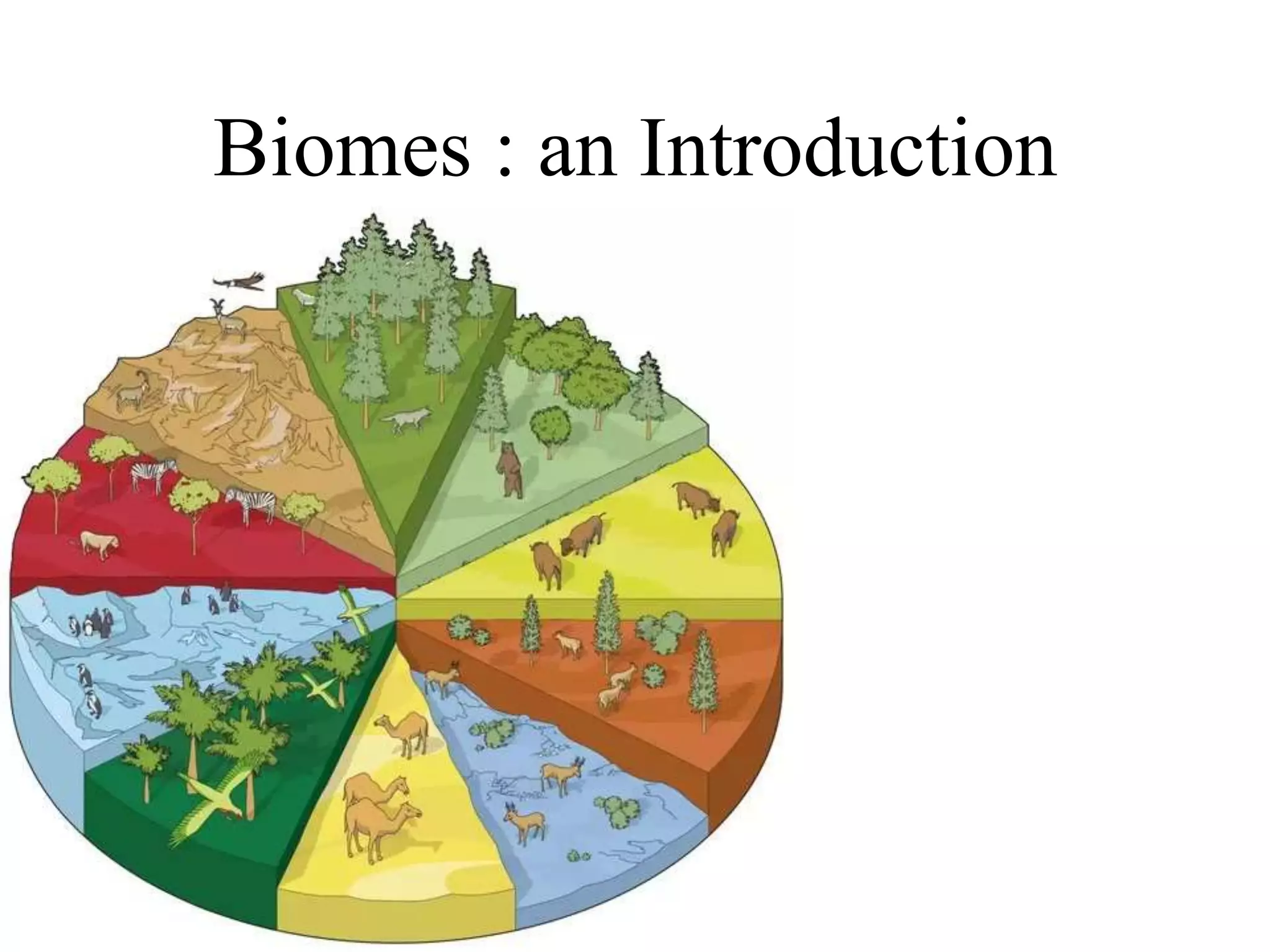
Biomes : an Introduction
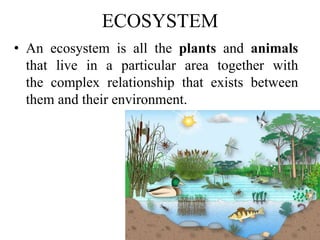
ECOSYSTEM
• An ecosystem is all the plants and animals
that live in a particular area together with
the complex relationship that exists between
them and their environment.
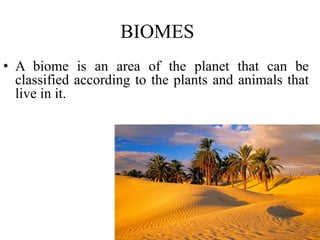
BIOMES
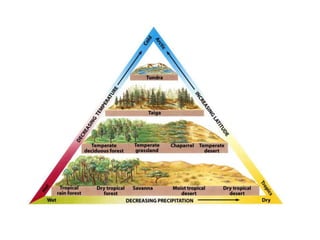
• A biome is an area of the planet that can be
classified according to the plants and animals that
live in it.
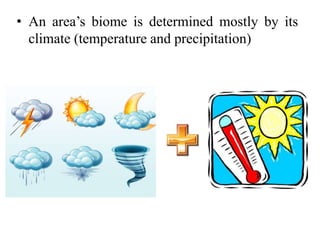
• An area’s biome is determined mostly by its
climate (temperature and precipitation)
• A biome is different from an ecosystem. An
ecosystem is the interaction of living and
nonliving things in an environment.
• A biome is a specific geographic area notable
for the species living there.
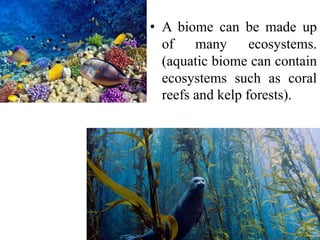
• A biome can be made up
of many ecosystems.
(aquatic biome can contain
ecosystems such as coral
reefs and kelp forests).
TYPES OF BIOMES
1)Terrestrial Biomes
2)Aquatic Biomes
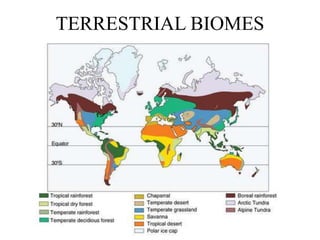
TERRESTRIAL BIOMES
Tundra
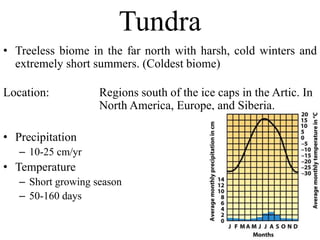
• Treeless biome in the far north with harsh, cold winters and
extremely short summers. (Coldest biome)
Location: Regions south of the ice caps in the Artic. In
North America, Europe, and Siberia.
• Precipitation
– 10-25 cm/yr
• Temperature
– Short growing season
– 50-160 days
Tundra
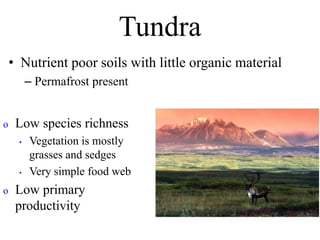
• Nutrient poor soils with little organic material
– Permafrost present
o Low species richness
• Vegetation is mostly
grasses and sedges
• Very simple food web
o Low primary
productivity
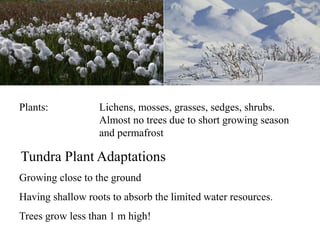
Plants: Lichens, mosses, grasses, sedges, shrubs.
Almost no trees due to short growing season
and permafrost
Tundra Plant Adaptations
Growing close to the ground
Having shallow roots to absorb the limited water resources.
Trees grow less than 1 m high!
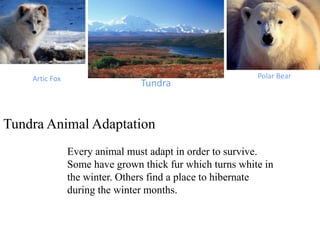
TundraArtic Fox Polar Bear
Tundra Animal Adaptation
Every animal must adapt in order to survive.
Some have grown thick fur which turns white in
the winter. Others find a place to hibernate
during the winter months.
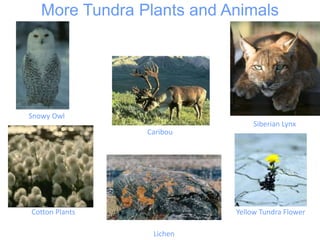
More Tundra Plants and Animals
Caribou
Snowy Owl
Siberian Lynx
Lichen
Cotton Plants Yellow Tundra Flower
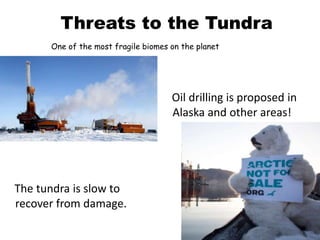
Threats to the Tundra
One of the most fragile biomes on the planet
The tundra is slow to
recover from damage.
Oil drilling is proposed in
Alaska and other areas!
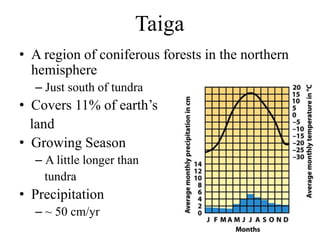
Taiga
• A region of coniferous forests in the northern
hemisphere
– Just south of tundra
• Covers 11% of earth’s
land
• Growing Season
– A little longer than
tundra
• Precipitation
– ~ 50 cm/yr
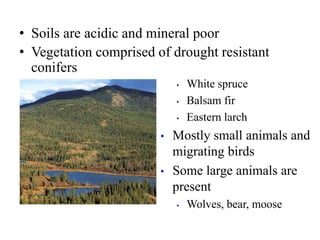
• Soils are acidic and mineral poor
• Vegetation comprised of drought resistant
conifers
• White spruce
• Balsam fir
• Eastern larch
• Mostly small animals and
migrating birds
• Some large animals are
present
• Wolves, bear, moose
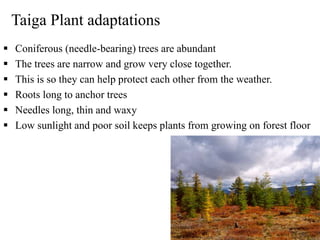
 Coniferous (needle-bearing) trees are abundant
 The trees are narrow and grow very close together.
 This is so they can help protect each other from the weather.
 Roots long to anchor trees
 Needles long, thin and waxy
 Low sunlight and poor soil keeps plants from growing on forest floor
Taiga Plant adaptations
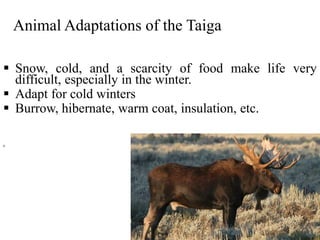
 Snow, cold, and a scarcity of food make life very
difficult, especially in the winter.
 Adapt for cold winters
 Burrow, hibernate, warm coat, insulation, etc.
h
Animal Adaptations of the Taiga
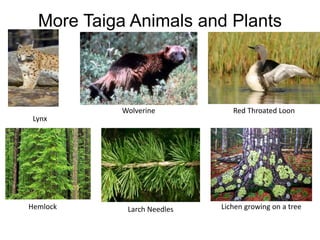
More Taiga Animals and Plants
Lynx
Wolverine Red Throated Loon
Hemlock Larch Needles Lichen growing on a tree
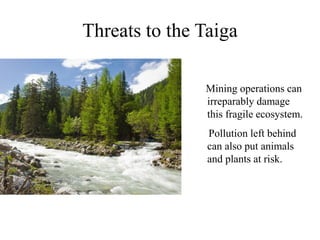
Threats to the Taiga
Mining operations can
irreparably damage
this fragile ecosystem.
Pollution left behind
can also put animals
and plants at risk.
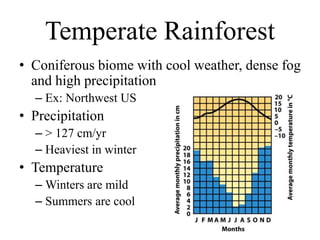
Temperate Rainforest
• Coniferous biome with cool weather, dense fog
and high precipitation
– Ex: Northwest US
• Precipitation
– > 127 cm/yr
– Heaviest in winter
• Temperature
– Winters are mild
– Summers are cool
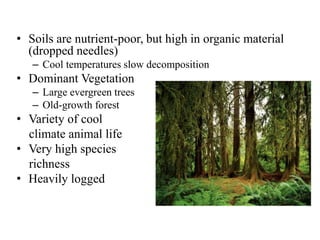
• Soils are nutrient-poor, but high in organic material
(dropped needles)
– Cool temperatures slow decomposition
• Dominant Vegetation
– Large evergreen trees
– Old-growth forest
• Variety of cool
climate animal life
• Very high species
richness
• Heavily logged
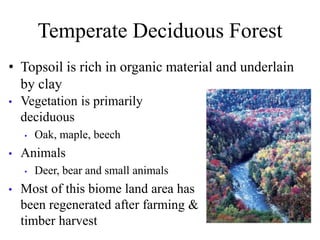
Temperate Deciduous Forest
• Topsoil is rich in organic material and underlain
by clay
• Vegetation is primarily
deciduous
• Oak, maple, beech
• Animals
• Deer, bear and small animals
• Most of this biome land area has
been regenerated after farming &
timber harvest
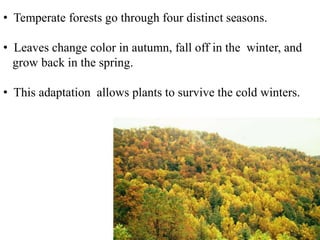
• Temperate forests go through four distinct seasons.
• Leaves change color in autumn, fall off in the winter, and
grow back in the spring.
• This adaptation allows plants to survive the cold winters.
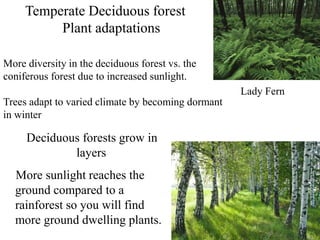
More diversity in the deciduous forest vs. the
coniferous forest due to increased sunlight.
Trees adapt to varied climate by becoming dormant
in winter
Lady Fern
Temperate Deciduous forest
Plant adaptations
Deciduous forests grow in
layers
More sunlight reaches the
ground compared to a
rainforest so you will find
more ground dwelling plants.
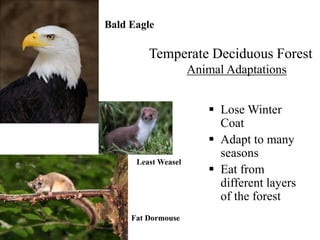
 Lose Winter
Coat
 Adapt to many
seasons
 Eat from
different layers
of the forest
Bald Eagle
Fat Dormouse
Least Weasel
Temperate Deciduous Forest
Animal Adaptations
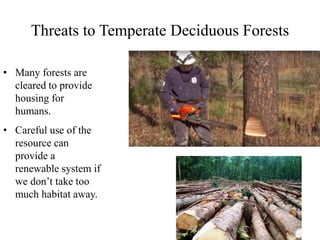
Threats to Temperate Deciduous Forests
• Many forests are
cleared to provide
housing for
humans.
• Careful use of the
resource can
provide a
renewable system if
we don’t take too
much habitat away.
Grassland
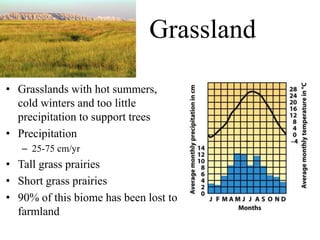
• Grasslands with hot summers,
cold winters and too little
precipitation to support trees
• Precipitation
– 25-75 cm/yr
• Tall grass prairies
• Short grass prairies
• 90% of this biome has been lost to
farmland
Grassland
• Soil has thick, organic material
rich organic horizon.
• Periodic fires keep the dominant
vegetation grasses
o Animals
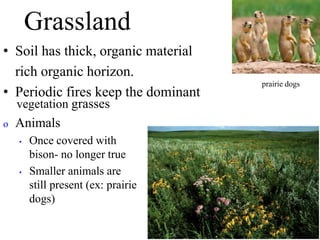
• Once covered with
bison- no longer true
• Smaller animals are
still present (ex: prairie
dogs)
prairie dogs
Deserts
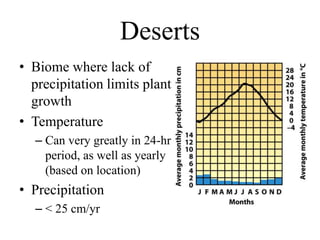
• Biome where lack of
precipitation limits plant
growth
• Temperature
– Can very greatly in 24-hr
period, as well as yearly
(based on location)
• Precipitation
– < 25 cm/yr
Deserts
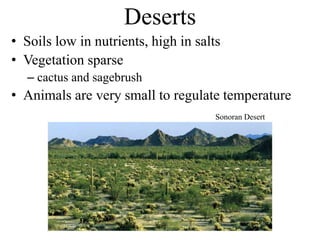
• Soils low in nutrients, high in salts
• Vegetation sparse
– cactus and sagebrush
• Animals are very small to regulate temperature
Sonoran Desert
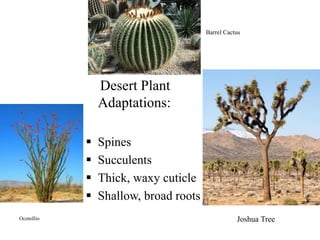
Joshua Tree
Desert Plant
Adaptations:
 Spines
 Succulents
 Thick, waxy cuticle
 Shallow, broad roots
Barrel Cactus
Ocotollio
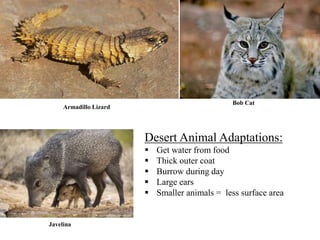
Desert Animal Adaptations:
 Get water from food
 Thick outer coat
 Burrow during day
 Large ears
 Smaller animals = less surface area
Javelina
Bob Cat
Armadillo Lizard
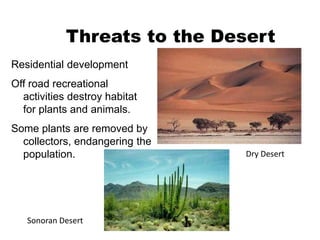
Threats to the Desert
Residential development
Off road recreational
activities destroy habitat
for plants and animals.
Some plants are removed by
collectors, endangering the
population.
Sonoran Desert
Dry Desert
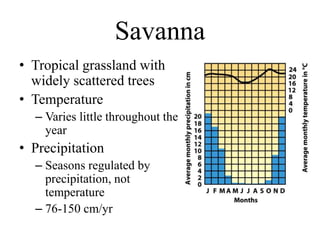
Savanna
• Tropical grassland with
widely scattered trees
• Temperature
– Varies little throughout the
year
• Precipitation
– Seasons regulated by
precipitation, not
temperature
– 76-150 cm/yr
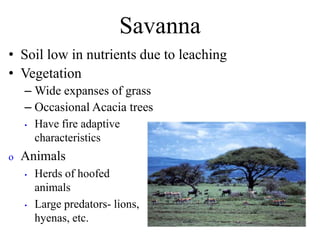
Savanna
• Soil low in nutrients due to leaching
• Vegetation
– Wide expanses of grass
– Occasional Acacia trees
• Have fire adaptive
characteristics
o Animals
• Herds of hoofed
animals
• Large predators- lions,
hyenas, etc.
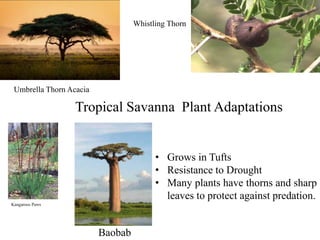
Whistling Thorn
Umbrella Thorn Acacia
Tropical Savanna Plant Adaptations
• Grows in Tufts
• Resistance to Drought
• Many plants have thorns and sharp
leaves to protect against predation.
Kangaroos Paws
Baobab
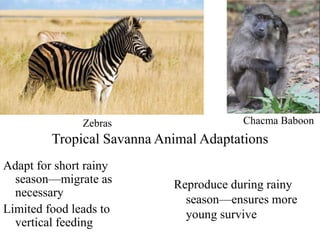
Adapt for short rainy
season—migrate as
necessary
Limited food leads to
vertical feeding
Reproduce during rainy
season—ensures more
young survive
Zebras Chacma Baboon
Tropical Savanna Animal Adaptations
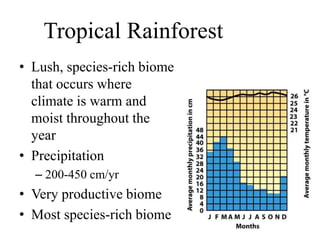
Tropical Rainforest
• Lush, species-rich biome
that occurs where
climate is warm and
moist throughout the
year
• Precipitation
– 200-450 cm/yr
• Very productive biome
• Most species-rich biome
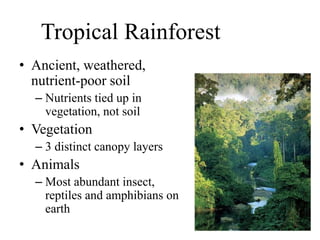
Tropical Rainforest
• Ancient, weathered,
nutrient-poor soil
– Nutrients tied up in
vegetation, not soil
• Vegetation
– 3 distinct canopy layers
• Animals
– Most abundant insect,
reptiles and amphibians on
earth
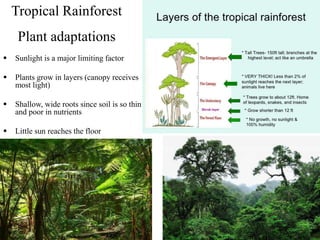
 Sunlight is a major limiting factor
 Plants grow in layers (canopy receives
most light)
 Shallow, wide roots since soil is so thin
and poor in nutrients
 Little sun reaches the floor
Tropical Rainforest
Plant adaptations
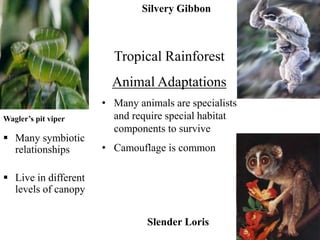
 Many symbiotic
relationships
 Live in different
levels of canopy
Wagler’s pit viper
Silvery Gibbon
Slender Loris
Tropical Rainforest
Animal Adaptations
• Many animals are specialists
and require special habitat
components to survive
• Camouflage is common
Aquatic Ecosystem
• Fundamental Division
– Freshwater
– Saltwater
• Aquatic Ecosystems also affected by
– Dissolved oxygen level, light penetration, pH,
presence/absence of currents
• Three main ecological categories of organisms
– Plankton- free floating
– Nekton- strong swimming
– Benthos- bottom dwelling
Freshwater Ecosystems
• Includes:
– Rivers and streams
– Lakes and ponds
– Marshes and swamps
• Represent 2% of earth’s surface
• Assist in recycling water back to the oceans
(Biogeochemical Cycling)
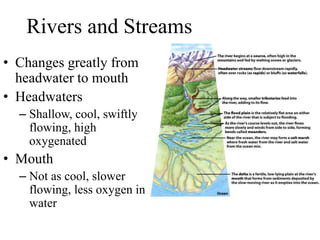
Rivers and Streams
• Changes greatly from
headwater to mouth
• Headwaters
– Shallow, cool, swiftly
flowing, high
oxygenated
• Mouth
– Not as cool, slower
flowing, less oxygen in
water
Lakes and Ponds
• Body of freshwater that does not flow
• Three zones
– Littoral
– Limnetic
– Profundal
• Experience thermal stratification (depending
on depth)
Lakes and Ponds
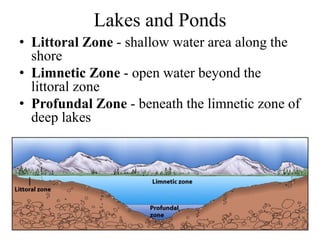
• Littoral Zone - shallow water area along the
shore
• Limnetic Zone - open water beyond the
littoral zone
• Profundal Zone - beneath the limnetic zone of
deep lakes
Marshes and Swamps
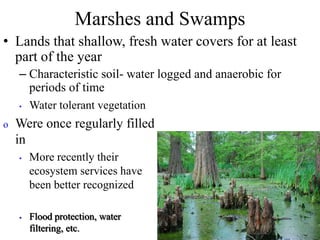
• Lands that shallow, fresh water covers for at least
part of the year
– Characteristic soil- water logged and anaerobic for
periods of time
• Water tolerant vegetation
o Were once regularly filled
in
• More recently their
ecosystem services have
been better recognized
• Flood protection, water
filtering, etc.
Estuaries
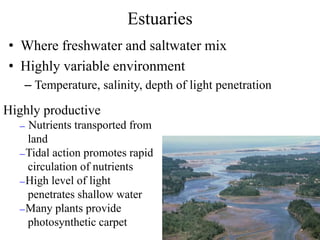
• Where freshwater and saltwater mix
• Highly variable environment
– Temperature, salinity, depth of light penetration
Highly productive
— Nutrients transported from
land
—Tidal action promotes rapid
circulation of nutrients
—High level of light
penetrates shallow water
—Many plants provide
photosynthetic carpet
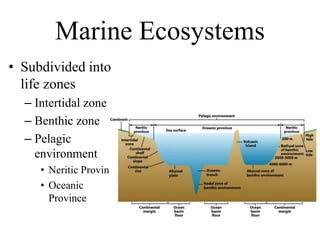
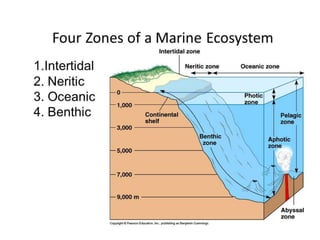
Marine Ecosystems
• Subdivided into
life zones
– Intertidal zone
– Benthic zone
– Pelagic
environment
• Neritic Province
• Oceanic
Province
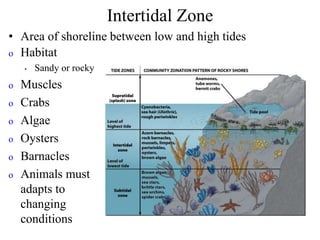
Intertidal Zone
• Area of shoreline between low and high tides
o Habitat
• Sandy or rocky
o Muscles
o Crabs
o Algae
o Oysters
o Barnacles
o Animals must
adapts to
changing
conditions
Benthic Zone
• Ocean floor, extending from tidal zone to deep
sea trenches
• Sediment is mostly mud
– Burrowing worms and clams
• Three zone
– Bathyal: 200m - 4000m deep
– Abyssal: 4000m -6000m deep
– Hadal: 6000m – bottom of deep sea trenches
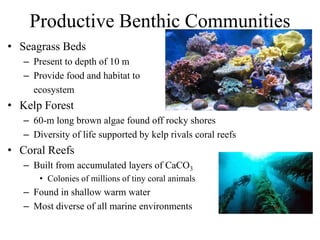
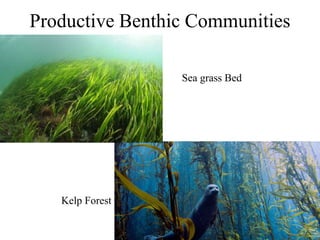
Productive Benthic Communities
• Seagrass Beds
– Present to depth of 10 m
– Provide food and habitat to
ecosystem
• Kelp Forest
– 60-m long brown algae found off rocky shores
– Diversity of life supported by kelp rivals coral reefs
• Coral Reefs
– Built from accumulated layers of CaCO3
• Colonies of millions of tiny coral animals
– Found in shallow warm water
– Most diverse of all marine environments
Productive Benthic Communities
Sea grass Bed
Kelp Forest
Coral Reef
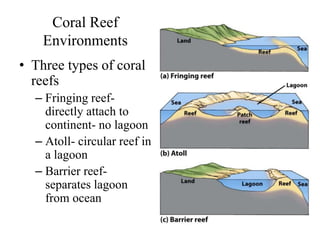
Environments
• Three types of coral
reefs
– Fringing reef-
directly attach to
continent- no lagoon
– Atoll- circular reef in
a lagoon
– Barrier reef-
separates lagoon
from ocean
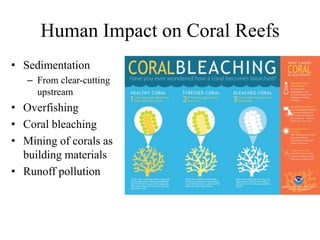
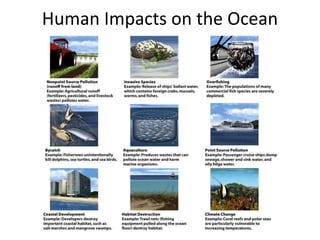
Human Impact on Coral Reefs
• Sedimentation
– From clear-cutting
upstream
• Overfishing
• Coral bleaching
• Mining of corals as
building materials
• Runoff pollution
Pelagic Environment
• All the open ocean water
• Two main divisions
– Neritic Province
• Water that overlies the continental shelf (to depth of 200 m)
• Organisms are all floaters or swimmers
– Oceanic Province
• Water that overlies depths greater than 200 m
• 75% of world’s ocean
• Most organisms are dependent on marine snow
• Organisms are filter feeders, scavengers and predators
Human Impacts on the Ocean

Ecosystem characetrs

  • 1.
    Biomes : anIntroduction
  • 2.
    ECOSYSTEM • An ecosystemis all the plants and animals that live in a particular area together with the complex relationship that exists between them and their environment.
  • 3.
    BIOMES • A biomeis an area of the planet that can be classified according to the plants and animals that live in it.
  • 4.
    • An area’sbiome is determined mostly by its climate (temperature and precipitation)
  • 5.
    • A biomeis different from an ecosystem. An ecosystem is the interaction of living and nonliving things in an environment. • A biome is a specific geographic area notable for the species living there.
  • 6.
    • A biomecan be made up of many ecosystems. (aquatic biome can contain ecosystems such as coral reefs and kelp forests).
  • 7.
    TYPES OF BIOMES 1)TerrestrialBiomes 2)Aquatic Biomes
  • 8.
  • 10.
    Tundra • Treeless biomein the far north with harsh, cold winters and extremely short summers. (Coldest biome) Location: Regions south of the ice caps in the Artic. In North America, Europe, and Siberia. • Precipitation – 10-25 cm/yr • Temperature – Short growing season – 50-160 days
  • 11.
    Tundra • Nutrient poorsoils with little organic material – Permafrost present o Low species richness • Vegetation is mostly grasses and sedges • Very simple food web o Low primary productivity
  • 12.
    Plants: Lichens, mosses,grasses, sedges, shrubs. Almost no trees due to short growing season and permafrost Tundra Plant Adaptations Growing close to the ground Having shallow roots to absorb the limited water resources. Trees grow less than 1 m high!
  • 13.
    TundraArtic Fox PolarBear Tundra Animal Adaptation Every animal must adapt in order to survive. Some have grown thick fur which turns white in the winter. Others find a place to hibernate during the winter months.
  • 14.
    More Tundra Plantsand Animals Caribou Snowy Owl Siberian Lynx Lichen Cotton Plants Yellow Tundra Flower
  • 15.
    Threats to theTundra One of the most fragile biomes on the planet The tundra is slow to recover from damage. Oil drilling is proposed in Alaska and other areas!
  • 16.
    Taiga • A regionof coniferous forests in the northern hemisphere – Just south of tundra • Covers 11% of earth’s land • Growing Season – A little longer than tundra • Precipitation – ~ 50 cm/yr
  • 17.
    • Soils areacidic and mineral poor • Vegetation comprised of drought resistant conifers • White spruce • Balsam fir • Eastern larch • Mostly small animals and migrating birds • Some large animals are present • Wolves, bear, moose
  • 18.
     Coniferous (needle-bearing)trees are abundant  The trees are narrow and grow very close together.  This is so they can help protect each other from the weather.  Roots long to anchor trees  Needles long, thin and waxy  Low sunlight and poor soil keeps plants from growing on forest floor Taiga Plant adaptations
  • 19.
     Snow, cold,and a scarcity of food make life very difficult, especially in the winter.  Adapt for cold winters  Burrow, hibernate, warm coat, insulation, etc. h Animal Adaptations of the Taiga
  • 20.
    More Taiga Animalsand Plants Lynx Wolverine Red Throated Loon Hemlock Larch Needles Lichen growing on a tree
  • 21.
    Threats to theTaiga Mining operations can irreparably damage this fragile ecosystem. Pollution left behind can also put animals and plants at risk.
  • 22.
    Temperate Rainforest • Coniferousbiome with cool weather, dense fog and high precipitation – Ex: Northwest US • Precipitation – > 127 cm/yr – Heaviest in winter • Temperature – Winters are mild – Summers are cool
  • 23.
    • Soils arenutrient-poor, but high in organic material (dropped needles) – Cool temperatures slow decomposition • Dominant Vegetation – Large evergreen trees – Old-growth forest • Variety of cool climate animal life • Very high species richness • Heavily logged
  • 24.
    Temperate Deciduous Forest •Topsoil is rich in organic material and underlain by clay • Vegetation is primarily deciduous • Oak, maple, beech • Animals • Deer, bear and small animals • Most of this biome land area has been regenerated after farming & timber harvest
  • 25.
    • Temperate forestsgo through four distinct seasons. • Leaves change color in autumn, fall off in the winter, and grow back in the spring. • This adaptation allows plants to survive the cold winters.
  • 26.
    More diversity inthe deciduous forest vs. the coniferous forest due to increased sunlight. Trees adapt to varied climate by becoming dormant in winter Lady Fern Temperate Deciduous forest Plant adaptations Deciduous forests grow in layers More sunlight reaches the ground compared to a rainforest so you will find more ground dwelling plants.
  • 27.
     Lose Winter Coat Adapt to many seasons  Eat from different layers of the forest Bald Eagle Fat Dormouse Least Weasel Temperate Deciduous Forest Animal Adaptations
  • 28.
    Threats to TemperateDeciduous Forests • Many forests are cleared to provide housing for humans. • Careful use of the resource can provide a renewable system if we don’t take too much habitat away.
  • 29.
    Grassland • Grasslands withhot summers, cold winters and too little precipitation to support trees • Precipitation – 25-75 cm/yr • Tall grass prairies • Short grass prairies • 90% of this biome has been lost to farmland
  • 30.
    Grassland • Soil hasthick, organic material rich organic horizon. • Periodic fires keep the dominant vegetation grasses o Animals • Once covered with bison- no longer true • Smaller animals are still present (ex: prairie dogs) prairie dogs
  • 31.
    Deserts • Biome wherelack of precipitation limits plant growth • Temperature – Can very greatly in 24-hr period, as well as yearly (based on location) • Precipitation – < 25 cm/yr
  • 32.
    Deserts • Soils lowin nutrients, high in salts • Vegetation sparse – cactus and sagebrush • Animals are very small to regulate temperature Sonoran Desert
  • 33.
    Joshua Tree Desert Plant Adaptations: Spines  Succulents  Thick, waxy cuticle  Shallow, broad roots Barrel Cactus Ocotollio
  • 34.
    Desert Animal Adaptations: Get water from food  Thick outer coat  Burrow during day  Large ears  Smaller animals = less surface area Javelina Bob Cat Armadillo Lizard
  • 35.
    Threats to theDesert Residential development Off road recreational activities destroy habitat for plants and animals. Some plants are removed by collectors, endangering the population. Sonoran Desert Dry Desert
  • 36.
    Savanna • Tropical grasslandwith widely scattered trees • Temperature – Varies little throughout the year • Precipitation – Seasons regulated by precipitation, not temperature – 76-150 cm/yr
  • 37.
    Savanna • Soil lowin nutrients due to leaching • Vegetation – Wide expanses of grass – Occasional Acacia trees • Have fire adaptive characteristics o Animals • Herds of hoofed animals • Large predators- lions, hyenas, etc.
  • 38.
    Whistling Thorn Umbrella ThornAcacia Tropical Savanna Plant Adaptations • Grows in Tufts • Resistance to Drought • Many plants have thorns and sharp leaves to protect against predation. Kangaroos Paws Baobab
  • 39.
    Adapt for shortrainy season—migrate as necessary Limited food leads to vertical feeding Reproduce during rainy season—ensures more young survive Zebras Chacma Baboon Tropical Savanna Animal Adaptations
  • 40.
    Tropical Rainforest • Lush,species-rich biome that occurs where climate is warm and moist throughout the year • Precipitation – 200-450 cm/yr • Very productive biome • Most species-rich biome
  • 41.
    Tropical Rainforest • Ancient,weathered, nutrient-poor soil – Nutrients tied up in vegetation, not soil • Vegetation – 3 distinct canopy layers • Animals – Most abundant insect, reptiles and amphibians on earth
  • 42.
     Sunlight isa major limiting factor  Plants grow in layers (canopy receives most light)  Shallow, wide roots since soil is so thin and poor in nutrients  Little sun reaches the floor Tropical Rainforest Plant adaptations
  • 43.
     Many symbiotic relationships Live in different levels of canopy Wagler’s pit viper Silvery Gibbon Slender Loris Tropical Rainforest Animal Adaptations • Many animals are specialists and require special habitat components to survive • Camouflage is common
  • 44.
    Aquatic Ecosystem • FundamentalDivision – Freshwater – Saltwater • Aquatic Ecosystems also affected by – Dissolved oxygen level, light penetration, pH, presence/absence of currents • Three main ecological categories of organisms – Plankton- free floating – Nekton- strong swimming – Benthos- bottom dwelling
  • 45.
    Freshwater Ecosystems • Includes: –Rivers and streams – Lakes and ponds – Marshes and swamps • Represent 2% of earth’s surface • Assist in recycling water back to the oceans (Biogeochemical Cycling)
  • 46.
    Rivers and Streams •Changes greatly from headwater to mouth • Headwaters – Shallow, cool, swiftly flowing, high oxygenated • Mouth – Not as cool, slower flowing, less oxygen in water
  • 47.
    Lakes and Ponds •Body of freshwater that does not flow • Three zones – Littoral – Limnetic – Profundal • Experience thermal stratification (depending on depth)
  • 48.
    Lakes and Ponds •Littoral Zone - shallow water area along the shore • Limnetic Zone - open water beyond the littoral zone • Profundal Zone - beneath the limnetic zone of deep lakes
  • 49.
    Marshes and Swamps •Lands that shallow, fresh water covers for at least part of the year – Characteristic soil- water logged and anaerobic for periods of time • Water tolerant vegetation o Were once regularly filled in • More recently their ecosystem services have been better recognized • Flood protection, water filtering, etc.
  • 50.
    Estuaries • Where freshwaterand saltwater mix • Highly variable environment – Temperature, salinity, depth of light penetration Highly productive — Nutrients transported from land —Tidal action promotes rapid circulation of nutrients —High level of light penetrates shallow water —Many plants provide photosynthetic carpet
  • 52.
    Marine Ecosystems • Subdividedinto life zones – Intertidal zone – Benthic zone – Pelagic environment • Neritic Province • Oceanic Province
  • 53.
    Intertidal Zone • Areaof shoreline between low and high tides o Habitat • Sandy or rocky o Muscles o Crabs o Algae o Oysters o Barnacles o Animals must adapts to changing conditions
  • 54.
    Benthic Zone • Oceanfloor, extending from tidal zone to deep sea trenches • Sediment is mostly mud – Burrowing worms and clams • Three zone – Bathyal: 200m - 4000m deep – Abyssal: 4000m -6000m deep – Hadal: 6000m – bottom of deep sea trenches
  • 55.
    Productive Benthic Communities •Seagrass Beds – Present to depth of 10 m – Provide food and habitat to ecosystem • Kelp Forest – 60-m long brown algae found off rocky shores – Diversity of life supported by kelp rivals coral reefs • Coral Reefs – Built from accumulated layers of CaCO3 • Colonies of millions of tiny coral animals – Found in shallow warm water – Most diverse of all marine environments
  • 56.
  • 57.
    Coral Reef Environments • Threetypes of coral reefs – Fringing reef- directly attach to continent- no lagoon – Atoll- circular reef in a lagoon – Barrier reef- separates lagoon from ocean
  • 58.
    Human Impact onCoral Reefs • Sedimentation – From clear-cutting upstream • Overfishing • Coral bleaching • Mining of corals as building materials • Runoff pollution
  • 59.
    Pelagic Environment • Allthe open ocean water • Two main divisions – Neritic Province • Water that overlies the continental shelf (to depth of 200 m) • Organisms are all floaters or swimmers – Oceanic Province • Water that overlies depths greater than 200 m • 75% of world’s ocean • Most organisms are dependent on marine snow • Organisms are filter feeders, scavengers and predators
  • 61.