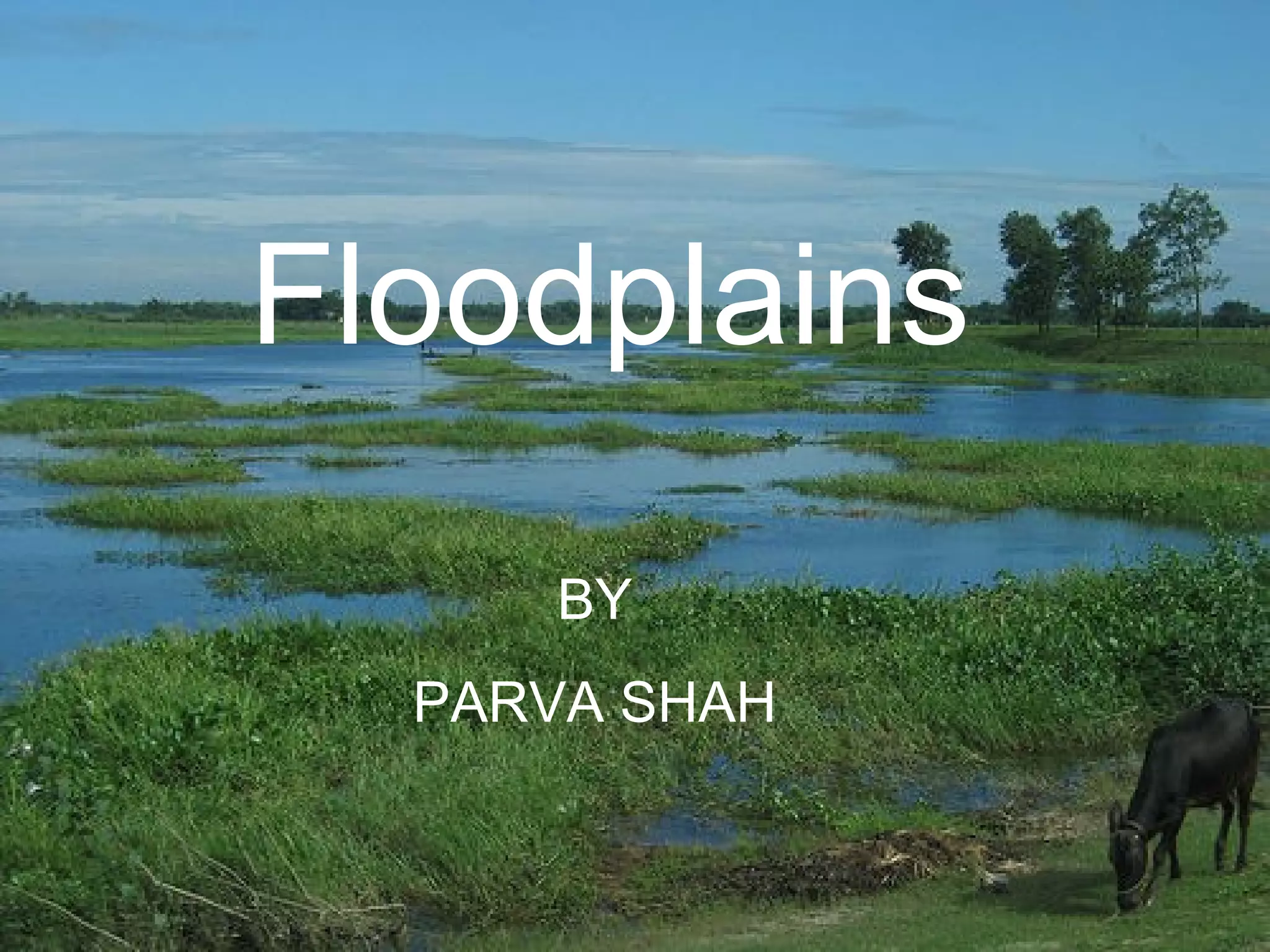
Floodplains
BY
PARVA SHAH
What are Floodplains?
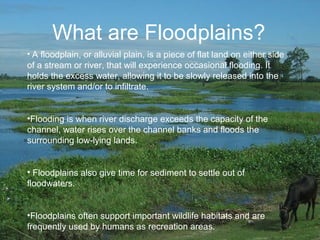
• A floodplain, or alluvial plain, is a piece of flat land on either side
of a stream or river, that will experience occasional flooding. It
holds the excess water, allowing it to be slowly released into the
river system and/or to infiltrate.
•Flooding is when river discharge exceeds the capacity of the
channel, water rises over the channel banks and floods the
surrounding low-lying lands.
• Floodplains also give time for sediment to settle out of
floodwaters.
•Floodplains often support important wildlife habitats and are
frequently used by humans as recreation areas.
What are Floodplains?
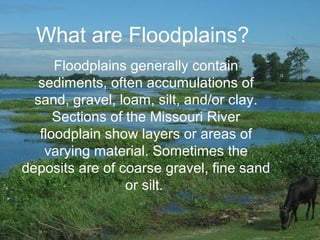
Floodplains generally contain
sediments, often accumulations of
sand, gravel, loam, silt, and/or clay.
Sections of the Missouri River
floodplain show layers or areas of
varying material. Sometimes the
deposits are of coarse gravel, fine sand
or silt.
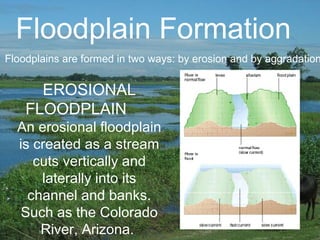
EROSIONAL
FLOODPLAIN
An erosional floodplain
is created as a stream
cuts vertically and
laterally into its
channel and banks.
Such as the Colorado
River, Arizona.
Floodplains are formed in two ways: by erosion and by aggradation
Floodplain Formation
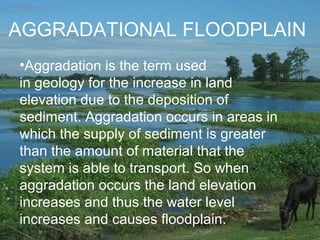
AGGRADATIONAL FLOODPLAIN
•Aggradation is the term used
in geology for the increase in land
elevation due to the deposition of
sediment. Aggradation occurs in areas in
which the supply of sediment is greater
than the amount of material that the
system is able to transport. So when
aggradation occurs the land elevation
increases and thus the water level
increases and causes floodplain.
Floodplain Uses
•The main use of floodplains is for agriculture, however the use of the land
for settlement has become more popular.
Settlement on floodplains, despite occasional flooding, is attractive because:
- Water is most available.
- The land is more fertile.
- Rivers correspond to cheap modes of transport.
- Flat or gently sloping land is more suitable for development.
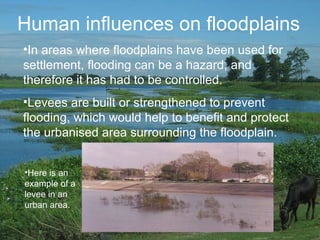
Here is an example of how floodplains have been used for settlement
and how the river flooding has had to be controlled.
Human influences on floodplains
•In areas where floodplains have been used for
settlement, flooding can be a hazard, and
therefore it has had to be controlled.
•Levees are built or strengthened to prevent
flooding, which would help to benefit and protect
the urbanised area surrounding the floodplain.
•Here is an
example of a
levee in an
urban area.
THANK YOU

Floodplain presentation 2

  • 1.
  • 2.
    What are Floodplains? •A floodplain, or alluvial plain, is a piece of flat land on either side of a stream or river, that will experience occasional flooding. It holds the excess water, allowing it to be slowly released into the river system and/or to infiltrate. •Flooding is when river discharge exceeds the capacity of the channel, water rises over the channel banks and floods the surrounding low-lying lands. • Floodplains also give time for sediment to settle out of floodwaters. •Floodplains often support important wildlife habitats and are frequently used by humans as recreation areas.
  • 3.
    What are Floodplains? Floodplainsgenerally contain sediments, often accumulations of sand, gravel, loam, silt, and/or clay. Sections of the Missouri River floodplain show layers or areas of varying material. Sometimes the deposits are of coarse gravel, fine sand or silt.
  • 4.
    EROSIONAL FLOODPLAIN An erosional floodplain iscreated as a stream cuts vertically and laterally into its channel and banks. Such as the Colorado River, Arizona. Floodplains are formed in two ways: by erosion and by aggradation Floodplain Formation
  • 5.
    Floodplain Formation AGGRADATIONAL FLOODPLAIN •Aggradationis the term used in geology for the increase in land elevation due to the deposition of sediment. Aggradation occurs in areas in which the supply of sediment is greater than the amount of material that the system is able to transport. So when aggradation occurs the land elevation increases and thus the water level increases and causes floodplain.
  • 6.
    Floodplain Uses •The mainuse of floodplains is for agriculture, however the use of the land for settlement has become more popular. Settlement on floodplains, despite occasional flooding, is attractive because: - Water is most available. - The land is more fertile. - Rivers correspond to cheap modes of transport. - Flat or gently sloping land is more suitable for development. Here is an example of how floodplains have been used for settlement and how the river flooding has had to be controlled.
  • 7.
    Human influences onfloodplains •In areas where floodplains have been used for settlement, flooding can be a hazard, and therefore it has had to be controlled. •Levees are built or strengthened to prevent flooding, which would help to benefit and protect the urbanised area surrounding the floodplain. •Here is an example of a levee in an urban area.
  • 8.