THE BIOSPHERELet’s join our animal friends around the world and explore all the Earth’s Biomes from the tallest mountains to the deepest depths of the sea.
Aquatic Biomes   LakesThis is any standing body of water and can range from tiny ponds to much larger lakes.The temperature ranges due to the decrease in light with the increase in depth.Some common organisms found in lakes are: 	-Photosynthetic which means they need sunlight to make their own food. 	   Examples: Rooted and aquatic floating plants	-Other organisms are called heterotrophs which cannot make their own food and rely on eating other substances. 	   Examples: simpler organisms like Zoey zooplankton and her friends, various         invertebrates and fish.
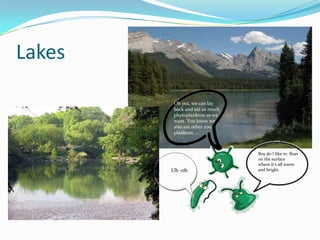
LakesOh yea, we can lay back and eat as much phytoplankton as we want. You know we also eat other zoo plankton. ..Boy do I like to  float on the surface where it’s all warm and bright.Uh -oh
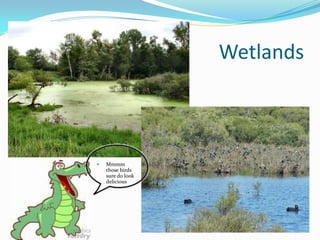
Aquatic Biomes WetlandsAny inundated areas which are areas saturated with water at least some of the time.3 kinds:Basin wetlands-in shallow basinsRiverine wetlands- along shallow streams & riversFringe wetlands- along coasts of big lakes and/or seasOrganismsPhotosynthetic- plants like cattails  that can grow in water and in soilHeterotrophs- invertebrates, birds, herbivores  (plant eaters) & carnivores (meat eaters) like Alfred the alligator.
WetlandsMmmm those birds sure do look delicious
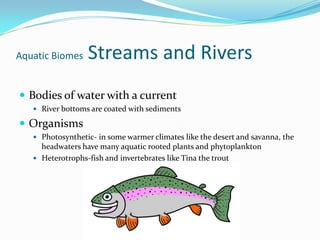
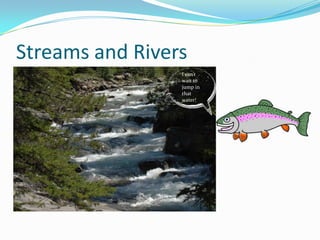
Aquatic Biomes  Streams and RiversBodies of water with a currentRiver bottoms are coated with sediments OrganismsPhotosynthetic- in some warmer climates like the desert and savanna, the headwaters have many aquatic rooted plants and phytoplanktonHeterotrophs-fish and invertebrates like Tina the trout
Streams and RiversI can’t wait to jump in that water!
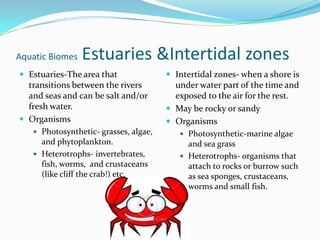
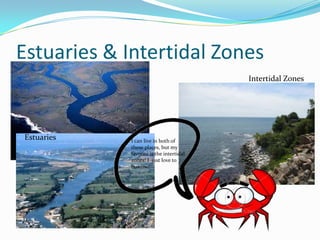
Aquatic BiomesEstuaries &Intertidal zonesEstuaries-The area that transitions between the rivers and seas and can be salt and/or fresh water.OrganismsPhotosynthetic- grasses, algae, and phytoplankton.Heterotrophs- invertebrates, fish, worms,  and crustaceans (like cliff the crab!) etc.Intertidal zones- when a shore is under water part of the time and exposed to the air for the rest.May be rocky or sandyOrganismsPhotosynthetic-marine algae and sea grassHeterotrophs- organisms that attach to rocks or burrow such as sea sponges, crustaceans, worms and small fish.
Estuaries & Intertidal ZonesIntertidal ZonesEstuariesI can live in both of these places, but my favorite is the intertidal zones! I  just love to burrow!
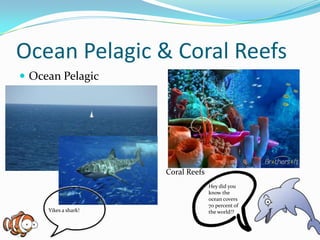
Aquatic Biomes Ocean Pelagic & Coral ReefsOcean Pelagic means a huge body of open water.OrganismsPhotosynthetic- phytoplankton, photosynthetic bacteriaHeterotrophs- zooplankton, protists, small invertebrates, and fish as well as squids, fish and marine mammals (like Wallace the Dolphin).Coral Reefs are actually skeletons of coral found near islands, or along the coasts of continents.OrganismsPhotosynthetic- unicellular, red, and green algaeHeterotrophs- coral, fish like Carl the Clownfish, and invertebrates.
Ocean Pelagic & Coral ReefsOcean Pelagic Coral ReefsHey did you know the ocean covers 70 percent of the world!?Yikes a shark!
Thanks for exploring the Aquatic Biomes with us!Now we're going to move onto land and discover the Terrestrial Biomes.
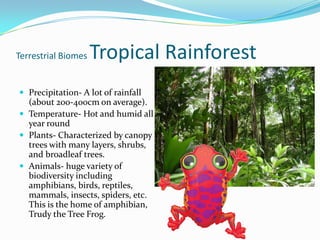
Terrestrial Biomes Tropical RainforestPrecipitation- A lot of rainfall (about 200-400cm on average).Temperature- Hot and humid all year roundPlants- Characterized by canopy trees with many layers, shrubs, and broadleaf trees.Animals- huge variety of biodiversity including amphibians, birds, reptiles, mammals, insects, spiders, etc. This is the home of amphibian, Trudy the Tree Frog.
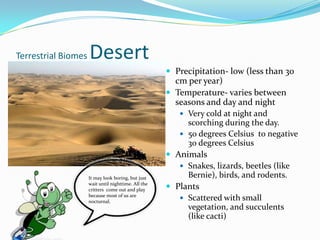
Terrestrial Biomes DesertPrecipitation- low (less than 30 cm per year)Temperature- varies between seasons and day and nightVery cold at night and scorching during the day.50 degrees Celsius  to negative 30 degrees CelsiusAnimalsSnakes, lizards, beetles (like Bernie), birds, and rodents.PlantsScattered with small vegetation, and succulents (like cacti)It may look boring, but just wait until nighttime. All the critters  come out and play because most of us are nocturnal.
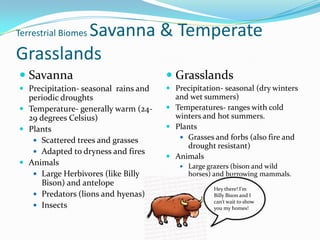
Terrestrial Biomes Savanna & Temperate GrasslandsSavannaPrecipitation- seasonal  rains and periodic droughtsTemperature- generally warm (24-29 degrees Celsius)PlantsScattered trees and grassesAdapted to dryness and firesAnimalsLarge Herbivores (like Billy Bison) and antelopePredators (lions and hyenas)Insects GrasslandsPrecipitation- seasonal (dry winters and wet summers)Temperatures- ranges with cold winters and hot summers.PlantsGrasses and forbs (also fire and drought resistant)AnimalsLarge grazers (bison and wild horses) and burrowing mammals.Hey there! I’m Billy Bison and I can’t wait to show you my homes!
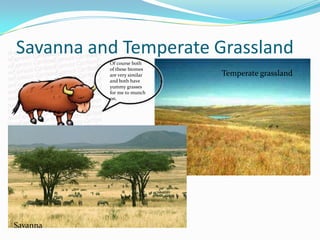
Savanna and Temperate GrasslandOf course both of these biomes are very similar and both have yummy grasses for me to munch on.Temperate grasslandSavanna
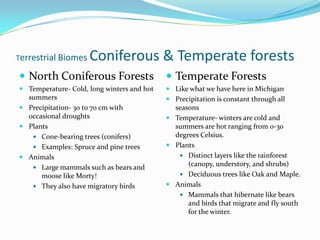
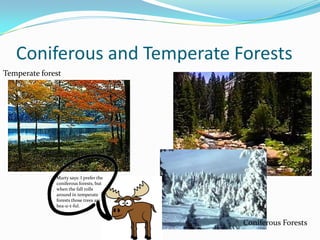
Terrestrial Biomes Coniferous & Temperate forestsNorth Coniferous ForestsTemperature- Cold, long winters and hot summersPrecipitation- 30 to 70 cm with occasional droughtsPlantsCone-bearing trees (conifers) Examples: Spruce and pine treesAnimalsLarge mammals such as bears and moose like Morty!They also have migratory birdsTemperate ForestsLike what we have here in MichiganPrecipitation is constant through all seasonsTemperature- winters are cold and summers are hot ranging from 0-30 degrees Celsius. PlantsDistinct layers like the rainforest (canopy, understory, and shrubs)Deciduous trees like Oak and Maple.AnimalsMammals that hibernate like bears and birds that migrate and fly south for the winter.
Coniferous and Temperate ForestsTemperate forestMarty says: I prefer the coniferous forests, but when the fall rolls around in temperate forests those trees are bea-u-t-ful.Coniferous Forests
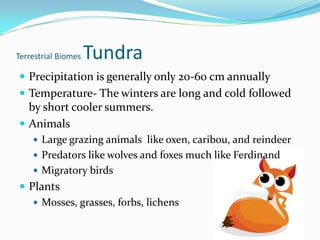
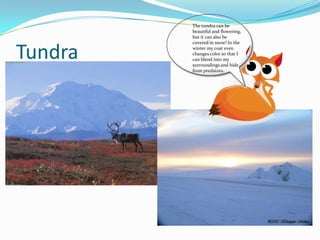
Terrestrial Biomes TundraPrecipitation is generally only 20-60 cm annuallyTemperature- The winters are long and cold followed by short cooler summers.Animals Large grazing animals  like oxen, caribou, and reindeerPredators like wolves and foxes much like FerdinandMigratory birdsPlantsMosses, grasses, forbs, lichens
TundraThe tundra can be beautiful and flowering, but it can also be covered in snow! In the winter my coat even changes color so that I can blend into my surroundings and hide from predators.
And that wraps up all the biomes!Thanks for joining us on our big exploration!
Work CitedSlide #1- Cartoon Earth- http://thumbs.dreamstime.com/thumblarge_165/1184774648GYH5l5.jpgSlide #2-Plankton- http://games.noaa.gov/seaturtle/images/plankton220.jpgSlide#3- Lake- http://hyperphysics.phy-astr.gsu.edu/nave-html/S08/imgsum/263lakes.jpgSlide #3,5,11,14-16-Speech bubble- http://www.boingboing.net/_01Independent-Projects_03Speech-Bubbles_Bubble.jpgSlide #3,9,11, 18- Speech bubble- http://www.wishfulthinking.co.uk/wp-content/speechbubble-1.jpgSlide #3- Pond- http://www.centralpark.com/pages/attractions/pond.jpgSlide #3, 7,20- Speech bubble- http://forum.weborum.com/josh/finalbubble.jpgSlide #4- alligator- http://www.graphicsfactory.com/clip-art/image_files/tn_image/8/582928-tn_allegator700.gifSlide#5- Alligator- http://i31.tinypic.com/154ks4j.gifSlide #5- wetland- http://www.waroona.wa.gov.au/services_and_facilities/community_development/Hamel%20Wetland/Hamel%20Wetlands%20-%20Birds%201Slide #6,7- trout- http://www.how-to-draw-cartoons-online.com/image-files/how-to-draw-a-fish-10.gifSlide #7- River- http://hyperphysics.phy-astr.gsu.edu/nave-html/S08/imgsum/233streams.jpgSlide #8, 9- Crab-  http://www.bradfitzpatrick.com/store/images/products/a008-cartoon-crab-clipart.jpgSlide#9- estuary- http://room19vv.tripod.com/sitebuildercontent/sitebuilderpictures/.pond/estuaries.jpg.w300h225.jpg
Work Cited Cont…Slide #9-estuary- http://www.iwight.com/living_here/environment/estuaries/images/5IslandEstuaries01.jpgSlide#9-Intertidal Zone- http://upload.wikimedia.org/wikipedia/commons/e/e6/Newport_beach.jpgSlide #10, 11- Clownfish- http://www.istockphoto.com/file_thumbview_approve/10068351/2/istockphoto_10068351-googly-eyed-clown-fish.jpgSlide#10, 11- dolphin- http://www.fotosearch.com/bthumb/CSP/CSP105/k1051597.jpgSlide#11- Open Ocean- http://c1.ecolocalizer.com/files/2009/07/whitesharkcreativecommons.jpgSlide #11-Open Ocean- http://www.davidstauffer.com/caribbean2007/pictures/Caribbean%20Cruise%202007%20-%20Disney%20Magic%20-%20Open%20Ocean%20-%20Sail%20Boat%2001.jpgSlide#12- Coral Reef- http://4.bp.blogspot.com/_zGrseSbwSE4/S7v6Z6MDFzI/AAAAAAAAAI8/4MdvTW0Ic4o/s1600/coral_reef_3d_screensavers-185850-3.jpegSlide #13- Tree Frog- http://www.balloonmaniacs.com/images/treefrogredheliumballoon.jpgSlide#13-Rainforest- http://www.svbchemicals.com/rainforest1.jpgSlide#14- desert- http://www.bugbog.com/images/galleries/namibia_pictures/namib_desert_pictures.jpgSlide#14- beetle- http://www.speedysigns.com/images/decals/jpg/H/345/19.jpgSlide #15- temperate grassland- http://library.thinkquest.org/CR0210360/grasslands_lrg.jpgSlide #15- savanna- http://room42.wikispaces.com/file/view/4savanna.jpg/34448245/4savanna.jpgSlide# 14, 15- bison-  http://www.andreadams.com/assets/watermark%20files/yak.jpgSlide #17- moose- http://www.how-to-draw-funny-cartoons.com/image-files/cartoon-moose-9.gif
Work Cited Cont…Slide#17 -Coniferous forest-http://earthobservatory.nasa.gov/Experiments/Biome/Images/picconiferous.jpgSlide#17 -Temperate Forest- http://earthobservatory.nasa.gov/Experiments/Biome/Images/pictemperate.jpgSlide #17 -Coniferous Forest- http://4.bp.blogspot.com/_w2R5TyJ6IFI/S5Wgl085jVI/AAAAAAAAAU4/j1xRmmDeY6U/s400/Coniferous+forest+in+snow.jpgSlide #19- Tundra- http://biomef.wikispaces.com/file/view/17HannahFrostyTundraPic.jpg/32753247/17HannahFrostyTundraPic.jpgSlide #18,19- Fox- http://www.istockphoto.com/file_thumbview_approve/9787533/2/istockphoto_9787533-cartoon-red-fox.jpgSlide#19- Tundra- http://room42.wikispaces.com/file/view/caribou_tundra.jpg/34402539/caribou_tundra.jpgCampbell, Neil A., Jane B. Reece, Lisa Andrea. Urry, Michael L. Cain, Steven Alexander. Wasserman, Peter V. Minorsky, and Robert Bradley Jackson. Biology. San Francisco: Pearson, Benjamin Cummings, 2008. Print.

The biosphere

  • 1.
    THE BIOSPHERELet’s joinour animal friends around the world and explore all the Earth’s Biomes from the tallest mountains to the deepest depths of the sea.
  • 2.
    Aquatic Biomes LakesThis is any standing body of water and can range from tiny ponds to much larger lakes.The temperature ranges due to the decrease in light with the increase in depth.Some common organisms found in lakes are: -Photosynthetic which means they need sunlight to make their own food. Examples: Rooted and aquatic floating plants -Other organisms are called heterotrophs which cannot make their own food and rely on eating other substances. Examples: simpler organisms like Zoey zooplankton and her friends, various invertebrates and fish.
  • 3.
    LakesOh yea, wecan lay back and eat as much phytoplankton as we want. You know we also eat other zoo plankton. ..Boy do I like to float on the surface where it’s all warm and bright.Uh -oh
  • 4.
    Aquatic Biomes WetlandsAnyinundated areas which are areas saturated with water at least some of the time.3 kinds:Basin wetlands-in shallow basinsRiverine wetlands- along shallow streams & riversFringe wetlands- along coasts of big lakes and/or seasOrganismsPhotosynthetic- plants like cattails that can grow in water and in soilHeterotrophs- invertebrates, birds, herbivores (plant eaters) & carnivores (meat eaters) like Alfred the alligator.
  • 5.
    WetlandsMmmm those birdssure do look delicious
  • 6.
    Aquatic Biomes Streams and RiversBodies of water with a currentRiver bottoms are coated with sediments OrganismsPhotosynthetic- in some warmer climates like the desert and savanna, the headwaters have many aquatic rooted plants and phytoplanktonHeterotrophs-fish and invertebrates like Tina the trout
  • 7.
    Streams and RiversIcan’t wait to jump in that water!
  • 8.
    Aquatic BiomesEstuaries &IntertidalzonesEstuaries-The area that transitions between the rivers and seas and can be salt and/or fresh water.OrganismsPhotosynthetic- grasses, algae, and phytoplankton.Heterotrophs- invertebrates, fish, worms, and crustaceans (like cliff the crab!) etc.Intertidal zones- when a shore is under water part of the time and exposed to the air for the rest.May be rocky or sandyOrganismsPhotosynthetic-marine algae and sea grassHeterotrophs- organisms that attach to rocks or burrow such as sea sponges, crustaceans, worms and small fish.
  • 9.
    Estuaries & IntertidalZonesIntertidal ZonesEstuariesI can live in both of these places, but my favorite is the intertidal zones! I just love to burrow!
  • 10.
    Aquatic Biomes OceanPelagic & Coral ReefsOcean Pelagic means a huge body of open water.OrganismsPhotosynthetic- phytoplankton, photosynthetic bacteriaHeterotrophs- zooplankton, protists, small invertebrates, and fish as well as squids, fish and marine mammals (like Wallace the Dolphin).Coral Reefs are actually skeletons of coral found near islands, or along the coasts of continents.OrganismsPhotosynthetic- unicellular, red, and green algaeHeterotrophs- coral, fish like Carl the Clownfish, and invertebrates.
  • 11.
    Ocean Pelagic &Coral ReefsOcean Pelagic Coral ReefsHey did you know the ocean covers 70 percent of the world!?Yikes a shark!
  • 12.
    Thanks for exploringthe Aquatic Biomes with us!Now we're going to move onto land and discover the Terrestrial Biomes.
  • 13.
    Terrestrial Biomes TropicalRainforestPrecipitation- A lot of rainfall (about 200-400cm on average).Temperature- Hot and humid all year roundPlants- Characterized by canopy trees with many layers, shrubs, and broadleaf trees.Animals- huge variety of biodiversity including amphibians, birds, reptiles, mammals, insects, spiders, etc. This is the home of amphibian, Trudy the Tree Frog.
  • 14.
    Terrestrial Biomes DesertPrecipitation-low (less than 30 cm per year)Temperature- varies between seasons and day and nightVery cold at night and scorching during the day.50 degrees Celsius to negative 30 degrees CelsiusAnimalsSnakes, lizards, beetles (like Bernie), birds, and rodents.PlantsScattered with small vegetation, and succulents (like cacti)It may look boring, but just wait until nighttime. All the critters come out and play because most of us are nocturnal.
  • 15.
    Terrestrial Biomes Savanna& Temperate GrasslandsSavannaPrecipitation- seasonal rains and periodic droughtsTemperature- generally warm (24-29 degrees Celsius)PlantsScattered trees and grassesAdapted to dryness and firesAnimalsLarge Herbivores (like Billy Bison) and antelopePredators (lions and hyenas)Insects GrasslandsPrecipitation- seasonal (dry winters and wet summers)Temperatures- ranges with cold winters and hot summers.PlantsGrasses and forbs (also fire and drought resistant)AnimalsLarge grazers (bison and wild horses) and burrowing mammals.Hey there! I’m Billy Bison and I can’t wait to show you my homes!
  • 16.
    Savanna and TemperateGrasslandOf course both of these biomes are very similar and both have yummy grasses for me to munch on.Temperate grasslandSavanna
  • 17.
    Terrestrial Biomes Coniferous& Temperate forestsNorth Coniferous ForestsTemperature- Cold, long winters and hot summersPrecipitation- 30 to 70 cm with occasional droughtsPlantsCone-bearing trees (conifers) Examples: Spruce and pine treesAnimalsLarge mammals such as bears and moose like Morty!They also have migratory birdsTemperate ForestsLike what we have here in MichiganPrecipitation is constant through all seasonsTemperature- winters are cold and summers are hot ranging from 0-30 degrees Celsius. PlantsDistinct layers like the rainforest (canopy, understory, and shrubs)Deciduous trees like Oak and Maple.AnimalsMammals that hibernate like bears and birds that migrate and fly south for the winter.
  • 18.
    Coniferous and TemperateForestsTemperate forestMarty says: I prefer the coniferous forests, but when the fall rolls around in temperate forests those trees are bea-u-t-ful.Coniferous Forests
  • 19.
    Terrestrial Biomes TundraPrecipitationis generally only 20-60 cm annuallyTemperature- The winters are long and cold followed by short cooler summers.Animals Large grazing animals like oxen, caribou, and reindeerPredators like wolves and foxes much like FerdinandMigratory birdsPlantsMosses, grasses, forbs, lichens
  • 20.
    TundraThe tundra canbe beautiful and flowering, but it can also be covered in snow! In the winter my coat even changes color so that I can blend into my surroundings and hide from predators.
  • 21.
    And that wrapsup all the biomes!Thanks for joining us on our big exploration!
  • 22.
    Work CitedSlide #1-Cartoon Earth- http://thumbs.dreamstime.com/thumblarge_165/1184774648GYH5l5.jpgSlide #2-Plankton- http://games.noaa.gov/seaturtle/images/plankton220.jpgSlide#3- Lake- http://hyperphysics.phy-astr.gsu.edu/nave-html/S08/imgsum/263lakes.jpgSlide #3,5,11,14-16-Speech bubble- http://www.boingboing.net/_01Independent-Projects_03Speech-Bubbles_Bubble.jpgSlide #3,9,11, 18- Speech bubble- http://www.wishfulthinking.co.uk/wp-content/speechbubble-1.jpgSlide #3- Pond- http://www.centralpark.com/pages/attractions/pond.jpgSlide #3, 7,20- Speech bubble- http://forum.weborum.com/josh/finalbubble.jpgSlide #4- alligator- http://www.graphicsfactory.com/clip-art/image_files/tn_image/8/582928-tn_allegator700.gifSlide#5- Alligator- http://i31.tinypic.com/154ks4j.gifSlide #5- wetland- http://www.waroona.wa.gov.au/services_and_facilities/community_development/Hamel%20Wetland/Hamel%20Wetlands%20-%20Birds%201Slide #6,7- trout- http://www.how-to-draw-cartoons-online.com/image-files/how-to-draw-a-fish-10.gifSlide #7- River- http://hyperphysics.phy-astr.gsu.edu/nave-html/S08/imgsum/233streams.jpgSlide #8, 9- Crab- http://www.bradfitzpatrick.com/store/images/products/a008-cartoon-crab-clipart.jpgSlide#9- estuary- http://room19vv.tripod.com/sitebuildercontent/sitebuilderpictures/.pond/estuaries.jpg.w300h225.jpg
  • 23.
    Work Cited Cont…Slide#9-estuary- http://www.iwight.com/living_here/environment/estuaries/images/5IslandEstuaries01.jpgSlide#9-Intertidal Zone- http://upload.wikimedia.org/wikipedia/commons/e/e6/Newport_beach.jpgSlide #10, 11- Clownfish- http://www.istockphoto.com/file_thumbview_approve/10068351/2/istockphoto_10068351-googly-eyed-clown-fish.jpgSlide#10, 11- dolphin- http://www.fotosearch.com/bthumb/CSP/CSP105/k1051597.jpgSlide#11- Open Ocean- http://c1.ecolocalizer.com/files/2009/07/whitesharkcreativecommons.jpgSlide #11-Open Ocean- http://www.davidstauffer.com/caribbean2007/pictures/Caribbean%20Cruise%202007%20-%20Disney%20Magic%20-%20Open%20Ocean%20-%20Sail%20Boat%2001.jpgSlide#12- Coral Reef- http://4.bp.blogspot.com/_zGrseSbwSE4/S7v6Z6MDFzI/AAAAAAAAAI8/4MdvTW0Ic4o/s1600/coral_reef_3d_screensavers-185850-3.jpegSlide #13- Tree Frog- http://www.balloonmaniacs.com/images/treefrogredheliumballoon.jpgSlide#13-Rainforest- http://www.svbchemicals.com/rainforest1.jpgSlide#14- desert- http://www.bugbog.com/images/galleries/namibia_pictures/namib_desert_pictures.jpgSlide#14- beetle- http://www.speedysigns.com/images/decals/jpg/H/345/19.jpgSlide #15- temperate grassland- http://library.thinkquest.org/CR0210360/grasslands_lrg.jpgSlide #15- savanna- http://room42.wikispaces.com/file/view/4savanna.jpg/34448245/4savanna.jpgSlide# 14, 15- bison- http://www.andreadams.com/assets/watermark%20files/yak.jpgSlide #17- moose- http://www.how-to-draw-funny-cartoons.com/image-files/cartoon-moose-9.gif
  • 24.
    Work Cited Cont…Slide#17-Coniferous forest-http://earthobservatory.nasa.gov/Experiments/Biome/Images/picconiferous.jpgSlide#17 -Temperate Forest- http://earthobservatory.nasa.gov/Experiments/Biome/Images/pictemperate.jpgSlide #17 -Coniferous Forest- http://4.bp.blogspot.com/_w2R5TyJ6IFI/S5Wgl085jVI/AAAAAAAAAU4/j1xRmmDeY6U/s400/Coniferous+forest+in+snow.jpgSlide #19- Tundra- http://biomef.wikispaces.com/file/view/17HannahFrostyTundraPic.jpg/32753247/17HannahFrostyTundraPic.jpgSlide #18,19- Fox- http://www.istockphoto.com/file_thumbview_approve/9787533/2/istockphoto_9787533-cartoon-red-fox.jpgSlide#19- Tundra- http://room42.wikispaces.com/file/view/caribou_tundra.jpg/34402539/caribou_tundra.jpgCampbell, Neil A., Jane B. Reece, Lisa Andrea. Urry, Michael L. Cain, Steven Alexander. Wasserman, Peter V. Minorsky, and Robert Bradley Jackson. Biology. San Francisco: Pearson, Benjamin Cummings, 2008. Print.