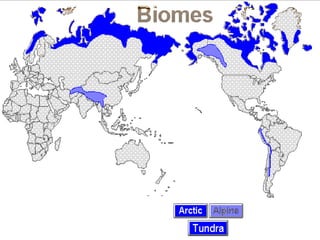
Biomes Regions of our planet distinguished by their climate and vegetation Types of Biomes: Aquatic Desert Forests Grasslands Tundra
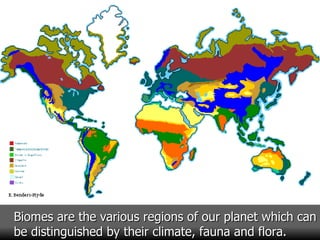
Biomes are the various regions of our planet which can be distinguished by their climate, fauna and flora.
Types of Biomes
 
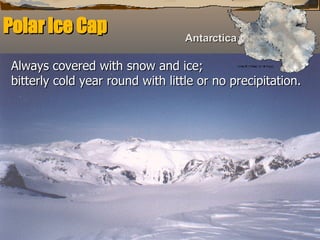
Polar Ice Cap   Always covered with snow and ice;  bitterly cold year round with little or no precipitation.   Antarctica
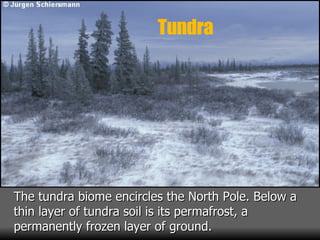
Tundra The tundra biome encircles the North Pole. Below a thin layer of tundra soil is its permafrost, a permanently frozen layer of ground.
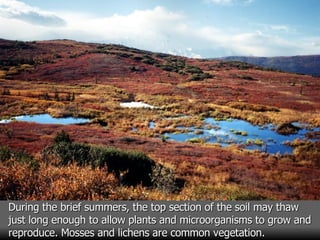
During the brief summers, the top section of the soil may thaw just long enough to allow plants and microorganisms to grow and reproduce. Mosses and lichens are common vegetation.
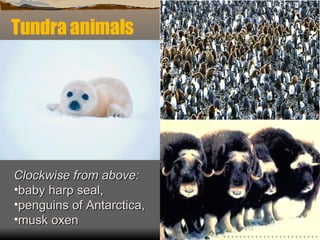
Tundra animals Clockwise from above: baby harp seal, penguins of Antarctica, musk oxen
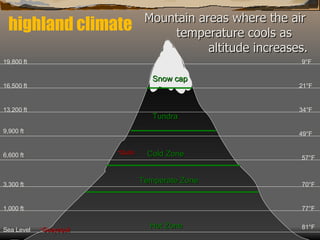
highland climate Sea Level 1,000 ft 3,300 ft 6,600 ft 9,900 ft 13,200 ft 16,500 ft 19,800 ft 81 °F 77 °F 70 °F 57°F 49 °F 34 °F 21°F 9 °F * Guayaquil * Quito Hot Zone Temperate   Zone Cold Zone Tundra Snow cap Mountain areas where the air  temperature cools as    altitude increases.
highlands
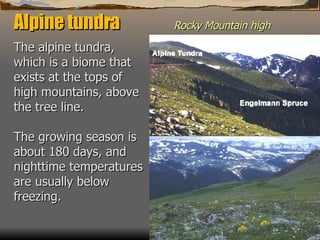
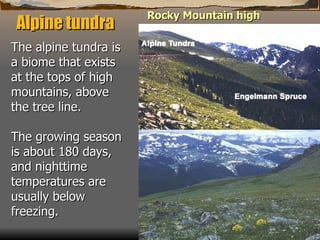
Alpine tundra  Rocky Mountain high The alpine tundra, which is a biome that exists at the tops of high mountains, above the tree line. The growing season is about 180 days, and nighttime temperatures are usually below freezing.
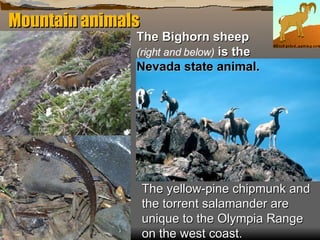
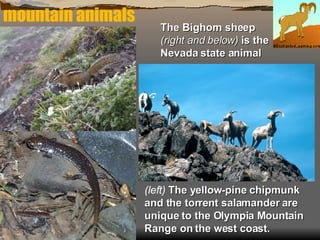
Mountain animals The yellow-pine chipmunk and the torrent salamander are unique to the Olympia Range on the west coast. The Bighorn sheep  (right and below)  is the  Nevada state animal.
Forests Represent the largest and most diverse Trees – take in carbon dioxide and produce oxygen Boreal, Taiga, and Temperate Deciduous
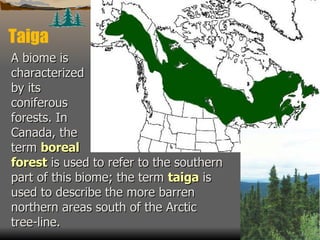
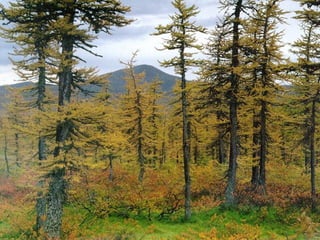
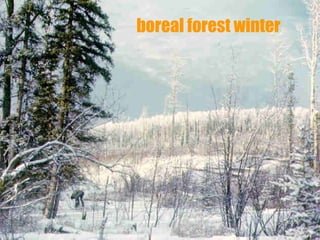
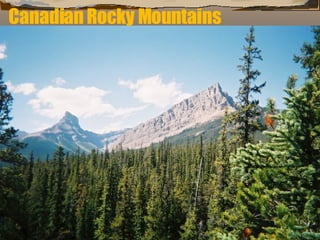
Taiga A biome is  characterized  by its  coniferous  forests. In  Canada, the  term  boreal  forest  is used to refer to the southern  part of this biome; the term  taiga  is  used to describe the more barren  northern areas south of the Arctic  tree-line.
 
boreal forest winter
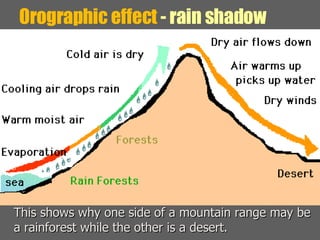
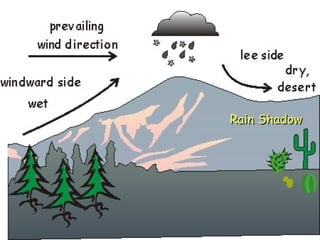
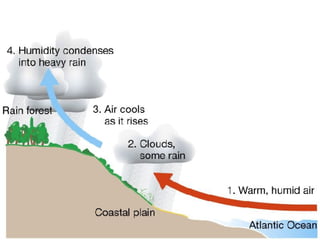
Orographic effect  -   rain shadow This shows why one side of a mountain range may be a rainforest while the other is a desert.
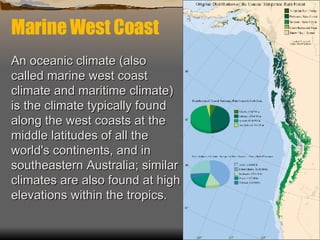
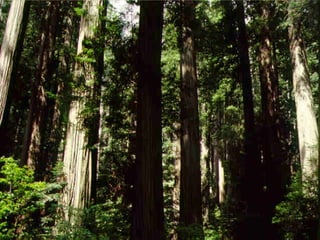
Marine West Coast An oceanic climate (also called marine west coast climate and maritime climate) is the climate typically found along the west coasts at the middle latitudes of all the world's continents, and in southeastern Australia; similar climates are also found at high elevations within the tropics.
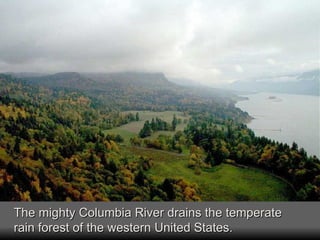
The mighty Columbia River drains the temperate rain forest of the western United States.
 
Rain Shadow
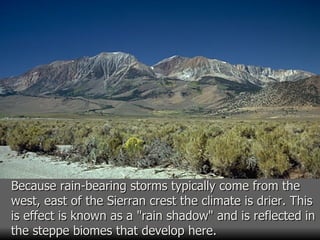
Because rain-bearing storms typically come from the west, east of the Sierran crest the climate is drier. This is effect is known as a "rain shadow" and is reflected in the steppe biomes that develop here.
Canadian Rocky Mountains
Alpine tundra   The alpine tundra is a biome that exists at the tops of high mountains, above the tree line. The growing season is about 180 days, and nighttime temperatures are usually below freezing.   Rocky Mountain high
mountain animals (left)  The yellow-pine chipmunk and the torrent salamander are unique to the Olympia Mountain Range on the west coast. The Bighorn sheep  (right and below)  is the Nevada state animal
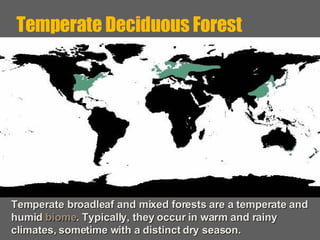
Temperate Deciduous Forest Temperate broadleaf and mixed forests are a temperate and humid  biome . Typically, they occur in warm and rainy climates, sometime with a distinct dry season.
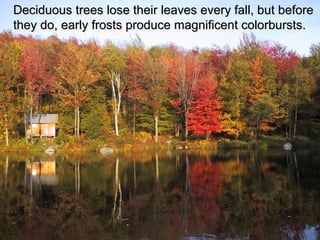
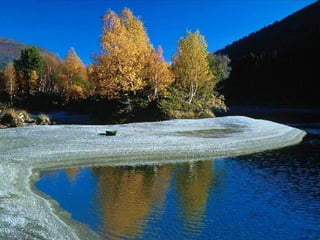
Deciduous trees lose their leaves every fall, but before they do, early frosts produce magnificent colorbursts.
 
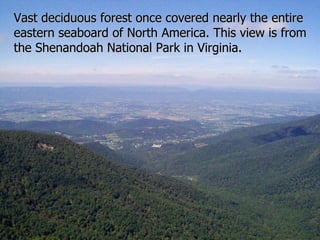
Vast deciduous forest once covered nearly the entire eastern seaboard of North America. This view is from the Shenandoah National Park in Virginia.
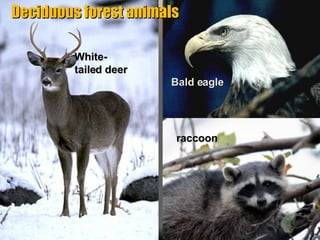
Bald eagle raccoon White-tailed deer Deciduous forest animals
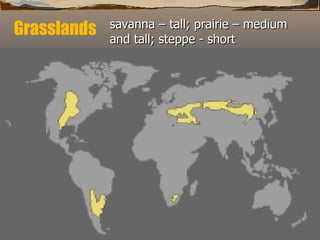
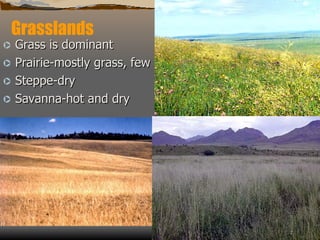
Grasslands savanna – tall; prairie – medium and tall; steppe - short
Grasslands Grass is dominant Prairie-mostly grass, few trees Steppe-dry Savanna-hot and dry
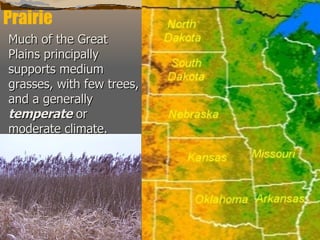
Prairie Much of the Great Plains principally supports medium grasses, with few trees, and a generally  temperate  or moderate climate.
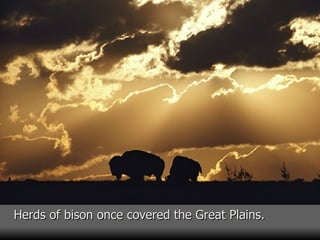
Herds of bison once covered the Great Plains.
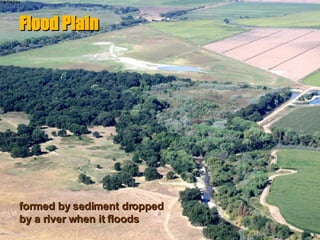
formed by sediment dropped by a river when it floods Flood Plain
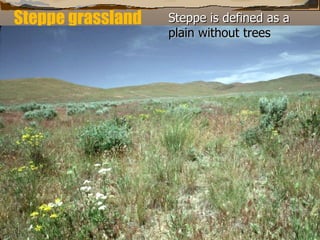
Steppe grassland Steppe is defined as a  plain without trees
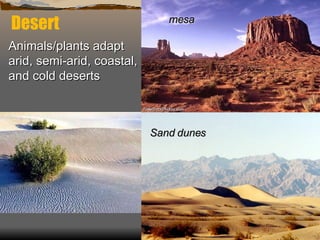
Desert Animals/plants adapt arid, semi-arid, coastal, and cold deserts mesa Sand dunes
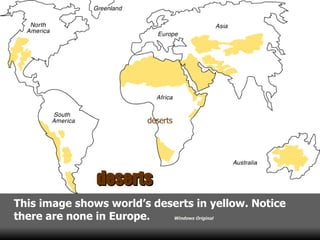
This image shows world’s deserts in yellow. Notice there are none in Europe .   Windows Original deserts deserts
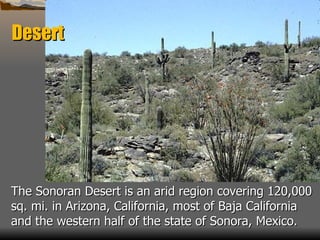
The Sonoran Desert is an arid region covering 120,000 sq. mi. in Arizona, California, most of Baja California and the western half of the state of Sonora, Mexico.   Desert
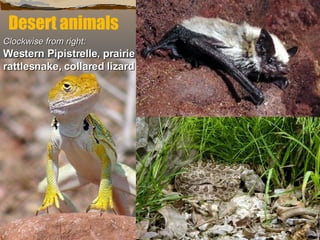
Desert animals Clockwise from right:   Western Pipistrelle, prairie rattlesnake, collared lizard
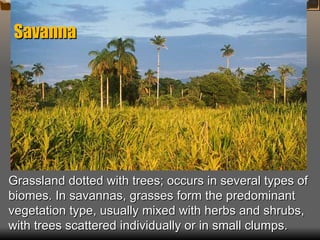
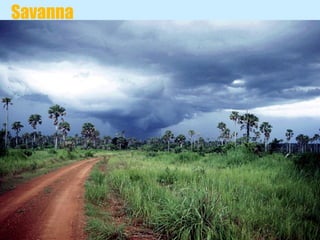
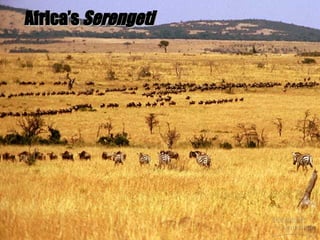
Savanna Grassland dotted with trees; occurs in several types of biomes. In savannas, grasses form the predominant vegetation type, usually mixed with herbs and shrubs, with trees scattered individually or in small clumps.   Savanna
Savanna
Africa’s  Serengeti
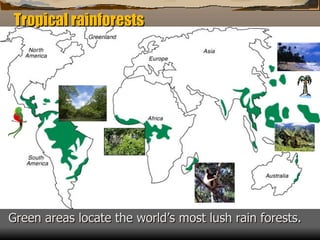
Green areas locate the world’s most lush rain forests. Tropical rainforests
 
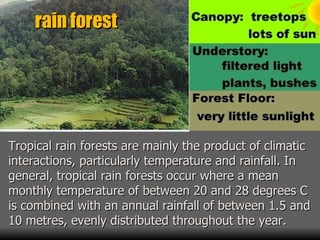
rain forest Tropical rain forests are mainly the product of climatic interactions, particularly temperature and rainfall. In general, tropical rain forests occur where a mean monthly temperature of between 20 and 28 degrees C is combined with an annual rainfall of between 1.5 and 10 metres, evenly distributed throughout the year.
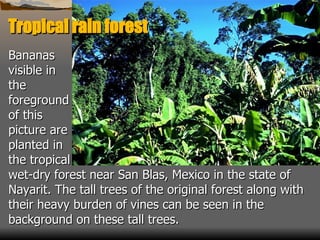
Bananas  visible in  the  foreground  of this  picture are  planted in  the tropical  wet-dry forest near San Blas, Mexico in the state of Nayarit. The tall trees of the original forest along with their heavy burden of vines can be seen in the background on these tall trees.   Tropical rain forest
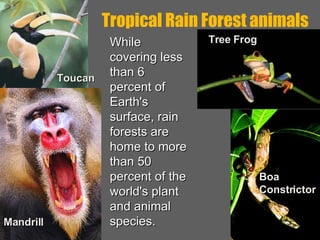
Tropical Rain Forest animals While covering less than 6 percent of Earth's surface, rain forests are home to more than 50 percent of the world's plant and animal species.   Toucan Mandrill Tree Frog Boa Constrictor
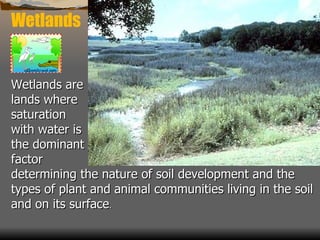
Wetlands Wetlands are  lands where  saturation  with water is  the dominant  factor  determining the nature of soil development and the types of plant and animal communities living in the soil and on its surface .
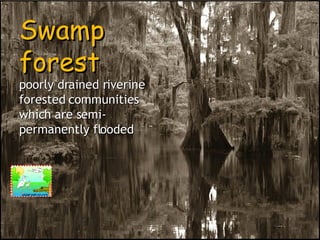
Swamp forest poorly drained riverine  forested communities which are semi-permanently flooded
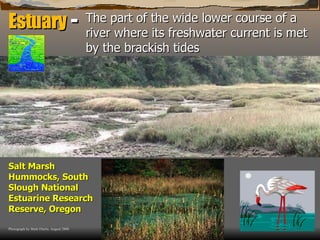
Estuary   - The part of the wide lower course of a river where its freshwater current is met by the brackish tides Salt Marsh Hummocks, South Slough National Estuarine Research Reserve, Oregon Photograph by Mark Eberle, August 2000
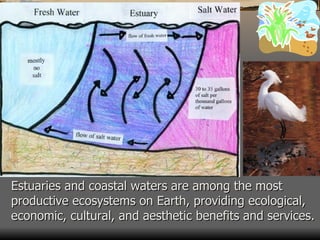
Estuaries and coastal waters are among the most productive ecosystems on Earth, providing ecological, economic, cultural, and aesthetic benefits and services.
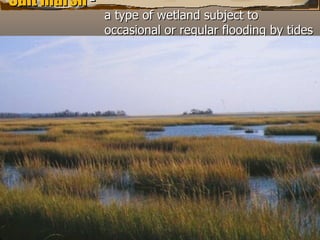
Salt marsh  -   a type of wetland subject to occasional or regular flooding by tides
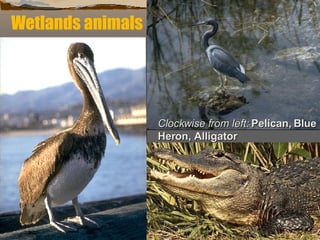
Wetlands animals Clockwise from left:  Pelican, Blue Heron, Alligator
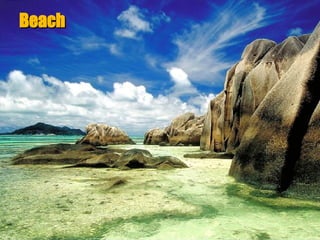
Beach
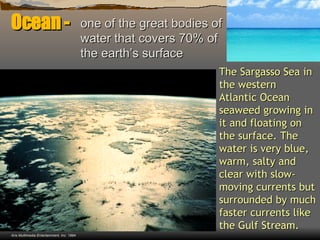
Ocean - The Sargasso Sea in the western Atlantic Ocean seaweed growing in it and floating on the surface. The water is very blue, warm, salty and clear with slow-moving currents but surrounded by much faster currents like the Gulf Stream.   one of the great bodies of water that covers 70% of the earth’s surface Aris Multimedia Entertainment, Inc. 1994
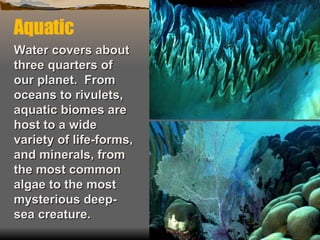
Aquatic Water covers about three quarters of our planet.  From oceans to rivulets, aquatic biomes are host to a wide variety of life-forms, and minerals, from the most common algae to the most mysterious deep-sea creature.
Links http://www.ecb.org/surf/weather.htm http://www.amphi.com/~tlcf/rakowitz/web4/frog5.jpg http://www.belizezoo.org/zoo/zoo/herps/boa/boa4.html http://www.nps.gov/whsa/factsheets.htm http://www.thefeltsource.com/Screensavers.html http://www.nps.gov/meve/ http://mbgnet.mobot.org/sets/tundra/index.htm http://raysweb.net/wildlife/pages/13.html http://www.epa.gov/owow/wetlands/what/definitions.html

Biomes

  • 1.
    Biomes Regions ofour planet distinguished by their climate and vegetation Types of Biomes: Aquatic Desert Forests Grasslands Tundra
  • 2.
    Biomes are thevarious regions of our planet which can be distinguished by their climate, fauna and flora.
  • 3.
  • 4.
  • 5.
    Polar Ice Cap Always covered with snow and ice; bitterly cold year round with little or no precipitation. Antarctica
  • 6.
    Tundra The tundrabiome encircles the North Pole. Below a thin layer of tundra soil is its permafrost, a permanently frozen layer of ground.
  • 7.
    During the briefsummers, the top section of the soil may thaw just long enough to allow plants and microorganisms to grow and reproduce. Mosses and lichens are common vegetation.
  • 8.
    Tundra animals Clockwisefrom above: baby harp seal, penguins of Antarctica, musk oxen
  • 9.
    highland climate SeaLevel 1,000 ft 3,300 ft 6,600 ft 9,900 ft 13,200 ft 16,500 ft 19,800 ft 81 °F 77 °F 70 °F 57°F 49 °F 34 °F 21°F 9 °F * Guayaquil * Quito Hot Zone Temperate Zone Cold Zone Tundra Snow cap Mountain areas where the air temperature cools as altitude increases.
  • 10.
  • 11.
    Alpine tundra Rocky Mountain high The alpine tundra, which is a biome that exists at the tops of high mountains, above the tree line. The growing season is about 180 days, and nighttime temperatures are usually below freezing.
  • 12.
    Mountain animals Theyellow-pine chipmunk and the torrent salamander are unique to the Olympia Range on the west coast. The Bighorn sheep (right and below) is the Nevada state animal.
  • 13.
    Forests Represent thelargest and most diverse Trees – take in carbon dioxide and produce oxygen Boreal, Taiga, and Temperate Deciduous
  • 14.
    Taiga A biomeis characterized by its coniferous forests. In Canada, the term boreal forest is used to refer to the southern part of this biome; the term taiga is used to describe the more barren northern areas south of the Arctic tree-line.
  • 15.
  • 16.
  • 17.
    Orographic effect - rain shadow This shows why one side of a mountain range may be a rainforest while the other is a desert.
  • 18.
    Marine West CoastAn oceanic climate (also called marine west coast climate and maritime climate) is the climate typically found along the west coasts at the middle latitudes of all the world's continents, and in southeastern Australia; similar climates are also found at high elevations within the tropics.
  • 19.
    The mighty ColumbiaRiver drains the temperate rain forest of the western United States.
  • 20.
  • 21.
  • 22.
    Because rain-bearing stormstypically come from the west, east of the Sierran crest the climate is drier. This is effect is known as a "rain shadow" and is reflected in the steppe biomes that develop here.
  • 23.
  • 24.
    Alpine tundra The alpine tundra is a biome that exists at the tops of high mountains, above the tree line. The growing season is about 180 days, and nighttime temperatures are usually below freezing. Rocky Mountain high
  • 25.
    mountain animals (left) The yellow-pine chipmunk and the torrent salamander are unique to the Olympia Mountain Range on the west coast. The Bighorn sheep (right and below) is the Nevada state animal
  • 26.
    Temperate Deciduous ForestTemperate broadleaf and mixed forests are a temperate and humid biome . Typically, they occur in warm and rainy climates, sometime with a distinct dry season.
  • 27.
    Deciduous trees losetheir leaves every fall, but before they do, early frosts produce magnificent colorbursts.
  • 28.
  • 29.
    Vast deciduous forestonce covered nearly the entire eastern seaboard of North America. This view is from the Shenandoah National Park in Virginia.
  • 30.
    Bald eagle raccoonWhite-tailed deer Deciduous forest animals
  • 31.
    Grasslands savanna –tall; prairie – medium and tall; steppe - short
  • 32.
    Grasslands Grass isdominant Prairie-mostly grass, few trees Steppe-dry Savanna-hot and dry
  • 33.
    Prairie Much ofthe Great Plains principally supports medium grasses, with few trees, and a generally temperate or moderate climate.
  • 34.
    Herds of bisononce covered the Great Plains.
  • 35.
    formed by sedimentdropped by a river when it floods Flood Plain
  • 36.
    Steppe grassland Steppeis defined as a plain without trees
  • 37.
    Desert Animals/plants adaptarid, semi-arid, coastal, and cold deserts mesa Sand dunes
  • 38.
    This image showsworld’s deserts in yellow. Notice there are none in Europe . Windows Original deserts deserts
  • 39.
    The Sonoran Desertis an arid region covering 120,000 sq. mi. in Arizona, California, most of Baja California and the western half of the state of Sonora, Mexico. Desert
  • 40.
    Desert animals Clockwisefrom right: Western Pipistrelle, prairie rattlesnake, collared lizard
  • 41.
    Savanna Grassland dottedwith trees; occurs in several types of biomes. In savannas, grasses form the predominant vegetation type, usually mixed with herbs and shrubs, with trees scattered individually or in small clumps. Savanna
  • 42.
  • 43.
  • 44.
    Green areas locatethe world’s most lush rain forests. Tropical rainforests
  • 45.
  • 46.
    rain forest Tropicalrain forests are mainly the product of climatic interactions, particularly temperature and rainfall. In general, tropical rain forests occur where a mean monthly temperature of between 20 and 28 degrees C is combined with an annual rainfall of between 1.5 and 10 metres, evenly distributed throughout the year.
  • 47.
    Bananas visiblein the foreground of this picture are planted in the tropical wet-dry forest near San Blas, Mexico in the state of Nayarit. The tall trees of the original forest along with their heavy burden of vines can be seen in the background on these tall trees. Tropical rain forest
  • 48.
    Tropical Rain Forestanimals While covering less than 6 percent of Earth's surface, rain forests are home to more than 50 percent of the world's plant and animal species. Toucan Mandrill Tree Frog Boa Constrictor
  • 49.
    Wetlands Wetlands are lands where saturation with water is the dominant factor determining the nature of soil development and the types of plant and animal communities living in the soil and on its surface .
  • 50.
    Swamp forest poorlydrained riverine forested communities which are semi-permanently flooded
  • 51.
    Estuary - The part of the wide lower course of a river where its freshwater current is met by the brackish tides Salt Marsh Hummocks, South Slough National Estuarine Research Reserve, Oregon Photograph by Mark Eberle, August 2000
  • 52.
    Estuaries and coastalwaters are among the most productive ecosystems on Earth, providing ecological, economic, cultural, and aesthetic benefits and services.
  • 53.
    Salt marsh - a type of wetland subject to occasional or regular flooding by tides
  • 54.
    Wetlands animals Clockwisefrom left: Pelican, Blue Heron, Alligator
  • 55.
  • 56.
    Ocean - TheSargasso Sea in the western Atlantic Ocean seaweed growing in it and floating on the surface. The water is very blue, warm, salty and clear with slow-moving currents but surrounded by much faster currents like the Gulf Stream. one of the great bodies of water that covers 70% of the earth’s surface Aris Multimedia Entertainment, Inc. 1994
  • 57.
    Aquatic Water coversabout three quarters of our planet.  From oceans to rivulets, aquatic biomes are host to a wide variety of life-forms, and minerals, from the most common algae to the most mysterious deep-sea creature.
  • 58.
    Links http://www.ecb.org/surf/weather.htm http://www.amphi.com/~tlcf/rakowitz/web4/frog5.jpghttp://www.belizezoo.org/zoo/zoo/herps/boa/boa4.html http://www.nps.gov/whsa/factsheets.htm http://www.thefeltsource.com/Screensavers.html http://www.nps.gov/meve/ http://mbgnet.mobot.org/sets/tundra/index.htm http://raysweb.net/wildlife/pages/13.html http://www.epa.gov/owow/wetlands/what/definitions.html