BiomesA Project in Science
Table of ContentsBiomesDifferent kinds of BiomesCharacteristicsExamplesMy BiomesDefinitionCharacteristicsLocation of BiomesPhilippinesAsiaEuropeNorth AmericaSouth AmericaAfricaAustraliaAntarctica
Biomes A biome is a large ecosystem where plants, animals, insects, and people live in a certain type of climate
Kinds of BiomesTerrestrialRainforests (Temperate or Tropical)TundraTaigaDesertTemperate DeciduousGrasslandAquaticMarineOceansCoral ReefsEstuariesFreshwaterRivers and StreamsPonds and lakesWetlands
Biome Characteristic: Rainforests2 types: Topical and TemperateMost trees flare at the baseVegetation is dense (tall and green)Rich in diversity (especially in tropical rainforests)Precipitation and Climate Lush and wetRainfall is regular throughout the year (80-400 inches of rainfall per year for tropical)Tropical rainforests are warm and moist; while temperate rainforests are cool. 
Biome Characteristic: TundraArctic tundra is located at the polesAnimals are adapted to handle cold winters and to breed and raise young quickly in the very short and cool summers.The soil is often frozen. Permafrost, or permanent ice, usually exists within a meter of the surface.Precipitation and Climate  The average annual temperature is only 10 to 20F (-12C to -6C)Water is unavailable during most of the year. Annual precipitation is very low, usually less than 10 inches (25 centimeters).
Biome Characteristic: TaigaThe largest biome in the world. Winters are cold. Summers are warm. Lots of conifers grow here. Prone to wildfires. Many trees have adapted to this by growing thick barkPrecipitation and Climate  The average temperature is below freezing for six months of the year.Total yearly precipitation in the taiga is 12 - 33 inches (30 - 85 centimeters). Although the cold winters have some snowfall, most of the precipitation comes during the warm, humid summer months.  
Biome Characteristic: Desertland of extremes: extreme heat and extreme dryness but sudden flash floods and cold nights. have so few trees and other vegetationPrecipitation and Climate  Deserts are usually very, very dry. Even the wettest deserts get less than ten inches of precipitation a yearthere may be only a few periods of rains per year with a lot of time between rains
Biome Characteristic: Temperate DeciduousHas four seasons of winter, spring, summer, and fall.Animals and plants have special adaptations to cope with yearly/seasonal changes. The word "deciduous" means exactly what the leaves on these trees do: change color in autumn, fall off in the winter, and grow back again in the spring.Precipitation and Climate Gets the second-most amount of rainfall per yearAverage temperature of the forest is about 50 degrees Fahrenheit.
Biome Characteristic: GrasslandsBig open spacesThere are not many bushes in the grassland. Trees are found only by rivers and streams. The grassland seems like an endless ocean of grassGrassland soil tends to be deep and fertile.Found on every continent except AntarcticaPrecipitation and Climate  Grasslands receive about 10 to 30 inches of rain per yearIf they received more rain, the grasslands would become a forest. If they received less, they would become a desert.
Biome Characteristic: MarineMarine regions cover about three-fourths of the Earth's surface and include oceans, coral reefs, and estuaries.Marine algae supply much of the world's oxygen supply and take in a huge amount of atmospheric carbon dioxide.The evaporation of the seawater provides rainwater for the land.
Biome Characteristic: FreshwaterFreshwater is defined as having a low salt concentration — usually less than 1%. Plants and animals in freshwater regions are adjusted to the low salt content and would not be able to survive in areas of high salt concentrationYou'll find a wide variety of animal life in or around fresh water ecosystems...aquatic birds... amphibians..mammals and of course, a wide variety of fish.  And the water cycle is very important to fresh water ecosystems
Kinds of Biomes
Kinds of BiomesMarineOceansCoral ReefsEstuaries.FreshwaterRivers and streamsLake and pondsWetlands.
My BiomesTerrestrialMy Terrestrial Biome is Rainforest.AquaticMy Aquatic Biome is Marine Coral reef.
My BiomesTerrestrialMy Terrestrial Biome is Tropical Rainforest. A Tropical Biome has wet and dry climate. It is rich in biodiversity The rainforests are home to more worldwide species than all other biomes added together. About 80 percent of the world's known biodiversity could be found in forests. AquaticMy Aquatic Biome is Marine Coral reef. Marine ecosystems are very important for the overall health of both marine and terrestrial environments. In addition, other marine ecosystems such as coral reefs, provide food and shelter to the highest levels of marine diversity in the world.
My BiomesAquaticCoral reefs are underwater structures made from calcium carbonate secreted by corals. Corals are colonies of tiny living animals found in marine waters that contain few nutrients. Most coral reefs are built from stony corals, which in turn consist of polyps that cluster in groups. But unlike sea anemones, coral polyps secrete hard carbonate exoskeletons which support and protect their bodies. Reefs grow best in warm, shallow, clear, sunny and agitated waters.TerrestrialThe leafy tops of tall trees - extending from 50 to 85 metres above the forest floor - forms an understory. Organic matter that falls to the forest floor quickly decomposes, and the nutrients.Rainforests are partly characterized by high rainfall. This often results in poor soils due to leaching of soluble nutrients.
Location: PhilippinesTropical Rainforest in Bohol
Location: AsiaGobi Desert between China and Mongolia
Location: EuropeTaiga in Central Germany
Location: North AmericaDeciduous forest in Texas Hill
Location: South AmericaGrassland in Buenos Aires, Argentina
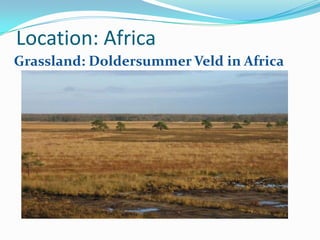
Location: AfricaGrassland: DoldersummerVeld in Africa
Location: AustraliaCoral reef in Great Barrier Reef in North Australia
Location: AntarcticaTundra in Antarctic Peninsula
Submitted by:Eunice Nicole dR. ValenciaYear II-GenesisTo: Mr. PunzalanOn: August 22, 2011

Biomes

  • 1.
  • 2.
    Table of ContentsBiomesDifferentkinds of BiomesCharacteristicsExamplesMy BiomesDefinitionCharacteristicsLocation of BiomesPhilippinesAsiaEuropeNorth AmericaSouth AmericaAfricaAustraliaAntarctica
  • 3.
    Biomes A biome isa large ecosystem where plants, animals, insects, and people live in a certain type of climate
  • 4.
    Kinds of BiomesTerrestrialRainforests(Temperate or Tropical)TundraTaigaDesertTemperate DeciduousGrasslandAquaticMarineOceansCoral ReefsEstuariesFreshwaterRivers and StreamsPonds and lakesWetlands
  • 5.
    Biome Characteristic: Rainforests2types: Topical and TemperateMost trees flare at the baseVegetation is dense (tall and green)Rich in diversity (especially in tropical rainforests)Precipitation and Climate Lush and wetRainfall is regular throughout the year (80-400 inches of rainfall per year for tropical)Tropical rainforests are warm and moist; while temperate rainforests are cool. 
  • 6.
    Biome Characteristic: TundraArctictundra is located at the polesAnimals are adapted to handle cold winters and to breed and raise young quickly in the very short and cool summers.The soil is often frozen. Permafrost, or permanent ice, usually exists within a meter of the surface.Precipitation and Climate  The average annual temperature is only 10 to 20F (-12C to -6C)Water is unavailable during most of the year. Annual precipitation is very low, usually less than 10 inches (25 centimeters).
  • 7.
    Biome Characteristic: TaigaThelargest biome in the world. Winters are cold. Summers are warm. Lots of conifers grow here. Prone to wildfires. Many trees have adapted to this by growing thick barkPrecipitation and Climate  The average temperature is below freezing for six months of the year.Total yearly precipitation in the taiga is 12 - 33 inches (30 - 85 centimeters). Although the cold winters have some snowfall, most of the precipitation comes during the warm, humid summer months.  
  • 8.
    Biome Characteristic: Desertlandof extremes: extreme heat and extreme dryness but sudden flash floods and cold nights. have so few trees and other vegetationPrecipitation and Climate  Deserts are usually very, very dry. Even the wettest deserts get less than ten inches of precipitation a yearthere may be only a few periods of rains per year with a lot of time between rains
  • 9.
    Biome Characteristic: TemperateDeciduousHas four seasons of winter, spring, summer, and fall.Animals and plants have special adaptations to cope with yearly/seasonal changes. The word "deciduous" means exactly what the leaves on these trees do: change color in autumn, fall off in the winter, and grow back again in the spring.Precipitation and Climate Gets the second-most amount of rainfall per yearAverage temperature of the forest is about 50 degrees Fahrenheit.
  • 10.
    Biome Characteristic: GrasslandsBigopen spacesThere are not many bushes in the grassland. Trees are found only by rivers and streams. The grassland seems like an endless ocean of grassGrassland soil tends to be deep and fertile.Found on every continent except AntarcticaPrecipitation and Climate  Grasslands receive about 10 to 30 inches of rain per yearIf they received more rain, the grasslands would become a forest. If they received less, they would become a desert.
  • 11.
    Biome Characteristic: MarineMarineregions cover about three-fourths of the Earth's surface and include oceans, coral reefs, and estuaries.Marine algae supply much of the world's oxygen supply and take in a huge amount of atmospheric carbon dioxide.The evaporation of the seawater provides rainwater for the land.
  • 12.
    Biome Characteristic: FreshwaterFreshwateris defined as having a low salt concentration — usually less than 1%. Plants and animals in freshwater regions are adjusted to the low salt content and would not be able to survive in areas of high salt concentrationYou'll find a wide variety of animal life in or around fresh water ecosystems...aquatic birds... amphibians..mammals and of course, a wide variety of fish.  And the water cycle is very important to fresh water ecosystems
  • 13.
  • 14.
    Kinds of BiomesMarineOceansCoralReefsEstuaries.FreshwaterRivers and streamsLake and pondsWetlands.
  • 15.
    My BiomesTerrestrialMy TerrestrialBiome is Rainforest.AquaticMy Aquatic Biome is Marine Coral reef.
  • 16.
    My BiomesTerrestrialMy TerrestrialBiome is Tropical Rainforest. A Tropical Biome has wet and dry climate. It is rich in biodiversity The rainforests are home to more worldwide species than all other biomes added together. About 80 percent of the world's known biodiversity could be found in forests. AquaticMy Aquatic Biome is Marine Coral reef. Marine ecosystems are very important for the overall health of both marine and terrestrial environments. In addition, other marine ecosystems such as coral reefs, provide food and shelter to the highest levels of marine diversity in the world.
  • 17.
    My BiomesAquaticCoral reefsare underwater structures made from calcium carbonate secreted by corals. Corals are colonies of tiny living animals found in marine waters that contain few nutrients. Most coral reefs are built from stony corals, which in turn consist of polyps that cluster in groups. But unlike sea anemones, coral polyps secrete hard carbonate exoskeletons which support and protect their bodies. Reefs grow best in warm, shallow, clear, sunny and agitated waters.TerrestrialThe leafy tops of tall trees - extending from 50 to 85 metres above the forest floor - forms an understory. Organic matter that falls to the forest floor quickly decomposes, and the nutrients.Rainforests are partly characterized by high rainfall. This often results in poor soils due to leaching of soluble nutrients.
  • 18.
  • 19.
    Location: AsiaGobi Desertbetween China and Mongolia
  • 20.
  • 21.
  • 22.
    Location: South AmericaGrasslandin Buenos Aires, Argentina
  • 23.
  • 24.
    Location: AustraliaCoral reefin Great Barrier Reef in North Australia
  • 25.
  • 26.
    Submitted by:Eunice NicoledR. ValenciaYear II-GenesisTo: Mr. PunzalanOn: August 22, 2011