Presentation by: 
k.Manasa 
Roll no-256212886046 
M.Pharmacy(pharmaceutics) 
1
CONTENTS 
 DEFINITION 
 ADVANTAGES 
 SPHERONIZATION PROCESS 
 EXTRUSION 
 ROTOR GRANULATION 
 KEY SPHERONIZATION FACTORS 
 MACHINE PARAMETERS 
 PRODUCT PARAMETERS 
 REFERENCE 
2
Definition:- 
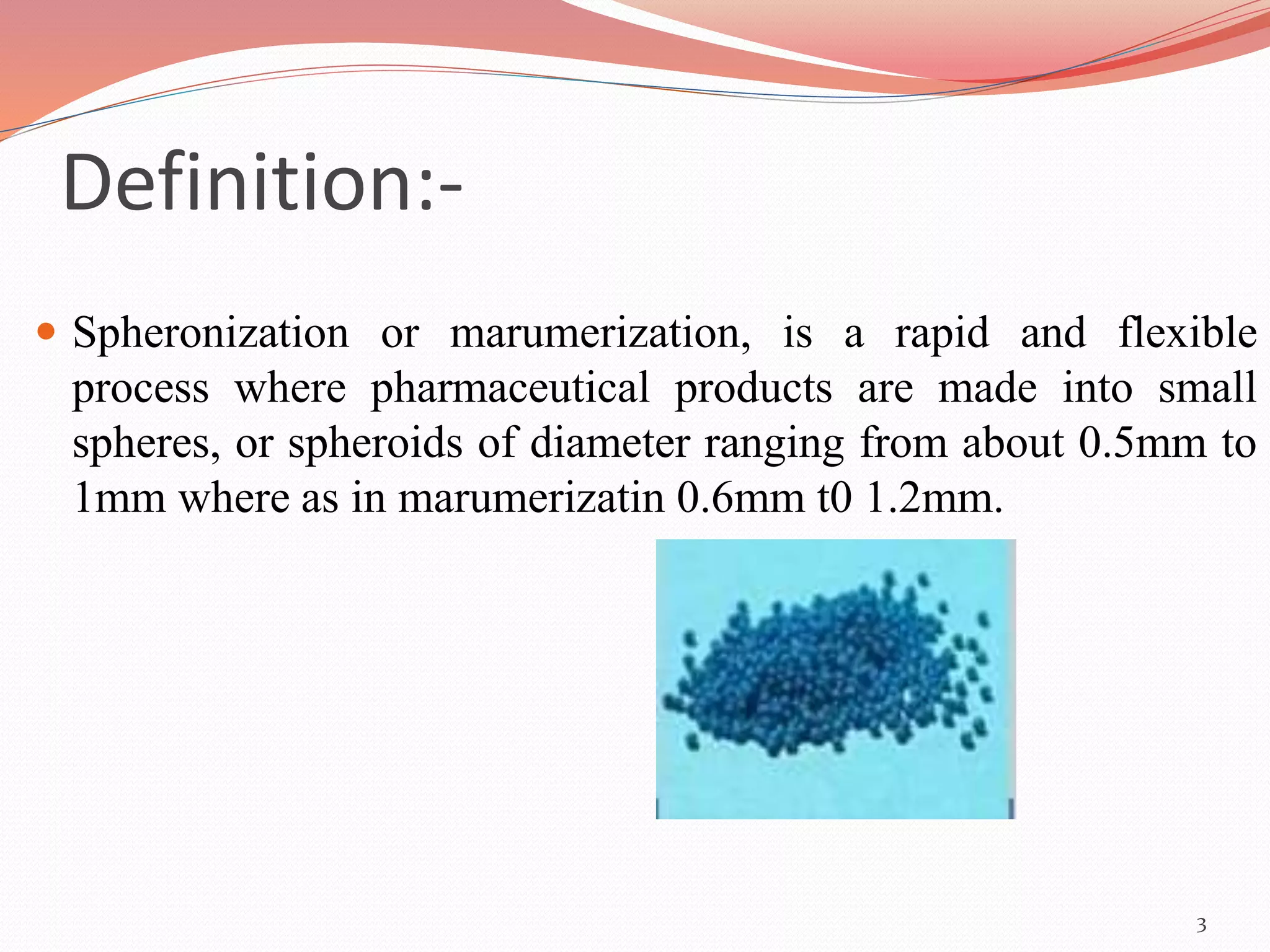
 Spheronization or marumerization, is a rapid and flexible 
process where pharmaceutical products are made into small 
spheres, or spheroids of diameter ranging from about 0.5mm to 
1mm where as in marumerizatin 0.6mm t0 1.2mm. 
3
Advantages:- 
1. Optimum flow and handling characteristics:- 
• The flow characteristics of spheres makes them suitable 
for transportation by most systems found in the 
pharmaceutical industry, including vacuum transfer. 
2. More reproducible packing into small container:- 
• The packing into small containers, such as hard gelatine 
capsules, or larger packages is much more convenient than 
other drug form such as powders or granules. 
• Eliminate quality problems with variable dosage due to 
packing problems with powder. 
4
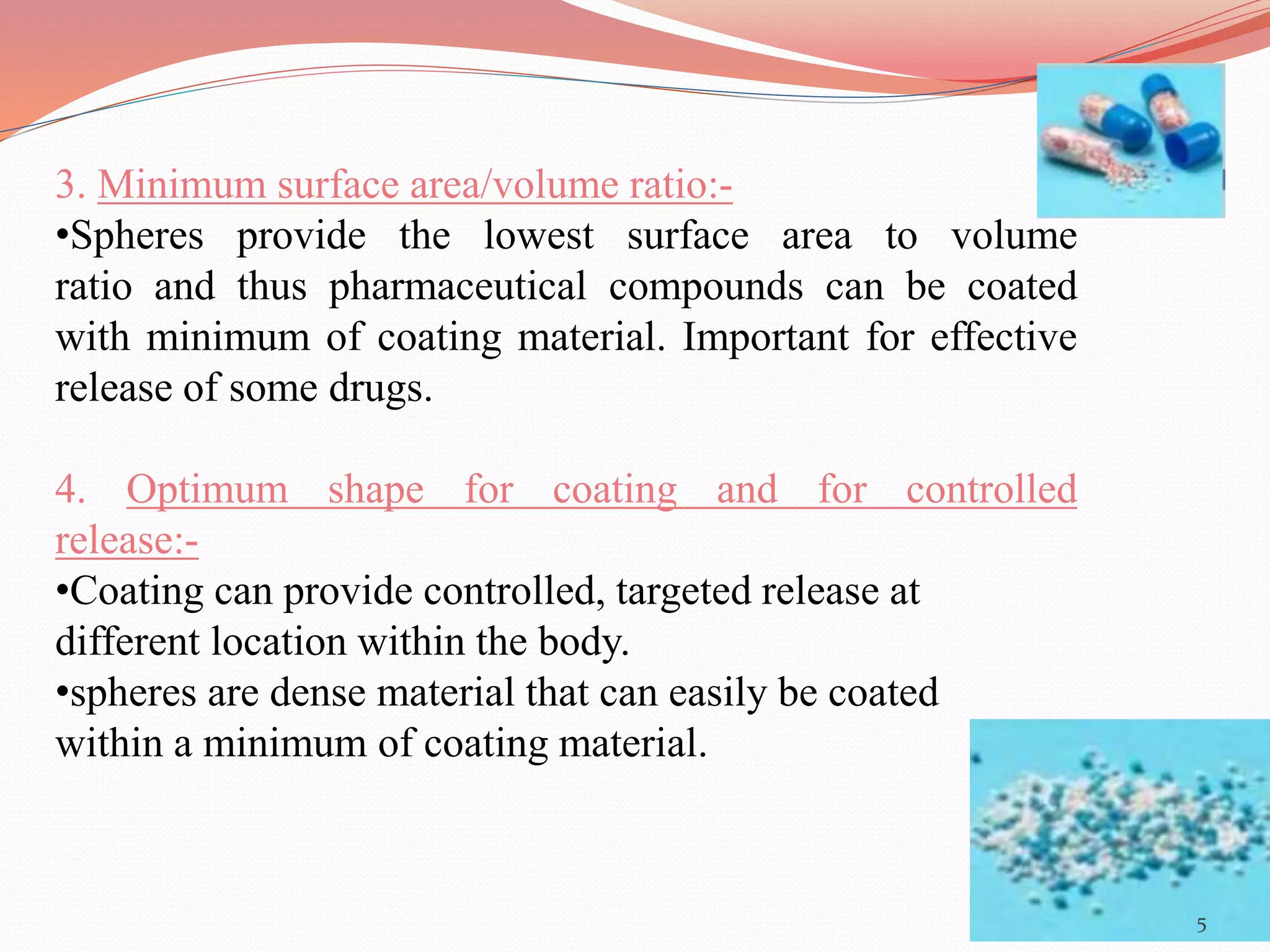
3. Minimum surface area/volume ratio:- 
•Spheres provide the lowest surface area to volume 
ratio and thus pharmaceutical compounds can be coated 
with minimum of coating material. Important for effective 
release of some drugs. 
4. Optimum shape for coating and for controlled 
release:- 
•Coating can provide controlled, targeted release at 
different location within the body. 
•spheres are dense material that can easily be coated 
within a minimum of coating material. 
5
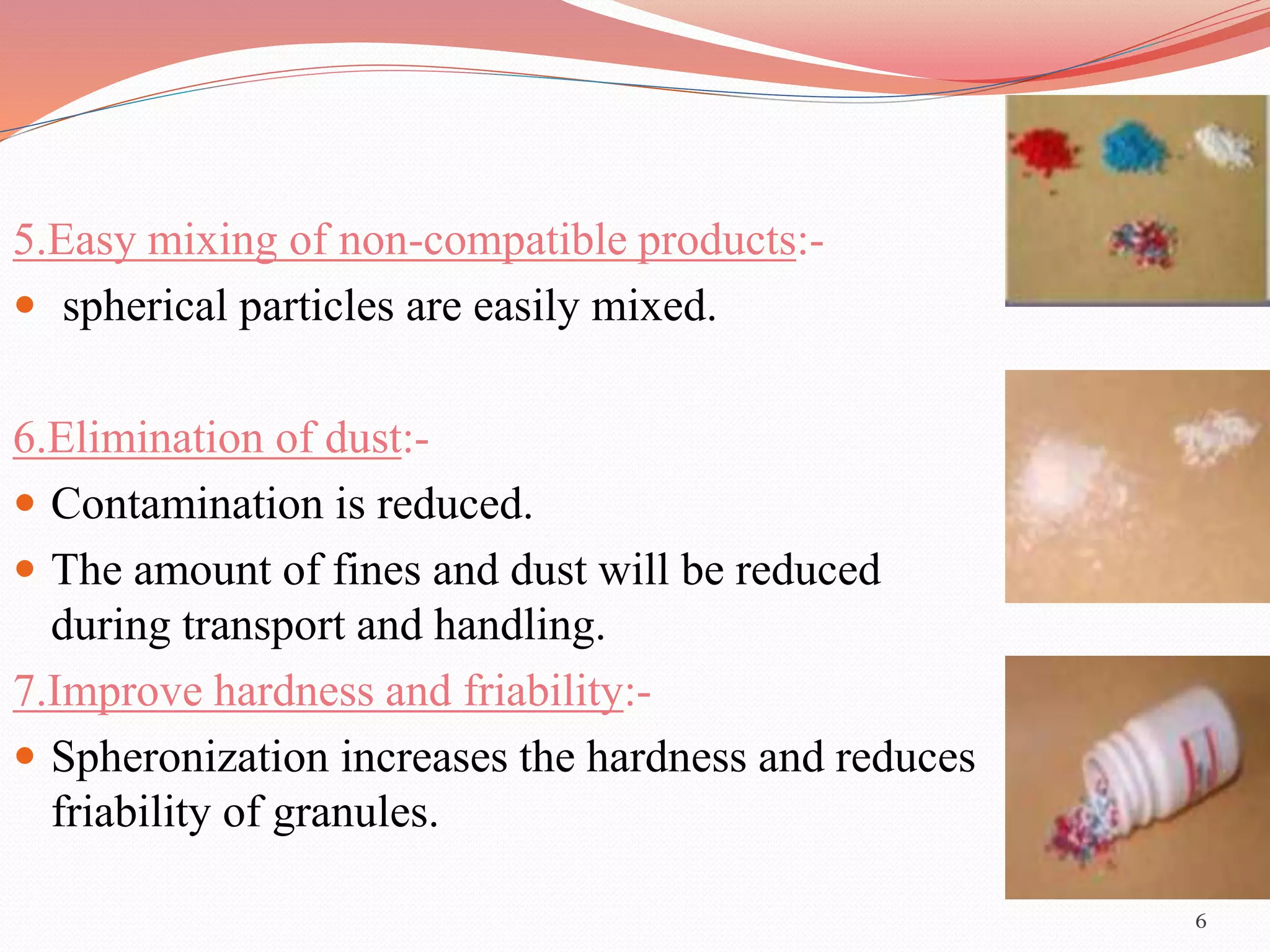
5.Easy mixing of non-compatible products:- 
 spherical particles are easily mixed. 
6.Elimination of dust:- 
 Contamination is reduced. 
 The amount of fines and dust will be reduced 
during transport and handling. 
7.Improve hardness and friability:- 
 Spheronization increases the hardness and reduces 
friability of granules. 
6
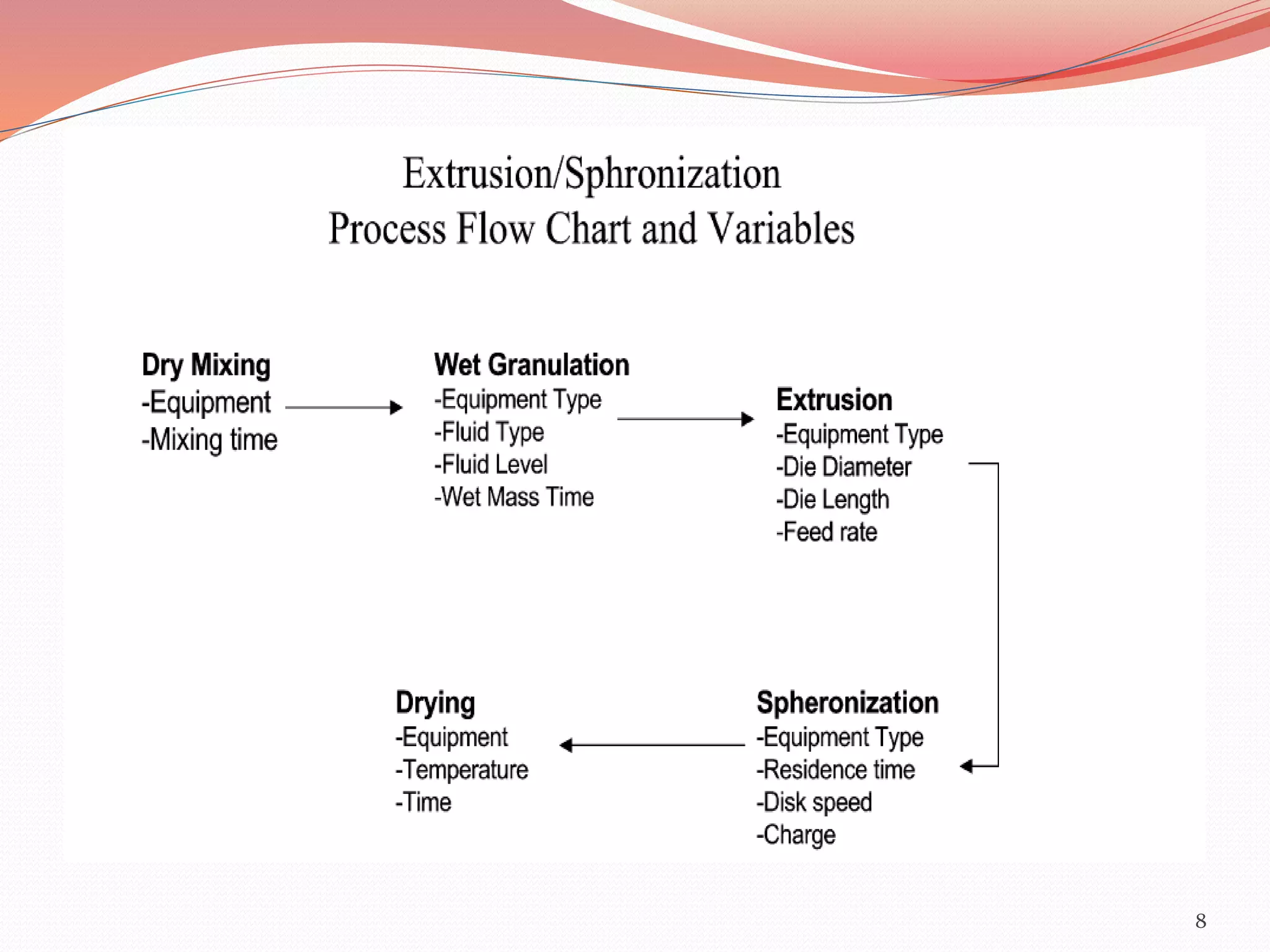
Spheronization process 
 Dry mixing of ingredients – to achieve a homogeneous powder 
dispersion; 
 Wet massing – to produce a sufficiently plastic wet mass. 
 Extrusion – to form rod shaped particles of uniform diameter . 
 Spheronization – to round off these rods into spherical particles . 
 Drying - to achieve the desired final moisture content. 
 Screening -to achieve the desired narrow size distribution. 
7
8
Extrusion 
 It produces rod shaped particles of uniform diameter from the 
wet mass. 
 Wet mass is forced through the dies and shaped into small 
cylindrical particles with uniform diameter . 
 The extrudate particles breaks at similar lengths under then 
own weight. 
 Extrudate must have enough plasticity to deform ,but extrudate 
particles do not adhere to other particles when collected. 
 Based on their feed mechanism extruders divided into 3 types 
1.screw feed extruder(axial and radial) 
2.Gravity feed extruder (cylinder roll, gear roll and radial) 
3.Piston feed extruder 
9
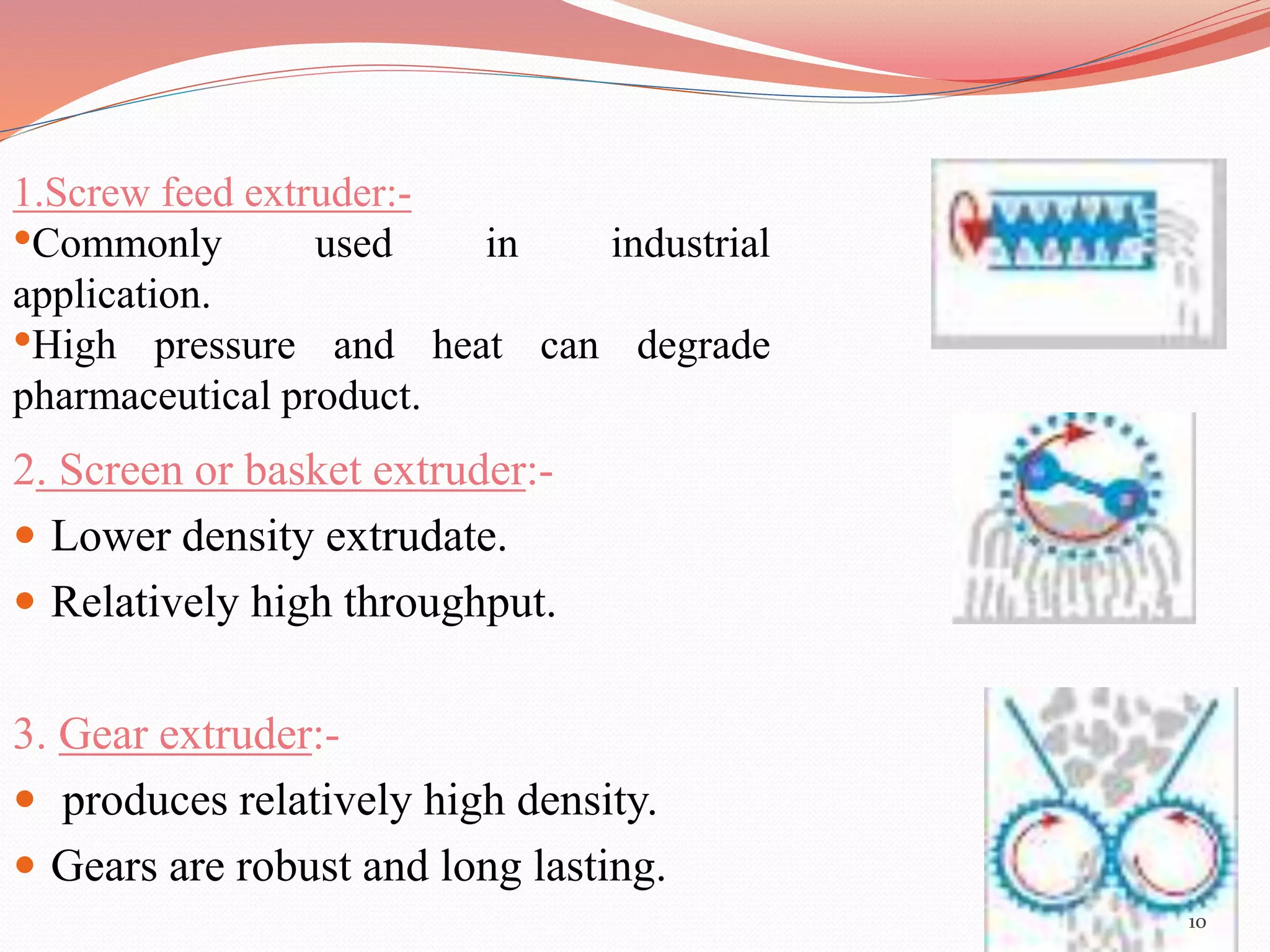
2. Screen or basket extruder:- 
 Lower density extrudate. 
 Relatively high throughput. 
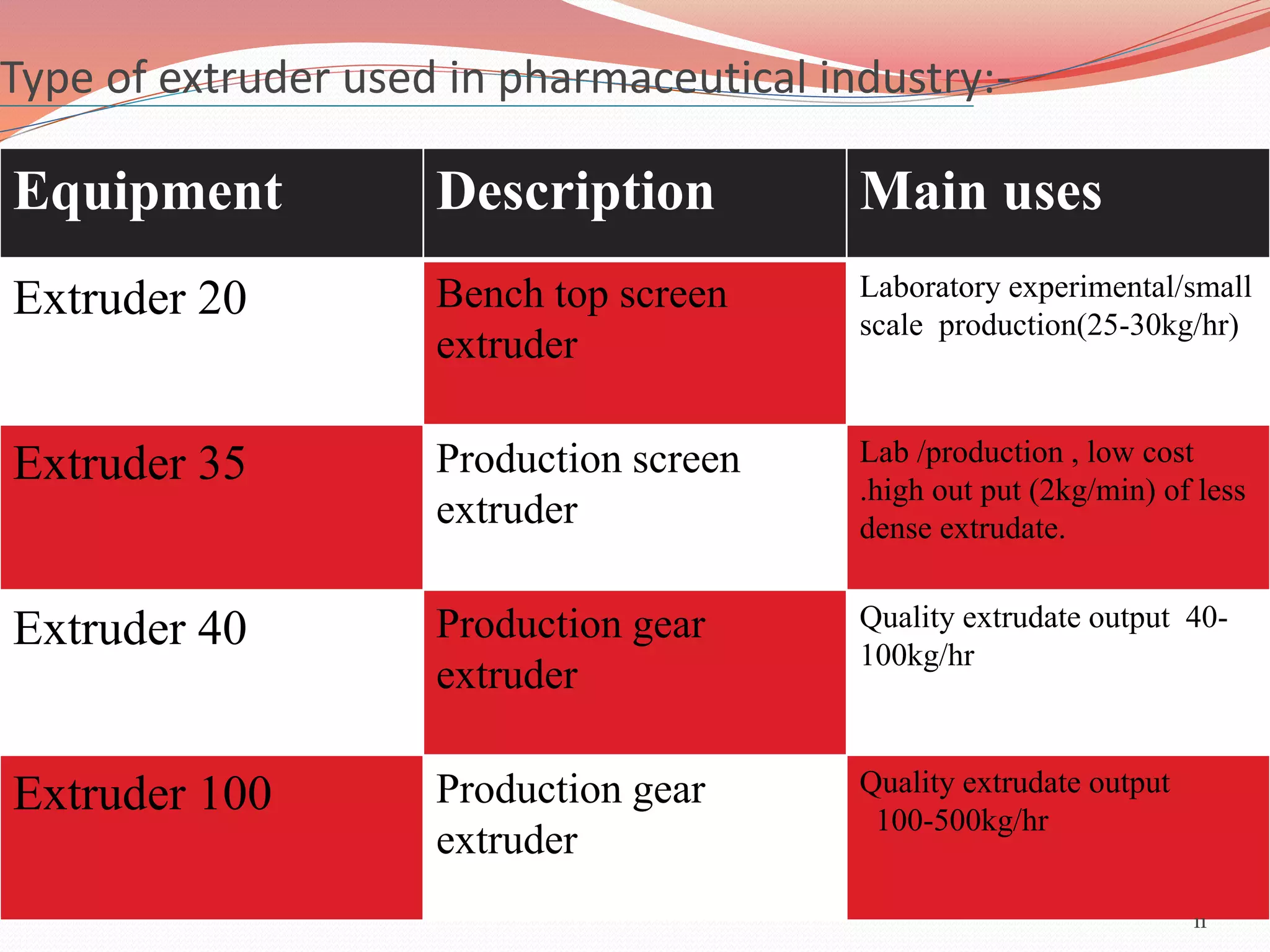
3. Gear extruder:- 
 produces relatively high density. 
 Gears are robust and long lasting. 
10 
1.Screw feed extruder:- 
•Commonly used in industrial 
application. 
•High pressure and heat can degrade 
pharmaceutical product.
Type of extruder used in pharmaceutical industry:- 
Equipment Description Main uses 
Extruder 20 Bench top screen 
extruder 
Laboratory experimental/small 
scale production(25-30kg/hr) 
Extruder 35 Production screen 
extruder 
Lab /production , low cost 
.high out put (2kg/min) of less 
dense extrudate. 
Extruder 40 Production gear 
extruder 
Quality extrudate output 40- 
100kg/hr 
Extruder 100 Production gear 
extruder 
Quality extrudate output 
100-500kg/hr 
11
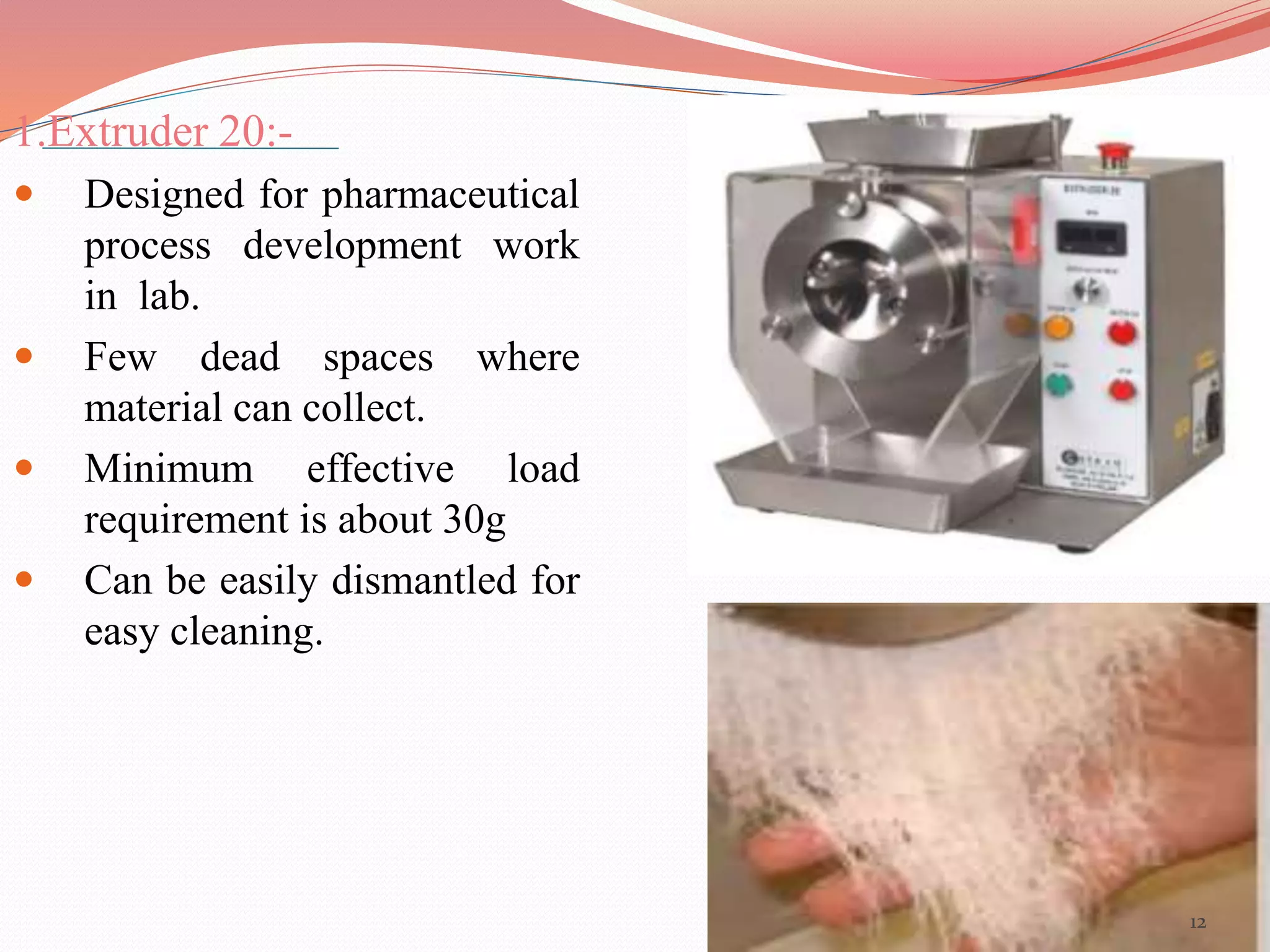
1.Extruder 20:- 
 Designed for pharmaceutical 
process development work 
in lab. 
 Few dead spaces where 
material can collect. 
 Minimum effective load 
requirement is about 30g 
 Can be easily dismantled for 
easy cleaning. 
12
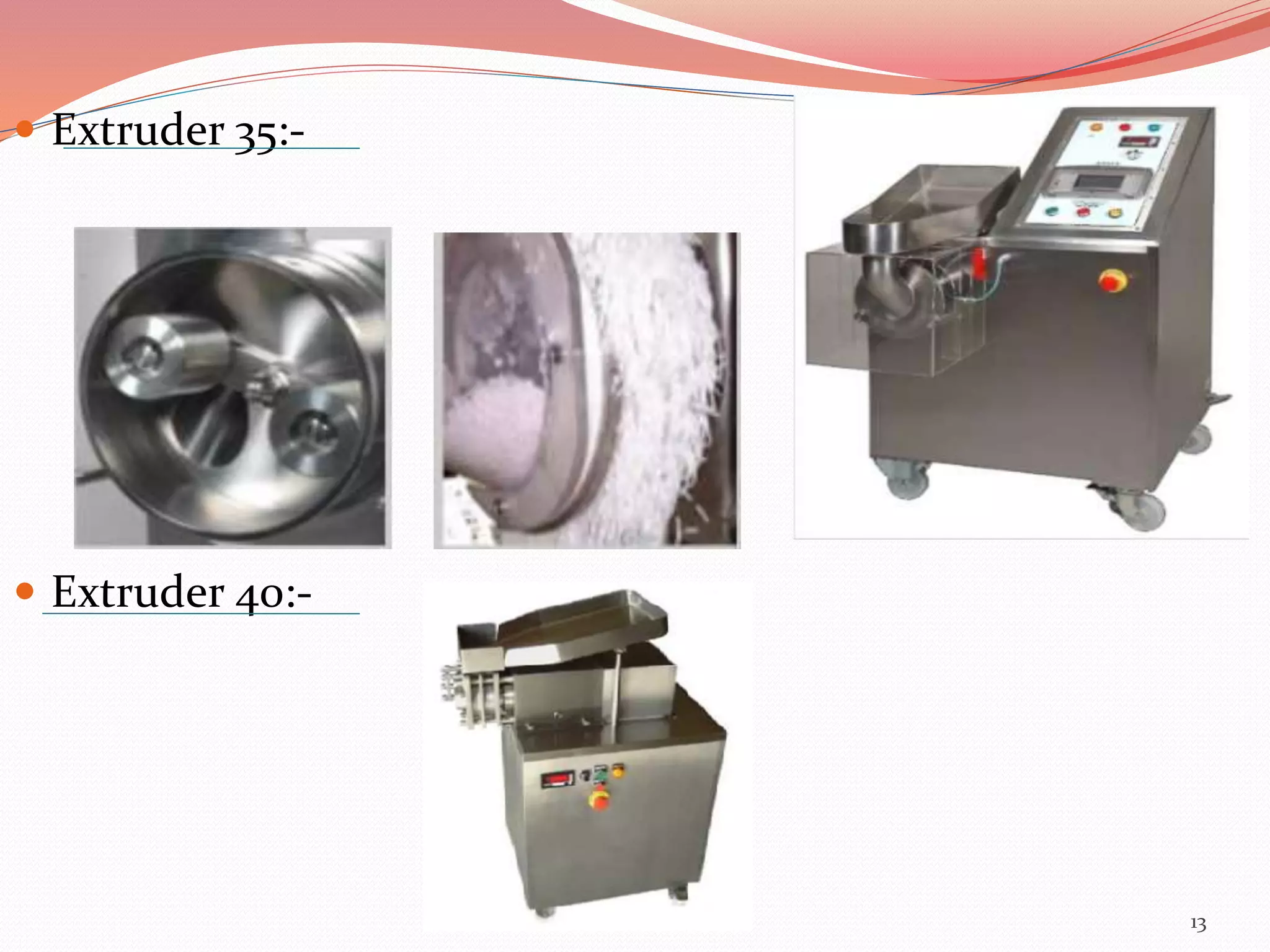
 Extruder 35:- 
 Extruder 40:- 
13
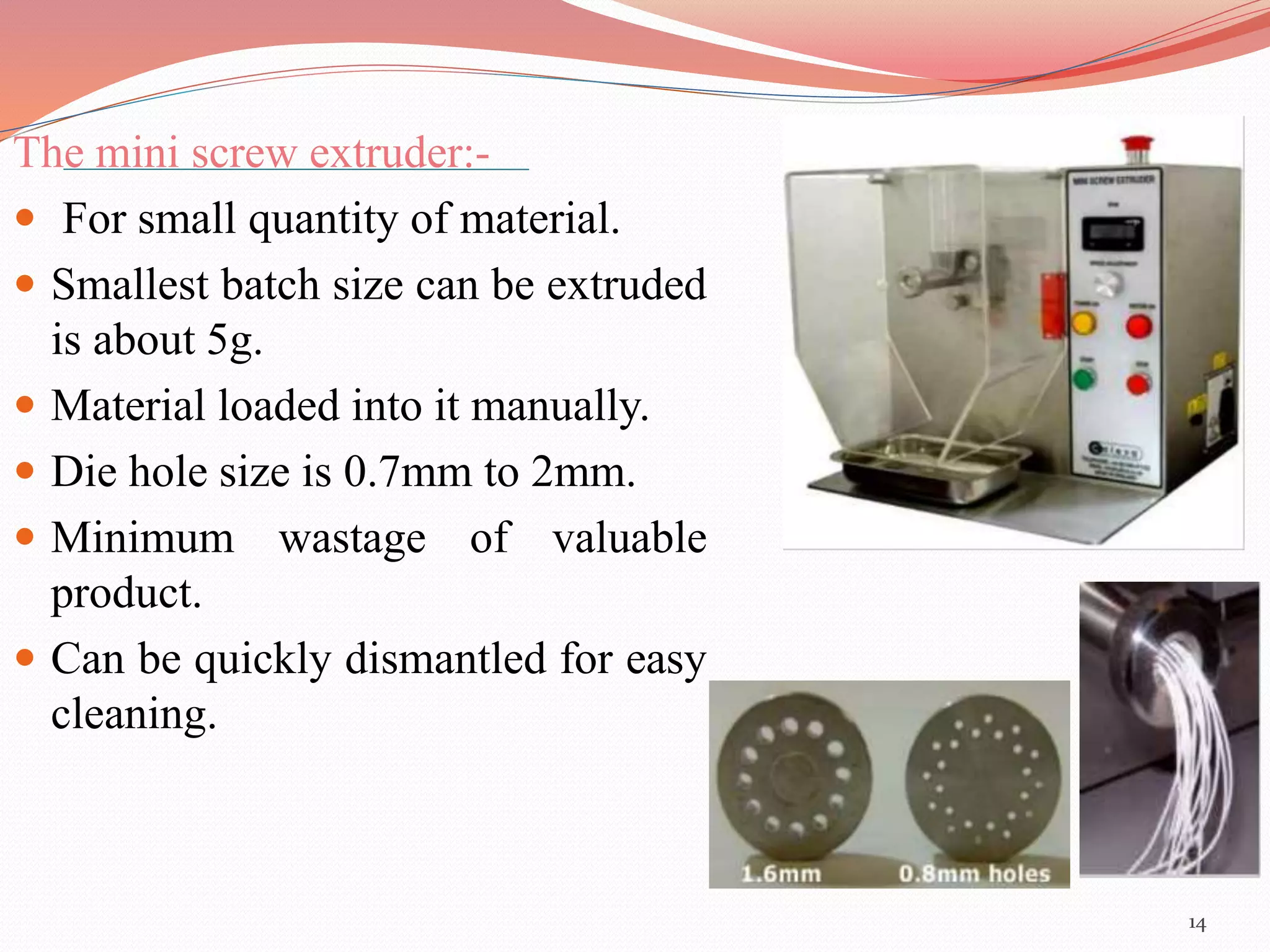
The mini screw extruder:- 
 For small quantity of material. 
 Smallest batch size can be extruded 
is about 5g. 
 Material loaded into it manually. 
 Die hole size is 0.7mm to 2mm. 
 Minimum wastage of valuable 
product. 
 Can be quickly dismantled for easy 
cleaning. 
14
 The primary extrusion process variables are : 
1) The feed rate of the wet mass 
2) The diameter of the die 
3) The length of the die 
4) The water content of the wet mass 
15
THE SPHERONIZATION PROCESS:- 
Basic configuration:- 
 Machine consists of a rotating friction disk, 
designed to increase friction with the 
product, which spins at high speed at the 
bottom of cylindrical bowl. 
16
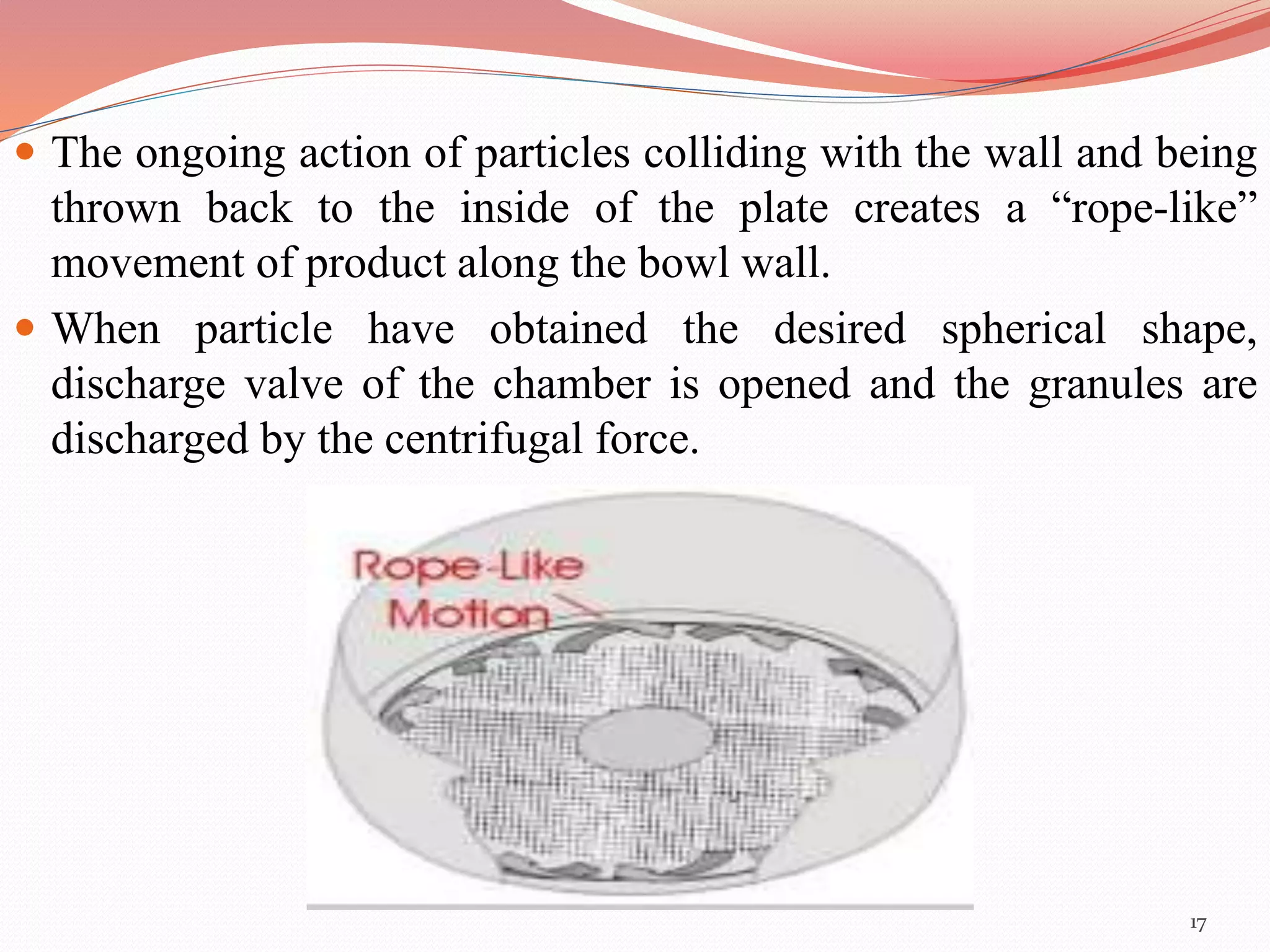
 The ongoing action of particles colliding with the wall and being 
thrown back to the inside of the plate creates a “rope-like” 
movement of product along the bowl wall. 
 When particle have obtained the desired spherical shape, 
discharge valve of the chamber is opened and the granules are 
discharged by the centrifugal force. 
17
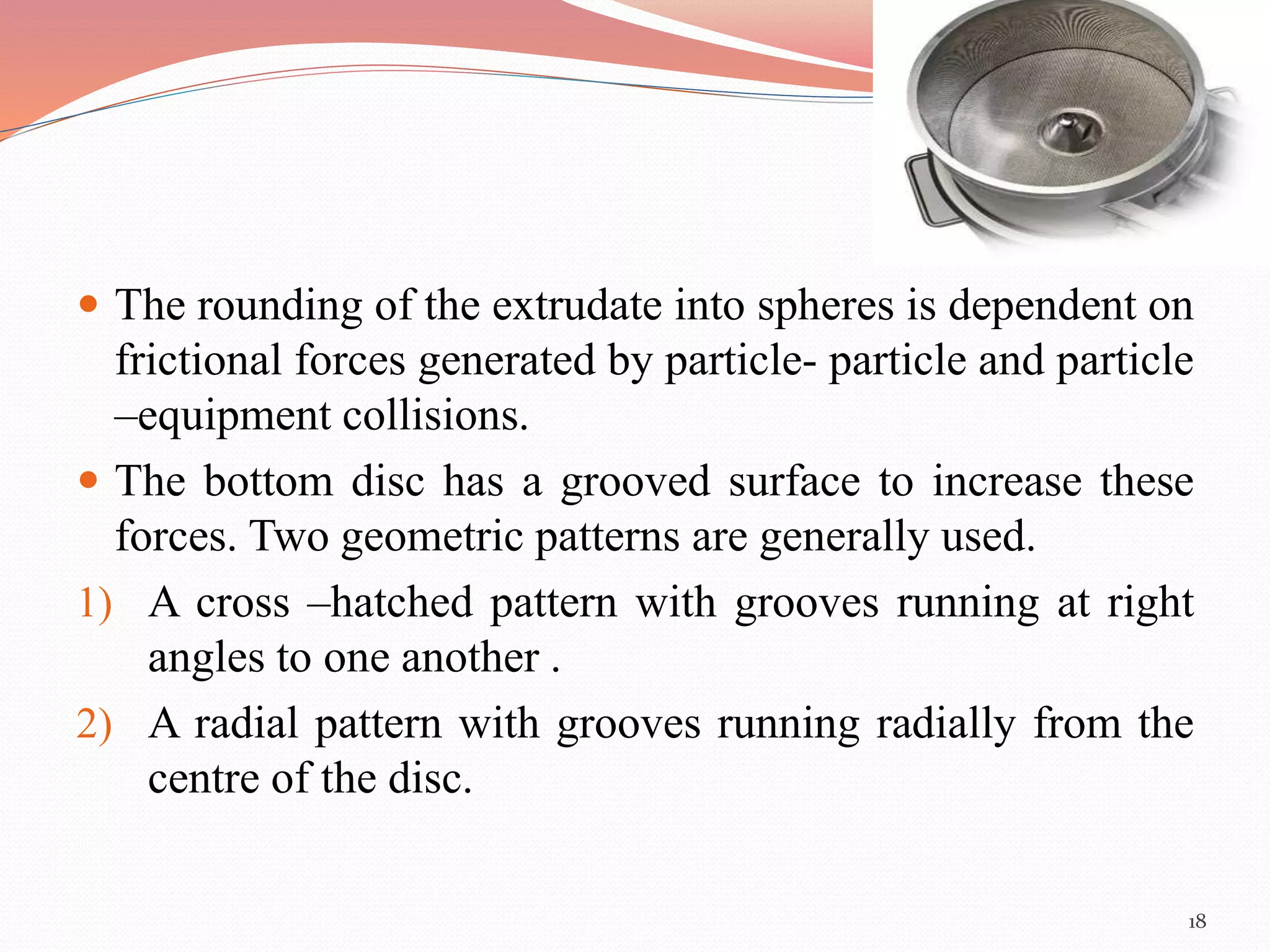
 The rounding of the extrudate into spheres is dependent on 
frictional forces generated by particle- particle and particle 
–equipment collisions. 
 The bottom disc has a grooved surface to increase these 
forces. Two geometric patterns are generally used. 
1) A cross –hatched pattern with grooves running at right 
angles to one another . 
2) A radial pattern with grooves running radially from the 
centre of the disc. 
18
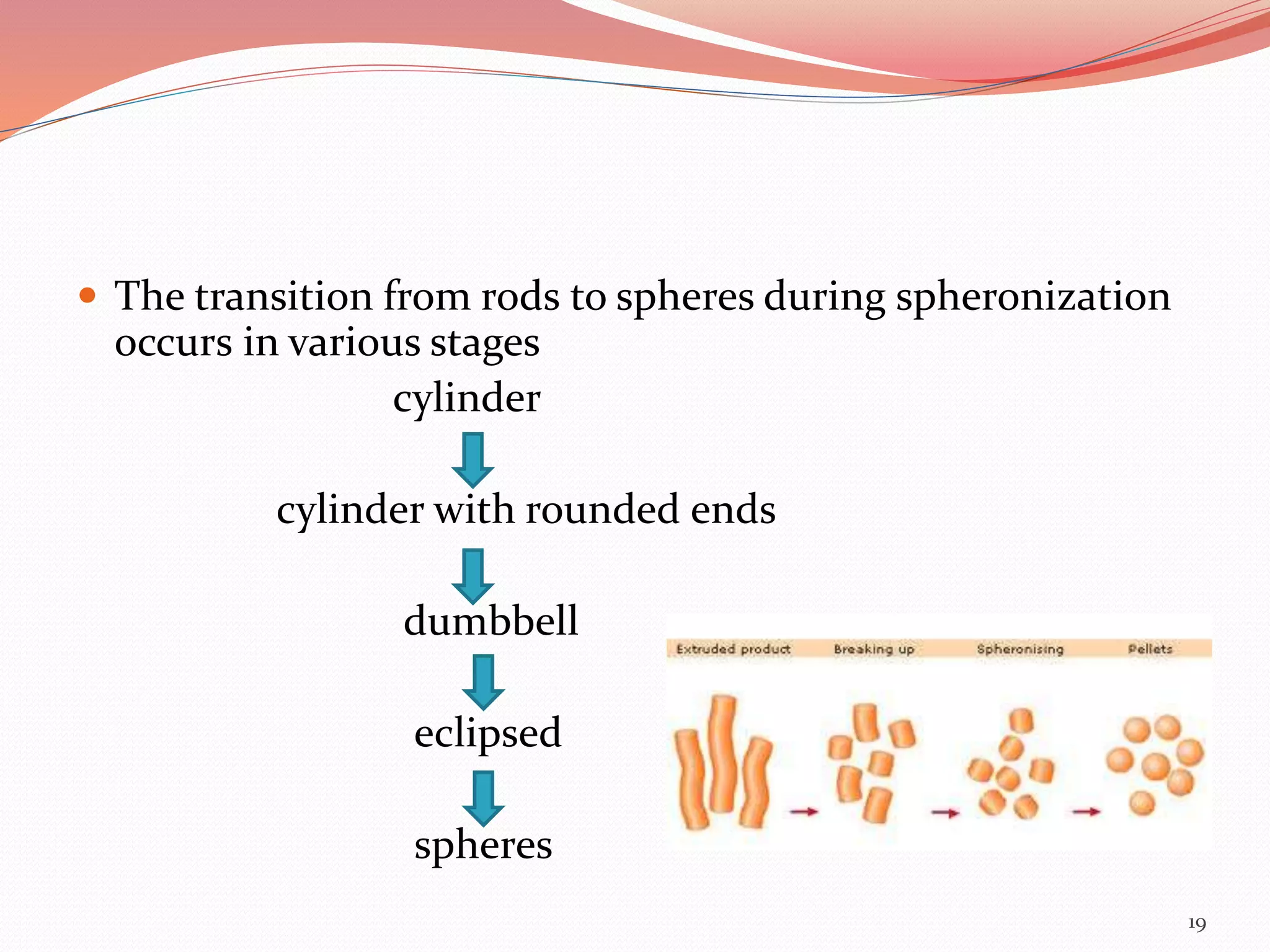
 The transition from rods to spheres during spheronization 
occurs in various stages 
cylinder 
cylinder with rounded ends 
dumbbell 
eclipsed 
spheres 
19
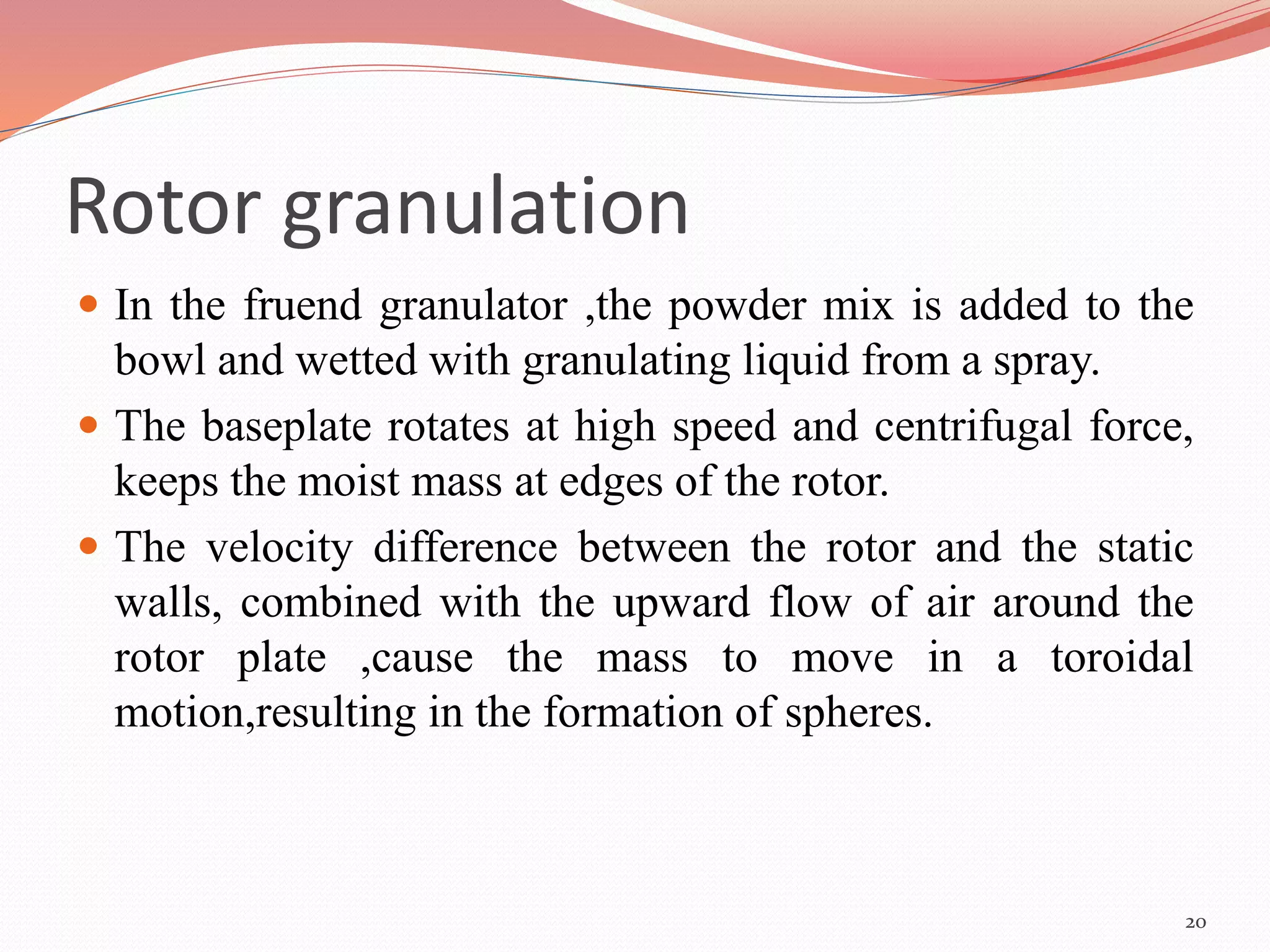
Rotor granulation 
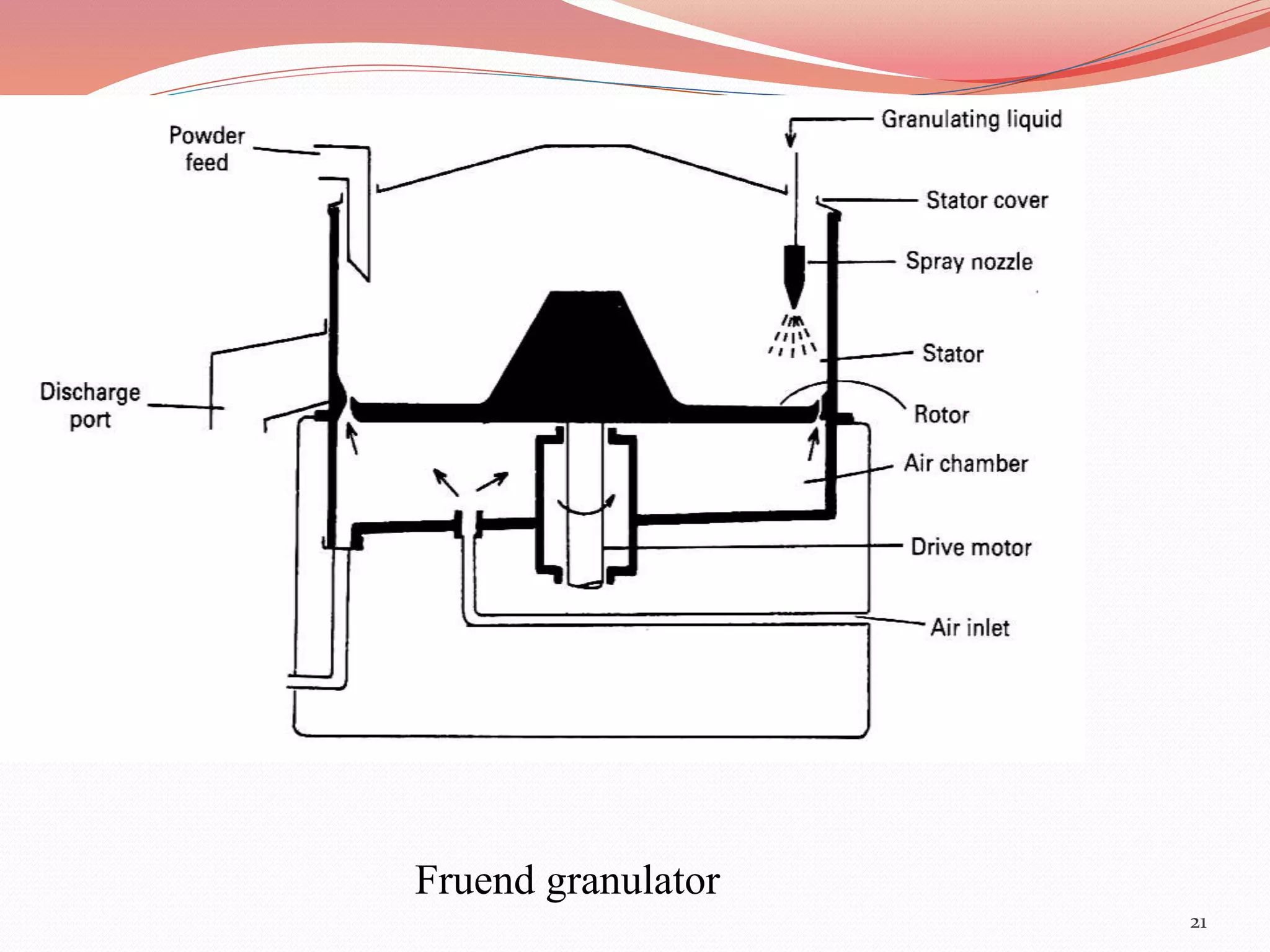
 In the fruend granulator ,the powder mix is added to the 
bowl and wetted with granulating liquid from a spray. 
 The baseplate rotates at high speed and centrifugal force, 
keeps the moist mass at edges of the rotor. 
 The velocity difference between the rotor and the static 
walls, combined with the upward flow of air around the 
rotor plate ,cause the mass to move in a toroidal 
motion,resulting in the formation of spheres. 
20
21 
Fruend granulator
Standard features of marumerizer 
 Perfect cGMP design,smooth covering. 
 Explosion free design. 
 Automatic cleaning of entire system. 
 Completely integrated full opening side discharge. 
 Advance process for easy and automated granulation. 
 jacketed/insulated bowl. 
 Integration with mill is possible. 
 Video monitoring the process. 
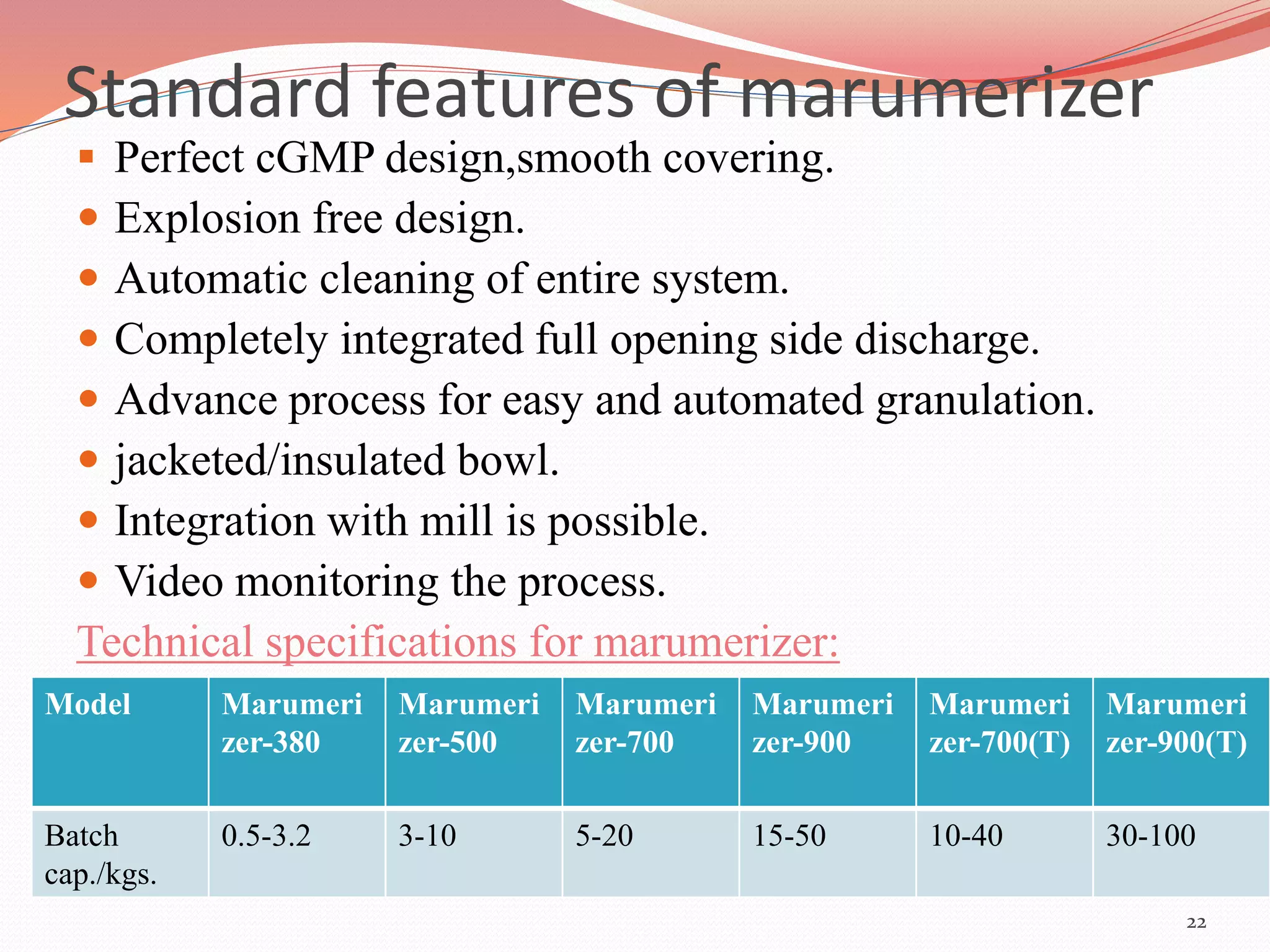
Technical specifications for marumerizer: 
22 
Model Marumeri 
zer-380 
Marumeri 
zer-500 
Marumeri 
zer-700 
Marumeri 
zer-900 
Marumeri 
zer-700(T) 
Marumeri 
zer-900(T) 
Batch 
cap./kgs. 
0.5-3.2 3-10 5-20 15-50 10-40 30-100
23 
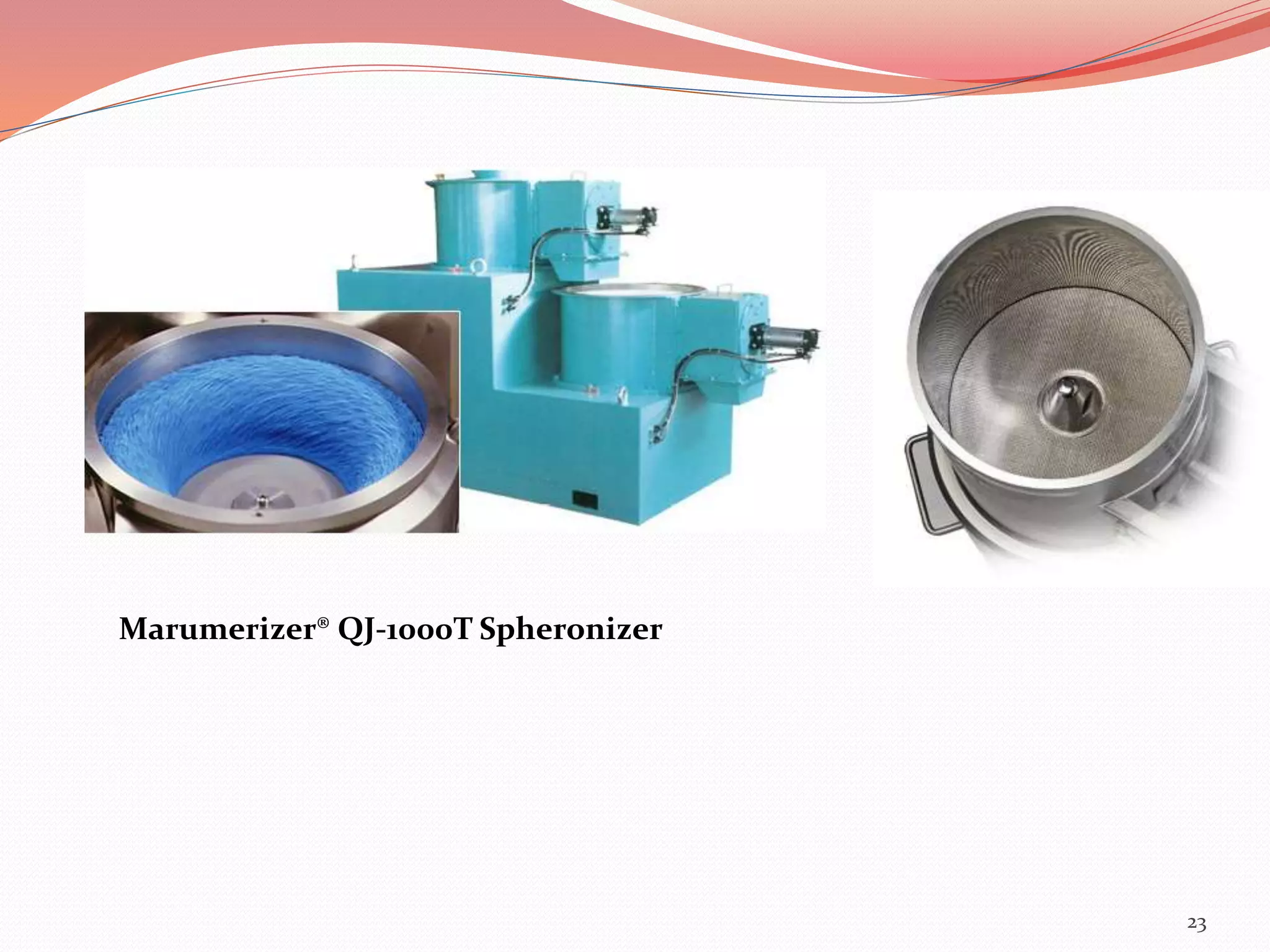
Marumerizer® QJ-1000T Spheronizer
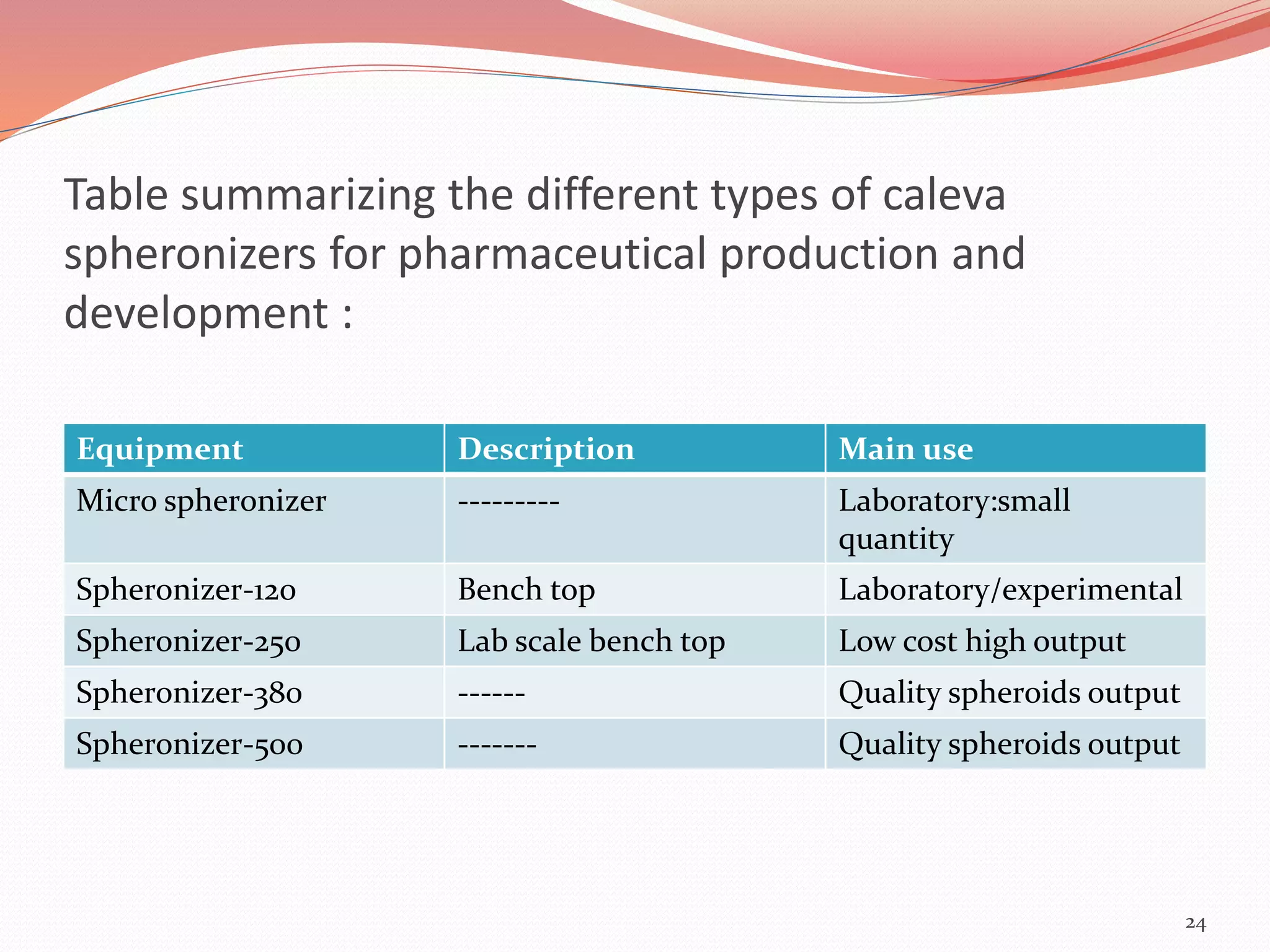
Table summarizing the different types of caleva 
spheronizers for pharmaceutical production and 
development : 
Equipment Description Main use 
Micro spheronizer --------- Laboratory:small 
quantity 
Spheronizer-120 Bench top Laboratory/experimental 
Spheronizer-250 Lab scale bench top Low cost high output 
Spheronizer-380 ------ Quality spheroids output 
Spheronizer-500 ------- Quality spheroids output 
24
 Example of spheronizers:- 
 Spheronizer 250:- 
25 
Spheronizes380 
spheronizer500
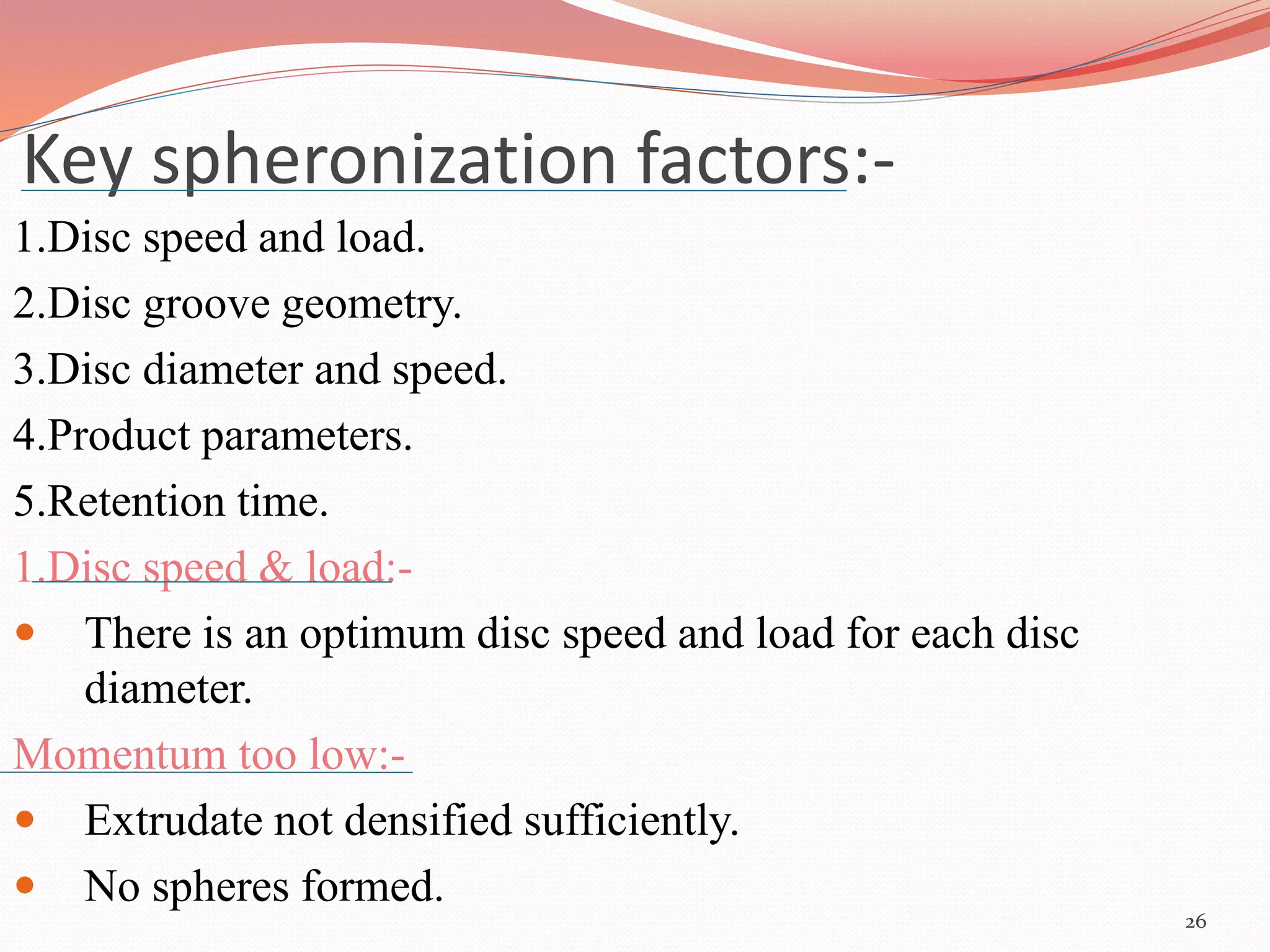
Key spheronization factors:- 
1.Disc speed and load. 
2.Disc groove geometry. 
3.Disc diameter and speed. 
4.Product parameters. 
5.Retention time. 
1.Disc speed & load:- 
 There is an optimum disc speed and load for each disc 
diameter. 
Momentum too low:- 
 Extrudate not densified sufficiently. 
 No spheres formed. 
26
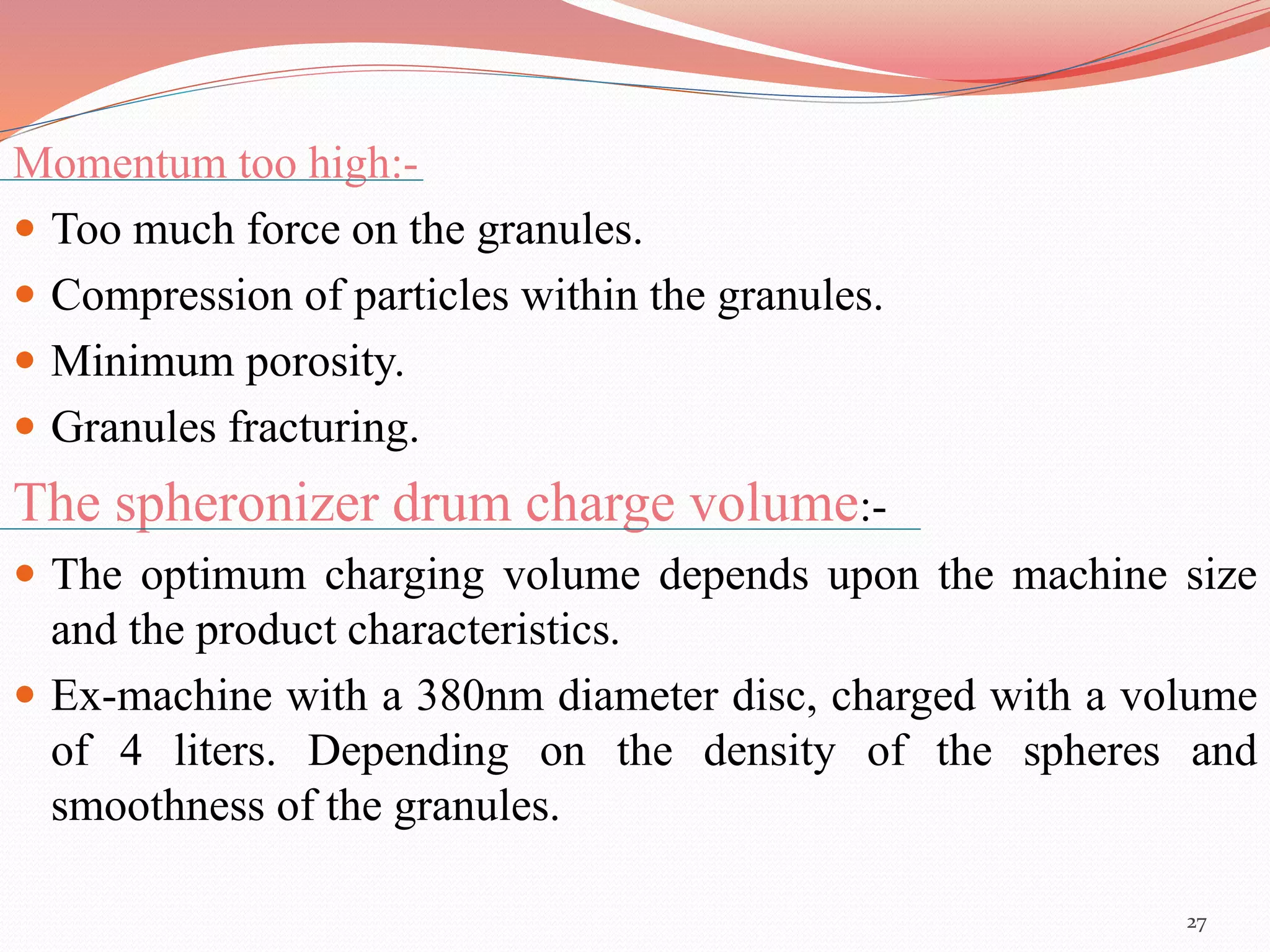
Momentum too high:- 
 Too much force on the granules. 
 Compression of particles within the granules. 
 Minimum porosity. 
 Granules fracturing. 
The spheronizer drum charge volume:- 
 The optimum charging volume depends upon the machine size 
and the product characteristics. 
 Ex-machine with a 380nm diameter disc, charged with a volume 
of 4 liters. Depending on the density of the spheres and 
smoothness of the granules. 
27
2.Disc groove geometry:- 
 Square cross hatched design is most commonly used. 
3.Product parameter:- 
 The particles must be plastic enough to allow deformation 
during collisions, but also must be strong enough to 
withstand collision with the disc, other particles & the 
spheronizer wall without breaking up. 
4.Retention time:- 
 Typical spheronization retention time necessary to 
obtained spheres is from 2 to 6 min . 
28
Machine parameters 
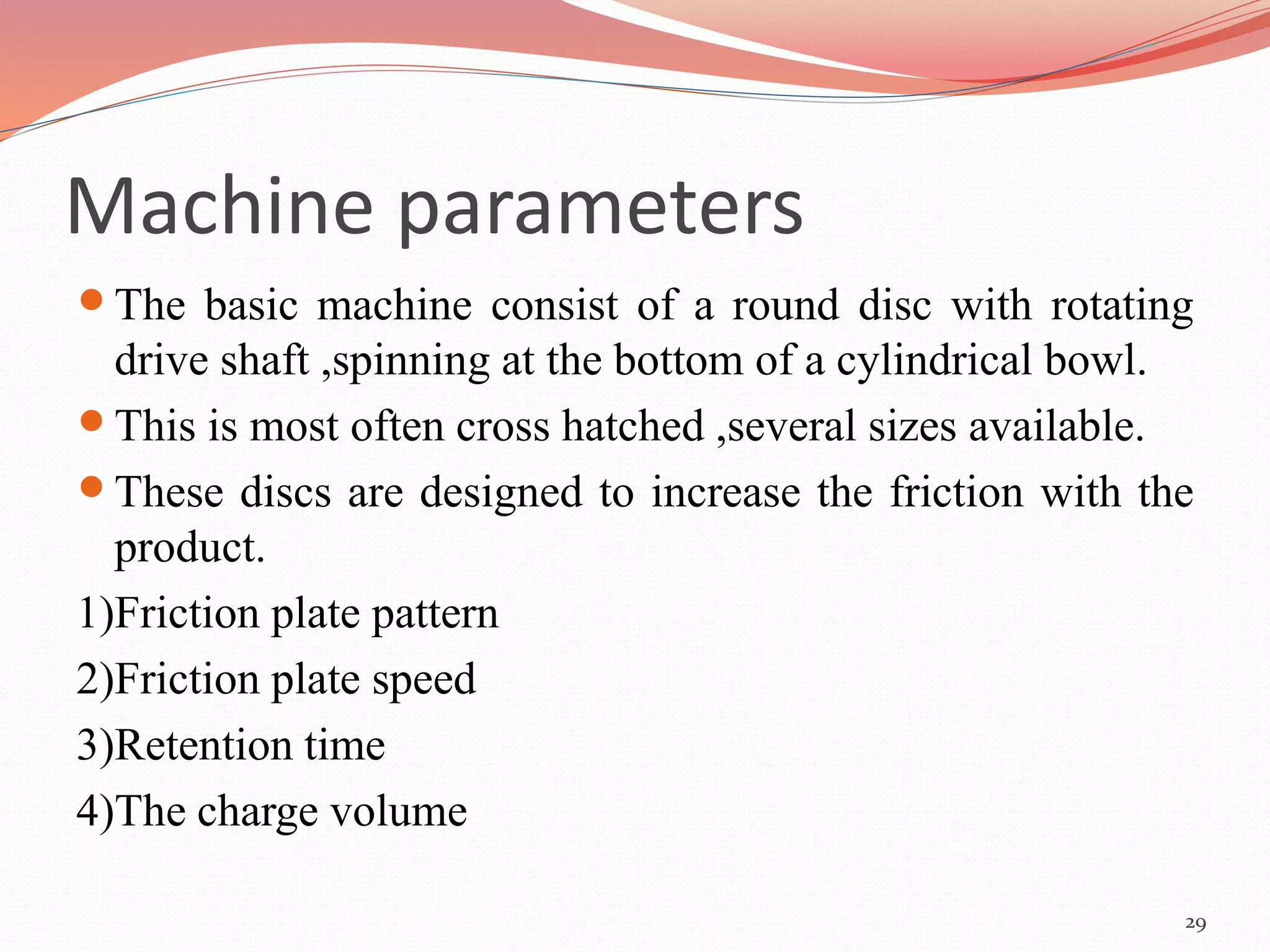
 The basic machine consist of a round disc with rotating 
drive shaft ,spinning at the bottom of a cylindrical bowl. 
 This is most often cross hatched ,several sizes available. 
 These discs are designed to increase the friction with the 
product. 
1)Friction plate pattern 
2)Friction plate speed 
3)Retention time 
4)The charge volume 
29
1)Friction plate pattern:- 
• The most common groove pattern used for spheroniser discs is 
the “waffle-iron” or cross hatch design ,where the friction plate 
is like a chessboard of chopped off pyramids. 
• Discs with a radial design are also used. 
2)Friction plate speed:- 
• The typical rotation speed of a 700 mm diameter disc ranges 
from 400 to 500 rpm. 
• The optimum speed depends on the characteristics of the 
product and the particle size. 
30
3)Retention time:- 
 Typical retention time to obtain spheres range from 2 to 6 
minutes. 
 The edges of cylindrical granules are the most fragile part and 
they will generate dust during handling . 
 Spheronization with short retention time can help to reduce 
dust significantly. 
4)The charge volume:- 
 The optimum level depends upon the machine size and the 
product characteristics. 
 Increasing the load per batch increases the hardness of the 
spheres and smooths the granule surface. 
31
Product parameters 
 The rheology of the product can be changed by varying 
the formulation or physically. 
 Binders can be used to increase the strength of the 
granules and reduce the amount of fines generated 
during the process. 
 Lubricants will increase the plasticity. 
 Water can also be used as lubricant. 
 The optimum moisture content for spheronization is 
slightly less than for extrusion. 
32
1)Auxillary equipment:- 
 These can help to improve the efficiency and ease of the 
process. 
2)Water jacket:- 
 Warm water useful to drive off moisture that would cause 
product sticking on the chamber wall. 
 Cooling the wall will avoid temperature rises in heat 
sensitive products. 
 The average temperature rise is generally rather 
small(normally about 4 c). 
33
3)Air introduction:- 
 It prevents dust from getting between the rotating plate 
and the wall of the chamber . 
 It also help to remove moisture from the granule’s surface. 
4)Non- stick coatings :- 
 The chamber wall and the spheronization plate can be 
coated with non-stick materials if this is necessary for 
ease of use with sticky materials or cleaning. 
34
Reference 
 The design and manufacture of medicines (edited by 
Michael.E Aulton),3rd edition.Aulton’s(pharmaceutics) 
page no:419-422. 
 Inventi rapid:pharma tech journal ;review on extrusion 
and spheronization (publication date 20-10-2012). 
 A literature review .,Chris Vervaet,Lieven Baert and Jean 
Paul Remon.Interntional journal of pharmaceutics volume 
116(28th march 1995). 
 www.umangpharmaceuticals.com. 
35
ge THANK YOU 
36

Spheronization

  • 1.
    Presentation by: k.Manasa Roll no-256212886046 M.Pharmacy(pharmaceutics) 1
  • 2.
    CONTENTS  DEFINITION  ADVANTAGES  SPHERONIZATION PROCESS  EXTRUSION  ROTOR GRANULATION  KEY SPHERONIZATION FACTORS  MACHINE PARAMETERS  PRODUCT PARAMETERS  REFERENCE 2
  • 3.
    Definition:-  Spheronizationor marumerization, is a rapid and flexible process where pharmaceutical products are made into small spheres, or spheroids of diameter ranging from about 0.5mm to 1mm where as in marumerizatin 0.6mm t0 1.2mm. 3
  • 4.
    Advantages:- 1. Optimumflow and handling characteristics:- • The flow characteristics of spheres makes them suitable for transportation by most systems found in the pharmaceutical industry, including vacuum transfer. 2. More reproducible packing into small container:- • The packing into small containers, such as hard gelatine capsules, or larger packages is much more convenient than other drug form such as powders or granules. • Eliminate quality problems with variable dosage due to packing problems with powder. 4
  • 5.
    3. Minimum surfacearea/volume ratio:- •Spheres provide the lowest surface area to volume ratio and thus pharmaceutical compounds can be coated with minimum of coating material. Important for effective release of some drugs. 4. Optimum shape for coating and for controlled release:- •Coating can provide controlled, targeted release at different location within the body. •spheres are dense material that can easily be coated within a minimum of coating material. 5
  • 6.
    5.Easy mixing ofnon-compatible products:-  spherical particles are easily mixed. 6.Elimination of dust:-  Contamination is reduced.  The amount of fines and dust will be reduced during transport and handling. 7.Improve hardness and friability:-  Spheronization increases the hardness and reduces friability of granules. 6
  • 7.
    Spheronization process Dry mixing of ingredients – to achieve a homogeneous powder dispersion;  Wet massing – to produce a sufficiently plastic wet mass.  Extrusion – to form rod shaped particles of uniform diameter .  Spheronization – to round off these rods into spherical particles .  Drying - to achieve the desired final moisture content.  Screening -to achieve the desired narrow size distribution. 7
  • 8.
  • 9.
    Extrusion  Itproduces rod shaped particles of uniform diameter from the wet mass.  Wet mass is forced through the dies and shaped into small cylindrical particles with uniform diameter .  The extrudate particles breaks at similar lengths under then own weight.  Extrudate must have enough plasticity to deform ,but extrudate particles do not adhere to other particles when collected.  Based on their feed mechanism extruders divided into 3 types 1.screw feed extruder(axial and radial) 2.Gravity feed extruder (cylinder roll, gear roll and radial) 3.Piston feed extruder 9
  • 10.
    2. Screen orbasket extruder:-  Lower density extrudate.  Relatively high throughput. 3. Gear extruder:-  produces relatively high density.  Gears are robust and long lasting. 10 1.Screw feed extruder:- •Commonly used in industrial application. •High pressure and heat can degrade pharmaceutical product.
  • 11.
    Type of extruderused in pharmaceutical industry:- Equipment Description Main uses Extruder 20 Bench top screen extruder Laboratory experimental/small scale production(25-30kg/hr) Extruder 35 Production screen extruder Lab /production , low cost .high out put (2kg/min) of less dense extrudate. Extruder 40 Production gear extruder Quality extrudate output 40- 100kg/hr Extruder 100 Production gear extruder Quality extrudate output 100-500kg/hr 11
  • 12.
    1.Extruder 20:- Designed for pharmaceutical process development work in lab.  Few dead spaces where material can collect.  Minimum effective load requirement is about 30g  Can be easily dismantled for easy cleaning. 12
  • 13.
     Extruder 35:-  Extruder 40:- 13
  • 14.
    The mini screwextruder:-  For small quantity of material.  Smallest batch size can be extruded is about 5g.  Material loaded into it manually.  Die hole size is 0.7mm to 2mm.  Minimum wastage of valuable product.  Can be quickly dismantled for easy cleaning. 14
  • 15.
     The primaryextrusion process variables are : 1) The feed rate of the wet mass 2) The diameter of the die 3) The length of the die 4) The water content of the wet mass 15
  • 16.
    THE SPHERONIZATION PROCESS:- Basic configuration:-  Machine consists of a rotating friction disk, designed to increase friction with the product, which spins at high speed at the bottom of cylindrical bowl. 16
  • 17.
     The ongoingaction of particles colliding with the wall and being thrown back to the inside of the plate creates a “rope-like” movement of product along the bowl wall.  When particle have obtained the desired spherical shape, discharge valve of the chamber is opened and the granules are discharged by the centrifugal force. 17
  • 18.
     The roundingof the extrudate into spheres is dependent on frictional forces generated by particle- particle and particle –equipment collisions.  The bottom disc has a grooved surface to increase these forces. Two geometric patterns are generally used. 1) A cross –hatched pattern with grooves running at right angles to one another . 2) A radial pattern with grooves running radially from the centre of the disc. 18
  • 19.
     The transitionfrom rods to spheres during spheronization occurs in various stages cylinder cylinder with rounded ends dumbbell eclipsed spheres 19
  • 20.
    Rotor granulation In the fruend granulator ,the powder mix is added to the bowl and wetted with granulating liquid from a spray.  The baseplate rotates at high speed and centrifugal force, keeps the moist mass at edges of the rotor.  The velocity difference between the rotor and the static walls, combined with the upward flow of air around the rotor plate ,cause the mass to move in a toroidal motion,resulting in the formation of spheres. 20
  • 21.
  • 22.
    Standard features ofmarumerizer  Perfect cGMP design,smooth covering.  Explosion free design.  Automatic cleaning of entire system.  Completely integrated full opening side discharge.  Advance process for easy and automated granulation.  jacketed/insulated bowl.  Integration with mill is possible.  Video monitoring the process. Technical specifications for marumerizer: 22 Model Marumeri zer-380 Marumeri zer-500 Marumeri zer-700 Marumeri zer-900 Marumeri zer-700(T) Marumeri zer-900(T) Batch cap./kgs. 0.5-3.2 3-10 5-20 15-50 10-40 30-100
  • 23.
  • 24.
    Table summarizing thedifferent types of caleva spheronizers for pharmaceutical production and development : Equipment Description Main use Micro spheronizer --------- Laboratory:small quantity Spheronizer-120 Bench top Laboratory/experimental Spheronizer-250 Lab scale bench top Low cost high output Spheronizer-380 ------ Quality spheroids output Spheronizer-500 ------- Quality spheroids output 24
  • 25.
     Example ofspheronizers:-  Spheronizer 250:- 25 Spheronizes380 spheronizer500
  • 26.
    Key spheronization factors:- 1.Disc speed and load. 2.Disc groove geometry. 3.Disc diameter and speed. 4.Product parameters. 5.Retention time. 1.Disc speed & load:-  There is an optimum disc speed and load for each disc diameter. Momentum too low:-  Extrudate not densified sufficiently.  No spheres formed. 26
  • 27.
    Momentum too high:-  Too much force on the granules.  Compression of particles within the granules.  Minimum porosity.  Granules fracturing. The spheronizer drum charge volume:-  The optimum charging volume depends upon the machine size and the product characteristics.  Ex-machine with a 380nm diameter disc, charged with a volume of 4 liters. Depending on the density of the spheres and smoothness of the granules. 27
  • 28.
    2.Disc groove geometry:-  Square cross hatched design is most commonly used. 3.Product parameter:-  The particles must be plastic enough to allow deformation during collisions, but also must be strong enough to withstand collision with the disc, other particles & the spheronizer wall without breaking up. 4.Retention time:-  Typical spheronization retention time necessary to obtained spheres is from 2 to 6 min . 28
  • 29.
    Machine parameters The basic machine consist of a round disc with rotating drive shaft ,spinning at the bottom of a cylindrical bowl.  This is most often cross hatched ,several sizes available.  These discs are designed to increase the friction with the product. 1)Friction plate pattern 2)Friction plate speed 3)Retention time 4)The charge volume 29
  • 30.
    1)Friction plate pattern:- • The most common groove pattern used for spheroniser discs is the “waffle-iron” or cross hatch design ,where the friction plate is like a chessboard of chopped off pyramids. • Discs with a radial design are also used. 2)Friction plate speed:- • The typical rotation speed of a 700 mm diameter disc ranges from 400 to 500 rpm. • The optimum speed depends on the characteristics of the product and the particle size. 30
  • 31.
    3)Retention time:- Typical retention time to obtain spheres range from 2 to 6 minutes.  The edges of cylindrical granules are the most fragile part and they will generate dust during handling .  Spheronization with short retention time can help to reduce dust significantly. 4)The charge volume:-  The optimum level depends upon the machine size and the product characteristics.  Increasing the load per batch increases the hardness of the spheres and smooths the granule surface. 31
  • 32.
    Product parameters The rheology of the product can be changed by varying the formulation or physically.  Binders can be used to increase the strength of the granules and reduce the amount of fines generated during the process.  Lubricants will increase the plasticity.  Water can also be used as lubricant.  The optimum moisture content for spheronization is slightly less than for extrusion. 32
  • 33.
    1)Auxillary equipment:- These can help to improve the efficiency and ease of the process. 2)Water jacket:-  Warm water useful to drive off moisture that would cause product sticking on the chamber wall.  Cooling the wall will avoid temperature rises in heat sensitive products.  The average temperature rise is generally rather small(normally about 4 c). 33
  • 34.
    3)Air introduction:- It prevents dust from getting between the rotating plate and the wall of the chamber .  It also help to remove moisture from the granule’s surface. 4)Non- stick coatings :-  The chamber wall and the spheronization plate can be coated with non-stick materials if this is necessary for ease of use with sticky materials or cleaning. 34
  • 35.
    Reference  Thedesign and manufacture of medicines (edited by Michael.E Aulton),3rd edition.Aulton’s(pharmaceutics) page no:419-422.  Inventi rapid:pharma tech journal ;review on extrusion and spheronization (publication date 20-10-2012).  A literature review .,Chris Vervaet,Lieven Baert and Jean Paul Remon.Interntional journal of pharmaceutics volume 116(28th march 1995).  www.umangpharmaceuticals.com. 35
  • 36.