Dr. D. Y. Patil Institute of Pharmaceutical Sciences and Research, Pimpri, Pune -
411018.
PRESENTED BY :DNYANESHWAR KHODSE
ROLL NO.:-537
(PHARMACEUTICAL QUALITY ASSURANCE)
GUIDED BY : Dr. R.K.NANDA
( Associate professor )
NON STERILE MANUFACTURING
PROCESS TECHNOLOGY
CONTENTS
• Introduction
• Types
• Tablets
• Formulation
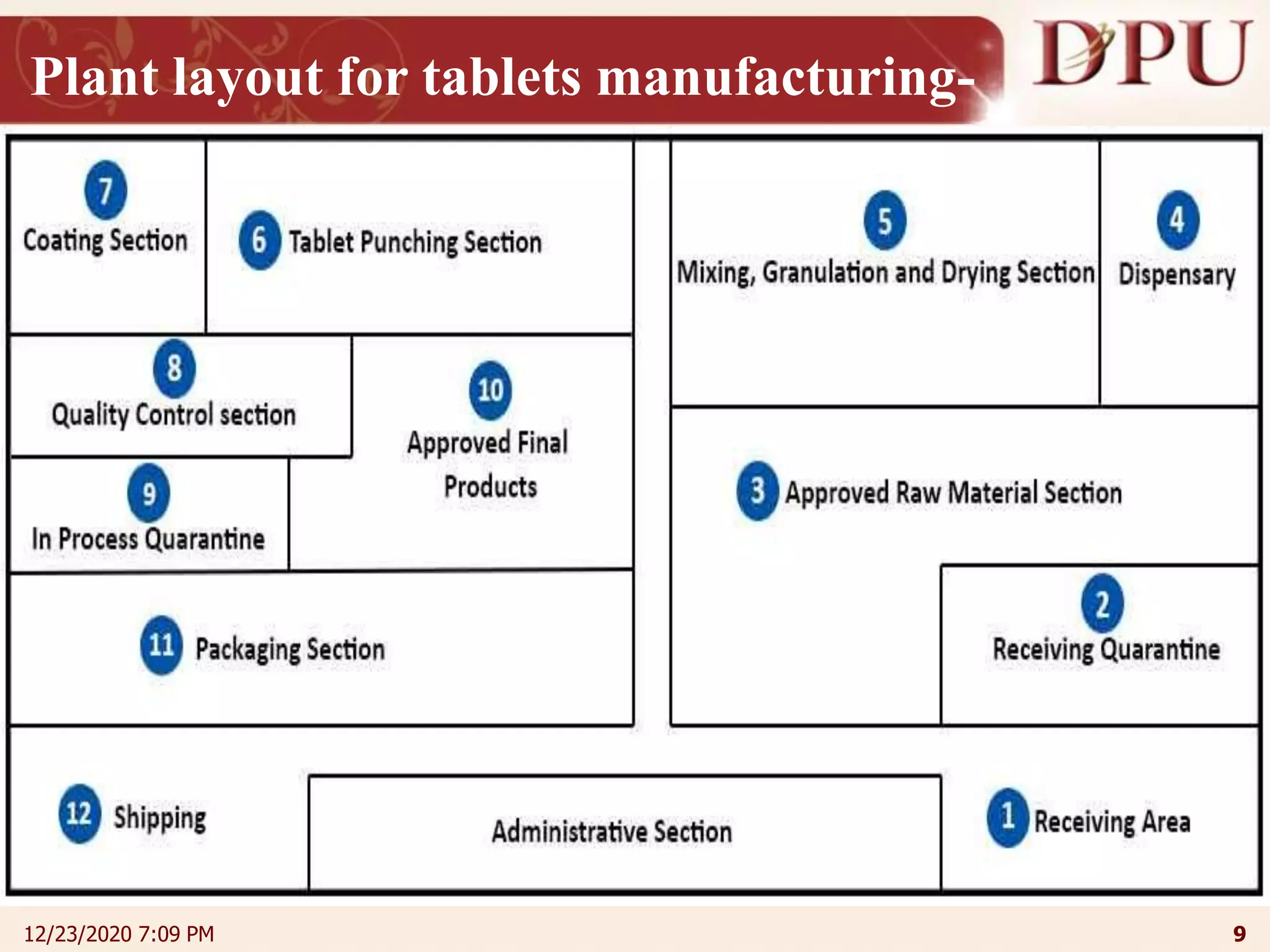
• Plant layout for tablets manufacturing
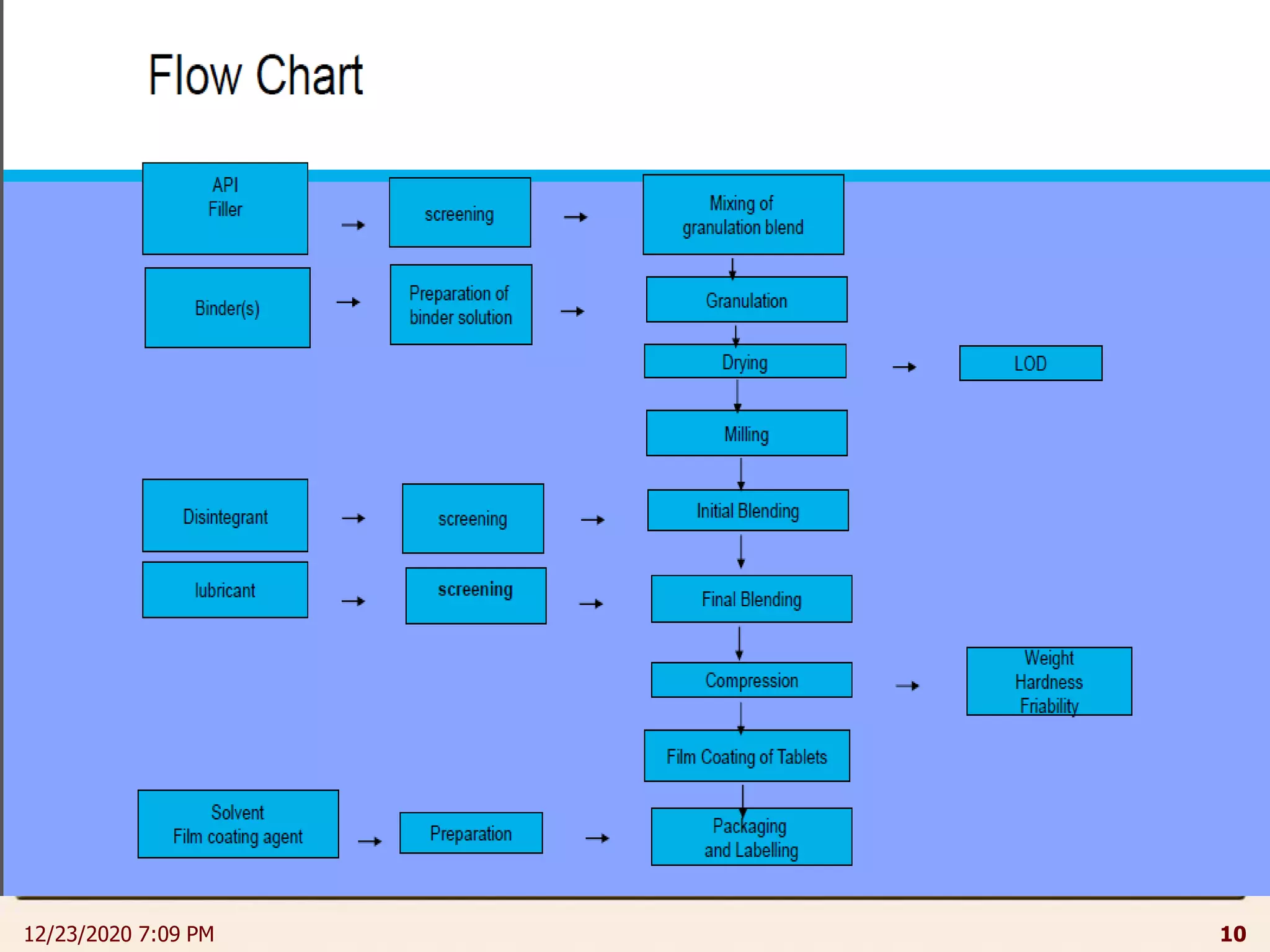
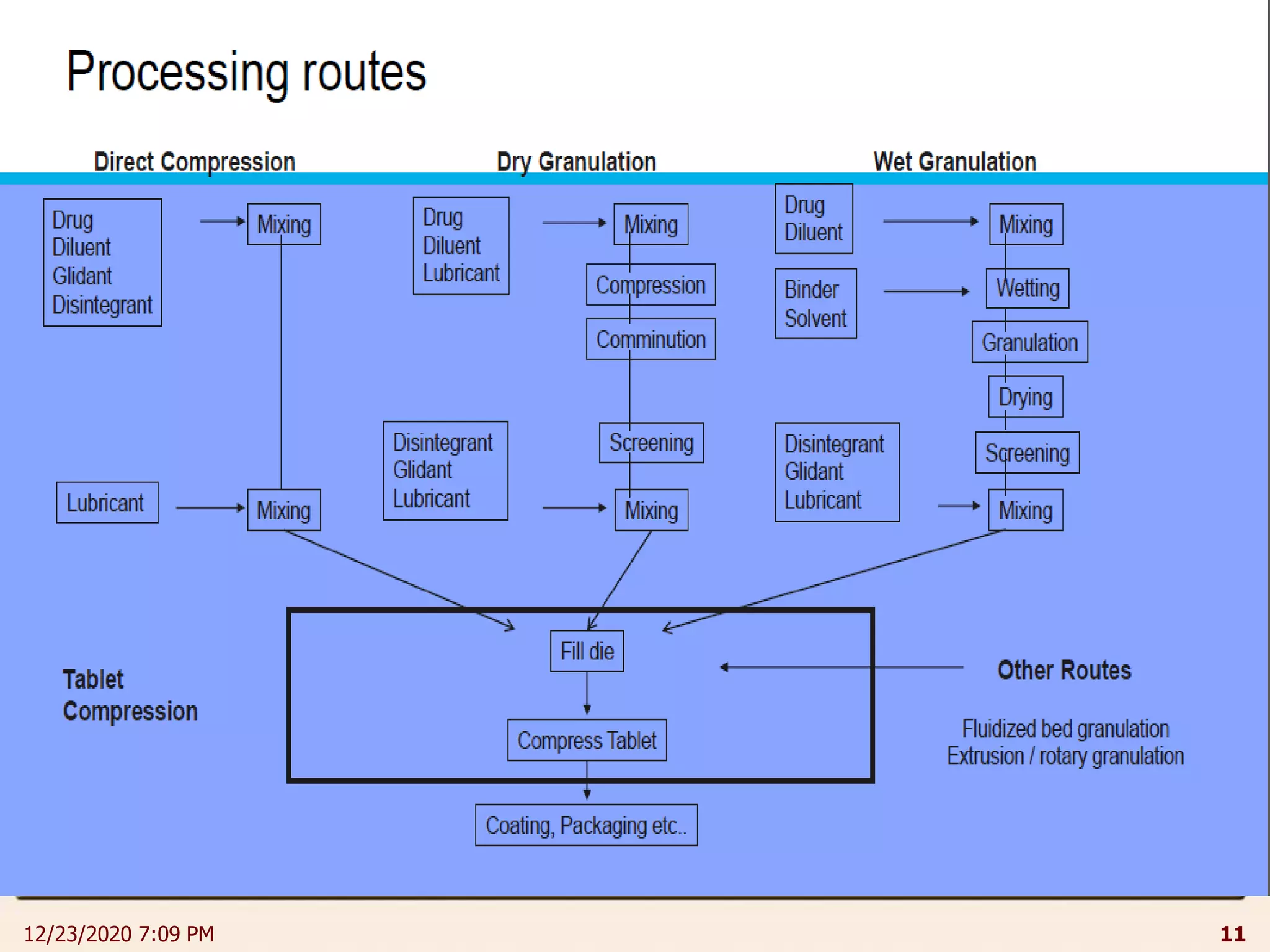
• Manufacturing flow charts
• Equipments used in tablet manufacturing
• Problems in tablet manufacturing process
• IPQC tests for tablets
• Coating technology
12/23/2020 7:09 PM 2
INTRODUCTION
 Non-sterile compounding involves creating a medication in a clean
environment but does not require the environment to be completely
free from all microorganisms.
Non sterile dosage forms-
• Tablets
• Capsules (Hard & Soft)
• Ointments
• Suspension
• Emulsion
12/23/2020 7:09 PM 3
TABLET MANUFACTURING PROCESS
DEFINITION :-
• Tablet is defined as a compressed solid dosage form
containing medicaments with or without excipients.
• According to the Indian Pharmacopoeia Pharmaceutical
tablets are solid, flat or biconvex dishes, unit dosage form,
prepared by compressing a drugs or a mixture of drugs,
with or without diluents.
• It is the most popular dosage form and 70% of the total
medicines are dispensed in the form of Tablet.
12/23/2020 7:09 PM 4
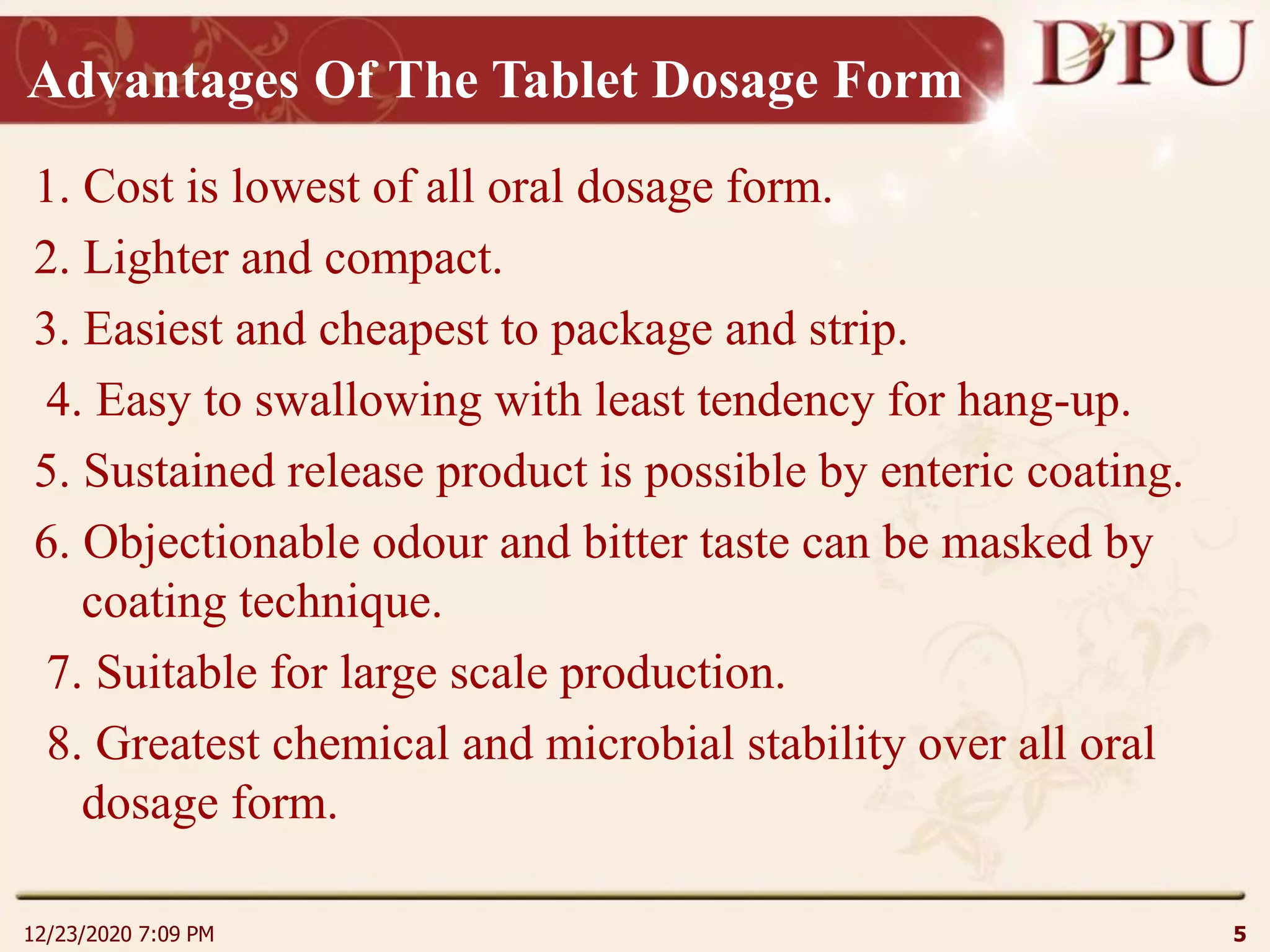
Advantages Of The Tablet Dosage Form
1. Cost is lowest of all oral dosage form.
2. Lighter and compact.
3. Easiest and cheapest to package and strip.
4. Easy to swallowing with least tendency for hang-up.
5. Sustained release product is possible by enteric coating.
6. Objectionable odour and bitter taste can be masked by
coating technique.
7. Suitable for large scale production.
8. Greatest chemical and microbial stability over all oral
dosage form.
12/23/2020 7:09 PM 5
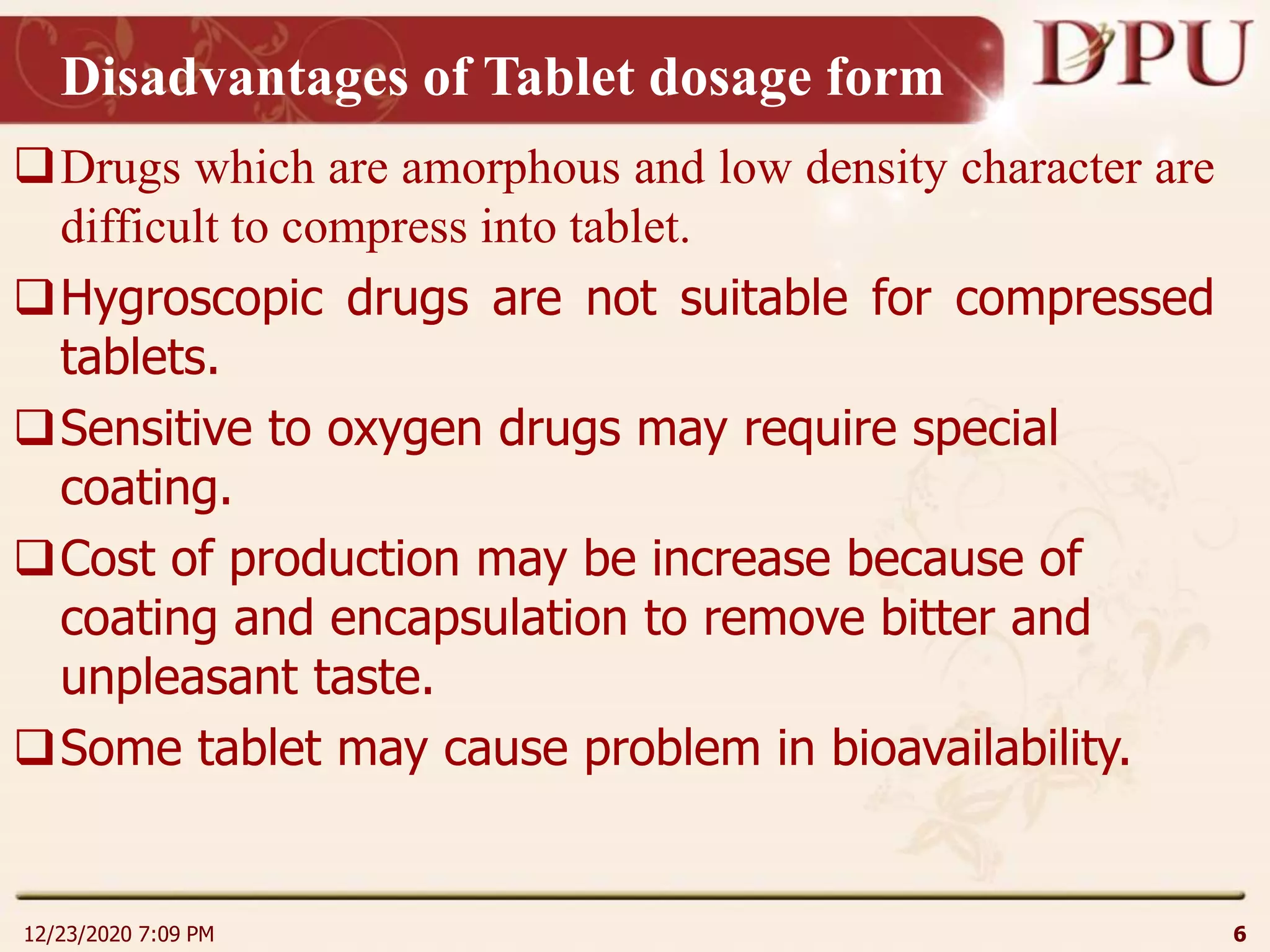
Disadvantages of Tablet dosage form
Drugs which are amorphous and low density character are
difficult to compress into tablet.
Hygroscopic drugs are not suitable for compressed
tablets.
Sensitive to oxygen drugs may require special
coating.
Cost of production may be increase because of
coating and encapsulation to remove bitter and
unpleasant taste.
Some tablet may cause problem in bioavailability.
12/23/2020 7:09 PM 6
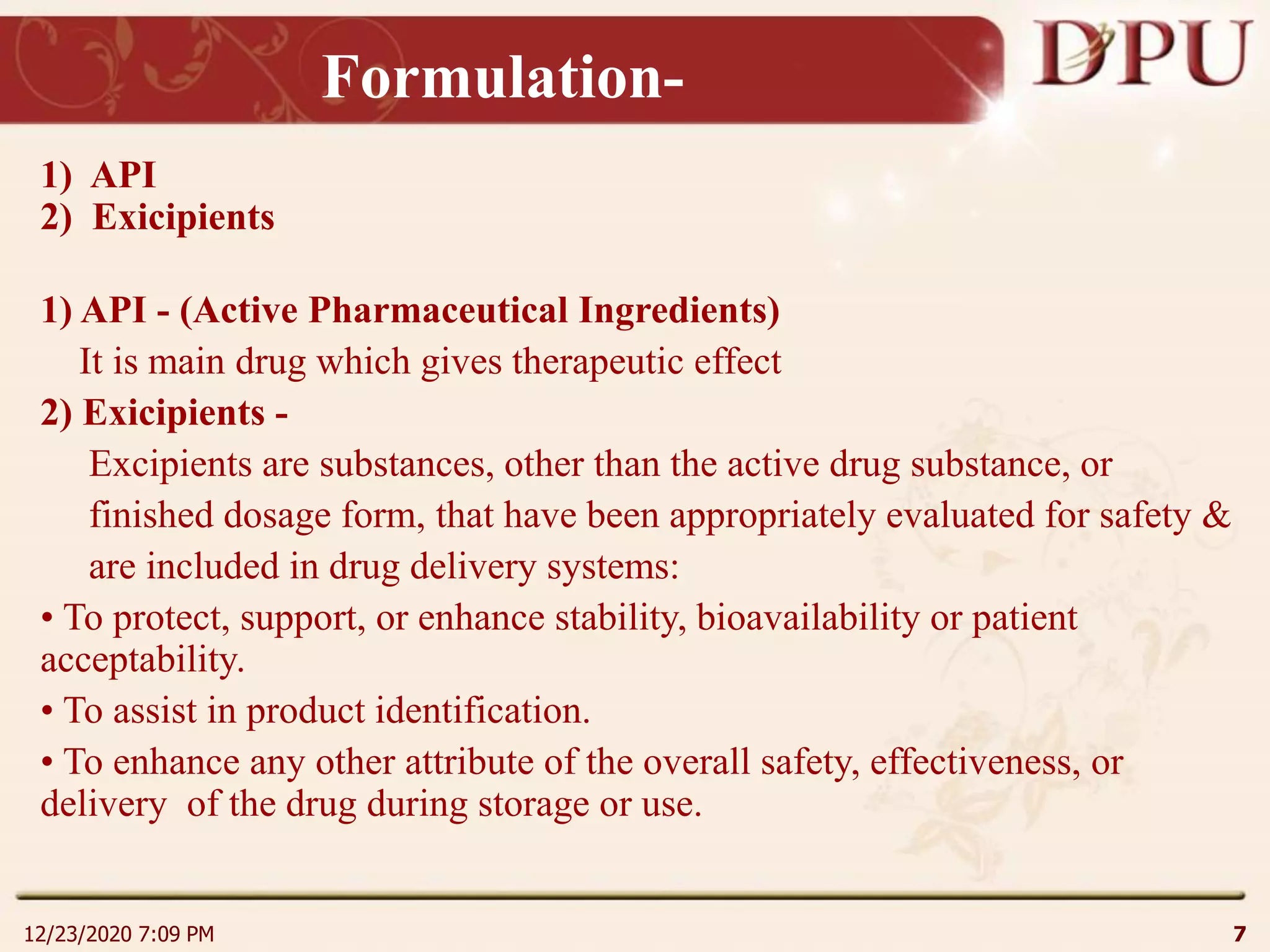
Formulation-
1) API
2) Exicipients
1) API - (Active Pharmaceutical Ingredients)
It is main drug which gives therapeutic effect
2) Exicipients -
Excipients are substances, other than the active drug substance, or
finished dosage form, that have been appropriately evaluated for safety &
are included in drug delivery systems:
• To protect, support, or enhance stability, bioavailability or patient
acceptability.
• To assist in product identification.
• To enhance any other attribute of the overall safety, effectiveness, or
delivery of the drug during storage or use.
12/23/2020 7:09 PM 7
12/23/2020 7:09 PM 8
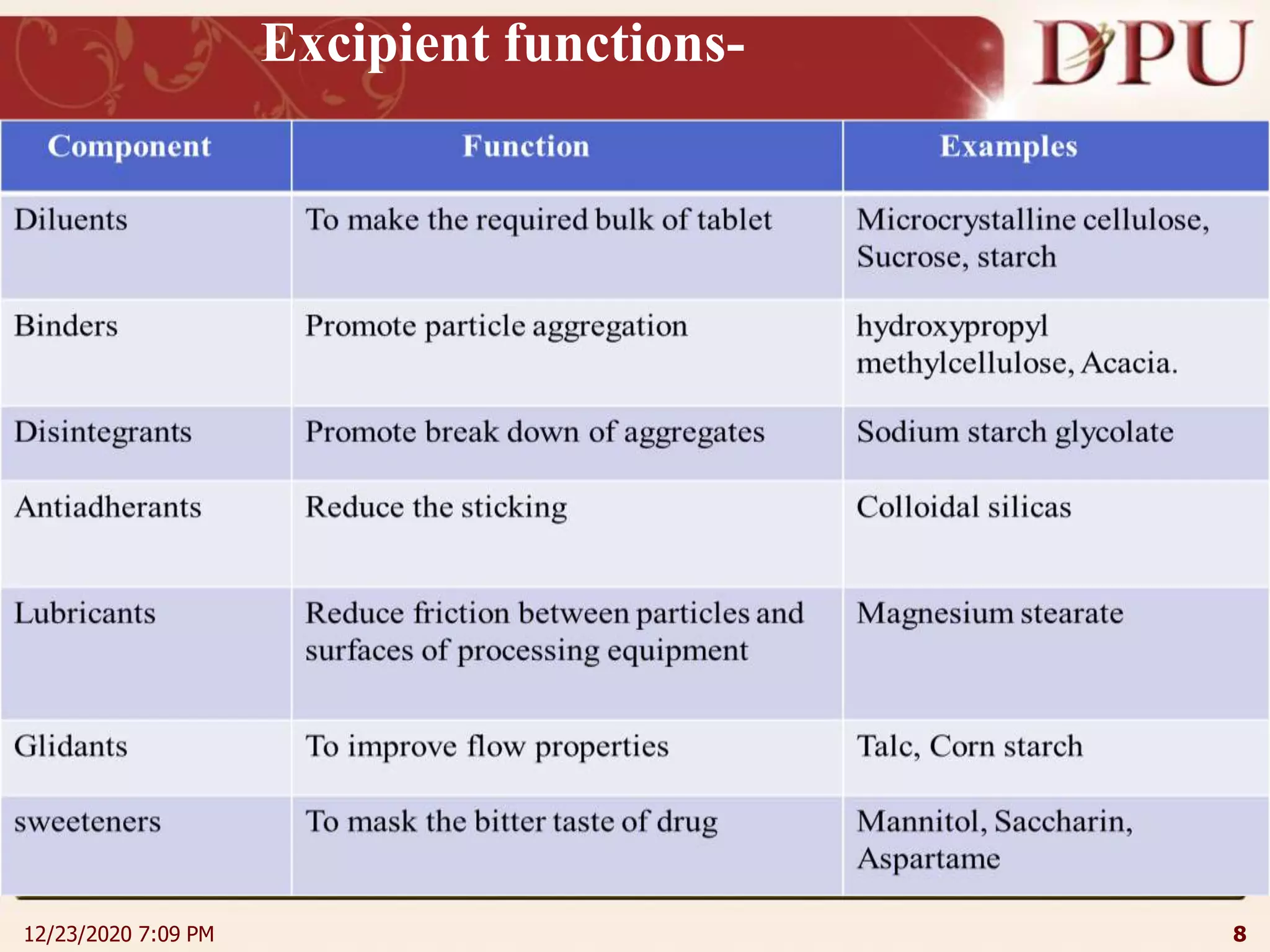
Excipient functions-
Plant layout for tablets manufacturing-
12/23/2020 7:09 PM 9
12/23/2020 7:09 PM 10
12/23/2020 7:09 PM 11
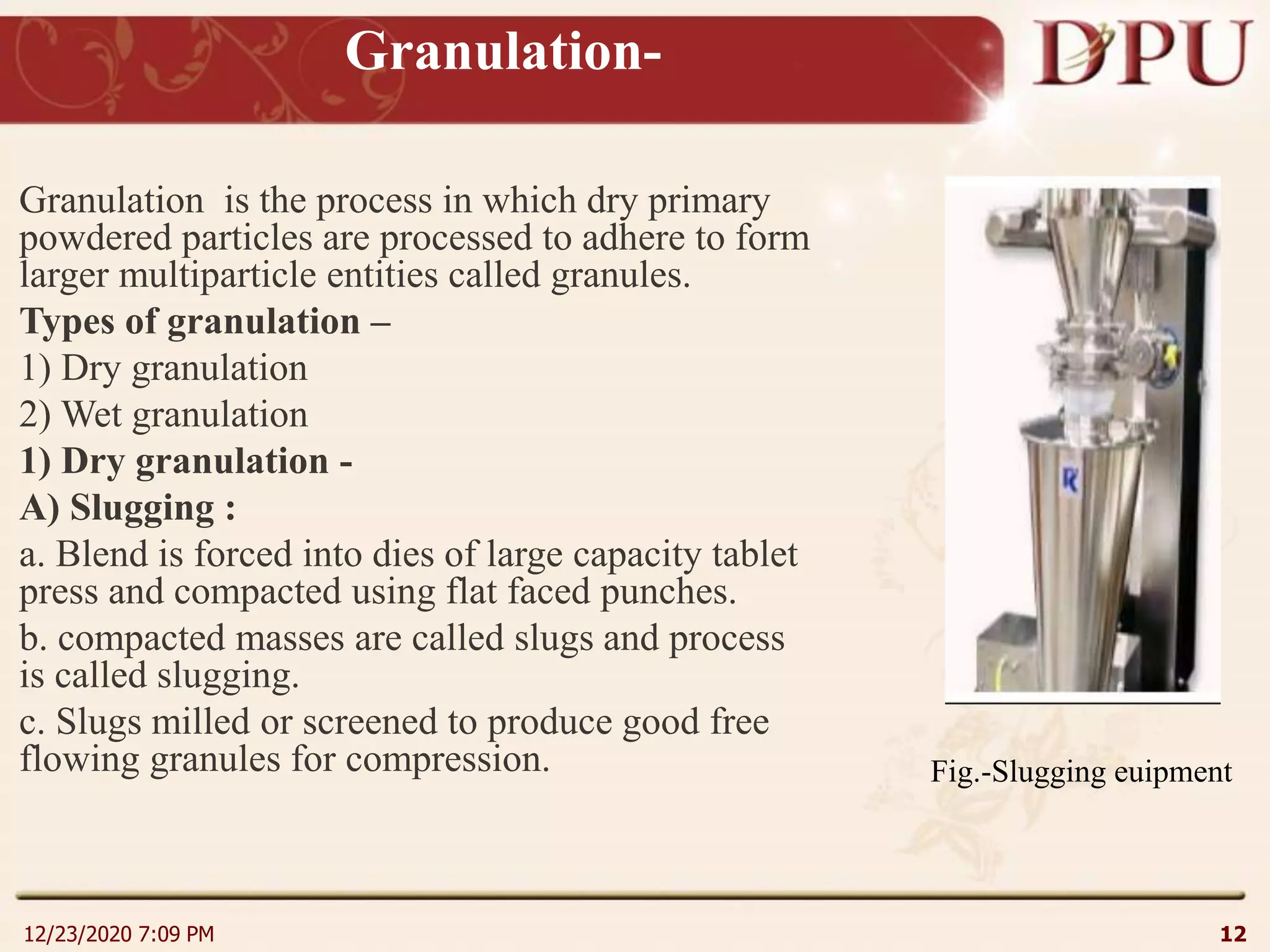
Granulation-
Granulation is the process in which dry primary
powdered particles are processed to adhere to form
larger multiparticle entities called granules.
Types of granulation –
1) Dry granulation
2) Wet granulation
1) Dry granulation -
A) Slugging :
a. Blend is forced into dies of large capacity tablet
press and compacted using flat faced punches.
b. compacted masses are called slugs and process
is called slugging.
c. Slugs milled or screened to produce good free
flowing granules for compression.
12/23/2020 7:09 PM 12
Fig.-Slugging euipment
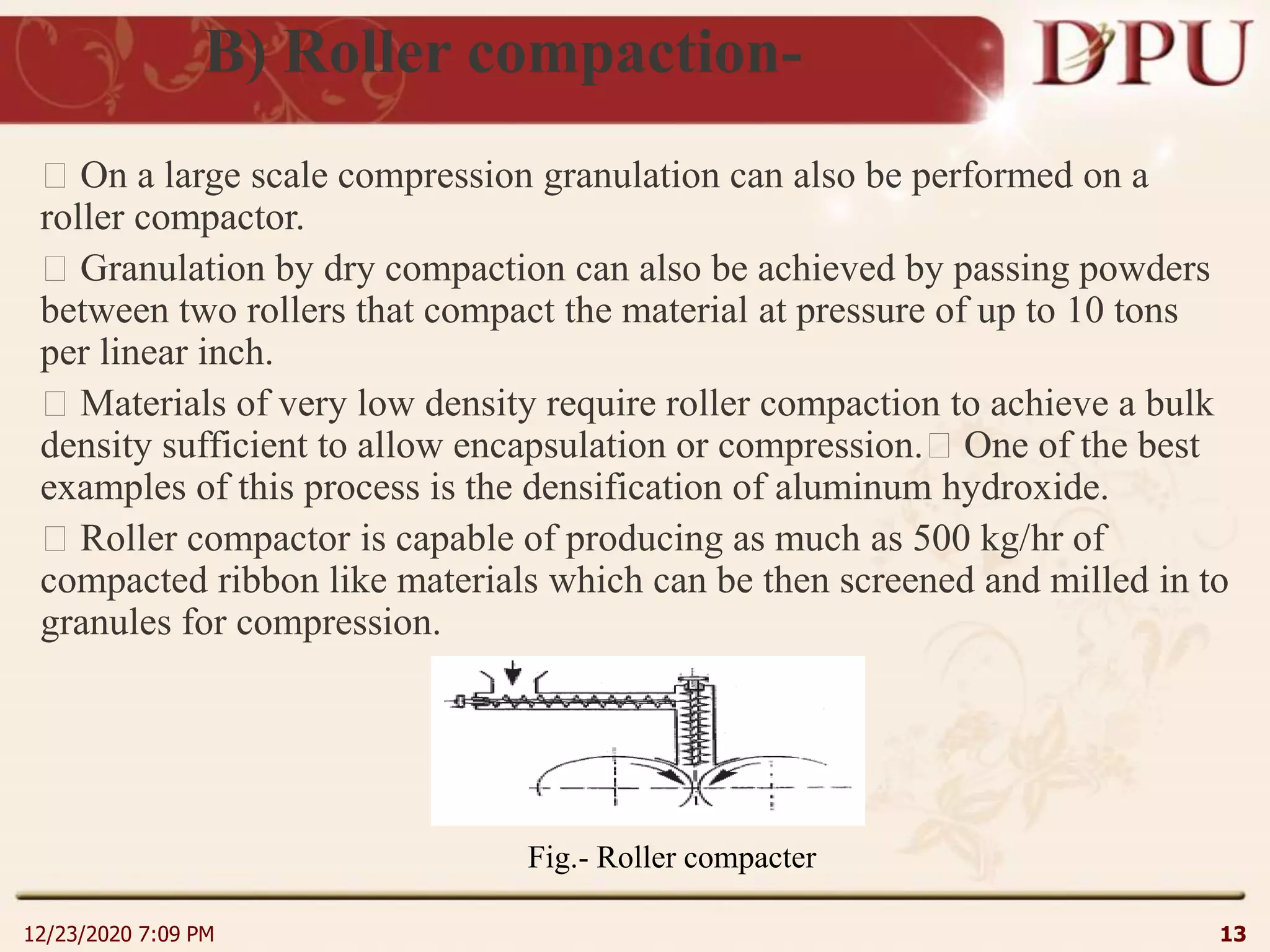
B) Roller compaction-
On a large scale compression granulation can also be performed on a
roller compactor.
Granulation by dry compaction can also be achieved by passing powders
between two rollers that compact the material at pressure of up to 10 tons
per linear inch.
Materials of very low density require roller compaction to achieve a bulk
density sufficient to allow encapsulation or compression. One of the best
examples of this process is the densification of aluminum hydroxide.
Roller compactor is capable of producing as much as 500 kg/hr of
compacted ribbon like materials which can be then screened and milled in to
granules for compression.
12/23/2020 7:09 PM 13
Fig.- Roller compacter
2) Wet granulation
 The most popular method (over 70% )Granulation is done
• To prevent segregation of the constituents of the powder blend.
• To improve flowability of the powder mixture.
• To improve the compaction characteristics of the powder mixture
due to better distribution of the binder within the granules.
• To improve homogeneity and thus ensure content uniformity Wet
granulation is a process of using a solution binder to the powder
mixture.
 The amount of liquid can be properly managed;
overwetting -the granules to be too hard,
underwetting -too soft and friable.
12/23/2020 7:09 PM 14
Limitations of wet granulation:
1) Multiple separate steps are involved.
2) Not suitable for heat and moisture sensitive drugs
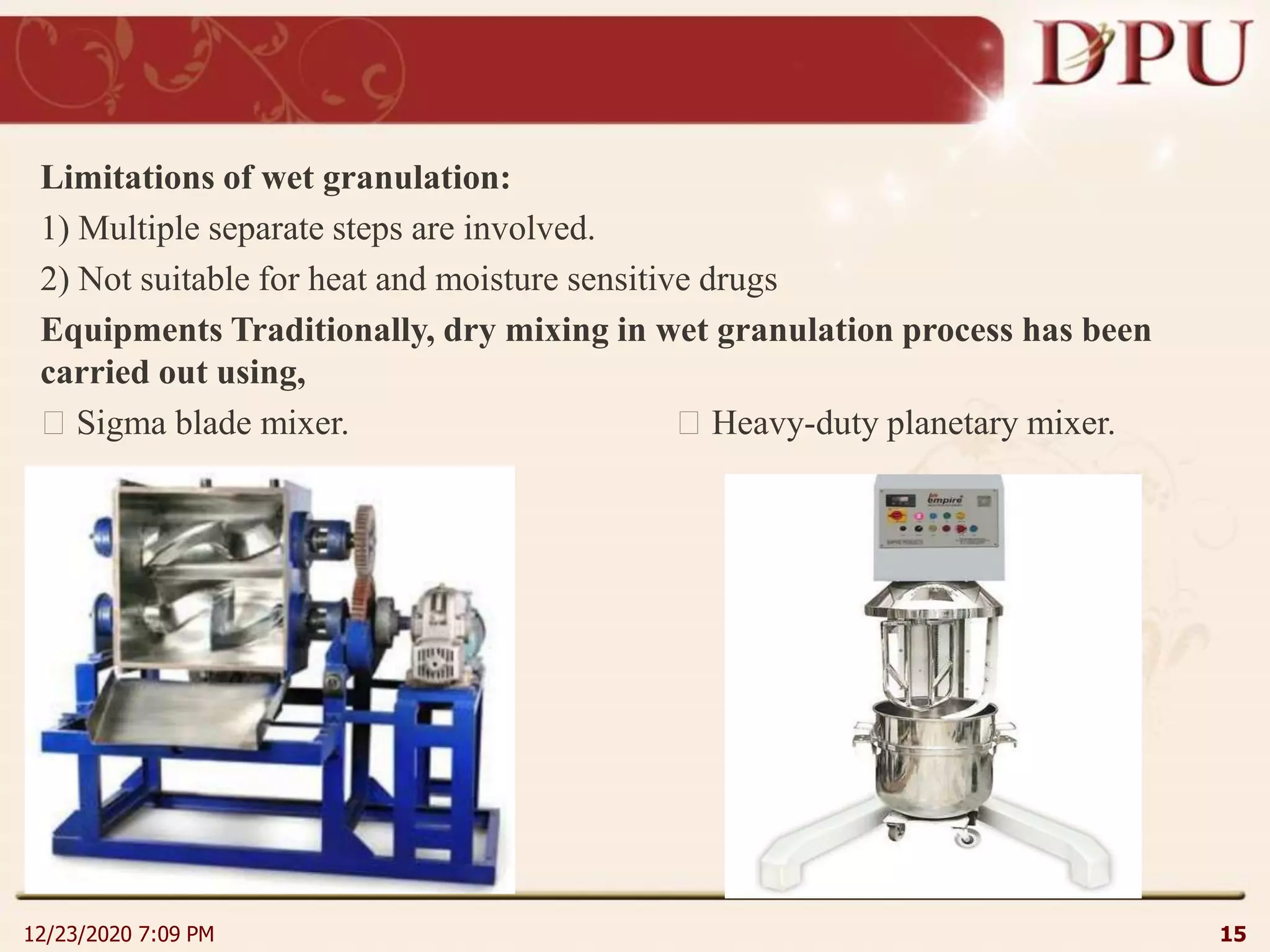
Equipments Traditionally, dry mixing in wet granulation process has been
carried out using,
Sigma blade mixer. Heavy-duty planetary mixer.
12/23/2020 7:09 PM 15
12/23/2020 7:09 PM 16
High Shear granulation:
i)Little ford Lodgie granulator
ii)Little ford MGT granulator
iii)Diosna granulator
iv)Gral mixerGranulator
with drying facility:
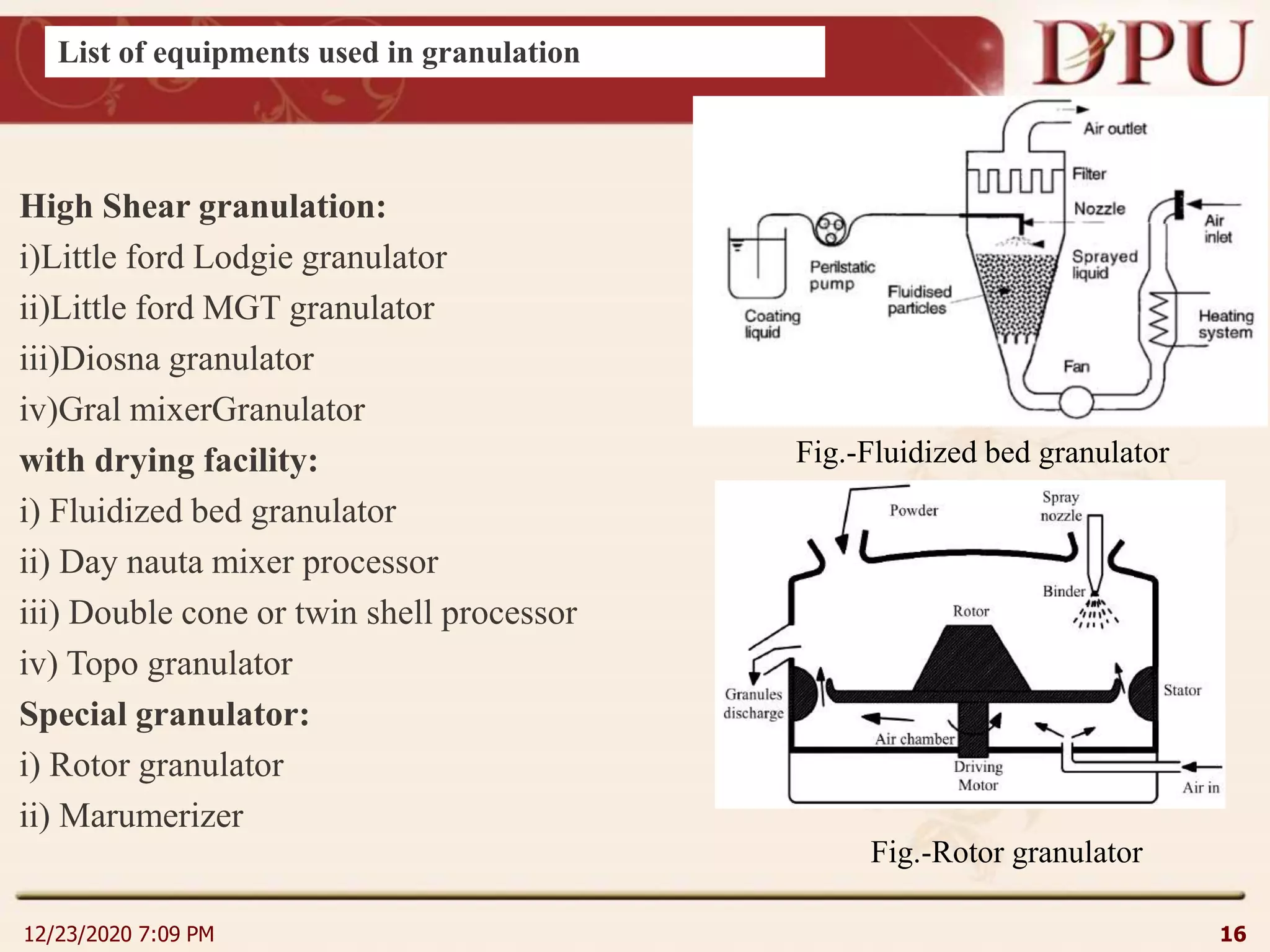
i) Fluidized bed granulator
ii) Day nauta mixer processor
iii) Double cone or twin shell processor
iv) Topo granulator
Special granulator:
i) Rotor granulator
ii) Marumerizer
Fig.-Fluidized bed granulator
Fig.-Rotor granulator
List of equipments used in granulation
Advanced Granulation Techniques
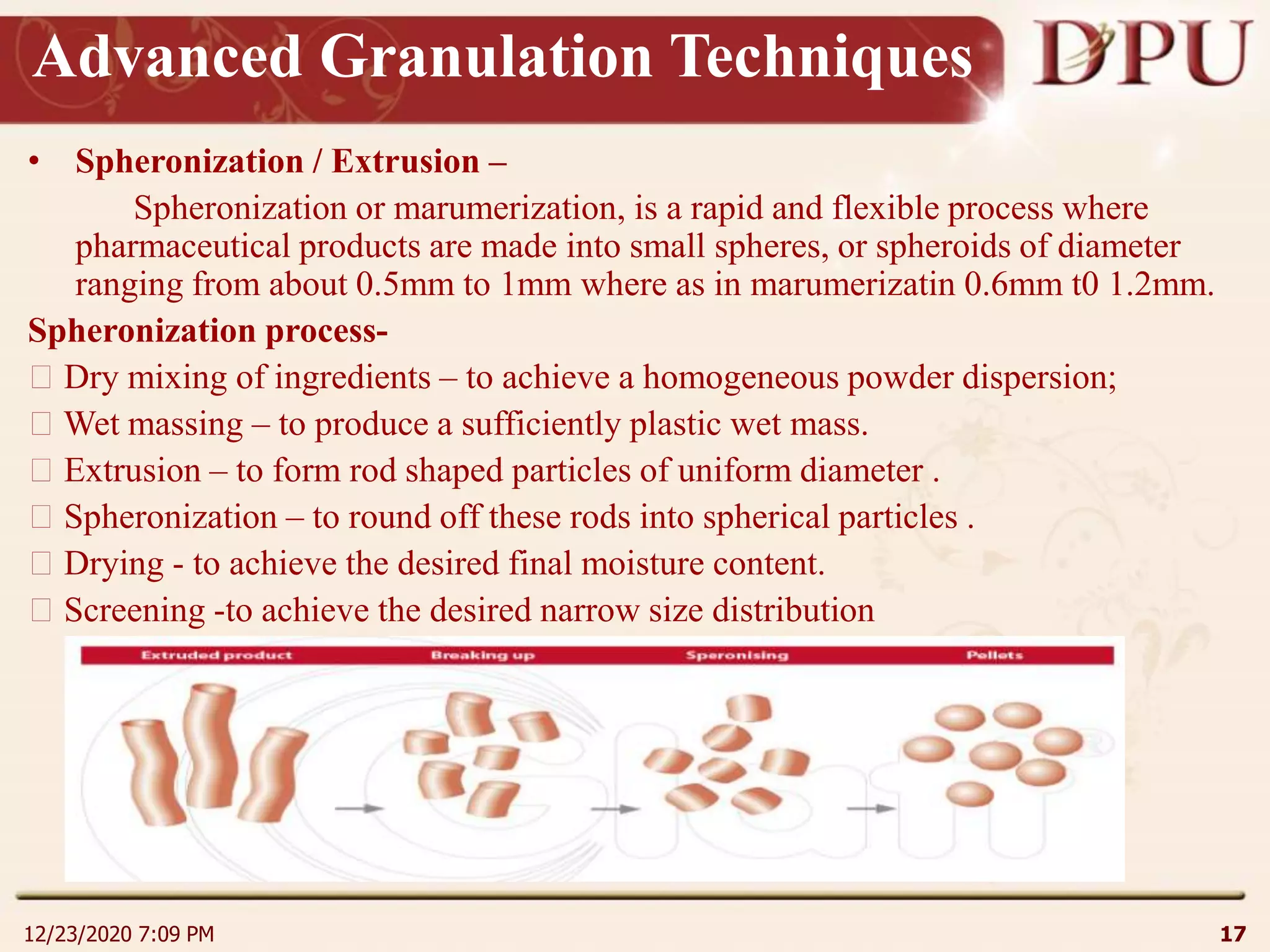
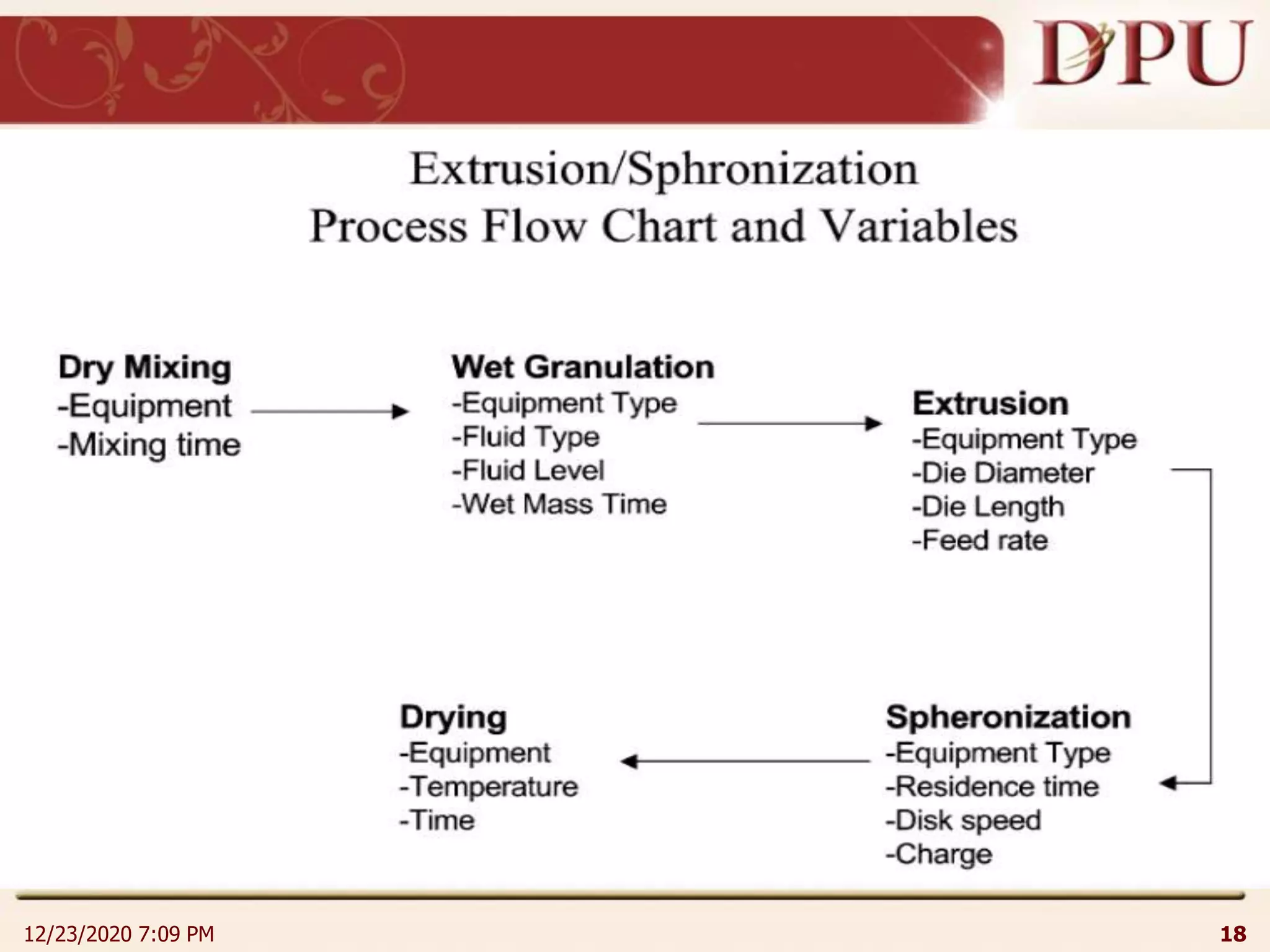
• Spheronization / Extrusion –
Spheronization or marumerization, is a rapid and flexible process where
pharmaceutical products are made into small spheres, or spheroids of diameter
ranging from about 0.5mm to 1mm where as in marumerizatin 0.6mm t0 1.2mm.
Spheronization process-
Dry mixing of ingredients – to achieve a homogeneous powder dispersion;
Wet massing – to produce a sufficiently plastic wet mass.
Extrusion – to form rod shaped particles of uniform diameter .
Spheronization – to round off these rods into spherical particles .
Drying - to achieve the desired final moisture content.
Screening -to achieve the desired narrow size distribution
12/23/2020 7:09 PM 17
12/23/2020 7:09 PM 18
12/23/2020 7:09 PM 19
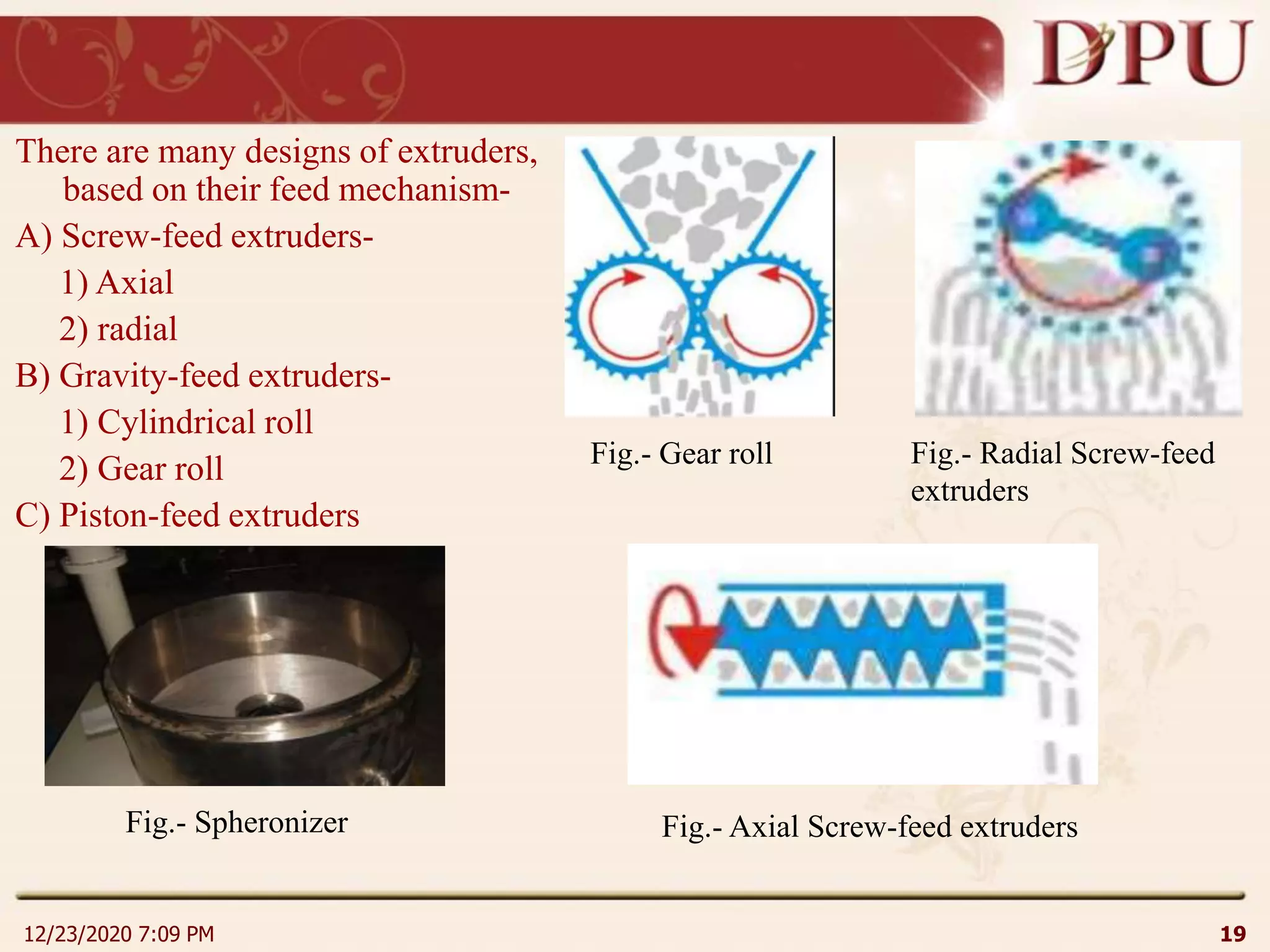
There are many designs of extruders,
based on their feed mechanism-
A) Screw-feed extruders-
1) Axial
2) radial
B) Gravity-feed extruders-
1) Cylindrical roll
2) Gear roll
C) Piston-feed extruders
Fig.- Spheronizer
Fig.- Gear roll Fig.- Radial Screw-feed
extruders
Fig.- Axial Screw-feed extruders
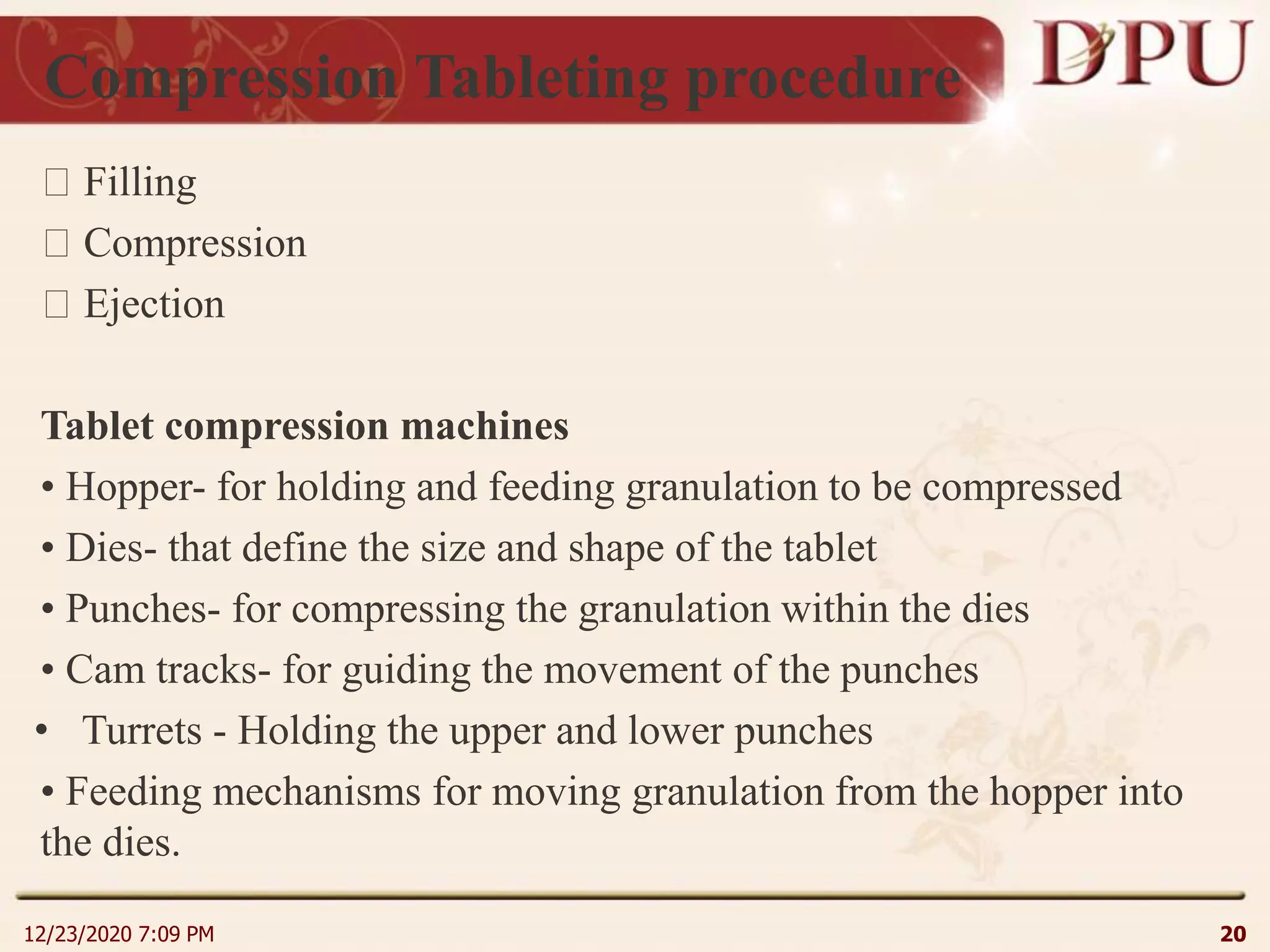
Compression Tableting procedure
Filling
Compression
Ejection
Tablet compression machines
• Hopper- for holding and feeding granulation to be compressed
• Dies- that define the size and shape of the tablet
• Punches- for compressing the granulation within the dies
• Cam tracks- for guiding the movement of the punches
• Turrets - Holding the upper and lower punches
• Feeding mechanisms for moving granulation from the hopper into
the dies.
12/23/2020 7:09 PM 20
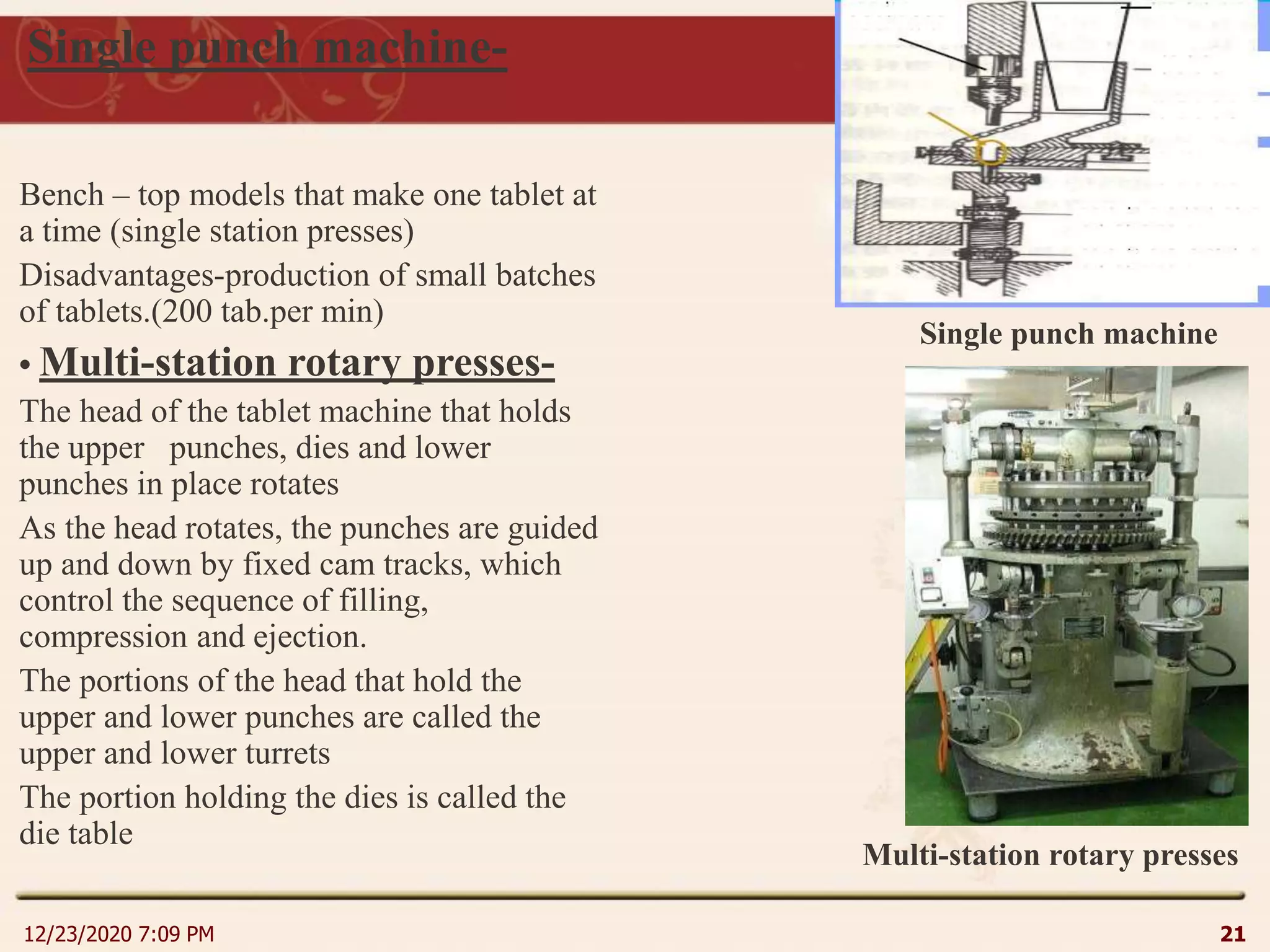
Single punch machine-
Bench – top models that make one tablet at
a time (single station presses)
Disadvantages-production of small batches
of tablets.(200 tab.per min)
• Multi-station rotary presses-
The head of the tablet machine that holds
the upper punches, dies and lower
punches in place rotates
As the head rotates, the punches are guided
up and down by fixed cam tracks, which
control the sequence of filling,
compression and ejection.
The portions of the head that hold the
upper and lower punches are called the
upper and lower turrets
The portion holding the dies is called the
die table
12/23/2020 7:09 PM 21
Single punch machine
Multi-station rotary presses
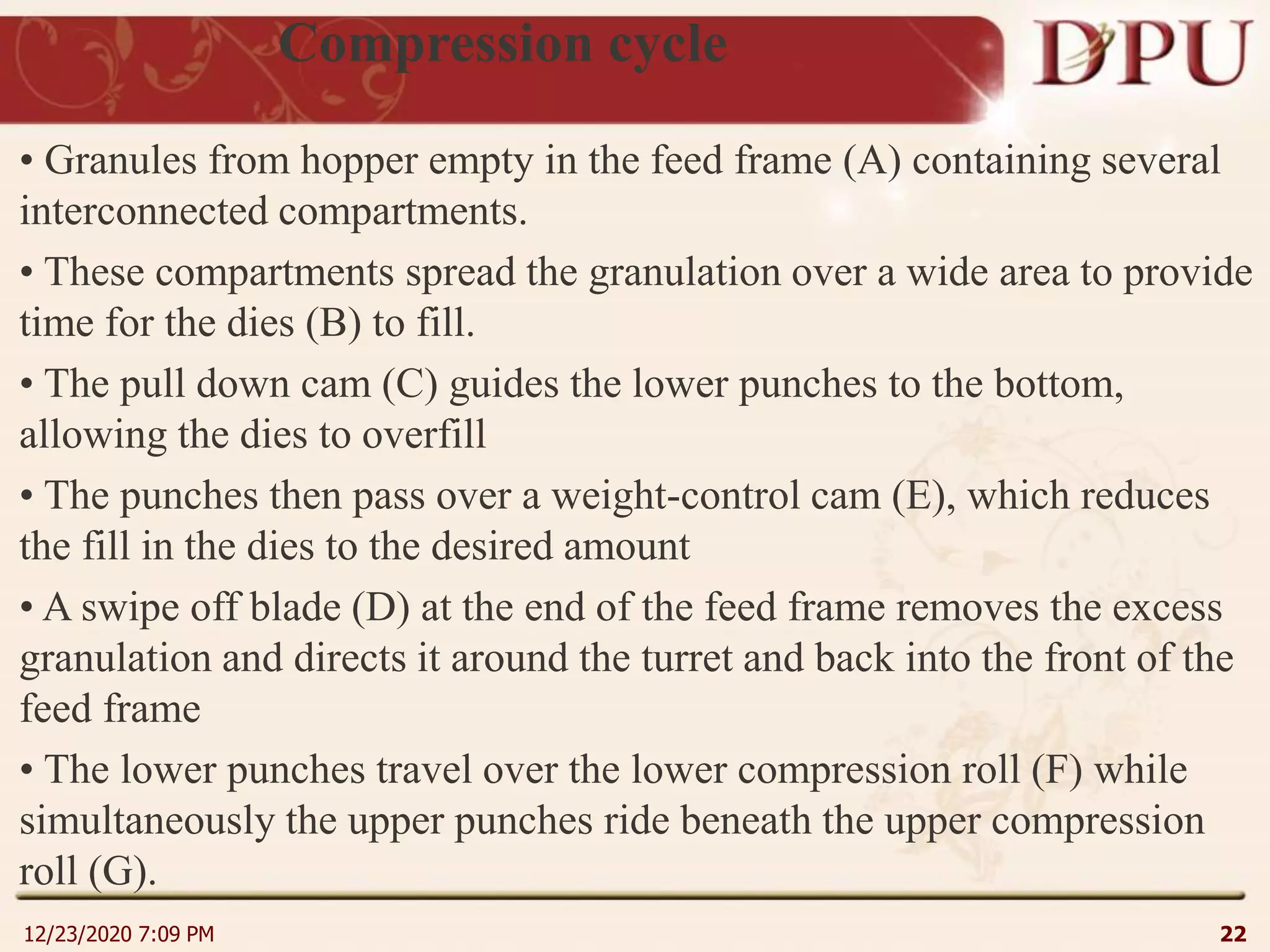
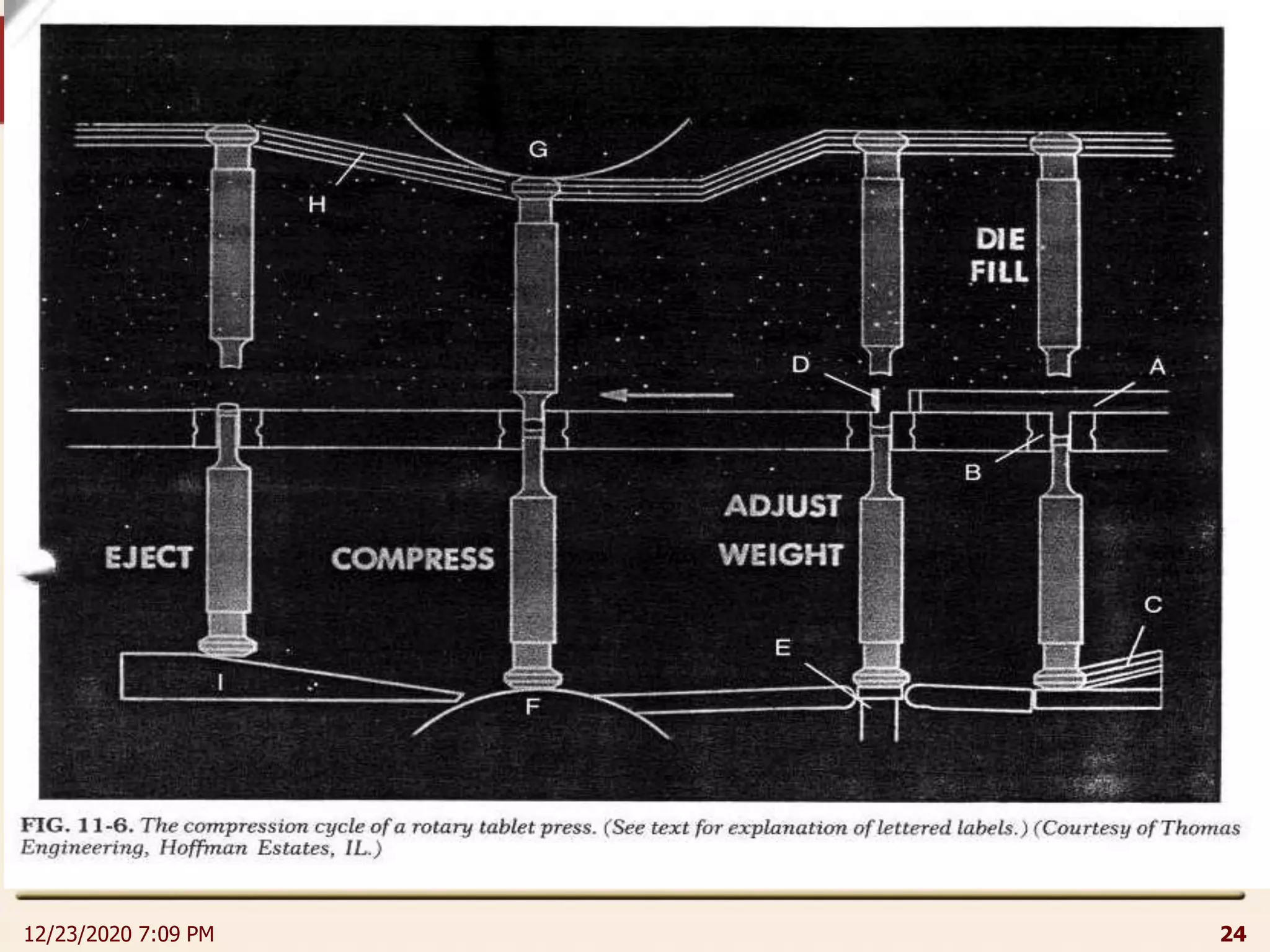
Compression cycle
• Granules from hopper empty in the feed frame (A) containing several
interconnected compartments.
• These compartments spread the granulation over a wide area to provide
time for the dies (B) to fill.
• The pull down cam (C) guides the lower punches to the bottom,
allowing the dies to overfill
• The punches then pass over a weight-control cam (E), which reduces
the fill in the dies to the desired amount
• A swipe off blade (D) at the end of the feed frame removes the excess
granulation and directs it around the turret and back into the front of the
feed frame
• The lower punches travel over the lower compression roll (F) while
simultaneously the upper punches ride beneath the upper compression
roll (G).
12/23/2020 7:09 PM 22
• The upper punches enter a fixed distance into the dies, while the
lower punches are raised to squeeze and compact the granulation
within the dies
• After the moment of compression, the upper punches are withdrawn
as they follow the upper punch raising cam (H)
• The lower punches ride up the cam (I) which brings the tablets flush
with or slightly above the surface of the dies
• The tablets strike a sweep off blade affixed to the front of the feed
frame (A) and slide down a chute into a receptacle
• At the same time, the lower punches re-enter the pull down cam (C)
and the cycle is repeated
12/23/2020 7:09 PM 23
12/23/2020 7:09 PM 24
12/23/2020 7:09 PM 25
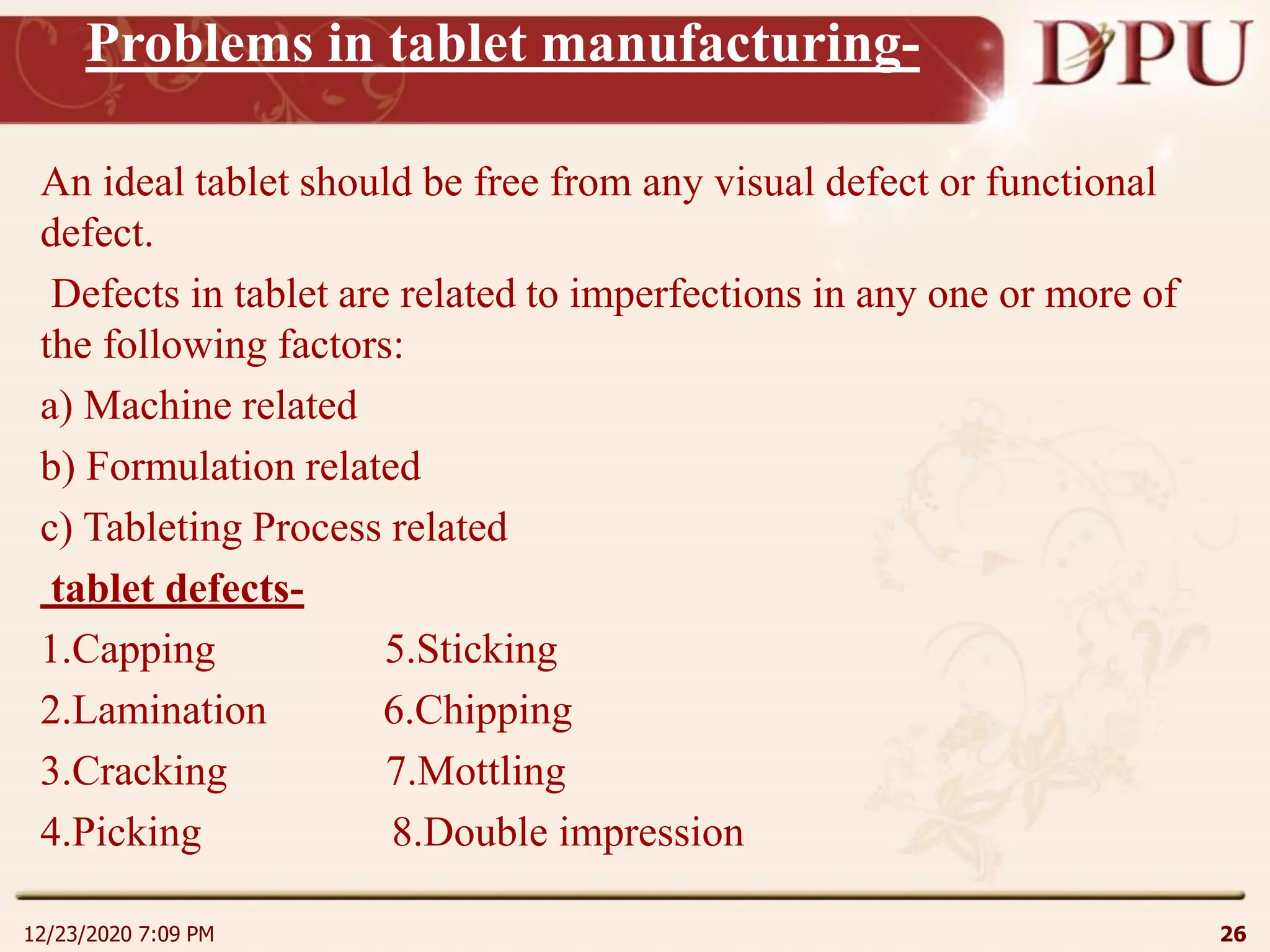
Problems in tablet manufacturing-
An ideal tablet should be free from any visual defect or functional
defect.
Defects in tablet are related to imperfections in any one or more of
the following factors:
a) Machine related
b) Formulation related
c) Tableting Process related
tablet defects-
1.Capping 5.Sticking
2.Lamination 6.Chipping
3.Cracking 7.Mottling
4.Picking 8.Double impression
12/23/2020 7:09 PM 26
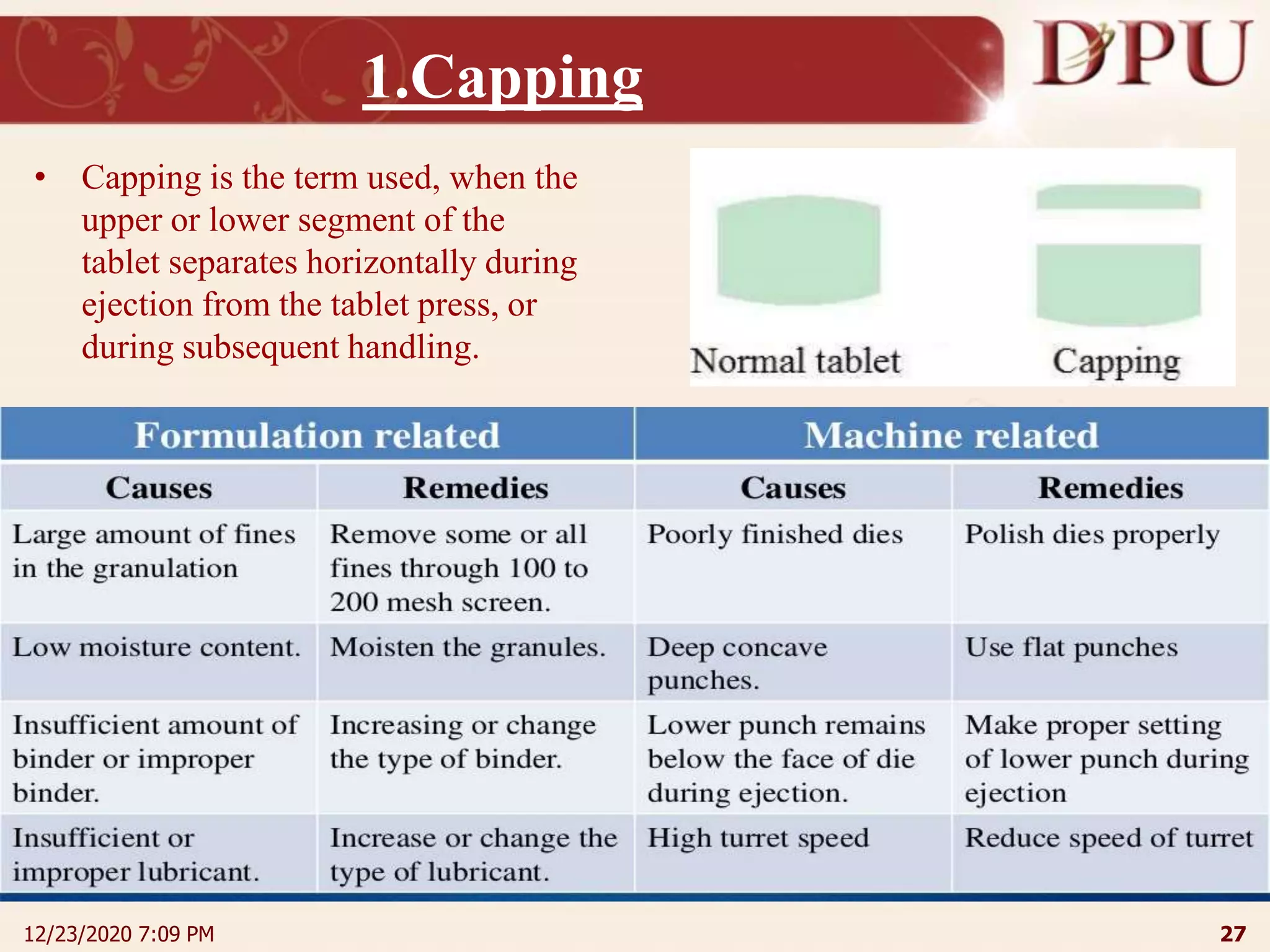
1.Capping
• Capping is the term used, when the
upper or lower segment of the
tablet separates horizontally during
ejection from the tablet press, or
during subsequent handling.
12/23/2020 7:09 PM 27
2.Lamination
• Lamination is the separation of a tablet
into two or more distinct horizontal
layers.
12/23/2020 7:09 PM 28
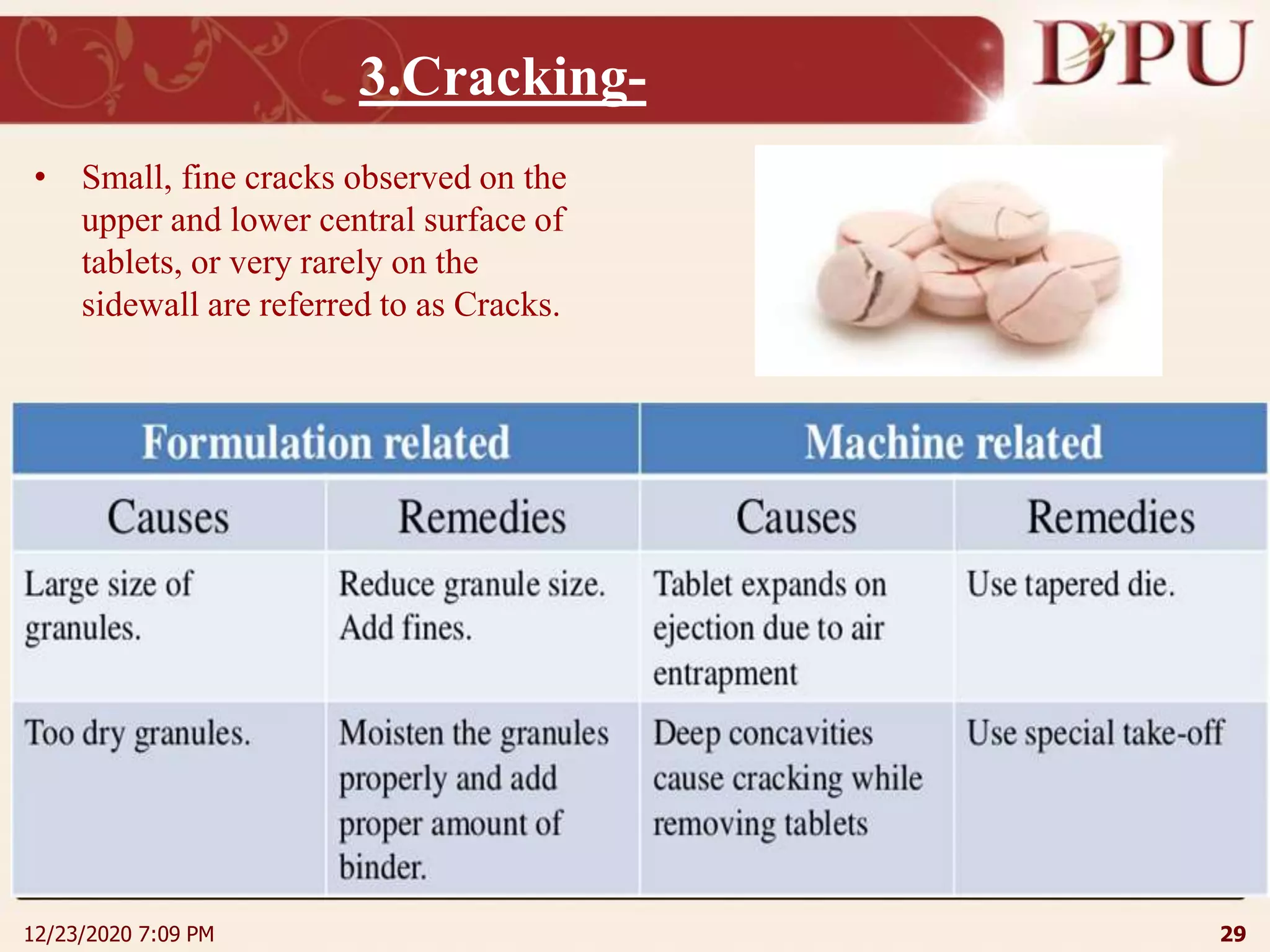
3.Cracking-
• Small, fine cracks observed on the
upper and lower central surface of
tablets, or very rarely on the
sidewall are referred to as Cracks.
12/23/2020 7:09 PM 29
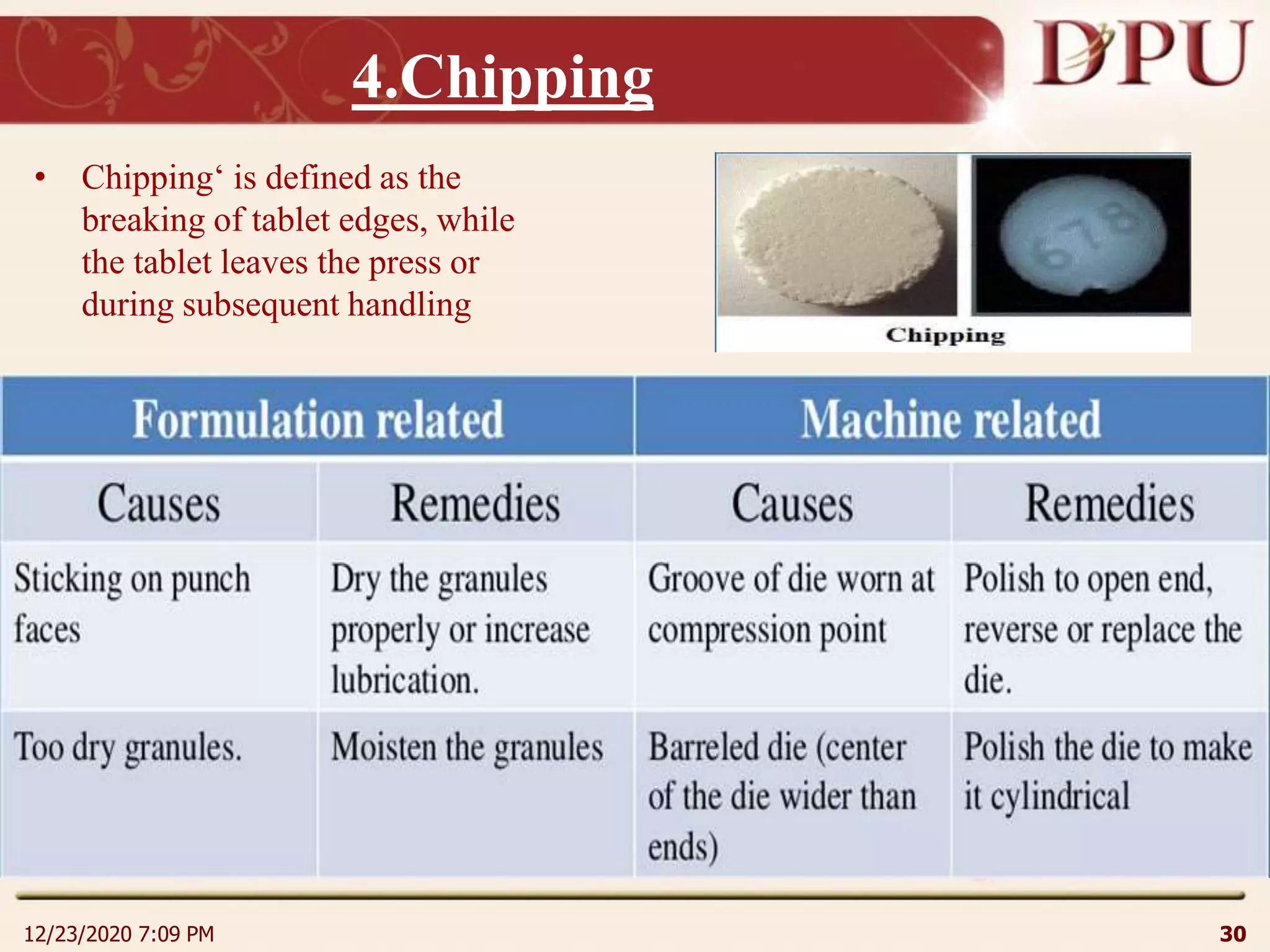
4.Chipping
• Chipping‘ is defined as the
breaking of tablet edges, while
the tablet leaves the press or
during subsequent handling
12/23/2020 7:09 PM 30
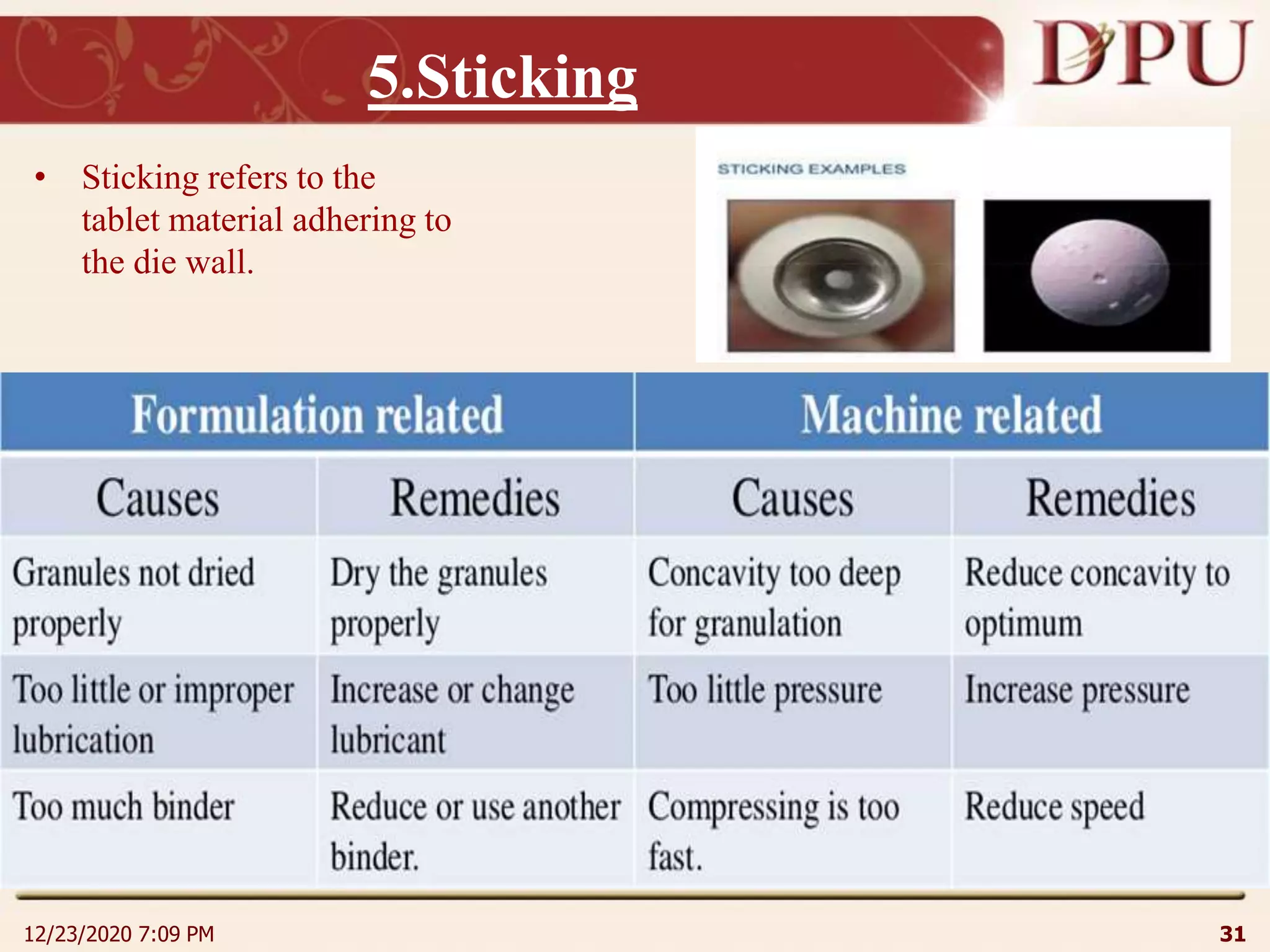
5.Sticking
• Sticking refers to the
tablet material adhering to
the die wall.
12/23/2020 7:09 PM 31
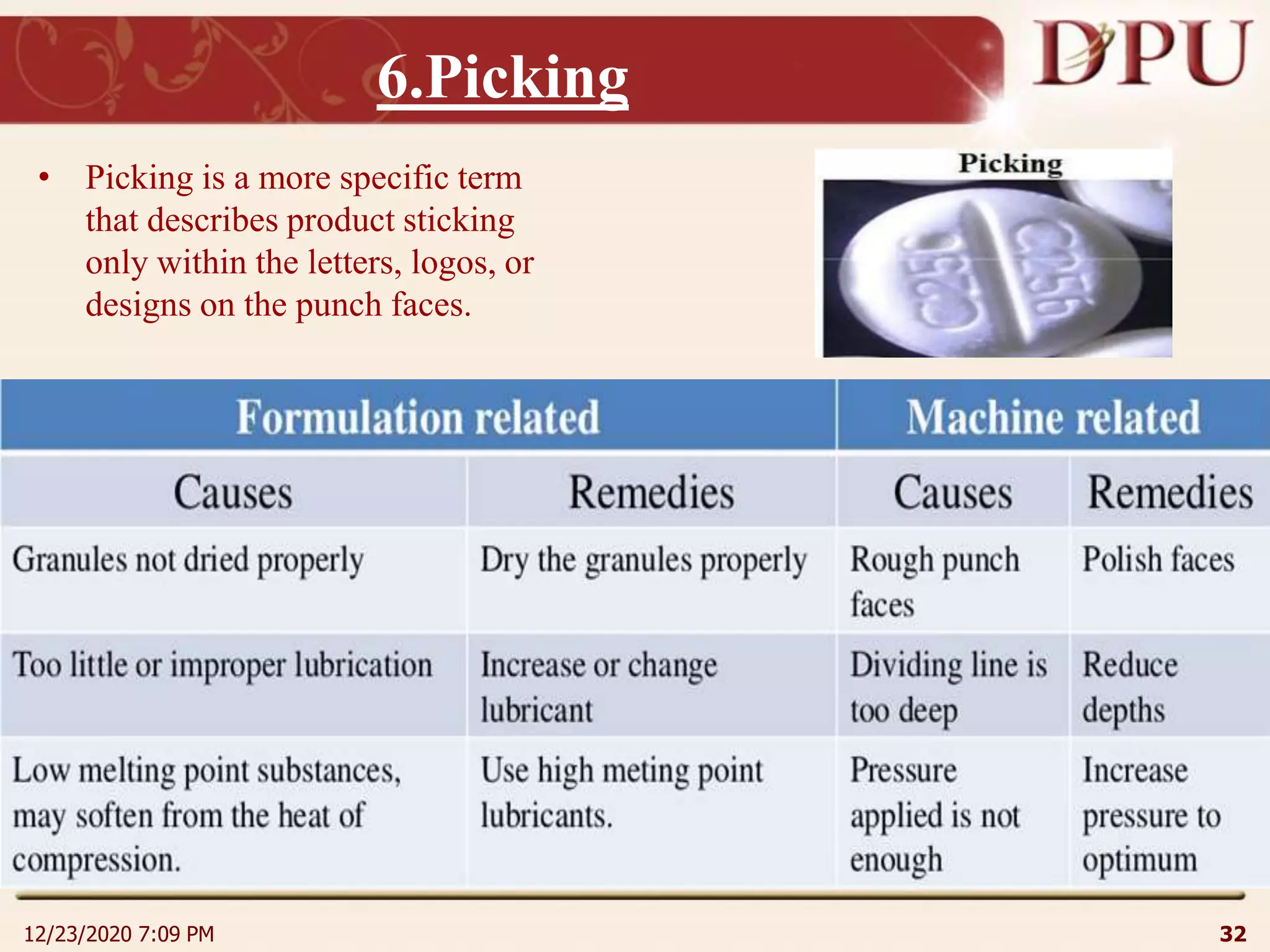
6.Picking
• Picking is a more specific term
that describes product sticking
only within the letters, logos, or
designs on the punch faces.
12/23/2020 7:09 PM 32
8.Mottling
• Mottling is the term used to
describe an unequal
distribution of colour on a
tablet.
12/23/2020 7:09 PM 33
9.Double impression
• It is due to free rotation of punches which have some engraving
or monogram on the punch faces. During his free travel, the
punch rotates and at this point, the punch may make a new
impression on the bottom of the tablet, resulting in 'Double
Impression.
12/23/2020 7:09 PM 34
IPQC Tests For Tablets
1.Hardness
2.Friability
3.Thickness
4.Disintegration
5.Weight variation
6.Content uniformity
7.Dissolution
12/23/2020 7:09 PM 35
1. hardness (crushing strength):
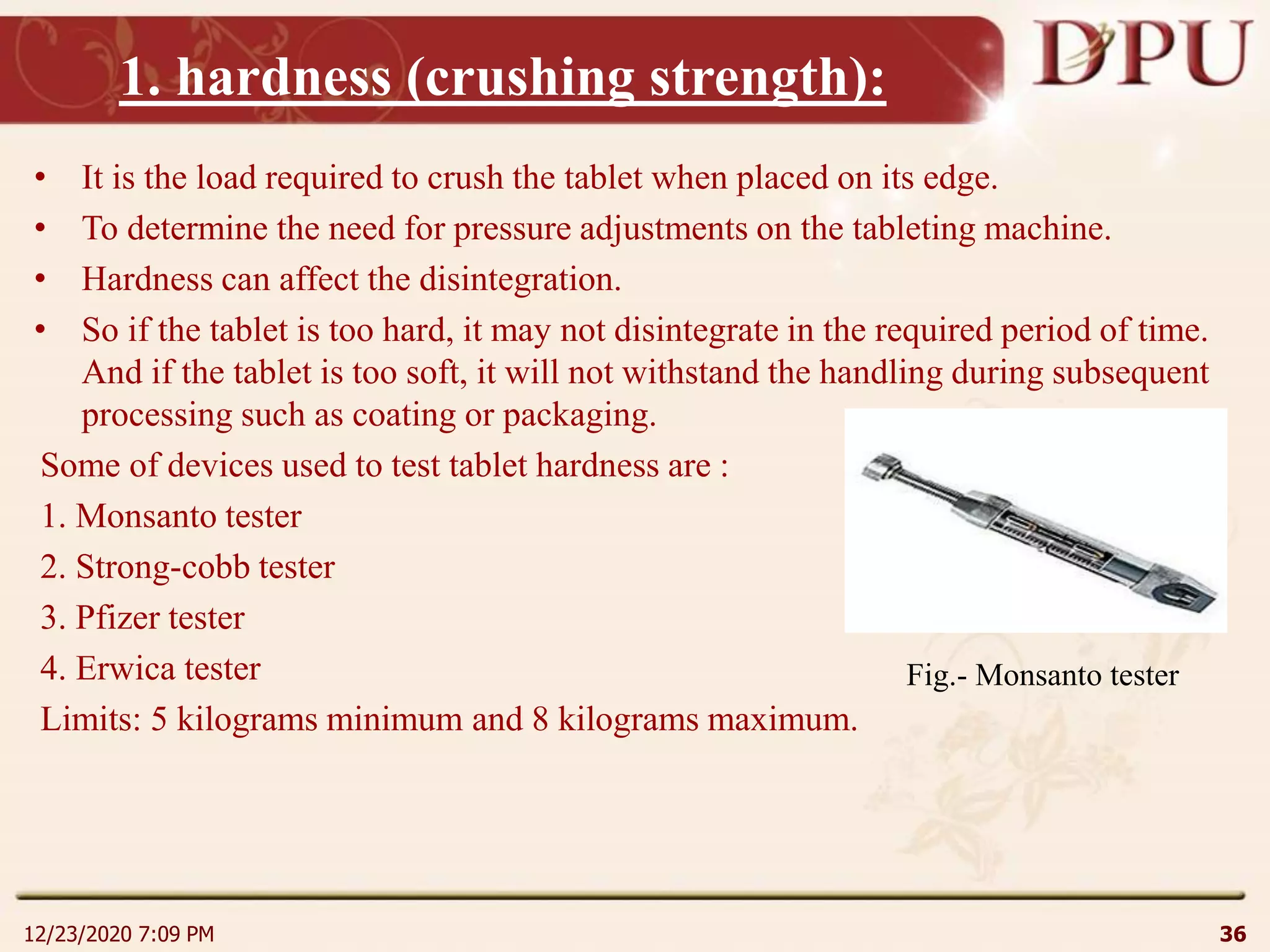
• It is the load required to crush the tablet when placed on its edge.
• To determine the need for pressure adjustments on the tableting machine.
• Hardness can affect the disintegration.
• So if the tablet is too hard, it may not disintegrate in the required period of time.
And if the tablet is too soft, it will not withstand the handling during subsequent
processing such as coating or packaging.
Some of devices used to test tablet hardness are :
1. Monsanto tester
2. Strong-cobb tester
3. Pfizer tester
4. Erwica tester
Limits: 5 kilograms minimum and 8 kilograms maximum.
12/23/2020 7:09 PM 36
Fig.- Monsanto tester
2.Friability
It is the tendency of tablets to powder, chip, or fragment and
this can affect the elegance appearance, consumer
acceptance of the tablet.
• Friability is a property that is related to the hardness of the
tablet.
• friabilator is used to evaluate the ability of the tablet to
withstand abrasion in packaging, handling, and shipping.
Friability (% loss) = It must be less than or equal to1%.
12/23/2020 7:09 PM 37
Fig.-Friabilator
3. Thickness test:
The thickness of a tablet depends on the upper and
lower punches at the moment of compression.
it can be tested using vernier calipers.
The range varies with +/- 5.0%
Fig.- Vernier caliper
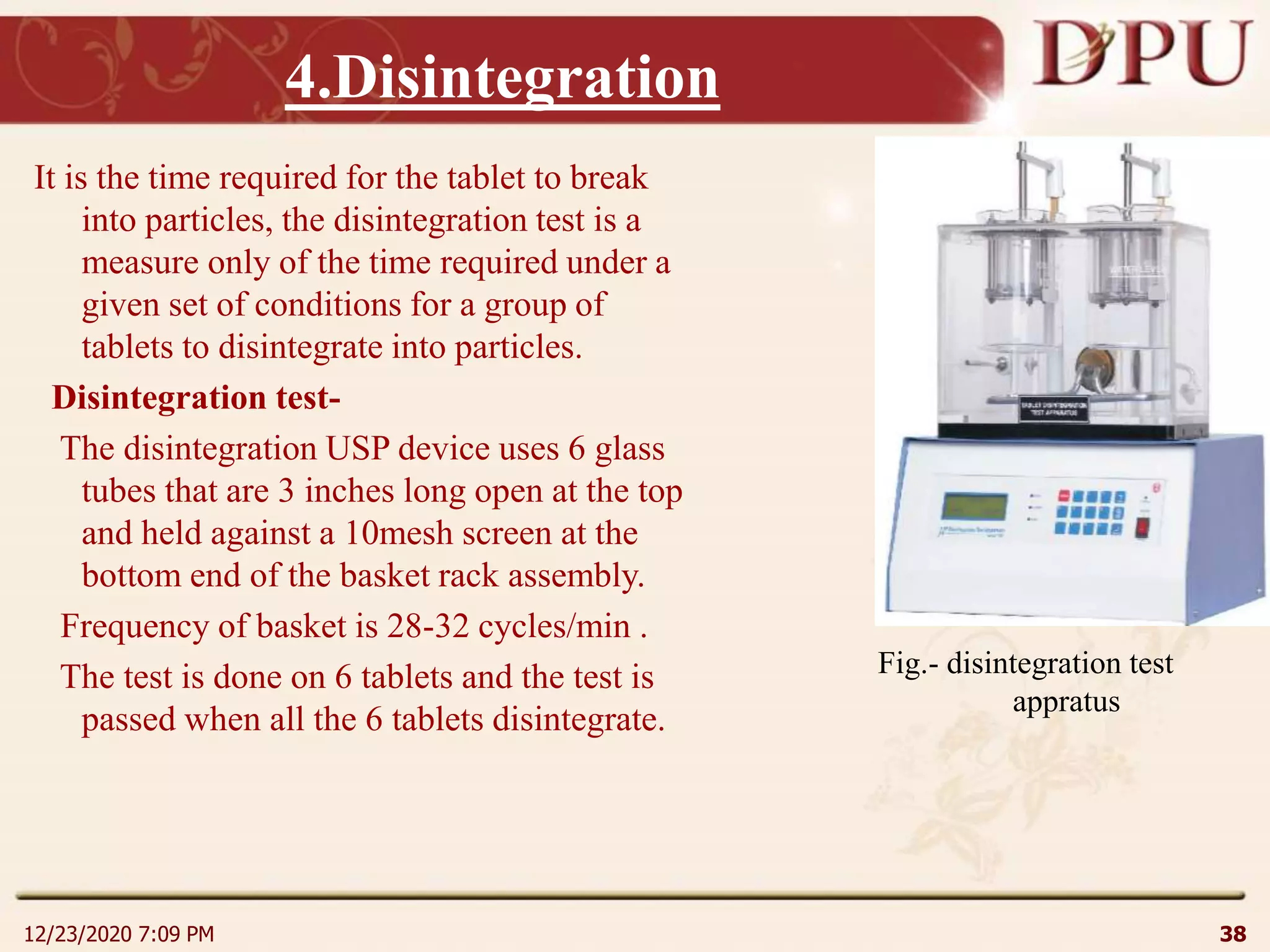
4.Disintegration
It is the time required for the tablet to break
into particles, the disintegration test is a
measure only of the time required under a
given set of conditions for a group of
tablets to disintegrate into particles.
Disintegration test-
The disintegration USP device uses 6 glass
tubes that are 3 inches long open at the top
and held against a 10mesh screen at the
bottom end of the basket rack assembly.
Frequency of basket is 28-32 cycles/min .
The test is done on 6 tablets and the test is
passed when all the 6 tablets disintegrate.
12/23/2020 7:09 PM 38
Fig.- disintegration test
appratus
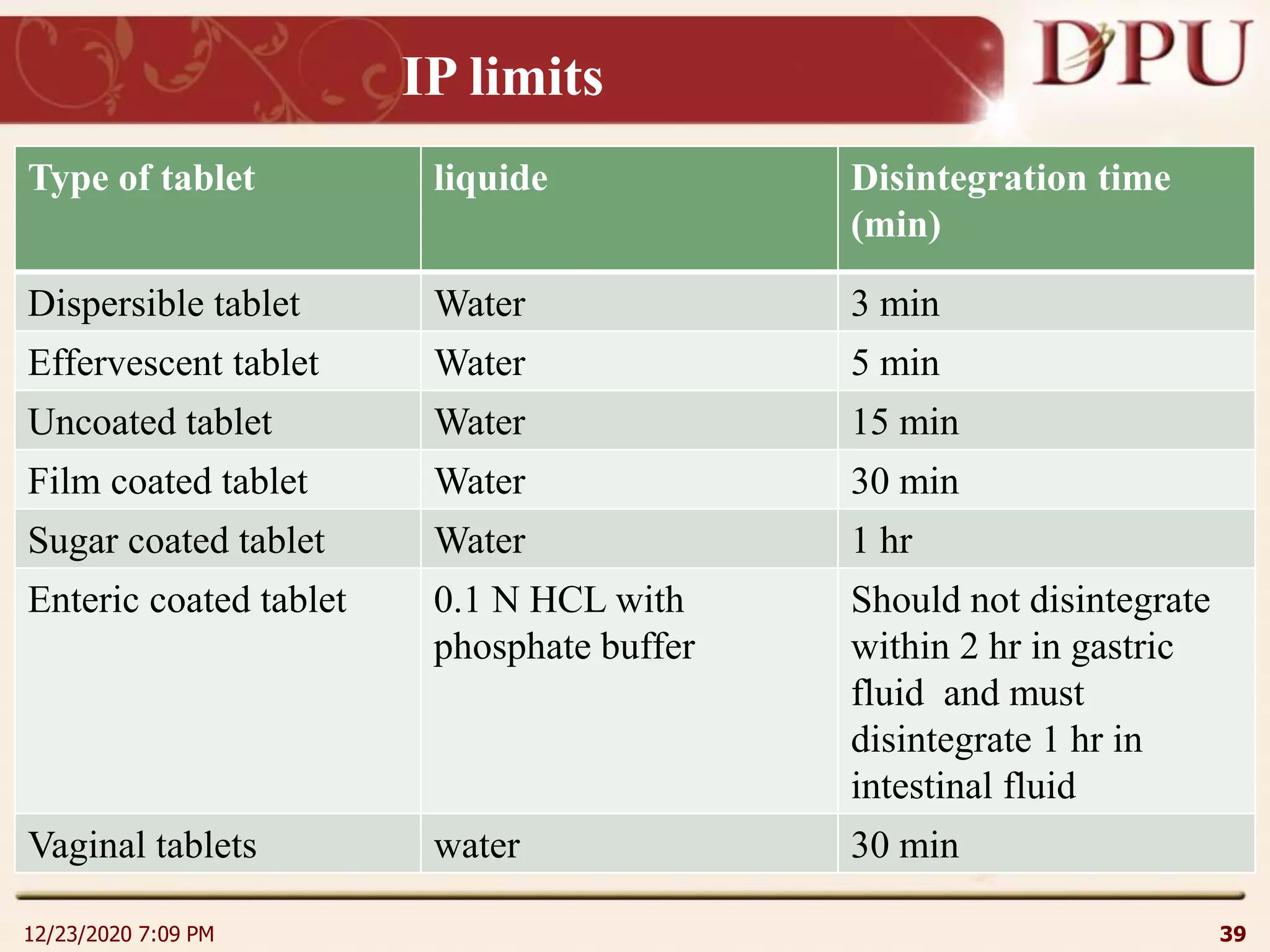
IP limits
12/23/2020 7:09 PM 39
Type of tablet liquide Disintegration time
(min)
Dispersible tablet Water 3 min
Effervescent tablet Water 5 min
Uncoated tablet Water 15 min
Film coated tablet Water 30 min
Sugar coated tablet Water 1 hr
Enteric coated tablet 0.1 N HCL with
phosphate buffer
Should not disintegrate
within 2 hr in gastric
fluid and must
disintegrate 1 hr in
intestinal fluid
Vaginal tablets water 30 min
5.Weight variation
The volumetric fill of the die cavity determines the weight of the
compressed tablet . The weight of the tablet is the quantity of the
granulation that contains the labeled amount of the therapeutic
ingredient.
•After the tablet machine in operation the weights of the tablets are
routinely checked to ensure that proper tablet weights are made.
•Compare the individual weight of tablets with avg weight.
•Not more than 2 tablets should deviate from avg weight by percent
deviaton and none should deviate more than twice the percentage
Limits according to U.S.P-
·Weight of tablet 130 mg or less then % deviation ±10%
·Weight of tablet 130-324 mg then %deviation= ±7.5%
·Weight of tablet 324 mg or more then %deviation = ±5%
12/23/2020 7:09 PM 40
6)Content uniformity
• This test is done to ensure that every tablet contains the amount of
drug substance intended with little variation within a batch
• In this test 30 tablets are randomly selected for the sample and atleast
10 of them assayed individually .
• 9 of the 10 tablets must contain not less than 85% or more than 115
% of labeled drug content.
• 10th tablet may not contain less than 75% or more than 125% of
labeled content .
• If this conditions are not meet the tablet remaining from the 30 must
be assayed individually and none may fall outside 85 to 115 %
12/23/2020 7:09 PM 41
7) Dissolution Test-
- Dissolution is performed to check the percentage release
from the dosage form i.e. tablets breaks down into
small particles which offers a greater surface area to the
dissolving media.
- Disintegration test does not gives assurance that particles
will release drug in solution at an appropriate rate,
that’s why dissolution tests and its specifications
developed for all tablet products.
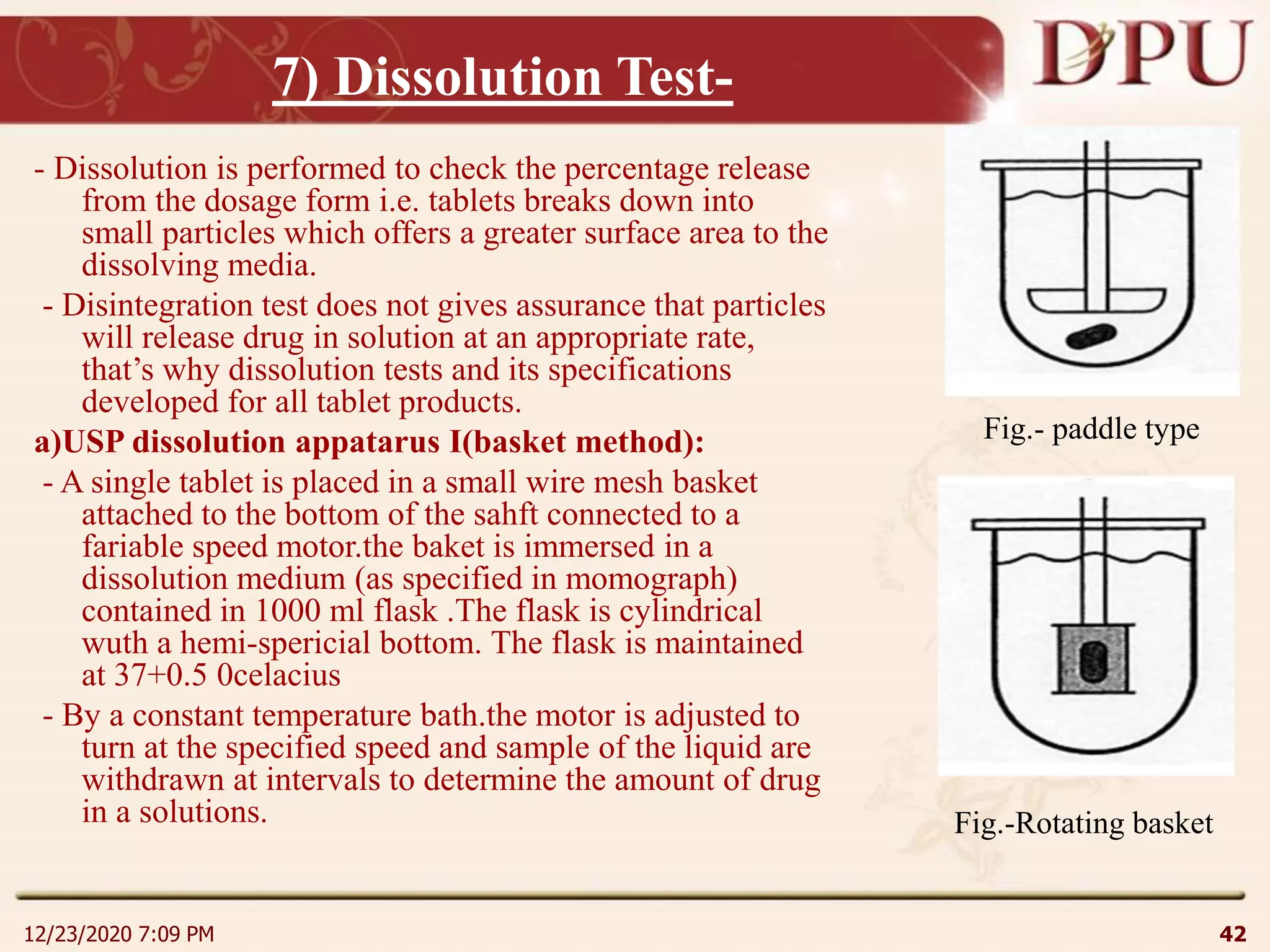
a)USP dissolution appatarus I(basket method):
- A single tablet is placed in a small wire mesh basket
attached to the bottom of the sahft connected to a
fariable speed motor.the baket is immersed in a
dissolution medium (as specified in momograph)
contained in 1000 ml flask .The flask is cylindrical
wuth a hemi-spericial bottom. The flask is maintained
at 37+0.5 0celacius
- By a constant temperature bath.the motor is adjusted to
turn at the specified speed and sample of the liquid are
withdrawn at intervals to determine the amount of drug
in a solutions.
12/23/2020 7:09 PM 42
Fig.- paddle type
Fig.-Rotating basket
b) USP dissolution apparatus II (paddle method):
it is same as apparatus-I, except the basket is replaced by a paddle. The dosage form
is allowed to sink to the bottom of the flask before stirring. For dissolution test
USP specifies the dissolution test medium and volume, type of apparatus to be
used,rpm of the shaft,time limit of the and assay procedure for. The test tolerance
is expressed as a % of the labelled amount of drug dissolved in time limit.
Dissolution testing and interpretation IP standards-
12/23/2020 7:09 PM 43
D is the amount of dissolved active ingredient specified in the individual monograph,
expressed as a percentage of the labelled content.
TABLET COATING -
“Tablet coating is the application of coating material to the exterior of
a tablet with the intention of conferring benefits and properties to a
dosage form over the uncoated variety.”
Why To Coat ???
Mask Bitter taste
Mask unpleasant odour.
Protecting the drug from surroundings.
To increase the Stability.
Handling & ease of ingesting by patients.
Mechanical protection from breakage.
Avoid Light incompatibility.
Protection from Environmental Oxidation.
12/23/2020 7:09 PM 44
In- elegent core.
To modifying the drug release profile.
For Product identity.
Types of Coating
Sugar coating
Film coating
Enteric coating
Controlled release coating
Specialized coating
12/23/2020 7:09 PM 45
Steps involved in Coating
1) Sealing/Seal coating
2) Sub-coating
3) Grossing/Smoothing
4) Coloring
5) Polishing/Finishing
6) Printing
12/23/2020 7:09 PM 46
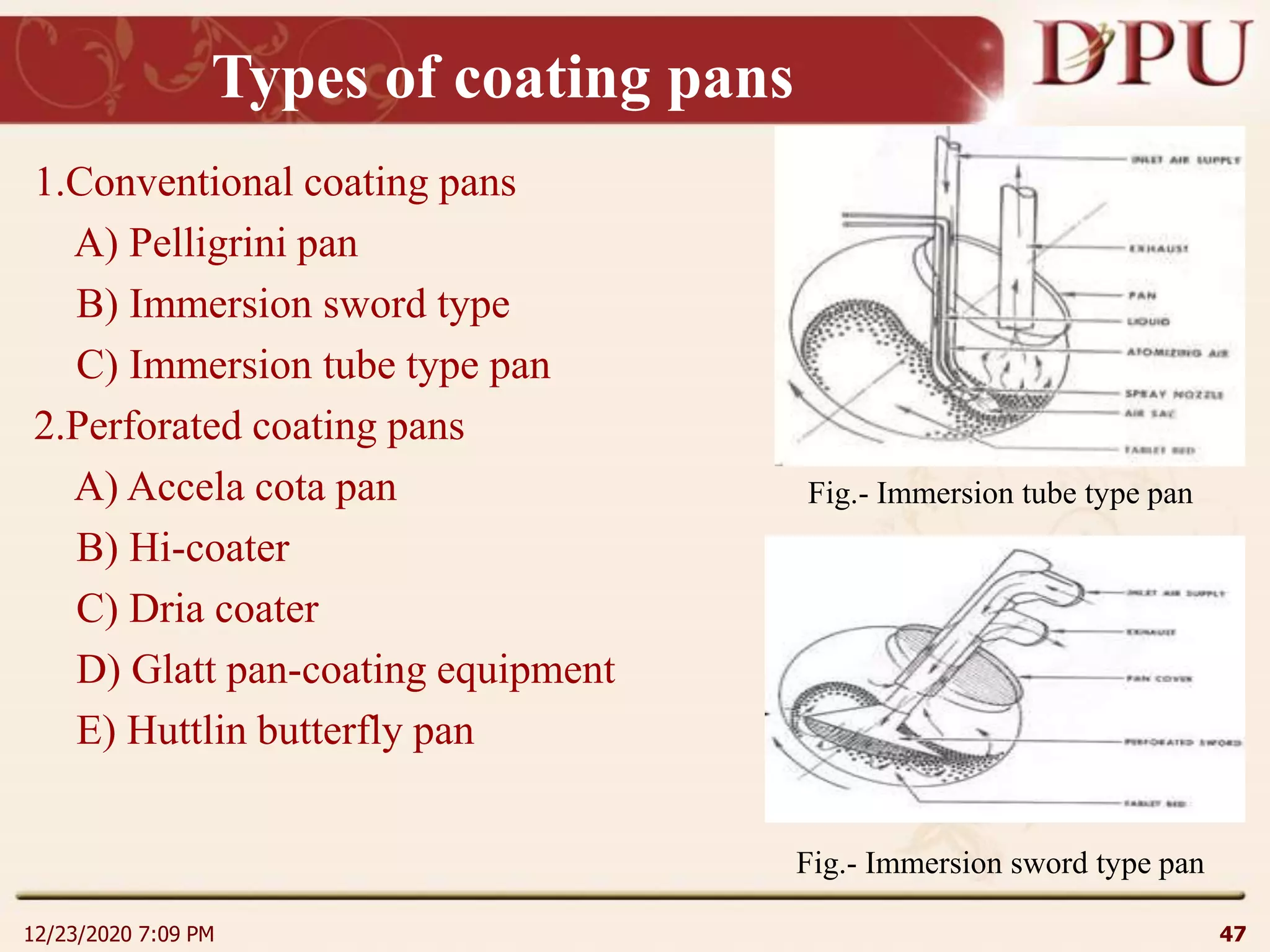
Types of coating pans
1.Conventional coating pans
A) Pelligrini pan
B) Immersion sword type
C) Immersion tube type pan
2.Perforated coating pans
A) Accela cota pan
B) Hi-coater
C) Dria coater
D) Glatt pan-coating equipment
E) Huttlin butterfly pan
12/23/2020 7:09 PM 47
Fig.- Immersion tube type pan
Fig.- Immersion sword type pan
References –
1. Leon Lachman, Herbert A. Lieberman, “The Theory and Practice
of Industrial Pharmacy” Special Indian Edition 2009, Page no: 293
to 334.
2. Herbert A. Lieberman, Leon Lachman, Joseph B.Schwartz,
“Pharmaceutical Dosage Forms: Tablets” Volume 1, Second
Edition, Page no: 88 to 121.
3. Joseph P. Remington, Paul Beringer, “ The Science and Practice of
Pharmacy” Published by: Philadelphia: Lippincott Williams and
Wilkins, 21st Edition, Page no:889 to 913.
4. Michael E. Aulton, Kevin M. G.Taylor, “The Design and
Manufacture of Medicine” Published by: Churchill Livingstone,
Fourth Edition, Page no: 465 to 549.
12/23/2020 7:09 PM 48
12/23/2020 7:09 PM 49
THANKYOU!

Nonsterile Manufacturing process Technology

  • 1.
    Dr. D. Y.Patil Institute of Pharmaceutical Sciences and Research, Pimpri, Pune - 411018. PRESENTED BY :DNYANESHWAR KHODSE ROLL NO.:-537 (PHARMACEUTICAL QUALITY ASSURANCE) GUIDED BY : Dr. R.K.NANDA ( Associate professor ) NON STERILE MANUFACTURING PROCESS TECHNOLOGY
  • 2.
    CONTENTS • Introduction • Types •Tablets • Formulation • Plant layout for tablets manufacturing • Manufacturing flow charts • Equipments used in tablet manufacturing • Problems in tablet manufacturing process • IPQC tests for tablets • Coating technology 12/23/2020 7:09 PM 2
  • 3.
    INTRODUCTION  Non-sterile compoundinginvolves creating a medication in a clean environment but does not require the environment to be completely free from all microorganisms. Non sterile dosage forms- • Tablets • Capsules (Hard & Soft) • Ointments • Suspension • Emulsion 12/23/2020 7:09 PM 3
  • 4.
    TABLET MANUFACTURING PROCESS DEFINITION:- • Tablet is defined as a compressed solid dosage form containing medicaments with or without excipients. • According to the Indian Pharmacopoeia Pharmaceutical tablets are solid, flat or biconvex dishes, unit dosage form, prepared by compressing a drugs or a mixture of drugs, with or without diluents. • It is the most popular dosage form and 70% of the total medicines are dispensed in the form of Tablet. 12/23/2020 7:09 PM 4
  • 5.
    Advantages Of TheTablet Dosage Form 1. Cost is lowest of all oral dosage form. 2. Lighter and compact. 3. Easiest and cheapest to package and strip. 4. Easy to swallowing with least tendency for hang-up. 5. Sustained release product is possible by enteric coating. 6. Objectionable odour and bitter taste can be masked by coating technique. 7. Suitable for large scale production. 8. Greatest chemical and microbial stability over all oral dosage form. 12/23/2020 7:09 PM 5
  • 6.
    Disadvantages of Tabletdosage form Drugs which are amorphous and low density character are difficult to compress into tablet. Hygroscopic drugs are not suitable for compressed tablets. Sensitive to oxygen drugs may require special coating. Cost of production may be increase because of coating and encapsulation to remove bitter and unpleasant taste. Some tablet may cause problem in bioavailability. 12/23/2020 7:09 PM 6
  • 7.
    Formulation- 1) API 2) Exicipients 1)API - (Active Pharmaceutical Ingredients) It is main drug which gives therapeutic effect 2) Exicipients - Excipients are substances, other than the active drug substance, or finished dosage form, that have been appropriately evaluated for safety & are included in drug delivery systems: • To protect, support, or enhance stability, bioavailability or patient acceptability. • To assist in product identification. • To enhance any other attribute of the overall safety, effectiveness, or delivery of the drug during storage or use. 12/23/2020 7:09 PM 7
  • 8.
    12/23/2020 7:09 PM8 Excipient functions-
  • 9.
    Plant layout fortablets manufacturing- 12/23/2020 7:09 PM 9
  • 10.
  • 11.
  • 12.
    Granulation- Granulation is theprocess in which dry primary powdered particles are processed to adhere to form larger multiparticle entities called granules. Types of granulation – 1) Dry granulation 2) Wet granulation 1) Dry granulation - A) Slugging : a. Blend is forced into dies of large capacity tablet press and compacted using flat faced punches. b. compacted masses are called slugs and process is called slugging. c. Slugs milled or screened to produce good free flowing granules for compression. 12/23/2020 7:09 PM 12 Fig.-Slugging euipment
  • 13.
    B) Roller compaction- Ona large scale compression granulation can also be performed on a roller compactor. Granulation by dry compaction can also be achieved by passing powders between two rollers that compact the material at pressure of up to 10 tons per linear inch. Materials of very low density require roller compaction to achieve a bulk density sufficient to allow encapsulation or compression. One of the best examples of this process is the densification of aluminum hydroxide. Roller compactor is capable of producing as much as 500 kg/hr of compacted ribbon like materials which can be then screened and milled in to granules for compression. 12/23/2020 7:09 PM 13 Fig.- Roller compacter
  • 14.
    2) Wet granulation The most popular method (over 70% )Granulation is done • To prevent segregation of the constituents of the powder blend. • To improve flowability of the powder mixture. • To improve the compaction characteristics of the powder mixture due to better distribution of the binder within the granules. • To improve homogeneity and thus ensure content uniformity Wet granulation is a process of using a solution binder to the powder mixture.  The amount of liquid can be properly managed; overwetting -the granules to be too hard, underwetting -too soft and friable. 12/23/2020 7:09 PM 14
  • 15.
    Limitations of wetgranulation: 1) Multiple separate steps are involved. 2) Not suitable for heat and moisture sensitive drugs Equipments Traditionally, dry mixing in wet granulation process has been carried out using, Sigma blade mixer. Heavy-duty planetary mixer. 12/23/2020 7:09 PM 15
  • 16.
    12/23/2020 7:09 PM16 High Shear granulation: i)Little ford Lodgie granulator ii)Little ford MGT granulator iii)Diosna granulator iv)Gral mixerGranulator with drying facility: i) Fluidized bed granulator ii) Day nauta mixer processor iii) Double cone or twin shell processor iv) Topo granulator Special granulator: i) Rotor granulator ii) Marumerizer Fig.-Fluidized bed granulator Fig.-Rotor granulator List of equipments used in granulation
  • 17.
    Advanced Granulation Techniques •Spheronization / Extrusion – Spheronization or marumerization, is a rapid and flexible process where pharmaceutical products are made into small spheres, or spheroids of diameter ranging from about 0.5mm to 1mm where as in marumerizatin 0.6mm t0 1.2mm. Spheronization process- Dry mixing of ingredients – to achieve a homogeneous powder dispersion; Wet massing – to produce a sufficiently plastic wet mass. Extrusion – to form rod shaped particles of uniform diameter . Spheronization – to round off these rods into spherical particles . Drying - to achieve the desired final moisture content. Screening -to achieve the desired narrow size distribution 12/23/2020 7:09 PM 17
  • 18.
  • 19.
    12/23/2020 7:09 PM19 There are many designs of extruders, based on their feed mechanism- A) Screw-feed extruders- 1) Axial 2) radial B) Gravity-feed extruders- 1) Cylindrical roll 2) Gear roll C) Piston-feed extruders Fig.- Spheronizer Fig.- Gear roll Fig.- Radial Screw-feed extruders Fig.- Axial Screw-feed extruders
  • 20.
    Compression Tableting procedure Filling Compression Ejection Tabletcompression machines • Hopper- for holding and feeding granulation to be compressed • Dies- that define the size and shape of the tablet • Punches- for compressing the granulation within the dies • Cam tracks- for guiding the movement of the punches • Turrets - Holding the upper and lower punches • Feeding mechanisms for moving granulation from the hopper into the dies. 12/23/2020 7:09 PM 20
  • 21.
    Single punch machine- Bench– top models that make one tablet at a time (single station presses) Disadvantages-production of small batches of tablets.(200 tab.per min) • Multi-station rotary presses- The head of the tablet machine that holds the upper punches, dies and lower punches in place rotates As the head rotates, the punches are guided up and down by fixed cam tracks, which control the sequence of filling, compression and ejection. The portions of the head that hold the upper and lower punches are called the upper and lower turrets The portion holding the dies is called the die table 12/23/2020 7:09 PM 21 Single punch machine Multi-station rotary presses
  • 22.
    Compression cycle • Granulesfrom hopper empty in the feed frame (A) containing several interconnected compartments. • These compartments spread the granulation over a wide area to provide time for the dies (B) to fill. • The pull down cam (C) guides the lower punches to the bottom, allowing the dies to overfill • The punches then pass over a weight-control cam (E), which reduces the fill in the dies to the desired amount • A swipe off blade (D) at the end of the feed frame removes the excess granulation and directs it around the turret and back into the front of the feed frame • The lower punches travel over the lower compression roll (F) while simultaneously the upper punches ride beneath the upper compression roll (G). 12/23/2020 7:09 PM 22
  • 23.
    • The upperpunches enter a fixed distance into the dies, while the lower punches are raised to squeeze and compact the granulation within the dies • After the moment of compression, the upper punches are withdrawn as they follow the upper punch raising cam (H) • The lower punches ride up the cam (I) which brings the tablets flush with or slightly above the surface of the dies • The tablets strike a sweep off blade affixed to the front of the feed frame (A) and slide down a chute into a receptacle • At the same time, the lower punches re-enter the pull down cam (C) and the cycle is repeated 12/23/2020 7:09 PM 23
  • 24.
  • 25.
  • 26.
    Problems in tabletmanufacturing- An ideal tablet should be free from any visual defect or functional defect. Defects in tablet are related to imperfections in any one or more of the following factors: a) Machine related b) Formulation related c) Tableting Process related tablet defects- 1.Capping 5.Sticking 2.Lamination 6.Chipping 3.Cracking 7.Mottling 4.Picking 8.Double impression 12/23/2020 7:09 PM 26
  • 27.
    1.Capping • Capping isthe term used, when the upper or lower segment of the tablet separates horizontally during ejection from the tablet press, or during subsequent handling. 12/23/2020 7:09 PM 27
  • 28.
    2.Lamination • Lamination isthe separation of a tablet into two or more distinct horizontal layers. 12/23/2020 7:09 PM 28
  • 29.
    3.Cracking- • Small, finecracks observed on the upper and lower central surface of tablets, or very rarely on the sidewall are referred to as Cracks. 12/23/2020 7:09 PM 29
  • 30.
    4.Chipping • Chipping‘ isdefined as the breaking of tablet edges, while the tablet leaves the press or during subsequent handling 12/23/2020 7:09 PM 30
  • 31.
    5.Sticking • Sticking refersto the tablet material adhering to the die wall. 12/23/2020 7:09 PM 31
  • 32.
    6.Picking • Picking isa more specific term that describes product sticking only within the letters, logos, or designs on the punch faces. 12/23/2020 7:09 PM 32
  • 33.
    8.Mottling • Mottling isthe term used to describe an unequal distribution of colour on a tablet. 12/23/2020 7:09 PM 33
  • 34.
    9.Double impression • Itis due to free rotation of punches which have some engraving or monogram on the punch faces. During his free travel, the punch rotates and at this point, the punch may make a new impression on the bottom of the tablet, resulting in 'Double Impression. 12/23/2020 7:09 PM 34
  • 35.
    IPQC Tests ForTablets 1.Hardness 2.Friability 3.Thickness 4.Disintegration 5.Weight variation 6.Content uniformity 7.Dissolution 12/23/2020 7:09 PM 35
  • 36.
    1. hardness (crushingstrength): • It is the load required to crush the tablet when placed on its edge. • To determine the need for pressure adjustments on the tableting machine. • Hardness can affect the disintegration. • So if the tablet is too hard, it may not disintegrate in the required period of time. And if the tablet is too soft, it will not withstand the handling during subsequent processing such as coating or packaging. Some of devices used to test tablet hardness are : 1. Monsanto tester 2. Strong-cobb tester 3. Pfizer tester 4. Erwica tester Limits: 5 kilograms minimum and 8 kilograms maximum. 12/23/2020 7:09 PM 36 Fig.- Monsanto tester
  • 37.
    2.Friability It is thetendency of tablets to powder, chip, or fragment and this can affect the elegance appearance, consumer acceptance of the tablet. • Friability is a property that is related to the hardness of the tablet. • friabilator is used to evaluate the ability of the tablet to withstand abrasion in packaging, handling, and shipping. Friability (% loss) = It must be less than or equal to1%. 12/23/2020 7:09 PM 37 Fig.-Friabilator 3. Thickness test: The thickness of a tablet depends on the upper and lower punches at the moment of compression. it can be tested using vernier calipers. The range varies with +/- 5.0% Fig.- Vernier caliper
  • 38.
    4.Disintegration It is thetime required for the tablet to break into particles, the disintegration test is a measure only of the time required under a given set of conditions for a group of tablets to disintegrate into particles. Disintegration test- The disintegration USP device uses 6 glass tubes that are 3 inches long open at the top and held against a 10mesh screen at the bottom end of the basket rack assembly. Frequency of basket is 28-32 cycles/min . The test is done on 6 tablets and the test is passed when all the 6 tablets disintegrate. 12/23/2020 7:09 PM 38 Fig.- disintegration test appratus
  • 39.
    IP limits 12/23/2020 7:09PM 39 Type of tablet liquide Disintegration time (min) Dispersible tablet Water 3 min Effervescent tablet Water 5 min Uncoated tablet Water 15 min Film coated tablet Water 30 min Sugar coated tablet Water 1 hr Enteric coated tablet 0.1 N HCL with phosphate buffer Should not disintegrate within 2 hr in gastric fluid and must disintegrate 1 hr in intestinal fluid Vaginal tablets water 30 min
  • 40.
    5.Weight variation The volumetricfill of the die cavity determines the weight of the compressed tablet . The weight of the tablet is the quantity of the granulation that contains the labeled amount of the therapeutic ingredient. •After the tablet machine in operation the weights of the tablets are routinely checked to ensure that proper tablet weights are made. •Compare the individual weight of tablets with avg weight. •Not more than 2 tablets should deviate from avg weight by percent deviaton and none should deviate more than twice the percentage Limits according to U.S.P- ·Weight of tablet 130 mg or less then % deviation ±10% ·Weight of tablet 130-324 mg then %deviation= ±7.5% ·Weight of tablet 324 mg or more then %deviation = ±5% 12/23/2020 7:09 PM 40
  • 41.
    6)Content uniformity • Thistest is done to ensure that every tablet contains the amount of drug substance intended with little variation within a batch • In this test 30 tablets are randomly selected for the sample and atleast 10 of them assayed individually . • 9 of the 10 tablets must contain not less than 85% or more than 115 % of labeled drug content. • 10th tablet may not contain less than 75% or more than 125% of labeled content . • If this conditions are not meet the tablet remaining from the 30 must be assayed individually and none may fall outside 85 to 115 % 12/23/2020 7:09 PM 41
  • 42.
    7) Dissolution Test- -Dissolution is performed to check the percentage release from the dosage form i.e. tablets breaks down into small particles which offers a greater surface area to the dissolving media. - Disintegration test does not gives assurance that particles will release drug in solution at an appropriate rate, that’s why dissolution tests and its specifications developed for all tablet products. a)USP dissolution appatarus I(basket method): - A single tablet is placed in a small wire mesh basket attached to the bottom of the sahft connected to a fariable speed motor.the baket is immersed in a dissolution medium (as specified in momograph) contained in 1000 ml flask .The flask is cylindrical wuth a hemi-spericial bottom. The flask is maintained at 37+0.5 0celacius - By a constant temperature bath.the motor is adjusted to turn at the specified speed and sample of the liquid are withdrawn at intervals to determine the amount of drug in a solutions. 12/23/2020 7:09 PM 42 Fig.- paddle type Fig.-Rotating basket
  • 43.
    b) USP dissolutionapparatus II (paddle method): it is same as apparatus-I, except the basket is replaced by a paddle. The dosage form is allowed to sink to the bottom of the flask before stirring. For dissolution test USP specifies the dissolution test medium and volume, type of apparatus to be used,rpm of the shaft,time limit of the and assay procedure for. The test tolerance is expressed as a % of the labelled amount of drug dissolved in time limit. Dissolution testing and interpretation IP standards- 12/23/2020 7:09 PM 43 D is the amount of dissolved active ingredient specified in the individual monograph, expressed as a percentage of the labelled content.
  • 44.
    TABLET COATING - “Tabletcoating is the application of coating material to the exterior of a tablet with the intention of conferring benefits and properties to a dosage form over the uncoated variety.” Why To Coat ??? Mask Bitter taste Mask unpleasant odour. Protecting the drug from surroundings. To increase the Stability. Handling & ease of ingesting by patients. Mechanical protection from breakage. Avoid Light incompatibility. Protection from Environmental Oxidation. 12/23/2020 7:09 PM 44
  • 45.
    In- elegent core. Tomodifying the drug release profile. For Product identity. Types of Coating Sugar coating Film coating Enteric coating Controlled release coating Specialized coating 12/23/2020 7:09 PM 45
  • 46.
    Steps involved inCoating 1) Sealing/Seal coating 2) Sub-coating 3) Grossing/Smoothing 4) Coloring 5) Polishing/Finishing 6) Printing 12/23/2020 7:09 PM 46
  • 47.
    Types of coatingpans 1.Conventional coating pans A) Pelligrini pan B) Immersion sword type C) Immersion tube type pan 2.Perforated coating pans A) Accela cota pan B) Hi-coater C) Dria coater D) Glatt pan-coating equipment E) Huttlin butterfly pan 12/23/2020 7:09 PM 47 Fig.- Immersion tube type pan Fig.- Immersion sword type pan
  • 48.
    References – 1. LeonLachman, Herbert A. Lieberman, “The Theory and Practice of Industrial Pharmacy” Special Indian Edition 2009, Page no: 293 to 334. 2. Herbert A. Lieberman, Leon Lachman, Joseph B.Schwartz, “Pharmaceutical Dosage Forms: Tablets” Volume 1, Second Edition, Page no: 88 to 121. 3. Joseph P. Remington, Paul Beringer, “ The Science and Practice of Pharmacy” Published by: Philadelphia: Lippincott Williams and Wilkins, 21st Edition, Page no:889 to 913. 4. Michael E. Aulton, Kevin M. G.Taylor, “The Design and Manufacture of Medicine” Published by: Churchill Livingstone, Fourth Edition, Page no: 465 to 549. 12/23/2020 7:09 PM 48
  • 49.
    12/23/2020 7:09 PM49 THANKYOU!