Databases
INSDC
International Nucleotide Sequence Database Collaboration
GenBank EMBL DDBJ
Sequence types:
Eukaryotic gene
Bacterial operon
Artificial Cloning vectors
Plasmid
Repeat element
Transfer RNA
GenBank
Nucleic Acids Research, 2008, 36, D25-D30
GenBank
Doubled in size about every 18 months
80 billion nucleotide bases from more than 76 million individual
sequences
Sequence-based
taxonomy
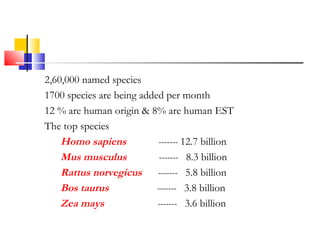
2,60,000 named species
1700 species are being added per month
12 % are human origin & 8% are human EST
The top species
Homo sapiens ------- 12.7 billion
Mus musculus ------- 8.3 billion
Rattus norvegicus ------- 5.8 billion
Bos taurus ------- 3.8 billion
Zea mays ------- 3.6 billion
GenBank
Records and Divisions
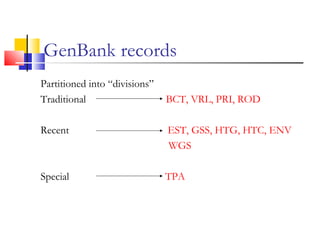
GenBank records
Partitioned into “divisions”
Traditional BCT, VRL, PRI, ROD
Recent EST, GSS, HTG, HTC, ENV
WGS
Special TPA
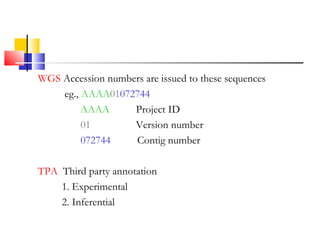
WGS Accession numbers are issued to these sequences
eg., AAAA01072744
AAAA Project ID
01 Version number
072744 Contig number
TPA Third party annotation
1. Experimental
2. Inferential
Data submission
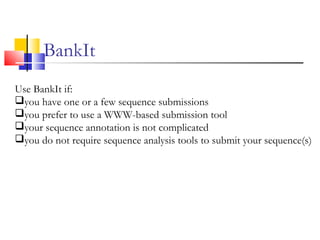
BankIt
Use BankIt if:
you have one or a few sequence submissions
you prefer to use a WWW-based submission tool
your sequence annotation is not complicated
you do not require sequence analysis tools to submit your sequence(s)
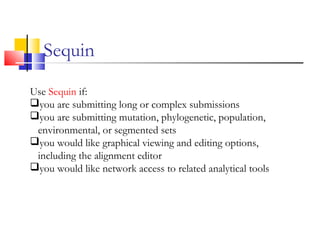
Sequin
Use Sequin if:
you are submitting long or complex submissions
you are submitting mutation, phylogenetic, population,
environmental, or segmented sets
you would like graphical viewing and editing options,
including the alignment editor
you would like network access to related analytical tools
EMBL
EMBL
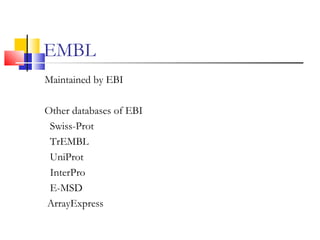
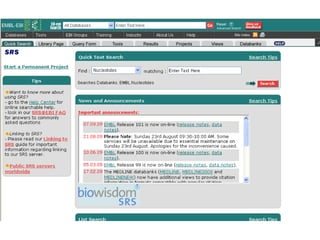
Maintained by EBI
Other databases of EBI
Swiss-Prot
TrEMBL
UniProt
InterPro
E-MSD
ArrayExpress
EMBL
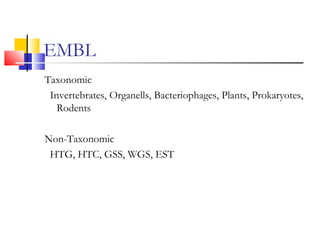
Taxonomic
Invertebrates, Organells, Bacteriophages, Plants, Prokaryotes,
Rodents
Non-Taxonomic
HTG, HTC, GSS, WGS, EST
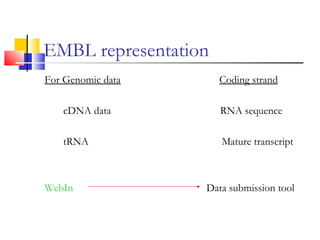
EMBL representation
For Genomic data Coding strand
cDNA data RNA sequence
tRNA Mature transcript
WebIn Data submission tool
DDBJ
DDBJ
Entry, format, abbreviation key same as GenBank
SAKURA Data submission tool
Secondary Nucleotide
Sequence Databases
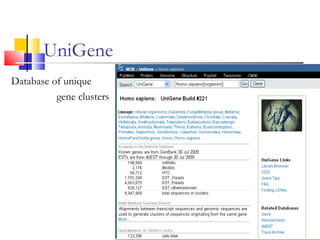
UniGene
Database of unique
gene clusters
STACK (Sequence Tag Alignment and Consensus Knowledgebase)
Ribosomal database
HIV sequence database
EPD (Eukaryotic Promoter Database)
REBASE
SwissProt
Curated protein sequence database
High level of annotation
Description of the function
Domains structure
PTMs
Variants
TrEMBL
Consists of entries in SWISS-PROT-like format
PIR-PSD
Protein Information resource- Protein Sequence Database
World’s first database of classified and funtionally annotated
protein sequences
Grew out of The Atlas of Protein Sequence and Structure
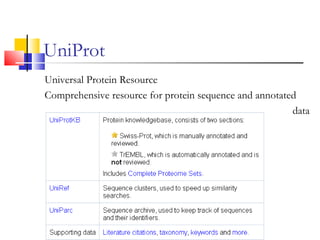
UniProt
Universal Protein Resource
Comprehensive resource for protein sequence and annotated
data
Sequence Alignments
Alignments:
Pairwise
Multiple
Multiple Sequence Alignments provide information on,
Alignment itself
Consensus Sequences
Conserved residues
Conserved residue patterns
Sequence Profiles
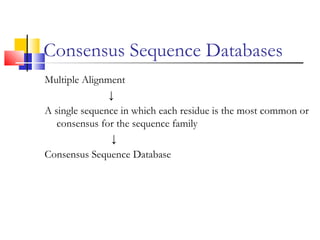
Consensus Sequence Databases
Multiple Alignment
↓
A single sequence in which each residue is the most common or
consensus for the sequence family
↓
Consensus Sequence Database
Consensus Sequence Databases
 Disadvantage:
Much information from the sequences that do not
contain the consensus residue is ignored, even though these
hold information about allowed substitutions.
PROSITE
 Database of sequence patterns
 Associated with protein family membership.
 Developed using patterns that best fit particular protein
families and functions.
PROSITE
Serine Protease Family :-
 Pattern1:
[LIVM]-[ST]-A-[STAG]-H-C
 Pattern2:
[DNSTAGC]-[GSTAPIMVQH]-x(2)-G-[DE]-S-G-[GS]-[SAPHV]-
[LIVMFYWH]-PA-[LIVMFYSTANQH]
PROSITE
Features:
1.Much shorter than total sequence length
2.Provide information on acceptable substitution.
3.Provide information on shared biological functions.
PROSITE
Disadvantage:
1. Lack of specificity.
2. They have no way of attaching
probabilities to the variation.
PRINTS and BLOCKS
 Contain multiply aligned ungapped segments.
BLOCKS- blocks
PRINTS - motifs
PRINTS and BLOCKS
 Advantages
1. Potentially more sensitive (more
distant relationships can be found)
2.More specific (fewer false positives
occur)
Specialized Sequence Database
 rRNA database
 tRNA database
 5S rRNA database
 Promoter sequence database
 InBase, a database on inteins
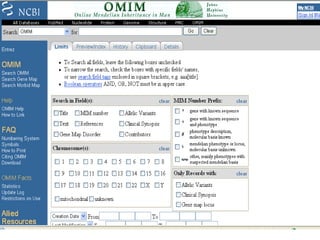
OMIM
 Online Mendelian Inheritance in Man
 Comprehensive database of human genes and genetic
disorders.
 Has numerous links to databases like SWISS- PROT,
PubMed, Mutation databases, Mapviewer.
Structural Databases
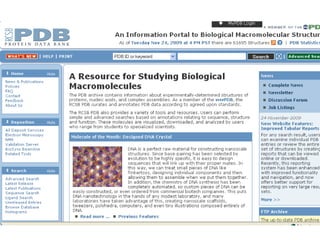
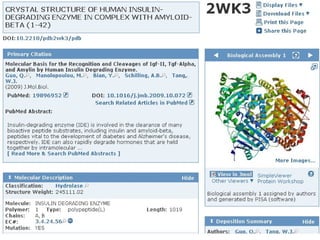
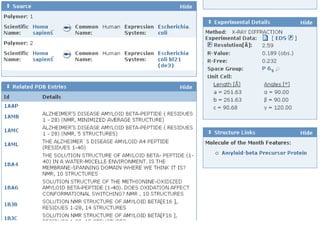
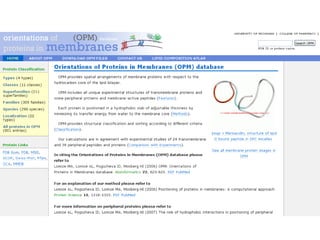
 RCSB
1. PDB
2. NDB
Structural Databases
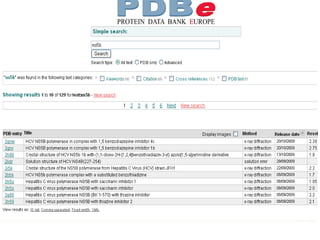
 PDBe of EBI
 MMDB
Structures derived from the PDB, with value-added features
such as,
Explicit chemical graphs,
Links to literature,
Similar sequences,
Related 3D structures,
Information about chemicals
Structural Databases
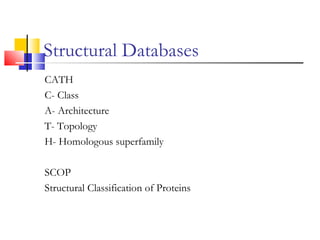
CATH
C- Class
A- Architecture
T- Topology
H- Homologous superfamily
SCOP
Structural Classification of Proteins
Higher Order Functions
Databases
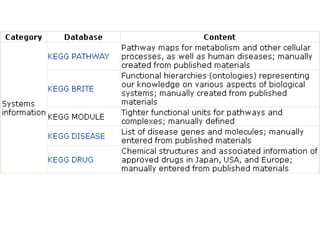
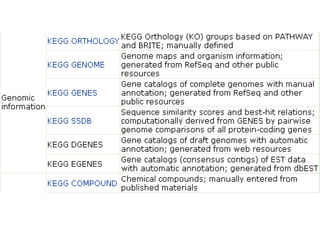
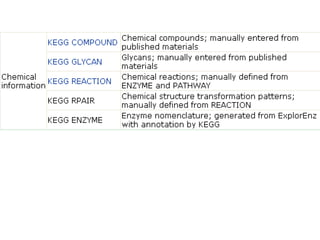
 KEGG (Kyoto Encyclopedia of Genes and Genomes)
Subsidiary Databases
Contains 16 main databases
Higher Order Functions
Databases
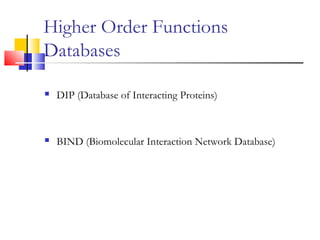
 DIP (Database of Interacting Proteins)
 BIND (Biomolecular Interaction Network Database)
Literature Databases
 PubMed
 Web of Science
 BioMedNet
Data retrieval tools
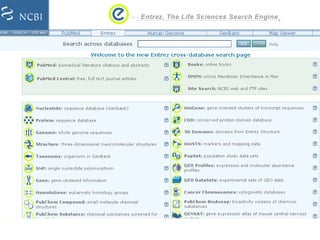
Entrez
Biological databases

Biological databases