TABLET COMPRESSION MACHINE
1
Department of Pharmacy (Pharmaceutics)Department of Pharmacy (Pharmaceutics) || Sagar savaleSagar savale
Mr. Sagar Kishor SavaleMr. Sagar Kishor Savale
Department of Pharmaceutics
avengersagar16@gmail.com
2015-016
CONTENTS
• Introduction
• Process of tablet compression
Compression and consolidation
Decompression
Ejection
Scrape off
• Rotary tablet press design
• Mechanism rotary tablet machine
• Press design and layout
• Troubleshooting
• Reference’s
2
Introduction
• The most common method of drug delivery is oral dosage
form of which tablet and capsule are predominant.
• Tablet is more accepted as compared to capsule due to
many reason such as cost, tamper resistance, ease of
handling, ease of identification and manufacturing efficiency.
• Tablet compression process understanding is resulted in
development of formulation.
• Recent advances in the design of tablet compression
equipment has conducted resulted in higher efficiency,
minimized tablet variation, greater flexibility.
3
• Modern machine provides greater accuracy and
efficiency as follows:-
1.Improved material feed system.
2.Improved cam design and material of construction.
3.Multistage compression.
4.Isolated design for quick cleaning and changeover.
5.Improved force measurement techniques.
6.High speed single tablet sorting to reject out of specification
tablets.
4
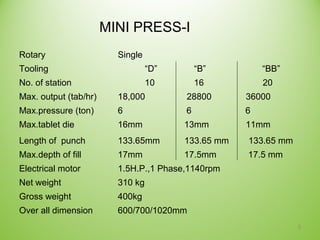
Rotary Single
Tooling “D” “B” “BB”
No. of station 10 16 20
Max. output (tab/hr) 18,000 28800 36000
Max.pressure (ton) 6 6 6
Max.tablet die 16mm 13mm 11mm
Length of punch 133.65mm 133.65 mm 133.65 mm
Max.depth of fill 17mm 17.5mm 17.5 mm
Electrical motor 1.5H.P.,1 Phase,1140rpm
Net weight 310 kg
Gross weight 400kg
Over all dimension 600/700/1020mm
5
MINI PRESS-I
PROCESS OF TABLET FORMATION
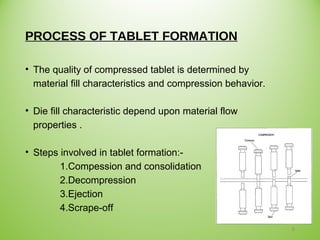
• The quality of compressed tablet is determined by
material fill characteristics and compression behavior.
• Die fill characteristic depend upon material flow
properties .
• Steps involved in tablet formation:-
1.Compession and consolidation
2.Decompression
3.Ejection
4.Scrape-off
6
1.COMPRESSION AND CONSOLIDATION
• During compression the bulk volume of material is
reduces resulted in the displacement of air.
• Increase in force lead to particle deformation and
rearrangement at this stage three principle mode of
deformation are follows:-
1.Elastic deformation
2.Plastic deformation
3.Brittle fractures
7
CONSOLIDATION:-
• Consolidation means bonding.
• The final tablet properties are affected by consolidation (i.e.
bonding).
• Mechanism of consolidation:-
1.Mechanical theory.
2.Intermolecular forces theory.
3.Liquid-surface film theory.
8
DECOMPRESSION
• The rate at which force is removed (dependent on
the compression roller diameter and machine
speed).
• The rate of decompression can also effect on the
ability of the compact to consolidate (form bonding).
• Based on liquid-surface film theory the rate of
crystallization or solidification and should have
effect on the strength of bounded surface.
• High decompression rate should result in high rate
of crystallization, typically slower crystallization rate
result in stronger crystals.
9
EJECTION AND SCRAPE-OFF
• Tablet ejection-the initial ejection peak force
required to break the tablet adhesion to die wall.
• Inadequate lubrication resulted in high ejection
force and possibly tablet failure and there is
chances of striation along with the tablet side wall
and picking, sticking.
• Ejection force below 200N-optimal
upto 400N-common
high 400-800 high
10
ROTARY TABLET PRESS DESIGN
• Pharmaceutical tablet was generally produced on
rotary tablet press.
• Upper and lower punches reside in upper and lower
turret.
• Dies are inserted in die table and the dies are
secured by die lock screw.
• The upper and lower turrets and die table are
precisely aligned.
• The movement of punches is controlled by cam track
and compression roller.
• As the entire assembly rotates the upper and lower
punches move along the cam track to accomplish die
fill tablet, compression, ejection and scrape-off .
11
PRESS DESIGN AND LAYOUT
• Modern rotary tablet presses are typically designed in
separate machine section.
• Rotary tablet compression machine having following
section.
1.Upper cam section
2.Lower cam section
3.Compression section
4.Lower mechanical section
12
UPPER CAM SECTION
• It consist of all upper compression roller and all
adjustment to the position to the upper compression
rollers.
• The primary component of upper cam section are as
follows,
1.Upper punch removal/dwell cam.
2.Upper punch lowering cam.
3.Upper precompression and main compression
rollers insertion depth adjustment .
4.Upper punch pull up-cam.
5.Cam material of construction.
13
COMPRESSION SECTION
• The compression section contain all
components that are exposed to the material.
• The compression section following part
1.Material hopper
2.Feed frame
3.Excess-material stripper
4.Tablet stripper
5.Material recirculation
14
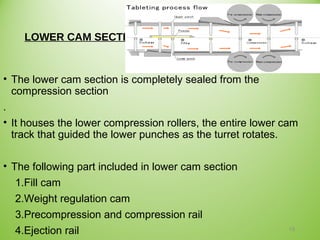
LOWER CAM SECTION
• The lower cam section is completely sealed from the
compression section
.
• It houses the lower compression rollers, the entire lower cam
track that guided the lower punches as the turret rotates.
• The following part included in lower cam section
1.Fill cam
2.Weight regulation cam
3.Precompression and compression rail
4.Ejection rail 15
LOWER MECHANILCAL SECTION
• The lower mechanical section houses the main
drive motor the gearbox, the hydraulic pump, the
lubrication pump and signal wire distribution.
• Proper venting and cooling of the lower
mechanical section is essential to prevent
machine damage and minimizing heat generation
• This section should be equipped with cooling
system for product that are sensitive to heat
generation (e.g. contain low melting point
component that are prone to picking and sticking
16
TROBLESHOOTING
• A proper understanding of material compression
characteristic combined with a knowledge of tablet
compression equipment allows efficient troubleshooting of
production problem.
• Various tablet problem occur in processing
1.Tablet weight variation .
2.Low hardness.
3.Capping and lamination.
4.picking and sticking.
5.Tablet jam and chipping.
6.Poor flow .
7.Punch variation.
8.Hardness variation.
17
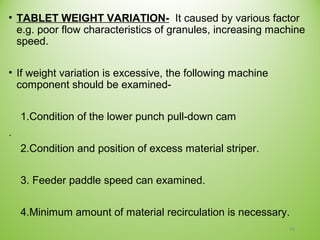
• TABLET WEIGHT VARIATION- It caused by various factor
e.g. poor flow characteristics of granules, increasing machine
speed.
• If weight variation is excessive, the following machine
component should be examined-
1.Condition of the lower punch pull-down cam
.
2.Condition and position of excess material striper.
3. Feeder paddle speed can examined.
4.Minimum amount of material recirculation is necessary.
18
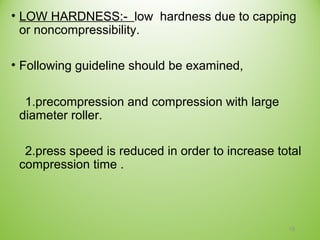
• LOW HARDNESS:- low hardness due to capping
or noncompressibility.
• Following guideline should be examined,
1.precompression and compression with large
diameter roller.
2.press speed is reduced in order to increase total
compression time .
19
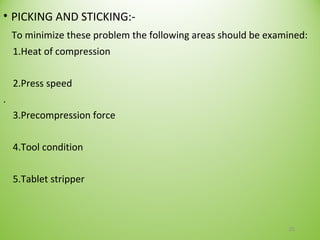
• PICKING AND STICKING:-
To minimize these problem the following areas should be examined:
1.Heat of compression
2.Press speed
.
3.Precompression force
4.Tool condition
5.Tablet stripper
20
REFERENCE’S
• James. S.; James. C. B.; Encyclopedia of
pharmaceutical technology. 2 ,Marcell Dekker, vol. 3,
2669-2687.
• Loyd.V.A.; Horward. C. A.; Pharmaceutical dosage
forms and drug delivery system, 8,Lipincott William and
Wilkins ,227- 230.
• Leon. L.; Herbert. A. L. Joseph. K.; The theory and
practice of industrial pharmacy. 3,Varghese publishing
house, Bombay, 72-75,293-309.
21
• Lachman. L.; Liberman. H. A. Joseph. B. S.
Pharmaceutical dosage form tablet. 2,Marcell Dekker.
Vol.1,136-138
• Remington.; The science and practice of pharmacy.
20. Lipincott William and Wilkins.vol.I,863-864
• Martin. A.; Physical pharmacy.4, B.I.Warly.pvt.ltd,New
Delhi.448-450
• Aulton M. E.; Pharmaceutics the science of dosage
form design.2.Churchill Livingstone.403-405sss
22
23

TABLET COMPRESSION MACHINE

  • 1.
    TABLET COMPRESSION MACHINE 1 Departmentof Pharmacy (Pharmaceutics)Department of Pharmacy (Pharmaceutics) || Sagar savaleSagar savale Mr. Sagar Kishor SavaleMr. Sagar Kishor Savale Department of Pharmaceutics avengersagar16@gmail.com 2015-016
  • 2.
    CONTENTS • Introduction • Processof tablet compression Compression and consolidation Decompression Ejection Scrape off • Rotary tablet press design • Mechanism rotary tablet machine • Press design and layout • Troubleshooting • Reference’s 2
  • 3.
    Introduction • The mostcommon method of drug delivery is oral dosage form of which tablet and capsule are predominant. • Tablet is more accepted as compared to capsule due to many reason such as cost, tamper resistance, ease of handling, ease of identification and manufacturing efficiency. • Tablet compression process understanding is resulted in development of formulation. • Recent advances in the design of tablet compression equipment has conducted resulted in higher efficiency, minimized tablet variation, greater flexibility. 3
  • 4.
    • Modern machineprovides greater accuracy and efficiency as follows:- 1.Improved material feed system. 2.Improved cam design and material of construction. 3.Multistage compression. 4.Isolated design for quick cleaning and changeover. 5.Improved force measurement techniques. 6.High speed single tablet sorting to reject out of specification tablets. 4
  • 5.
    Rotary Single Tooling “D”“B” “BB” No. of station 10 16 20 Max. output (tab/hr) 18,000 28800 36000 Max.pressure (ton) 6 6 6 Max.tablet die 16mm 13mm 11mm Length of punch 133.65mm 133.65 mm 133.65 mm Max.depth of fill 17mm 17.5mm 17.5 mm Electrical motor 1.5H.P.,1 Phase,1140rpm Net weight 310 kg Gross weight 400kg Over all dimension 600/700/1020mm 5 MINI PRESS-I
  • 6.
    PROCESS OF TABLETFORMATION • The quality of compressed tablet is determined by material fill characteristics and compression behavior. • Die fill characteristic depend upon material flow properties . • Steps involved in tablet formation:- 1.Compession and consolidation 2.Decompression 3.Ejection 4.Scrape-off 6
  • 7.
    1.COMPRESSION AND CONSOLIDATION •During compression the bulk volume of material is reduces resulted in the displacement of air. • Increase in force lead to particle deformation and rearrangement at this stage three principle mode of deformation are follows:- 1.Elastic deformation 2.Plastic deformation 3.Brittle fractures 7
  • 8.
    CONSOLIDATION:- • Consolidation meansbonding. • The final tablet properties are affected by consolidation (i.e. bonding). • Mechanism of consolidation:- 1.Mechanical theory. 2.Intermolecular forces theory. 3.Liquid-surface film theory. 8
  • 9.
    DECOMPRESSION • The rateat which force is removed (dependent on the compression roller diameter and machine speed). • The rate of decompression can also effect on the ability of the compact to consolidate (form bonding). • Based on liquid-surface film theory the rate of crystallization or solidification and should have effect on the strength of bounded surface. • High decompression rate should result in high rate of crystallization, typically slower crystallization rate result in stronger crystals. 9
  • 10.
    EJECTION AND SCRAPE-OFF •Tablet ejection-the initial ejection peak force required to break the tablet adhesion to die wall. • Inadequate lubrication resulted in high ejection force and possibly tablet failure and there is chances of striation along with the tablet side wall and picking, sticking. • Ejection force below 200N-optimal upto 400N-common high 400-800 high 10
  • 11.
    ROTARY TABLET PRESSDESIGN • Pharmaceutical tablet was generally produced on rotary tablet press. • Upper and lower punches reside in upper and lower turret. • Dies are inserted in die table and the dies are secured by die lock screw. • The upper and lower turrets and die table are precisely aligned. • The movement of punches is controlled by cam track and compression roller. • As the entire assembly rotates the upper and lower punches move along the cam track to accomplish die fill tablet, compression, ejection and scrape-off . 11
  • 12.
    PRESS DESIGN ANDLAYOUT • Modern rotary tablet presses are typically designed in separate machine section. • Rotary tablet compression machine having following section. 1.Upper cam section 2.Lower cam section 3.Compression section 4.Lower mechanical section 12
  • 13.
    UPPER CAM SECTION •It consist of all upper compression roller and all adjustment to the position to the upper compression rollers. • The primary component of upper cam section are as follows, 1.Upper punch removal/dwell cam. 2.Upper punch lowering cam. 3.Upper precompression and main compression rollers insertion depth adjustment . 4.Upper punch pull up-cam. 5.Cam material of construction. 13
  • 14.
    COMPRESSION SECTION • Thecompression section contain all components that are exposed to the material. • The compression section following part 1.Material hopper 2.Feed frame 3.Excess-material stripper 4.Tablet stripper 5.Material recirculation 14
  • 15.
    LOWER CAM SECTION •The lower cam section is completely sealed from the compression section . • It houses the lower compression rollers, the entire lower cam track that guided the lower punches as the turret rotates. • The following part included in lower cam section 1.Fill cam 2.Weight regulation cam 3.Precompression and compression rail 4.Ejection rail 15
  • 16.
    LOWER MECHANILCAL SECTION •The lower mechanical section houses the main drive motor the gearbox, the hydraulic pump, the lubrication pump and signal wire distribution. • Proper venting and cooling of the lower mechanical section is essential to prevent machine damage and minimizing heat generation • This section should be equipped with cooling system for product that are sensitive to heat generation (e.g. contain low melting point component that are prone to picking and sticking 16
  • 17.
    TROBLESHOOTING • A properunderstanding of material compression characteristic combined with a knowledge of tablet compression equipment allows efficient troubleshooting of production problem. • Various tablet problem occur in processing 1.Tablet weight variation . 2.Low hardness. 3.Capping and lamination. 4.picking and sticking. 5.Tablet jam and chipping. 6.Poor flow . 7.Punch variation. 8.Hardness variation. 17
  • 18.
    • TABLET WEIGHTVARIATION- It caused by various factor e.g. poor flow characteristics of granules, increasing machine speed. • If weight variation is excessive, the following machine component should be examined- 1.Condition of the lower punch pull-down cam . 2.Condition and position of excess material striper. 3. Feeder paddle speed can examined. 4.Minimum amount of material recirculation is necessary. 18
  • 19.
    • LOW HARDNESS:-low hardness due to capping or noncompressibility. • Following guideline should be examined, 1.precompression and compression with large diameter roller. 2.press speed is reduced in order to increase total compression time . 19
  • 20.
    • PICKING ANDSTICKING:- To minimize these problem the following areas should be examined: 1.Heat of compression 2.Press speed . 3.Precompression force 4.Tool condition 5.Tablet stripper 20
  • 21.
    REFERENCE’S • James. S.;James. C. B.; Encyclopedia of pharmaceutical technology. 2 ,Marcell Dekker, vol. 3, 2669-2687. • Loyd.V.A.; Horward. C. A.; Pharmaceutical dosage forms and drug delivery system, 8,Lipincott William and Wilkins ,227- 230. • Leon. L.; Herbert. A. L. Joseph. K.; The theory and practice of industrial pharmacy. 3,Varghese publishing house, Bombay, 72-75,293-309. 21
  • 22.
    • Lachman. L.;Liberman. H. A. Joseph. B. S. Pharmaceutical dosage form tablet. 2,Marcell Dekker. Vol.1,136-138 • Remington.; The science and practice of pharmacy. 20. Lipincott William and Wilkins.vol.I,863-864 • Martin. A.; Physical pharmacy.4, B.I.Warly.pvt.ltd,New Delhi.448-450 • Aulton M. E.; Pharmaceutics the science of dosage form design.2.Churchill Livingstone.403-405sss 22
  • 23.