
Formulation and development
of
parenterals
Presented by:
SAI DHATRI ARIGE
V. V. Institute of Pharmaceutical Sciences
Contents:
• Introduction
• Containers and closure
• processing
• Formulation and production
• Evaluation
• References
2 Pharmaceutics
Parenteral
Parenteral refers injectable route of administration.
It derived from Greek words Para (Outside) and
enteron (Intestine).
So it is a route of administration other than the oral
route. This route of administration bypasses the
alimentary canal
3 Pharmaceutics
Containers:
1. Glass:
• Highly Resistant Borosilicate Glass
• Treated Soda lime Glass
• Regular Soda Lime Glass
• N.P (Non-parenteral) Glass
Type 4 is not used for parenteral packaging, others
all are used for parenteral packaging.
4 Pharmaceutics
2. Plastic:
Plastic containers are used but they face following problems
• Sorption
• Leaching
• Softening
3. Rubber:
To provide closure for multiple dose vials, IV fluid bottles, plugs for disposable
syringes and bulbs for ophthalmic pipettes, rubber is the material of choice.
Problems associated with rubber closures are
• Incompatibility
• Chemical instability
• Physical instability5 Pharmaceutics
Closure:
• Characteristics of Good Pharmaceutical rubbers
• Good ageing qualities
• Satisfactory hardness and elasticity
• Resistance to sterilization conditions
• Impermeable to moisture and air
• Examples:
• Butyl Rubbers
• Natural Rubbers
• Neoprene Rubbers
• Poly isoprene rubbers
• Silicone Rubbers
6 Pharmaceutics
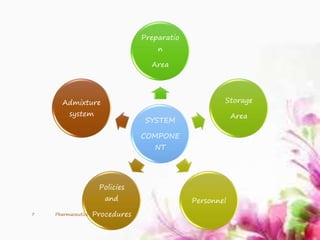
SYSTEM
COMPONE
NT
Preparatio
n
Area
Storage
Area
Personnel
Policies
and
Procedures
Admixture
system
7 Pharmaceutics
PROCESSING OF
PARENTERALS
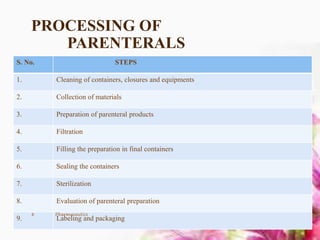
S. No. STEPS
1. Cleaning of containers, closures and equipments
2. Collection of materials
3. Preparation of parenteral products
4. Filtration
5. Filling the preparation in final containers
6. Sealing the containers
7. Sterilization
8. Evaluation of parenteral preparation
9. Labeling and packaging
8 Pharmaceutics
Formulation of parenteral products
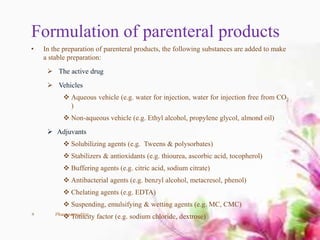
• In the preparation of parenteral products, the following substances are added to make
a stable preparation:
 The active drug
 Vehicles
 Aqueous vehicle (e.g. water for injection, water for injection free from CO2
)
 Non-aqueous vehicle (e.g. Ethyl alcohol, propylene glycol, almond oil)
 Adjuvants
 Solubilizing agents (e.g. Tweens & polysorbates)
 Stabilizers & antioxidants (e.g. thiourea, ascorbic acid, tocopherol)
 Buffering agents (e.g. citric acid, sodium citrate)
 Antibacterial agents (e.g. benzyl alcohol, metacresol, phenol)
 Chelating agents (e.g. EDTA)
 Suspending, emulsifying & wetting agents (e.g. MC, CMC)
 Tonicity factor (e.g. sodium chloride, dextrose)9 Pharmaceutics
Production facilities of parenterals
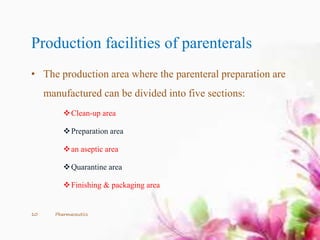
• The production area where the parenteral preparation are
manufactured can be divided into five sections:
Clean-up area
Preparation area
an aseptic area
Quarantine area
Finishing & packaging area
10 Pharmaceutics
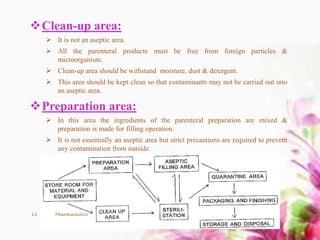
Clean-up area:
 It is not an aseptic area.
 All the parenteral products must be free from foreign particles &
microorganism.
 Clean-up area should be withstand moisture, dust & detergent.
 This area should be kept clean so that contaminants may not be carried out into
an aseptic area.
Preparation area:
 In this area the ingredients of the parenteral preparation are mixed &
preparation is made for filling operation.
 It is not essentially an aseptic area but strict precautions are required to prevent
any contamination from outside.
11 Pharmaceutics
An aseptic area:
 The parenteral preparations are filtered, filled into final container & sealed
should be in an an aseptic area.
 The entry of personnel into an an aseptic area should be limited & through
an air lock system.
 Ceiling, wall & floor of that area should be sealed & painted.
 The air in the an aseptic area should be free from fibers, dust and
microorganism.
 The High efficiency particulate air filters (HEPA) is used for air.
 UV lamps are fitted in order to maintain sterility.
12 Pharmaceutics
Quarantine area:
 After filling, sealing & sterilization the parenteral product are held up in
quarantine area.
 Randomly samples were kept foe evaluation.
 The batch or product pass the evaluation tests are transfer in to finishing or
packaging area.
Finishing & packaging area:
 Parenteral products are properly labelled and packed.
 Properly packing is essential to provide protection against physical
damage.
 The labelled container should be packed in cardboard or plastic container.
 Ampoules should be packed in partitioned boxes
13 Pharmaceutics
EVALUATION OF PARENTERAL
PREPARATIONS
• The finished parenteral products are
subjected to the following tests, in order to
maintain quality control:
A) Sterility Test
B) Clarity Test
C) Leakage Test
D) Pyrogen Test
E) Assay
14 Pharmaceutics
A) Sterility test
• It is a procedure carried out to detect and conform
absence of any viable form of microbes in or on
pharmacopeia preparation or product.
1) Method of sterility testing
i ) METHOD 1 Membrane filtration method
ii) METHOD 2 Direct inoculation method
15 Pharmaceutics
B)Clarity test
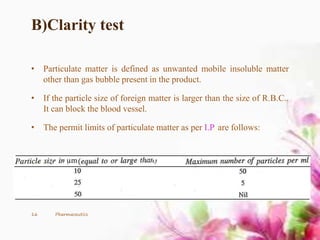
• Particulate matter is defined as unwanted mobile insoluble matter
other than gas bubble present in the product.
• If the particle size of foreign matter is larger than the size of R.B.C..
It can block the blood vessel.
• The permit limits of particulate matter as per I.P. are follows:
16 Pharmaceutics
C)Leakage test
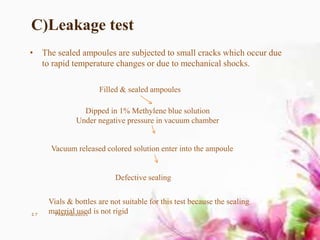
• The sealed ampoules are subjected to small cracks which occur due
to rapid temperature changes or due to mechanical shocks.
Filled & sealed ampoules
Dipped in 1% Methylene blue solution
Under negative pressure in vacuum chamber
Vacuum released colored solution enter into the ampoule
Defective sealing
Vials & bottles are not suitable for this test because the sealing
material used is not rigid17 Pharmaceutics
D)Pyrogen test
 Pyrogen = “Pyro” (Greek = Fire) + “gen” (Greek =
beginning).
 The presence of pyrogens produces metabolic by products
which leads to increase in fever and further increase in
microbial growth leads to death
 Bacterial pyrogens are called “Endotoxins”. Gram negative
bacteria produce more potent endotoxins than gram + bacteria
and fungi.
 Endotoxins are heat stable lipopolysaccharides (LPS) present
in bacterial cell walls, not present in cell-free bacterial filtrates
18 Pharmaceutics
E)Assay
• Assay is performed according to method given In the
monograph of that parental preparation.
• Assay is done to check the quantity of medicament
present in the parenteral preparation.
19 Pharmaceutics
References
• Encyclopedia of pharmaceutical technology by James Swarbrick
pg.no.1266-1299
• Pharmaceutical product development by N.K.JAIN
• Chemical Incompatibility of Parenteral Drug Admixtures; T. J.
Mccarthy; S.A. Medical journal 2
• The theory & pratice of “Industrial Pharmacy” Leon Lachman ,Herbert
A. Liberman.special Indian Edition 2009 Pg. No.693-680.
• Modern Pharmaceutics Fourth Edition, Revised and Expanded, Edited
By G.S. Banker & C.T. Rhodes, Marcel Dekker pg387-389.
• The Science & practice of Pharmacy, By Remington, Vol-01, Edi.21st,
Lippincott Publication, pg-838-840.
20 Pharmaceutics
21 Pharmaceutics

Formulation and development of parenterals

  • 1.
    Formulation and development of parenterals Presentedby: SAI DHATRI ARIGE V. V. Institute of Pharmaceutical Sciences
  • 2.
    Contents: • Introduction • Containersand closure • processing • Formulation and production • Evaluation • References 2 Pharmaceutics
  • 3.
    Parenteral Parenteral refers injectableroute of administration. It derived from Greek words Para (Outside) and enteron (Intestine). So it is a route of administration other than the oral route. This route of administration bypasses the alimentary canal 3 Pharmaceutics
  • 4.
    Containers: 1. Glass: • HighlyResistant Borosilicate Glass • Treated Soda lime Glass • Regular Soda Lime Glass • N.P (Non-parenteral) Glass Type 4 is not used for parenteral packaging, others all are used for parenteral packaging. 4 Pharmaceutics
  • 5.
    2. Plastic: Plastic containersare used but they face following problems • Sorption • Leaching • Softening 3. Rubber: To provide closure for multiple dose vials, IV fluid bottles, plugs for disposable syringes and bulbs for ophthalmic pipettes, rubber is the material of choice. Problems associated with rubber closures are • Incompatibility • Chemical instability • Physical instability5 Pharmaceutics
  • 6.
    Closure: • Characteristics ofGood Pharmaceutical rubbers • Good ageing qualities • Satisfactory hardness and elasticity • Resistance to sterilization conditions • Impermeable to moisture and air • Examples: • Butyl Rubbers • Natural Rubbers • Neoprene Rubbers • Poly isoprene rubbers • Silicone Rubbers 6 Pharmaceutics
  • 7.
  • 8.
    PROCESSING OF PARENTERALS S. No.STEPS 1. Cleaning of containers, closures and equipments 2. Collection of materials 3. Preparation of parenteral products 4. Filtration 5. Filling the preparation in final containers 6. Sealing the containers 7. Sterilization 8. Evaluation of parenteral preparation 9. Labeling and packaging 8 Pharmaceutics
  • 9.
    Formulation of parenteralproducts • In the preparation of parenteral products, the following substances are added to make a stable preparation:  The active drug  Vehicles  Aqueous vehicle (e.g. water for injection, water for injection free from CO2 )  Non-aqueous vehicle (e.g. Ethyl alcohol, propylene glycol, almond oil)  Adjuvants  Solubilizing agents (e.g. Tweens & polysorbates)  Stabilizers & antioxidants (e.g. thiourea, ascorbic acid, tocopherol)  Buffering agents (e.g. citric acid, sodium citrate)  Antibacterial agents (e.g. benzyl alcohol, metacresol, phenol)  Chelating agents (e.g. EDTA)  Suspending, emulsifying & wetting agents (e.g. MC, CMC)  Tonicity factor (e.g. sodium chloride, dextrose)9 Pharmaceutics
  • 10.
    Production facilities ofparenterals • The production area where the parenteral preparation are manufactured can be divided into five sections: Clean-up area Preparation area an aseptic area Quarantine area Finishing & packaging area 10 Pharmaceutics
  • 11.
    Clean-up area:  Itis not an aseptic area.  All the parenteral products must be free from foreign particles & microorganism.  Clean-up area should be withstand moisture, dust & detergent.  This area should be kept clean so that contaminants may not be carried out into an aseptic area. Preparation area:  In this area the ingredients of the parenteral preparation are mixed & preparation is made for filling operation.  It is not essentially an aseptic area but strict precautions are required to prevent any contamination from outside. 11 Pharmaceutics
  • 12.
    An aseptic area: The parenteral preparations are filtered, filled into final container & sealed should be in an an aseptic area.  The entry of personnel into an an aseptic area should be limited & through an air lock system.  Ceiling, wall & floor of that area should be sealed & painted.  The air in the an aseptic area should be free from fibers, dust and microorganism.  The High efficiency particulate air filters (HEPA) is used for air.  UV lamps are fitted in order to maintain sterility. 12 Pharmaceutics
  • 13.
    Quarantine area:  Afterfilling, sealing & sterilization the parenteral product are held up in quarantine area.  Randomly samples were kept foe evaluation.  The batch or product pass the evaluation tests are transfer in to finishing or packaging area. Finishing & packaging area:  Parenteral products are properly labelled and packed.  Properly packing is essential to provide protection against physical damage.  The labelled container should be packed in cardboard or plastic container.  Ampoules should be packed in partitioned boxes 13 Pharmaceutics
  • 14.
    EVALUATION OF PARENTERAL PREPARATIONS •The finished parenteral products are subjected to the following tests, in order to maintain quality control: A) Sterility Test B) Clarity Test C) Leakage Test D) Pyrogen Test E) Assay 14 Pharmaceutics
  • 15.
    A) Sterility test •It is a procedure carried out to detect and conform absence of any viable form of microbes in or on pharmacopeia preparation or product. 1) Method of sterility testing i ) METHOD 1 Membrane filtration method ii) METHOD 2 Direct inoculation method 15 Pharmaceutics
  • 16.
    B)Clarity test • Particulatematter is defined as unwanted mobile insoluble matter other than gas bubble present in the product. • If the particle size of foreign matter is larger than the size of R.B.C.. It can block the blood vessel. • The permit limits of particulate matter as per I.P. are follows: 16 Pharmaceutics
  • 17.
    C)Leakage test • Thesealed ampoules are subjected to small cracks which occur due to rapid temperature changes or due to mechanical shocks. Filled & sealed ampoules Dipped in 1% Methylene blue solution Under negative pressure in vacuum chamber Vacuum released colored solution enter into the ampoule Defective sealing Vials & bottles are not suitable for this test because the sealing material used is not rigid17 Pharmaceutics
  • 18.
    D)Pyrogen test  Pyrogen= “Pyro” (Greek = Fire) + “gen” (Greek = beginning).  The presence of pyrogens produces metabolic by products which leads to increase in fever and further increase in microbial growth leads to death  Bacterial pyrogens are called “Endotoxins”. Gram negative bacteria produce more potent endotoxins than gram + bacteria and fungi.  Endotoxins are heat stable lipopolysaccharides (LPS) present in bacterial cell walls, not present in cell-free bacterial filtrates 18 Pharmaceutics
  • 19.
    E)Assay • Assay isperformed according to method given In the monograph of that parental preparation. • Assay is done to check the quantity of medicament present in the parenteral preparation. 19 Pharmaceutics
  • 20.
    References • Encyclopedia ofpharmaceutical technology by James Swarbrick pg.no.1266-1299 • Pharmaceutical product development by N.K.JAIN • Chemical Incompatibility of Parenteral Drug Admixtures; T. J. Mccarthy; S.A. Medical journal 2 • The theory & pratice of “Industrial Pharmacy” Leon Lachman ,Herbert A. Liberman.special Indian Edition 2009 Pg. No.693-680. • Modern Pharmaceutics Fourth Edition, Revised and Expanded, Edited By G.S. Banker & C.T. Rhodes, Marcel Dekker pg387-389. • The Science & practice of Pharmacy, By Remington, Vol-01, Edi.21st, Lippincott Publication, pg-838-840. 20 Pharmaceutics
  • 21.