DIFFERENT TYPES OF GRANULATORS
PRESENTED BY : HAFSA AZAM (D18E32)
PUNJAB UNIVERSITY COLLEGE OF
PHARMACY
TABLE OF CONTENTS
 INTRODUCTION TO GRANULATION
 TYPES OF GRANULATION
 WET GRANULATION
 EQUIPMENTS FOR WET GRANULATION
 Introduction
 Construction
 Working
 Advantages
 Disadvantages
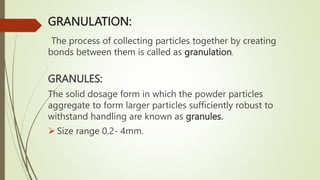
GRANULATION:
The process of collecting particles together by creating
bonds between them is called as granulation.
GRANULES:
The solid dosage form in which the powder particles
aggregate to form larger particles sufficiently robust to
withstand handling are known as granules.
 Size range 0.2- 4mm.
WHY USE GRANULES WHEN WE HAVE
POWDERS?
To enhance the flow of powders.
To produce uniform mixtures.
To produce dust free formulation.
TYPES OF GRANULATION METHODS:
DRY METHOD/SLUGGING/PRE-COMPRESSION
WET METHOD/WET GRANULATION
DIRECT COMPRESSION
WET GRANULATION:
In this method, powdered medicament and other excipients are
moistened with granulating agent.
STEPS:
1- Mixing of drugs and excipients.
2- Formation of wet mass.
3- Coarse screening of wet mass.
4- Drying of moist granules.
EQUIPMENTS USED FOR WET GRANULATION:
High speed mixer granulators
Shear granulators
Fluidized bed granulators
Spray drier granulators
Spheronizer granulator
HIGH SPEED MIXER GRANULATORS:
INTRODUCTION:
This granulator can both mix and
granulate the product thus, removing the need to transfer the
product between pieces of equipment and thus reducing the
opportunity of segregation to occur.
CONSTRUCTION:
The machine has a stainless steel mixing bowl
containing , a main impeller which revolves in horizontal plane
and an auxiliary chopper which revolves either in vertical or
the horizontal plane.
WORKING:
The centrally mounted impeller blade at the
bottom of mixer rotates at high speed throwing materials
towards the mixer bowl wall by centrifugal force . The material
is then forced upward before dropping back down towards
center of mixer.
ADVANTAGES AND DISADVANTAGES:
ADVANTAGES
Can reduce granulation
time
Produces dense
granules
DISADVANTAGES
Can’t be used for
blending lubricants.
Care needs to be taken
if the material being
mixed fractures easily
HIGH SHEAR GRANULATORS:
CONSTRUCTION:
It consists of a cylindrical or conical
mixing bowl , a three bladed impeller , a chopper , an auxiliary
chopper , a mortor to drive blades , a discharge pot.
WORKING:
 Powder mixing
 Binder addition or addition of granulating liquid
 Wetting of powder and nucleation
 Growth of granules and densification of powders
 Granule attrition
SUBCLASSIFICATION:
High shear granulators are sub-classified into:
1- Vertical high shear granulators( e.g : Diosna granulator)
2- Horizontal high shear granulators
ADVANTAGES AND DISADVANTAGES:
ADVANTAGES
Less binder solution
required
Granulation is achieved in
shorter time
Greater densification
Less friable granules
DISADVANTAGES
Narrow range of
operating conditions
Over wetting may lead to
formation of large sized
lumps
Thermolabile materials
degradation
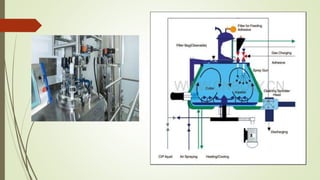
FLUIDIZED-BED GRANULATOR:
Fluidized beds have been
expanded from their original use as dryers to encompass
granulation as well.
 It is multipurpose equipment.
CONSTRUCTION:
It consists of:
 Gas plenum which screws as the receiver of inlet
fluidization air
 Gas distribution
 Product container
 An expanded chamber containing a set of filter bag in
expansion chamber
 Binders spray system which is characterized by one oe four
nozzle designs
WORKING:
Granulation is achieved by suspending powder
in the air of fluidized bed and then spraying a liquid binder
from nozzle that are positioned above or below the powder
bed.
Top spray operation  porous granules
Bottom spray operation  dense and highly spherical
granules
ADVANTAGES AND DISADVANTAGES
ADVANTAGES
One unit system; saves
labor cost , transfer loss
and time
Heat transfer is 2-6
times greater than that
generated by tray dryer
DISADVANTAGES
Expensive to acquire
Practically impossible to
achieve same degree of
densification
SPRAY-DRYING GRANULATORS:
This machine makes use of spray and fluid
bed technology to realize mixing, granulation and drying in
one container.
WORKING:
The fluidized powder is wetted by spraying the
extract until agglomeration occurs. As soon as the size of
granule is reached, spraying is stopped and wet granules are
dries and cooled.
ADVANTAGES AND DISADVANTAGES:
ADVANTAGES
It is particularly suitable
for micro-auxiliary and
heat sensitive raw
materials
Efficiency is 1-2 times
greater than fluidized
granulators
DISADVANTAGES
Difficult to clean after use
Bulky and expensive to
install
SPHERONIZERS:
The instrument used for
spheronization process is called spheronizer.
SPHERONIZATION:
The process where extrudates are
shaped into small rounded or spherical granules is called
as spheronization.
This process is also called as marumerization.
WORKING:
 Dry mixing of ingredients- to achieve a homogenous powder
dispersion
 Wet massing- to produce a sufficiently plastic wet mass
 Extrusion- to form rod shaped particles of uniform diameter
 Spheronization- to round off all these rods into spherical
particles
 Drying- to achieve the desired final moisture content.
 Screening- to achieve the desired narrow sized distribution.
ADVANTAGES:
Easy mixing of non compatible products
Improve hardness and friability
Elimination of dust
Minimum surface area to volume ratio
Bibliography:
 The theory and practice of industrial pharmacy by
LACHMAN
 The science and engineering of granulation processes by
JIM LISTER and BRYAN ENNIS
 Modern pharmaceutics by GILBERT S. BANKER
 AULTON’S pharmaceutics
granulation.pptx
granulation.pptx

granulation.pptx

  • 1.
    DIFFERENT TYPES OFGRANULATORS PRESENTED BY : HAFSA AZAM (D18E32) PUNJAB UNIVERSITY COLLEGE OF PHARMACY
  • 2.
    TABLE OF CONTENTS INTRODUCTION TO GRANULATION  TYPES OF GRANULATION  WET GRANULATION  EQUIPMENTS FOR WET GRANULATION  Introduction  Construction  Working  Advantages  Disadvantages
  • 3.
    GRANULATION: The process ofcollecting particles together by creating bonds between them is called as granulation. GRANULES: The solid dosage form in which the powder particles aggregate to form larger particles sufficiently robust to withstand handling are known as granules.  Size range 0.2- 4mm.
  • 4.
    WHY USE GRANULESWHEN WE HAVE POWDERS? To enhance the flow of powders. To produce uniform mixtures. To produce dust free formulation.
  • 5.
    TYPES OF GRANULATIONMETHODS: DRY METHOD/SLUGGING/PRE-COMPRESSION WET METHOD/WET GRANULATION DIRECT COMPRESSION
  • 6.
    WET GRANULATION: In thismethod, powdered medicament and other excipients are moistened with granulating agent. STEPS: 1- Mixing of drugs and excipients. 2- Formation of wet mass. 3- Coarse screening of wet mass. 4- Drying of moist granules.
  • 7.
    EQUIPMENTS USED FORWET GRANULATION: High speed mixer granulators Shear granulators Fluidized bed granulators Spray drier granulators Spheronizer granulator
  • 8.
    HIGH SPEED MIXERGRANULATORS: INTRODUCTION: This granulator can both mix and granulate the product thus, removing the need to transfer the product between pieces of equipment and thus reducing the opportunity of segregation to occur.
  • 10.
    CONSTRUCTION: The machine hasa stainless steel mixing bowl containing , a main impeller which revolves in horizontal plane and an auxiliary chopper which revolves either in vertical or the horizontal plane. WORKING: The centrally mounted impeller blade at the bottom of mixer rotates at high speed throwing materials towards the mixer bowl wall by centrifugal force . The material is then forced upward before dropping back down towards center of mixer.
  • 11.
    ADVANTAGES AND DISADVANTAGES: ADVANTAGES Canreduce granulation time Produces dense granules DISADVANTAGES Can’t be used for blending lubricants. Care needs to be taken if the material being mixed fractures easily
  • 12.
    HIGH SHEAR GRANULATORS: CONSTRUCTION: Itconsists of a cylindrical or conical mixing bowl , a three bladed impeller , a chopper , an auxiliary chopper , a mortor to drive blades , a discharge pot.
  • 14.
    WORKING:  Powder mixing Binder addition or addition of granulating liquid  Wetting of powder and nucleation  Growth of granules and densification of powders  Granule attrition SUBCLASSIFICATION: High shear granulators are sub-classified into: 1- Vertical high shear granulators( e.g : Diosna granulator) 2- Horizontal high shear granulators
  • 15.
    ADVANTAGES AND DISADVANTAGES: ADVANTAGES Lessbinder solution required Granulation is achieved in shorter time Greater densification Less friable granules DISADVANTAGES Narrow range of operating conditions Over wetting may lead to formation of large sized lumps Thermolabile materials degradation
  • 16.
    FLUIDIZED-BED GRANULATOR: Fluidized bedshave been expanded from their original use as dryers to encompass granulation as well.  It is multipurpose equipment.
  • 18.
    CONSTRUCTION: It consists of: Gas plenum which screws as the receiver of inlet fluidization air  Gas distribution  Product container  An expanded chamber containing a set of filter bag in expansion chamber  Binders spray system which is characterized by one oe four nozzle designs
  • 19.
    WORKING: Granulation is achievedby suspending powder in the air of fluidized bed and then spraying a liquid binder from nozzle that are positioned above or below the powder bed. Top spray operation  porous granules Bottom spray operation  dense and highly spherical granules
  • 20.
    ADVANTAGES AND DISADVANTAGES ADVANTAGES Oneunit system; saves labor cost , transfer loss and time Heat transfer is 2-6 times greater than that generated by tray dryer DISADVANTAGES Expensive to acquire Practically impossible to achieve same degree of densification
  • 21.
    SPRAY-DRYING GRANULATORS: This machinemakes use of spray and fluid bed technology to realize mixing, granulation and drying in one container. WORKING: The fluidized powder is wetted by spraying the extract until agglomeration occurs. As soon as the size of granule is reached, spraying is stopped and wet granules are dries and cooled.
  • 23.
    ADVANTAGES AND DISADVANTAGES: ADVANTAGES Itis particularly suitable for micro-auxiliary and heat sensitive raw materials Efficiency is 1-2 times greater than fluidized granulators DISADVANTAGES Difficult to clean after use Bulky and expensive to install
  • 24.
    SPHERONIZERS: The instrument usedfor spheronization process is called spheronizer. SPHERONIZATION: The process where extrudates are shaped into small rounded or spherical granules is called as spheronization. This process is also called as marumerization.
  • 25.
    WORKING:  Dry mixingof ingredients- to achieve a homogenous powder dispersion  Wet massing- to produce a sufficiently plastic wet mass  Extrusion- to form rod shaped particles of uniform diameter  Spheronization- to round off all these rods into spherical particles  Drying- to achieve the desired final moisture content.  Screening- to achieve the desired narrow sized distribution.
  • 27.
    ADVANTAGES: Easy mixing ofnon compatible products Improve hardness and friability Elimination of dust Minimum surface area to volume ratio
  • 28.
    Bibliography:  The theoryand practice of industrial pharmacy by LACHMAN  The science and engineering of granulation processes by JIM LISTER and BRYAN ENNIS  Modern pharmaceutics by GILBERT S. BANKER  AULTON’S pharmaceutics