


STABILITIY STUDIES OF PACKAGING 
MOUMITA BANERJEE 
B.PHARM 
4TH YEAR
WHAT IS PACKAGING? 
Packaging is defined as the collection 
of different components which surround 
the pharmaceutical product from the time 
of production until its use.
IMPORTANCE OF PACKAGING 
Protect against all adverse external influences 
That can alter the properties of the product. 
Protect against biological contamination. 
Protect against physical damage. 
Carry the correct information and identification of the product. 
Tamper evident / Child resistance/ Anti counterfeiting.
FUNCTIONS OF PACKAGING 
• Containment 
• Not to leak, nor allow diffusion and permeation 
• Strong enough to hold the contents during handling 
• Protection 
• Light 
• Moisture 
• Oxygen 
• Biological contamination 
• Mechanical damage 
• Counterfeiting
STABILITY TESTING 
The purpose of stability testing is to provide evidence on how the 
quality of a FPP varies with time under the influence of a variety of 
environmental conditions such as temperature, humidity and light 
and to establish a shelf-life for the FPP, to determine the storage 
conditions and the in-use stability 
Should be conducted on the dosage form packaged in the container 
closure system proposed for marketing ( including, as appropriate, any 
secondary packaging and container label)
STABILITY STUDIES 
Ultimate proof of suitability of the container closure system and the 
packaging processes established by full shelf life stability studies
STABILITY TESTING CONT. 
Stability testing of pharmaceutical products is a complex set of procedures involving 
considerable cost, time consumption and scientific expertise in order to build in 
quality, efficacy and safety in a drug formulation. 
The most important steps during the developmental stages include pharmaceutical 
analysis and stability studies that are required to determine and assure: 
the identity, potency and purity of ingredients, as well as those of the 
formulated products
STABILITY TESTING CONT. 
Stability testing is termed as a complex process because of involvement of 
a variety of factors influencing the stability of a pharmaceutical product. 
These factors include: 
Stability of the active ingredient(s); 
interaction between active ingredients and excipients, 
manufacturing process followed , type of dosage form, 
container/closure system used for packaging. 
Light, heat and moisture conditions encountered during shipment, 
storage and handling.
STABILITY TESTING CONT. 
Stability testing is a routine procedure performed on drug substances 
and products and is employed at various stages of the product 
development. 
In early stages, accelerated stability testing (at relatively high 
temperatures and/or humidity) is used in order to determine the type 
of degradation products which may be found after long-term storage. 
Testing under less rigorous conditions i.e. those recommended for 
long-term shelf storage, at slightly elevated temperatures is used to 
determine a product’s shelf life and expiration dates.
AIM 
The major aim of pharmaceutical stability testing is: 
To provide reasonable assurance that the products will remain at an 
acceptable level of fitness/quality throughout the period during which they 
are in market place available for supply to the patients. 
And will be fit for their consumption until the patient uses the last unit of 
the product.
PROTOCOL FOR STABILITY TESTING 
The protocol for stability testing is a pre-requisite for starting stability testing and is 
necessarily a written document that describes the key components of a regulated 
and well-controlled stability study. 
Because the testing condition is based on inherent stability of the compound, the 
type of dosage form and the proposed container-closure system, the protocol 
depends on the type of drug substance or the product. 
In addition, the protocol can depend on whether the drug is new or is already in 
the market . 
The protocol should also reflect the regions where the product is proposed to be 
marketed.
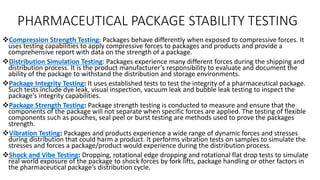
PHARMACEUTICAL PACKAGE STABILITY TESTING 
Compression Strength Testing: Packages behave differently when exposed to compressive forces. It 
uses testing capabilities to apply compressive forces to packages and products and provide a 
comprehensive report with data on the strength of a package. 
Distribution Simulation Testing: Packages experience many different forces during the shipping and 
distribution process. It is the product manufacturer’s responsibility to evaluate and document the 
ability of the package to withstand the distribution and storage environments. 
Package Integrity Testing: It uses established tests to test the integrity of a pharmaceutical package. 
Such tests include dye leak, visual inspection, vacuum leak and bubble leak testing to inspect the 
package's integrity capabilities. 
Package Strength Testing: Package strength testing is conducted to measure and ensure that the 
components of the package will not separate when specific forces are applied. The testing of flexible 
components such as pouches, seal peel or burst testing are methods used to prove the packages 
strength. 
Vibration Testing: Packages and products experience a wide range of dynamic forces and stresses 
during distribution that could harm a product. It performs vibration tests on samples to simulate the 
stresses and forces a package/product would experience during the distribution process. 
Shock and Vibe Testing: Dropping, rotational edge dropping and rotational flat drop tests to simulate 
real world exposure of the package to shock forces by fork lifts, package handling or other factors in 
the pharmaceutical package’s distribution cycle.
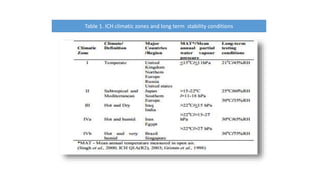
Table 1. ICH climatic zones and long term stability conditions
CLIMATIC ZONES FOR STABILITY TESTING 
For the purpose of stability testing, the whole world has been divided into 
four zones (I - IV) depending upon the environmental conditions the 
pharmaceutical products are likely to be subjected to during their storage. 
These conditions have been derived on the basis of the mean annual 
temperature and relative humidity data in these region
CONTAINERS AND CLOSURES 
• The testing is done on the product in immediate containers and 
closures proposed for marketing. 
• The packaging materials include aluminium strip packs, blister packs, 
HDPE bottles etc.
ORIENTATION OF STORAGE OF CONTAINERS 
Samples of the solutions, dispersed systems and semi solid drug 
products for stability studies must be kept upright and positioned 
either inverted or on the side to allow for full interaction of the 
product with the container-closure. 
This orientation helps to determine whether the contact between 
the drug product or solvent and the closure results in the extraction 
of chemical substances from the closure components or adsorption 
of product components in to the container-closure
SAMPLING TIME POINTS 
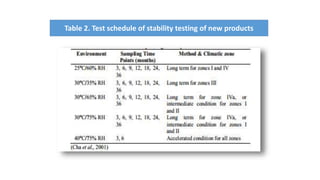
Frequency of testing should be such that it is sufficient to establish the 
stability profile of the new drug substance. 
For products with a proposed shelf life of at least 12 months, the testing 
frequency at the long-term storage condition should be every 3 months 
over the first year, every 6 months over the second year and annually 
thereafter throughout the proposed shelf life expiration date.
Table 2. Test schedule of stability testing of new products
TEST STORAGE CONDITIONS 
The storage conditions to be selected are based upon 
the climatic zone in which the product is intended to be 
marketed or for which the product is proposed to be 
filed for regulatory approval.
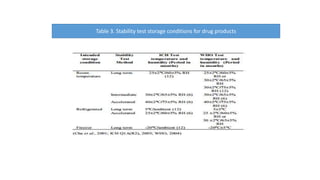
Table 3. Stability test storage conditions for drug products
TEST PARAMETERS 
The stability test protocol should define the test parameters that would be used 
for evaluation of the stability samples. 
The tests that monitor the quality, purity, potency, and identity which could be 
expected to change upon storage are chosen as stability tests. 
Therefore appearance, assay, degradation products, dissolution, microbiological 
testing, and moisture are standard tests performed on stability test samples. 
 Microbiological tests include sterility, preservative efficacy and microbial count 
as applicable e.g. for liquid injectable preparations. 
 The batches used for stability study must meet all the testing requirements 
including heavy metals, residue on ignition, residual solvents
PRESENTATION AND RECORDING OF STABILITY DATA 
Stability data is recorded in an organized, comprehensive and 
cumulative format. 
 The stability data table is the means for reporting the results of the 
stability study in a concise format for ease of review and 
interpretation. 
 The data is recorded in a proper tabular format. 
 In addition, a graphical presentation of stability data versus time for 
the test data can be used to illustrate trends in data and may be 
helpful for data evaluation
THANK YOU

Stability of packaging in pharmacy

  • 1.
    STABILITIY STUDIES OFPACKAGING MOUMITA BANERJEE B.PHARM 4TH YEAR
  • 2.
    WHAT IS PACKAGING? Packaging is defined as the collection of different components which surround the pharmaceutical product from the time of production until its use.
  • 3.
    IMPORTANCE OF PACKAGING Protect against all adverse external influences That can alter the properties of the product. Protect against biological contamination. Protect against physical damage. Carry the correct information and identification of the product. Tamper evident / Child resistance/ Anti counterfeiting.
  • 4.
    FUNCTIONS OF PACKAGING • Containment • Not to leak, nor allow diffusion and permeation • Strong enough to hold the contents during handling • Protection • Light • Moisture • Oxygen • Biological contamination • Mechanical damage • Counterfeiting
  • 5.
    STABILITY TESTING Thepurpose of stability testing is to provide evidence on how the quality of a FPP varies with time under the influence of a variety of environmental conditions such as temperature, humidity and light and to establish a shelf-life for the FPP, to determine the storage conditions and the in-use stability Should be conducted on the dosage form packaged in the container closure system proposed for marketing ( including, as appropriate, any secondary packaging and container label)
  • 6.
    STABILITY STUDIES Ultimateproof of suitability of the container closure system and the packaging processes established by full shelf life stability studies
  • 7.
    STABILITY TESTING CONT. Stability testing of pharmaceutical products is a complex set of procedures involving considerable cost, time consumption and scientific expertise in order to build in quality, efficacy and safety in a drug formulation. The most important steps during the developmental stages include pharmaceutical analysis and stability studies that are required to determine and assure: the identity, potency and purity of ingredients, as well as those of the formulated products
  • 8.
    STABILITY TESTING CONT. Stability testing is termed as a complex process because of involvement of a variety of factors influencing the stability of a pharmaceutical product. These factors include: Stability of the active ingredient(s); interaction between active ingredients and excipients, manufacturing process followed , type of dosage form, container/closure system used for packaging. Light, heat and moisture conditions encountered during shipment, storage and handling.
  • 9.
    STABILITY TESTING CONT. Stability testing is a routine procedure performed on drug substances and products and is employed at various stages of the product development. In early stages, accelerated stability testing (at relatively high temperatures and/or humidity) is used in order to determine the type of degradation products which may be found after long-term storage. Testing under less rigorous conditions i.e. those recommended for long-term shelf storage, at slightly elevated temperatures is used to determine a product’s shelf life and expiration dates.
  • 10.
    AIM The majoraim of pharmaceutical stability testing is: To provide reasonable assurance that the products will remain at an acceptable level of fitness/quality throughout the period during which they are in market place available for supply to the patients. And will be fit for their consumption until the patient uses the last unit of the product.
  • 11.
    PROTOCOL FOR STABILITYTESTING The protocol for stability testing is a pre-requisite for starting stability testing and is necessarily a written document that describes the key components of a regulated and well-controlled stability study. Because the testing condition is based on inherent stability of the compound, the type of dosage form and the proposed container-closure system, the protocol depends on the type of drug substance or the product. In addition, the protocol can depend on whether the drug is new or is already in the market . The protocol should also reflect the regions where the product is proposed to be marketed.
  • 12.
    PHARMACEUTICAL PACKAGE STABILITYTESTING Compression Strength Testing: Packages behave differently when exposed to compressive forces. It uses testing capabilities to apply compressive forces to packages and products and provide a comprehensive report with data on the strength of a package. Distribution Simulation Testing: Packages experience many different forces during the shipping and distribution process. It is the product manufacturer’s responsibility to evaluate and document the ability of the package to withstand the distribution and storage environments. Package Integrity Testing: It uses established tests to test the integrity of a pharmaceutical package. Such tests include dye leak, visual inspection, vacuum leak and bubble leak testing to inspect the package's integrity capabilities. Package Strength Testing: Package strength testing is conducted to measure and ensure that the components of the package will not separate when specific forces are applied. The testing of flexible components such as pouches, seal peel or burst testing are methods used to prove the packages strength. Vibration Testing: Packages and products experience a wide range of dynamic forces and stresses during distribution that could harm a product. It performs vibration tests on samples to simulate the stresses and forces a package/product would experience during the distribution process. Shock and Vibe Testing: Dropping, rotational edge dropping and rotational flat drop tests to simulate real world exposure of the package to shock forces by fork lifts, package handling or other factors in the pharmaceutical package’s distribution cycle.
  • 13.
    Table 1. ICHclimatic zones and long term stability conditions
  • 14.
    CLIMATIC ZONES FORSTABILITY TESTING For the purpose of stability testing, the whole world has been divided into four zones (I - IV) depending upon the environmental conditions the pharmaceutical products are likely to be subjected to during their storage. These conditions have been derived on the basis of the mean annual temperature and relative humidity data in these region
  • 15.
    CONTAINERS AND CLOSURES • The testing is done on the product in immediate containers and closures proposed for marketing. • The packaging materials include aluminium strip packs, blister packs, HDPE bottles etc.
  • 16.
    ORIENTATION OF STORAGEOF CONTAINERS Samples of the solutions, dispersed systems and semi solid drug products for stability studies must be kept upright and positioned either inverted or on the side to allow for full interaction of the product with the container-closure. This orientation helps to determine whether the contact between the drug product or solvent and the closure results in the extraction of chemical substances from the closure components or adsorption of product components in to the container-closure
  • 17.
    SAMPLING TIME POINTS Frequency of testing should be such that it is sufficient to establish the stability profile of the new drug substance. For products with a proposed shelf life of at least 12 months, the testing frequency at the long-term storage condition should be every 3 months over the first year, every 6 months over the second year and annually thereafter throughout the proposed shelf life expiration date.
  • 18.
    Table 2. Testschedule of stability testing of new products
  • 19.
    TEST STORAGE CONDITIONS The storage conditions to be selected are based upon the climatic zone in which the product is intended to be marketed or for which the product is proposed to be filed for regulatory approval.
  • 20.
    Table 3. Stabilitytest storage conditions for drug products
  • 21.
    TEST PARAMETERS Thestability test protocol should define the test parameters that would be used for evaluation of the stability samples. The tests that monitor the quality, purity, potency, and identity which could be expected to change upon storage are chosen as stability tests. Therefore appearance, assay, degradation products, dissolution, microbiological testing, and moisture are standard tests performed on stability test samples.  Microbiological tests include sterility, preservative efficacy and microbial count as applicable e.g. for liquid injectable preparations.  The batches used for stability study must meet all the testing requirements including heavy metals, residue on ignition, residual solvents
  • 22.
    PRESENTATION AND RECORDINGOF STABILITY DATA Stability data is recorded in an organized, comprehensive and cumulative format.  The stability data table is the means for reporting the results of the stability study in a concise format for ease of review and interpretation.  The data is recorded in a proper tabular format.  In addition, a graphical presentation of stability data versus time for the test data can be used to illustrate trends in data and may be helpful for data evaluation
  • 23.