Presented By :
Mr. Sanket Rajiv Shinde
M.Pharmacy (QAT)
1
 Introduction
 Objectives
 Need
 Types of Process Validation
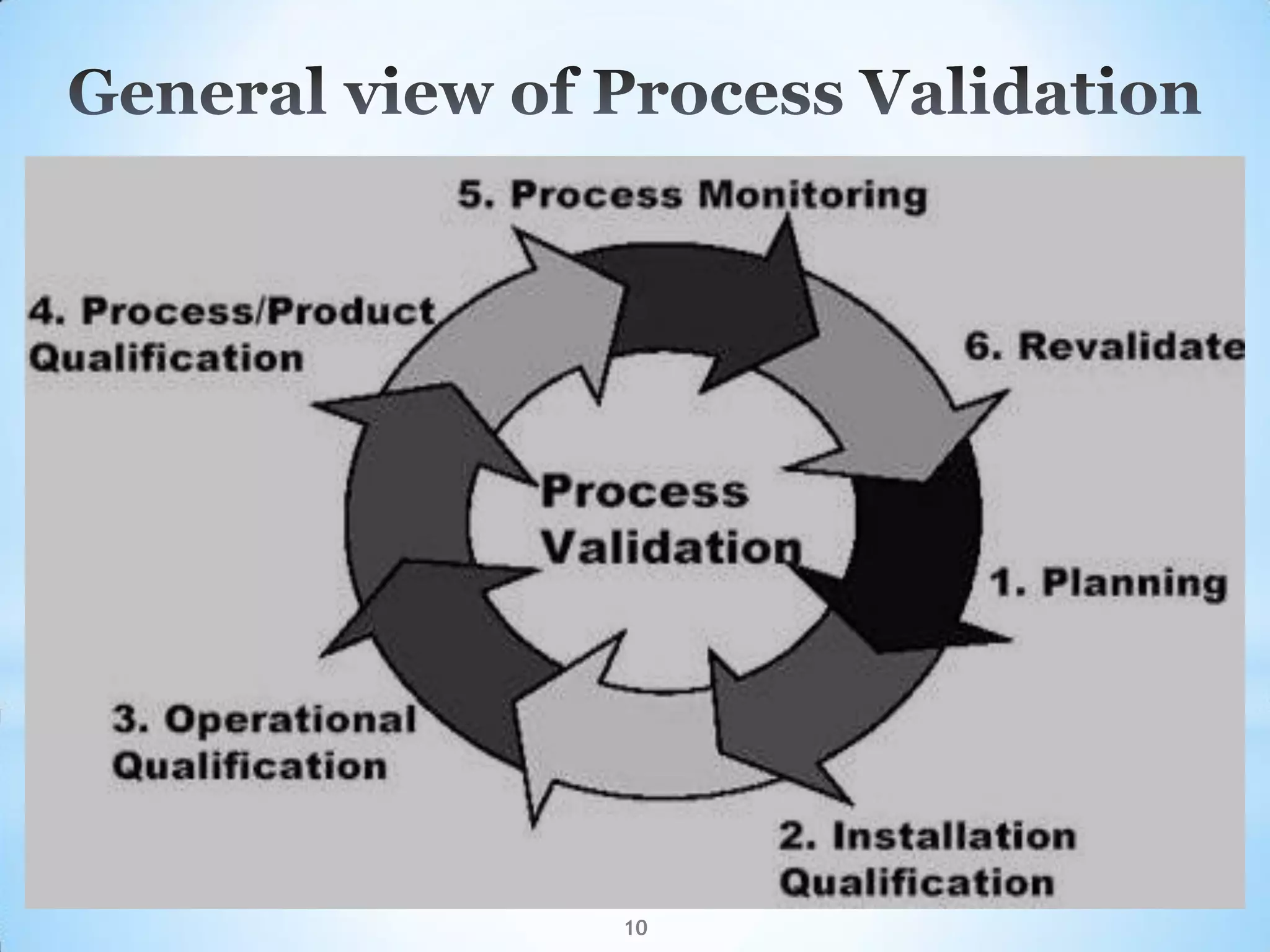
 General view of Process Validation
 Industrial Process Evaluation
 Tablet Compression
 Variables
 Tablet compression M/C validation
 Qualifications
 Revalidation
 References
2
 Validation is a key process for effective quality
assurance.
 “Validation is establishing documented evidence
which provides a high degree of assurances that a
specific process or equipment will
consistently produce a product or result meeting
its predetermined specifications and quality
attributes.”
 Validation of the individual step of manufacturing
processes is called the Process Validation.
3
It would not be feasible to use the equipments
without knowing whether it will produce the product we
wanted or not.
The compression step is the critical step in the solid
dosage form preparations that affect the assay at great
extent.
4
 To create a robust manufacturing process that
consistently produces a drug product with minimal
variation that adheres to quality criteria of purity,
identity, and potency.
 Process validation will ensure a robust product which is
highly reproducible over time.
5
 Assurance of Quality Cost reduction.
 Process validation is necessary if failure needs to be
reduced.
 Productivity to be increased.
PROCESS
VALIDATION
Retrospective
Prospective
Concurrent
6
Revalidation
7
 The validation protocol is executed before the process
is put into commercial use.
 Each validation step should be evaluated on the basis
of experimental or theoretical considerations to
determine the critical parameter that may affect the
quality of finished product.
 Each experiment should be planned and documented
 All equipment, production environment, and testing
method to be used should have been fully validated.
8
 It is similar to the prospective.
 This validation involves in process monitoring of critical
processing steps and product testing.
 This help to generate documented evidence to show the
production process.
 Historical data taken from the records of the completed
production batches are use to provide documented
evidence.
9
 It is repetition of validation process or a part of its.
 This is carried out when there is any change or
replacement in formulation, equipment plan or site
location batch size or in case of sequential batches
that do not meet specifications and is carried out at
specific time intervals in case of no changes.
10
Determine the unit operations needed to manufacture the
tablets :
1. Mixing or Blending
2. Wet Granulation
3. Wet Milling
4. Drying
5. Milling
6. Lubrication
7. Tablet Compression
8. Tablet Coating
9. In-process tests
10. Finished product tests
11
12
 Compression is a critical step in the production of a tablet
dosage form.
 The materials being compressed will need to have
adequate flow and compression properties.
 The material should readily flow from the hopper onto the
feed frame and into the dies.
 Inadequate flow can result in “rat holing” in the hopper
and/ or segregation of the blend in the hopper/feed frame.
 This can cause tablet weight and content uniformity
problems.
 As for the compressibility properties of the formulation, it
should be examined on an instrumented tablet press.
Good compression outcome is a measure of :-
Granule/powder mix properties
• bulk and tapped density-granulation
• particle size and particle size distribution-granulation
• moisture content- drying
• extent of lubrication- lubrication time
Machine and tooling attributes
• appropriate selection and adequate lubrication of
punches and dye
• machine speed
• applied compression pressure
13
Compression – Sampling frequency and size
Depends on the length of the run time/batch size :
 we expect frequent sampling than the normal
IPQC frequency
 the number of tablets taken should be greater
than those taken during a normal IPQC sampling
14
After the preparation of granules (in case of wet
granulation) or sized slugs (in case of dry granulation) or
mixing of ingredients (in case of direct compression),
they are compressed to get final product.
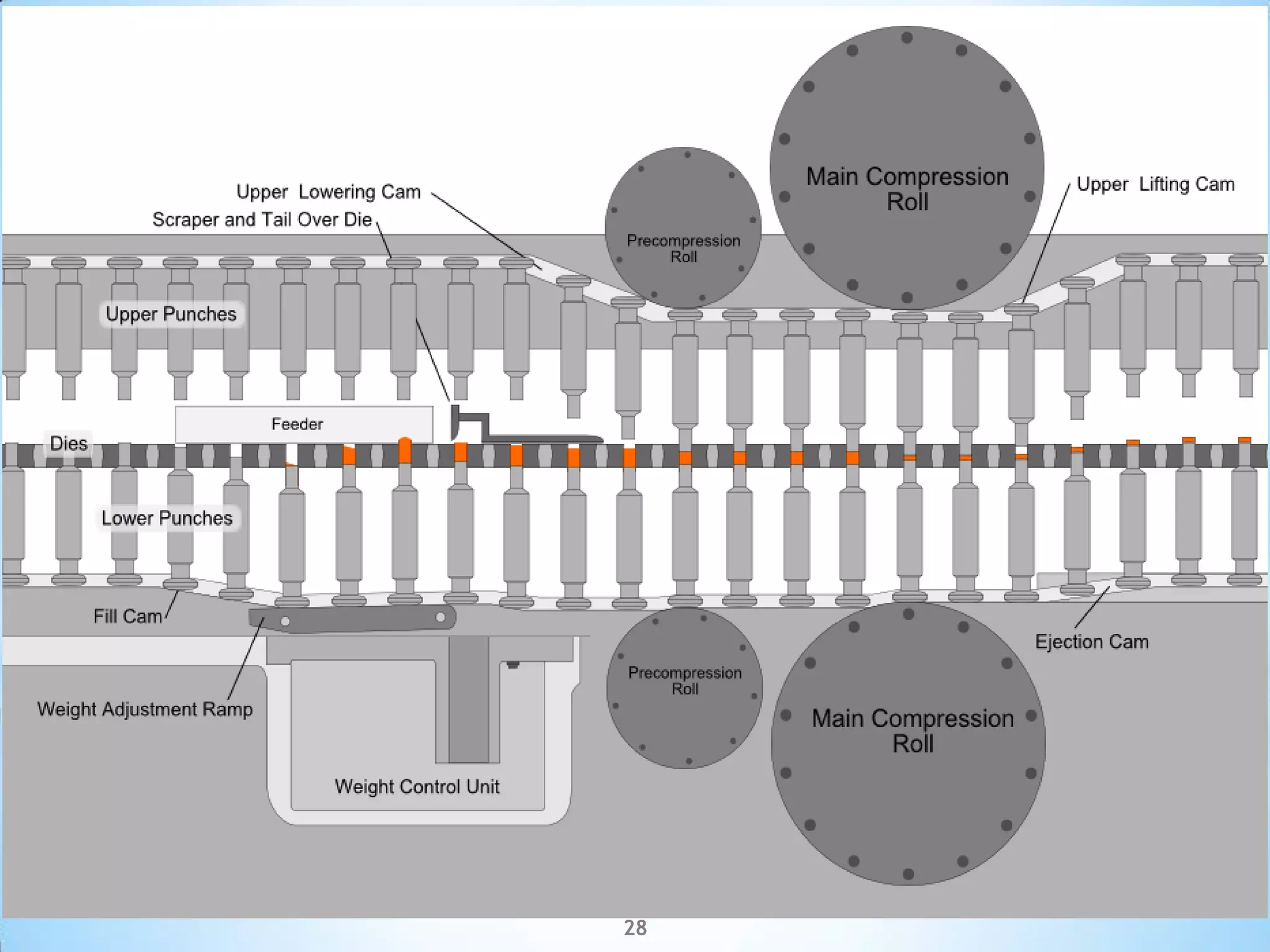
The compression is done either by single punch
machine (stamping press) or by multi station machine
(rotary press).
Factors-
• Compression speed-
Range of compression speed to determine the operating
range of the compressor.
• Compression or ejection force-
Determined optimal compression force to obtain the
desired tablet hardness.
15
16
• Speed of press
• Hopper load
• Position of punches & dies
• Pre-compression
• Compression force
• Feed frame (open/forced)
• Feeder speed
(in-process tests)
• Appearance
• Weight variation
• Hardness/friability
• Thickness
• Moisture content
• Disintegration/dissolution
• Assay/dose uniformity
17
 Fill volume
 Pre-compression force, compression force
 Turntable speed
 Dwell time
 Granule size and feed
 Ejection force, lubrication
18
 Operating criteria must be adequate
 Spares should be available
 Easy maintenance
 Equipment should not disseminate dust
 Low cost
 Material of construction/Non reactive surface
 Hopper Capacity
 Compression speed
 Display
 Types of dies & punches
 Position as per drawing
19
It includes-
 Material of construction
 Load Capacity of mixer
 Design & dimension of blades
 No of shafts
 Speed/RPM
 Electrical specification
 Digital Display for time and RPM
 Drawing, Utilities
 Equipment alignment
Above parameters are checked against documented
specifications.
 Load Capacity, Speed/RPM, time display are calibrated.
20
Details of the Equipment :
• Equipment name, make & model No. shall be noted down.
• Location for the installation equipment shall be checked.
• Utilities required shall be listed down.
• Any deviation observed while following above procedure
should be informed for corrective action.
Installation Procedure :
• After checking all the specifications as mentioned in the
selection criteria, service engineer shall commission the
equipment.
• Authorized validation team shall carry out installation checks.
21
22
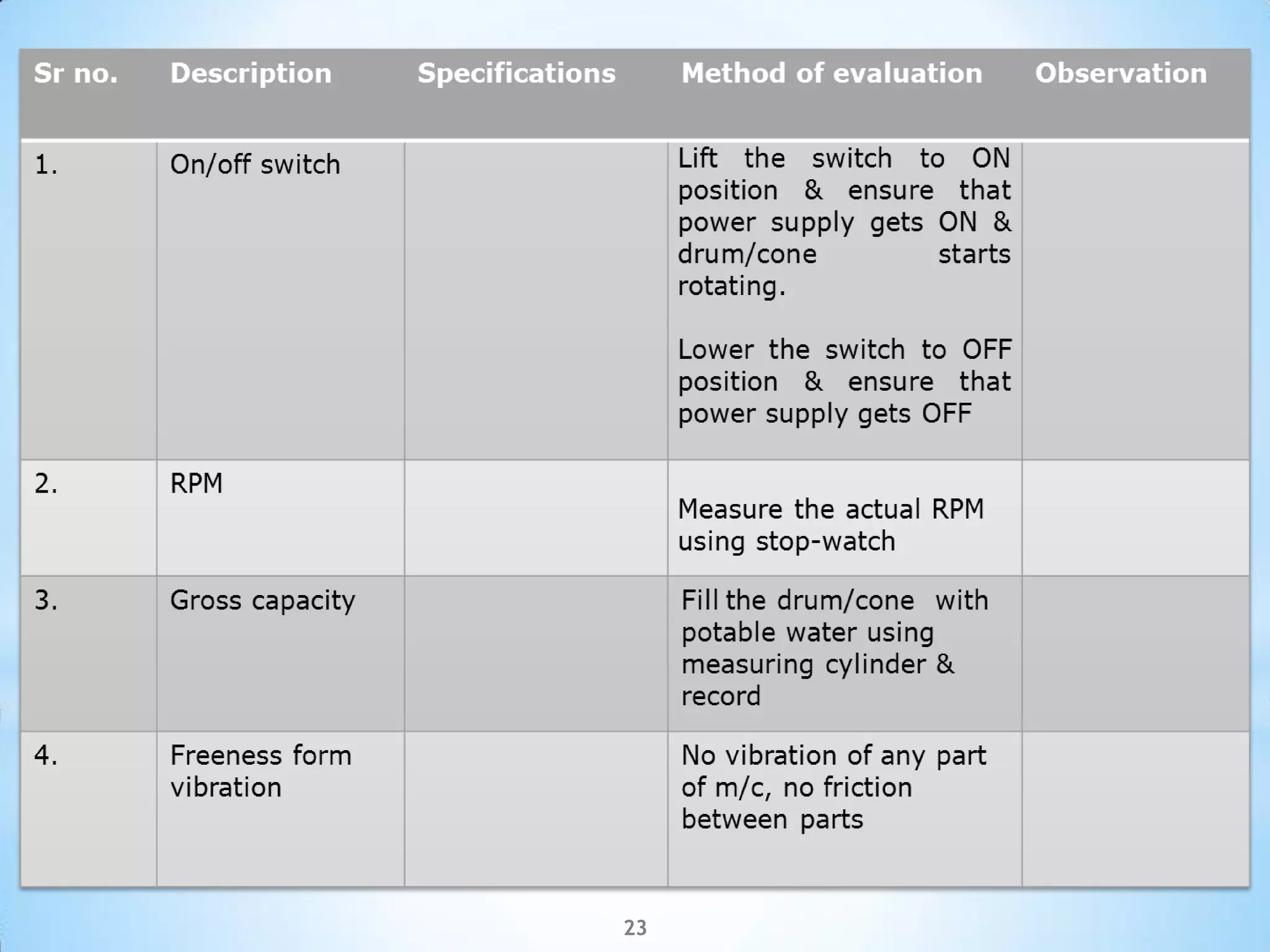
 After completions of successful installation qualification initiate
the actual operation to ensure that machine is operating within
specification.
 Check the operation qualification parameters against their
specifications.
 Document the deviation details.
 The Quality head and the department head shall decide whether
deviation is acceptable or not.
23
24
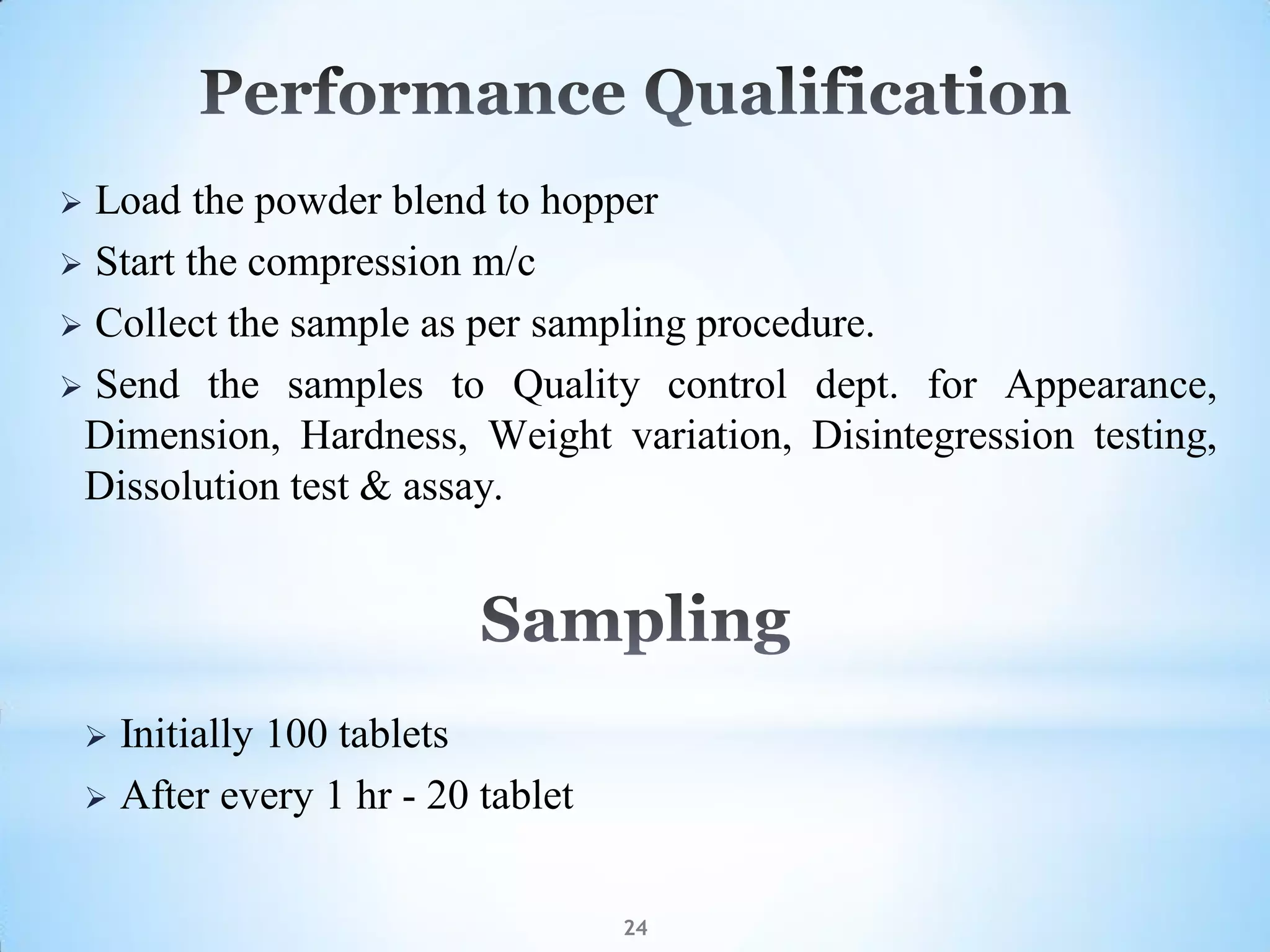
 Load the powder blend to hopper
 Start the compression m/c
 Collect the sample as per sampling procedure.
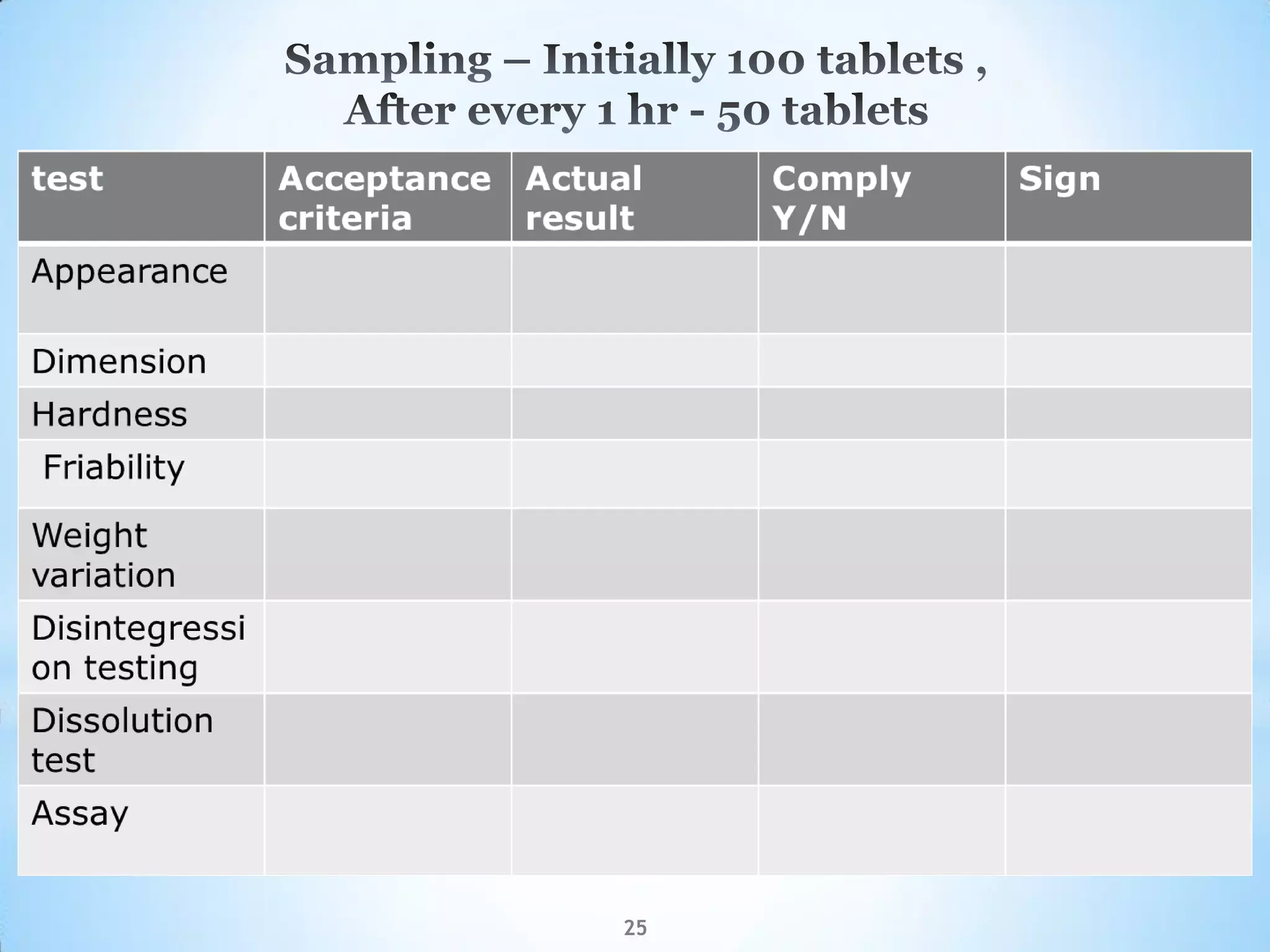
 Send the samples to Quality control dept. for Appearance,
Dimension, Hardness, Weight variation, Disintegression testing,
Dissolution test & assay.
 Initially 100 tablets
 After every 1 hr - 20 tablet
25
26
 Location of the equipment is changed.
 There is change of spare/ parts that have a direct effect
on the performance of the equipment
 At normal revalidation schedule.
27
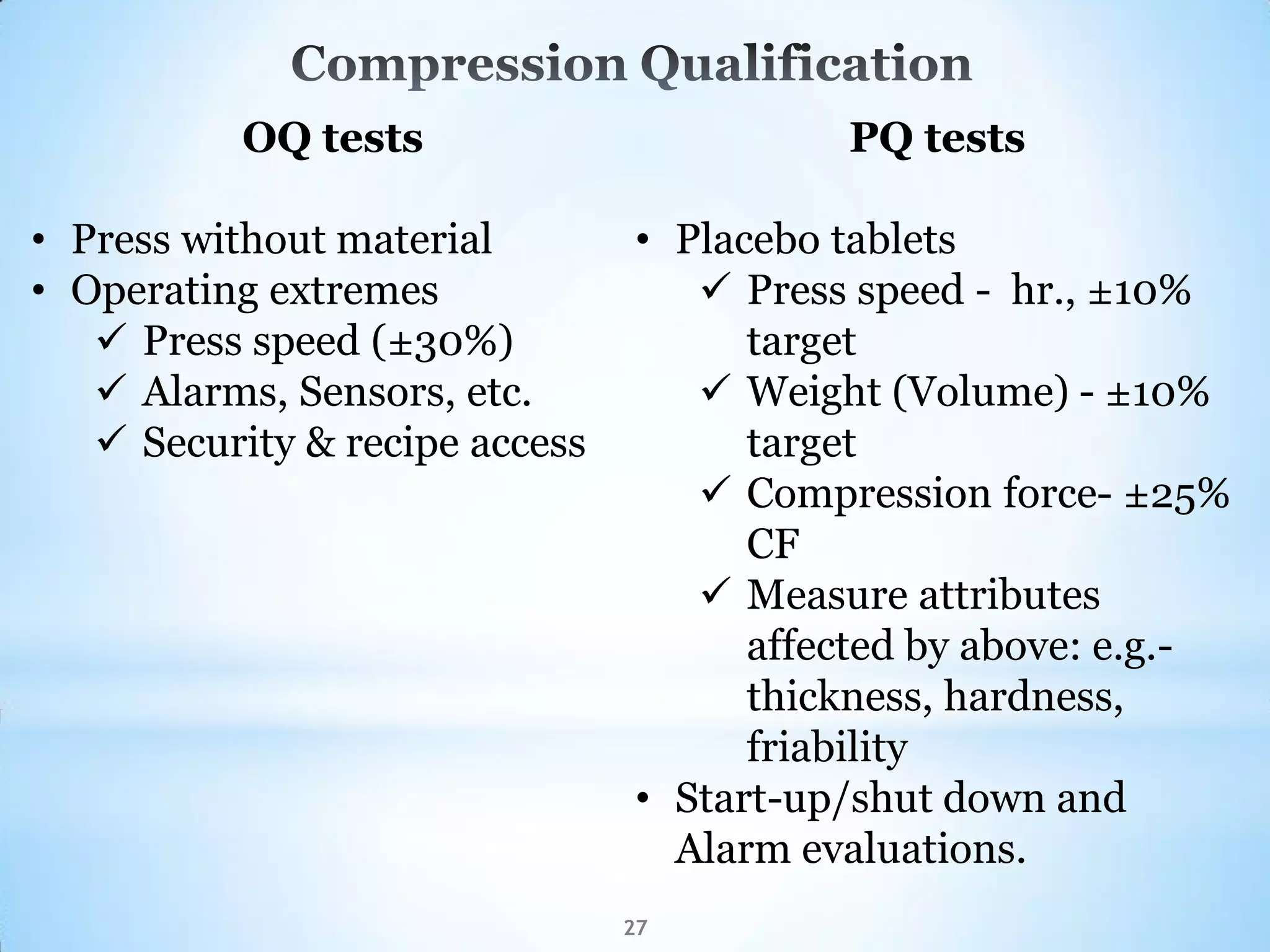
OQ tests
• Press without material
• Operating extremes
 Press speed (±30%)
 Alarms, Sensors, etc.
 Security & recipe access
PQ tests
• Placebo tablets
 Press speed - hr., ±10%
target
 Weight (Volume) - ±10%
target
 Compression force- ±25%
CF
 Measure attributes
affected by above: e.g.-
thickness, hardness,
friability
• Start-up/shut down and
Alarm evaluations.
28
29
 Pharmaceutical Process Validation, Third Edition,
Ira R.Berry & Robert Nash, Marcel Decker Inc,
Page No. 170-180
 Pharmaceutical Quality Assurance, Manohar
Potdar, Nirali Prakashan, Page No.- 8.36-8.37
 Pharmaceutical Master Validation Plan by Sayed
Imtiyaz Haider published by st. Luice press page
no 125.
30

Process validation of tablet compression

  • 1.
    Presented By : Mr.Sanket Rajiv Shinde M.Pharmacy (QAT) 1
  • 2.
     Introduction  Objectives Need  Types of Process Validation  General view of Process Validation  Industrial Process Evaluation  Tablet Compression  Variables  Tablet compression M/C validation  Qualifications  Revalidation  References 2
  • 3.
     Validation isa key process for effective quality assurance.  “Validation is establishing documented evidence which provides a high degree of assurances that a specific process or equipment will consistently produce a product or result meeting its predetermined specifications and quality attributes.”  Validation of the individual step of manufacturing processes is called the Process Validation. 3
  • 4.
    It would notbe feasible to use the equipments without knowing whether it will produce the product we wanted or not. The compression step is the critical step in the solid dosage form preparations that affect the assay at great extent. 4
  • 5.
     To createa robust manufacturing process that consistently produces a drug product with minimal variation that adheres to quality criteria of purity, identity, and potency.  Process validation will ensure a robust product which is highly reproducible over time. 5  Assurance of Quality Cost reduction.  Process validation is necessary if failure needs to be reduced.  Productivity to be increased.
  • 6.
  • 7.
    7  The validationprotocol is executed before the process is put into commercial use.  Each validation step should be evaluated on the basis of experimental or theoretical considerations to determine the critical parameter that may affect the quality of finished product.  Each experiment should be planned and documented  All equipment, production environment, and testing method to be used should have been fully validated.
  • 8.
    8  It issimilar to the prospective.  This validation involves in process monitoring of critical processing steps and product testing.  This help to generate documented evidence to show the production process.  Historical data taken from the records of the completed production batches are use to provide documented evidence.
  • 9.
    9  It isrepetition of validation process or a part of its.  This is carried out when there is any change or replacement in formulation, equipment plan or site location batch size or in case of sequential batches that do not meet specifications and is carried out at specific time intervals in case of no changes.
  • 10.
  • 11.
    Determine the unitoperations needed to manufacture the tablets : 1. Mixing or Blending 2. Wet Granulation 3. Wet Milling 4. Drying 5. Milling 6. Lubrication 7. Tablet Compression 8. Tablet Coating 9. In-process tests 10. Finished product tests 11
  • 12.
    12  Compression isa critical step in the production of a tablet dosage form.  The materials being compressed will need to have adequate flow and compression properties.  The material should readily flow from the hopper onto the feed frame and into the dies.  Inadequate flow can result in “rat holing” in the hopper and/ or segregation of the blend in the hopper/feed frame.  This can cause tablet weight and content uniformity problems.  As for the compressibility properties of the formulation, it should be examined on an instrumented tablet press.
  • 13.
    Good compression outcomeis a measure of :- Granule/powder mix properties • bulk and tapped density-granulation • particle size and particle size distribution-granulation • moisture content- drying • extent of lubrication- lubrication time Machine and tooling attributes • appropriate selection and adequate lubrication of punches and dye • machine speed • applied compression pressure 13
  • 14.
    Compression – Samplingfrequency and size Depends on the length of the run time/batch size :  we expect frequent sampling than the normal IPQC frequency  the number of tablets taken should be greater than those taken during a normal IPQC sampling 14
  • 15.
    After the preparationof granules (in case of wet granulation) or sized slugs (in case of dry granulation) or mixing of ingredients (in case of direct compression), they are compressed to get final product. The compression is done either by single punch machine (stamping press) or by multi station machine (rotary press). Factors- • Compression speed- Range of compression speed to determine the operating range of the compressor. • Compression or ejection force- Determined optimal compression force to obtain the desired tablet hardness. 15
  • 16.
    16 • Speed ofpress • Hopper load • Position of punches & dies • Pre-compression • Compression force • Feed frame (open/forced) • Feeder speed (in-process tests) • Appearance • Weight variation • Hardness/friability • Thickness • Moisture content • Disintegration/dissolution • Assay/dose uniformity
  • 17.
    17  Fill volume Pre-compression force, compression force  Turntable speed  Dwell time  Granule size and feed  Ejection force, lubrication
  • 18.
    18  Operating criteriamust be adequate  Spares should be available  Easy maintenance  Equipment should not disseminate dust  Low cost  Material of construction/Non reactive surface  Hopper Capacity  Compression speed  Display  Types of dies & punches  Position as per drawing
  • 19.
    19 It includes-  Materialof construction  Load Capacity of mixer  Design & dimension of blades  No of shafts  Speed/RPM  Electrical specification  Digital Display for time and RPM  Drawing, Utilities  Equipment alignment Above parameters are checked against documented specifications.  Load Capacity, Speed/RPM, time display are calibrated.
  • 20.
    20 Details of theEquipment : • Equipment name, make & model No. shall be noted down. • Location for the installation equipment shall be checked. • Utilities required shall be listed down. • Any deviation observed while following above procedure should be informed for corrective action. Installation Procedure : • After checking all the specifications as mentioned in the selection criteria, service engineer shall commission the equipment. • Authorized validation team shall carry out installation checks.
  • 21.
  • 22.
    22  After completionsof successful installation qualification initiate the actual operation to ensure that machine is operating within specification.  Check the operation qualification parameters against their specifications.  Document the deviation details.  The Quality head and the department head shall decide whether deviation is acceptable or not.
  • 23.
  • 24.
    24  Load thepowder blend to hopper  Start the compression m/c  Collect the sample as per sampling procedure.  Send the samples to Quality control dept. for Appearance, Dimension, Hardness, Weight variation, Disintegression testing, Dissolution test & assay.  Initially 100 tablets  After every 1 hr - 20 tablet
  • 25.
  • 26.
    26  Location ofthe equipment is changed.  There is change of spare/ parts that have a direct effect on the performance of the equipment  At normal revalidation schedule.
  • 27.
    27 OQ tests • Presswithout material • Operating extremes  Press speed (±30%)  Alarms, Sensors, etc.  Security & recipe access PQ tests • Placebo tablets  Press speed - hr., ±10% target  Weight (Volume) - ±10% target  Compression force- ±25% CF  Measure attributes affected by above: e.g.- thickness, hardness, friability • Start-up/shut down and Alarm evaluations.
  • 28.
  • 29.
    29  Pharmaceutical ProcessValidation, Third Edition, Ira R.Berry & Robert Nash, Marcel Decker Inc, Page No. 170-180  Pharmaceutical Quality Assurance, Manohar Potdar, Nirali Prakashan, Page No.- 8.36-8.37  Pharmaceutical Master Validation Plan by Sayed Imtiyaz Haider published by st. Luice press page no 125.
  • 30.