-By Archana B. Chavhan
M.Pharm(QA)
RSCP,Buldana1
Pharmaceutical Plant Layout
 plant layout is a coordinate effort to achieve the final objective to
integrate machines, materials and personnel for economic production.
 It involves the location of different departments and arrangement of
machinery in each department.
 plant layout characteristics:
1. Provide space for machine/materials/ storage/etc.
2. Flexible for future changes in capacity/ design/process etc
3. Deals with government rules & regulations
4. Safety of employees
5. Achieve economy
2
Types of plant layout
A. Process layout/ functional layout
B. Product/ straight line layout
 Process layout:
 The arrangement of machines of a particular class doing a
particular type of work or process as a separate department.
 Product layout:
 The arrangement of machines doing various operations in a line as
one department.
3
Factors affecting plant layout
Plant location & building
Space available & space
required
Waste disposal problems
Production process
Type of machinery
Repairs & maintenance
Human needs
Plant environment 4
Special provisions of plant layout
1. Premises should be suitable for the purpose of drug manufacturing & should prevent
mixing ups of materials.
2. Building for the factory shall constructed so as to permit the production under hygienic
conditions.
3. They shall conform to the conditions laid down in the Factories Act, 1948.
 Any part of the building used for manufacturing shall not be used as sleeping place.
 The walls of the rooms in which manufacturing operations are carried out shall have a height of 6
feet from the floor & waterproof.
 The flooring shall be smooth, even and washable and do not permit any dust.
 Floor should not have any chinks or crevices.
 Buildings are arranged to permit economic production
 Successive Unit operations can be done in adjacent rooms without superfluous transportation.
 Adequate facilities should be maintained to provide safety and fire protection.
 Installation of devices in every process-room is essential so that in time of emergency the power
supply can be immediately cut off from the transmission machinery.
5
Storage space requirements
 Adequate storage should be allocated for different materials
and supplies.
 Sufficient additional storage facilities should be provided for
any possible increase in supplies .
 Stores-location
1. Should be located adjacent to the manufacturing area and finished goods
nearer to the shipping area, so that handling costs will be minimum.
2. Location of stores depend upon the nature and value of items to be
stored and the frequently which items are received.
3. Facillates better inventory checks.
6
General storage space requirement
 Adequate storage facilities for raw materials, intermediates, rejected
materials etc, are essential
 Adequate space facilities for stocking incoming raw material, for their
checking sorting, inspection before they are placed at proper location.
 Adequate space should be provided for storing the tools and other supplies
 Storage space for packaging materials
 Special products that requires low temp., special conditions such as cold place
are provided.
 Special storage facilities should be provided separately for the following
products;
 Highly toxic and dangerous substances
 Narcotic drugs
 Explosive & flammable
 Rejected or recoverable
7
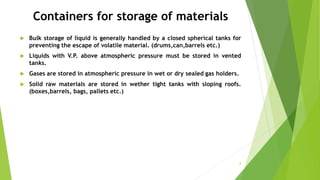
Containers for storage of materials
 Bulk storage of liquid is generally handled by a closed spherical tanks for
preventing the escape of volatile material. (drums,can,barrels etc.)
 Liquids with V.P. above atmospheric pressure must be stored in vented
tanks.
 Gases are stored in atmospheric pressure in wet or dry sealed gas holders.
 Solid raw materials are stored in wether tight tanks with sloping roofs.
(boxes,barrels, bags, pallets etc.)
8
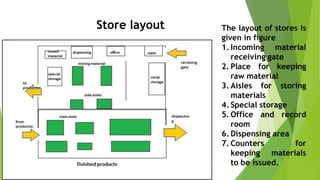
Store layout The layout of stores is
given in figure
1. Incoming material
receiving gate
2. Place for keeping
raw material
3. Aisles for storing
materials
4. Special storage
5. Office and record
room
6. Dispensing area
7. Counters for
keeping materials
to be issued.9
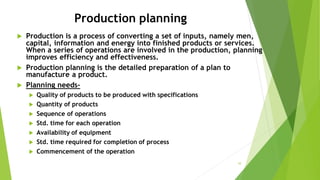
Production planning
 Production is a process of converting a set of inputs, namely men,
capital, information and energy into finished products or services.
When a series of operations are involved in the production, planning
improves efficiency and effectiveness.
 Production planning is the detailed preparation of a plan to
manufacture a product.
 Planning needs-
 Quality of products to be produced with specifications
 Quantity of products
 Sequence of operations
 Std. time for each operation
 Availability of equipment
 Std. time required for completion of process
 Commencement of the operation
10
Steps involved in production planning
production
budget
selection of
process
selection of
materials,
methods and
machinery
selection of
layout
setup time &
route sheet
process
11
1. Planning of process:
1. Consideration of cost of production
2. Change the unit operation or equipment such as tray drying to FBD
3. Product specifications to be considered
2. Planning of materials
1. Once process is selected, the materials, tools should be selected.
2. Should be of quality and right chemical compositions.
3. Qualified vendors
3. Planning of process layout
1. Should indicate every operations and their sequences.
4. Setup time
5. Route sheet
1. These documents summarize the flow of operations or sequences of operations
2. These route sheets are prepared and dispatched to production department.
12
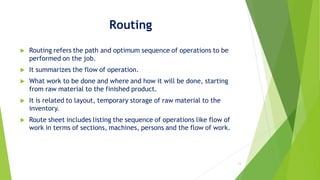
Routing
 Routing refers the path and optimum sequence of operations to be
performed on the job.
 It summarizes the flow of operation.
 What work to be done and where and how it will be done, starting
from raw material to the finished product.
 It is related to layout, temporary storage of raw material to the
inventory.
 Route sheet includes listing the sequence of operations like flow of
work in terms of sections, machines, persons and the flow of work.
13
Routing procedure
a. Requirements of materials and components are identified for
production. Then availability of these materials from vendors.
b. Bill of materials are prepared showing name of the part, qty. of
material, specifications etc.
c. Operations to be performed are established and a proper sequence is
listed.
d. The lot size to be manufactured or batch is finalized
e. Controls and limits of variation are specified including extent of rejects.
f. Costs of the components are estimated through steps (a) to (e)
14
Route sheet
 It is the map or blueprint of the manufacturing process in a
production unit. It provides the exact location of the
various processes of the unit.
 A typical route sheet contains the following information:
1. Identification and sequences of work arrangement
2. Symbol or sign of the component of the product
3. Computing the number of units to be produced
4. Machines and tools used in the operation , their efficiency and
capacity
5. Evaluation of the entire production process
15
loading
 It is study of relationship between load and capacity, so as to assign
the work for the production.
 Load indicates assignment of work to men,machines or department in
advance without specifying when the work is to be done.
 The no. of machines available, speeds and capabilities are considered
for assigning the work
 Loading information is used for ensuring :
1. Efficient utilization of plant and labor
2. Setting a reliable delivery promises
3. Forward planning of the purchases of new plant
 Load charts are prepared showing the productive capacity that is
already occupied and at the same time the available production
capacity.
16
Scheduling
 Production scheduling may be defined as a process of
decision taking to start the work for production
 It is a statement of target dates for all operations in hand
and reveals their starting and finished dates.
 Production schedule is the basic means for :
 Monitoring production activities
 Checking progress of production
 Decision making during the production cycle
17
Factors affecting scheduling
1. Customer demand and delivery dates are considered
2. Stock of goods already lying with the dealers and retailers will be
estimated before scheduling of production.
3. Adequate time should be available for mfg. the remaining goods to
meet demands
4. Availability of various resources must be considered
e.g. availability of equipment, materials, manpower, facilities etc.
18
Dispatching of records
 Dispatching of records is the process of actually ordering work to be
done in the production.
 The planning department dispatches the record of schedules. It is an
order and instructions for starting the work.
 This record is physically handed over to the production department
for the implementation.
 According to the plan of activity , the production efforts starts.
 Dispatching is a key function to link between production and sales.
19
Dispatching procedure
 The procedure involves dispatching a number of records of different
departments for initiating the operations. A few of these sections and
authorization are as follows:
1. Stores is authorized to deliver required raw materials
2. Tool store is authorized to release necessary tools
3. Job order to instruct the worker to proceed with the operation
4. Line ticket to record the beginning and ending time of the operation
5. Inspection order authorizes the inspector to carry out inspection w.r.t.
quality of the product
6. Move order authorizes movement of materials and components from one
operation to the next operation for further work.
20
Production control
 Consists of two parts, progress reporting and corrective action.
 It involves four stages.
21
observation analysis
Corrective
action
post-
operation
evaluation
Functions of production control
1. Receives work progress reports
2. Compares them with the scheduled plans
3. Removes causes of delay in production
4. Modifies the schedules or plant capacities
5. Control of material movement
6. Availability of tool is controlled
7. Quantity produced is controlled
8. Control of replacement
9. Labor efficiency and control
22
Advantages of production control
 Better service to customers
 Less overtime work
 More effective purchasing
 Effective inventory control
 Effective use of equipment
 Reduced loss of time
 Saving in cost and time
23
24

Pharmaceutical plant layout

  • 1.
    -By Archana B.Chavhan M.Pharm(QA) RSCP,Buldana1
  • 2.
    Pharmaceutical Plant Layout plant layout is a coordinate effort to achieve the final objective to integrate machines, materials and personnel for economic production.  It involves the location of different departments and arrangement of machinery in each department.  plant layout characteristics: 1. Provide space for machine/materials/ storage/etc. 2. Flexible for future changes in capacity/ design/process etc 3. Deals with government rules & regulations 4. Safety of employees 5. Achieve economy 2
  • 3.
    Types of plantlayout A. Process layout/ functional layout B. Product/ straight line layout  Process layout:  The arrangement of machines of a particular class doing a particular type of work or process as a separate department.  Product layout:  The arrangement of machines doing various operations in a line as one department. 3
  • 4.
    Factors affecting plantlayout Plant location & building Space available & space required Waste disposal problems Production process Type of machinery Repairs & maintenance Human needs Plant environment 4
  • 5.
    Special provisions ofplant layout 1. Premises should be suitable for the purpose of drug manufacturing & should prevent mixing ups of materials. 2. Building for the factory shall constructed so as to permit the production under hygienic conditions. 3. They shall conform to the conditions laid down in the Factories Act, 1948.  Any part of the building used for manufacturing shall not be used as sleeping place.  The walls of the rooms in which manufacturing operations are carried out shall have a height of 6 feet from the floor & waterproof.  The flooring shall be smooth, even and washable and do not permit any dust.  Floor should not have any chinks or crevices.  Buildings are arranged to permit economic production  Successive Unit operations can be done in adjacent rooms without superfluous transportation.  Adequate facilities should be maintained to provide safety and fire protection.  Installation of devices in every process-room is essential so that in time of emergency the power supply can be immediately cut off from the transmission machinery. 5
  • 6.
    Storage space requirements Adequate storage should be allocated for different materials and supplies.  Sufficient additional storage facilities should be provided for any possible increase in supplies .  Stores-location 1. Should be located adjacent to the manufacturing area and finished goods nearer to the shipping area, so that handling costs will be minimum. 2. Location of stores depend upon the nature and value of items to be stored and the frequently which items are received. 3. Facillates better inventory checks. 6
  • 7.
    General storage spacerequirement  Adequate storage facilities for raw materials, intermediates, rejected materials etc, are essential  Adequate space facilities for stocking incoming raw material, for their checking sorting, inspection before they are placed at proper location.  Adequate space should be provided for storing the tools and other supplies  Storage space for packaging materials  Special products that requires low temp., special conditions such as cold place are provided.  Special storage facilities should be provided separately for the following products;  Highly toxic and dangerous substances  Narcotic drugs  Explosive & flammable  Rejected or recoverable 7
  • 8.
    Containers for storageof materials  Bulk storage of liquid is generally handled by a closed spherical tanks for preventing the escape of volatile material. (drums,can,barrels etc.)  Liquids with V.P. above atmospheric pressure must be stored in vented tanks.  Gases are stored in atmospheric pressure in wet or dry sealed gas holders.  Solid raw materials are stored in wether tight tanks with sloping roofs. (boxes,barrels, bags, pallets etc.) 8
  • 9.
    Store layout Thelayout of stores is given in figure 1. Incoming material receiving gate 2. Place for keeping raw material 3. Aisles for storing materials 4. Special storage 5. Office and record room 6. Dispensing area 7. Counters for keeping materials to be issued.9
  • 10.
    Production planning  Productionis a process of converting a set of inputs, namely men, capital, information and energy into finished products or services. When a series of operations are involved in the production, planning improves efficiency and effectiveness.  Production planning is the detailed preparation of a plan to manufacture a product.  Planning needs-  Quality of products to be produced with specifications  Quantity of products  Sequence of operations  Std. time for each operation  Availability of equipment  Std. time required for completion of process  Commencement of the operation 10
  • 11.
    Steps involved inproduction planning production budget selection of process selection of materials, methods and machinery selection of layout setup time & route sheet process 11
  • 12.
    1. Planning ofprocess: 1. Consideration of cost of production 2. Change the unit operation or equipment such as tray drying to FBD 3. Product specifications to be considered 2. Planning of materials 1. Once process is selected, the materials, tools should be selected. 2. Should be of quality and right chemical compositions. 3. Qualified vendors 3. Planning of process layout 1. Should indicate every operations and their sequences. 4. Setup time 5. Route sheet 1. These documents summarize the flow of operations or sequences of operations 2. These route sheets are prepared and dispatched to production department. 12
  • 13.
    Routing  Routing refersthe path and optimum sequence of operations to be performed on the job.  It summarizes the flow of operation.  What work to be done and where and how it will be done, starting from raw material to the finished product.  It is related to layout, temporary storage of raw material to the inventory.  Route sheet includes listing the sequence of operations like flow of work in terms of sections, machines, persons and the flow of work. 13
  • 14.
    Routing procedure a. Requirementsof materials and components are identified for production. Then availability of these materials from vendors. b. Bill of materials are prepared showing name of the part, qty. of material, specifications etc. c. Operations to be performed are established and a proper sequence is listed. d. The lot size to be manufactured or batch is finalized e. Controls and limits of variation are specified including extent of rejects. f. Costs of the components are estimated through steps (a) to (e) 14
  • 15.
    Route sheet  Itis the map or blueprint of the manufacturing process in a production unit. It provides the exact location of the various processes of the unit.  A typical route sheet contains the following information: 1. Identification and sequences of work arrangement 2. Symbol or sign of the component of the product 3. Computing the number of units to be produced 4. Machines and tools used in the operation , their efficiency and capacity 5. Evaluation of the entire production process 15
  • 16.
    loading  It isstudy of relationship between load and capacity, so as to assign the work for the production.  Load indicates assignment of work to men,machines or department in advance without specifying when the work is to be done.  The no. of machines available, speeds and capabilities are considered for assigning the work  Loading information is used for ensuring : 1. Efficient utilization of plant and labor 2. Setting a reliable delivery promises 3. Forward planning of the purchases of new plant  Load charts are prepared showing the productive capacity that is already occupied and at the same time the available production capacity. 16
  • 17.
    Scheduling  Production schedulingmay be defined as a process of decision taking to start the work for production  It is a statement of target dates for all operations in hand and reveals their starting and finished dates.  Production schedule is the basic means for :  Monitoring production activities  Checking progress of production  Decision making during the production cycle 17
  • 18.
    Factors affecting scheduling 1.Customer demand and delivery dates are considered 2. Stock of goods already lying with the dealers and retailers will be estimated before scheduling of production. 3. Adequate time should be available for mfg. the remaining goods to meet demands 4. Availability of various resources must be considered e.g. availability of equipment, materials, manpower, facilities etc. 18
  • 19.
    Dispatching of records Dispatching of records is the process of actually ordering work to be done in the production.  The planning department dispatches the record of schedules. It is an order and instructions for starting the work.  This record is physically handed over to the production department for the implementation.  According to the plan of activity , the production efforts starts.  Dispatching is a key function to link between production and sales. 19
  • 20.
    Dispatching procedure  Theprocedure involves dispatching a number of records of different departments for initiating the operations. A few of these sections and authorization are as follows: 1. Stores is authorized to deliver required raw materials 2. Tool store is authorized to release necessary tools 3. Job order to instruct the worker to proceed with the operation 4. Line ticket to record the beginning and ending time of the operation 5. Inspection order authorizes the inspector to carry out inspection w.r.t. quality of the product 6. Move order authorizes movement of materials and components from one operation to the next operation for further work. 20
  • 21.
    Production control  Consistsof two parts, progress reporting and corrective action.  It involves four stages. 21 observation analysis Corrective action post- operation evaluation
  • 22.
    Functions of productioncontrol 1. Receives work progress reports 2. Compares them with the scheduled plans 3. Removes causes of delay in production 4. Modifies the schedules or plant capacities 5. Control of material movement 6. Availability of tool is controlled 7. Quantity produced is controlled 8. Control of replacement 9. Labor efficiency and control 22
  • 23.
    Advantages of productioncontrol  Better service to customers  Less overtime work  More effective purchasing  Effective inventory control  Effective use of equipment  Reduced loss of time  Saving in cost and time 23
  • 24.