Chunilal Bhawan (Adjacent to BCPL),168, Maniktala Main Road · P.O.
Bengal Chemicals, P.S. Phoolbagan · Kolkata – 700054
Contents
 Introduction
 Objective of granulation
 Essential properties of granules
 Method of granulation
 Modern equipment in granulation technology
Introduction
 Granulation, derived from the Latin word granulatum,
meaning grain, is a process of enlargement of powdered
particles to form grain-like agglomerates.
 In the pharmaceutical industry, the granules formed from
the particles of the active pharmaceutical ingredient (API)
and excipient mix are further processed effectively into
solid dosage forms, such as tablets and capsules, or
multiparticulates, such as pellets, beads, or spheroids to be
filled into capsules or packed as sprinkle formulations.

 These granules offer the advantages of favorable size
distribution, improved bulk density, and flow properties
that further prevent the problems of caking, segregation,
and poor tableting performance in the downstream
processing.
Objective of Granulation
 To improve the compaction characteristics of the
mixture.
 It also helps to minimize segregation risk.
 To improve the flow characteristics
 To produce uniform mixture
 To produce dust free formulation
 To improve bulk density
 It offers better content uniformity
Essential Properties of Granules
Granules should have-
 Spherical shape
 Smaller particle size
 Optimum moisture content(1-2%)
 Good flow
 Good compressibility
 Sufficient hardness
 Have particle size in the range of 0.2-4.0 mm
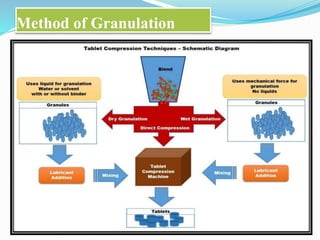
Method of Granulation
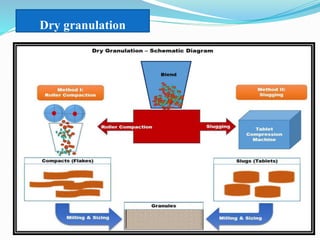
Dry granulation
Recent progress in wet granulation
1. Reverse wet granulation
2. Steam Granulation
3. Moisture-Activated Dry Granulation (MADG)
4. Thermal Adhesion Granulation (TAG)
5. Melt granulation
6. Freeze granulation
7. Foam granulation
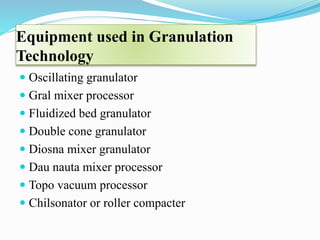
Equipment used in Granulation
Technology
 Oscillating granulator
 Gral mixer processor
 Fluidized bed granulator
 Double cone granulator
 Diosna mixer granulator
 Dau nauta mixer processor
 Topo vacuum processor
 Chilsonator or roller compacter
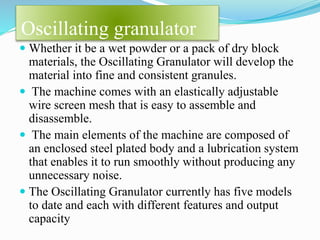
Oscillating granulator
 Whether it be a wet powder or a pack of dry block
materials, the Oscillating Granulator will develop the
material into fine and consistent granules.
 The machine comes with an elastically adjustable
wire screen mesh that is easy to assemble and
disassemble.
 The main elements of the machine are composed of
an enclosed steel plated body and a lubrication system
that enables it to run smoothly without producing any
unnecessary noise.
 The Oscillating Granulator currently has five models
to date and each with different features and output
capacity
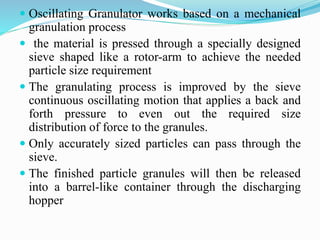
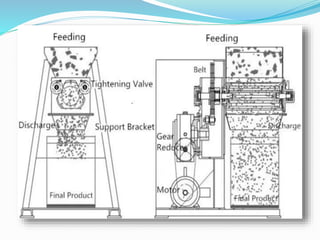
 Oscillating Granulator works based on a mechanical
granulation process
 the material is pressed through a specially designed
sieve shaped like a rotor-arm to achieve the needed
particle size requirement
 The granulating process is improved by the sieve
continuous oscillating motion that applies a back and
forth pressure to even out the required size
distribution of force to the granules.
 Only accurately sized particles can pass through the
sieve.
 The finished particle granules will then be released
into a barrel-like container through the discharging
hopper
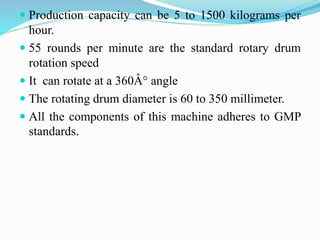
 Production capacity can be 5 to 1500 kilograms per
hour.
 55 rounds per minute are the standard rotary drum
rotation speed
 It can rotate at a 360° angle
 The rotating drum diameter is 60 to 350 millimeter.
 All the components of this machine adheres to GMP
standards.
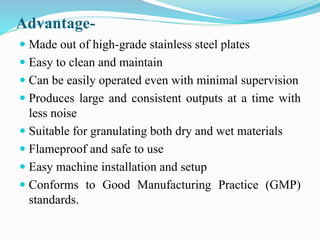
Advantage-
 Made out of high-grade stainless steel plates
 Easy to clean and maintain
 Can be easily operated even with minimal supervision
 Produces large and consistent outputs at a time with
less noise
 Suitable for granulating both dry and wet materials
 Flameproof and safe to use
 Easy machine installation and setup
 Conforms to Good Manufacturing Practice (GMP)
standards.
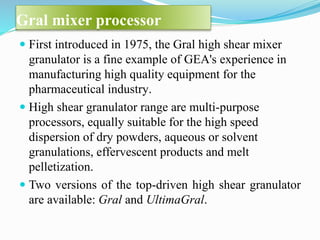
Gral mixer processor
 First introduced in 1975, the Gral high shear mixer
granulator is a fine example of GEA's experience in
manufacturing high quality equipment for the
pharmaceutical industry.
 High shear granulator range are multi-purpose
processors, equally suitable for the high speed
dispersion of dry powders, aqueous or solvent
granulations, effervescent products and melt
pelletization.
 Two versions of the top-driven high shear granulator
are available: Gral and UltimaGral.
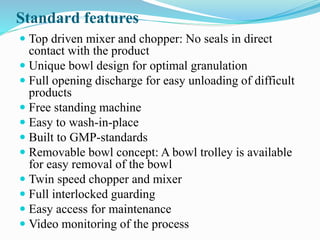
Standard features
 Top driven mixer and chopper: No seals in direct
contact with the product
 Unique bowl design for optimal granulation
 Full opening discharge for easy unloading of difficult
products
 Free standing machine
 Easy to wash-in-place
 Built to GMP-standards
 Removable bowl concept: A bowl trolley is available
for easy removal of the bowl
 Twin speed chopper and mixer
 Full interlocked guarding
 Easy access for maintenance
 Video monitoring of the process
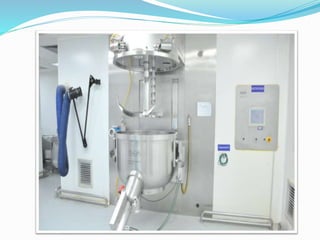
Fluidized bed granulator
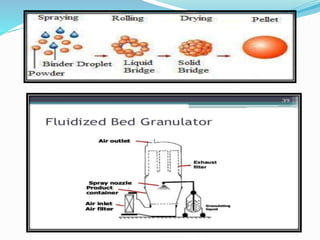
 The powder particles are fluidized in a stream of air.
 Granulation fluid is pumped from a reservoir and
sprayed from a nozzle on to the bed of powder
 Heated and filtered air is blown through the bed of
unmixed powder to fluidize the particle admix the
powder.
 The fluid causes the primary powder particles to
adhere when the droplets and powder get collide.
 Sufficient liquid is sprayed to produce granules of the
required size at that point the spray turned off but the
fluidizing air continued.
 The wet granules are then dried in the heated
fluidizing air stream.
Advantages-
1. It reduces product loss
2. Uniform drying
3. Fully automated
4. 2-6 times Greater heat transfer than tray dryer
Disadvantages-
1. Expensive
2. Time consuming
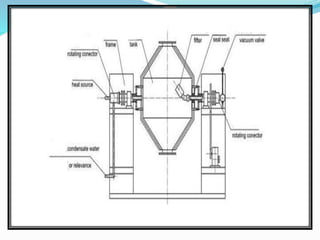
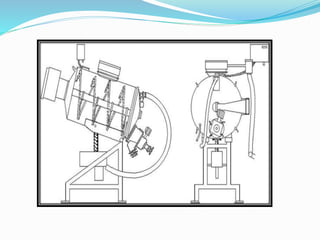
Double cone granulator
 Its principle based on double cone mixer.
 The whole unit is rotated along axis.
 This blender supplied with vacuum which is
ultimately reduce atmospheric pressure.
 Blades are present inside the double cone, for
granulation.
 It is very advantageous for heat liable granules.
 The conical shape at both ends enables uniform
mixing and easy discharge.
 Double Cone Blenders are most often used for dry
blending of free flowing solids.
 Normal cycle times are typically in the range of 10
minutes
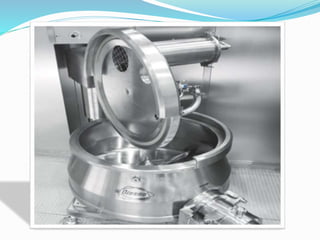
Diosna mixer granulator
 The machine have a stainless steel mixing bowl
containing three blade impeller and auxiliary chopper
blade.
 The main blade rotation about to 150-300 rpm.
 The speed of chopper blade is about 1500-3000rpm.
 The high shear wet granulation process can be divided
into five stages-
1. Powder mixing
2. Binder addition
3. Nucleation
4. Growth of granules
5. Granule attrition
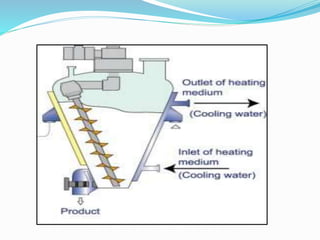
Nauta Mixer Processor
 Nauta Mixers (also called Conical Screw Mixers)
make use of a conical chamber with a vertical screw
that mixes the powder.
 The typical speed of the central screw is 70 to 80 Rpm
 It provide gentle mixing action and minimal heat
generation.
 Its have many application, given below-
1. Mixing of free flowing powders
2. Moistening of powders
3. Coating
4. Granulation
5. Drying of powders
6. Mixing of slurries
Topo Vacuum granulator
 It was developed in Austria for the preparation of
granules and coated particles under high vacuum
condition
 The material placed in chamber which must be dust
free suction, and the compartment is loaded by
vacuum, granulating fluid with some additional
materials as well.
 Under vacuum condition granulation force are
increasing eventually, to produce necessary
compaction.
 After that agglomerated particles dried under vacuum
in chamber.
 The main advantages of this equipment is that it
required less granulating fluid than others.
 Hermes Pharma was a pioneer in applying TOPO
vacuum granulation. This procedure comprises a
synthetic granulation to enlarge the particles and
increase their stability
 The TOPO granulation is a process utilized for the
manufacture of effervescent granulate
Chilsonator or Roller Compacter
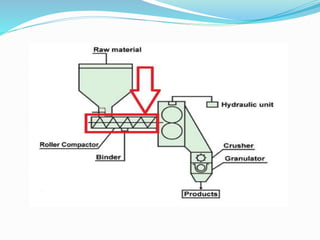
 This is mainly used for dry granulation process.
 Formation of dry granules mainly required dry
powder for densification as well for agglomeration.
 This provides tremendous control of the final particle
size and density.
 the product compacted by the Chilsonator must be
granulated to a uniform particle size distribution.
 The basic concept of compaction is to force fine
powders between two counter rotating rolls.
 Some of the factors controlling the compaction process
are-
1. Roll Surface Diameter,
2. Peripheral Speed,
3. Separating Force Or Pressure Capabilities,
4. Feed Screw Design, And
5. Material Being Processed.
Advantages-
1. For thermo labile drugs
2. Moisture sensitive drugs like aspirin and vitamins
3. Those drugs which is not well compressed by wet
granulation
Granulation and techniques

Granulation and techniques

  • 1.
    Chunilal Bhawan (Adjacentto BCPL),168, Maniktala Main Road · P.O. Bengal Chemicals, P.S. Phoolbagan · Kolkata – 700054
  • 2.
    Contents  Introduction  Objectiveof granulation  Essential properties of granules  Method of granulation  Modern equipment in granulation technology
  • 3.
    Introduction  Granulation, derivedfrom the Latin word granulatum, meaning grain, is a process of enlargement of powdered particles to form grain-like agglomerates.  In the pharmaceutical industry, the granules formed from the particles of the active pharmaceutical ingredient (API) and excipient mix are further processed effectively into solid dosage forms, such as tablets and capsules, or multiparticulates, such as pellets, beads, or spheroids to be filled into capsules or packed as sprinkle formulations.  These granules offer the advantages of favorable size distribution, improved bulk density, and flow properties that further prevent the problems of caking, segregation, and poor tableting performance in the downstream processing.
  • 4.
    Objective of Granulation To improve the compaction characteristics of the mixture.  It also helps to minimize segregation risk.  To improve the flow characteristics  To produce uniform mixture  To produce dust free formulation  To improve bulk density  It offers better content uniformity
  • 5.
    Essential Properties ofGranules Granules should have-  Spherical shape  Smaller particle size  Optimum moisture content(1-2%)  Good flow  Good compressibility  Sufficient hardness  Have particle size in the range of 0.2-4.0 mm
  • 6.
  • 7.
  • 8.
    Recent progress inwet granulation 1. Reverse wet granulation 2. Steam Granulation 3. Moisture-Activated Dry Granulation (MADG) 4. Thermal Adhesion Granulation (TAG) 5. Melt granulation 6. Freeze granulation 7. Foam granulation
  • 9.
    Equipment used inGranulation Technology  Oscillating granulator  Gral mixer processor  Fluidized bed granulator  Double cone granulator  Diosna mixer granulator  Dau nauta mixer processor  Topo vacuum processor  Chilsonator or roller compacter
  • 10.
    Oscillating granulator  Whetherit be a wet powder or a pack of dry block materials, the Oscillating Granulator will develop the material into fine and consistent granules.  The machine comes with an elastically adjustable wire screen mesh that is easy to assemble and disassemble.  The main elements of the machine are composed of an enclosed steel plated body and a lubrication system that enables it to run smoothly without producing any unnecessary noise.  The Oscillating Granulator currently has five models to date and each with different features and output capacity
  • 11.
     Oscillating Granulatorworks based on a mechanical granulation process  the material is pressed through a specially designed sieve shaped like a rotor-arm to achieve the needed particle size requirement  The granulating process is improved by the sieve continuous oscillating motion that applies a back and forth pressure to even out the required size distribution of force to the granules.  Only accurately sized particles can pass through the sieve.  The finished particle granules will then be released into a barrel-like container through the discharging hopper
  • 12.
     Production capacitycan be 5 to 1500 kilograms per hour.  55 rounds per minute are the standard rotary drum rotation speed  It can rotate at a 360° angle  The rotating drum diameter is 60 to 350 millimeter.  All the components of this machine adheres to GMP standards.
  • 13.
    Advantage-  Made outof high-grade stainless steel plates  Easy to clean and maintain  Can be easily operated even with minimal supervision  Produces large and consistent outputs at a time with less noise  Suitable for granulating both dry and wet materials  Flameproof and safe to use  Easy machine installation and setup  Conforms to Good Manufacturing Practice (GMP) standards.
  • 15.
    Gral mixer processor First introduced in 1975, the Gral high shear mixer granulator is a fine example of GEA's experience in manufacturing high quality equipment for the pharmaceutical industry.  High shear granulator range are multi-purpose processors, equally suitable for the high speed dispersion of dry powders, aqueous or solvent granulations, effervescent products and melt pelletization.  Two versions of the top-driven high shear granulator are available: Gral and UltimaGral.
  • 16.
    Standard features  Topdriven mixer and chopper: No seals in direct contact with the product  Unique bowl design for optimal granulation  Full opening discharge for easy unloading of difficult products  Free standing machine  Easy to wash-in-place  Built to GMP-standards  Removable bowl concept: A bowl trolley is available for easy removal of the bowl  Twin speed chopper and mixer  Full interlocked guarding  Easy access for maintenance  Video monitoring of the process
  • 18.
    Fluidized bed granulator The powder particles are fluidized in a stream of air.  Granulation fluid is pumped from a reservoir and sprayed from a nozzle on to the bed of powder  Heated and filtered air is blown through the bed of unmixed powder to fluidize the particle admix the powder.  The fluid causes the primary powder particles to adhere when the droplets and powder get collide.  Sufficient liquid is sprayed to produce granules of the required size at that point the spray turned off but the fluidizing air continued.
  • 19.
     The wetgranules are then dried in the heated fluidizing air stream. Advantages- 1. It reduces product loss 2. Uniform drying 3. Fully automated 4. 2-6 times Greater heat transfer than tray dryer Disadvantages- 1. Expensive 2. Time consuming
  • 21.
    Double cone granulator Its principle based on double cone mixer.  The whole unit is rotated along axis.  This blender supplied with vacuum which is ultimately reduce atmospheric pressure.  Blades are present inside the double cone, for granulation.  It is very advantageous for heat liable granules.  The conical shape at both ends enables uniform mixing and easy discharge.  Double Cone Blenders are most often used for dry blending of free flowing solids.  Normal cycle times are typically in the range of 10 minutes
  • 23.
    Diosna mixer granulator The machine have a stainless steel mixing bowl containing three blade impeller and auxiliary chopper blade.  The main blade rotation about to 150-300 rpm.  The speed of chopper blade is about 1500-3000rpm.  The high shear wet granulation process can be divided into five stages- 1. Powder mixing 2. Binder addition 3. Nucleation 4. Growth of granules 5. Granule attrition
  • 25.
    Nauta Mixer Processor Nauta Mixers (also called Conical Screw Mixers) make use of a conical chamber with a vertical screw that mixes the powder.  The typical speed of the central screw is 70 to 80 Rpm  It provide gentle mixing action and minimal heat generation.  Its have many application, given below- 1. Mixing of free flowing powders 2. Moistening of powders 3. Coating 4. Granulation 5. Drying of powders 6. Mixing of slurries
  • 27.
    Topo Vacuum granulator It was developed in Austria for the preparation of granules and coated particles under high vacuum condition  The material placed in chamber which must be dust free suction, and the compartment is loaded by vacuum, granulating fluid with some additional materials as well.  Under vacuum condition granulation force are increasing eventually, to produce necessary compaction.  After that agglomerated particles dried under vacuum in chamber.
  • 28.
     The mainadvantages of this equipment is that it required less granulating fluid than others.  Hermes Pharma was a pioneer in applying TOPO vacuum granulation. This procedure comprises a synthetic granulation to enlarge the particles and increase their stability  The TOPO granulation is a process utilized for the manufacture of effervescent granulate
  • 30.
    Chilsonator or RollerCompacter  This is mainly used for dry granulation process.  Formation of dry granules mainly required dry powder for densification as well for agglomeration.  This provides tremendous control of the final particle size and density.  the product compacted by the Chilsonator must be granulated to a uniform particle size distribution.  The basic concept of compaction is to force fine powders between two counter rotating rolls.
  • 31.
     Some ofthe factors controlling the compaction process are- 1. Roll Surface Diameter, 2. Peripheral Speed, 3. Separating Force Or Pressure Capabilities, 4. Feed Screw Design, And 5. Material Being Processed. Advantages- 1. For thermo labile drugs 2. Moisture sensitive drugs like aspirin and vitamins 3. Those drugs which is not well compressed by wet granulation